



Our goal with The Daily Brief is to simplify the biggest stories in the Indian markets and help you understand what they mean. We won’t just tell you what happened; we’ll tell you why and how too. We do this show in both formats: video and audio. This piece curates the stories that we talk about.
You can listen to the podcast on Spotify, Apple Podcasts, or wherever you get your podcasts and watch the videos on YouTube. You can also watch The Daily Brief in Hindi.
In today’s edition of The Daily Brief:
1. The world’s oil has a burning desire
Global oil is hovering near $116 a barrel, but the real crisis isn't a lack of crude—it's a severe shortage of refined fuels like diesel. While crude can bypass the closed Strait of Hormuz, damaged Gulf refineries are struggling to ship highly flammable finished products. With Russia and China also restricting their fuel exports, global stockpiles have hit their lowest since 2016, baking a $27 "fear premium" into every barrel. For India, this creates a harsh divide: state-owned retailers are bleeding ₹8–₹9 per litre to subsidize local pumps, while private refiners cash in on record-high export margins.
2. The milk bill is trickling down to you
India’s dairy industry is facing a severe supply-side squeeze, forcing companies to pass record-high milk procurement costs directly to consumers. Despite collecting higher volumes of milk, firms like Dodla Dairy and Heritage Foods are seeing their profit margins shrink. The culprit is a perfect storm of rising cattle feed costs—driven largely by maize being diverted for ethanol—and massive price hikes by state cooperatives like Karnataka’s Nandini to prevent farmers from selling across state lines. With raw milk becoming prohibitively expensive, dairy brands are pivoting aggressively toward high-margin, “value-added” products like Greek yogurt, cheese, and high-protein paneer to protect their bottom lines, meaning your daily staple is likely to stay permanently more expensive.
Subtext by Zerodha
Why do credit cards look like the ultimate financial free lunch while acting as an aggressive lending machine? In our latest episode of Cash & Copium, credit card enthusiast Pranay Kapoor unpacks the industry's “reverse Robin Hood” model, the hidden forex traps of swiping abroad, and why paying the “minimum due” triggers punishing backdated interest. We also discuss why credit card chargebacks actually offer better consumer protection than UPI and how to safely build your CIBIL score.
Watch the full episode here.
The world’s oil has a burning desire
Well, it seems like oil is flowing out of the Gulf again. Ships are carrying about as much (or even a little more) crude out of the region as they did before the war with Iran began in February.
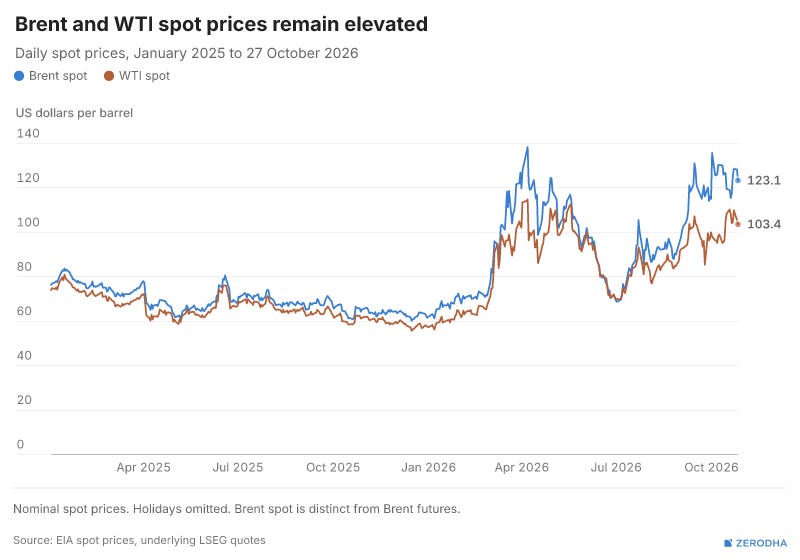
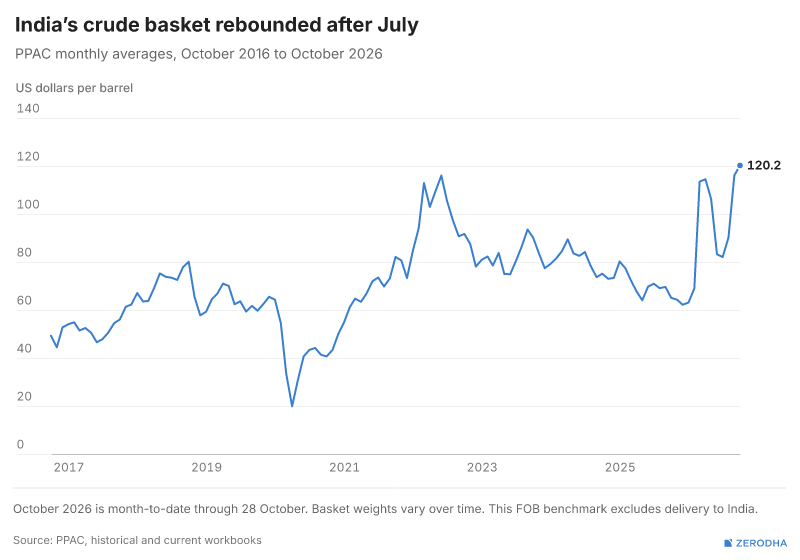
You’d expect prices to fall with new supply. But last Friday, Brent crude, the global price benchmark for crude oil, closed at $116.72 a barrel, its highest since April. The crude India buys has averaged about $120 a barrel this month. Before the war, it was around $69.

Part of the reason is that we’re still talking about crude, and not petrol or diesel, which are fuels that trucks and tractors actually use. The pipeline between crude and finished fuels has become slower as Gulf refineries were hit during the war, and the ones still working are struggling to ship what they make. Goldman Sachs estimates the region is exporting less than half the fuel it normally does.
That is just one among a few problems plaguing the health of global oil supply.
The great escape
Let’s start with how crude got out despite the Strait of Hormuz being shut.
For one, Saudi Arabia and the UAE have pipelines that skip Hormuz entirely. By September, the IEA estimated these bypass routes were moving 5.6 million barrels a day.
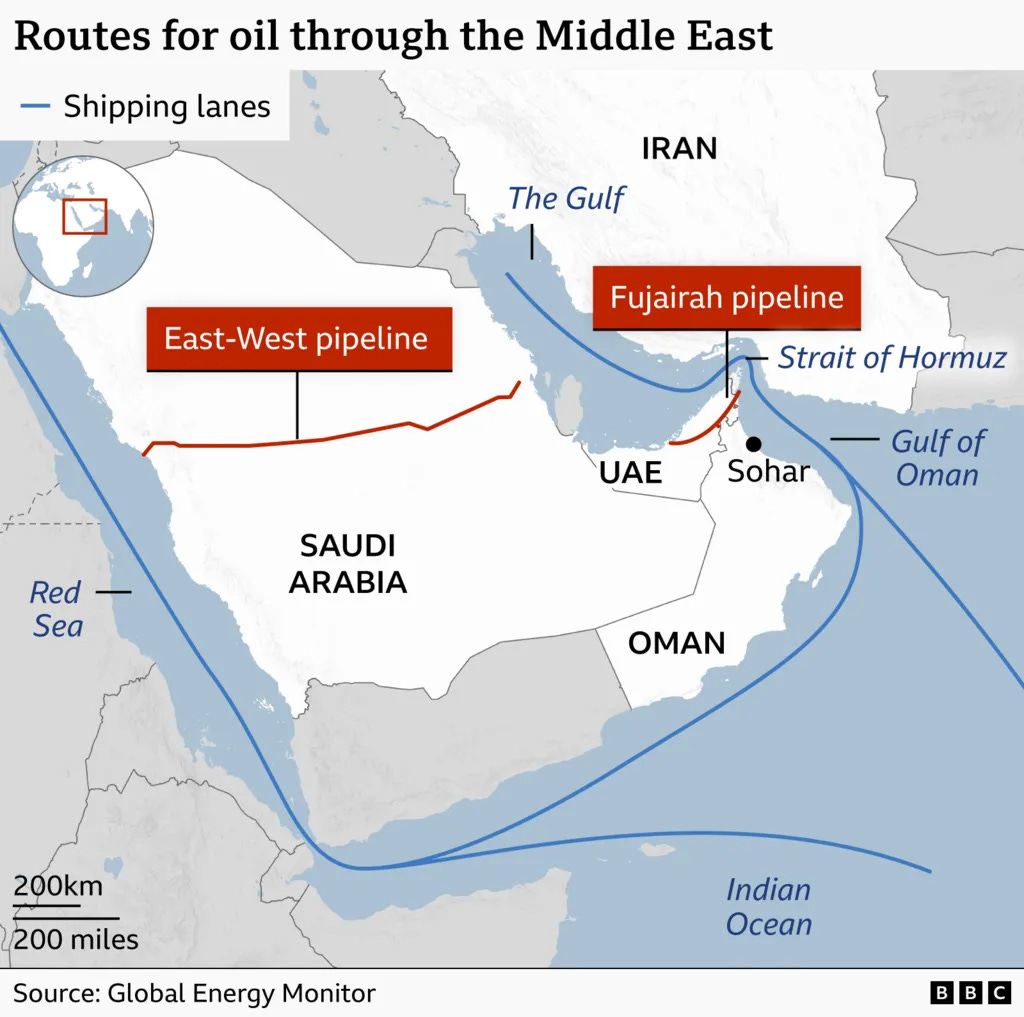
For oil that still had to go through the strait, traders actually found a workaround. Smaller tankers carry crude out into the Gulf of Oman, where it’s pumped from one ship, to another ship, then into larger tankers bound for Asia. According to the IEA, these transfers helped push flows through Hormuz up to 10.9 million barrels a day in September. That’s on top of what the Saudi and UAE pipelines carried.
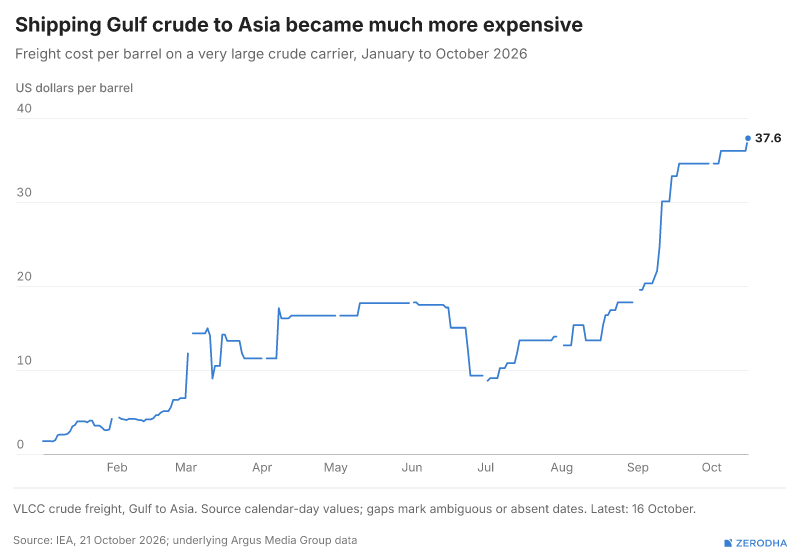
None of this comes cheap, though. Longer routes and ship-to-ship transfers tie tankers up for longer, and the risk of attack raises insurance costs. Goldman estimates that the average cost of shipping a single barrel of crude has risen by about $20 over the past year, roughly 75% of it from rerouting Gulf supply.
The non-Hormuz pipelines, meanwhile, were always intended as backups rather than primary pipelines. They can’t fully substitute the full volume that flows through the Strait of Hormuz. The pipelines aren’t fully safe, either. On 11 September, Saudi Arabia shut its East-West pipeline on after drone attacks, and only restarted it 11 days later.
Even with all this, the IEA estimates that Gulf oil production in September was only about 75% of its pre-war level. Some experts don’t expect it to go above 85% without a lasting peace deal.
The shrinking stockpile
What about the inventory of oil that the world has? How much of it remains to sustain the rest of the world?
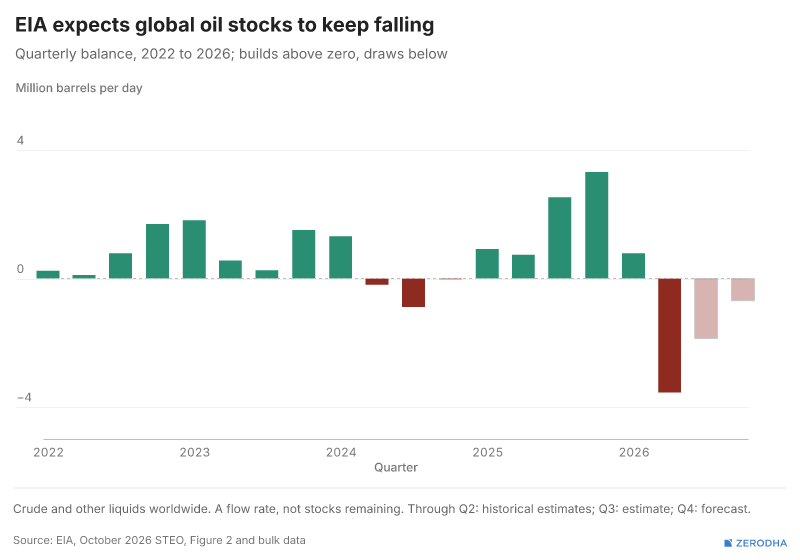
Well, not enough. By the end of September, the IEA estimated that global oil stocks were 509 million barrels below their end-February level. Stocks held on land were at their lowest since at least 2016. The US Energy Information Administration expects stocks to keep falling through the rest of this year.
When the tank runs this low, buyers start paying extra just to get oil now rather than later. Traders call this backwardation, which we covered in our Subtext episode with oil expert Rory Johnston. Right now, next month’s oil costs close to $5 a barrel more than oil delivered a month after that. That gap is wider than 99% of readings since 1990.
With reserves so fragile, every new threat moves the price more.
The Houthis, an Iran-backed group in Yemen, have been attacking Saudi Arabia. Last week, they claimed a missile strike on Ras Tanura, Saudi Arabia’s biggest refinery, and Saudi Aramco reportedly told staff to evacuate its Dhahran headquarters. As per The New York Times, the US and Israel have plans for fresh strikes on Iran after the American midterm elections on 3 November. October has already been the deadliest month for attacks on ships since the war began.
Goldman Sachs has tried to put a number on this fear. It estimates that about $27 of Brent’s price, which is nearly a quarter of it, comes from the worry of what might happen next, not from an actual shortage of crude today. By Goldman’s count, the world was producing roughly as much crude as it consumed in September.
Governments have tried to calm things down. Earlier this month, the G7 countries agreed to release 100 million barrels of oil and diesel from their emergency reserves over a period of four months. But that barely moved prices, because what can you even do when much of the price represents fear of the future? Traders actually seemed to see it as wasting a cushion that barely exists.
But there’s one country whose oil stockpile did make a material difference to the rest of the market.
When prices spiked, China, the world’s biggest crude importer, simply bought less and lived off its stockpiles. Rory Johnston estimates that China cut its seaborne crude imports by about 5.4 million barrels a day through June. That’s roughly as much oil as India uses in a day. China freed up as much oil as the G7’s entire emergency release in under three weeks.
Johnston argues that China moved the global oil balance by about as much as the entire OPEC+ group can. As a result, China left more oil for everyone else, which helped cap prices. It’s worth noting though that was a side effect, not an act of benevolence, as buying another expensive cargo made little sense for Chinese refiners compared to using the stockpile.
That buffer is now being used up. Kpler estimates that Chinese onshore crude stocks fell by roughly 1.6 million barrels a day in September as refineries ramped up, and expects China’s October imports to rebound above 10 million barrels a day, the highest since March. China still holds an estimated 1.2 billion barrels in storage, so it could cut back again if prices spike. But its shelf-life as a protector is expiring.
The refinery knockout
If there’s a hitch bigger than present supply and stockpiles, it’s refineries. The finished fuels in shortest supply right now are diesel, jet fuel and heating oil.
Over the past decade, Gulf countries like Kuwait, Oman and Saudi Arabia built giant refineries meant purely for export. But the war inflicted physical damage on some of them. For example, the Jizan refinery in Saudi Arabia, which can process 400,000 barrels a day, was shut in late July after a Houthi attack, and has been targeted several times since.
But even without damage, refined fuels are much harder to get out. They can’t be pushed through a cross-country crude pipeline. The ship-to-ship trick that rescued crude works less well for fuels. So most of them still have to leave by tanker, which means through Hormuz. Goldman points out that refined products are more flammable, which makes those transfers harder to arrange. That’s why crude exports have bounced back while fuel exports haven’t.
According to commodity data firm Kpler, Middle Eastern refineries were processing 9.9 million barrels of crude a day in February. By August, that had fallen to about 7.3 million. Not all of that was bomb damage. With Hormuz shut, even undamaged refineries couldn’t ship their fuel out, so their storage tanks filled up and they cut output.
Russia and China
Two of the world’s largest refiners, Russia and China, are also holding back.
Russia is one of the world’s biggest diesel exporters. But Ukrainian drone strikes have repeatedly hit its refineries, and from July this year onwards, Moscow banned diesel exports to most countries to keep its own pumps supplied.
On 9 October, Donald Trump announced a deal with Vladimir Putin. Russia would immediately export about 2.25 million barrels of diesel, followed by about 3.75 million barrels in November and roughly 7.5 million after that. For scale, the world uses about 28.7 million barrels of diesel and gasoil every day. Even if Russia delivers all of it, the whole deal covers less than half a day of the world’s diesel use.
China, the only country with significant spare refining capacity, has chosen to keep its fuel at home. Beijing halted fuel exports for the first week of October.
The diesel shock
The refineries knocked out in Russia and the Middle East mostly run on heavy crude that yields a lot of diesel. So this was primarily a diesel shock. On the other hand, petrol demand eases once summer driving ends. Diesel demand doesn’t, because it runs trucks, tractors, ships and generators. In the US, petrol prices have fallen for five weeks straight, while diesel kept climbing.
Petrol’s relief may not last too long, either. With diesel margins this high, refiners are shifting output away from petrol towards diesel and jet fuel, and Goldman expects the petrol market to tighten as a result.
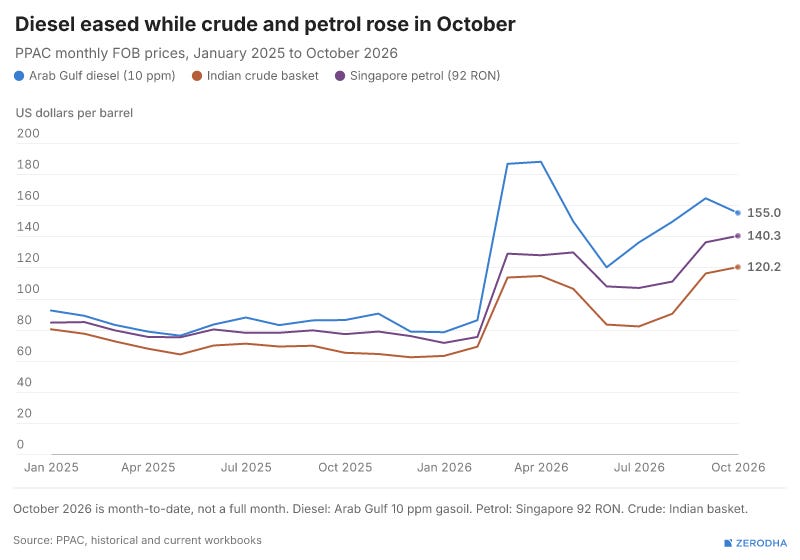
Diesel has eased from its peak, though crude and petrol haven’t. PPAC’s Arab Gulf diesel price has averaged about $155 a barrel so far in October, down from $164 in September and nearly $188 in April, while crude and petrol prices rose. Oil isn’t one price, its parts move in different directions.
India sits on both sides of this
India’s crude import bill rose 46.4% to $90.6 billion between April and September. Even the basket price understates the pain. This figure excludes freight costs, that Asian refineries far from the source have to pay more of compared to others.
The state-owned fuel retailers — Indian Oil, BPCL and HPCL — kept losing money even after an excise duty cut and pump price hikes. That has only intensified. On 23 September, when the basket was at $117.4 a barrel, Icra estimated the three were losing ~₹9 on every litre of diesel and ₹8 on every litre of petrol. They’ve even started blending biodiesel into diesel at select outlets, because it’s cheaper.
As a refiner, though, India gains. Icra puts diesel cracks, which is the gap between the price of diesel and the crude it’s made from, at $50-70 a barrel, against a long-term average of about $16. A crack isn’t profit, since it ignores a refinery’s running costs and the rest of what it produces. But at those levels, it’s a very good time to make diesel.
Whether India wins or loses depends on the company. Private refiners like Reliance and Nayara sell a large share of their fuel abroad, where diesel prices are very high, and the government lowered its windfall tax on diesel exports for October. State-owned companies mostly sell at home, where pump prices are subsidized.
Conclusion
Futures tell you where traders think this goes. Brent for near-term delivery traded above $100 early this month, but contracts for 2028-2030 sat around $63-70. The market expects the crunch to last another year or so, not a new era of permanently expensive oil.
There’s a less comfortable way for prices to fall, too: people using less fuel because they can’t afford it. The World Bank projects global oil demand will shrink by 2.6 million barrels a day in 2026. A transporter who parks half his trucks because diesel costs too much helps balance the market, but he’s worse off for it.
For now, diesel is the truer gauge of this crisis. Crude swings with every threat of escalation; diesel reflects damage already done, and Kpler doesn’t expect Gulf refineries back to pre-war output until mid-2027. For India, that leaves an awkward question of who absorbs the cost — drivers at the pump, or the government through more tax cuts. A fresh flare-up in the Gulf would only make that choice harder.

The milk bill is trickling down to you
For about a year now, we’ve been tracking India’s listed dairy companies quarter after quarter. First, it was a rain-hit lean season that made milk costly. Then came the dire lack of a much-needed flush season that milk supply depends on. Last quarter, a skipped mini-flush and pricier packaging squeezed margins even as revenues grew.
This time, the story is much the same, but with one simple change. You see, as a commodity essential to many Indians, milk has a price that is best left largely untouched. But this quarter, companies are finding different ways to pass on the price increases.
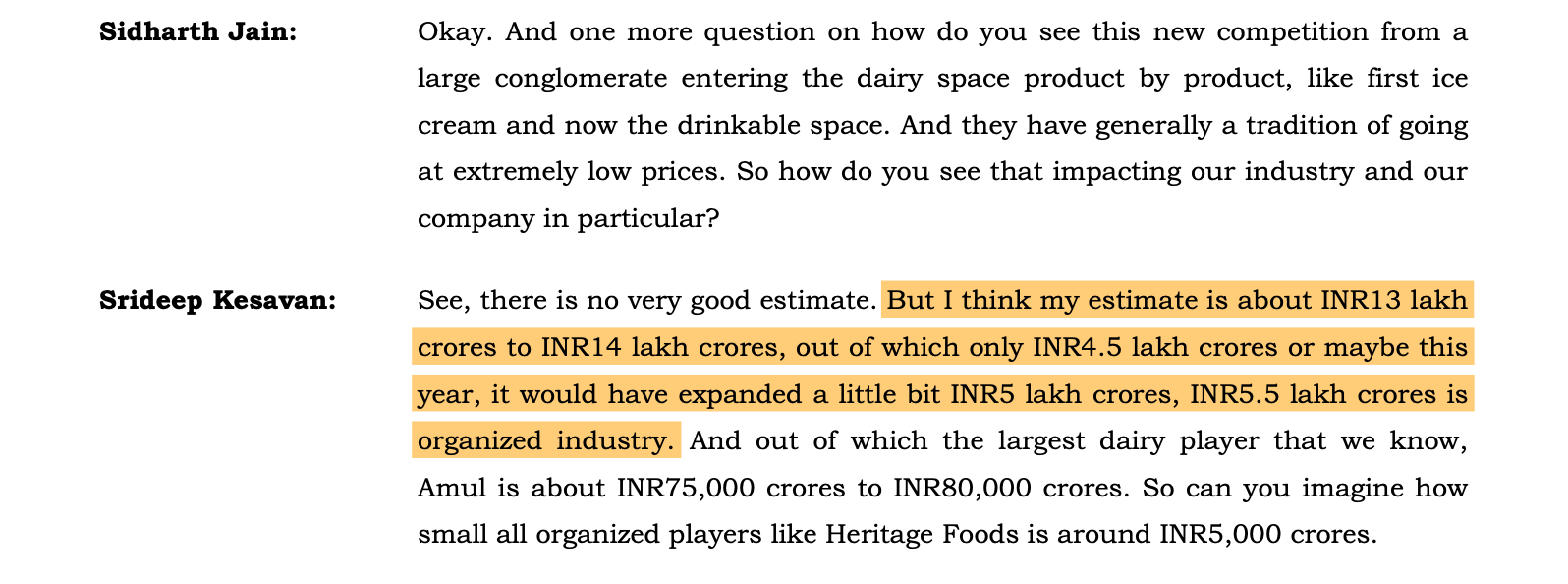
For scale, Heritage CEO Srideep Kesavan estimates India’s dairy industry at ₹13–14 lakh crore, of which only ₹4.5–5.5 lakh crore is organised. It grows 4–5% a year, which, as he put it, adds roughly one Amul to the industry every year. There’s room for everyone. The question is who can grow profitably while milk stays this costly.
We’re looking at three companies this time: Dodla Dairy, Heritage Foods, and a new name on our list, Milky Mist, whose IPO we covered last year. It listed in August, and just held its first full earnings call as a listed company.
The numbers
Let’s start with the numbers.
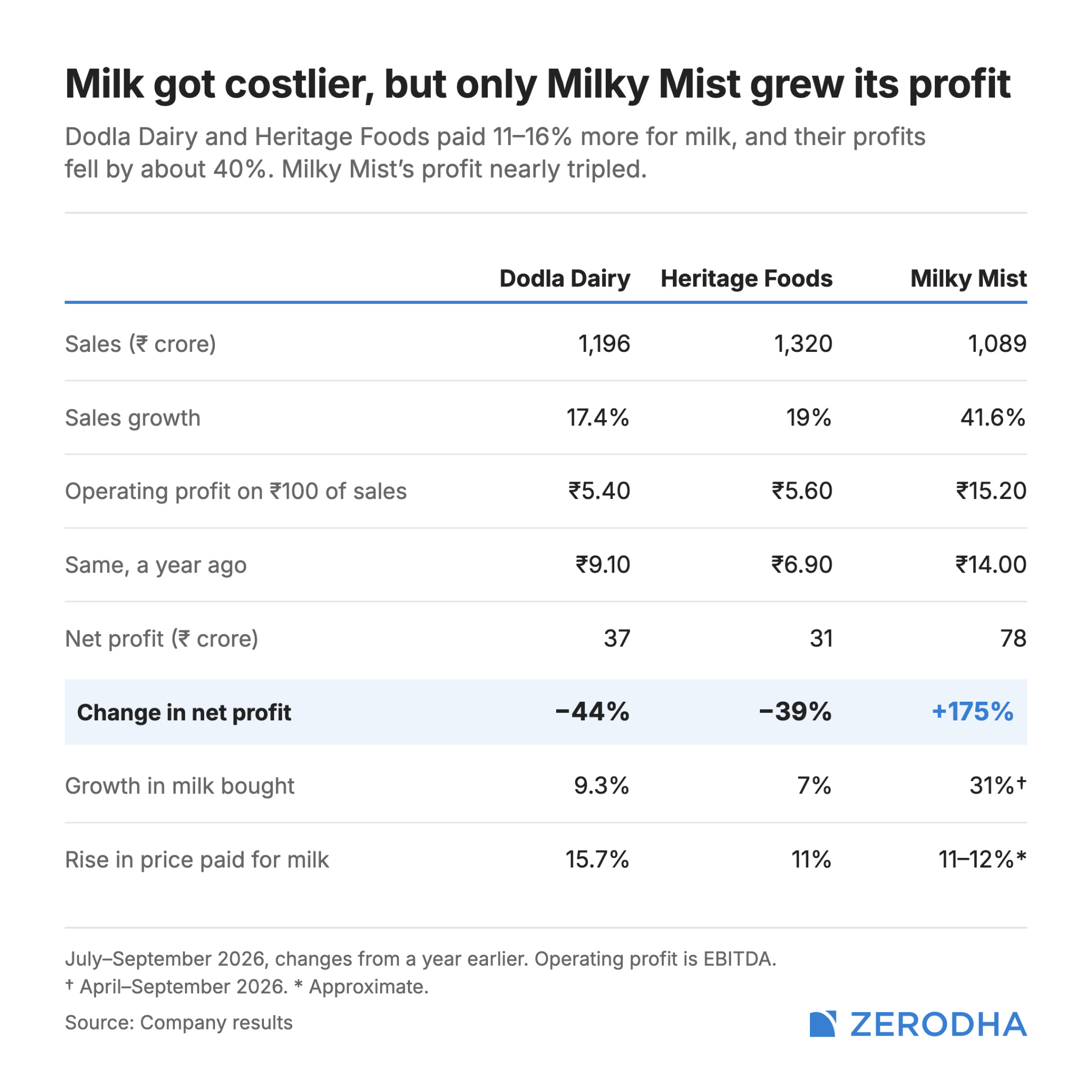
Dodla Dairy grew revenue 17.4% year-on-year to ₹1,196 crore. But its EBITDA margin slid from 9.1% a year ago to 5.4%. Dodla paid farmers ₹43.2 a litre on average, up from ₹37.3 a year ago. That’s ~16% more, and that was a substantial reason for the fall in margins.
Heritage Foods, meanwhile, grew its revenue by 19% y-o-y to ₹1,320 crore. Net profit fell 39% to ₹31 crore, and its EBITDA margin was 5.6%, down from 6.9% a year ago. Still, that’s nearly a full percentage point better than last quarter. Its milk cost rose 11% to ₹47.73 a litre, while its milk selling price rose just 6%.
Then there’s Milky Mist, whose picture couldn’t be more different from the other two. Its revenue jumped 42% to ₹1,089 crore, and EBITDA margins went from 14% a year ago to 15.2% now. Net profit nearly tripled to ₹78 crore. Part of that came from a deferred tax credit and lower interest costs, after it used IPO money to repay loans. Even so, the operating margin story gives an optimistic picture.
Milk procurement
Much like last quarter, every one of these companies collected more milk this quarter than a year ago. Dodla’s procurement rose 9.3% to a record 21.3 lakh litres a day. Heritage’s own metric rose 7%, and Milky Mist procured 31% more in the first half.
But what’s also true is that procurement prices remain elevated despite record procurement volumes. All the reasons impact the supply side of milk.
The first is that it costs a lot to keep and maintain a cow. Milky Mist noted that cattle feed was 15–20% costlier in September than a year ago. Dodla flagged a more worrying structural cause: maize, the main input for cattle feed, is increasingly going into ethanol and compressed biogas. Farmers’ costs are up, and if dairies don’t pay more, the milk simply won’t come to them. And dairy companies take farmer loyalty extremely seriously.
The second reason entails a shift from buffaloes to cows. As per Dodla, rearing buffaloes isn’t viable for many farmers anymore, given strong demand for buffalo meat instead. So farmers and companies alike are switching to cow milk, which is cheaper on a per unit basis. But, as per Heritage, this switch itself has pushed cow milk prices up so much that, on a total-solids basis, cow milk now costs almost as much as buffalo milk.
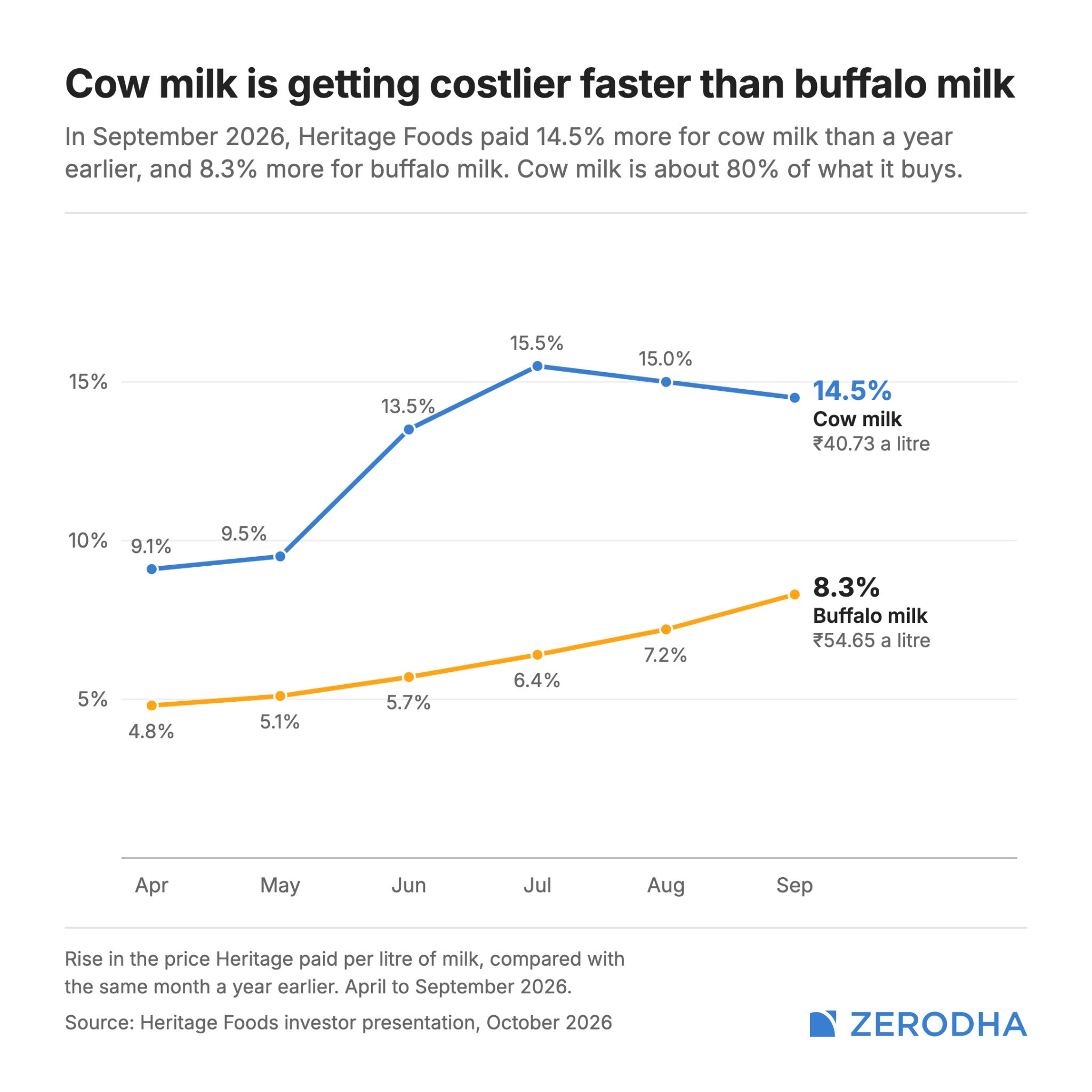
The third reason is milk cooperatives, who set the pace in the South. Aavin, Tamil Nadu’s largest cooperative, raised what it pays farmers by about ₹6 a litre in two quick steps, a move Heritage called unprecedented. Then on October 29, Karnataka cleared an ₹8 hike for Nandini milk from November 1, taking it from ₹46 to ₹54 a litre, with ₹7 going straight to farmers.
The state government said cooperative milk collection had fallen by around 10 lakh litres a day over four to five months because of drought conditions. Without a hike, they argued, milk would have flowed to neighbouring states that pay more.
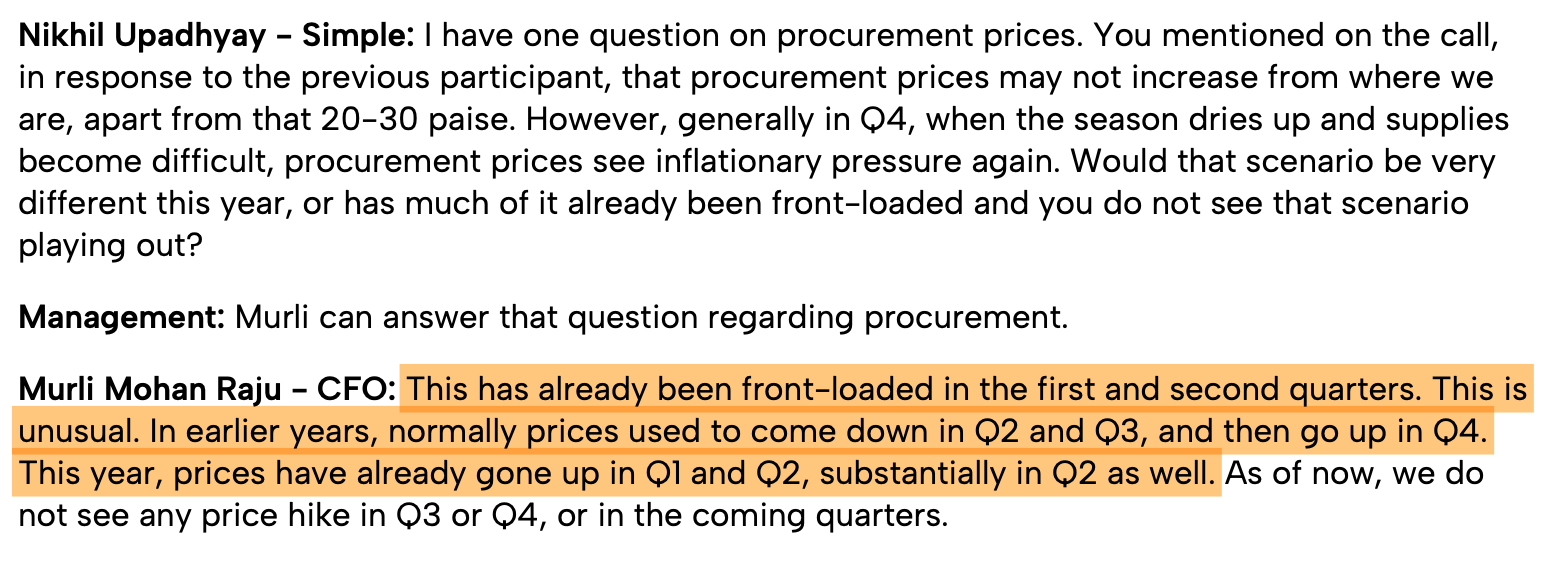
All of this has broken the usual calendar. Dodla’s CFO said procurement prices normally fall in Q2 and Q3, then rise in Q4. This year, they rose in Q1 and Q2 instead. Heritage pointed out that it’s the second year in a row prices have climbed in what should be a flush season, but has instead been disrupted by an El Niño year.
A slow explosion
Now that milk is getting prohibitively costlier, companies are doing the unthinkable: passing more of the inflation to consumers. But, being a politically explosive move, this is not going to be easy or possible to do in one fell swoop. There is real hesitation on everyone’s part.
Dodla, for instance, said it waits to see what others do before moving. It was waiting on Karnataka’s earlier announcement of a ₹2 hike, which never actually happened on the ground. So its own ₹2.5 hike came only in September. The logic was that if procurement prices correct soon after, it doesn’t want to cut prices again. The cost of waiting was 3-4 months of higher milk bills without matching prices.
Milky Mist did something similar. It took a roughly 10% price hike in Q2, but only 1.5–2% of it showed up in the quarter, because of how its packs were restructured. The rest lands in Q3.
There’s also a limit to what plain milk can take. Heritage raised its prices about 8% on average against an 11% rise in milk costs: 6% on milk, 9-10% on other value-added products. On premium curd, Heritage raised prices by over 15%.
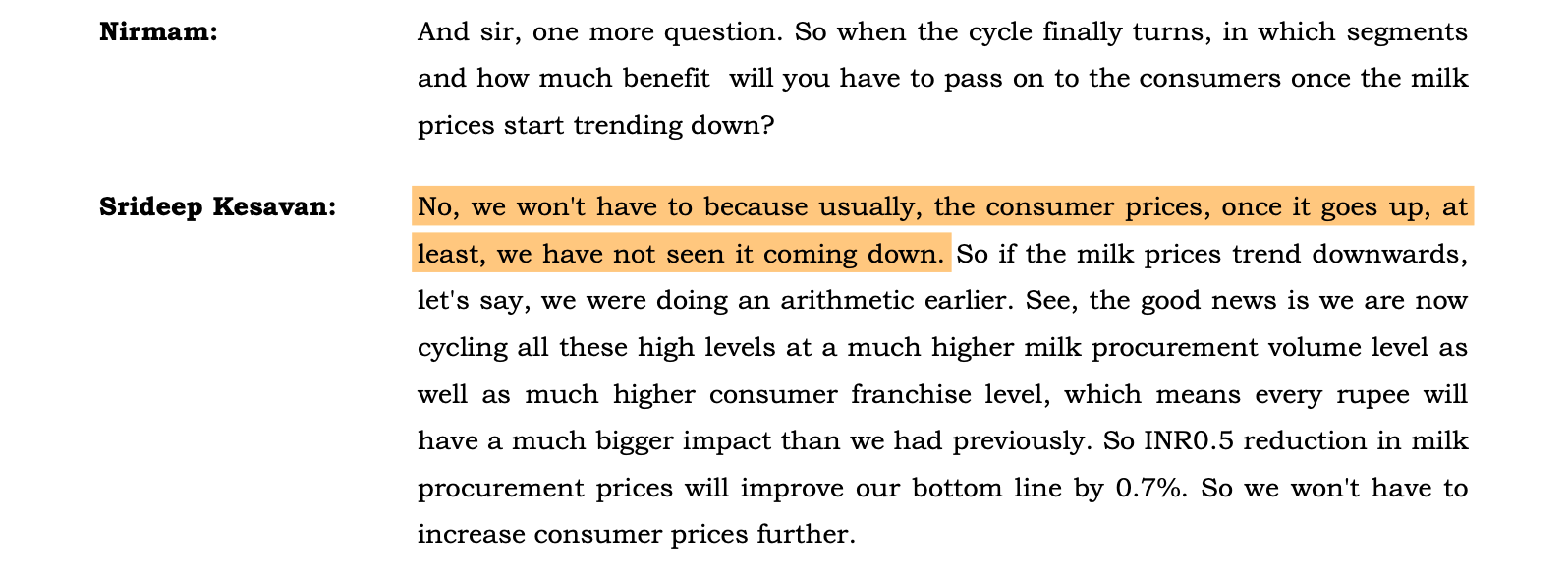
Now, dairy price hikes tend to be one-way. Heritage’s CEO said plainly that once consumer prices go up, he hasn’t seen them come down.

Milky Mist said even if procurement fell ₹5–10 a litre, it would cut prices only 2-5%. Heritage estimates a mere ₹0.5 drop in procurement cost would add nearly ₹3 crore a month to its bottom line.
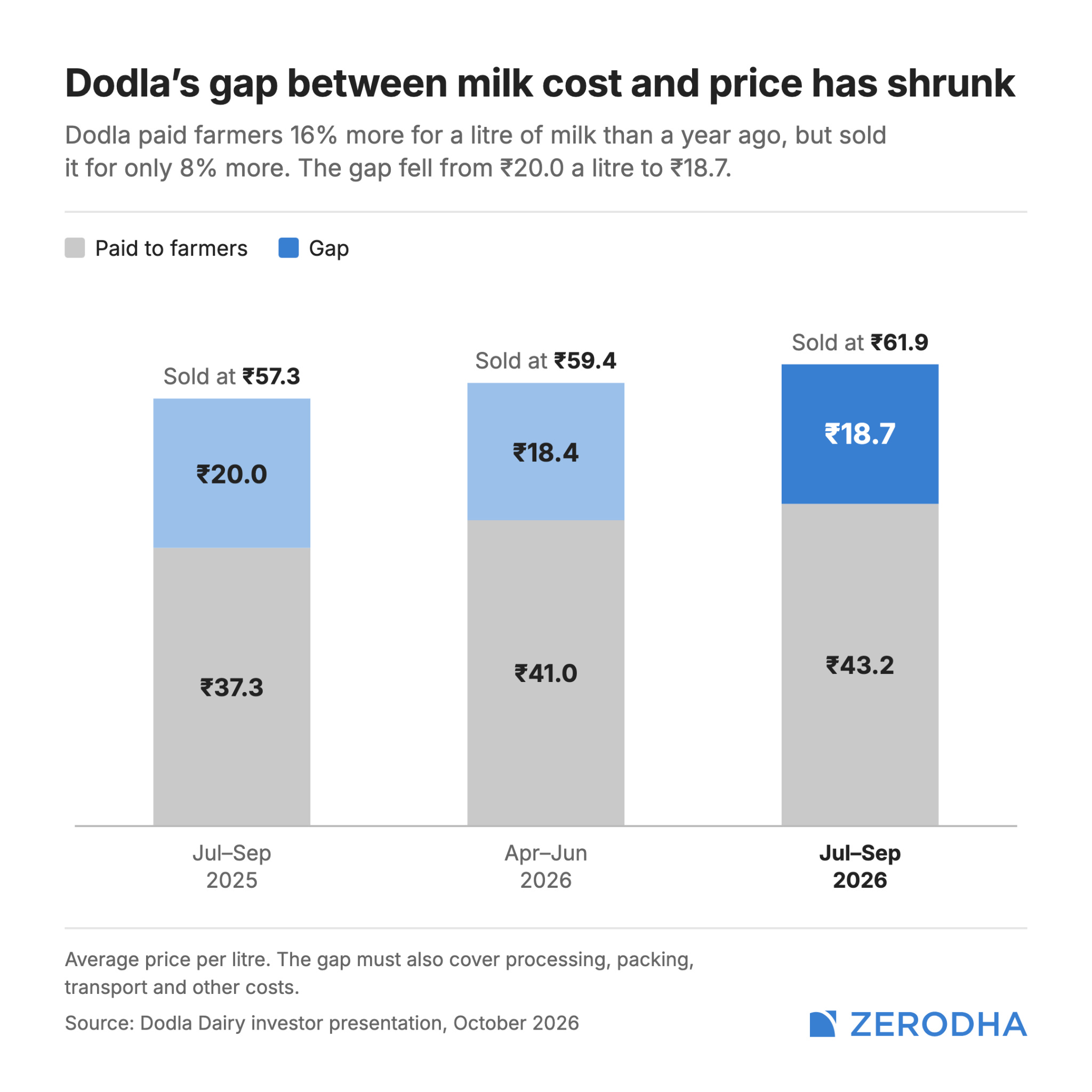
The price hikes do help the firms make better future predictions. Dodla said it has put the bad quarters behind it, and expects EBITDA margins of 7.5-8% next quarter. They support their hypothesis by saying that procurement prices have peaked. Cow milk volumes, it said, now swing barely 10% across seasons, while buffalo milk swings, while still more volatile, have also fallen.
Not everyone is that sure about that assumption, though. Heritage said procurement prices in October were still slightly higher than September, and declined to guess where they’d go. Milky Mist sees no softening yet either. If anything, the Nandini hike may help them all. Once Karnataka’s biggest cooperative raises prices, private players get cover to follow.
Value-added products
Now, it’s well-known that all dairy firms have been doubling down on value-added dairy products. But all of them are in different positions in this race.
For instance, Milky Mist is almost entirely a value-added business: paneer, cheese, curd, yogurt, ice cream. It claims over 65% of the branded paneer market in the South, and its yogurt revenue grew 168% this quarter. It’s why, even as its milk costs rose about 11–12%, it says it could absorb another 5% rise easily.
Milky Mist’s biggest bet is protein. High-protein paneer, skyr and Greek yogurt, cheddar, and a new lactose-free milk with 25 grams of protein in a 250 ml pack now make up about 12% of sales, up from 7% a year ago. Gross margins on these are above 50%. They sell especially well on quick commerce, which now brings in 21% of Milky Mist’s revenue, up from 11%.
Compare that with Dodla, where curd and curd-based products make up about ₹251 crore of its ₹327 crore in VAP. Curd earns a 19% gross margin; buttermilk and lassi do a little better at 20–23%. Heritage is further along: VAP is 42.5% of its revenue, including ghee and butter. It’s chasing protein too, with a 25-gram protein curd, Greek yogurt, and a high-protein paneer that’s now over 15% of its paneer sales.
These products are also milk-hungry. It takes about 6 litres of milk to make 1 kg of paneer, Dodla noted, and skyr and Greek yogurt are concentrated milk too. Whey, which we covered through Parag’s Avvatar last time, comes out of the same process as a by-product. That’s partly why these products are priced high.
Could that make the milk crunch worse? Nobody on the calls said so. Milky Mist argued the opposite: its cheddar plant, just 20% utilised, doubles as a buffer. In a glut, it can turn cheap milk into cheese and age it, instead of dumping it into powder.

Regulation cuts both ways for Milky Mist. In September, FSSAI proposed a nationwide ban on selling “analogue paneer”, made without milk, under the paneer name. That helps branded players; Milky Mist expects the organised share of paneer to rise from about 10% to 25–30%. But just a day earlier, the regulator’s action against Instamart and BigBasket named three Milky Mist products, including its Greek yoghurt, over misleading claims and non-compliant product information. For a company that sells protein on its labels and now gets a fifth of its revenue online, that’s worth watching.
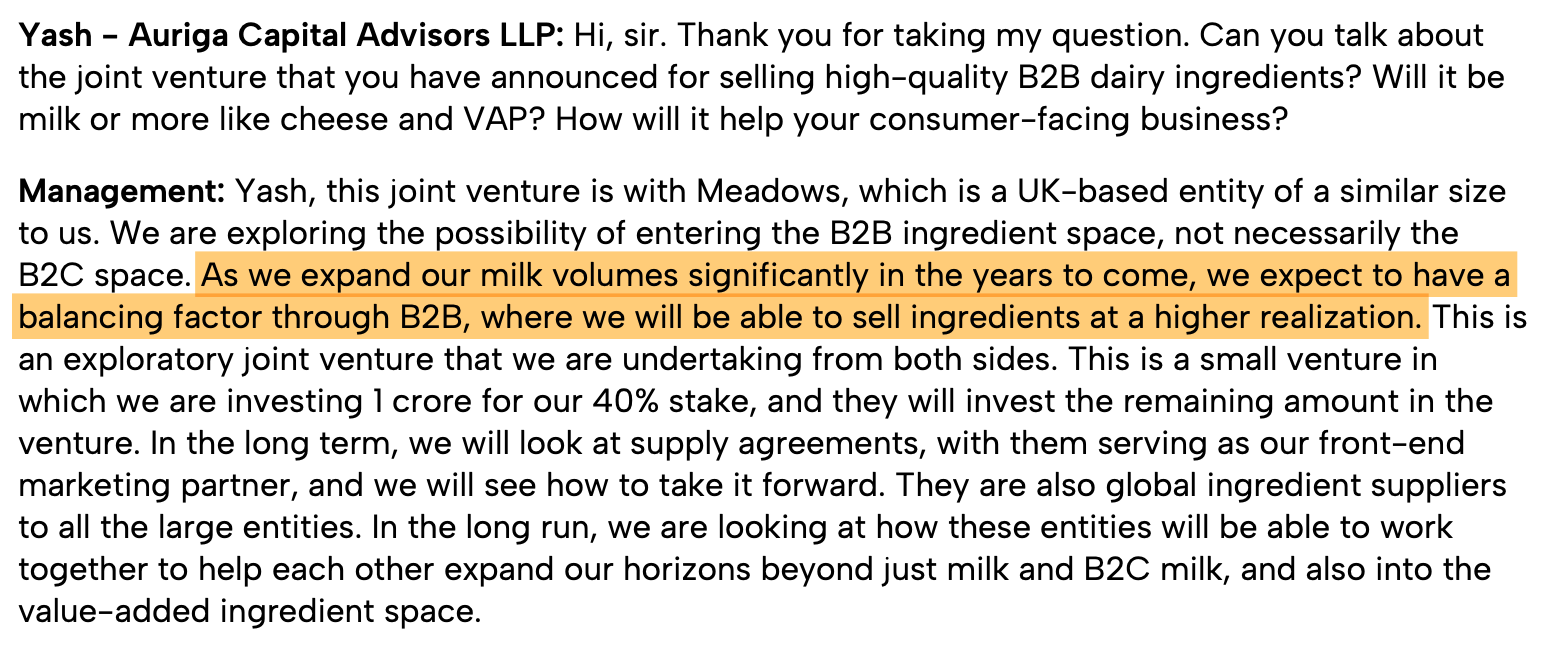
Interestingly, the rise of VAP has also introduced a new twist. So far, every dairy was running away from low-margin B2B bulk sales. This quarter, though, Dodla found a smarter use for it. It announced a joint venture with UK-based Meadows, putting in ₹1 crore for a 40% stake, to sell tailored dairy ingredients to food companies.
Conclusion
On paper, next quarter should look better for everyone. The September price hikes will show up in full. The Nandini hike sets a new floor for southern milk prices. And managements are, cautiously, calling a peak in procurement costs.
But something has changed. For over a year, the hope was that milk would get cheaper and a flush of some kind would arrive. Now the plan is for you to keep paying more, and for it to stick. Whether that works depends on how long consumers accept costlier staples, and, once again, on the weather. And how this, in turn, would affect the continuing shift to value-added products is also unclear.
- This edition of the newsletter was written by Vignesh & Kulsum.
Tidbits:
[1] Uber rolls out new driver features including WhatsApp onboarding
Uber has introduced several features for drivers in India, including WhatsApp onboarding, voice notes and flexible subscription passes. It is also expanding safety tools such as encrypted in-app video recording and ambulance assistance.
Source: Hindu
[2] IndiGo posts ₹1,879 crore quarterly loss as fuel costs surge
InterGlobe Aviation, operator of IndiGo, reported a net loss of ₹1,879 crore for the September quarter despite raising passenger fares. While revenue per available seat kilometre rose 26.4%, the improvement was wiped out by a 67% surge in fuel expenses to nearly ₹10,000 crore, underscoring the severe impact of volatile global energy prices on airline margins.
Source: Livemint
[3] Government defends ₹11,000 crore customs duty demand against Volkswagen
The government has defended its ₹11,000 crore customs duty demand against Volkswagen before the Bombay High Court, arguing that the automaker failed to provide required import information on time. Volkswagen denies wrongdoing and says authorities cannot retrospectively scrutinise imports going back 12 years.
Source: Livemint
[4] MSME ministry seeks ₹6,000 crore to extend khadi and village industries scheme
The Ministry of Micro, Small and Medium Enterprises has requested ₹6,000 crore to extend its flagship Khadi Gramodyog Vikas Yojana for five years through March 2031. The proposed funding aims to continue targeted support for artisans, self-help groups, and rural youth, following ₹2,374 crore in government expenditure on the scheme over the past three fiscal years.
Source: Livemint
[5] Adani Ports submits $3.3 billion binding bid for Europe’s Evos Terminals
Adani Ports has submitted a binding $3.3 billion offer for Evos Terminals, a European liquid-storage operator with eight terminals across five countries. The bid forms part of Adani’s overseas expansion into ports and energy logistics and follows its unsuccessful attempt to acquire Associated British Ports.
Source: The Economic Times
Want more tidbits? Catch up on last week’s recap!

Beyond Today’s Brief
There’s always more happening at Markets by Zerodha.
The Chatter: What is SEBI focusing on in its latest regulatory moves? How is Asian Paints navigating competitive pressures and shifting market demand? And what are the key takeaways from Motilal Oswal and Gulf Oil’s latest business updates?
Aftermarket Report: How did IT stocks lead the charge to help Nifty defy a global market rout and close the week above the 23,000 mark? And why do broader markets continue to underperform despite the headline index's resilience?
Join us on WhatsApp, where we share interesting soundbites from concalls, articles, and everything else we come across throughout the day. You’ll also get notified the moment a new video or article drops so that you can read or watch it right away.
Thank you for reading. Do share this with your friends and make them as smart as you are 😉