


Hi everyone, I’m Mridula, and welcome to the eleventh edition of Weekly Tidbits.
We spend a lot of time reading interesting stories that never make it into a full Daily Brief piece. So, once a week, we pick some of the best ones and add a little context.
We sort them into GEIC: Global, Economy, Industry and Company.
Let’s get started!
If you prefer watching the video, here’s the link:
G — Global
[1] Bayer wins a major cancer lawsuit in America
German drugmaker Bayer has won a US trial over its weedkiller, Roundup. On October 29, a jury ruled against three women who said the product had caused their cancer. This was the first such trial since a US Supreme Court ruling in June made some of these cases harder to bring.
Roundup contains glyphosate, a chemical used to kill weeds. Thousands of people have sued Bayer. They claim the weedkiller caused their cancer and that the company failed to warn them. Bayer denies these claims. It took on this legal trouble when it bought Monsanto, the maker of Roundup, in 2018.
Bayer says US rules did not require a cancer warning on the product. The Supreme Court ruling may help it fight some claims based on that missing warning. The company is also seeking court approval for a $7.25 billion settlement, roughly ₹68,000 crore. The new win helps Bayer, but many cases are still open.
[2] Marvell may buy Lumentum in a huge AI deal
American chipmaker Marvell is in talks to buy Lumentum, a company that helps move data using light. Lumentum was worth around $83 billion when news of the talks came out. That’s roughly ₹7.8 lakh crore. Neither company has announced a deal.
AI needs more than fast chips. Thousands of chips in a data centre must send data to each other. As these centres grow, moving all that data becomes harder. Lumentum makes lasers and other parts that send data through fibre-optic cables. These cables use light to carry information. Marvell makes chips that help manage this flow.
We wrote earlier about why AI data centres need so much optical fibre. Buying Lumentum could help Marvell offer more of the parts needed to move data. The deal would be large, though, and Marvell would need to find the money to pay for it. Regulators may also want to look at it closely.
[3] German carmakers are struggling in China
Mercedes-Benz has cut its profit forecast for 2026 as sales in China fall. It now expects a margin of 2–3% from its car business, down from 3–5% earlier. BMW and Volkswagen have also cut their outlooks this year. Mercedes sold 8% fewer cars in the July–September quarter than a year ago.
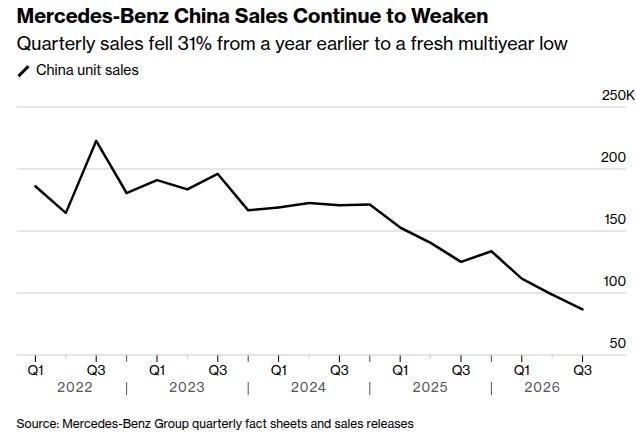
China is the world’s largest car market. For years, it was a key source of profits for German brands. Buyers paid more for cars from Mercedes and BMW. Now, Chinese firms offer electric and hybrid cars with new features at lower prices. Buyers are also being more careful with their money.
German brands have to work harder to win sales. They can cut prices, add features or build cars that suit Chinese buyers. But price cuts hurt profits, while new models cost money to develop. Mercedes’ weaker forecast shows how much the change in China is hurting its business.
E — Economy
[4] The government cuts wheat supply even as prices rise
The government has cut the amount of wheat it sells at its weekly auction. The quota for October 28 fell by 5,000 tonnes to 1.01 lakh tonnes. This comes as flour millers in some states are paying more than ₹31 a kilo for wheat.
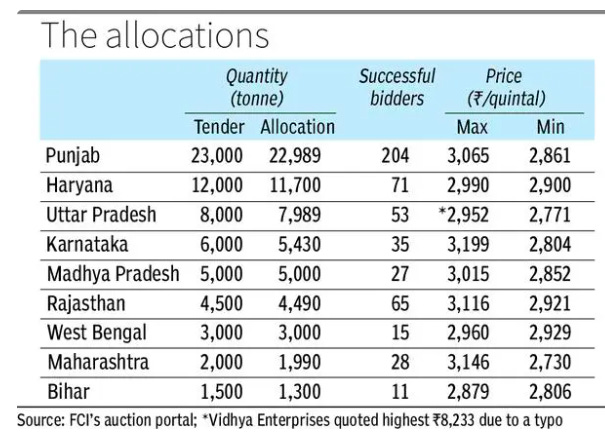
The Food Corporation of India, or FCI, buys wheat from farmers and stores it. It also sells some of that grain to mills and traders each week. These sales add more wheat to the market when private stocks run low. Millers need it to make atta and maida. When they can’t find enough, they pay more. That can push up the price of flour, bread and other foods.
We wrote earlier about why rice prices are rising even when government stores are full. Wheat faces a similar problem. Grain in a warehouse won’t help buyers unless the government sells it at a price they can pay. Trade groups want more wheat released, but the Centre must also keep enough in stock for the months ahead.
[5] Karnataka wants to earn money from cutting carbon emissions
Karnataka is exploring ways to earn money from cutting carbon emissions. It has picked Kolar district to test its net-zero plan. The state wants to turn these cuts into income. It has set an early goal of earning money from 5 million tonnes of carbon by 2030.
One way to do this is through carbon credits. A company may earn credits when it cuts or removes carbon emissions. For example, it might switch to solar power or plant trees. But it can’t sell credits just because it has cut emissions. The project must follow the rules of a carbon-credit programme. An approved agency must also check how much carbon it has saved. Only then can the credits be sold to other firms.
Karnataka’s plan is still at an early stage. It must prove that the cuts are real and would not have happened on their own. Buyers will pay for these credits only if they trust the numbers.
[6] SEBI makes cheaper mutual fund plans the default
From November 1, direct mutual fund plans will be the default choice on fund houses’ websites and apps. SEBI also wants people who pick regular plans to know that they cost more.
A mutual fund can have two plans that invest in the same stocks or bonds. A regular plan pays a fee to the person or firm that sold you the fund. A direct plan does not have that fee. This makes it cheaper. The gap may look small, but it adds up over time. Say you invest ₹1 lakh for 20 years. At 12% a year, it grows to about ₹9.6 lakh. At 11%, it grows to about ₹8.1 lakh. That’s a gap of nearly ₹1.6 lakh.
SEBI isn’t banning regular plans. People who want help from a distributor can still choose one. The change is about what investors see first. It puts the cheaper option in front of them and makes the extra cost of the other plan clear.
I — Industry
[7] India puts fresh duties on a key Chinese chemical
India has brought back import duties of $460 to $681 a tonne on some types of titanium dioxide from China. That’s roughly ₹43,000 to ₹64,000 a tonne. The duties will stay for five years unless the government changes them.
Titanium dioxide is a white powder used in paints, plastics and other goods. It gives them a bright white colour and makes them less see-through. Indian firms that produce it have faced tough price competition from China. The government found that Chinese sellers were offering it below fair value. This is called dumping.
The new duty makes these imports cost more. That helps Indian firms compete with Chinese sellers. But paint and plastic makers also use this powder to make their goods. They may now have to pay more for it. Some may raise prices, while others may earn less on each sale. The duty helps local chemical makers but adds costs for firms that buy from them.
[8] Indian electronics firms are buying more parts from Vietnam
Indian phone and earbud makers are buying more parts from Vietnam as some parts get costlier at home. India’s trade deal with ASEAN also lets them import certain goods at lower duties. ASEAN is a group of Southeast Asian countries that includes Vietnam.
A phone may carry an Indian brand or be put together in India. Yet many of its parts still come from abroad. Memory chips have become much costlier as AI data centres buy more of them. Chipmakers are also using more of their factories to produce chips for AI. This leaves fewer chips for phones, so phone makers are trying to save money on other parts.
Vietnam has a large electronics industry and strong ties with global suppliers. Lower import duties can also make its parts cheaper than local ones. This helps Indian brands keep costs down. But it puts more pressure on Indian parts makers. India now puts together more devices than ever. Local firms will have to match global prices if they want a larger share of that work.
[9] India approves ₹1,857 crore to make more sports goods
The Union Cabinet has approved a ₹1,857 crore scheme to help India make more sports goods. It will run until FY34 and support new factories, better machines, worker training and exports.
India already makes many sports goods. Small firms in Meerut and Jalandhar produce bats, balls, nets and other items. But selling to big global brands takes more than making a good product. The goods must often pass strict tests and meet the rules of sports bodies. Small firms may not have enough money for new machines or these tests.
The scheme will help set up sports goods hubs with shared testing and design centres. It will also support firms that build new plants or raise output. The government has kept ₹105 crore to help companies get global product approvals. This could help Indian makers sell more goods abroad. The test will be whether these firms can turn the support into new orders.
C — Company
[10] Dr Reddy’s launches new semaglutide brands after a supply problem
Dr Reddy’s Laboratories has launched two new brands of semaglutide, Obeda Pro and Obeda Plus. This comes after a supply problem with its first Obeda injection.
Semaglutide is the drug used in Ozempic and Wegovy. It helps treat diabetes and manage weight. Its Indian patent expired in March, so Indian firms began selling cheaper versions. We wrote earlier about how these firms are fighting for a share of this market. Low prices can help win buyers, but firms also need to keep their drugs in stock. In July, Dr Reddy’s found a quality issue with Obeda and stopped supplies while it checked the problem.
Hetero Labs makes the two new brands, giving Dr Reddy’s another source of the drug. Some sellers think they may replace the first Obeda product. Dr Reddy’s says it planned the new brands before the supply issue. It has not said it will stop selling the old one. With many firms selling the same drug, a supply gap can help rivals win customers.
[11] Singareni wants to move beyond coal
Telangana’s state-run miner Singareni Collieries is looking to expand beyond coal. State officials want it to look at minerals such as copper, lithium, gold and vanadium. They have also asked it to cut costs and open new coal mines.
Singareni has mined coal for decades, much of it for power plants. But demand is also growing for minerals used in batteries, electric vehicles and power grids. Lithium goes into many batteries, while copper carries power through wires and motors. These minerals could give Singareni new ways to earn money as energy use changes.
The company knows how to run large mines and move huge amounts of material. Yet each mineral needs different tools and skills. Singareni has been asked to look at mineral blocks in India and abroad, but it has not announced a major new mine yet. For now, it is looking for ways to grow beyond coal while keeping its current business profitable.
[12] Reliance plans to close a UK Hamleys company
Reliance Industries has applied to close one of its UK firms, Hamleys (Franchising). The firm had sales of ₹56 crore in 2025. That’s less than 0.005% of Reliance’s total sales.
Reliance bought Hamleys, the famous toy store brand, in 2019 for around ₹620 crore. The brand has shops in India and abroad. The firm Reliance wants to close is just one part of this business. The Hamleys stores are not shutting down.
The process is called a voluntary strike-off. A company asks the UK government to remove its name from the list of active firms. Anyone owed money by the firm can object. The closure cannot take place before late December. Reliance has not said why it wants to shut this unit or made any plans to close the wider Hamleys business public.
That’s it for this week.
A few of these stories are still developing, so we’ll be keeping an eye on them. But if there’s one you’d like us to write about properly, let us know in the comments.
See you next edition :)