


Our goal with The Daily Brief is to simplify the biggest stories in the Indian markets and help you understand what they mean. We won’t just tell you what happened; we’ll tell you why and how too. We do this show in both formats: video and audio. This piece curates the stories that we talk about.
You can listen to the podcast on Spotify, Apple Podcasts, or wherever you get your podcasts and watch the videos on YouTube. You can also watch The Daily Brief in Hindi.
In today’s edition of The Daily Brief:
1. Who pays to invent the energy future?
While global oil shocks historically triggered sharp spikes in public energy research, governments inevitably pull back once crises fade, leaving rich-world energy R&D today at half its 1980 share of GDP. Traditional oil and power utilities spend a sector-low 0.6% of sales on innovation, meaning lasting breakthroughs now flow from scaled equipment manufacturers like China’s BYD, which alone outspends five Western oil majors combined. India faces acute energy shocks but lags far behind, devoting just 0.84% of GDP to total R&D while chronically underspending its renewable research budgets.
2. Ola finally lets the middleman in
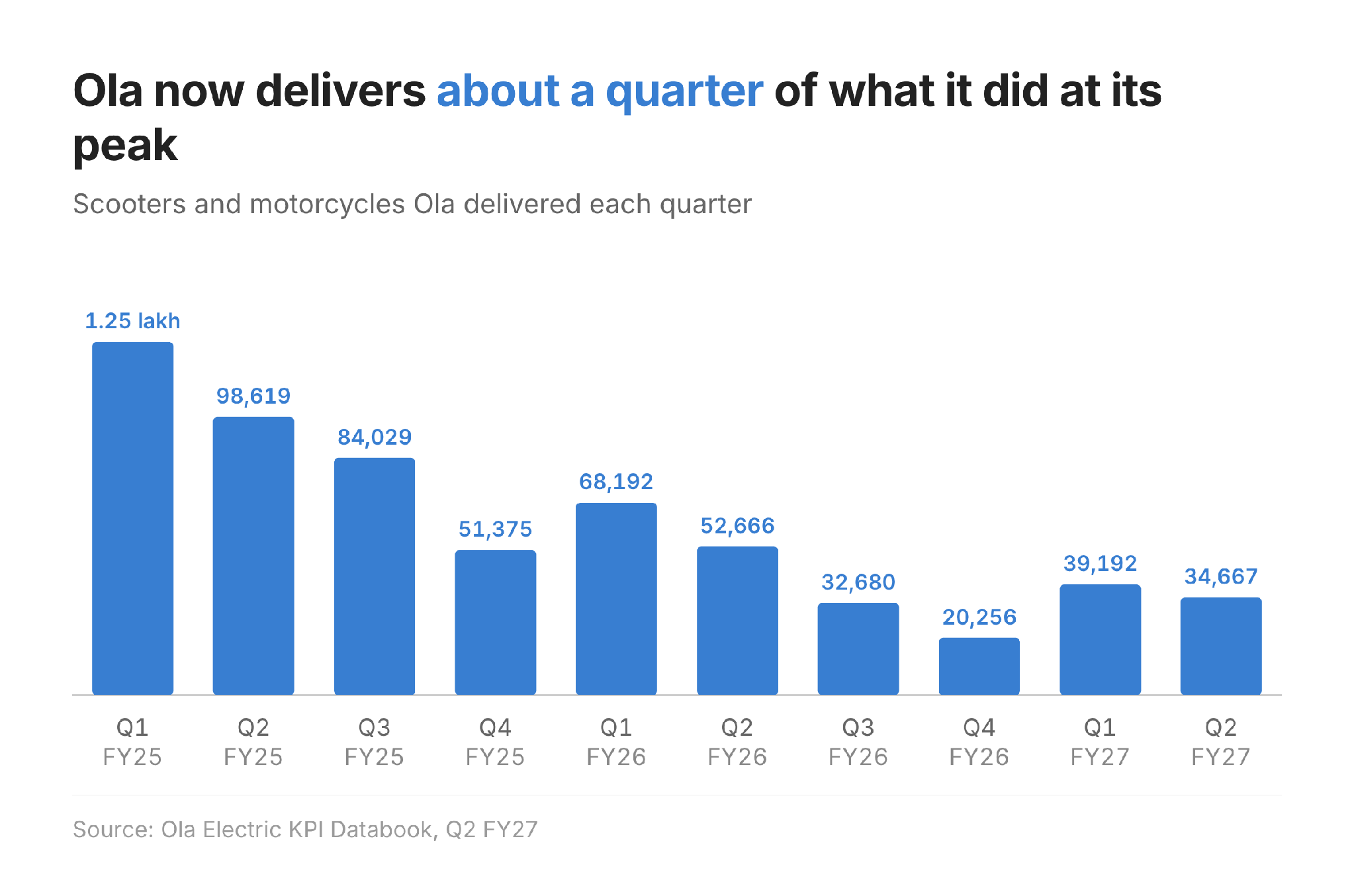
After years of championing a direct-to-consumer model, Ola Electric has abruptly pivoted to traditional dealerships—shutting down most of its own stores and signing up 255 dealers to run 319 outlets. The shift follows severe service backlogs, 54% staff attrition, a SEBI notice over store count disclosures, and quarterly deliveries collapsing by nearly 75% from peak levels as rival Ather surged ahead. By handing inventory, GST refund friction, and workshop management over to local dealers, Ola hopes to stem ₹362 crore quarterly losses and rebuild lost market share.
Mahanadi Coalfields (MCL) IPO opens for subscription today! Wondering whether it’s worth your attention?
Check out our video, where we break down the company’s business, financials, valuations, and key things investors should know before applying.
Who pays to invent the energy future?
This year, the world got its biggest energy scare in half a century. The head of the International Energy Agency (IEA) called the crisis at the Strait of Hormuz the largest supply disruption in the history of the oil market, worse than the shocks of 1973, 1979 and 2002 put together.
The last time oil frightened the world this badly, in the 1970s, rich countries poured money into energy research. Within six years, their governments more than doubled what they spent on inventing new ways to make and use energy. They backed nuclear reactors, solar cells and fuel-efficient engines.
Will that happen again? And if it does, who will actually do the inventing?
We went through 5 decades of government research budgets, many years of company accounts and India’s own budget documents to answer that. We found that governments spend on energy research when they’re scared, and pull back when the scare passes. The spending that lasts comes from companies that make and sell energy equipment, like batteries and solar panels. Today, most of those companies are Chinese. India has felt the scares, but it has very few such companies, and its government spends little on research.
Let’s walk through it.
The last time oil scared the world
The IEA tracks how much its member governments spend on energy research, development and demonstration, which it shortens to RD&D. In practice, that covers things like a government grant to a university lab testing a new battery chemistry, a national lab working on better wind turbine blades, or public money for the first pilot plant that captures carbon from a factory chimney. That last kind, building the first real-world version of a technology before anyone knows if it works at scale, is the “demonstration” part.
The IEA’s database goes back to 1974, with a few limits. It counts what governments budget, not always what they spend. It covers only the IEA’s 32 members, so China and India don’t appear. And the US, the biggest spender, stopped sending detailed figures after 2015, so the IEA now estimates its numbers.
With that in mind, here’s what the data tells us.
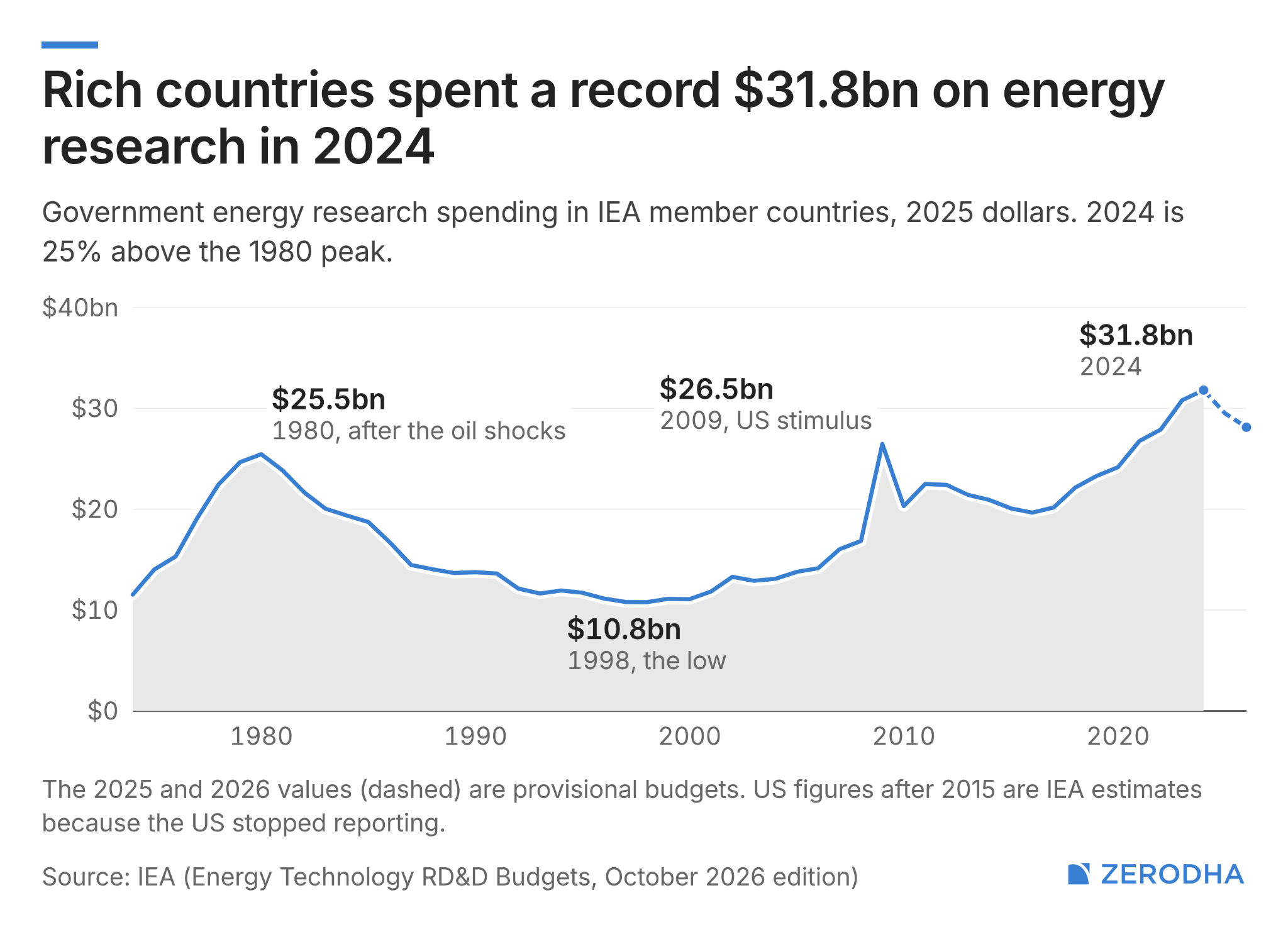
After the 1973 oil embargo, government spending on energy research more than doubled to ~$25 bn by 1980, in today’s dollars. Then it slid for almost two decades. By 1998, it had fallen to ~$11 bn, less than half its peak. Apart from a one-year spike in 2009, it took until 2021 to climb back above the 1980 level. In 2024, it hit a record $32 billion.
That sounds like a boom, but it isn’t quite one. Economies and research budgets have grown enormously since 1980, so a record in absolute terms can still be a modest effort in relative terms. To check, we looked at what share of all government research money goes to energy. The OECD tracks this, and we took the 14 rich countries with a full record since 1981.
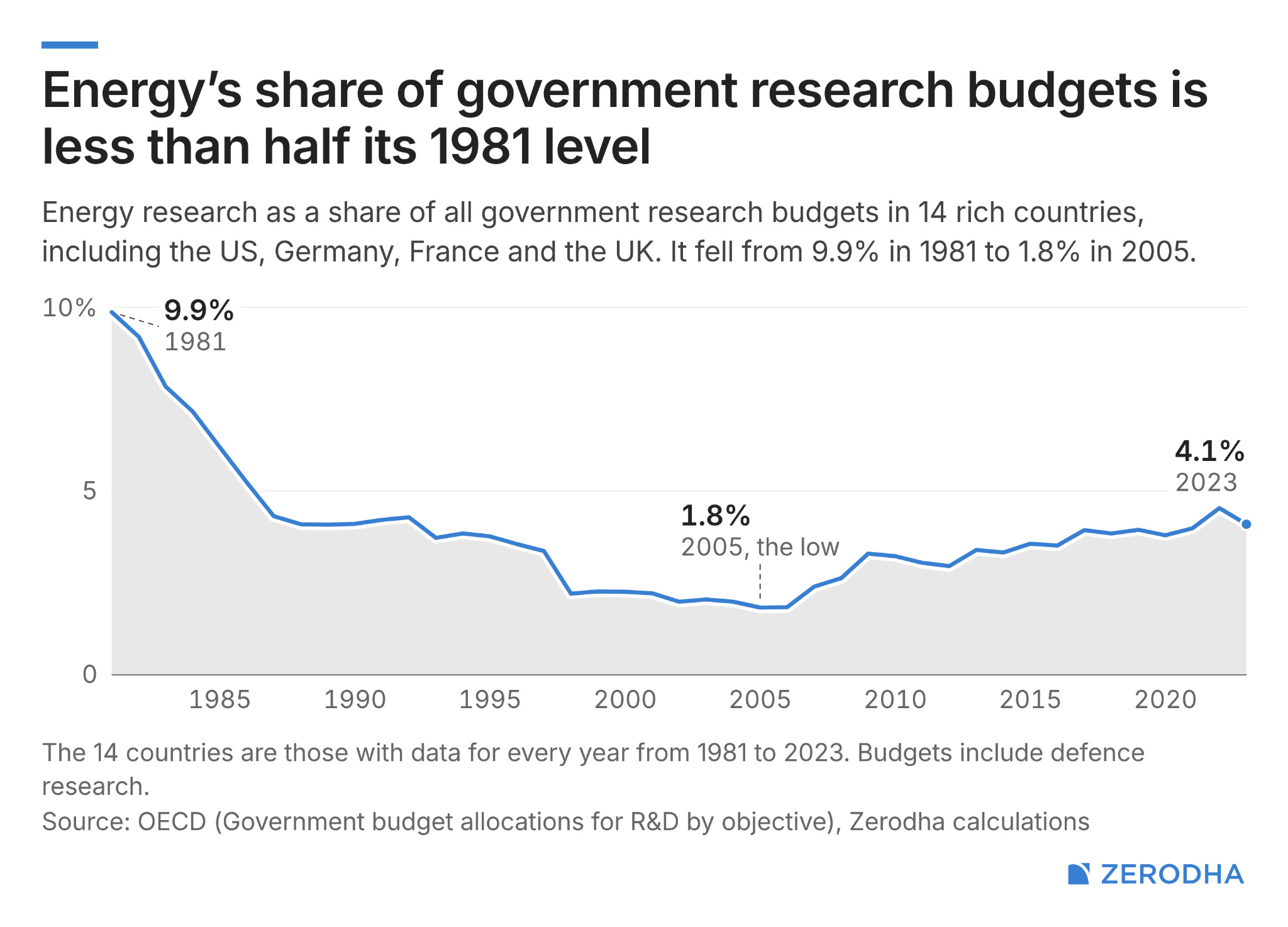
In 1981, these governments spent roughly one in every ten research dollars on energy. By 2005, they spent less than two in a hundred. Today it’s about four. The IEA makes the same point another way: its members spent about 0.1% of their GDP on energy research after the oil shocks, and spend about 0.05% now. Relative to the size of their economies, today’s record is half the old effort.
As for who spends that money, The US is still the biggest spender by far, at about $11 billion by the IEA’s estimate, which is why what happens in Washington matters so much.
Why the money comes and goes
What drives these budgets up and down? For a long time, the answer was simple: the price of oil.
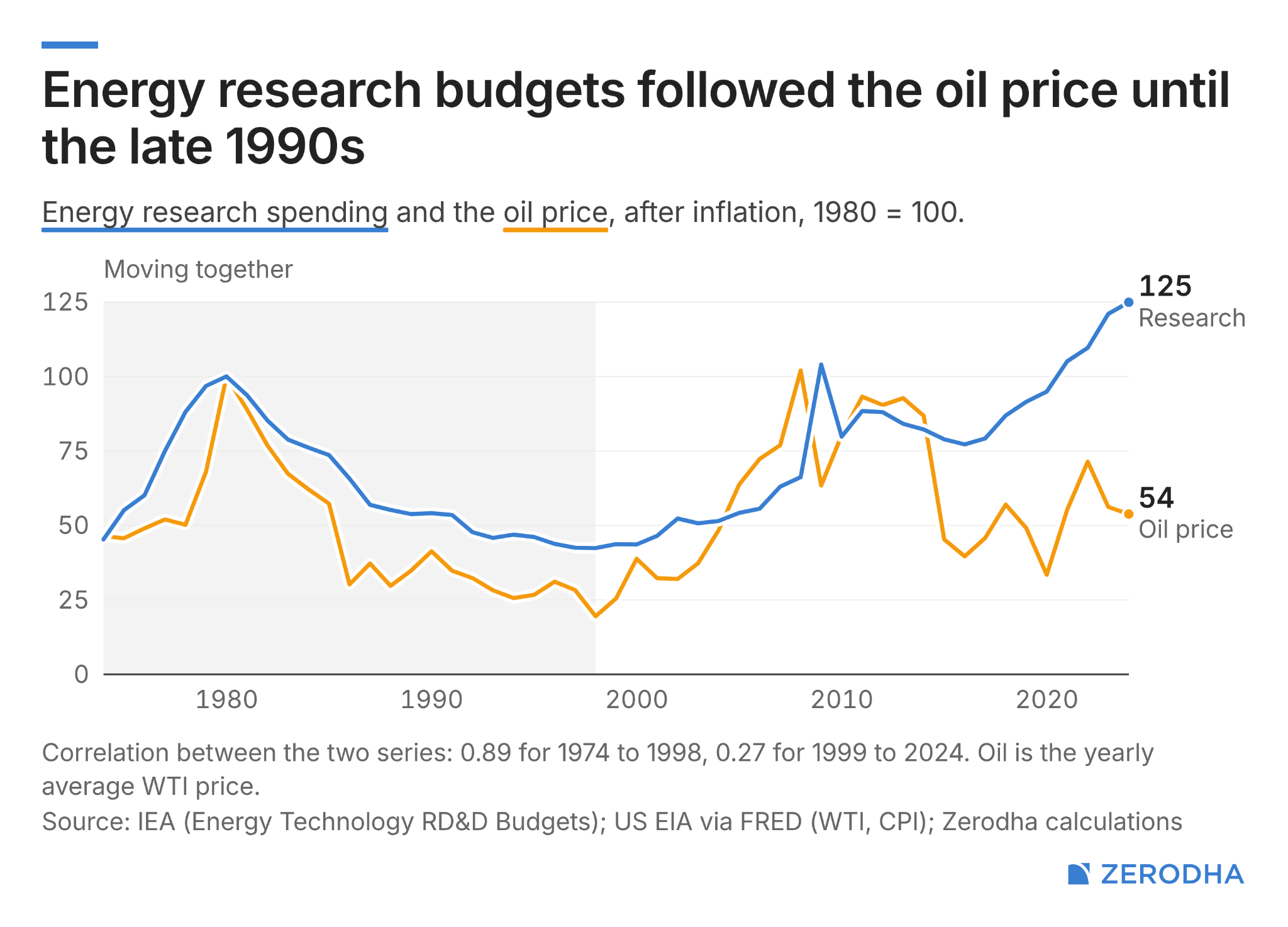
From 1974 to 1998, the two moved almost in lockstep. When oil prices shot up in the late 1970s, research budgets shot up too. When oil prices crashed in 1986, budgets fell with them. If you measure how closely they moved together, the correlation comes to 0.89, where 1 would mean perfect step. That doesn’t prove oil prices caused the spending, but the timing is hard to ignore.
After the late 1990s, that link broke. Oil prices kept swinging, but research budgets climbed more steadily, because governments had found new worries. First came climate change. Then, after Russia invaded Ukraine in 2022, Europe had to worry about its gas supply, and European spending rose faster than anywhere else. By 2024, oil cost less than it did ten years earlier, yet governments spent 50% more on energy research.
What the money buys now
The worries also changed what governments pay for.
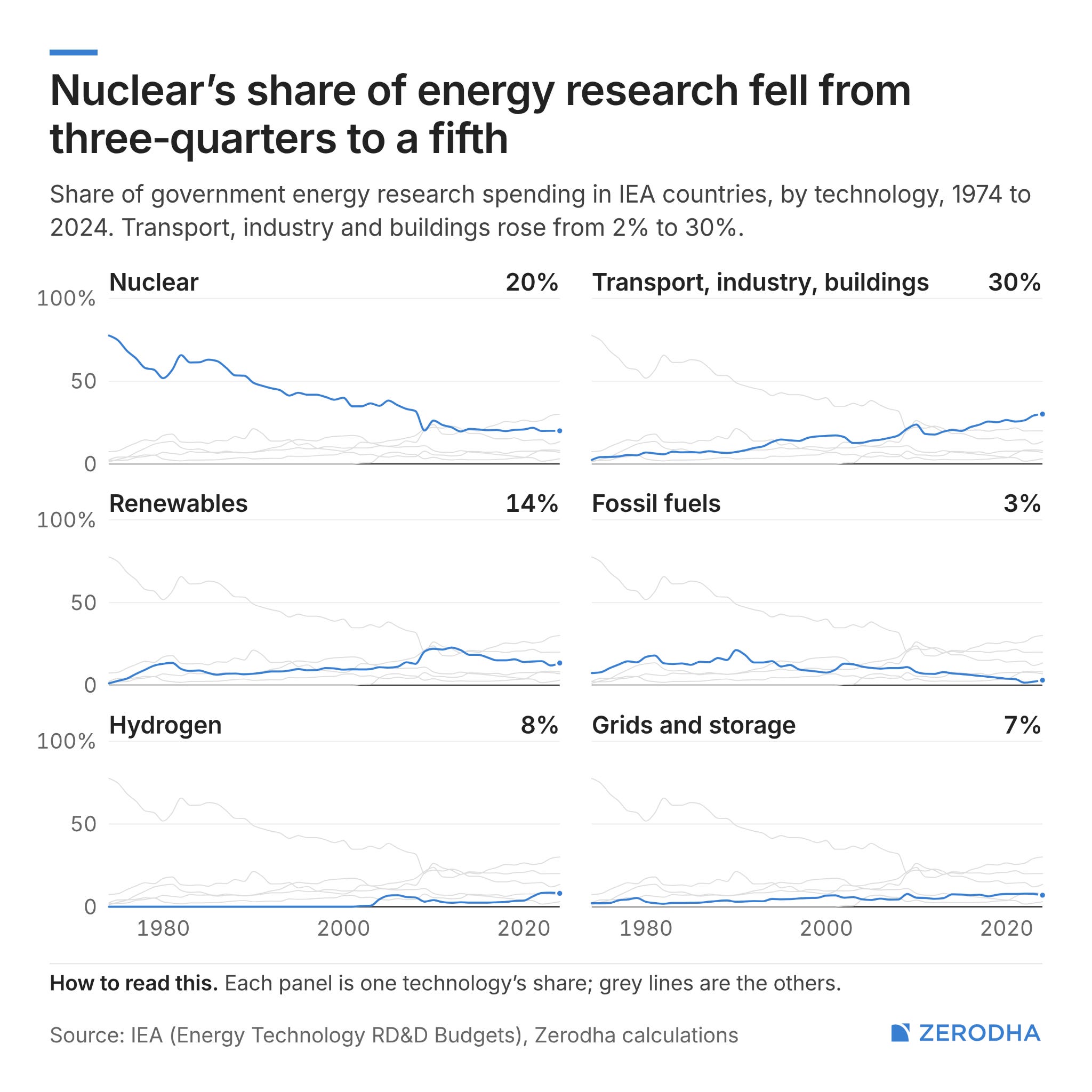
In 1974, nuclear power took three out of every four research dollars. Governments felt so sure of it that people talked about electricity becoming “too cheap to meter”. Then Three Mile Island and Chernobyl soured the world on it. Today, nuclear gets a fifth of the money.
If you want to understand why nuclear stalled in India too, we had a long conversation on Subtext by Zerodha with Karthik Ganesan on the state of nuclear energy.
The biggest slice, about 30%, now goes to how we use energy: transport, industry and buildings. Fossil fuels get just 3%. Over the last decade, transport research grew about six times, hydrogen production research grew 13 times, and coal research shrank by 96%.
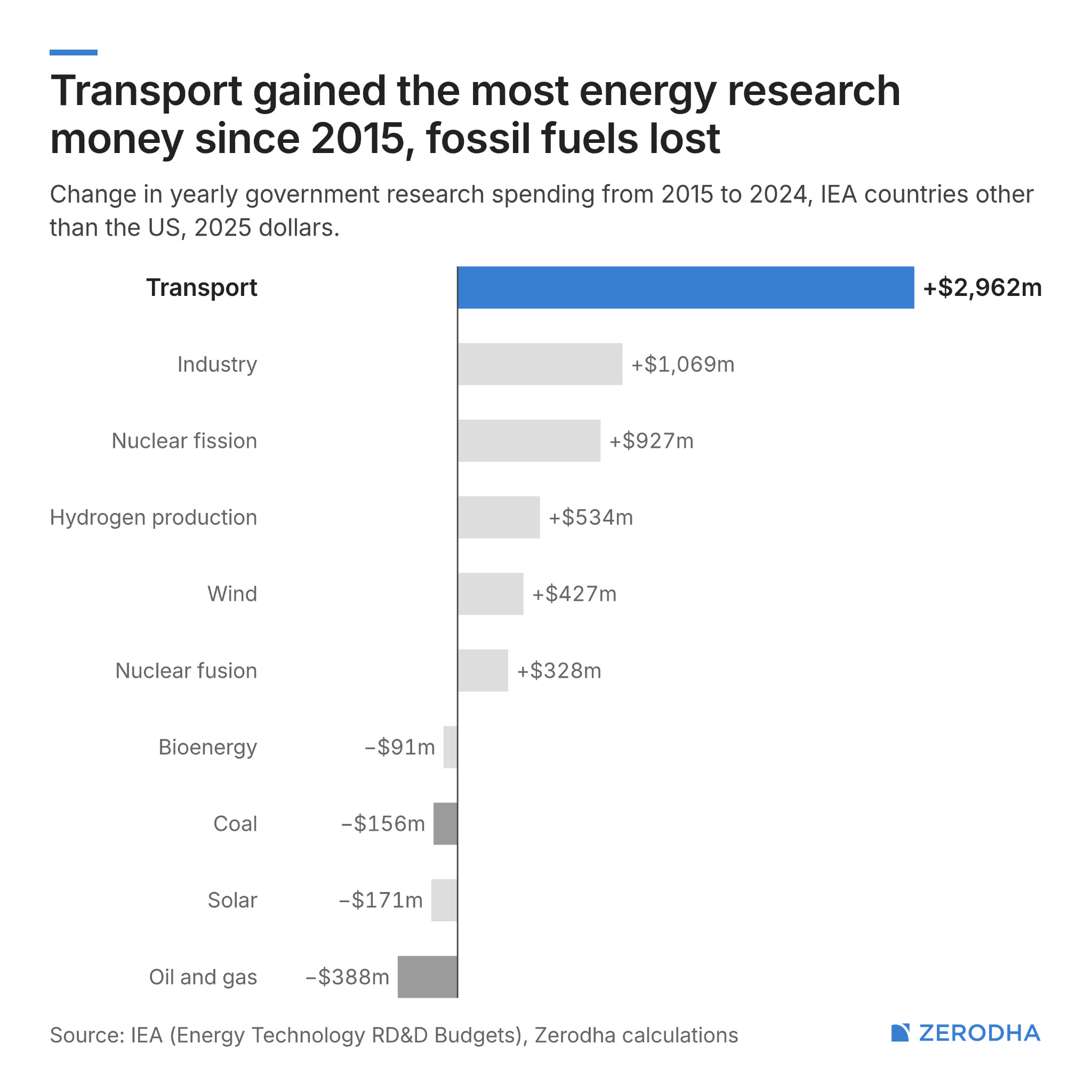
Source: IEA, Zerodha calculations. Excludes the US, which stopped reporting detailed figures to the IEA after 2015. Spain’s 2022 change in how it counts EU recovery funds inflates transport’s rise.
The boom has already wobbled
Scare-driven money tends to leave as quickly as it arrives, and some of it already has.
In 2024, governments in the IEA’s member countries spent a record $32 billion on energy research. Add China and the rest of the world, and public spending comes to roughly $55 billion in 2025. But that figure is already down about 2% from the year before, the IEA estimates, partly because of cuts in Washington.
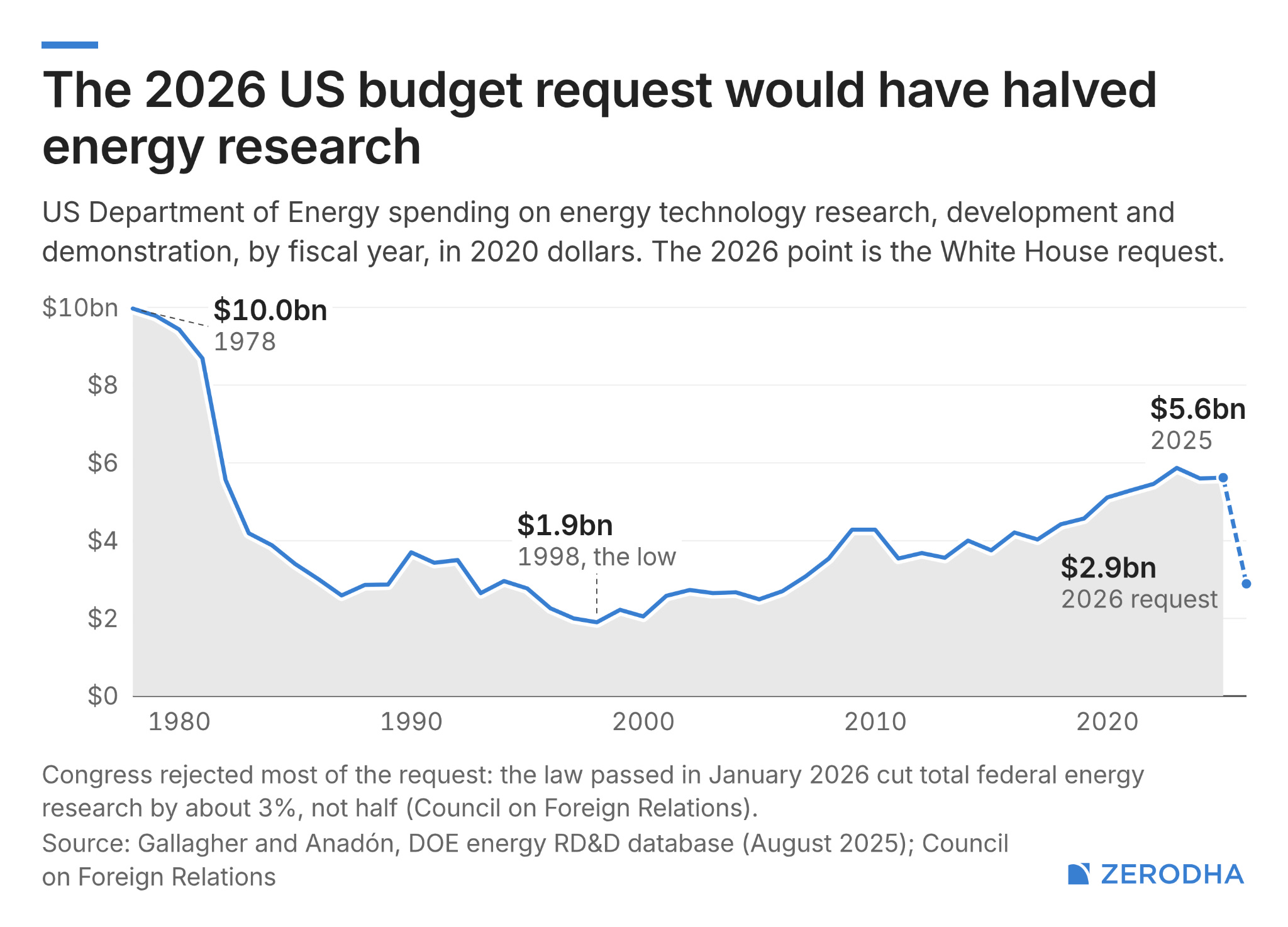
The White House asked Congress to roughly halve the Department of Energy’s research budget for 2026. Congress refused, and the final cut came to about 3%. But in 2025, the department had already cancelled over $11 billion of clean-energy projects and awards, in two rounds.
Europe has a different problem: it announces far more than it spends. By mid-2025, its €40 billion Innovation Fund had paid out just €332 million, according to the European Court of Auditors, less than 1% of the total. That gap between announcing and spending will come up again when we get to India.
Why energy companies barely do research
Governments aren’t the biggest funders anyway. Take the IEA’s latest figures for each source of money, and roughly two-thirds of all spending on energy research comes from companies. Governments put in about a fifth, and start-up investors about a tenth. Those start-up investors have other priorities, too. In 2024, AI start-ups raised nearly three times as much venture money as all energy start-ups put together.
The start-up money that does go to energy has moved to the frontier. The IEA’s Energy Technology Perspectives 2026 finds a recent surge into six areas: hydrogen electrolysers, geothermal, advanced heating and cooling, small nuclear reactors, hydrogen-based fuels and grid technology. Fusion alone has drawn almost $11 billion. A similar rush of venture money came two to three years before the solar and battery booms, but the IEA finds that none of today’s candidates has everything that made those two take off.
So companies carry most of the load. But energy companies, as a group, spend very little of what they earn on research.
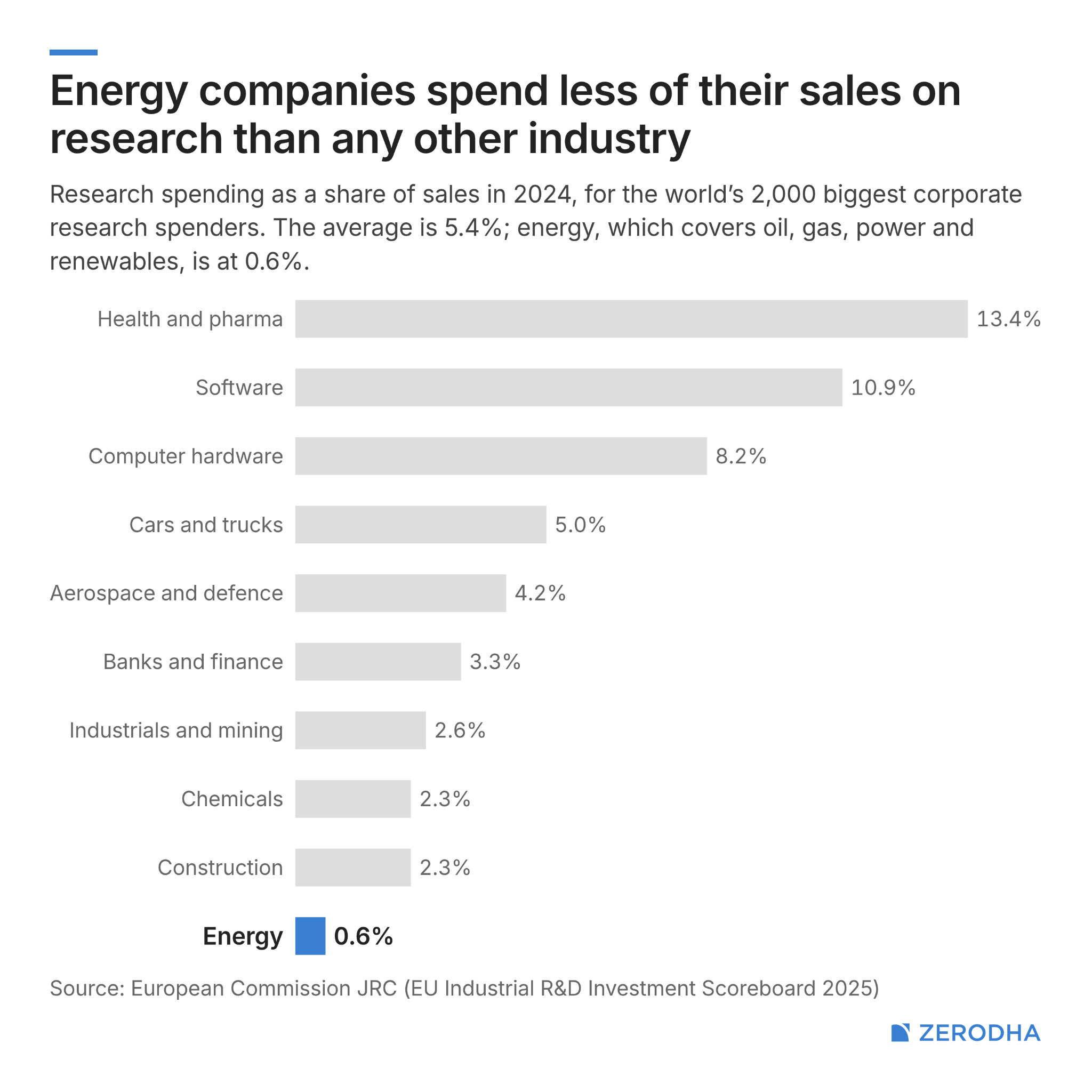
Among the world’s 2,000 biggest corporate research spenders, energy companies spend just 0.6% of their sales on research, the lowest of any industry. Health and pharma companies spend 13.4%. Even banks spend more. China’s own statistics show the same pattern at home.
Why? Think about what an oil company or a power utility actually sells. A barrel of oil or a unit of electricity is the same whoever produces it. So these companies compete on cost, not on new products. Many utilities earn returns that regulators set, which leaves little reward for invention. And any breakthrough in, say, grid storage helps every rival as much as the inventor. A drug company can patent a molecule and charge for it. A power company can’t charge more for a better electron. When fuel prices fell in 2025, oil and gas companies even cut their research spending by 4%.
Today’s research follows factories
So who invents energy technology today? Mostly the companies that make energy equipment, and most of those are Chinese.
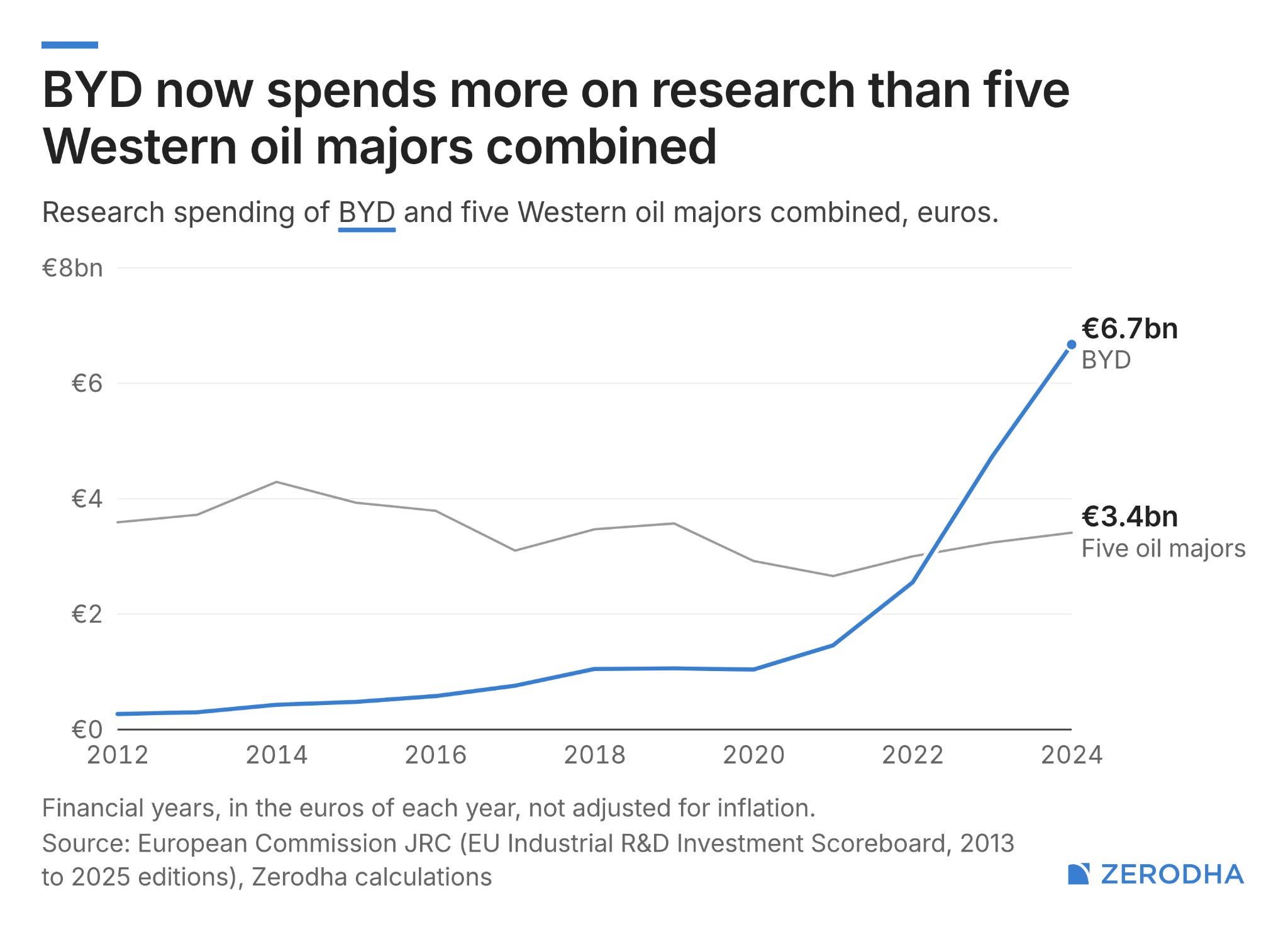
One comparison says it all. BYD, the Chinese EV and battery maker, now spends more on research than ExxonMobil, Shell, BP, Chevron and TotalEnergies combined. BYD’s research budget grew from €0.27 billion in 2012 to €6.7 billion in 2024, or 6.5% of its sales. The five oil majors spent about the same in 2024 as in 2012, around €3.5 billion between them.
As we wrote in our BYD story, China put EVs into its high-tech development plan in 2001 partly because it depended on imported oil. So the scare came first there, too. Then came years of subsidies and research grants, then factories, and only then companies that fund research at this scale. A company selling millions of batteries a year has every reason to make the next one better, and the revenue to pay for it.
That revenue matters more than it sounds. When Chinese overcapacity crushed solar prices, solar manufacturers cut their research spending by about 25% between 2022 and 2024. Even battery makers now spend 5% of revenue on research, down from 8% in 2015. Factories pay for research only while they make money.
India has the scares, but not the labs
India isn’t in the IEA’s research data, so we built the picture from Indian sources, starting with research of every kind.
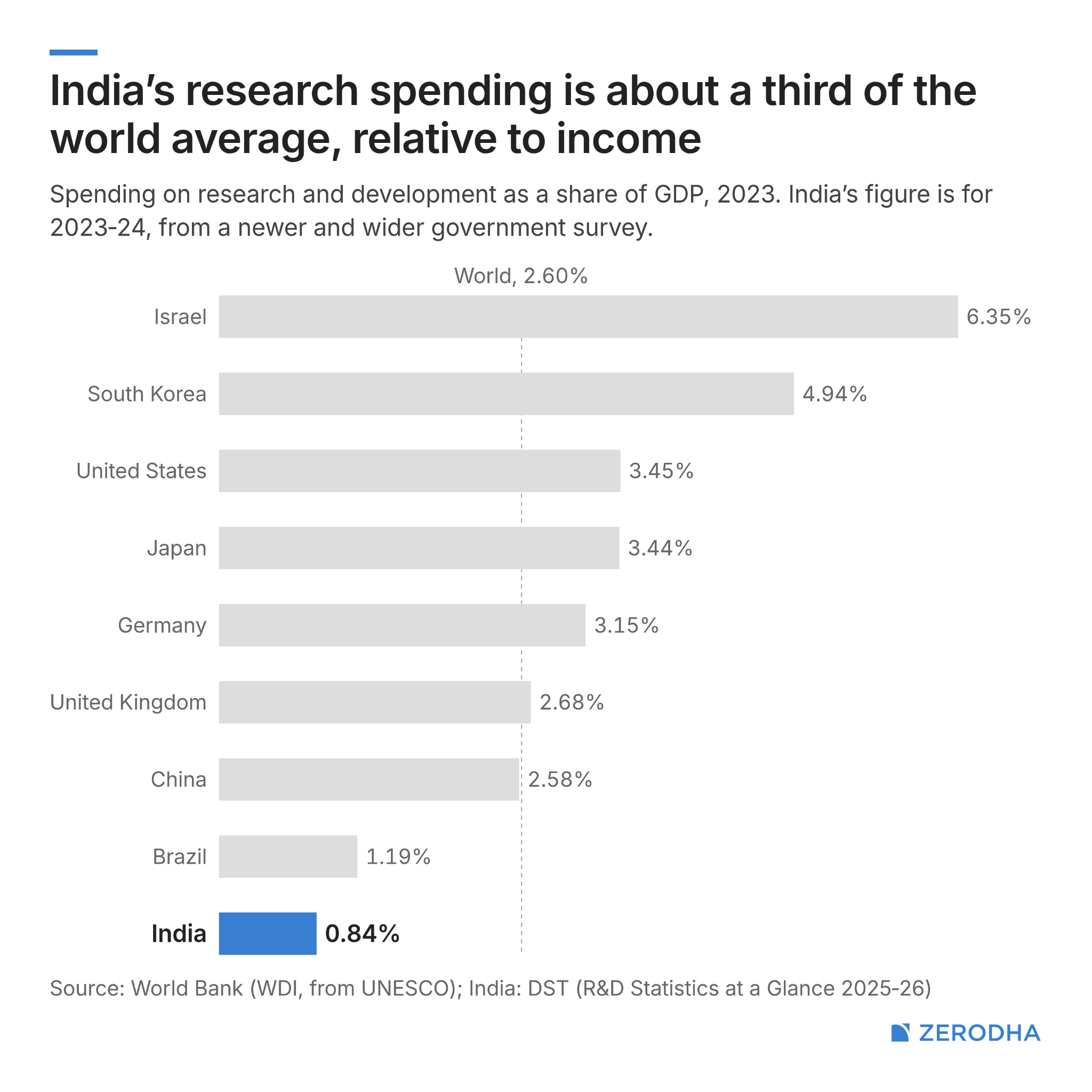
When we asked why India can’t build the next Apple or Tesla last year, India spent 0.64% of its GDP on research. The government’s newest survey now puts it at 0.84%. Part of that rise comes from counting more companies, and The India Forum points out that some of that “Indian” research actually happens abroad. Either way, India spends about a third of the world average.
For energy, there’s no official number at all. The best recent attempt, a study by the Sustainable Futures Collaborative and Tufts University, found about ₹1,450 crore of public money spread over 1,359 clean-energy research projects across six years. Two-thirds of those projects got less than ₹50 lakh each, enough for a single professor’s lab. A typical American grant for similar work runs 20 to nearly 100 times bigger.
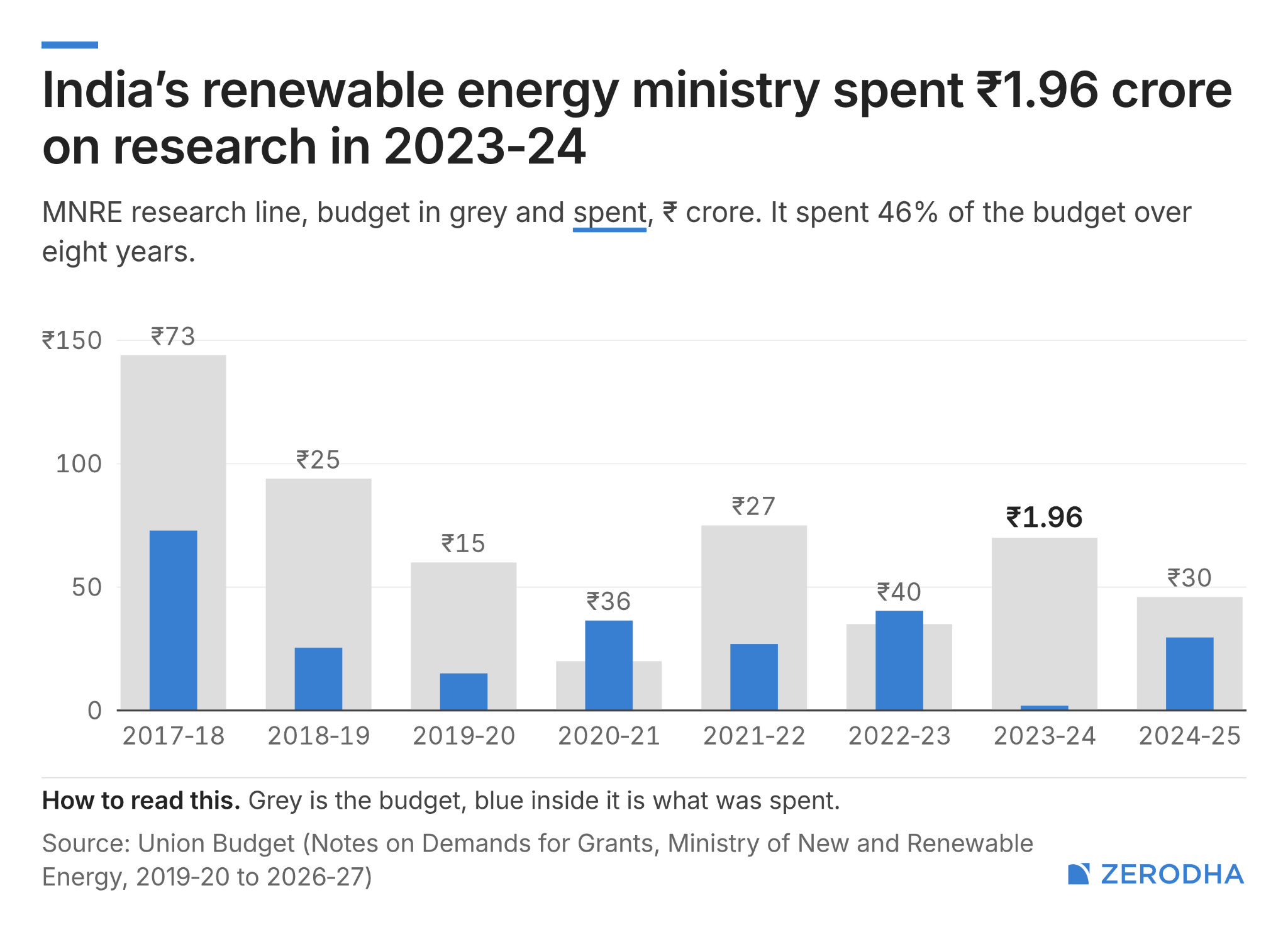
The renewable energy ministry shows the problem most clearly. Over the last eight years, it spent less than half of what it budgeted for research. Its research budget for this year is ₹46 crore. Its rooftop solar subsidy, by comparison, gets ₹22,000 crore.
The same gap between announcing and spending shows up elsewhere. The government’s flagship ₹1 lakh crore research fund got ₹20,000 crore for 2025-26, but the revised estimate cut that to ₹3,000 crore.
If the government is lacking, Indian companies don’t fill the gap either, though nobody collects consistent data across them. Where government data exists, state-owned defence firms like HAL spend far more of their sales on research than state-owned oil and power companies do.
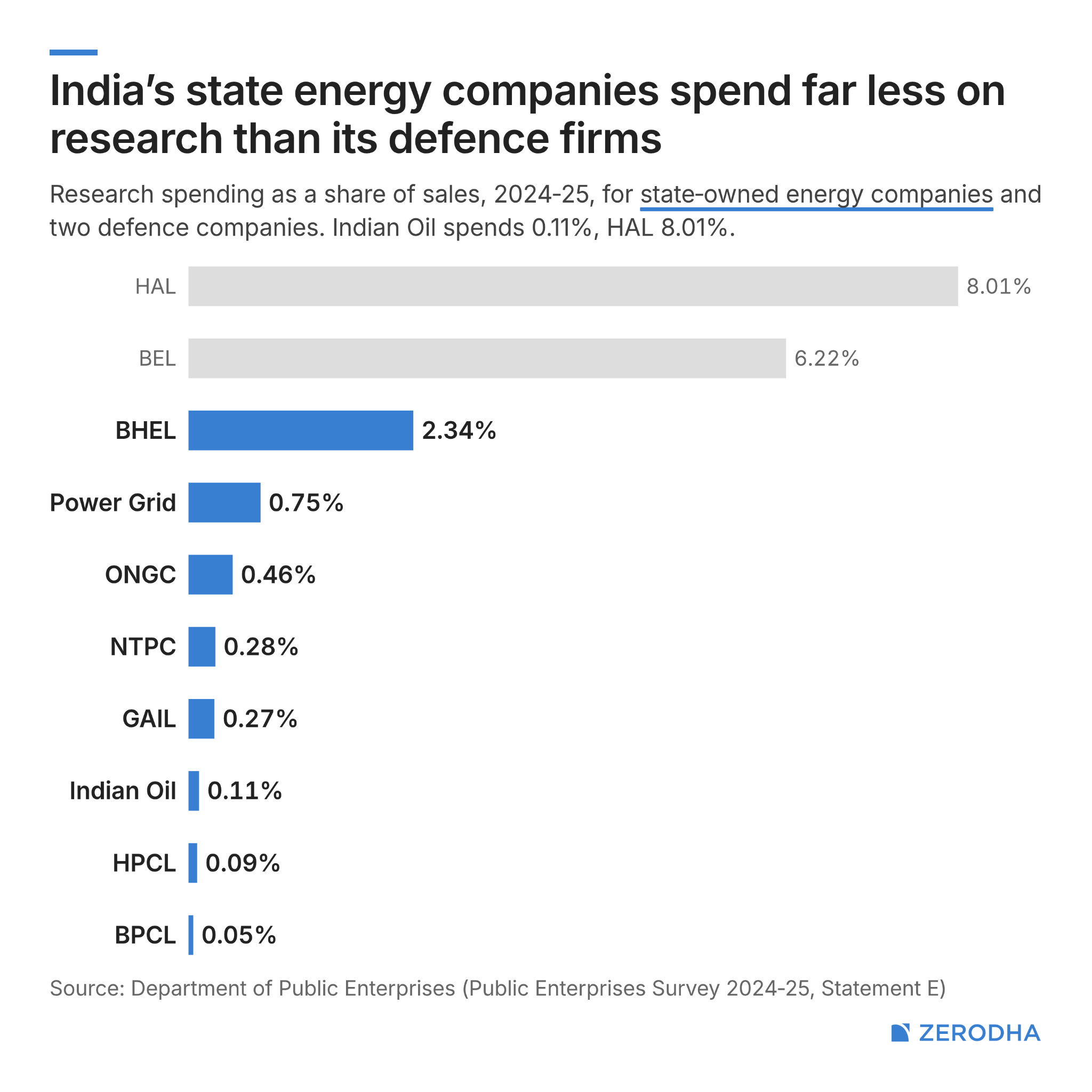
That isn’t a fair comparison, since defence firms build their own products. But it does show how little research happens at India’s energy companies, most of which still sell oil, gas and power, not technology.
What to watch
The 1970s showed that a big enough scare can double energy research budgets in a few years. The last decade showed something different: the research that lasts comes from companies that build and sell energy hardware, and China built most of those companies. India now wants to make its own solar cells and batteries. As we covered last month, China restricted exports of some battery technology in 2025, so Indian companies can no longer simply buy the know-how. They will have to develop it.
That makes three things worth tracking. First, whether this year’s Hormuz scare lifts research budgets the way 1973 did; the IEA’s next data release will show the first signs. Second, whether India’s government actually spends what it budgets for research this year, starting with the ₹20,000 crore fund. And third, whether India’s new battery and solar factories, like Tata’s cell plant due in 2027, start spending on research the way CATL and BYD do. If they do, India’s energy labs could finally grow out of its factories.

Ola finally lets the middleman in
In May, an analyst asked Bhavish Aggarwal, founder of Ola Electric, whether the company would finally bring in dealers. Its stores, the analyst said, had been very good when they opened, then got worse.
Bhavish, at the time, was adamant on having no such plans.
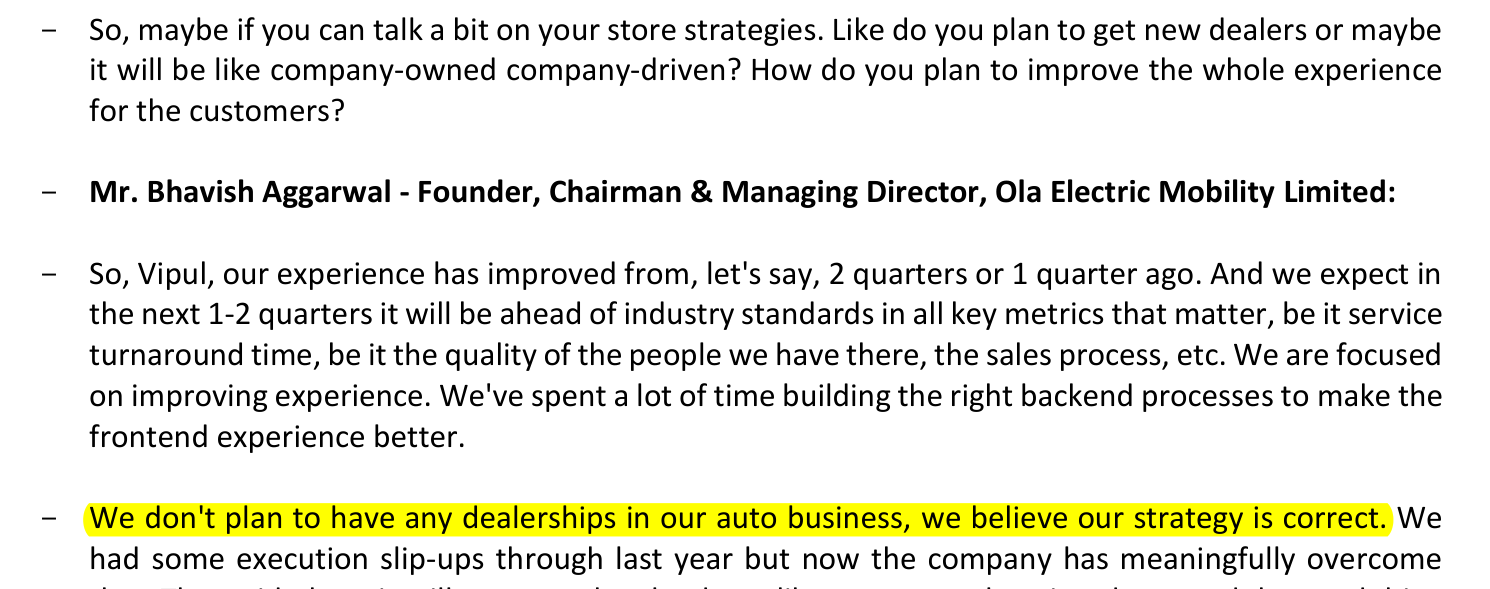
But three months later, on 6 August, Ola finally announced it was moving to dealers. What’s more, its own stores have already stopped taking new orders. Service is moving to dealers too. By 8 November, 255 dealers were already running 319 stores for Ola, and it plans about 450 dealer stores by December while shutting down most of its own by then.
Why the seemingly sudden change of heart? What did Ola want to do without dealers, and can they now fix what broke?
Selling scooters like phones
Most two-wheelers in India are sold through dealers, who tend to be local businesspeople putting up their own money.
But with EVs, Ola wanted to cut out the dealer. An electric scooter is, in a sense, a gadget on wheels, so Ola sold it like a phone. You booked online, test-rode at a company store, and got new features over the air.
For a while, it worked.
By its own count, nearly one in every two electric two-wheelers registered in India in April to June 2024 was an Ola. By December that year, Ola announced it would take its company-owned network from about 800 stores to 4,000 within that same month, each with a service centre. By any metric, this was a bold claim.
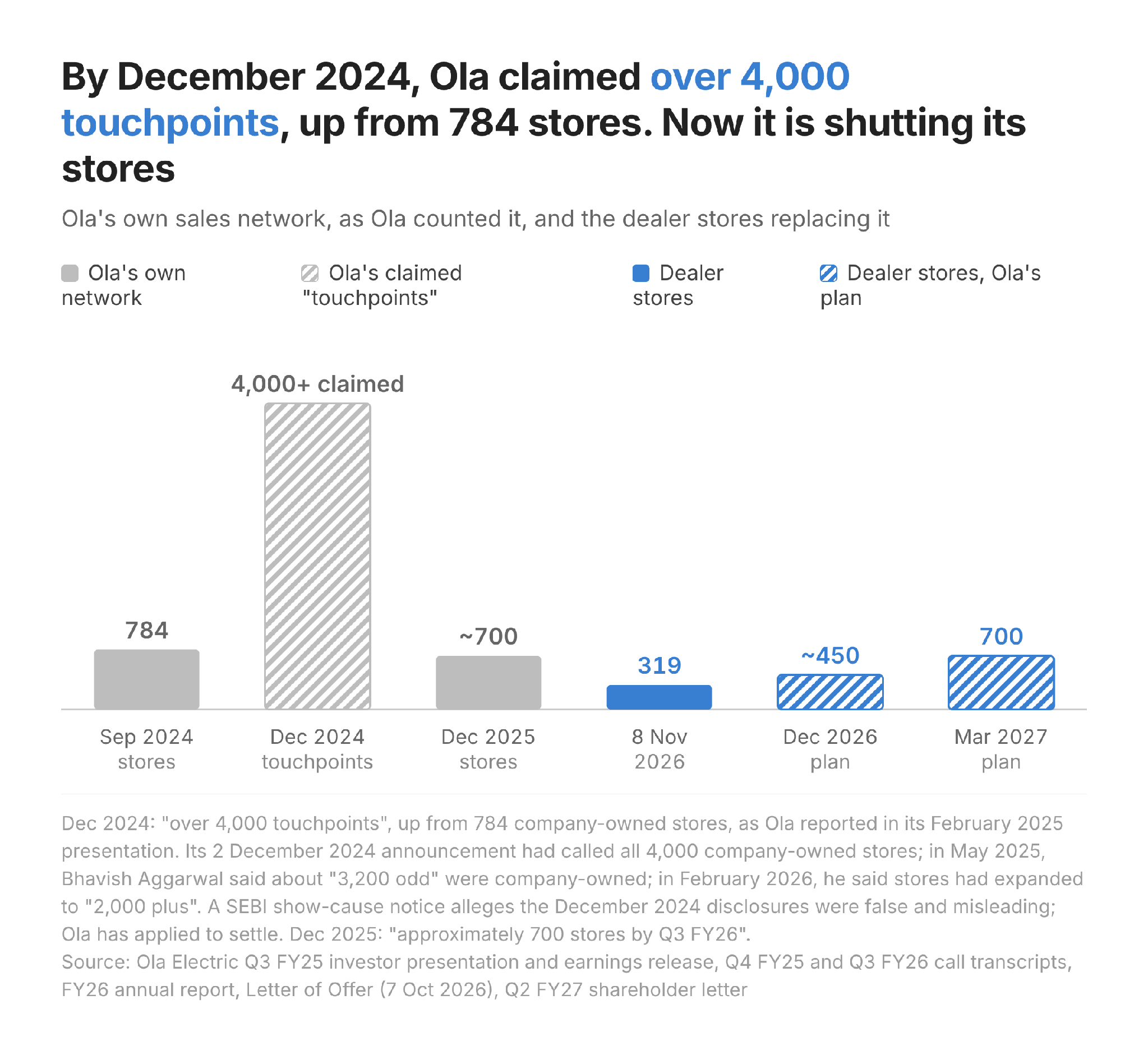
Perhaps too bold, as Ola would painfully realise that running service centres was no easy ballgame.
Every store needed staff and spare parts, and all of that was now Ola’s problem. In FY25, staff attrition at Ola hit 54%, primarily driven at these stores. What’s more, in October 2025, a repair took about 9 days on average — far too high compared to a dealer workshop or standalone service centre. By then, it had already begun receiving lots of customer complaints on their products and their servicing.
There were questions raised around the store expansion itself as well. In April 2026, SEBI sent Ola and Bhavish a show-cause notice that alleged that the December 2024 announcement was “false and misleading“ about how many stores had service centres, and that it lifted Ola’s share price 8.45% that day. Ola has applied to settle without admitting liability, and SEBI hasn’t decided yet.

Ola says it got repairs down to about a day by March 2026. But by then, many customers had moved on. January to March 2026 was its weakest quarter in at least two years, at 20,256 vehicles, 84% below its peak. It had also begun strongly cutting its own store network.
The value of a middleman
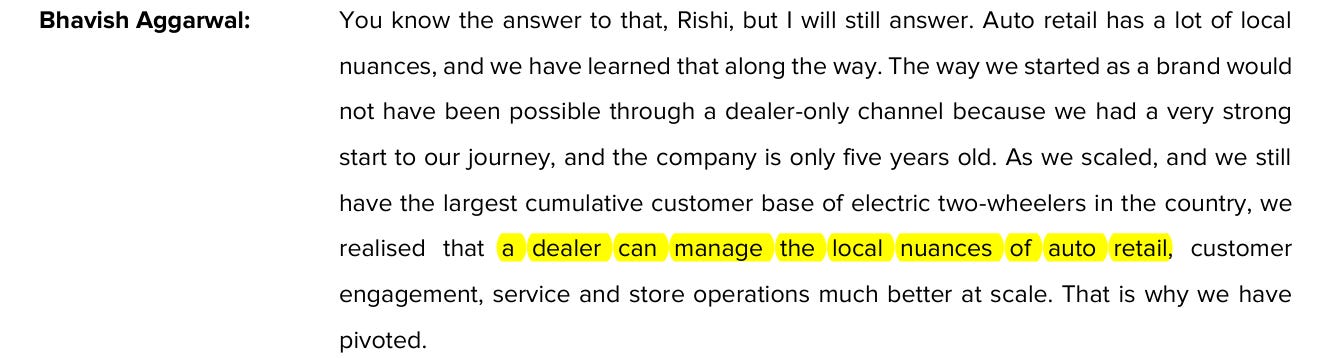
In August, Ola admitted that a dealer can handle auto retail’s local nuances, service and stores much better at scale.
A dealer does three things that are hard to do from a head office.
The first is putting up money. When Ola ran its own stores, every scooter on the showroom floor was Ola’s money until someone bought it. Now, dealers pay when they order and hold the stock in their stores. That requires efficient working capital management, which is hard to do when you’re both a manufacturer and a dealer. It’s why car companies also sell largely through dealerships.
The second is that a dealer makes tax refunds for Ola much easier. How so, you might ask?
See, an electric scooter attracts less GST than some of the parts inside it. Say a scooter carries ₹5,000 of GST when it’s sold, but its parts carry ₹8,000. The maker can then claim a refund of ₹3,000. But you had to prove you sold the scooter to make the claim.
By bearing the burden of unsold inventory, Ola found it difficult to do this at scale across states. But now, the sale is first recorded when the dealer buys, so Ola would find it easier to reclaim the refunds.
The third is the workshop, which Ola’s customers felt most. A dealer who owns the business has their money in it, and loses repair income and customers when scooters sit waiting. When Bhavish pitched Ola to dealers in August, he pointed to Ola’s very large customer base, many of whom were now past their three-year warranty. That is paid service work for a dealer.
Some of Ola’s rivals didn’t make the same mistake. The comparison most helpful here is Ather, which, like Ola, makes only electric two-wheelers. In FY26, it doubled its network to 700 experience centres. About three-quarters of the new ones came from dealers who already ran an Ather store.
The difference shows up in registrations, which are counted the same way for both companies. In October 2024, Ola registered about 2.6 vehicles for every Ather. But two years later, it has completely flipped. Between July and September 2026, mostly before its switch to dealerships began, Ola registered about 41,400 to Ather’s 89,600.
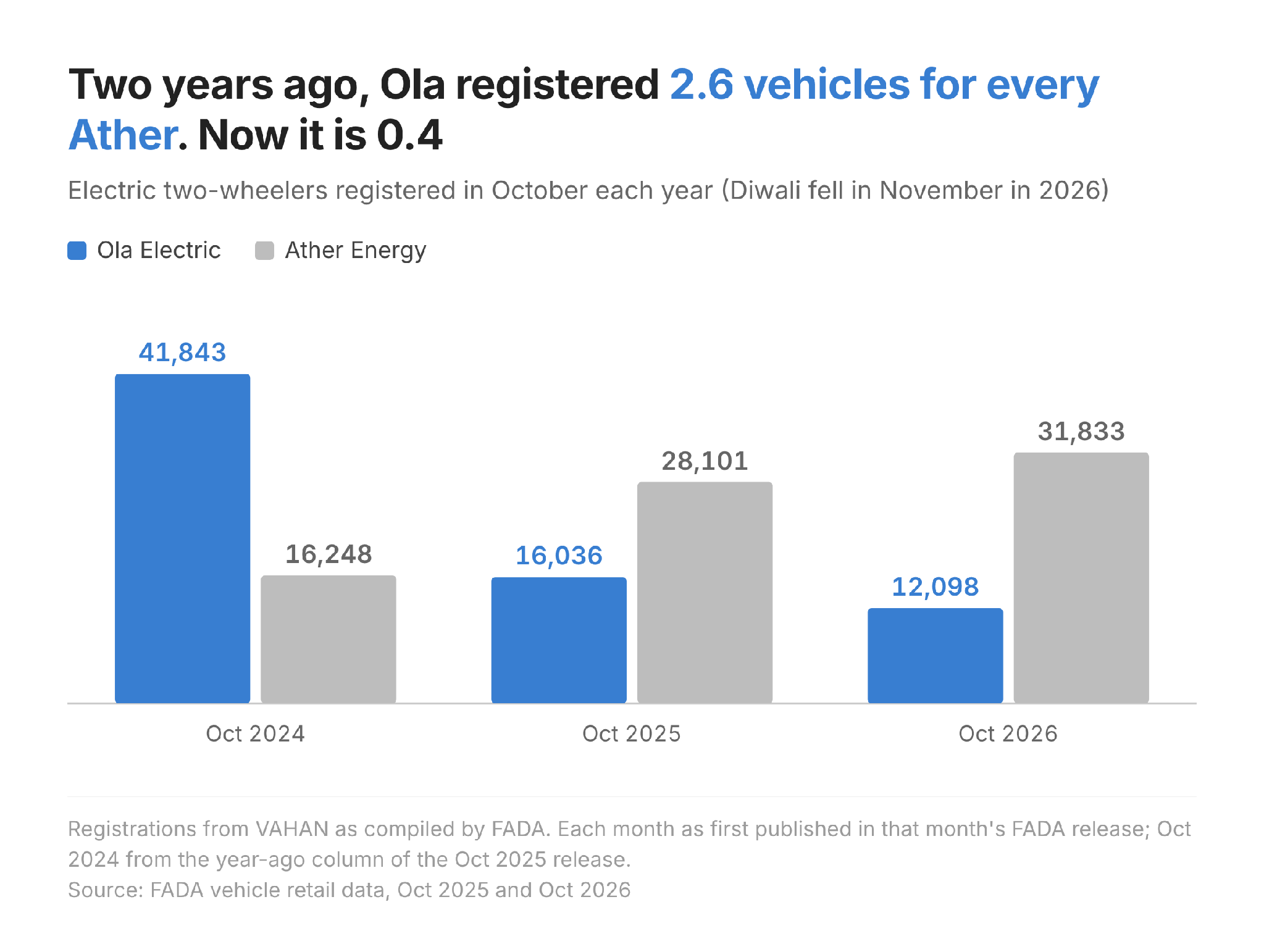
To be fair, much of this metric is down to the product quality itself, and Ola’s scooters had plenty of quality problems. But a dealer who owns the store has a reason to keep repairs quick, and Ola had none of them while Ather did.
Does the switch fix Ola’s money?
The switch to dealers pulls Ola’s numbers in two directions. Ola says that closing its stores should cut costs by about ₹50 crore. But every dealer takes a cut of every sale, and that comes out of Ola’s margin. In Ola’s latest Q2 earnings call, an analyst put the dealer cut at ~₹11,000 per vehicle. Management wouldn’t confirm the number but it called the terms an “introductory commission“ that should come down.
Let’s do a rough sum. Ola delivered close to 35,000 vehicles in the July-September quarter. At ₹11,000 each, dealers would get about ₹38.5 crore a quarter. Ola doesn’t say if the ₹50 crore saving is per quarter or per year. If it’s per quarter, Ola comes out about ₹11.5 crore ahead. If it’s per year, Ola is worse off until that commission falls or sales rise.
Either way, it’s small next to Ola’s total losses. In July to September, Ola lost ₹362 crore. In the same quarter, Ather made a small profit of ₹1.26 crore. Between March and September, Ola’s cash and bank balances also fell from ₹1,542 crore to ₹750 crore. In October, Ola raised money from its shareholders through a ₹1,000 crore rights issue, of which ₹600 crore has come in.
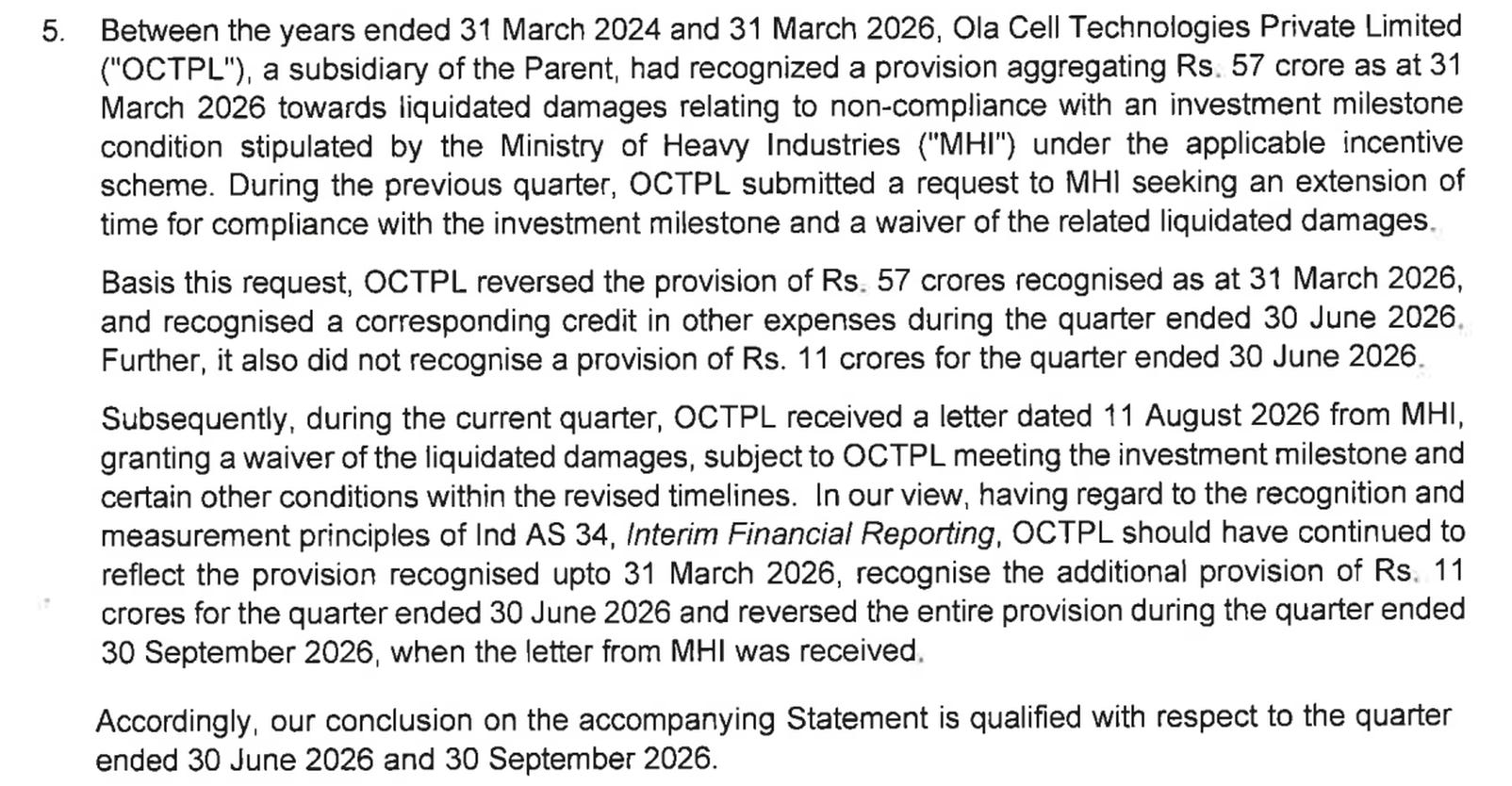
Ola’s auditor, BSR, pointed readers to its going-concern note, where management explains why it believes the company can keep paying its debts. BSR disagreed over when Ola should book a potential penalty of ~₹68 crore, which might arise because it couldn’t meet an investment deadline as per the PLI scheme. BSR thinks the penalty belonged in the April–June quarter instead. Ola’s total loss doesn’t change; only when it shows up does.
Conclusion
The first signs of Ola’s dealer switch seem to be optimistic. Dealers ordered ~13,500 vehicles from Ola in October, up from ~4,000 in September. Production rose from ~9,200 in August to ~14,100 in October. Ola has made 5,526 in the first 11 days of November already. However, at that pace, Ola will probably make ~15,000 for the month, against the 20,000 its own letter forecast.
Business is all about how quickly you can pivot from longstanding assumptions which are proven wrong. Ola has finally pulled the clutch on one such belief, but one wonders if it’s too late. Dealers are signing up and the market is growing fast, but Ola has also slipped down the ranks compared to its peers. Its hill remains much steeper to climb.
- This edition of the newsletter was written by Kashish & Krishna.
Tidbits
1. Fairfax exits IIFL Finance to fund IDBI Bank deal
Fairfax is selling its entire 13.25% stake in IIFL Finance for about ₹3,454 crore. The sale will help fund its much larger ₹52,878 crore acquisition of a 60.72% stake in IDBI Bank. Meanwhile, Blackstone is investing ₹5,000 crore in IIFL Finance for a nearly 16% stake.
Source: Business Standard
2. Xiaomi’s royalty payments land it in a $150 million tax dispute
India says Xiaomi and its former contract manufacturer Flex did not fully disclose royalty agreements while importing phone components. Xiaomi argues these royalties, paid separately to technology partners, shouldn’t attract customs duties. The dispute could cost Xiaomi India over $150 million, and the outcome could also affect similar contract-manufacturing arrangements in other industries.
Source: Business Standard
3. Amazon plans another $7 billion renewable energy push in India
Amazon plans to invest another $7 billion in renewable energy projects in India by 2030, on top of $4 billion already contracted. It has also announced four new wind and solar projects totalling 934 MW. Once these are operational, Amazon’s renewable energy portfolio in India will cross 2 GW.
Source: Amazon
4. An internal update briefly knocks out Apple’s systems
An internal software update caused widespread outages at Apple, disrupting employee systems, stores, the App Store and services like iCloud. Some stores faced problems with sales, repairs and customer service, while employees were locked out of key tools for hours. Apple said many systems have been restored and clarified that the outage wasn’t caused by a cyberattack.
Source: Business Standard
5. India is buying more LPG from the US
Indian Oil, BPCL and HPCL will import about 2.75 million tonnes of US LPG in 2027 through contracts with Aramco, Chevron, TotalEnergies and Vitol. India traditionally depends heavily on the Middle East, which supplied about 90% of its LPG imports in 2025. It now plans to source up to a quarter of its LPG imports from the US in 2027.
Source: Reuters
Want more tidbits? Catch up on last week’s recap!

Beyond Today’s Brief
There’s always more happening at Markets by Zerodha.
The Chatter: Why does SEBI see India’s securities investor base nearly tripling to 380 million over the next five years while piloting corporate bond tokenisation under ‘Demat 2.0’? And how are Eicher Motors, Ashok Leyland, Cummins, RVNL, Vodafone Idea, Patanjali Foods, and Oil India navigating supply constraints, data centre demand, Vande Bharat timelines, 4G tower rollouts, and offshore oil discoveries?
Aftermarket Report: How did Nifty slip below 25,250 to close at 25,228 as profit booking and shaky global cues weighed on sentiment despite 13 straight sessions of foreign institutional buying? And what do 11 declining sectors led by Consumer Durables’ 3.1% drop, deteriorating market breadth with nearly three losers for every gainer, and the Fear & Greed Index ticking up to 72 signal for the near term?
Zero1 by Zerodha: Ready to build a customised early-retirement plan from scratch? In the opening episode, we cover conducting a money audit, why fixed deposits barely beat inflation post-tax, how different asset classes work, and four essential safety nets emergency funds, clearing high-interest debt, insurance, and account setup before investing your first rupee.
Join us on WhatsApp, where we share interesting soundbites from concalls, articles, and everything else we come across throughout the day. You’ll also get notified the moment a new video or article drops so that you can read or watch it right away.
Thank you for reading. Do share this with your friends and make them as smart as you are 😉