

Hi everyone, I’m Mridula, and welcome to the thirteenth edition of Weekly Tidbits.
We spend a lot of time reading interesting stories that never make it into a full Daily Brief piece. So, once a week, we pick some of the best ones and add a little context.
We sort them into GEIC: Global, Economy, Industry and Company.
Let’s get started!
If you prefer watching the video instead, here’s the link:
G — Global
[1] HSBC may give Singapore a bigger role
HSBC is exploring ways to grow its Singapore business and depend less on Hong Kong and China. Under a plan called Project Sirena, it may give its Singapore unit more control over its own operations.
Hong Kong is HSBC’s single biggest market. It brought in about 40% of the bank’s profit before tax in the first half of 2026. Relying that heavily on one city is a risk. If rules change or tensions with China rise, a large share of the bank’s earnings could be hit at once. Singapore offers a second base for banking and wealth management in Asia, in a city with close ties to both China and the West.
HSBC has confirmed it will combine its main Singapore units, and reports suggest it may move more of its Asian business there over time. The bank says it has no plans to change its Hong Kong-led structure for now. A stronger Singapore arm would spread HSBC’s risk, though it also has to avoid upsetting officials in Hong Kong and Beijing, where most of its profits still come from.
[2] A Venezuela oil deal raises questions about political ties
A Reuters investigation has raised questions about how oil trader Vitol won a prized deal to sell Venezuelan oil. The report focuses on the ties between a Vitol trader, John Addison, and US Vice President JD Vance.
According to Reuters, the two met in Montana in late December 2025. They discussed Venezuela and how quickly its oil could reach buyers if the US took control of the country’s supplies. Days later, the US captured Venezuela’s leader, and Vitol went on to win a deal to trade some of its oil.
Commodity traders like Vitol buy crude from producers and sell it on to refineries, earning a margin on each barrel. Access to a large new source of supply can be worth a great deal, so traders compete hard for these contracts. Reuters’ findings raise the question of whether a political connection gave Vitol an edge. The reported meeting alone doesn’t prove that officials gave the firm special treatment.
[3] The UK is investigating a budget leak
The UK Treasury has launched an inquiry into whether details of its budget leaked before the finance minister announced them.
One concern is a change to the tax on banks. News of it came out before the official budget speech and may have moved bank share prices. A tax change affects how much profit a bank keeps, so its share price reacts as soon as investors hear about it. Anyone who learned of the plan early could have traded ahead of everyone else.
The Treasury says it didn’t brief banks or industry groups on the change in advance. As a budget nears, though, more officials and advisers need to see the plans, which makes leaks harder to prevent. The inquiry will try to establish what got out, and whether market-moving details reached investors before the public.
[4] Nvidia’s CEO is stepping down
Jensen Huang is stepping down as CEO of Nvidia, the chipmaker he co-founded 33 years ago and turned into the centre of the AI boom.
His exit follows a scandal that grew quickly over two weeks. News reports alleged that Huang had an affair with a client whom US intelligence officials believe had been recruited by China’s top spy agency. The shares fell sharply after a second report said he had also had an affair with an Nvidia executive who reported to him. China has called the spying allegations baseless. Nvidia CEO Jensen Huang steps down amid alleged spy scandal +2
Investors take this seriously because Huang was more than a manager. He made the early bet that turned Nvidia’s graphics chips into the go-to hardware for AI, taking the company from about $400 billion in value in late 2022 to over $4 trillion today. Much of that valuation rests on confidence in his judgement, and analysts say he never laid out a clear succession plan.
CFO Colette Kress will be interim CEO while Nvidia searches for a permanent replacement, and former Synopsys CEO Harvey Jones becomes its first-ever board chair. The company still plans to report quarterly earnings on Tuesday.
E — Economy
[5] More young people in Indian cities are out of work
India’s urban youth unemployment rate rose to 18.9% in July–September, up from 18.2% in the previous quarter and the highest in six quarters. The figure covers people aged 15 to 29 living in cities.
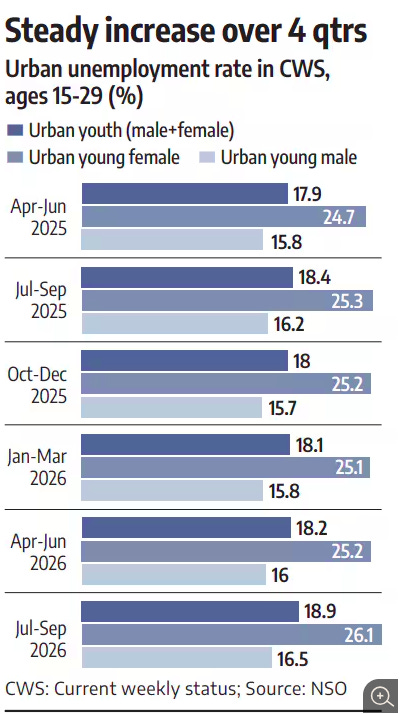
The unemployment rate counts only people who want work and are actively looking for it. A rate of 18.9% means that nearly 19 out of every 100 young city-dwellers in the job market couldn’t find work. Students and others not seeking jobs aren’t counted.
The wider job market looks healthier. India’s overall unemployment rate fell to 5.1%, and rural youth unemployment also dropped. That leaves a widening gap between young people in villages and those in cities, where more graduates compete for formal jobs. We wrote earlier about why India’s job market is broken, and this is one of its clearest symptoms. A slow start for young workers can hold back their earnings for years, even when the broader economy is adding jobs.
[6] Indian Railways plans more tracks on busy routes
Indian Railways plans to add tracks along seven major routes, which could let it run over 1,000 more regular trains once the work is done.
Many of India’s busiest routes carry passenger and freight trains on the same lines. When tracks are crowded, one delayed train holds up the ones behind it. Goods trains carrying coal, food and other cargo also need time slots on those lines. Once a route is full, the railways can’t add trains to meet demand, however long the waiting lists get.
The plan would give these routes four tracks, so more trains can run side by side. It covers key links between cities including Delhi, Mumbai, Kolkata and Chennai. More capacity could mean shorter waiting lists, fewer delays and faster freight. The work will take years, though, along with land and a lot of money, and the extra trains can run only once the new tracks are ready.
[7] India’s inflation crosses the RBI’s upper limit
India’s retail inflation rose to 6.09% in October, crossing the top of the Reserve Bank of India’s comfort range.
That is up from 5.54% in September and the highest reading since October 2024, when inflation was 6.21%. Food prices drove most of the jump, especially onions and garlic. Part of the rise is also arithmetic. Inflation compares prices with the same month a year earlier, and October 2025 had the lowest reading in the current CPI series, at 0.25%. A very low starting point makes this year’s rise look bigger. India Retail Inflation Hits 6.09 Percent in October Amid Food Spikes +2
The RBI aims to keep inflation near 4% and treats 6% as the outer limit. Breaching it puts pressure on the central bank to keep interest rates high, or even raise them, since higher rates cool spending and slow price rises. That would make loans more expensive for households and businesses.
The RBI’s monetary policy committee meets in December, and this will be the only fresh inflation data it has before deciding on rates.
I — Industry
[8] India bans exports of some battery waste
India has banned exports of lithium-ion battery black mass from November 10. Black mass is the dark powder left after old batteries are shredded, and it still contains valuable metals such as lithium, cobalt and nickel.
Those metals go into new batteries for electric vehicles, phones and power storage, and India imports most of what it uses. When Indian firms ship black mass abroad, recyclers in other countries extract the metals and sell them back. The ban aims to keep that material in India, so domestic recycling plants have more to work with. It covers the specified waste and scrap category, including unsorted battery material. The government has also set aside ₹1,500 crore to help build recycling capacity.
Keeping black mass at home could cut imports and create new work for Indian plants. Extracting metals cheaply takes advanced technology and scale, though. If local recyclers can’t match the prices foreign buyers paid, firms holding black mass may end up with fewer good options.
[9] India may put a duty on cheap medical gloves
India’s trade remedies authority has recommended an anti-dumping duty on medical examination gloves from Malaysia and Thailand. The recommendation follows an investigation into whether exporters there sold gloves in India at unfairly low prices.
Hospitals use these gloves every day to prevent the spread of infection. India makes them too, but local manufacturers say cheap imports have hurt them. When foreign sellers price far below what it costs to make the gloves, Indian makers either lose orders or cut prices to keep up.
An anti-dumping duty adds a charge on such imports, which gives domestic manufacturers room to compete. Hospitals and clinics, however, would end up paying more for something they use in huge quantities. The Finance Ministry still has to decide whether to impose the duty, so it isn’t in force yet.
[10] India’s Scotch whisky dispute gets worse
Indian customs officials are holding over 80 containers of Scotch whisky brought in by Pernod Ricard and Diageo. The firms want to pay a 75% import duty under the India–UK trade deal. But customs wants them to pay 150%.
We covered this dispute earlier. Most Scotch comes to India in large containers, not bottles. Firms use it to make whisky brands like Royal Stag and McDowell’s. Customs says the lower tax rate only applies to finished Scotch, not the bulk whisky that firms bring in to make these brands.
The Commerce Ministry told the firms on November 2 that it would help settle the issue. But two days later, the tax department told customs officials to keep charging 150%. Both sides of the government now seem to be taking different stands. With shipments stuck at ports, firms could soon face supply problems. A trade deal meant to make Scotch imports cheaper has instead left whisky makers unsure of what they must pay.
C — Company
[11] Reliance, ONGC and BP may share a $1 billion dollars gas facility
Reliance Industries, ONGC and BP are in early talks to build a shared gas facility in the Mahanadi basin, off India’s east coast. The facility could cost about $1 billion, roughly ₹9,500 crore at ₹95 to the dollar. The Oil Ministry has proposed the idea, but the companies haven’t agreed to it yet.
Finding gas under the sea is only half the job. To bring it ashore, a company has to build undersea pipelines and processing plants, and that gets far more expensive when the gas sits in deep water. For a small field, those costs can wipe out the profit, so the gas is often left in the ground.
A shared facility changes that maths. Instead of each company building its own system, all three would use one and split the cost. Other firms could later pay to plug their own fields into it. That could make smaller discoveries worth developing, which matters for a country that imports nearly half its gas. Before any of that happens, the three companies have to agree on who builds the facility, who pays for what, and who runs it.
[12] MakeMyTrip buys a majority stake in Quick Ride
MakeMyTrip has bought a majority stake in Quick Ride’s carpooling business. The deal was announced on November 6, and MakeMyTrip hasn’t disclosed the price. The purchase covers only the ride-pooling app. Quick Ride’s older electric-taxi business stays with a separate company.
Quick Ride matches people travelling along the same route. Two people heading to the same office park, for instance, can share one car instead of taking separate rides. Riders save money, and drivers recover some of their fuel costs.
MakeMyTrip already sells flights, hotels, buses and cabs, but most of those are occasional bookings for holidays or long trips. Quick Ride takes it into the daily commute, a habit people repeat twice a day, five days a week. It also brings Quick Ride’s relationships with offices and business parks. Quick Ride’s founders will continue to run the business. For MakeMyTrip, the deal is a way to show up in customers’ lives far more often than a few times a year.
[13] Waaree plans a ₹15,000 crore green ammonia plant
Waaree Energies is planning to invest ₹15,000 crore in a green ammonia plant in Andhra Pradesh, with capacity to produce 12 lakh tonnes a year. It has already bought 300 acres near Kakinada Port.
Ammonia is mainly used to make fertilisers. Most of it is made from natural gas, a process that releases a lot of carbon dioxide. Green ammonia uses renewable electricity instead to produce hydrogen from water, which is then combined with nitrogen from the air. The result is the same chemical without the emissions, but it currently costs more to make.
Being next to a port lets Waaree target export buyers, especially in countries pushing industries to cut emissions. The Andhra Pradesh government has also approved support for the project. Waaree still has to finalise the deal, build the plant and, hardest of all, find buyers willing to pay more for green ammonia than for the regular kind.
That’s it for this week.
A few of these stories are still developing, so we’ll be keeping an eye on them. But if there’s one you’d like us to write about properly, let us know in the comments.
See you next edition :)