


Our goal with The Daily Brief is to simplify the biggest stories in the Indian markets and help you understand what they mean. We won’t just tell you what happened; we’ll tell you why and how too. We do this show in both formats: video and audio. This piece curates the stories that we talk about.
You can listen to the podcast on Spotify, Apple Podcasts, or wherever you get your podcasts and watch the videos on YouTube. You can also watch The Daily Brief in Hindi.
In today’s edition of The Daily Brief:
1. The Chinese whispers in India’s EV batteries
Despite PLI scheme incentives, Indian conglomerates like JSW, Reliance, and Tata are struggling to scale battery-cell factories due to tight Chinese control over advanced LFP technology and export restrictions on manufacturing know-how. With visa limits on Chinese engineers delaying equipment setup, Indian firms are forced to pivot toward in-house R&D, acquiring overseas IP, or relying on imported cells.
2. Why India’s airlines want cheaper fuel
A 13% surge in Aviation Turbine Fuel (ATF) prices has forced Indian airlines to hike passenger surcharges as fuel expenses consume profit margins. Because domestic ATF prices track international import benchmarks and face compounded central and state taxes, carriers are pushing for cost-plus pricing, fixed tax levies, and a revised price stabilisation fund to curb widening operational losses.
The Chinese whispers in India’s EV batteries
This year, India’s largest conglomerates tried to make a lot of noise regarding EV batteries. But somehow, each of their noises showed the same pattern.
For instance, in early 2024, JSW announced plans for a 50 GWh cell giga-factory, using technology from a Chinese partner. But this year, JSW halted those plans because it hinted that acquiring such a license was too much trouble.
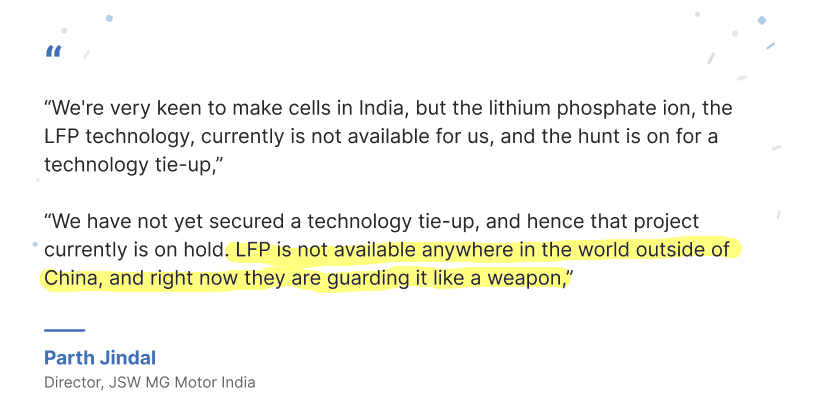
Tata’s battery arm, Agratas also tried to license Chinese technology. But they realized they couldn’t make it work, and then decided to develop its own.
Meanwhile, a somewhat-unexpected entrant in Reliance also announced that it was building a large cell factory in Jamnagar, Gujarat. But, as per Bloomberg, it turns out that they, too, had also hit a block with a potential licensing deal with a Chinese partner.
It’s no secret that India has been trying hard to move up the value chain in EV batteries. A year ago, we covered Ashok Leyland’s ₹5,000 crore deal with China’s CALB, one of the world’s largest battery-cell makers. The long-term goal was to eventually build the cells within the batteries themselves. Similarly, Amara Raja had struck a similar deal with another Chinese company, Gotion, and Exide with SVOLT.
However, tech transfer deals have always been tricky to execute, more so if the foreign company giving us the technology is based within the jurisdiction of a geopolitical rival. How we’re trying to navigate this complexity is the story we’ll be telling you today.
The little things you do
First, let’s explore what it means to even make an EV battery.
An electric car battery is a pack made up of hundreds or even thousands of cells, along with cooling systems, electronics and software to manage them. Making these packs isn’t easy, but Indian companies already know how to do it. Tata, Mahindra and Ather, for instance, make battery packs in India using cells bought from elsewhere. Ola is an exception, which we’ll come to later.
Even harder than the pack is making the cells that go inside it. Building a cell factory isn’t the hardest part, either. The real challenge is learning how to make millions of cells that perform the same way, last long and remain cheap.
That requires a lot of trial-and-error, constant iterations on the factory floor, and lots of practice. For every batch of cells you make, some will go to waste, and the purpose of those iterations is to reduce that. Chinese and Japanese companies have spent years — even decades — getting better at this, while we’re only beginning.
So, merely buying the license to the technology isn’t enough. Learning the actual know-how takes a lot more practical effort beyond the manual that explains how to make cells. This is called tacit knowledge, and we shall illustrate later with an example how critical it is.
Even if Indian companies learn to make cells, there is another problem. They still need the materials that go inside them, and India imports most of those, too. India’s rare earth dependence on China is well-known, so we won’t be discussing this here.
Now, India has been trying to speed things up with incentives. We have an ₹18,100 crore Advanced Chemistry Cell PLI scheme that pays firms to set up large battery-cell factories. The target is 50 GWh of capacity, enough cells to store 50 billion watt-hours of energy. Of this, 40 GWh has been awarded and the remaining 10 GWh is being tendered.
But as of June 2026, only 1.4 GWh was actually up and running, all of it from Ola. Plenty of factories are planned, but very few are in operation.

Kicking away the ladder
Which brings us back to the main problem Indian companies are stuck on, and the one country that we’re dependent on to solve it.
Most of the expertise required to make advanced cells at scale is held by Chinese companies. Today, China makes roughly 80% of the world’s battery cells and more than 90% of its LFP cathode material.
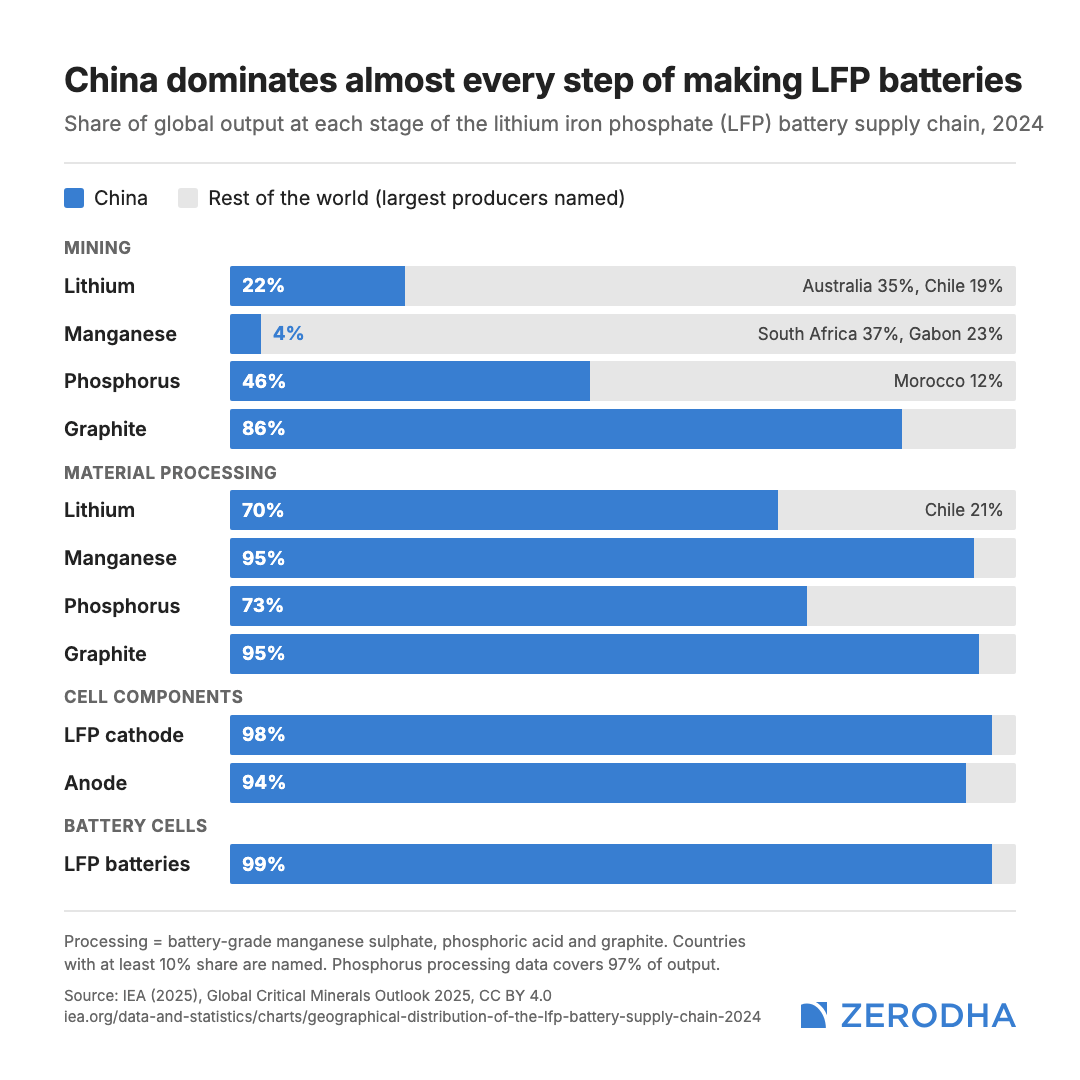
Unfortunately, getting access to their knowledge has only become much harder over the past year, at least partly because of China’s own policies.
It’s not like China has stopped sharing battery technology altogether. But the restrictions are more selective than that. China appears to be drawing a line around some of its more advanced manufacturing know-how, while older technology is still more transferable.
For instance, in July 2025, China added some parts of LFP cathode-making technology to its restricted-export list. The rules use technical cut-offs to decide what exactly is restricted. Put simply, some of the know-how used to make the highest generation of LFP batteries now needs government approval before a Chinese company can share it abroad, but less-advanced generations actually fall outside these restrictions.
China went further in October, announcing broader controls across industries. Then in November, it suspended those rules. But the restrictions introduced in July remained.
Another measure that China has used to hamper tech transfer is limiting the mobility of its engineers that we’d need to help us with setting up factory processes.
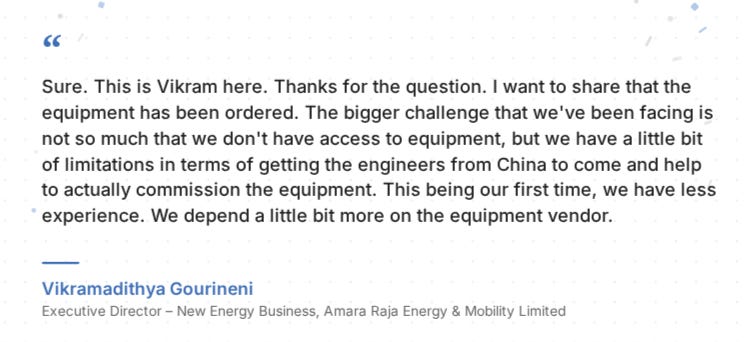
Take Amara Raja’s deal with Chinese battery major Gotion. Chinese engineers were supposed to help Amara Raja set up the machines, put quality control processes in place, and train its Indian employees. But one of the biggest bottlenecks they highlighted in that deal was the inability to court Chinese engineers. That hurt their ability to absorb the tacit knowledge embedded in manufacturing.
If you’d recall, this is not very different from when China called back its engineers from Foxconn’s factories in India last year.
On top of all this, there is pressure from the Chinese state on Chinese companies to scale down licensing of technologies not just to India, but to any other country. In 2024, China’s commerce ministry reportedly held a meeting with their domestic automakers regarding the risks of making overseas investments. It signaled India in particular, while also advising strongly against investing in Russia and Turkey.
Beyond this, there is also the problem that all tech transfer deals face regardless of which countries are involved: what is the incentive for a company with the technology to teach us how to use it? After all, the moment you give the license away, you create a potential competitor. So the licensing firm’s incentive is to teach the licensee only as much as is needed to run a factory, and no more.
Meanwhile, the licensing firm also gains access to the market of the licensee, which is why they enter a deal in the first place. As we’ve covered before, given China’s domestic sales plateauing, they have a particular interest in gaining access to the Indian market.
Of course, our own policies with Chinese investments make things harder, especially with Press Note 3, which ensured that Chinese companies face an extra layer of scrutiny before investing here. BYD, for example, proposed a $1 billion EV plant in India in 2023, but the plan did not get government approval. India eased the rules slightly in 2026 for small Chinese stakes in Indian businesses, but bigger investments still need approval.
The bets
Even within this context, different companies have taken very different routes to the same problem. We’ll be looking at a few of those.
JSW’s frustrations
First comes JSW.
On 26 August this year, JSW paused its cell giga-factory. It linked its inability to find a Chinese partner for LFP batteries to China’s tighter controls. JSW was ready to build the factory, but couldn’t get the know-how needed to make cells at scale.
4 weeks later, JSW launched its electric trucks and buses from a plant in Maharashtra capable of producing 15,000 vehicles a year. The vehicles are engineered in India, the software is developed here and the battery packs are assembled here. But the cells inside those packs still come from elsewhere.
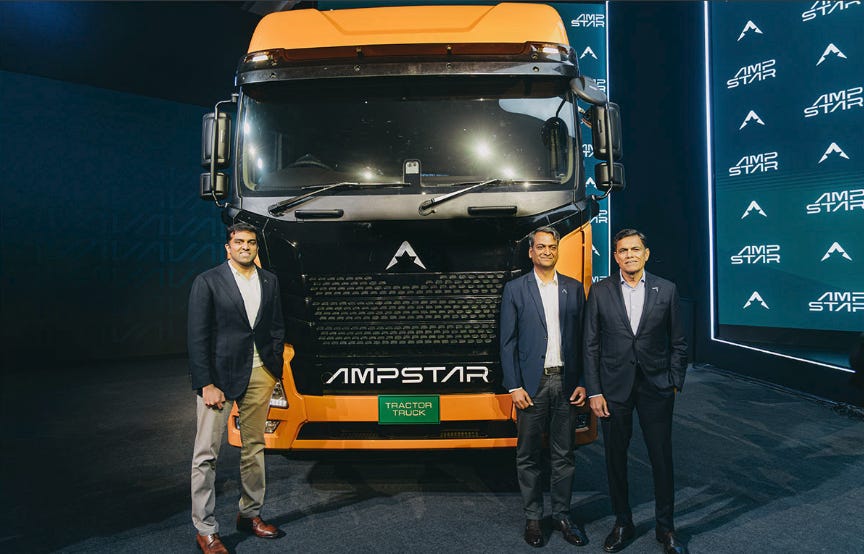
Then, on 28 September, JSW committed over ₹800 crore to a battery research centre with COEP Technological University in Pune. The centre will work not just on lithium-ion cells, but also sodium-ion cells, which are relatively more unexplored even on China’s part.
Over a few weeks, you could see JSW’s approach change. It first tried to get the technology from an established Chinese player. When that didn’t work, it started investing in developing the knowledge itself. In the meantime, JSW can build an electric truck in India and assemble its battery pack here.
Tata’s hedge
Tata, meanwhile, is taking a different route. Agratas, its battery company subsidiary, is building a 20 GWh cell factory in Sanand, Gujarat. The first production equipment started arriving in September 2026, and the factory is expected to start making cells in 2027.
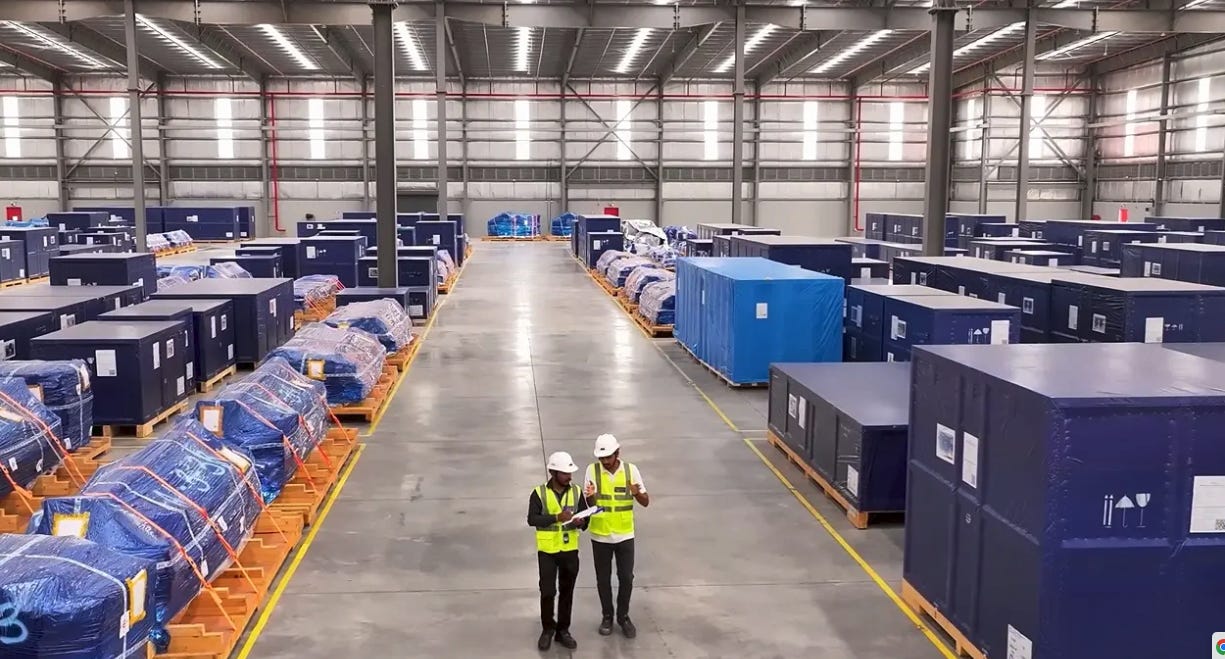
But Tata isn’t using the same approach for every type of battery. While it found a technology partner for one form of battery chemistry, it failed for another.
For the NMC (nickel-manganese-cobalt) chemistry, Agratas has licensed technology from AESC Apollo, a Japanese firm that’s now majority-owned by China’s Envision Group. The deal saves Tata the effort of developing the technology from scratch.
But we don’t know how far that gets Tata on its own. The details of the deal aren’t public, so it’s unclear whether, once the licensing deal is over, Tata will eventually be able to produce these cells independently or continue to rely on AESC.
With LFP, Agratas didn’t even have the option to license. It couldn’t find a Chinese company willing to share it. So Agratas is now trying to develop the LFP manufacturing process itself.
An oil company enters the game
Perhaps, the most interesting move in battery cells came from a company which is known neither for cars like Tata, nor for batteries like Exide. But it does understand chemicals very well, while also having some of India’s largest cash reserves.
Those facts have allowed Reliance to do something no other Indian company has tried. Reliance decided to buy the firms that own the technology itself. That’s certainly more durable than renting it.
For instance, in March 2022, Reliance acquired almost all of Lithium Werks for ~$61 million (₹464 crore @ $1 = ₹78.6), picking up a portfolio of 219 LFP patents, a manufacturing facility in China, existing employees and 3 decades of accumulated process technology. Then in 2021, it had agreed to buy sodium-ion specialist Faradion for about £100 million (₹1,000 cr @ 1£ = ₹100).
Despite these moves, though, as per Bloomberg, Reliance was seemingly looking for another partner, that too a Chinese one. In January 2026, Bloomberg reported that Reliance had been trying to license LFP technology from China’s Hithium, but the talks had stalled and its cell-making plans were paused.
What Reliance has said is that its battery project is progressing and is on schedule. Its FY26 annual report said its Jamnagar battery factory was nearing completion, with 40 GWh of capacity planned.

But what we still don’t know is exactly whose technology those cells will use, or why Reliance was trying to look for another partner in China. Perhaps, buying battery technology doesn’t necessarily end the search for better technology.
A few more bets
Beyond these three, a few more companies in India have their own strategies to skirt around China’s dominance.
For instance, there’s Ola, which decided to develop its own cells from scratch. Its 4680 NMC cell is already used in its scooters, while its newer 46100 LFP cell has received BIS certification. While this marks significant progress from mere assembly, Ola still imports active key materials like the cathode and anode.
Then, there’s Maruti, whose EV trajectory we’ve covered in a recent story. Maruti imports the entire battery pack for the e-Vitara from BYD. That saves Maruti from having to develop cells or even battery packs itself, but makes it dependent on BYD.
What to watch from here
What’s clear is that announcements about large cell factories are easy and quite abundant, too. But as far as making those factories operational at high efficiency goes, there’s still a long way to go unless the underlying policy situation changes dramatically.
Tata will be one of the first big tests, with its Sanand factory expected to start producing cells in 2027. JSW’s research centre may not produce commercial cells anytime soon, but it should show whether Indian companies can build more of this technology themselves.
Ola, meanwhile, will test whether doing almost everything in-house can work at scale. And Maruti will show how far a company can go by relying on an established foreign supplier instead.

Why India’s airlines want cheaper fuel
If you’re booking an IndiGo flight for the festive season, you already know how expensive it can be. Now there’s a fresh addition to the bill.
From October 6, the airline increased its fuel surcharge by ₹100–₹350 on domestic flights, taking it to ₹375–₹1,300 per sector, depending on distance. IndiGo first introduced the charge on March 14, revised it from April 2, and has now raised it again. International passengers face higher charges too.
Behind that decision is another jump in the price of aviation turbine fuel, or ATF, which powers aircraft. In Delhi, it reached roughly ₹137 a litre on October 1, about 13% above the previous month and nearly 25% above July.
The government is now reportedly considering reviving a ₹10,000-crore scheme to protect airlines from these swings. There’s just one complication: it offered that protection a few months ago, and no airline signed up.
To understand why, we need to start with the fuel bill.
What airlines pay for
India refines virtually all the ATF it consumes and exports a substantial surplus. Yet airlines don’t pay the domestic cost of making it plus a margin. Oil marketing companies, or OMCs, use an international jet-fuel benchmark called MOPAG, or Mean of Platts Arab Gulf. It reflects prices in the Arab Gulf market. The logic is simple: fuel is traded globally, so its price here reflects what buyers would pay elsewhere.
The calculation starts with what it would cost to import that fuel: the international price, shipping, insurance and applicable import charges. This is called import-parity pricing, and it applies even when the fuel was refined in India.
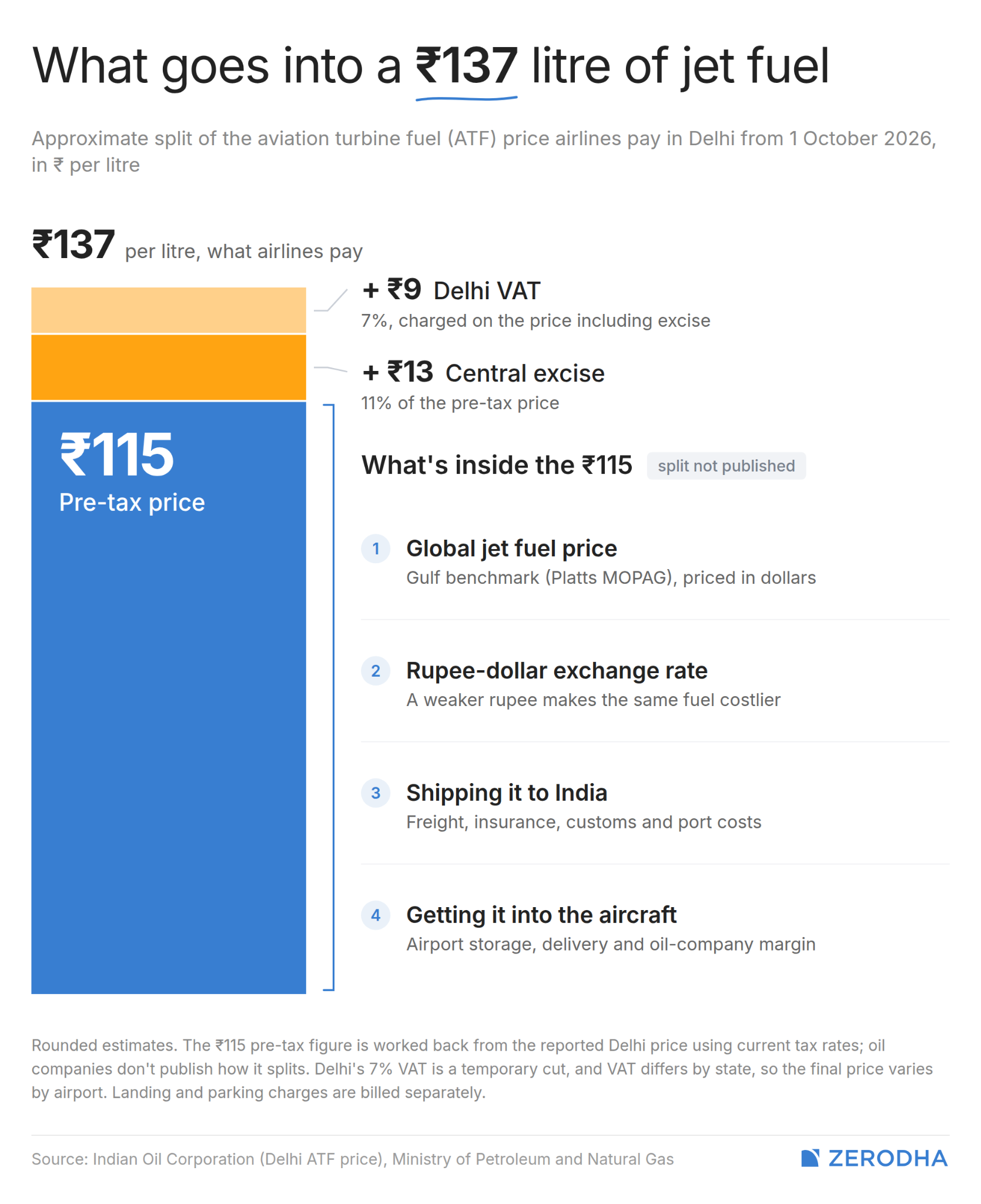
That dollar price is converted into rupees, and local delivery costs and supplier margins are added. Then come taxes. ATF is outside GST, so airlines pay central excise and state VAT. VAT rates vary by state, which helps explain why the same fuel costs different amounts at different airports.
So the bill depends on three things: global jet-fuel prices, the rupee and local costs and taxes.
Jet-fuel prices rose sharply at the start of the year, eased, and are now back near the highs seen earlier this year. But jet fuel and crude oil don’t always move together.
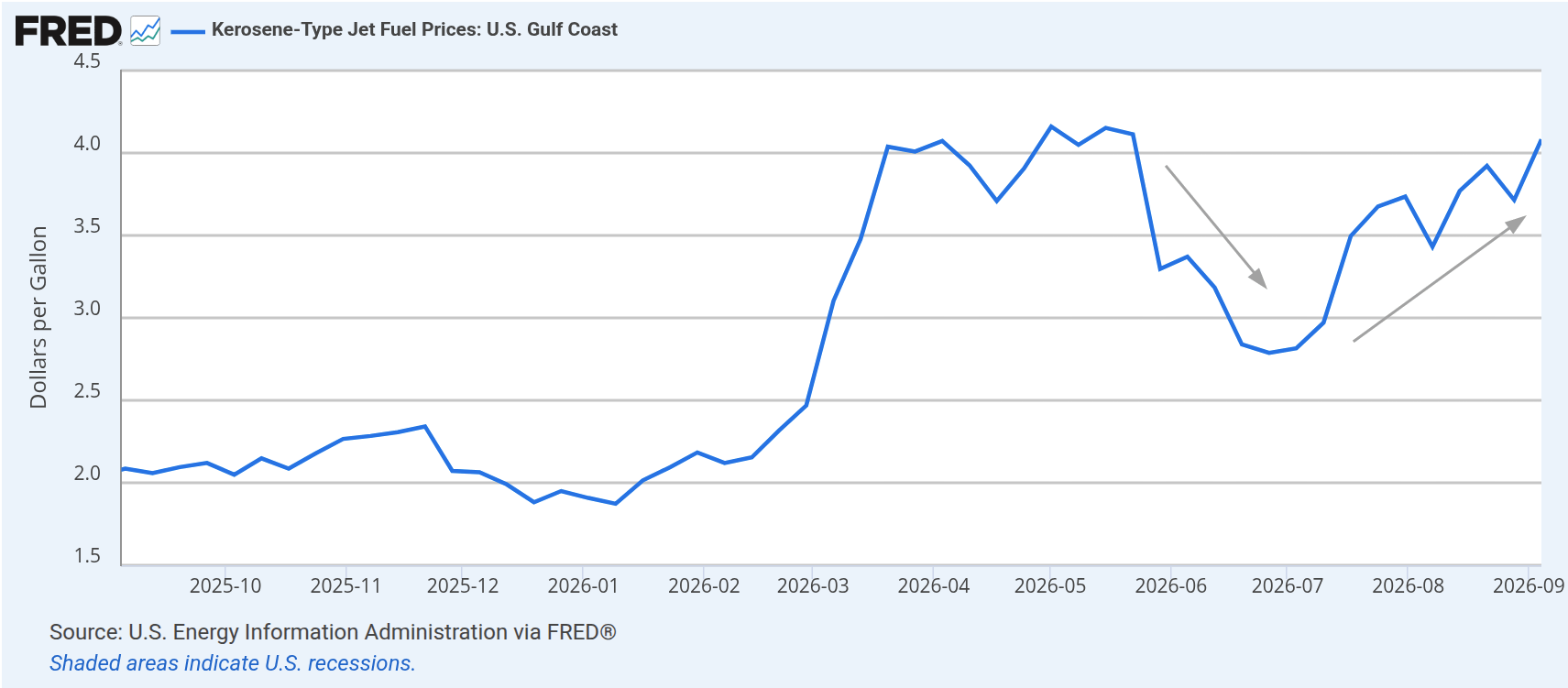
Crude must first be refined into usable fuels. The gap between crude and jet-fuel prices is called the “crack spread”. When jet fuel becomes scarce, its price can rise much faster than crude, widening that gap.
The Federation of Indian Airlines, or FIA, which represents Air India, IndiGo and SpiceJet, says this gap has become unusually large. In its submission to the government, it cited a spread of roughly $60 a barrel against the usual $10–12.
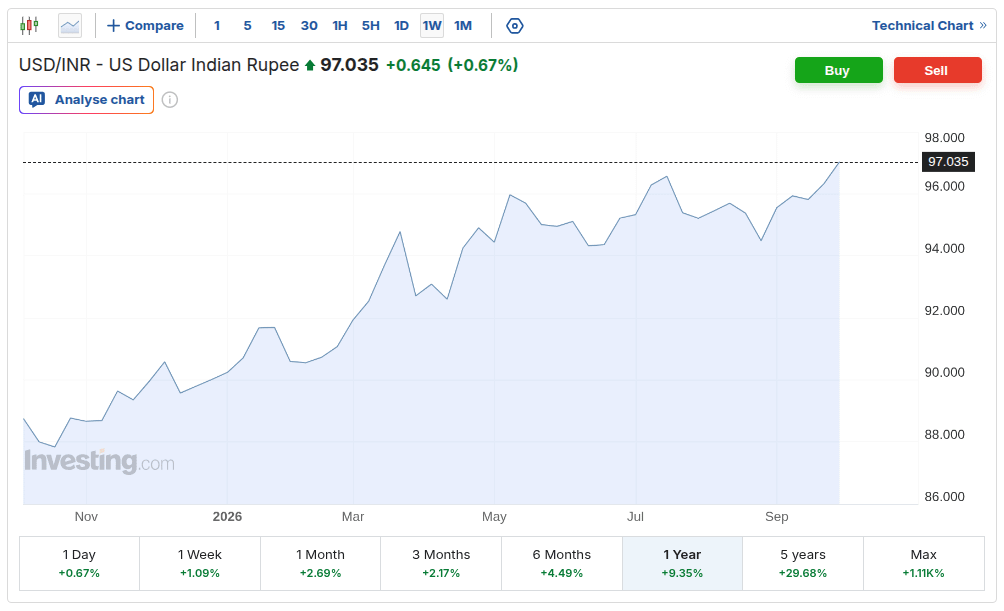
The West Asia conflict has added other pressures. A weaker rupee makes aircraft leases and maintenance more expensive too, because many of those expenses are dollar-linked.
Airspace restrictions force detours on affected international routes, increasing fuel consumption and crew costs. Airlines can end up paying more for each litre while needing more litres to complete the journey.
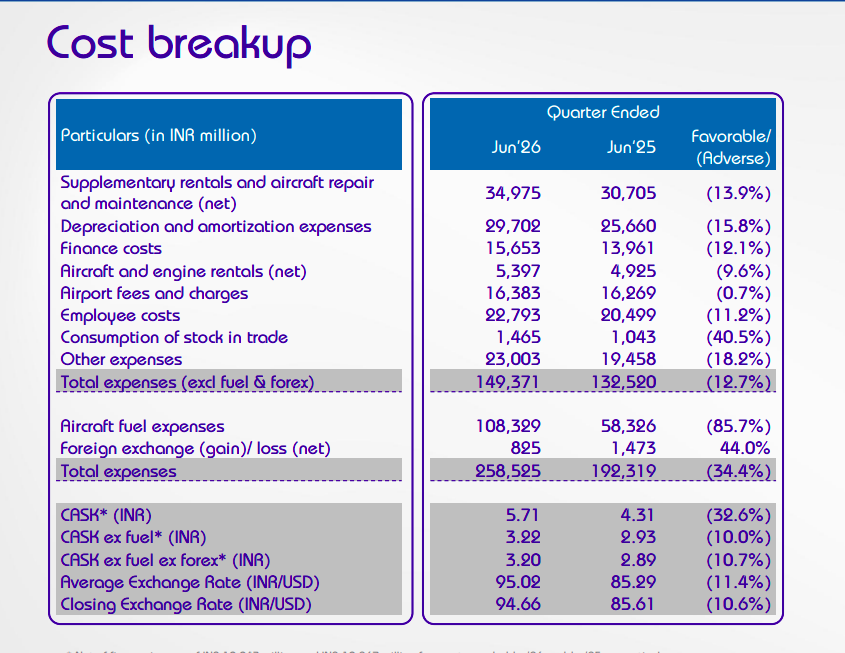
We saw the financial consequences in our earlier story on IndiGo’s results. In April–June, its revenue from operations grew nearly 20%, but its fuel expense rose about 86%. The airline reported a ₹238-crore net loss, compared with a ₹2,176-crore profit a year earlier. Those results captured the earlier shock, before October’s increase. Even then, we were worried the next quarter could be worse.
The protection nobody bought
Normally, market-linked fuel pricing would mean international price increases are passed on to airlines and, in turn, customers. During the crisis earlier this year, the government interrupted that process.
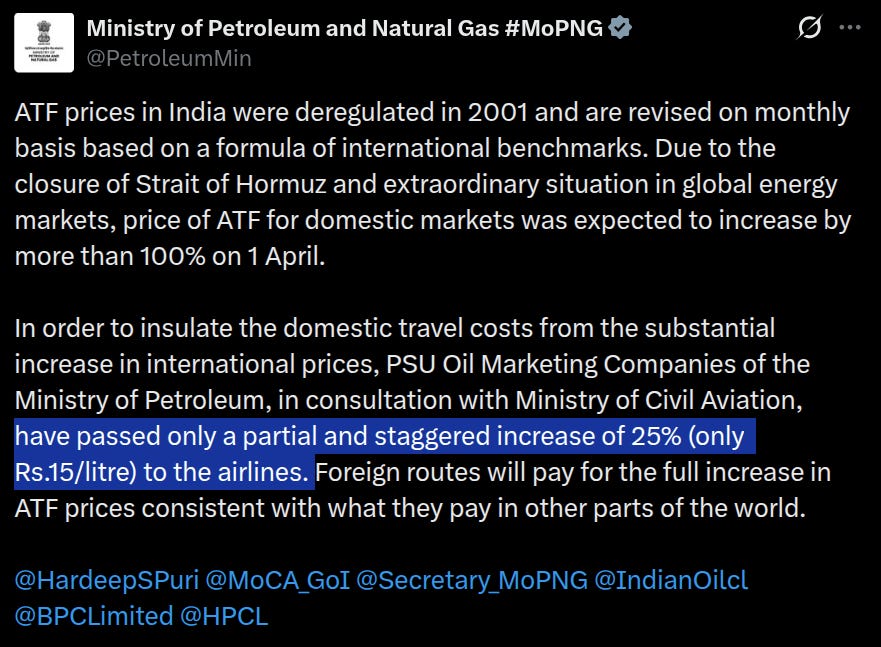
On April 1, it limited the increase in ATF base prices for domestic operations to 25%, despite international benchmarks indicating a rise of over 100%. That softened the hit to airlines, but left OMCs absorbing the price gap.
By June, the government acknowledged that this was unsustainable. The Cabinet therefore approved a separate price stabilisation mechanism, backed by up to ₹10,000 crore in interest-free advances to OMCs.
Participating Indian airlines would receive fixed-price fuel for domestic and international operations. The proposed selling price in Delhi worked out to approximately ₹115 a litre, after charges and taxes.
Take a simplified example, keeping taxes and other charges unchanged. If the comparable market price rose to ₹135, the airline would still pay ₹115, with the government advance financing the ₹20 difference. If it later fell to ₹100, the airline would continue paying ₹115, while the OMC used the ₹15 difference to repay earlier advances.
The basic bargain: predictable prices in exchange for giving up some benefit when fuel became cheaper.
Participation also required an exclusive supply arrangement with OMCs. The scheme would run for up to 36 months, subject to annual review or earlier settlement once the advance was recovered. An extension could be approved if recovery remained incomplete.
For airlines, the timing made this difficult to accept. The ₹115 Delhi price was already above the prevailing price in June–July, when the government clarified the terms. As international prices eased, committing to that arrangement became less attractive. According to The Indian Express, no carrier joined within the prescribed window, and the scheme lapsed.
Now prices have risen again, and there is renewed interest. But that doesn’t automatically resolve the objections to the original offer.
Airlines want the bill itself changed
That is why FIA’s requests go beyond reviving the fund.
First, it wants cost-plus pricing: fuel priced at its actual cost plus a reasonable margin, instead of international jet-fuel benchmarks. The aim is to reduce exposure to unusually wide crack spreads.
This would require deciding which costs count and what margin is reasonable. Refineries produce several fuels together, so working out how much of the cost belongs to jet fuel isn’t straightforward.
Then come taxes.
Ordinary domestic ATF supplies attract 11% central excise, followed by applicable state VAT. Because excise is a percentage, the tax amount rises with the underlying price. On a hypothetical taxable value of ₹100, it is ₹11. At ₹120, it becomes ₹13.20, even though the government hasn’t changed the rate. VAT can compound the increase because it is calculated on a price that includes excise.
FIA wants a fixed levy instead. That would prevent excise from automatically climbing with fuel prices, although the relief would depend on the amount chosen.
It also wants Delhi and Maharashtra’s temporary VAT concession continued, and lower rates in states including Karnataka, Tamil Nadu, Telangana and West Bengal.
Bringing ATF under GST offers another possible route. But the benefit would depend on both the rate and the input-tax-credit rules: whether airlines could offset tax paid on fuel against tax collected on their services. Simply moving ATF into GST would not guarantee full credit.
Beyond fuel, FIA has asked for an extension of the earlier 25% reduction in landing and parking charges for domestic flights. That concession expired in July, according to the association. These requests would lower airlines’ bills, but also reduce government or airport revenues.
Why not just raise fares?
Airlines are doing that, but recovering the entire increase is harder.
For one, many tickets are sold well before departure. A fuel-price increase can arrive after the airline has committed to carrying passengers at previously agreed fares. FIA has pointed to this mismatch in its appeal for relief.
There are also limits to what new passengers will pay.
According to IATA’s August report, India’s domestic revenue passenger-kilometres fell 7.5% year-on-year. This measures the distance travelled by paying passengers and is a useful proxy for demand. For the second consecutive month, India recorded the largest decline among the world’s major domestic markets.
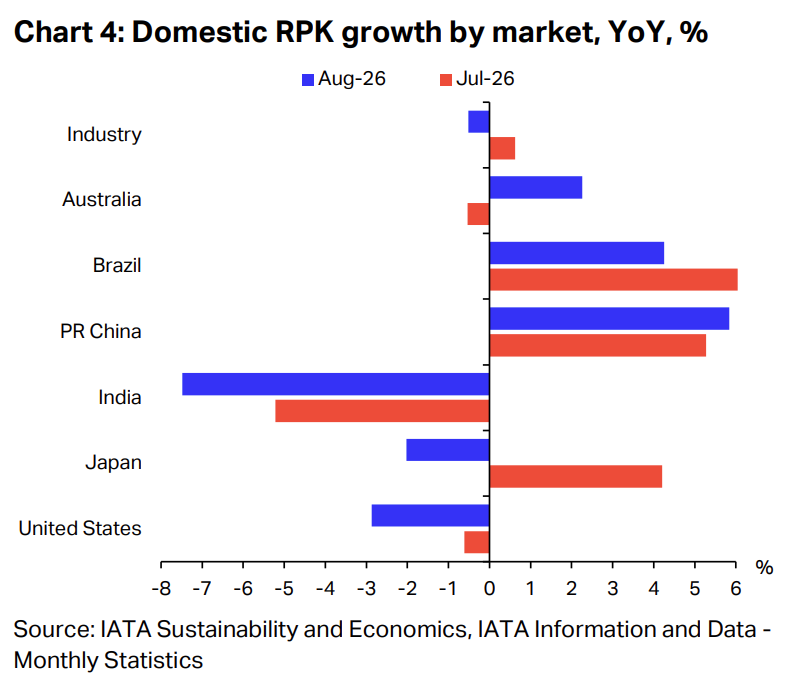
Those figures don’t tell us how much of the decline was caused by higher fuel prices. They do show that airlines were already filling a smaller share of their capacity. Further fare increases could make that harder.
The pressure also explains their request for faster disbursement under the Emergency Credit Line Guarantee Scheme 5.0.
The scheme targets ₹5,000 crore in additional airline credit, with government-backed guarantees covering 90% of eligible lenders’ exposure to default. Airlines still have to repay the loans. This can help them meet immediate bills, but borrowing cannot permanently fix a route that costs more to operate than it earns.
FIA has warned that, without timely relief, carriers may withdraw from unviable routes. For passengers, that could mean higher ticket prices and fewer flight options.
The aviation minister has confirmed discussions with airlines and OMCs, but revised stabilisation terms have yet to be announced.
The next offer will have to settle some difficult questions. How long must airlines commit? How much benefit can they retain when prices fall? And if fuel stays expensive, who pays for support that cannot be recovered?
Last time, airlines decided the certainty on offer wasn’t worth the commitment. A revived scheme will need to give them a reason to decide differently.
- This edition of the newsletter was written by Vignesh & KK.
Tidbits
1. Paramount takes over Warner Bros in $110 billion Hollywood merger
Paramount Skydance has completed its takeover of Warner Bros. Discovery, creating a new entertainment giant called Skydance. The combined company brings HBO, CNN, CBS, Paramount+, Warner Bros and major franchises such as Harry Potter and Game of Thrones under one roof. The deal closed after months of legal challenges over competition and consolidation.
Source: BBC News
2. Cabinet clears ₹10,000 crore fund to help SMEs scale up
The Cabinet has approved a ₹10,000 crore SME Growth Fund to provide long-term equity capital to small and medium businesses looking to expand, invest in technology or enter global markets. It has also created a new transport and logistics authority that will prepare a long-term national master plan and coordinate projects across roads, railways, ports and aviation.
Source: The Economic Times
3. MoCA asks Mumbai airport to pause flight shift to Navi Mumbai
The Civil Aviation Ministry has asked MIAL to defer its plan to shift 265 of Mumbai airport’s 770 weekly international flights to Navi Mumbai by October 25. MIAL will now have to consult airlines and other stakeholders and come up with a jointly agreed transition plan before seeking regulatory approvals.
Source: Business Standard
4. India may bring Taiwan and Singapore institutes to train semiconductor workers
The government may invite Taiwan’s ITRI and Singapore’s A*STAR to establish semiconductor training centres in India, potentially funding their setup. The aim is to create a ready pool of engineers and shop-floor workers as new chip plants come online. Under the second semiconductor mission, India wants to train another 100,000 engineers over six years.
Source: Business Standard
5. RBI hikes repo rate to 5.50% after nearly three-and-a-half years
The RBI has raised the repo rate by 25 basis points to 5.50%, its first hike in nearly three-and-a-half years, as inflation pressures rise. It also shifted its policy stance from “neutral” to “calibrated tightening”, signalling that rate cuts are unlikely soon. The RBI raised its FY27 real GDP growth forecast to 7.1%.
Source: The Hindu
Want more tidbits? Catch up on last week’s recap!

Beyond Today’s Brief
There’s always more happening at Markets by Zerodha.
The Chatter: What strategic trends are leaders in banking, payment solutions, dairy, and retail highlighting? How are PNB and Central Bank of India driving credit expansion while managing funding costs? And how are Manipal Payments, Dodla Dairy, and Rentomojo scaling high-margin metal cards, regional processing hubs, and subscription-led retail?
Points & Figures: What does having a job even mean in today’s economy? And how are the blurring lines between formal employment, gig work, and underemployment complicating India’s labour market data?
Aftermarket Report: How did Nifty cool off to close near 22,603 after the RBI raised the repo rate by 25 bps to 5.50% in its first rate hike in four years? And what do persistent FII selling for eight straight sessions, extreme fear sentiment, and the rupee nearing fresh record lows against the dollar reveal as 12 of 15 sectors ended in the red?
Join us on WhatsApp, where we share interesting soundbites from concalls, articles, and everything else we come across throughout the day. You’ll also get notified the moment a new video or article drops so that you can read or watch it right away.
Thank you for reading. Do share this with your friends and make them as smart as you are 😉