



Our goal with The Daily Brief is to simplify the biggest stories in the Indian markets and help you understand what they mean. We won’t just tell you what happened; we’ll tell you why and how too. We do this show in both formats: video and audio. This piece curates the stories that we talk about.
You can listen to the podcast on Spotify, Apple Podcasts, or wherever you get your podcasts and watch the videos on YouTube. You can also watch The Daily Brief in Hindi.
In today’s edition of The Daily Brief:
1. Indian hotels name their price, and it’s steep
Historically a weak quarter, July-September just delivered record results for Indian hotel chains like IHCL, The Leela, and Lemon Tree. The driver wasn't filling more rooms, but charging significantly more for them. A severe shortage of premium supply, combined with massive events like the BRICS Summit, created intense "compression" that allowed hotels to dictate surge pricing. With new convention infrastructure booming and real estate permanently capped in top business hubs, hotels are successfully extracting maximum value from a captive audience.
2. What’s squeezing India’s hospitals after a strong quarter?
India's major hospital chains just reported a blockbuster quarter, maintaining high occupancy despite rapid bed expansions. However, their core business model is under threat. The government recently capped lucrative trade margins on cancer drugs, forcing hospitals to rethink how they subsidize expensive care. To protect margins, chains are aggressively optimizing their payer mix—prioritizing complex, high-margin robotic surgeries and quietly dropping low-paying government schemes that routinely delay payments by months. Furthermore, while operating margins look massive, the heavy depreciation costs of an impending 34,000-bed national expansion spree are keeping actual net profits surprisingly thin.
Indian hotels name their price, and it’s steep
Historically, the July-September quarter has always been weak for Indian hotels, purely for seasonal reasons. The monsoon dampens leisure travel, and the wedding season is yet to enter full swing. For example, in the case of The Leela, ~70% of their total operating profit for FY26 came from the second half. For Lemon Tree, that same share hovers around 60%.
This year’s Q2 seems even more difficult to weather. The conflict in West Asia kept fuel prices high, so airlines cut capacity and raised fares. Foreign tourist arrivals were already struggling. IHCL’s airline-catering arm had a rough quarter simply because there were fewer flights to cater to.
And yet, Indian hotels just had one of their best September quarters ever.
IHCL posted its 18th straight record quarter and raised its full-year guidance. Lemon Tree called it its best second quarter ever. The Leela and ITC Hotels both grew revenue per available room (or RevPAR) by over 20%. Even Chalet, which filled fewer rooms than last year, charged noticeably more for the ones it did fill.
The short explanation is one we’ve run into before: there are just not enough branded, high-quality rooms as there are customers. This demand-supply mismatch gives hotels immense pricing power. According to EIH, which runs the Oberoi and Trident hotels, room rates across the industry rose by 8-10% compared to last year, while occupancy rose by just 1-3%. This was, by many measures, a story of value over volume.

But it’s why that gap exists that remains the most curious piece, and why this quarter, it only got more entrenched even as hotel companies race to expand.
In this results story, we won’t be looking at the headline numbers of companies beyond a table, but instead look at the broad forces affecting almost every player in this game.
Summits and sangeets
It has been a high-profile year for India when it comes to hosting global conferences. Most recently, there was the BRICS Summit in New Delhi. A few months prior to that, the capital also hosted the India AI Summit. In Mumbai, meanwhile, we saw the Global Fintech Fest (GFF).
All events where the high and mighty of the world arrive, and all events where branded hotels stay best poised to benefit. The hotel industry calls this business MICE, which stands for “meetings, incentives, conferences and exhibitions”. A big event like this means banquet halls get filled, food and beverages sell out, and rooms in multiple different hotels get booked to nearly full occupancy for a week or so.
And that’s what happened this quarter.
Most major hotel chains credited the BRICS Summit behind their stellar quarter. IHCL, which operates the famous Taj and Vivanta brands, pointed to a string of events in Delhi. The Leela’s Delhi palace hosted four heads-of-state delegations. Similarly, Chalet, which owns Marriott and Westin-branded properties in Mumbai, enjoyed growth because of GFF.

Now, you may be forgiven for thinking that such events only happen once in a while. The BRICS Summit will be in a different country each year.
However, hotels don’t think events like BRICS are a one-off. They believe that there is a structural tailwind for MICE: India now has better infrastructure to host such high-profile, large-scale events. The Bharat Mandapam in Delhi, for instance, hosted both G20 and the India AI Summit. Similarly, GFF was hosted at the Jio World Convention Center.

What’s more, when, say, a head-of-state comes for such an event in India, he or she brings entire delegations alongwith. They may even stay on a little longer and make a leisure trip somewhere in India. A summit in Delhi can end up filling a resort in Nainital.
That being said, this quarter’s events were still largely domestic or government-led. Large international corporate groups, especially from the US, held back due to high airfares owing to the West Asia conflict.
Chalet, which depends more heavily on foreign travelers than many of its peers, said that its large-group business grew slower than expected. However, due to GCC hiring, they hope that multinationals return to booking rooms again.

Then, there’s the big fat Indian wedding.
A single wedding books a block of rooms for several nights, plus the banquet halls and catering. Since families book whole floors at once, a busy wedding season fills hotels on dates that would otherwise be quiet.
The wedding calendar is only going to get busier. IHCL says that next year, they expect to serve 95 wedding nights against the usual 60-65.
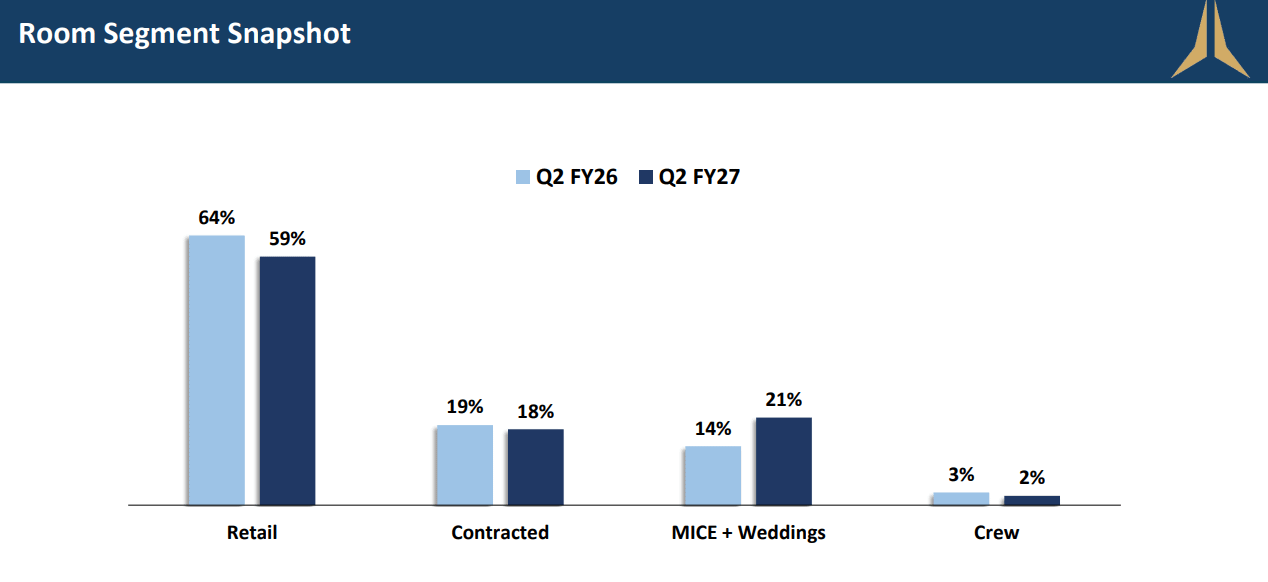
You can see the shift in the revenue mix. At ITC Hotels, MICE and weddings made up 21% of owned-hotel room revenue this quarter, up from 14% a year ago. At EIH, MICE’s share of room revenue rose from 12% twelve months ago to 16% now.
A tight squeeze
Any city has a fixed number of good hotel rooms on any given night. When a summit lands, thousands of delegates, officials and executives need those rooms on the same dates. Then, there are regular leisure and business travelers who also might do so. Whoever is still looking pays whatever is asked.
Hotels call this “compression“, but it’s really the same logic as surge pricing on a cab app on a rainy evening.
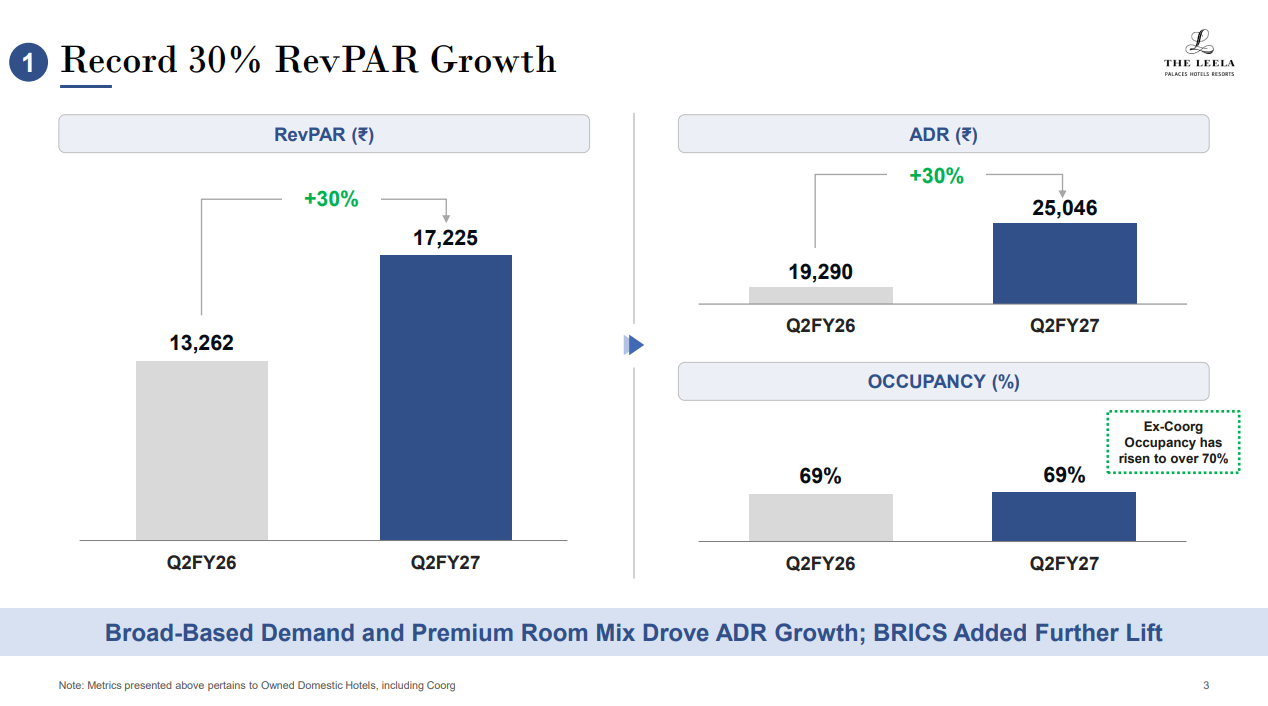
This is where events and the supply shortage feed into each other. Events squeeze an already-scarce supply even tighter, giving hotels leverage over every room, including those booked by guests who have nothing to do with the event. At The Leela, occupancy was roughly flat at 69%, but room rates rose 30%.
Meanwhile, hotels have also changed how they price corporates, only adding further to their compression.
You see, for years, companies negotiated fixed annual rates during the “RFP season”, which runs from July to the end of the year. Once locked in, that rate held whether the hotel was empty in the monsoon or packed during a different event. But hotels have now been moving these to dynamic rates, which move in tandem with the hotel’s daily prices, usually at a discount. The Leela has shifted 60-70% of its fixed corporate rates this way.
The old arrangement suited corporates well, but the hotels less. It would mean revenue leakage, especially when there were other customers willing to pay a lot more.
But why would corporates agree to this? Well, they don’t have much of a choice.
Imagine you have a meeting with a high-profile client whose office is located in Bandra-Kurla Complex (BKC) in Mumbai, which is one of India’s most expensive areas. Real estate there is prohibitively high, and there is simply not enough land to build another hotel. Now, imagine this problem for multiple other business and policy hubs. If you’re a policy delegate going to Delhi, you’d ideally like to stay somewhere near the central part of the city.
In these high-value micro-markets within India’s biggest cities, it is reasonable to assume that there is going to be very little supply. The Leela’s own BKC hotel only got its land lease this September, and won’t open until 2030. Lemon Tree, which is more mid-market than The Leela or Taj, expects its own BKC hotel to command about ₹12,000 a night — almost double its chain-wide average.
The timing helped, because corporate travel itself has been weak. Inflation and the war have made companies cut discretionary travel. Moreover, when companies hire freshers, they may sometimes host them for some days at a mid-market hotel like Lemon Tree. But, in what might be a more worrying signal about the broader economy, Lemon Tree has noticed that such hiring from the IT sector in particular continues to be slow.

Another lever that hotels have used to increase prices is by increasing the value of the existing rooms through renovation. Usually, these renovations take place in the lean months of the year. But last year’s renovations are now showing up in the profit-and-loss statement of this quarter.
For instance, Lemon Tree’s renovated Keys hotels saw revenue per room jump almost 30%. Taj Palace Delhi also saw its room revenue surge 132% year-on-year after upgrades to some rooms; this number comes with the caveat that 150 rooms were taken offline, so the base of growth was low. Yet, it directionally reflects how valuable renovations can be.
More rooms, fewer bricks
So far, we’ve only addressed the demand side of the hotel equation. And as we’ve already mentioned before, building a new hotel from scratch takes tons of capital tied up in fixed assets, and patience.
That’s why, as we’ve covered many times before, to avoid having so much capital tied up in one basket, hotels have adopted an asset-light approach to business expansion.
Asset-light
The most popular form of this approach is the management contract.
Here, a developer or landowner builds and owns the hotel, and the chain runs it under its brand for a fee. The owner gets a respectable brand and a booking system that fills rooms. The chain gets to grow without spending its own capital, while earning very high margins.
For instance, The Leela says 85-90% of a new managed hotel’s fees flow straight to its operating profit, and its management fees grew a whopping 76% y-o-y this quarter. IHCL management fees grew 25% y-o-y to ₹156 crore, and 81% of all the rooms currently in its pipeline run under this type of contract. Lemon Tree made 30% more through the same mechanism than what it did last year.
The second form of the asset-light approach is the operating lease, where the chain rents the building and runs the hotel itself. This is a riskier deal, since the rent is due whether the hotel is full or not. That’s partly why Lemon Tree has demerged its asset-heavy subsidiary, Fleur, keeping only the franchising part of the business.
Asset-heavy
That doesn’t mean hotel chains have completely given up on owning or operating hotels outright. However, they’ve chosen to acquire pre-existing properties instead of greenfield projects.
For instance, in July, ITC Hotels agreed to buy a 130-room Ahmedabad hotel it already operated under an asset-light model. The Leela says room rates at its newly-acquired Coorg resort have doubled since it took on the Leela name in July. In fact, many of these acquisitions were made to tap into the weekend getaway business, which we covered more extensively in September.
Very few hotels still insist on owning a hotel top-to-bottom. Chalet, for example, owns the land and buildings of its Marriott and Westin hotels, while Marriott runs them for a fee. It keeps the full upside when rates rise, and carries the full risk when occupancy falls. It cushions that with office towers whose rents earn operating margins of over 80%. Even so, Chalet is also shifting towards a hybrid model.
All this means branded supply is certainly growing. But much of it is headed to smaller cities and leisure towns; Udaipur’s branded room supply grew by almost a third last year alone. It will ironically be next to impossible to grow supply in the very markets which have the deepest demand, like BKC in Mumbai, MG Road in Bengaluru, or Central Delhi.
Conclusion
In a world where international travel has remained very subdued, Indian hotels have grown surprisingly well. This has been happening for a while now, and this quarter has only made it more convincing.
Hotel companies are convinced this is structural. IHCL’s management even rejected the idea that hotels were just catching Indians who couldn’t travel abroad, and called it a lasting shift in how people spend.
But it is also worth noting that Q2 last year had a somewhat weaker base. Corporate travel is still soft, and foreign tourists haven’t really returned. The bet may work out, but only as long as events and weddings keep filling rooms in the few places where new ones can’t be built.

What’s squeezing India’s hospitals after a strong quarter?
Midway through Max Healthcare’s earnings call this month, an analyst asked what sounds like a basic question: how much of the hospital’s revenue comes from selling medicines? When he didn’t get a number, he offered a range. Could it be 15%? 25%? 35%? Max‘s chairman wouldn’t bite. Medicines are bundled into treatment packages with everything else, he explained, so the split is hard to work out.
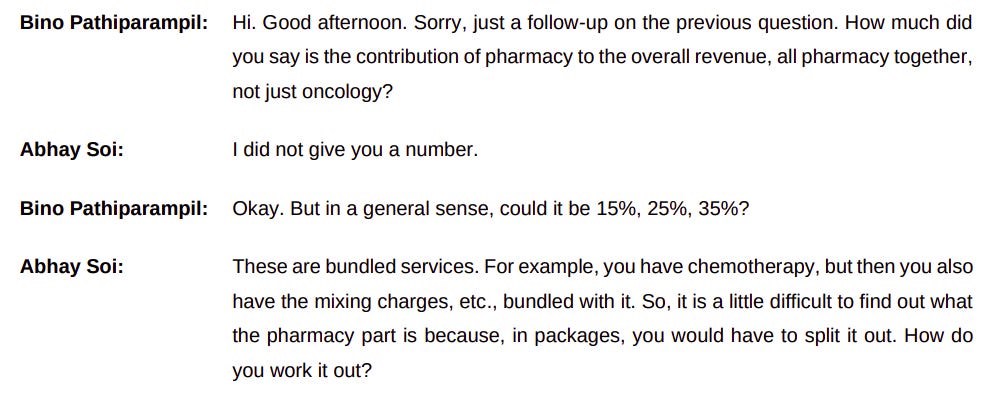
Medanta, asked the same thing on its own call, said it doesn’t track its numbers that way.
The question wasn’t idle: new caps on cancer-drug margins were days away. And it wasn’t the only one hospitals couldn’t answer this quarter, in what was otherwise one of their best quarters in a while.
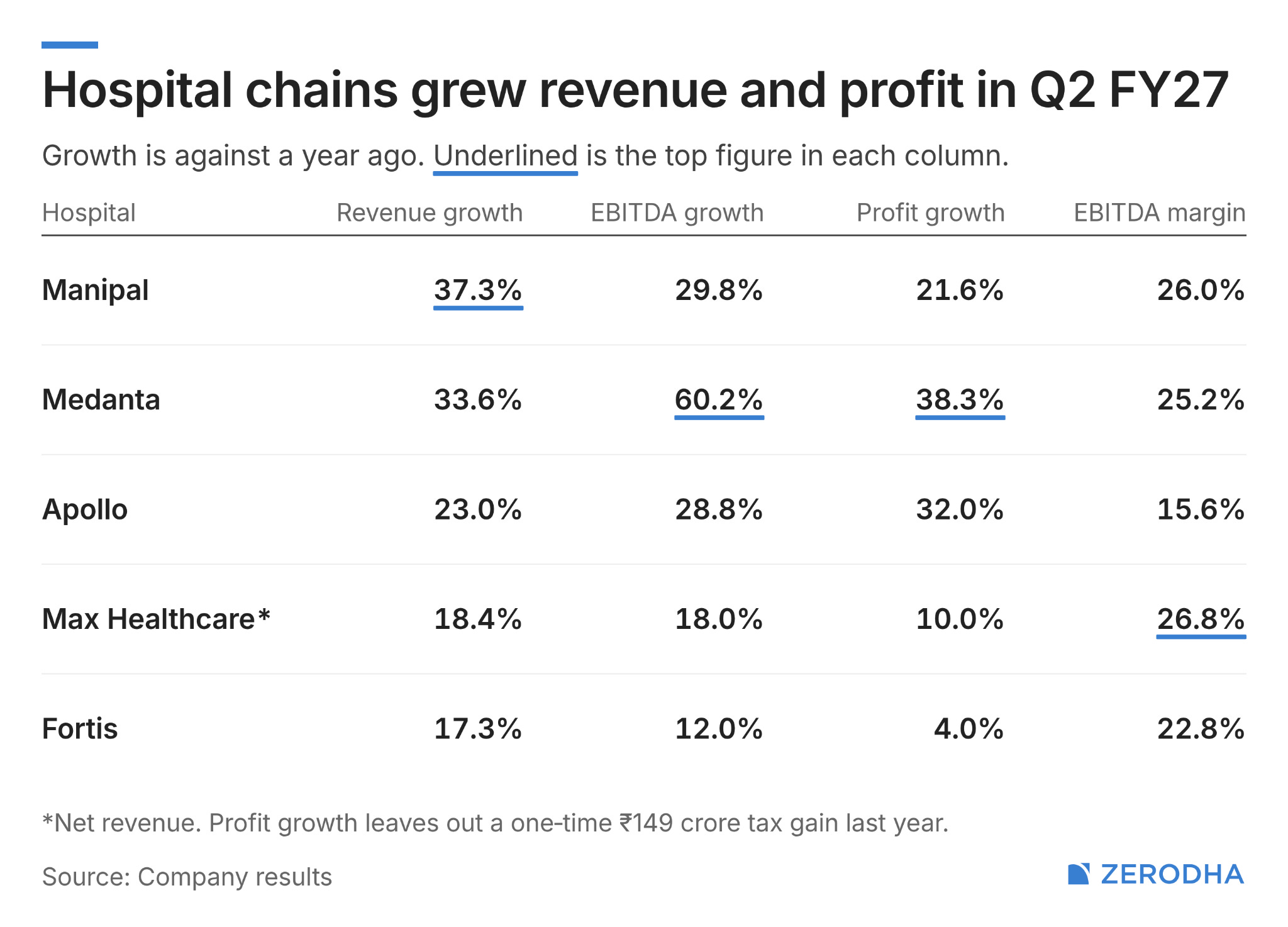
On the numbers alone, things could hardly look better. Every major chain grew revenue in double digits. Medanta had the standout quarter, with EBITDA up 60% as its new Noida hospital turned profitable. Manipal grew revenue fastest, though much of that came from Sahyadri, the Pune chain it acquired last year.
What’s more striking is how full these hospitals stayed while they grew. Max grew its bed capacity by 14% over the year and still ran its hospitals at 77% occupancy, exactly where it was a year ago. At Apollo Hospitals, occupancy rose even after it added hundreds of beds in six months. New beds usually sit half-empty for a while. This time, patients got there first.
Getting patients in is no longer the hard part. What’s harder now is everything else: what hospitals can charge, who pays and how late, and what new beds cost before they earn.
Why a cap on cancer drugs worries hospitals
Start with what hospitals can charge. India’s drug pricing regulator has just capped the “trade margins” on around 137 cancer-drug formulations, effective 9 November. A trade margin is the gap between what a drugmaker charges the supply chain and the MRP on the pack. Hospitals buy near the first price and bill near the second. Cap the gap, and their spread shrinks.
That spread matters. As Max’s chairman put it, “historically, it’s been a product-based pricing industry rather than a services-based pricing industry.” Apollo said much the same: product pricing “was a proxy for the service.” Markups on drugs and consumables have long helped pay for everything else in a patient’s treatment: the surgeon’s time, the ICU, the round-the-clock nursing. Squeeze those markups, and hospitals either absorb the loss or start charging for the service directly.
Since no chain will say how much it earns from drugs, the closest clue sits on the cost side. At Max, pharmacy, drugs and consumables cost roughly 25% of revenue. What we do know is how much each chain leans on cancer care. It ranges from about 10% of revenue at Aster and Manipal to over 20% of inpatient revenue at Max.
With exposure this uneven, it’s no surprise that managements sound like they’re living in different worlds. Aster says most of its treatments are package-based, and cheaper drugs might bring in more patients. Manipal is “not concerned at all,” even as it hires senior oncology teams in Bangalore and Kolkata. Medanta pointed to history: after stents were capped nearly a decade ago, patient volumes rose and everyone eventually benefited. That’s partly true. But as we noted in June, hospitals also clawed back some of that margin through less visible charges, like consumables and room rents.
And regulators may not stop at drugs. Kerala is considering a bill to regulate what private hospitals charge overall, which matters enormously to Aster. Kerala and Tamil Nadu bring in about 45% of its revenue.
Growing without raising prices
With regulators circling what hospitals charge, you might expect them to be raising prices while they still can. They aren’t, really. And yet they are earning more from every patient.
A hospital’s revenue depends on two things: how many patients it treats, and how much it earns from each. The second number rose 7-11% at most of the big chains this quarter.
At Apollo’s established hospitals, price hikes accounted for only about 4 of 19 percentage points of growth; the rest came from more patients and harder cases. Others said much the same, with Fortis noting that hospitals have little room to raise prices.
So where is the extra money coming from? A little comes from foreign patients: with flows from Bangladesh nearly back to their earlier peak, international patient revenue grew 30-37% at most of the large chains. Most of it, though, comes from two places.
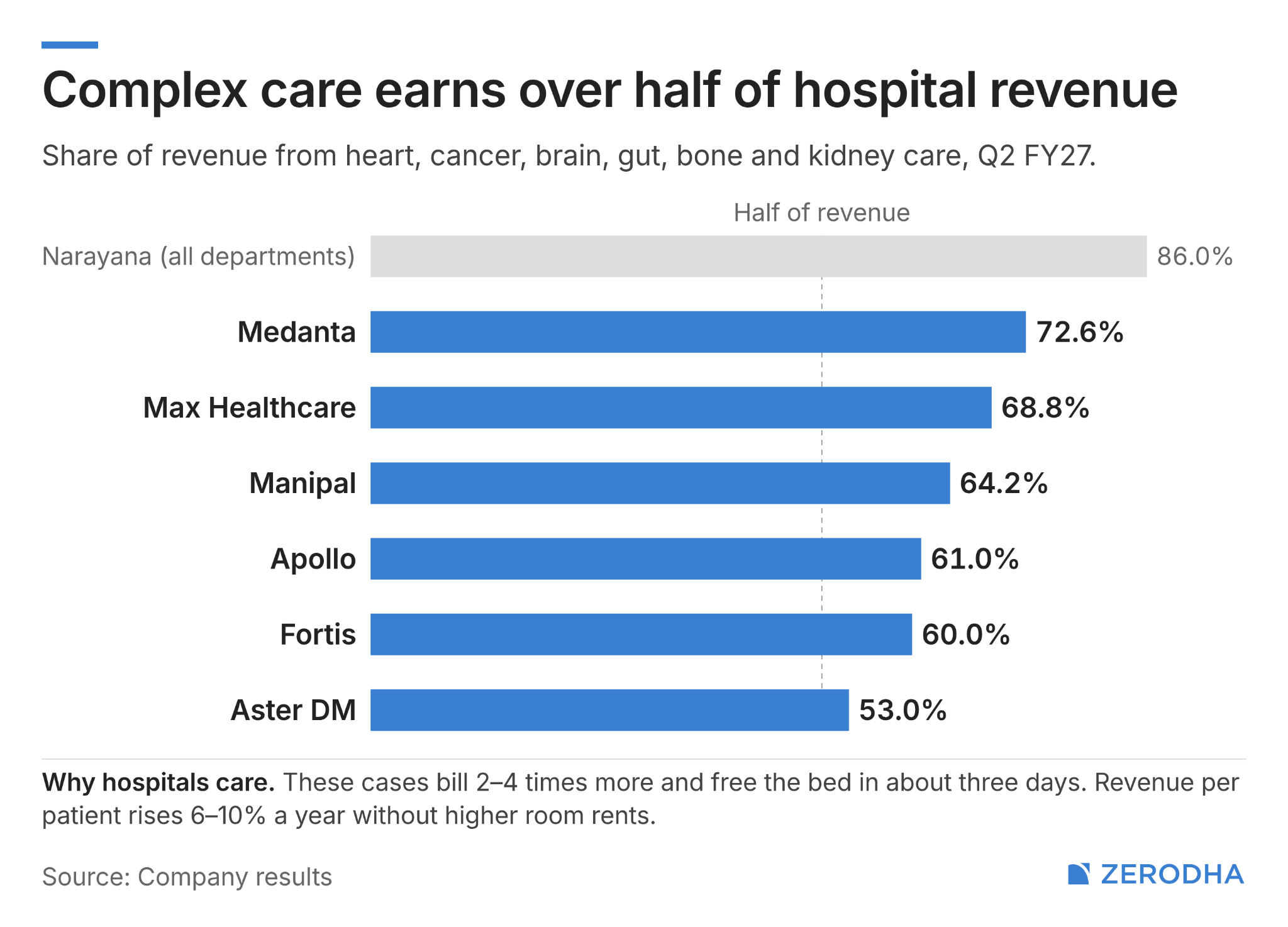
The first is complexity. High-end specialties like cardiac care, cancer, neurosciences and transplants already bring in anywhere from half to nearly three-quarters of revenue at the big chains. That share didn’t rise much this quarter, partly because oncology shrank at some of them. But within those specialties, the work is getting harder and pricier. At Aster, robotic surgeries grew nearly 40% and kidney transplants 31%. Fortis credited its higher revenue per patient to “more robotic surgeries, doing more complex cases.” Such procedures command bigger bills, and patients often go home sooner, freeing the bed for the next one.
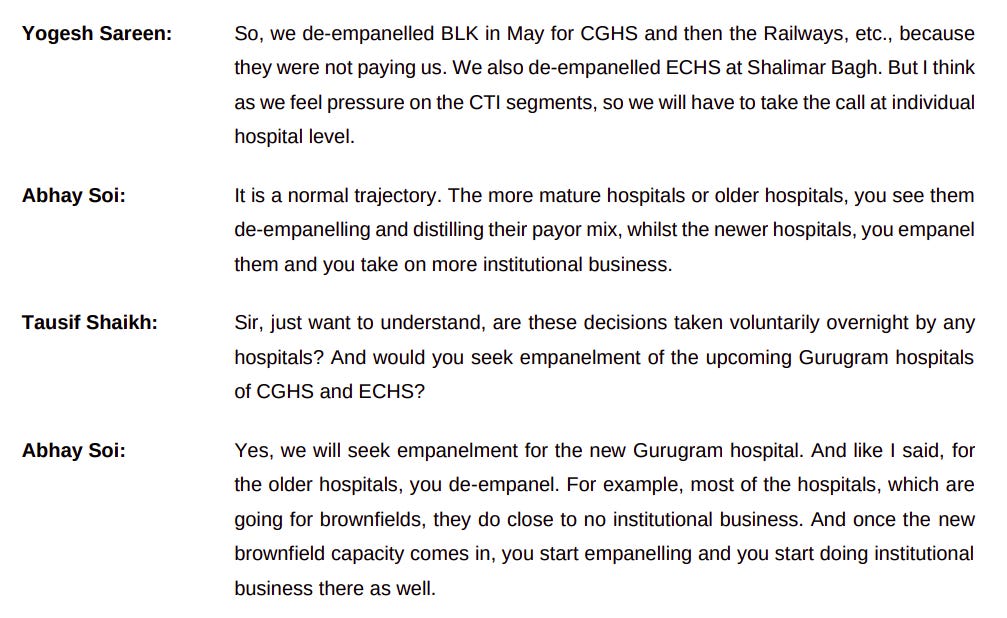
The second is choosing who pays. Not every patient brings in the same money for the same treatment. Government schemes like CGHS, ECHS and Ayushman Bharat pay fixed package rates, which often sit far below what a cash-paying or privately insured patient would pay. And as hospitals fill up, they are getting choosier.
Max’s chairman laid out the playbook with unusual candour. A new hospital signs up for government schemes to fill its beds quickly. Once it matures and space gets tight, it starts “de-empanelling and distilling” its payer mix, dropping the schemes to make room for better-paying patients.
The share of Max’s beds taken by government-scheme patients fell from about 33% to under 30% over the year, and the company credits that shift for part of its growth in revenue per patient.
Why hospitals are waiting longer to get paid
Sometimes, though, the swap isn’t about rates at all. It’s about whether a payer pays on time. And this quarter, the profits hospitals reported and the cash they collected drifted apart at more than one chain.
The biggest culprit, once again, is the government. Max had its flagship BLK hospital in Delhi taken off the CGHS and Railways panels in May “because they were not paying us,” as its CFO put it. The money owed to Max rose by about 25% in six months, and it now takes 93 days, on average, to collect a bill. The story we wrote in May, of private hospitals walking away from government schemes over low rates and late payments, is clearly still playing out.
Max isn’t alone. KIMS had to set aside money against unpaid dues from the Andhra Pradesh government. Narayana, which has historically turned about 93% of its EBITDA into operating cash, managed 88% in the first half, citing slow payments from both government and insurance payers.
Not everyone is squeezed. Medanta converted 86% of its EBITDA into cash in the first half, and has more cash than debt.
There’s a quieter bottleneck, though, that matters more for new hospitals: private insurers. A hospital can only treat insured patients cashlessly once their insurer has “empanelled” it, which means agreeing on rates. And insurers are driving hard bargains. KIMS’s newer hospitals in Thane and Bangalore are still waiting on two or three major insurers each. Its Nashik hospital took roughly a year to sign up the government-owned insurers, which KIMS says bring in 40-50% of all insurance volumes. “We want a good rate and they also want a good rate,” as KIMS’s CEO put it.
In other words, how quickly a new hospital breaks even now depends, in part, on an insurer’s signature.
Why new beds pay off faster but still cost a lot
How quickly the cash comes in matters because the industry is in the middle of its biggest building spree in years. Across the big chains, about 34,000 new beds are planned by FY30, at several times the pace of recent years. Max and Medanta alone plan to roughly double their capacity.
The good news is that a new bed no longer takes as long to pay for itself. For most of the last decade, building a hospital was a slow way to lose money. As we wrote last year, Indian chains built massive hospitals in empty fields and then waited years for patients to show up. Until a new hospital filled up, its fixed costs dragged down returns for the entire company. That’s why, when we looked at the sector’s expansion plans last year, the big theme was caution.
This quarter, that penalty looked much smaller. Several chains said their new beds broke even within three or four months of opening. Medanta’s large new hospital in Noida turned profitable within its first year, and Manipal’s two new Bangalore hospitals, barely a year old, already earn margins close to what a mature hospital makes.
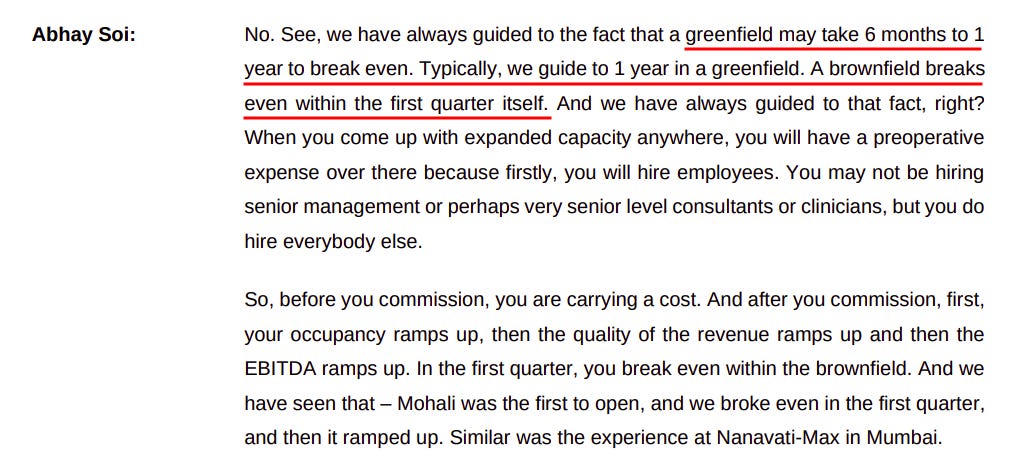
Part of the reason lies in where the new beds are going. Many are “brownfield” additions to hospitals that already exist, rather than “greenfield” hospitals built from scratch. A brownfield block inherits a known brand, doctors already on staff, and often a queue of patients the hospital was turning away. As Max’s chairman described it, such a block fills within three or four months, and since most hospital costs are fixed, every patient after that adds mostly profit. His rule of thumb: brownfield beds break even within a quarter, greenfield ones within six months to a year.
That speed isn’t uniform, though. It works best where a chain already has a strong local presence; Manipal admits its hospitals in newer markets like Mumbai and Raipur won’t break even “at the same breakneck speed.” Nor has the drag disappeared. Apollo’s new hospitals lost ₹35 crore this quarter, enough to pull down its overall hospital margin. At KIMS, revenue grew 41%, but profit barely moved.
And even beds that pay off quickly leave a mark further down the profit and loss statement. Max’s EBITDA grew 18% this quarter, but its profit only 10%, as depreciation and interest costs both rose by about a third. Fortis’s profit grew just 4%.
Why hospital profits look smaller than their margins
That gap sits at the heart of this quarter’s story. EBITDA measures what a hospital earns from treating patients, before counting the cost of the building it treats them in. Net profit counts everything. In a business this capital-hungry, the difference is enormous. A bed at Max’s upcoming Gurugram hospital costs roughly ₹2 crore, and every such bed shows up first as depreciation, and often as interest, long before it adds to profit.
That’s how the same industry can report operating margins of around 25% while Max’s chairman argues that the sector’s median net profit is closer to 9%. Both numbers are true, and which one you look at shapes how you read everything else here. Regulators capping drug margins see the 25%. Hospitals pushing back point to the 9%. And with tens of thousands of new beds on the way, the gap between the two is likely to stay wide for a while.
- This edition of the newsletter was written by Manie & Kashish.
Tidbits
[1] AI boom is making chips costlier for Indian automakers
Indian automakers are paying more for semiconductors as chipmakers divert capacity towards higher-margin AI data centres. Tata Motors, M&M and Ather have all flagged higher costs, although production has largely continued. S&P Global expects prices under new automotive DRAM contracts to rise 70–100% in 2026, with supply constraints potentially lasting through 2027.
Source: Business Standard
[2] ONGC takes over disputed Cambay block from Vedanta
ONGC has taken control of the CB-OS-02 oil and gas block after the Delhi High Court dismissed Vedanta’s challenge to the government’s refusal to extend its production-sharing contract. Vedanta, which held a 40% stake, has booked a ₹379 crore impairment. The dispute isn’t over yet: Vedanta has appealed and the judgment is reserved.
Source: Mint
[3] Indians are paying a smaller share of healthcare costs from their pockets
Households’ out-of-pocket spending has fallen from 64.2% of India’s total health expenditure in 2013-14 to 42.7% in 2023-24. Over the same period, government health spending more than tripled from ₹1.30 lakh crore to ₹4.14 lakh crore. Per-person government spending also rose from ₹1,042 to ₹2,959.
Source: Press Information Bureau
[4] India’s exports jump nearly 30% in October
India’s merchandise and services exports are estimated at $89.99 billion in October, up 29.9% year-on-year. Merchandise exports alone jumped from $34.11 billion to $49.47 billion, helped by petroleum products, electronics, gems and jewellery, chemicals and engineering goods. For April–October, total exports reached $568.84 billion, up 16.66%.
Source: Press Information Bureau
[5] ITC wants to double consumer spending on Savlon and Nimyle
Consumer spending on ITC-owned Savlon and Nimyle has crossed ₹1,000 crore and is growing at over 20% annually. ITC expects this to more than double to ₹2,000 crore in the medium term through new products and wider distribution. Since acquisition, Savlon has grown nearly nine-fold and Nimyle eight-fold.
Source: The Economic Times
Want more tidbits? Catch up on last week’s recap!

Beyond Today’s Brief
There’s always more happening at Markets by Zerodha.
The Chatter: What is Sunil Mittal’s strategic vision for Bharti Airtel amidst the evolving telecom landscape? And how is Hitachi positioning itself to capture demand across India’s infrastructure and technology sectors?
Aftermarket Report: How did a late recovery help Nifty defy intraday volatility, selling pressure, and a tumble in Asian markets to hold its ground near the 25,300 mark? And why did broader markets remain weak despite the headline index managing to finish the session on a positive note?
Join us on WhatsApp, where we share interesting soundbites from concalls, articles, and everything else we come across throughout the day. You’ll also get notified the moment a new video or article drops so that you can read or watch it right away.
Thank you for reading. Do share this with your friends and make them as smart as you are 😉