

Our goal with The Daily Brief is to simplify the biggest stories in the Indian markets and help you understand what they mean. We won’t just tell you what happened; we’ll tell you why and how too. We do this show in both formats: video and audio. This piece curates the stories that we talk about.
You can listen to the podcast on Spotify, Apple Podcasts, or wherever you get your podcasts and watch the videos on YouTube. You can also watch The Daily Brief in Hindi.
Just a quick heads-up before we dive in. The Jio Platforms IPO opened yesterday. We wrote about it then, and you can read the full story here.
In today’s edition of The Daily Brief:
1. Bajaj Finance has started behaving like a bank
While Bajaj Finance continues its rapid expansion with loan book growth surging 26% year-on-year to ₹5.85 lakh crore, the non-banking lender is shifting toward bank-like risk management. Facing impending rate hikes, regulatory restrictions on bullet gold loans, and proposed bans on revolving credit, the company has proactively raised ₹17,500 crore in equity, tightened its leverage ceiling, and built additional loss provisions to fortify its massive balance sheet.
2. India bets on better weather forecasting
To tackle increasingly volatile climate patterns and their severe impact on agriculture and food inflation, India is scaling up its ₹2,000-crore Mission Mausam with a proposed ₹10,000-crore expansion plan. Supported by new supercomputers, higher-resolution 6-km forecasting models, and an expanded Doppler radar network, the initiative aims to deliver hyper-local, 5-km-grid weather alerts and improve extreme weather prediction accuracy by 2030.
Bajaj Finance has started behaving like a bank
For most of its life, Bajaj Finance has been the fast, aggressive kid of Indian lending. It made no-cost EMIs a household habit, lent to people banks often wouldn’t, and grew at a pace no bank could match.
It’s still growing fast. Its loan book rose 26% over the past year, quicker than when we asked whether its best days were behind it almost two years ago. But listen to how it talks now, and it sounds less like a challenger and more like a bank. It’s raising capital it doesn’t need, lowering the ceiling on its own borrowing, and setting aside money for losses it hasn’t seen yet.
That’s no coincidence. By its own reckoning, Bajaj Finance is about to become bigger than HDFC Ltd was when it merged into HDFC Bank. At that size, mistakes stop being cheap. This quarter showed that caution.

Another quarter, another ₹38,000 crore
Just how big is it?
Bajaj Finance’s assets under management (AUM), the total value of the loans it manages, now stand at ₹5.85 lakh crore. In these three months alone, it added ₹37,680 crore.
For perspective, Bajaj Finance’s entire loan book in FY08 was about ₹2,500 crore. Last quarter, it added fifteen times that. Even Rajeev Jain, its vice chairman and managing director, sounded a little surprised on the earnings call: “These are fascinating numbers even for me.”
It now has 12.9 crore customers, roughly one in every eleven Indians. Profit grew 29% to ~₹6,400 crore.
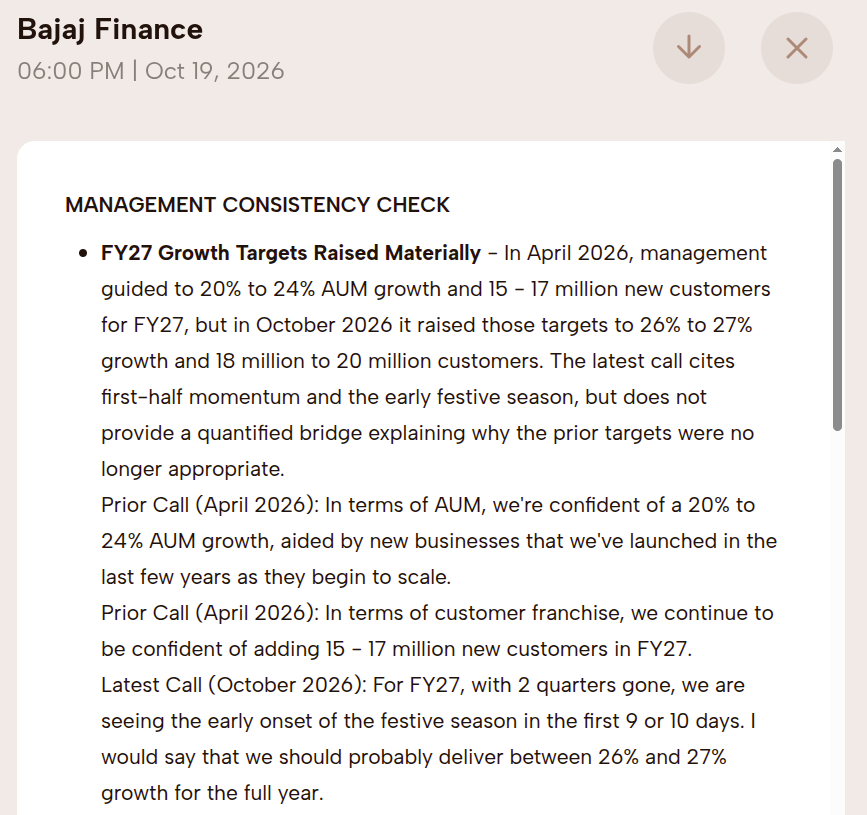
This comes after a rough patch. A year ago, Bajaj Finance cut its FY26 growth guidance to 22–23%, from 24–25%, after stress in its loans to small businesses forced it to slash volumes there. It ended FY26 at about 22%, and began this year guiding for 22–24%. Now it expects 26–27%, above the 23–25% it considers its long-run normal.
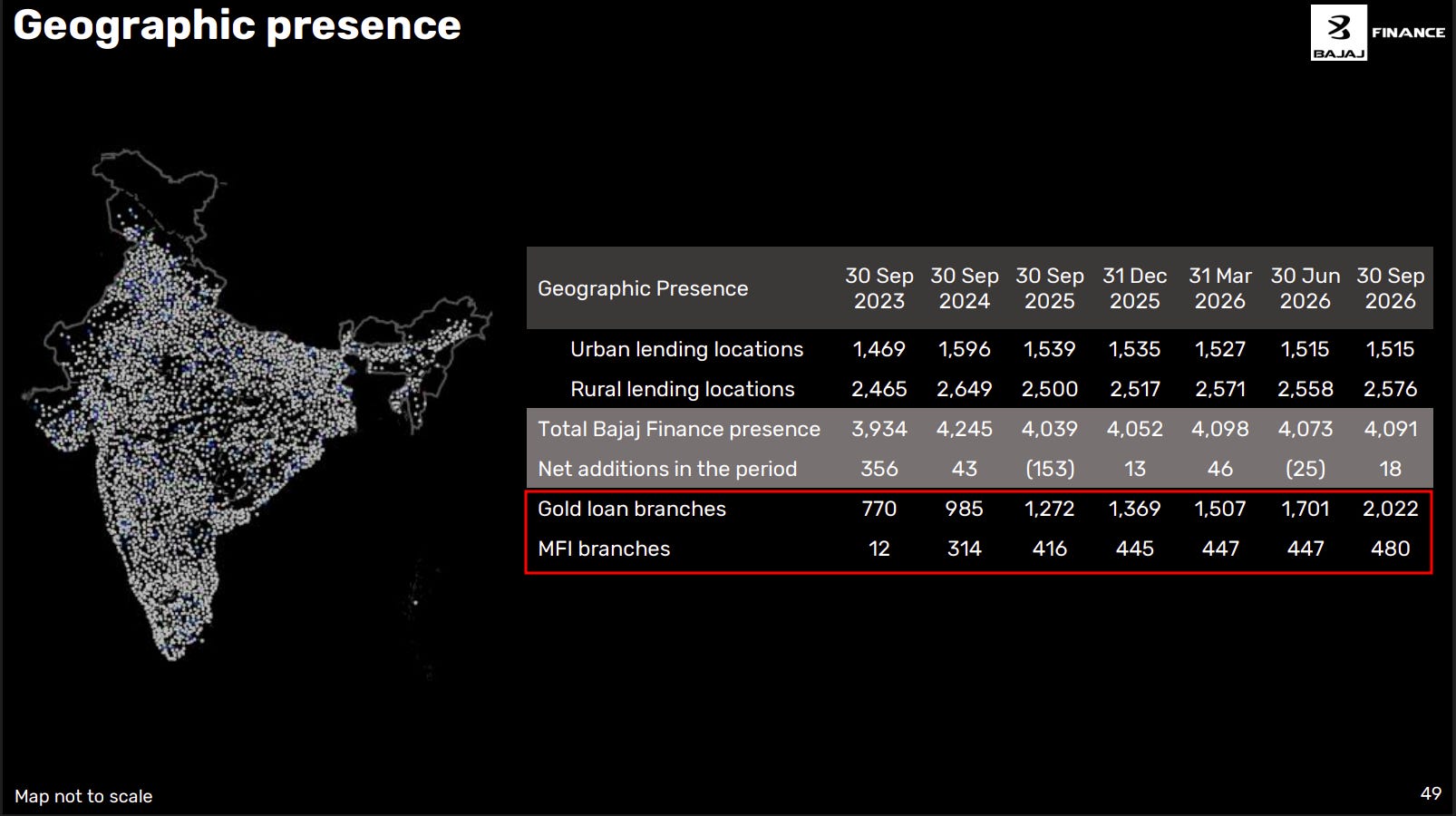
One of our worries last time, that it was running out of new places to set up shop, turned out to be right. Its count of locations has actually fallen over two years.
Growth simply found other roads: twice as many gold loan branches, new microfinance branches, and existing customers, who now take nearly 68% of its new loans, up from 58% in FY25.
The rate hike Bajaj Finance hasn’t felt yet
We explained last week why the RBI is fighting inflation on three fronts. One of those fronts is interest rates: in October, it raised the repo rate to 5.50%, its first hike since February 2023. Bajaj Finance is bracing for two more this year, which would take the rate to around 6%.
That matters more to an NBFC than to a bank. Banks fund much of their lending with cheap savings and current account deposits. NBFCs don’t have those, so Bajaj Finance borrows almost everything it lends: about 40% through bonds, 30% from banks, 14% through fixed deposits (down from 21% in early 2024), and the rest from short-term paper and overseas loans. When rates rise, all of it eventually gets costlier, the short-term stuff first.
And yet, this quarter, Bajaj Finance’s cost of funds actually fell, by 9 basis points to 7.31%. Stranger still, its net interest margin, the gap between what it earns on loans and what it pays on borrowings, shrank anyway, by 10–12 basis points.
The fall in costs is the easy part. The hike only came a week after the quarter ended. Until then, Bajaj Finance was still enjoying the tail end of the RBI’s 125 basis points of rate cuts in 2025, and it had hedged a good chunk of its borrowing costs before rates turned.
The shrinking margin comes from the other side: what Bajaj Finance earns. Its fastest-growing businesses are also its safest, and safety pays less. Home loans, loans against shares and gold loans, all backed by collateral and carrying lower rates, went from about 40% of its book to 43% in a year.
The high-yield stuff stagnated. Small-business loans barely grew, an old two-wheeler book is running off, and Bajaj Finance is deliberately turning away some of its most indebted borrowers, who pay the most. So its yields fell faster than its borrowing costs.
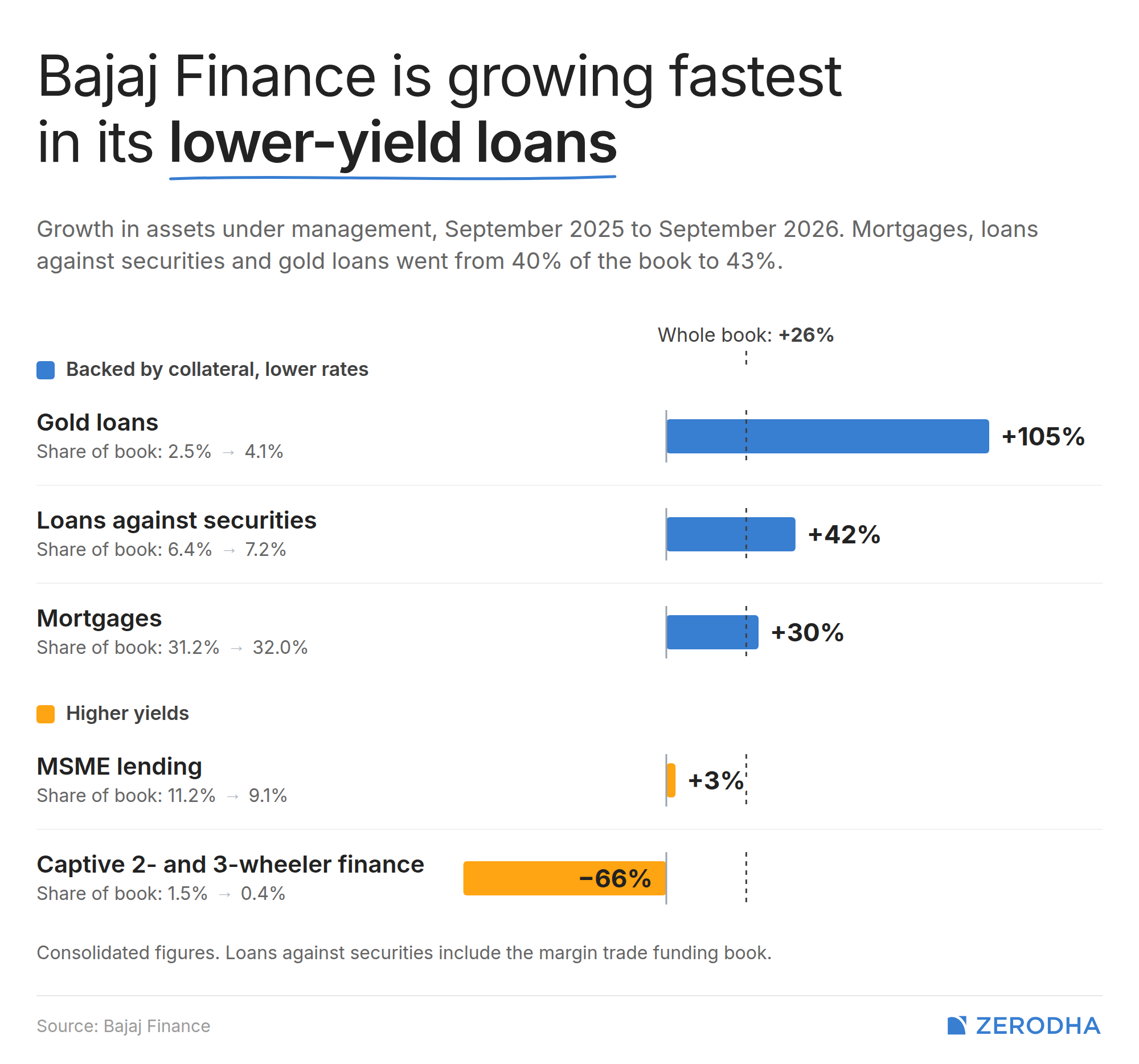
Management now expects margins to shrink a little more this year than the 10–15 basis points it had guided for, and hopes to make up for it by running leaner and losing less to bad loans.
Why Bajaj Finance chose to lend less against gold
Gold loans are one of those safer, collateral-backed businesses, and Bajaj Finance’s fastest-growing large one. The book more than doubled in a year, and it plans to have about 40% more gold loan branches by the end of this financial year.
Yet this quarter, the share of its gold loans in “Stage 2” jumped from under 1% to about 4.5%. Stage 2 is where a borrower has fallen behind by over a month but hasn’t yet defaulted. The trigger was a new RBI rulebook for gold loans that kicked in this April.
To see why, you need to know how most gold loans in India work. They’re “bullet” loans: you pledge your jewellery, take the cash, and repay principal and interest in one go at the end. The RBI caps how much a lender can give against your gold, at up to 85% of its value for smaller loans. Under the new rules, for bullet loans, that cap covers everything you’ll owe over the life of the loan, interest included. That wasn’t the case earlier.
That created a curious incentive. Say your gold is worth ₹1 lakh, and the interest rate is 12% a year. On a 12-month loan, what you owe at the end must stay under ₹85,000, so you can only borrow about ₹76,000 today.
What happens if you make it a three-month loan? There’s far less interest to account for, so you could borrow about ₹82,500 against the very same gold.
So lenders, Bajaj Finance included, rushed to offer three-month loans after the rule change in April. The catch is that the borrower now has to come back to the branch every three months to pay interest and renew. Many don’t, often not because they can’t pay, but because it’s a hassle.
That’s what produced a jump of over ₹1,000 crore in stage 2 gold loans. These shorter loans simply fell overdue sooner.
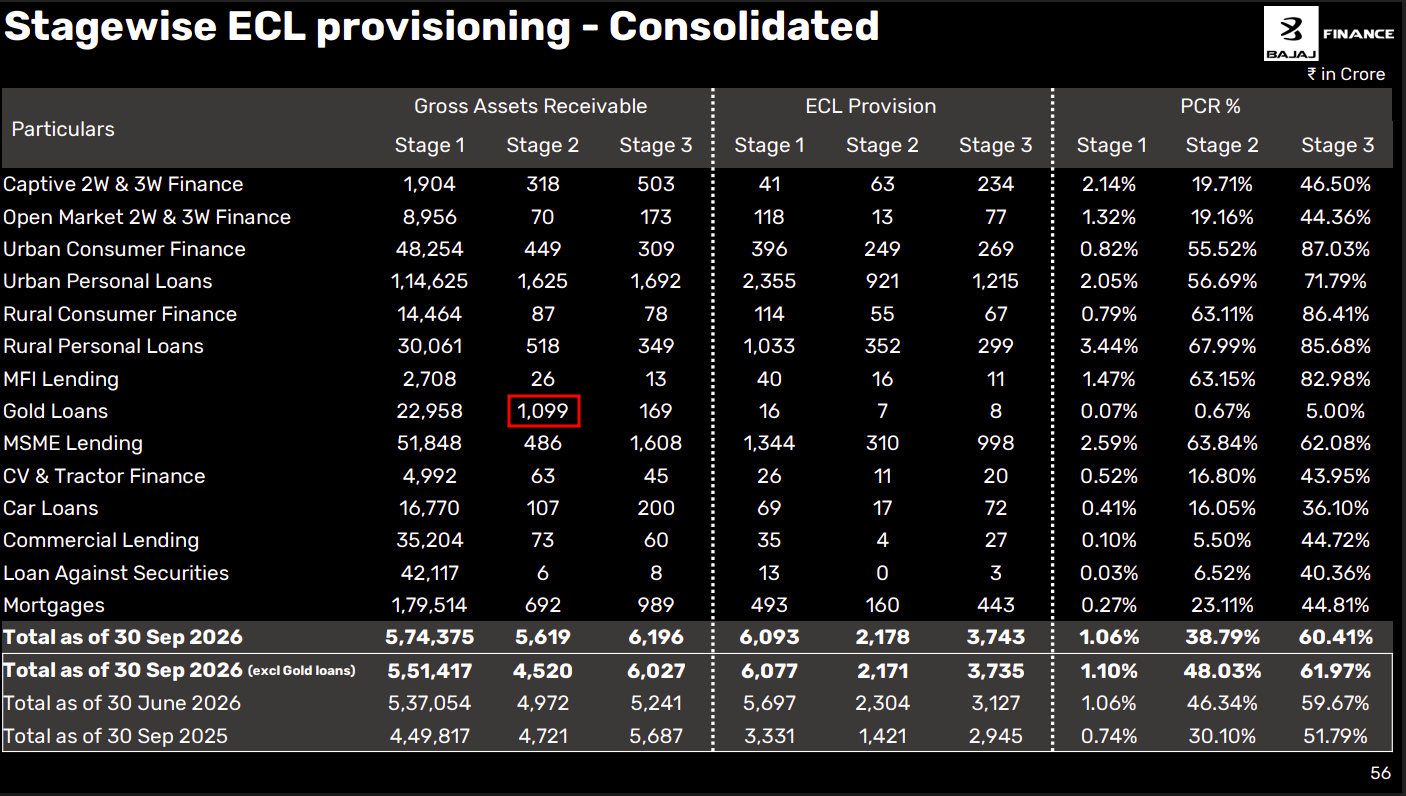
Bajaj Finance didn’t like this, and scrapped the three-month loans in August, even though much of the industry still offers them. It went back to 9–12 month loans, with the option to pay interest monthly or quarterly. That should bring the spike in stage 2 loans back down.
Going back to longer loans also means smaller loans than its rivals offer, and slower growth. Management seemed fine with that.
Two rules still being written
The gold rules are already in force. Two other changes are still proposals, so for now they’re risks rather than rules. But both go after products central to how Bajaj Finance makes money.
The first is about revolving credit. In August, the RBI proposed that most NBFCs should offer only term loans, where you borrow a fixed sum and repay it on a set schedule. They’d no longer be allowed to offer revolving credit, where you get a limit you can borrow from, repay, and borrow from again. Only NBFCs licensed to issue credit cards would be exempt. The RBI’s worry is that borrowers might use such credit lines to pay off older dues, and slip into a cycle of debt.
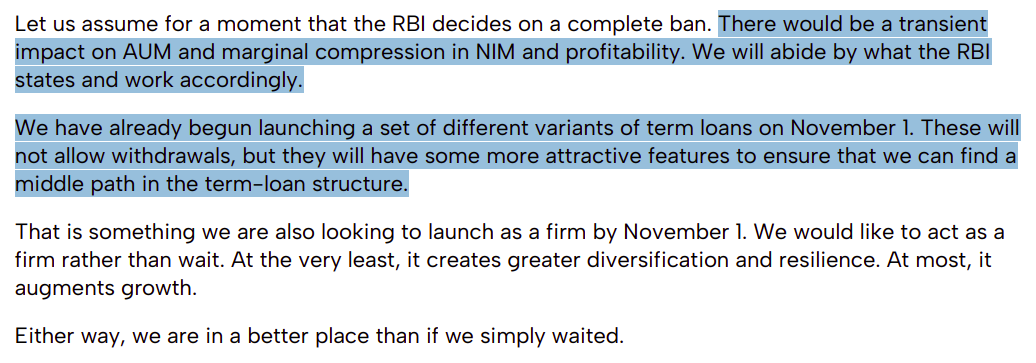
That’s exactly how Bajaj Finance’s “Flexi” loans work, and analysts estimate they make up somewhere around 13% of its book. Management says even a complete ban would only cause a “transient” dent in growth and slightly thinner margins. It isn’t waiting to find out, either. From November 1, it’s launching new term-loan products meant to keep some of that flexibility within the rules.
The second is insurance. In September, the insurance regulator, IRDAI, proposed sharp caps on the commissions banks and NBFCs earn for selling insurance. It also wants to stop lenders from making insurance compulsory with a loan.
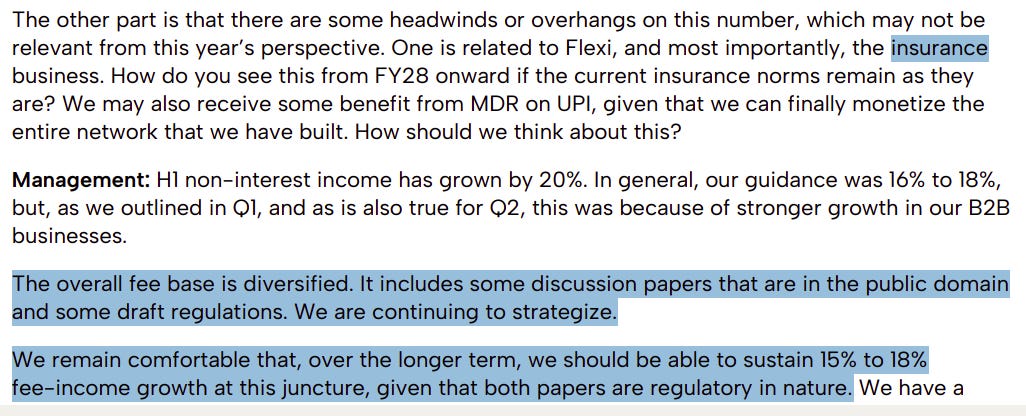
This isn’t small change. Fees make up about 28% of Bajaj Finance’s pre-tax profit, and selling third-party products like insurance accounted for over a third of those fees. Management says it can still grow fee income at 15–18% a year, and that its plans are ready for when the final rules land.
Where the stress has moved
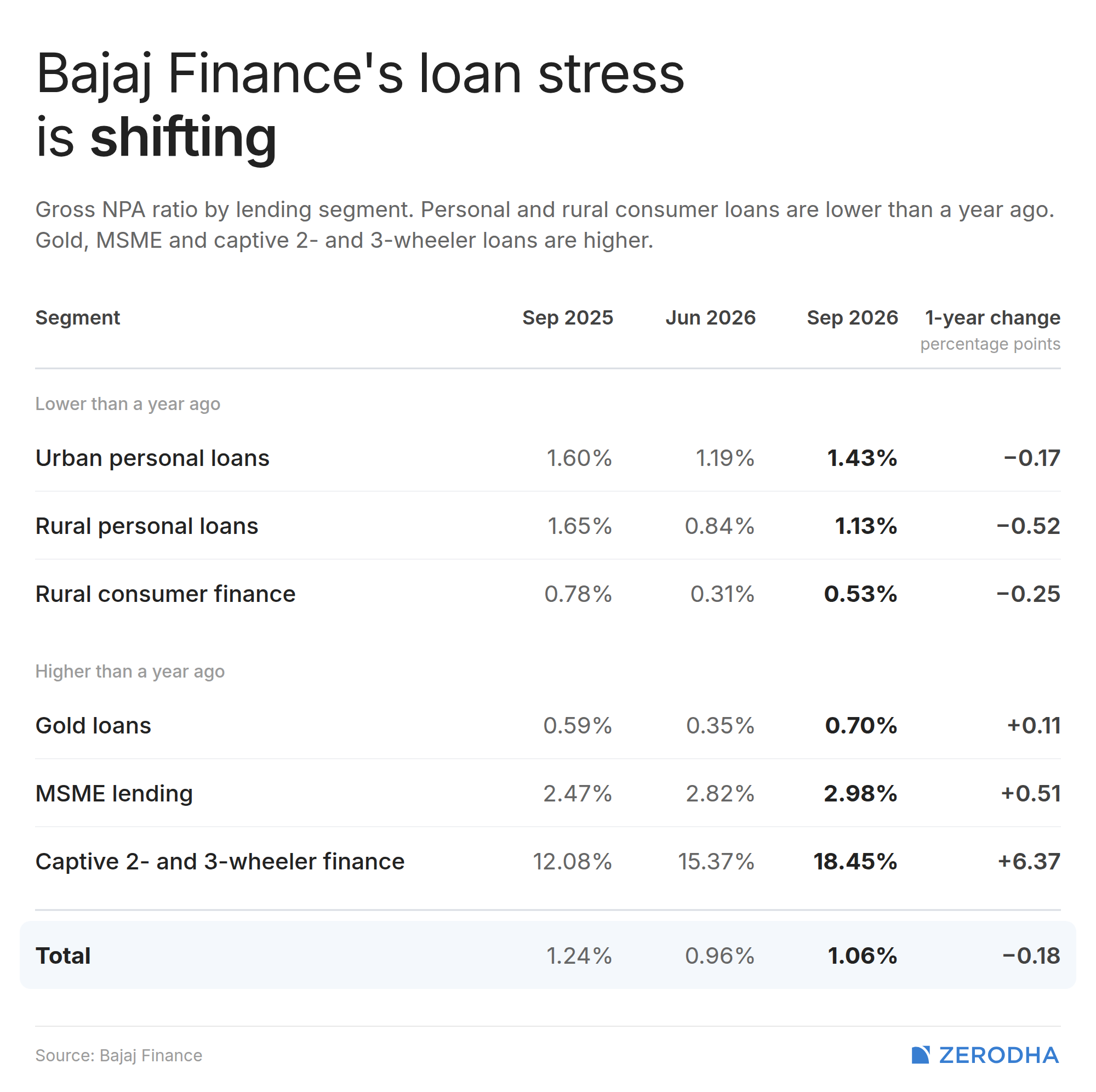
Regulation is a risk Bajaj Finance can at least see coming. Bad loans are harder to read. When we last wrote about Bajaj Finance, the worry was stress in unsecured retail loans, and that got worse before it got better. Over the year, gross NPAs in urban personal loans fell from 1.60% to 1.43%, and in rural personal loans from 1.65% to 1.13%.
But the stress just moved to other segments.
The clearest spot is loans to small businesses, or MSMEs. This book grew just 3% in a year, while its gross NPAs rose from 2.5% to 3%. Management calls this “pure mathematics”: when a book barely grows, the same bad loans look bigger as a share of it. We’ve seen that effect before, with the captive two-wheeler loans from Bajaj Auto showrooms we wrote about last time. That book has since shrunk another 66%, and its NPA ratio has ballooned to 18.45%.
But MSMEs are only partly a denominator story. In rupee terms too bad MSME loans grew by roughly 25% over the year, while the book grew just 3%. That’s older loans going sour, not just arithmetic. Bajaj Finance tightened how it lends to small businesses in July 2025, says loans written since then are behaving well, and expects double-digit growth to return in the second half.
The newest worry is rural India, and the weather.
India’s monsoon ended about 13% below normal this year, partly because of El Niño, as we wrote last week. Maharashtra and Karnataka had it far worse declaring drought in most of their talukas.
A failed monsoon hits lenders slowly. Crops fail and farm incomes fall, and then so do the incomes of the labourers, shopkeepers and traders around those farms. It can be months before any of that shows up as missed EMIs.
So far, it hasn’t clearly shown up at Bajaj Finance. Rural personal loans look healthier than they did a year ago. They aren’t waiting for the numbers to turn, though. It says it tracks all of India’s roughly 720 districts, and has spent the last few months cutting back on microfinance and other lending in drought-hit ones, with Maharashtra the worst affected.
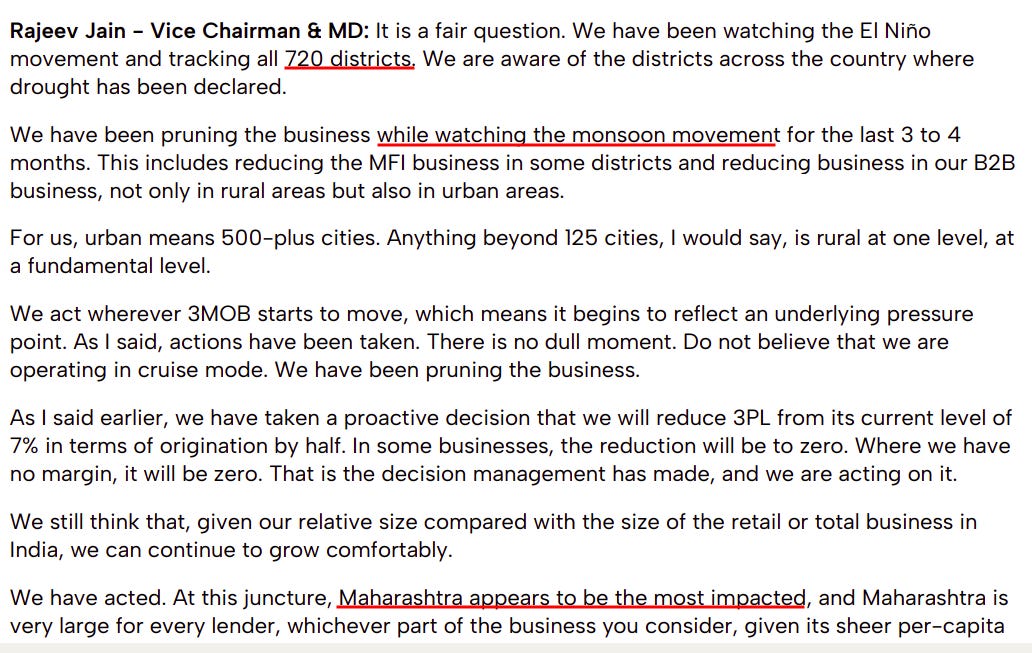
It also set aside an extra ₹337 crore this quarter as a “macro overlay”. A lender’s provisions usually come from models built on past data, and those models struggle with things that haven’t happened yet, like a drought, oil at $100–110 a barrel, and the inflation that follows. An overlay is a cushion on top, based on management’s judgment. Bajaj Finance’s is aimed at unsecured loans to self-employed borrowers, whose incomes take the first hit from droughts and price spikes in a way salaries don’t.
And it’s only one of the cushions Bajaj Finance is building.
Bulletproofing a giant
The biggest cushion comes in now, when its board approved raising up to ₹17,500 crore of fresh equity: ₹11,700 crore from institutional investors, and ₹5,800 crore from its parent, Bajaj Finserv.
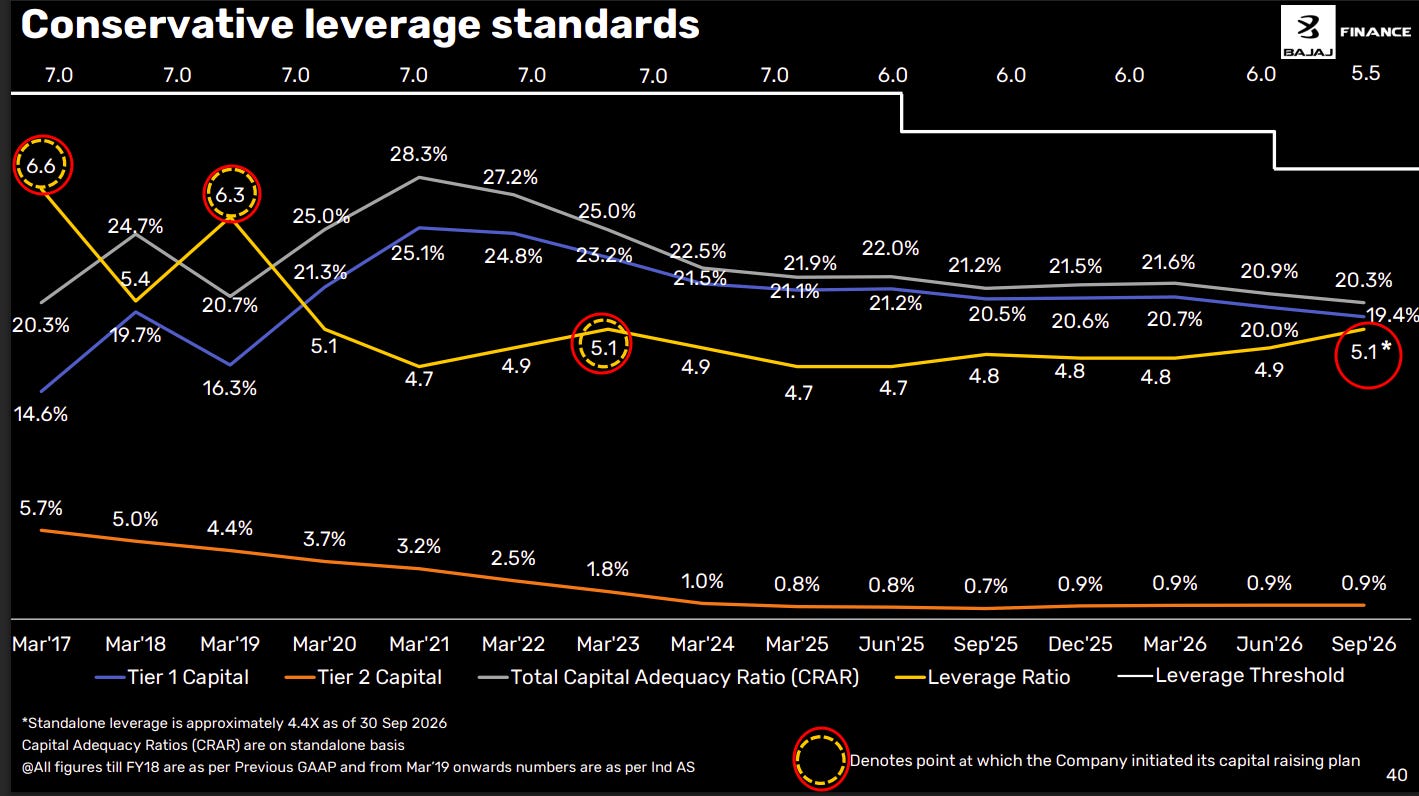
The odd thing is that Bajaj Finance doesn’t need this money. Its capital adequacy ratio is 20.3%, well above the 15% the RBI requires.
What it’s really doing is moving its own goalposts. Bajaj Finance has always raised capital before its leverage, or how many rupees it borrows for every rupee of its own, got too high. In 2017 and 2019, it raised money with leverage above six times. Its last raise, of about ₹10,000 crore in 2023, began at about 5.1 times. Leverage is back at 5.1 times today. But this time, it has also lowered its ceiling to 5–5.5 times, from 6 earlier, and 7 before that.
It even had another way to raise the money: selling down its stake in Bajaj Housing Finance, which it must cut from 87% to 75% within three years anyway. It chose to give that business more time.
So why raise money it doesn’t need? Because of scale. At ₹5.85 lakh crore, a rate hike, a rule change or a bad monsoon is no longer a passing headwind for Bajaj Finance. Each one lands on a balance sheet that the whole system now has a stake in, and one that regulators watch more closely the bigger it gets.
Hence the cushions: more capital, less leverage, extra provisions, and nearly ₹20,000 crore of cash on hand. Bajaj Finance still grows like the fast, aggressive kid of Indian lending. It has just started thinking like a bank.

India bets on better weather forecasting
Most of us don’t think about weather forecasts beyond whether to carry an umbrella. But for millions of Indians, a forecast decides when to sow, when to harvest, whether to go to sea, and when to leave home before a cyclone hits. That, in turn, also shapes what the rest of us pay for commodities like vegetables and grains. With climate change, those prices are only getting more volatile.
What would help make it more predictable is better weather forecasting. That is the bet India is making with Mission Mausam, a ₹2,000 crore, two-year scheme to make the country “weather-ready and climate-smart“.

Two years since, that bet may be about to get much bigger. In September 2026, a ₹10,000 crore plan to expand the mission was tabled with the Finance Ministry. It’s a good time, then, to look at the progress so far, and how it has advanced how we predict climate vagaries.
First, what has already changed
The standard weather forecast is its own intricate process.
In it, a weather model splits the country into a grid of squares and works out the weather in each square. The smaller the squares, the sharper the picture. India’s two main weather models work with squares 12 km wide. A newer one, the Bharat Forecasting System, now works with squares just 6 km wide. That is sharp enough to forecast for individual blocks, and over time, for panchayats.
But this is harder than it sounds. If you halve the size of the squares, you get four times as many of them to calculate for the same map. India also has some of the hardest weather in the world to predict.
That is why computing power matters. In September 2024, the Prime Minister inaugurated two new supercomputers under Mission Mausam, called Arka and Arunika. Along with a separate AI system, they have more than tripled the ministry’s computing power since 2018, when its earlier supercomputers, Pratyush and Mihir, gave it 6.8 petaflops. One petaflop is a thousand trillion calculations every second. Forecasters now also get help from three AI-based global weather models.
The second big change is in how forecasts reach people. For instance, in IMD’s Mausamgram platform, when you type in a PIN code, you can get village-level forecasts with updates by the hour for the next 36 hours, and further ahead up to ten days. Forecasts now go out on WhatsApp to panchayat members, who can pass them on. And under Mission Mausam, IMD has built a tool which gives farmers advice suited to their location, their crop and how far along that crop is.
However, it’s a little harder to measure the actual impact of these changes. The government says forecasts of severe weather have become 40% more accurate in recent decades compared with the decade before. But that covers many years of work, most of it before Mission Mausam began. What the mission alone has added has not yet been published.
What Mission Mausam promised
Sharper models and faster computers only help if they’re fed good information. That is the heart of Mission Mausam: putting many more eyes and ears on India’s weather.
But part of the problem lies in where the measurement systems that collect data are located.
In late 2024, India had 39 Doppler weather radars, which are the main tool for warning people about thunderstorms, heavy rain and approaching cyclones beforehand. Most of the big, long-range ones, which can see about 400 km, stand along the coast, in cities like Visakhapatnam, Paradip, Chennai, Kochi, and Mumbai.
That’s no accident, either. India’s weather service was set up in the 1870s partly to warn ports and coastal towns about cyclones, and the coast is still where its strongest radars stand. Smaller radars, which see about 100 km, are scattered across the Himalayas, from Srinagar and Leh to Kufri and Mukteshwar, where mountains block the view of the bigger ones.
The rest sit in large inland cities such as Delhi, Nagpur, Bhopal, Lucknow and Patna. Alongside the radars, IMD sends up weather balloons twice a day from 56 stations, which measure the air up to about 30 km above the ground.
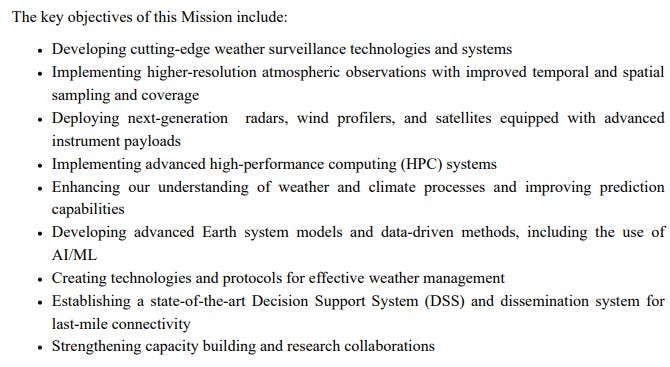
The mission plans to set up a long list of instruments, like doppler weather radars, weather balloon stations, wind profiler radars, disdrometers that count raindrops, and so on. Each of them tackles a different feature of weather. All of it is meant to add up to three things by 2030: warnings of severe weather for every 5 km by 5 km patch of the country, alerts that reach every household, and forecasts that are 10–15% more accurate.
But where the new instruments will go is less clear. The government says locations are picked based on what forecasters need, how exposed an area is to dangerous weather, and what resources are available, but it hasn’t published a full list. What it has shared is the mix. Of the 86 new radars it listed in July 2026, 45 are the smaller X-band kind, alongside 29 medium-range C-band and 12 long-range S-band radars. An X-band radar, for instance, sees about a quarter as far as the big coastal ones, so it’s built to watch a smaller area more closely.
Where the build-out stands
Now, the plan was for the first phase to run from 2024 to 2026. When the mission was announced, the ministry’s Secretary said the aim was to have a wider network of radars, wind profilers and radiometers in place by March 2026.
By March 2026, most of these instruments were still being bought. The government told the Lok Sabha that they were “in advanced stages of procurement.”
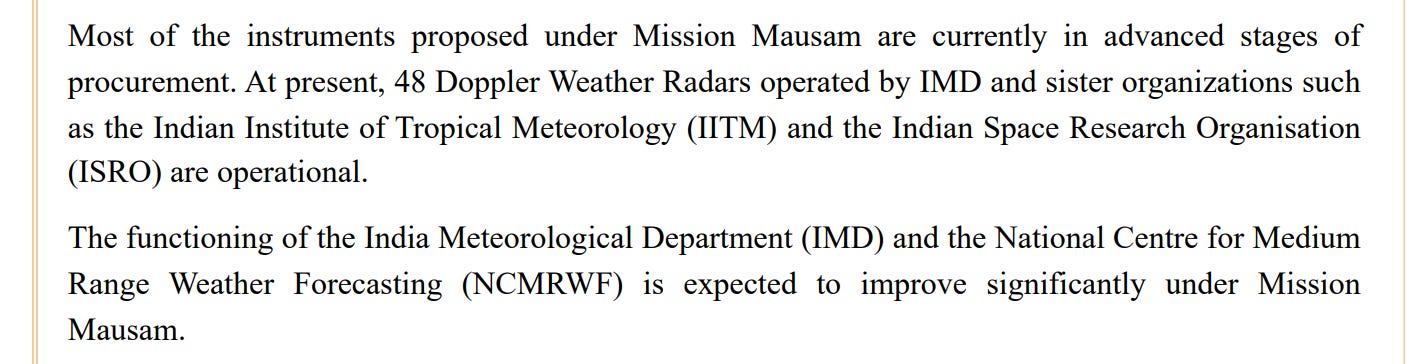
Radars give the clearest picture. In March, India had 48 working Doppler weather radars, run by IMD, IITM and ISRO. By July, it had 50. That count includes radars set up long before the mission began, and the government has not said how many of them came from Mission Mausam.
The money tells a similar story. The mission spent ~₹516 crore in its first year, 2024-25. For 2025-26, the government set aside ₹1,329 crore, then cut it to ₹840 crore partway through the year. The biggest cut was in capital spending, the money used to buy equipment and other lasting assets, which fell from ~₹529 crore to ~₹178 crore. Put together, about ₹1,356 crore of the ₹2,000 crore was set to be spent in the first two years.
None of this has to mean the plan has been dropped. Weather radars are complex machines, and big government purchases often slip from one year to the next. The 2026-27 budget sets aside ~₹1,342 crore for the mission, including ₹487 crore for equipment. That suggests the buying has simply moved into this year.
But it does mean that two years in, many of the instruments at the centre of the mission are, as far as the public record shows, still on their way.
So why ask for more money now?
If so much of the first phase is still being built, why is the government already planning a second one, and a ₹10,000 crore expansion?
As per Mint, which cited two people aware of the plan, the money would go towards more radars, more satellites and more trained staff. But that’s still source-based, and the government hasn’t explained its thinking in public yet.
To be fair, a second phase was always part of the plan. IMD’s own mission document says Phase I would run from 2024 to 2026, and Phase II from 2026 to 2031, in the government’s next spending cycle.
But another possible reason for why the expansion was announced now is that this kind of equipment takes years to plan, order and install. If funding for the next stage is decided only after every first-phase radar is up and running, work could stall in between.
Yet another reason is that there are gaps that the first phase was never meant to fill. In January 2026, Earth Sciences Secretary M. Ravichandran said the second phase would focus on measuring the weather higher up in the sky, including through readings taken from aircraft, Informist reported.
So, should the government wait for results first? There is a fair case on both sides.
The case for waiting is simple. The first phase spent less than planned, and the equipment budget was cut sharply in 2025-26. More money can’t make a radar arrive faster if the slowdown is in buying and installing it.
The case against waiting is also strong. Extreme weather is not waiting, and erratic weather and disasters are already pushing up the social and economic costs of installing new measurement systems. There may even be a middle path: approve the next phase, but tie the money to clear milestones, such as the number of instruments installed each year, and share that progress in public.
Either way, the success of India’s weather forecasting bet will depend on timing which is only going to get harder to land with time.
- This edition of the newsletter was written by Kashish & Kulsum.
Tidbits
1. SBI investigates suspected data leak involving customer records
State Bank of India is investigating a suspected data leak after around 3.75 lakh records linked to the bank surfaced on the dark web. Preliminary analysis identified 3,897 customer records containing personally identifiable information, while SBI said the incident has had no material impact on its operations.
Source: The Economic Times
2. Government to pitch 11 airports to global investors ahead of December bidding
The Indian government plans to hold promotional roadshows in international financial hubs to attract foreign investors for the upcoming airport privatisation process. The December bidding round will cover 11 airports across the country.
Source: The Economic Times
3. Newsprint manufacturers seek PM’s intervention over coal supply disruptions
The Indian Newsprint Manufacturers Association has sought Prime Minister Narendra Modi’s intervention regarding irregular coal dispatches to the non-regulated sector. The industry body warned that rail rake delays are severely disrupting operations and forcing manufacturers to buy open-market coal at exorbitant prices, sharply driving up production costs.
Source: Business Standard
4. India’s strategic petroleum reserve expansion gains urgency amid energy-security concerns
India is developing 6.5 million tonnes of additional commercial-cum-strategic crude storage at Chandikhol in Odisha and Padur in Karnataka under Phase 2 of its reserve programme. The projects are being viewed as increasingly important as geopolitical disruptions expose India’s dependence on imported crude.
Source: The Hindu BusinessLine
5. Satellite-based highway tolling to begin on select stretches, not replace FASTag immediately
The government is targeting satellite-based tolling on select national highways from around 2028, with the system initially operating alongside FASTag and other electronic tolling infrastructure. A nationwide transition would come only later, subject to technical readiness and successful phased deployment.
Source: Livemint
Want more tidbits? Catch up on last week’s recap!

Beyond Today’s Brief
There’s always more happening at Markets by Zerodha.
The Chatter: What are executive teams across real estate, cement, and metals signalling for Q2 FY27? How is DLF establishing a new ₹100 crore benchmark per apartment at Dahlias, while UltraTech Cement sees spot price realisations rise 5% and Hindustan Zinc delivers a record 62% EBITDA margin?
Points & Figures: Why are fewer Indians flying? From a 6.5% drop in domestic air passengers to a 170% surge in jet fuel prices and severe disruptions on West Asia routes, what do airline cuts and empty seats reveal about the true cost of air travel?
Aftermarket Report: How did Nifty erase a strong 127-point gap-up to close near 22,800 as rising oil prices and persistent selling pressure weighed on markets? And what do extreme fear, sharply negative market breadth, and bearish FII and options positioning reveal about sentiment despite strength in IT stocks?
Subtext by Zerodha: What is the true cost of India’s government job exams? In our latest episode, former development economist and AI engineer Kunal Mangal breaks down why millions of aspirants take multiple attempts at the UPSC, how they assess risk, and what this reveals about unemployment, skill development, and state capacity in India.
Join us on WhatsApp, where we share interesting soundbites from concalls, articles, and everything else we come across throughout the day. You’ll also get notified the moment a new video or article drops so that you can read or watch it right away.
Thank you for reading. Do share this with your friends and make them as smart as you are 😉
can you guys also cover other NBFCs like Shriram and Sundaram Finance as well??
The point that Bajaj Finance's cost of funds fell 9 basis points while its margin still shrank 10-12 basis points is a useful detail. It shows the mix shift toward safer, lower-yield secured loans is doing the work, not funding costs, ahead of the repo rate hikes it expects.