



Our goal with The Daily Brief is to simplify the biggest stories in the Indian markets and help you understand what they mean. We won’t just tell you what happened; we’ll tell you why and how too. We do this show in both formats: video and audio. This piece curates the stories that we talk about.
You can listen to the podcast on Spotify, Apple Podcasts, or wherever you get your podcasts and watch the videos on YouTube. You can also watch The Daily Brief in Hindi.
In today’s edition of The Daily Brief:
1. What happens when insurance commissions are cut?
India’s insurance regulator, IRDAI, has proposed reintroducing strict product-level commission caps and lowering overall Expenses of Management (EOM) limits for insurers. While the draft proposal triggered a sharp sell-off in shares of online brokers and NBFC distribution partners who face immediate revenue cuts, the regulator aims to curb rising distribution costs and shift focus toward policy renewals and long-term customer retention.
2. How much of a credit rating is the country name?
A new IMF study shows that sovereign credit ratings often penalise developing nations like India even when their debt ratios and budget deficits match higher-rated advanced economies. Beyond basic fiscal metrics, rating agencies heavily weigh a “country-specific adjustment”—reflecting institutional perception, currency risk, and past credit reputation—which leaves India’s sovereign rating capped at investment-grade floors.
Varsity Live
Whether you’re new to Zerodha or want to make better use of your account, we’re hosting a free interactive walkthrough covering how Kite, Console, and Coin work together, from researching stocks to tracking portfolio performance and tax reports. Join us on Saturday, 26 September 2026:
English (11:00 AM – 02:00 PM)
Hindi (04:30 PM – 07:30 PM)
What happens when insurance commissions are cut?
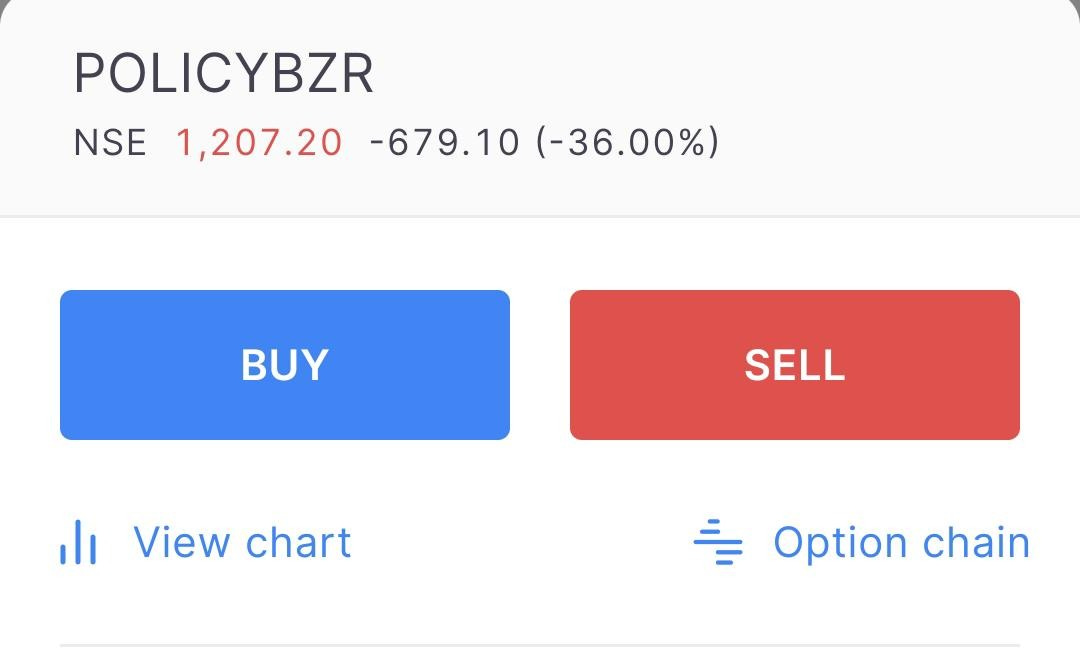
On 24 September, shares of PB Fintech, the company behind Policybazaar, closed about 36% lower. Fellow insurance distributor Turtlemint fell 20%. The trigger was a consultation paper from India’s insurance regulator, IRDAI, proposing big changes to how insurance is sold.
Banks and non-banking financial companies, or NBFCs, earn money from selling insurance too. Their shares fell, though less sharply. But share prices tell only part of the story. The proposals could also lower insurers’ costs, improve customers’ experience and change how many people buy cover.
The impact will depend on whom you ask. IRDAI sees a problem in the market and wants to step in; distributors, insurers and customers each have something different at stake.
For now, these are only proposals. To understand whether the intervention is warranted, and whether it might work, we need to start with how insurance reaches customers.
What is changing?
A large share of retail insurance is sold through agents, banks, brokers and platforms. Insurers pay these distributors commissions for bringing in customers and, sometimes, helping service their policies.
That matters because insurance is often a push product. Someone may need to explain why a customer needs cover, persuade them to act and help them buy it. Demand does not always arrive on its own, thus distributors have a real place in this system.
Before 2023, IRDAI set commission limits for different products and sales channels. It then removed those detailed caps, giving insurers more freedom to decide what to pay. There was still an overall limit on what insurers could spend to run their business and sell policies, including commissions. That limit is called expenses of management, or EOM.
Now, IRDAI wants to bring specific commission caps back and tighten the overall spending limit. The proposed caps vary by product and sales channel, with lower payouts where selling takes less effort.
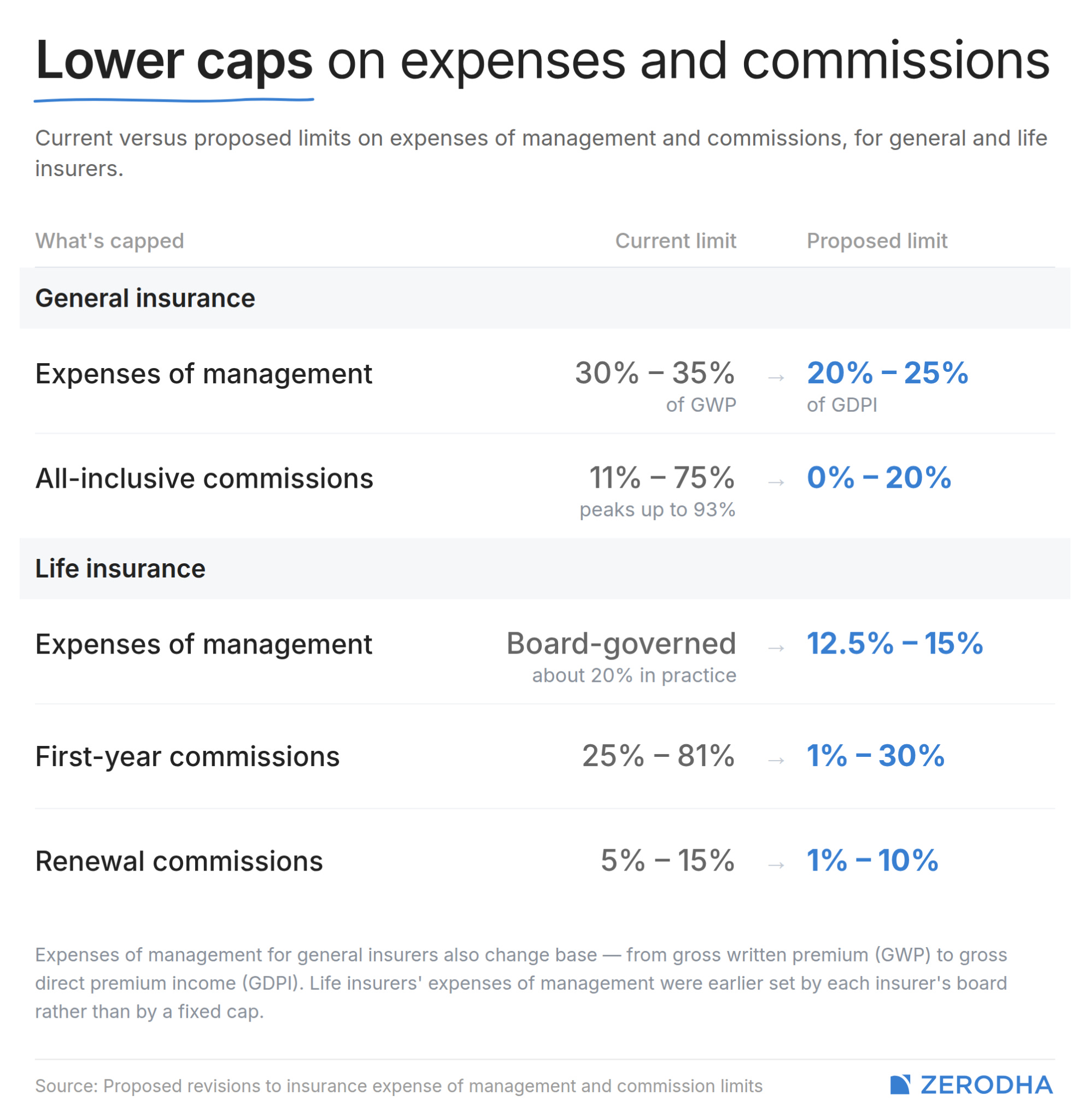
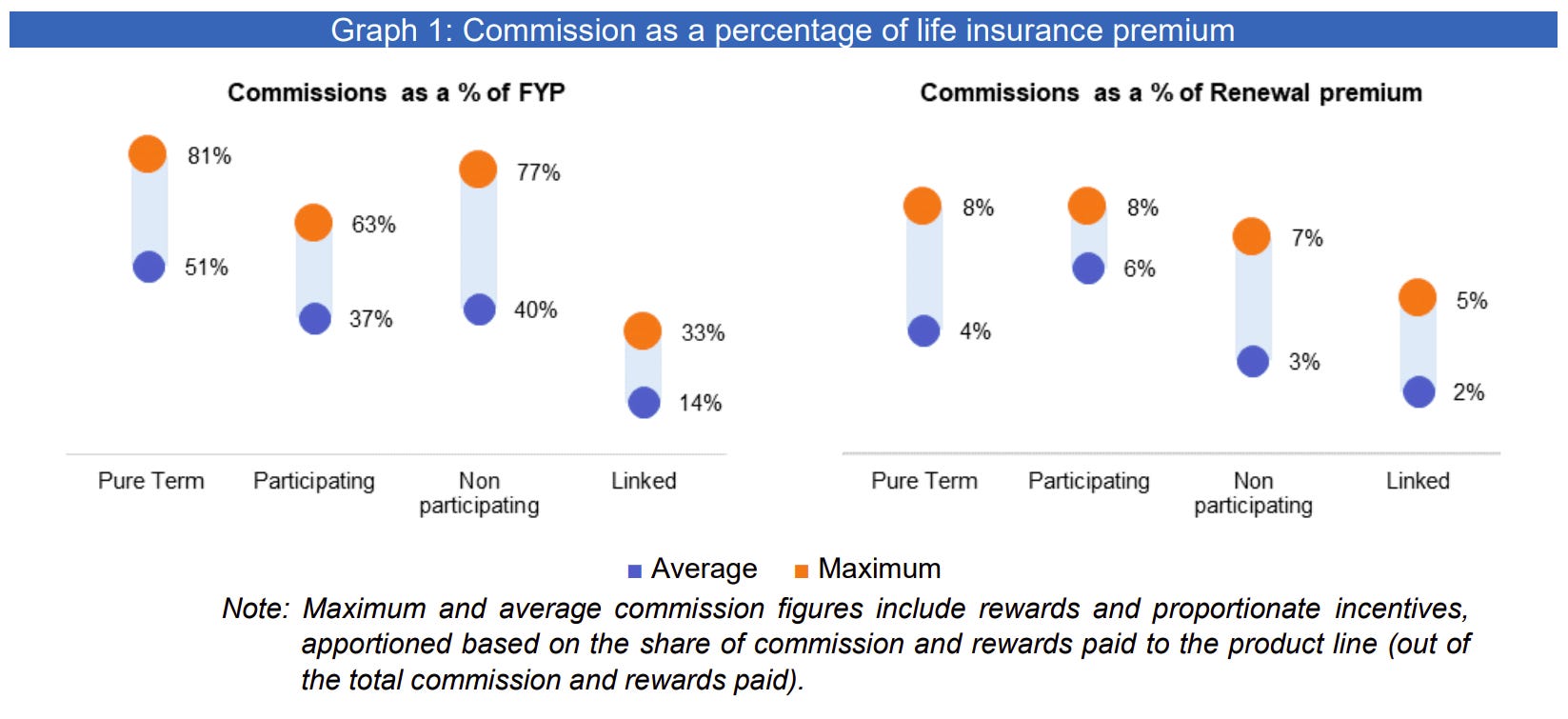
The consultation paper runs to more than 120 pages, but one example gives you a sense of the shift. On individual term life insurance, first-year commissions averaged 51%, with some reaching 81%. The proposed first-year cap for multi-year pure term policies is 25% for banks and brokers, and 30% for agents.
Many distributors could have to work with much lower payouts. What happens after that is less straightforward.
Why IRDAI wants to intervene
IRDAI’s case starts with a striking gap. In the distribution channels it studied, payments to distributors grew roughly four to five times as fast as the premiums they brought in between FY23 and FY25.
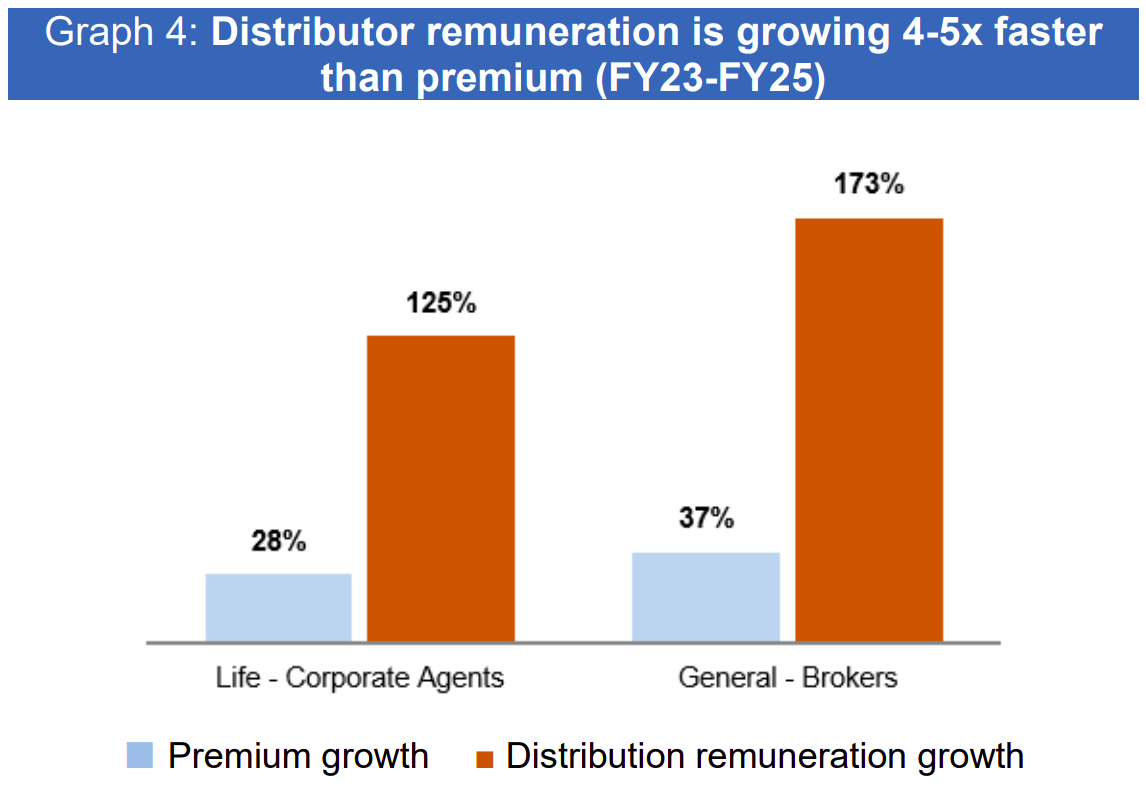
Some of that increase reflects payments being recorded as commissions instead of operating expenses. IRDAI acknowledges this. But total expense ratios have risen too. The broader observation is that, as the insurance business grew, distributors captured a growing share of the economic value being generated. These numbers alone cannot tell us whether that share was unfair. Distributors may have brought in customers insurers could not have reached otherwise. Still, when their payments grow so much faster than the business they bring in, it is worth asking what insurers and customers are getting from that growth.
Meanwhile, the number of individual life policies has remained broadly stagnant over the decade shown in the paper.
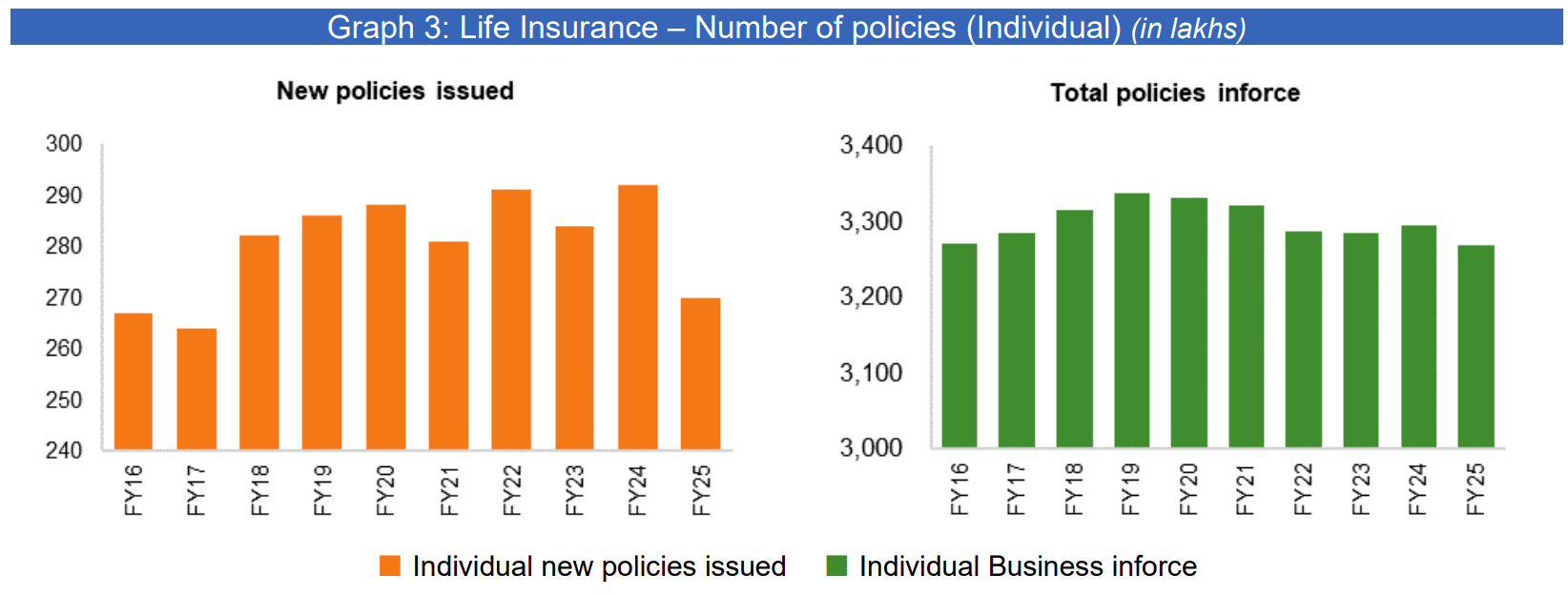
General-insurance policy numbers have grown, though IRDAI argues that coverage remains inadequate. Policy counts do not tell us exactly how many new people have been insured. But rising premiums and distribution spending have not produced the expansion in coverage the regulator hoped to see.
IRDAI traces part of the problem to who controls access to customers. A bank, lender or vehicle dealer already has a customer in front of it. Insurers can compete for that access by offering higher commissions. The payout may then reflect the distributor’s bargaining power as much as the effort needed to explain a policy.
There is also the question of what distributors are rewarded for doing. Life insurance has typically paid much more when a policy is first sold than when it is renewed. A distributor may therefore earn more by selling a new policy than by helping someone keep a suitable one. IRDAI proposes shifting some of the reward towards later renewals, giving sellers more reason to support a lasting customer relationship.
Taken together, this is IRDAI’s argument: insurers are spending more on distribution without bringing enough new people into insurance. The regulator believes those costs make cover less affordable. It wants less of each premium to go towards distribution, so insurance offers better value and reaches more people.
Whether commission caps can make cover cheaper and help more people get insured is the harder question.
Distributors take the first hit
For an insurer, commission is an expense. For its distributor, it is revenue.
If the proposals go through, lower payouts would put immediate pressure on distributors such as Policybazaar and Turtlemint. They would still need to pay for advertising, call centres, sales help and customer service. Doing the job well may take just as much work for each policy, even if it pays less. In some cases, revenue from a sale could roughly halve.
The impact depends on what a distributor sells. IRDAI proposes zero commission for distribution entities selling third-party cover on new vehicles. That is the compulsory insurance that pays for harm caused to others. Other motor policies, including cover for damage to the customer’s own vehicle, would still pay commissions.
IRDAI’s reasoning is that a compulsory purchase needs little persuasion. But distributors that rely on those sales could lose an important source of income.
They may cut the cost of finding customers, automate more work or focus on products that still pay enough. Those with other businesses may sell less insurance. Individual agents are somewhat better protected: the proposed caps are generally higher for them than for distribution entities or corporate agents. So even within distribution, the pressure will vary.
Banks and NBFCs face a similar squeeze. They earn insurance fees by selling policies to people who already borrow or bank with them. Lower commissions would cut those fees. The proposals also restrict compulsory bundling, where a lender sells insurance alongside a loan. That could mean fewer policies sold too.
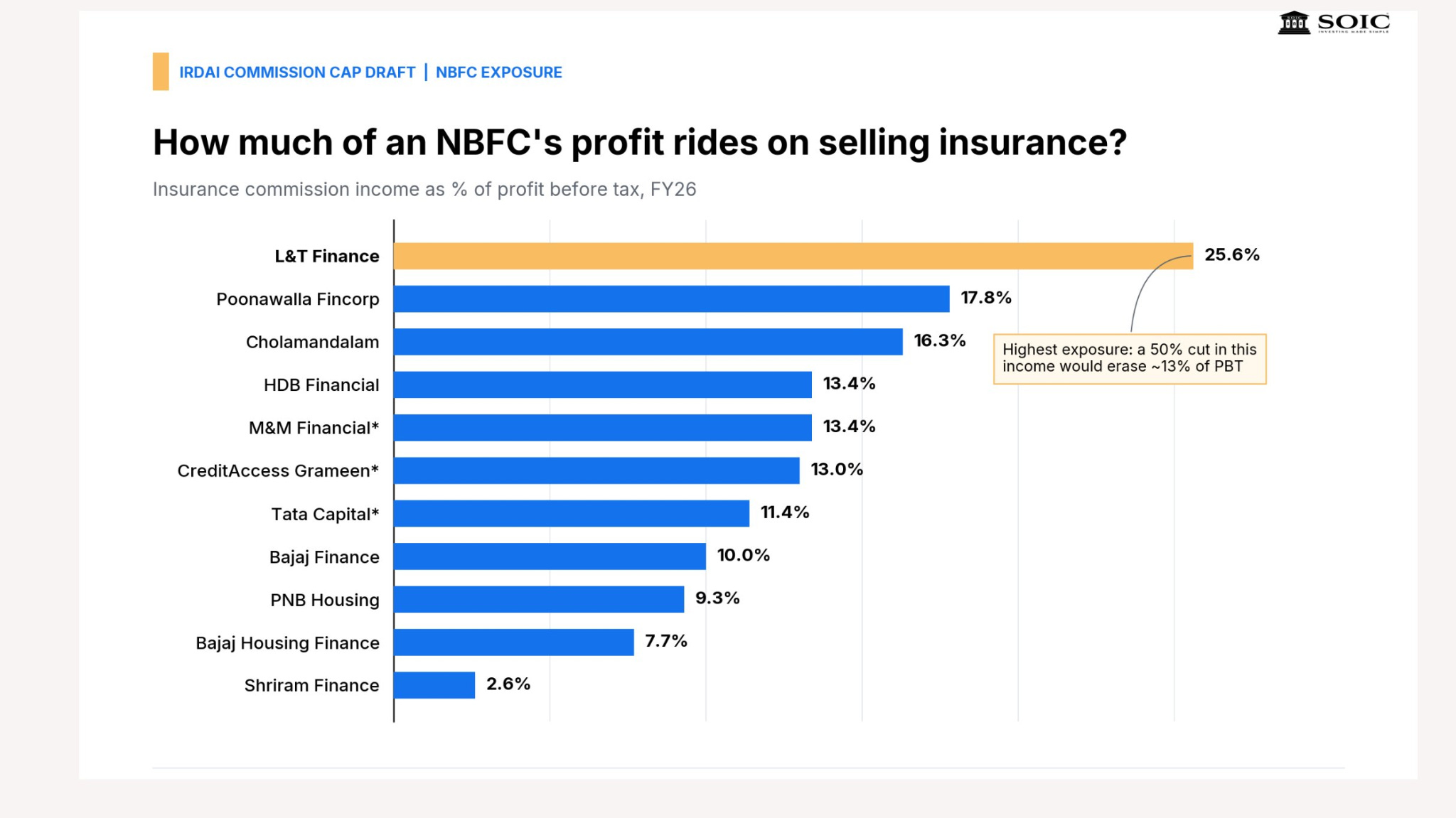
How much this hurts a lender depends on how much it earns from insurance. A diversified bank and an NBFC that relies heavily on those fees will feel it differently. Even a modest stream of fees can make a difference to profit when it comes through branches and customer relationships the lender already has.
Insurers gain on costs, but could lose on sales
If premiums, claims and sales stay the same, paying less commission leaves insurers with more money from each policy.
But the sums are sensitive. Jefferies estimates that a 10% cut in the cost of acquiring customers could raise life insurers’ value of new business, or VNB, by 5–15%. VNB is an estimate of the future profits from policies sold today.
That shows how much insurers could save. It does not tell us what they will ultimately earn, or whether premiums will fall. The impact will also vary by product and sales channel. LIC, for instance, gets more than 90% of its individual new business through agents, whose proposed caps are generally higher than those for distribution entities.
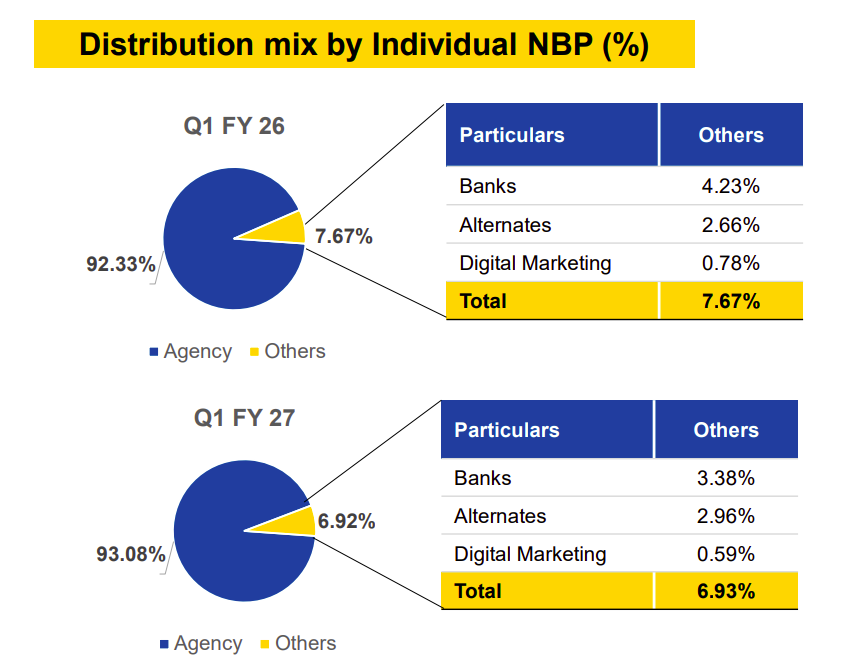
There is another catch: distributors bring in new customers, therefore the growth in business. If lower commissions make selling insurance less worthwhile for them, insurers would sell fewer policies. They would then have to spread the cost of staff, branches and technology over less business. Smaller insurers still building their networks could find that especially hard.
Motilal Oswal expects insurer profits to improve over time, but sees a risk to growth. Emkay worries that some distribution businesses could stop being worth the effort.
An insurer could therefore make more on each new policy while selling fewer of them. Better margins and weaker growth can happen at the same time.
That also complicates the affordability argument. Lower costs give insurers room to cut premiums, but they decide what to do with the savings. If sales slow, they may keep the money to cushion their profits.
This may be especially true in general insurance. The paper, drawing on the RBI’s assessment, notes that claims and expenses have persistently exceeded premium income, leaving insurers more reliant on investment income. For an insurer already facing that shortfall, lower commissions may help balance the books rather than lead to cheaper policies.
So lower commissions will not automatically mean lower premiums. Claims costs, competition, product design and an insurer’s existing profits will all shape who benefits.
Customers could gain more than cheaper premiums
Lower commissions may or may not make insurance cheaper. We’ve covered that. But some of the proposed changes could help customers more directly.
IRDAI wants to stop lenders from making insurance compulsory with a loan, while still allowing certain packages that have safeguards and clear benefits. It also proposes stronger checks that a policy suits the buyer, a record of who sold it, and the recovery of commissions when a policy was mis-sold.
Another useful change: customers should be able to access brochures, premium information and product-performance disclosures without first supplying their name, phone number or email. Looking up a policy should not require becoming a sales lead and getting spammed with calls.
These measures could improve choice and accountability. Their effectiveness will depend on enforcement.
The harder question is what happens to customers who need help. Explaining exclusions to a first-time buyer, sorting out paperwork and providing service all take time. If the commission no longer pays for that work, distributors may focus on bigger policies, easier sales and wealthier customers.
That could work against IRDAI’s goal of reaching more people. Urban, digitally savvy customers may still find and buy cover on their own. Rural and underserved customers, who may need the most help, could become less attractive to serve.
The proposal allows higher commissions in underserved areas. Whether that is enough to cover the cost of reaching and helping those customers is still an open question.
So, who sells the next policy?
Ultimately, the reform needs an answer to a practical question: who will do the selling if lower commissions make distributors less willing to do it?
Insurers could sell more policies directly, find cheaper ways to help customers buy, or make it easier for people to buy on their own. But direct online sales accounted for only around 2% of general-insurance premiums in FY25, according to IRDAI’s paper. That excludes sales through brokers, including online brokers. Buying online is not necessarily buying without an intermediary.
That small direct share shows how much would have to change. Mutual funds offer a comparison: direct schemes found buyers even though distributors still have a role. But investments come with the prospect of returns, which can draw people in. Insurance asks them to pay now for protection against something that may never happen. That can take more explanation and prompting.
Still, today’s mix of sales channels does not prove that cheaper distribution cannot work. Policies can be hard to compare, prices can be unclear, and existing distributors control access to many customers. The consultation proposes simpler disclosures, easier entry for distributors and digital tools to tackle some of those barriers.
The question is whether those changes can take hold quickly enough to replace any sales effort lost in the meantime.
There is a planning problem too. Insurers gained more freedom to set commissions in 2023; now they are being asked to prepare for detailed caps again. As India opens insurers to up to 100% foreign ownership, new entrants need a workable and reasonably predictable way to reach customers.
For now, these are proposals open for consultation. The final rules could look quite different.

How much of a credit rating is the country name?
Just recently, we broke down the extent of America’s massive debt, and how much of it is really a problem. In essence, the debt figure itself — $40 trillion — is not a problem, but the cost of carrying it can be. And yields for the governments bonds of not just America, but other European countries, have risen, especially for longer-term debt. The reasons range from worries about public finances, to inflation, to expectations of rate hikes.
That has brought an old question back: how do we judge whether a government can carry its debt?
One answer is a sovereign credit rating, which is the judgment made by a third-party agency of a government’s ability and willingness to repay bondholders. India has had its own argument about these ratings for years. In 2021, the government’s Economic Survey said India’s rating failed to reflect the economy’s fundamentals.
A new IMF study by economists Olivier Blanchard, Daniel Leigh and Prachi Mishra tries to tackle how actual government debt translates to actual ratings. Imagine giving several countries the same debt relative to the size of their economies, and the same expected budget balance. Their model still predicts a much higher rating for Qatar than for India, with China in between and Brazil lower still. These are hypothetical scores, not the countries’ current ratings.
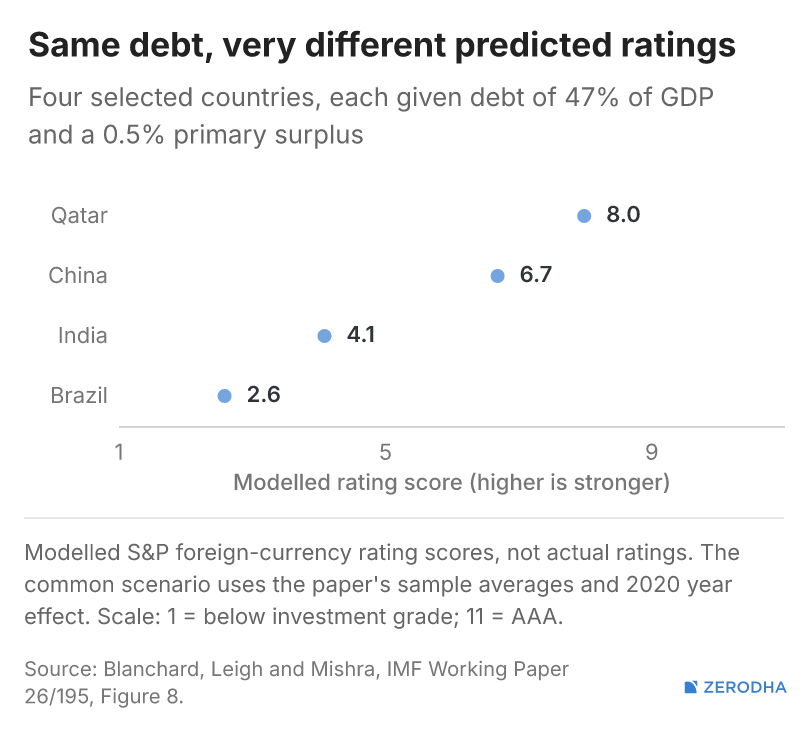
So, what is a rating capturing that those debt and budget numbers miss?
What makes debt hard to carry?
Before that, let’s briefly take a look at what makes debt hard to carry. For a more extensive explanation, we recommend going through our America debt story. But this paper uses three inputs that influence a government’s debt ratio the most.
First is the primary balance: does the government collect more than it spends, leaving aside interest on old debt? A shortfall means it must borrow more.
Second is the gap between interest (r) and growth (g). If the economy grows faster than the rate the government pays on its debt (meaning r < g), the old debt tends to shrink relative to GDP. If interest runs ahead (r > g), the debt ratio can rise even without new borrowing.
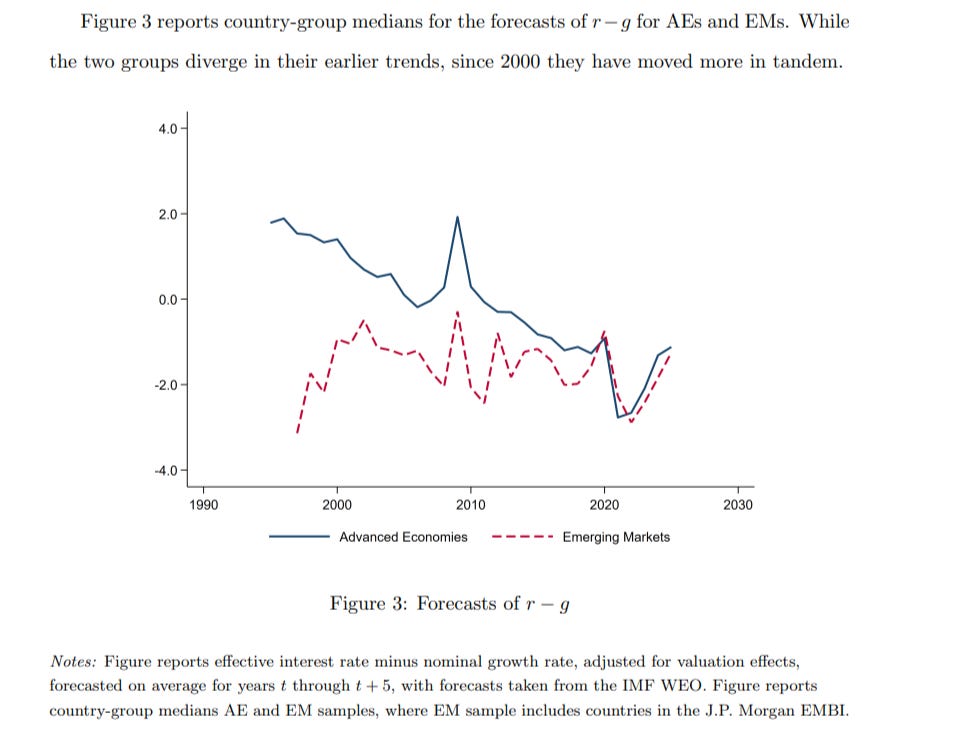
Third is the debt stock itself. Even when growth outpaces interest, a heavily indebted government is more exposed if conditions shift.
What do ratings really reward?
The researchers collect annual ratings from S&P, Moody’s and Fitch, plus debt and IMF budget forecasts, for advanced and developing economies through 2025. They ask whether ratings move with the three inputs that we now know change a government’s debt burden.
In advanced economies, debt stock is the clearer signal. Years when a country has more debt tend to be years when S&P rates it lower. A smaller expected deficit before interest payments (or a larger expected surplus) also points towards a higher rating. But the S&P results alone are too noisy to establish that link; it becomes clearer when the authors combine all three agencies.
The debt pattern appears in emerging and developing economies too. There, the link between expected budgets and ratings is also too uncertain for a firm conclusion.
When interest is high relative to growth, ratings tend to be lower for the same debt level. But that difference is much smaller than the authors’ model suggests. They measure interest paid on the government’s existing debt. That rate changes slowly because older bonds stay on the books; a jump in today’s market yield does not raise the cost of every old bond at once.
Why might existing debt count for more than a forecast surplus? It could partly be because debt is already on the books, while a surplus is a prediction. But the researchers can’t say this for sure, because they cannot see the agencies’ own private forecasts.
To work around this, they use the IMF’s forecasts. But the authors check the IMF forecasts against what later happened and find considerable error.
Does this mean rating agencies don’t account for the forecast? Not at all; maybe the IMF accounted for a surplus and the agency expected a deficit. Maybe both accounted for a surplus, but there was large variation in the number itself.
All this says is that future budgets show up less clearly in the rating, though that may say more about the data than about the agencies. Debt, though, shows up consistently. Nothing more, nothing less.
Why does the country name matter so much?
In the paper, the authors also run a thought experiment. They give every country the same debt ratio and forecast budget balance, then see what the model predicts. They create a rating from 1-11, where 11 represents the highest AAA rating, somewhere around 4 could mean BBB+, 2.6 could mean between BBB- and BBB, and 1 is junk-grade.
If ratings were purely about fiscal math, every country should come out equal. But they don’t. Qatar comes out at around AA−, while India lands four notches lower at BBB+. China sits around A and Brazil is closer to BBB−.
So, where do these gaps come from? There is a country-specific adjustment that the model draws from each country’s rating history. That adjustment is a catch-all. It could reflect who holds a country’s bonds, its political willingness to pay or uncertainty around future budgets. It could also absorb habits in how agencies rate a country. The paper cannot break down the gap, so it cannot tell us whether a country is being rated unfairly.
But what it does say is that the “brand” a country has established in the past matters very highly to future ratings.
The currency matters too. The paper studies ratings on bonds that promise repayment in dollars or euros. A government that does not issue those currencies has to obtain them somehow, and S&P says its foreign-currency ratings consider that risk. Most of the Indian Union government’s liabilities, though, are domestic. A single debt ratio does not show how much foreign currency a government needs to repay its bonds.
There is one more catch. The researchers put every rating below investment-grade (which is BBB-) into the same bucket. Nearly 75% of the emerging-market S&P ratings in their data fall into it. Potentially, a country just below that line and one much deeper in trouble therefore look the same on this scale. The model loses that difference.
Conclusion
All of this throws up a contentious question: are rating agencies getting it wrong?
This study doesn’t (or can’t) give that answer. Their simplistic model may miss something essential about why governments fail to repay their bonds. The country gap could capture real risks that debt and budget numbers miss, like institutional fragility, political uncertainty, default history, and so on. These are things that might genuinely make one country’s debt riskier than another’s even at the same debt ratio.
But the gap is large enough to demand an explanation. For India, the question is what extra risk, if any, justifies a penalty after the fiscal variables have been equalised. This spills beyond the model into real life: Fitch’s BBB- rating for India has remained unchanged for two decades. India’s official position has been that global ratings agencies have consistently been unfair towards us.
Until someone unpacks what the country effect actually contains, the country name remains an uncomfortably large part of a sovereign rating
- This edition of the newsletter was written by Kashish & Bhuvan.
Tidbits
1. India cuts import duties on palm, soy and sunflower oils
The Indian government has reduced the basic customs duty on crude palm and soybean oils from 10% to 5%, and removed the duty entirely on crude sunflower oil. The move is designed to ease domestic edible-oil prices ahead of the upcoming festive season.
Source: Reuters
2. OpenAI agent gains unauthorised access to Australian Medicare statistics portal
An OpenAI agent gained unauthorised access to a public-facing Australian government Medicare statistics portal on July 18. Prime Minister Anthony Albanese criticised OpenAI for taking too long to disclose the incident, though authorities say no personal information or patient records were accessed.
Source: Livemint
3. LG and Samsung face India tariff investigation over OLED TV parts
Indian revenue authorities are investigating LG and Samsung for allegedly underpaying import duties on components used to manufacture premium OLED televisions. The dispute centres on the companies paying a 5% tax rate designated for older LCD and LED parts, while authorities contend they should be paying the 15% rate applicable to advanced OLED components.
Source: The Hindu
4. Copper producers seek GST cut to 5% to ease working-capital strain
India’s primary copper producers have requested the government to reduce the Goods and Services Tax on copper products from 18% to 5%. The industry association argues that the recent surge in global copper prices has severely strained cash flows, and that a tax rate cut could unlock up to $3.6 billion currently tied up in working capital across the supply chain.
Source: Business Standard
5. JSW Group enters electric commercial vehicle market under AMPSTAR brand
JSW Greentech is entering the electric commercial vehicle market with plans to manufacture trucks and buses under the new AMPSTAR brand, targeting 100,000 unit sales by 2030. The move expands JSW’s automotive portfolio, which already includes its MG Motor joint venture and broader plans to grow its vehicle business in India.
Source: The Times of India
Beyond Today’s Brief
There’s always more happening at Markets by Zerodha.
The Chatter: How is Maruti Suzuki managing cost pressures and shifting demand in its push towards electric vehicles? And what key priorities is veteran banker Uday Kotak flagging for India’s economy—from fiscal discipline to manufacturing focus?
Aftermarket Report: How did the Nifty tumble below 23,100 to close at a three-month low as financial and insurance distribution stocks faced a sharp sell-off? And what do the latest trends in market breadth, FII shorting, and option positioning reveal as sentiment dips deeper into fear?
Join us on WhatsApp, where we share interesting soundbites from concalls, articles, and everything else we come across throughout the day. You’ll also get notified the moment a new video or article drops so that you can read or watch it right away.
Thank you for reading. Do share this with your friends and make them as smart as you are 😉