


Hi everyone, I’m Mridula, and welcome to the ninth edition of Weekly Tidbits.
We spend a lot of time reading interesting stories that never make it into a full Daily Brief piece. So, once a week, we pick some of the best ones and add a little context.
We sort them into GEIC: Global, Economy, Industry and Company.
Let’s get started!
If you prefer watching the video, here’s the link:
G — Global
[1] Investors are getting nervous about CoreWeave’s debt
CoreWeave rents computing power to AI developers. It buys thousands of expensive GPUs, the chips used to run AI models, and installs them in data centres it mostly leases from other companies. Customers then pay to use that computing power.
The business needs a lot of money upfront, so CoreWeave has borrowed heavily to expand. By the end of June, it owed around $35 billion, roughly ₹3.3 lakh crore at ₹94 to the dollar. In the April–June quarter, it made $128 million in adjusted operating profit but paid $640 million in net interest expenses, even before repaying the loans themselves.
Now, investors are getting nervous. The cost of insuring CoreWeave’s debt against default has climbed to distressed levels. This insurance comes through credit default swaps, or CDS, which can pay out if a borrower defaults. Their prices rise when investors see greater repayment risk.
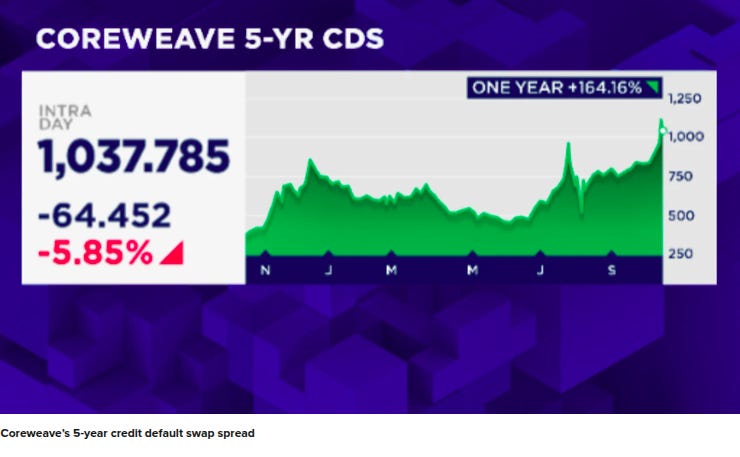
We wrote earlier about how data centres are financed, and CoreWeave shows one of the risks in that model. GPUs lose value as newer chips arrive, while loans still need to be repaid. CoreWeave has large customer contracts, but it must turn those contracts into enough cash to pay its lenders and keep expanding.
[2] Jefferies alleges fraud in $900 million of commodity deals
A fund managed by investment bank Jefferies has alleged fraud in commodity-financing deals worth nearly $900 million, or roughly ₹8,460 crore at ₹94 to the dollar. The deals involve iron ore traders Radiant World and Sapphire Minmetals. Jefferies has taken the matter to court, but the allegations have not been proven.
The deals used something called receivables financing. Imagine a trader sells iron ore to a customer who promises to pay after 90 days. The trader doesn’t want to wait that long, so it borrows money from a lender using that future payment as security. When the customer pays, the lender gets its money back.
This only works if the sale actually happened and the customer really owes the money. If the documents are fake, or the trader has promised the same payment to several lenders, the lender could lose its money. Jefferies alleges that the transactions behind these loans were not what they appeared to be. If the allegations hold up, the case would show how much risk lenders take on when they rely on paperwork without checking the actual trades.
[3] Bank of America faces a $1.21 billion penalty
US authorities have fined Bank of America more than $1.21 billion, roughly ₹11,370 crore. Regulators say the bank failed to properly monitor and report suspicious transactions, even after earlier warnings about its anti-money-laundering controls.
Banks have to know who their customers are and watch for unusual activity. A customer repeatedly moving large sums through unrelated accounts, for example, should set off an alert. Bank staff then look into it and report it to the authorities if something seems wrong.
Bank of America handles a huge volume of payments every day, and its monitoring software is supposed to flag such patterns for employees to review. Regulators found serious gaps in that process, including missed activity linked to Chinese money-laundering networks and other high-risk payments. The bank had already been warned about weak compliance, and the new penalties came after it failed to fix those problems.
E — Economy
[4] India’s wholesale inflation has reached 11.39%
India’s wholesale inflation climbed to 11.39% year-on-year in September, up from 9.92% in August. Fuel and power prices were 25.85% higher than a year earlier, while manufactured products became 9.76% more expensive.
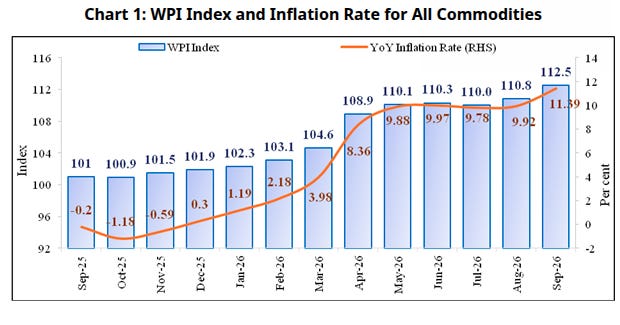
The Wholesale Price Index, or WPI, tracks prices earlier in the supply chain: raw materials, fuel and goods that factories sell to other businesses. Retail inflation tracks what consumers pay in shops. The two often move differently.
Fuel feeds into almost every business’s costs. Factories spend more to run machines, trucking companies pay more for diesel, and manufacturers face higher bills for materials made from oil or gas. Each then has to choose between absorbing the increase and earning less, or raising its own prices. That is why wholesale inflation often signals pressure before it reaches shops. How much of it consumers eventually feel will depend on whether demand is strong enough for companies to charge more without losing customers.
We wrote recently about how the RBI is fighting inflation on three fronts. It has raised interest rates, stepped in to support the rupee and tightened banking-system liquidity to stop rising costs from spreading further through the economy.
[5] India’s grain surplus could raise the food subsidy bill
The Food Corporation of India, or FCI, holds 84.38 million tonnes of grain, nearly three times its prescribed buffer. Stocks that large could push the government’s food subsidy spending past its budget.
The government buys wheat and rice from farmers at minimum support prices. FCI and state agencies store it and hand much of it out through ration shops, with the government paying for every step along the way.
Grain that just sits in warehouses keeps costing money. FCI has to finance the stock, run storage facilities and protect it from damage. Selling large amounts on the open market isn’t easy either, since a sudden flood of supply can drag prices down and hurt farmers.
We wrote recently about the odd side of this surplus. Rice prices have been rising even with record stocks in storage. That is partly because traders haven’t always wanted FCI’s rice at the price and quality on offer. Meanwhile, procurement keeps adding to the pile, and to the bill for holding it.
[6] India is attracting more greenfield investment than China
Foreign companies committed $351 billion in greenfield investment to India between 2021 and 2025, roughly ₹33 lakh crore at ₹94 to the dollar, according to Boston Consulting Group. China attracted $159 billion over the same period. India’s figure was also 61% higher than in the previous five years.
Greenfield means building from scratch rather than buying an existing business. A foreign carmaker setting up a fresh factory in India would count. These figures are announced projects, not necessarily money already spent.
Global firms have spent the past few years trying to rely less on China. Trade tensions, tariffs and supply-chain disruptions pushed them to look for other places to manufacture, and India’s large domestic market made it an obvious contender.
Announcing a plant is the easy part, though. Building and running one takes land, reliable electricity, local suppliers, skilled workers and costs that can compete. How many of these plans turn into working factories will decide how many jobs and exports India actually gets out of them.
I — Industry
[7] India’s semiconductor startups are attracting buyers
Investors and global chipmakers are paying more attention to India’s semiconductor startups. Around 620 have emerged over the past five years, raising more than $1 billion between them, roughly ₹9,400 crore at ₹94 to the dollar. Seven acquisitions have been announced in 2026 alone.
Making a chip involves three broad stages: designing it, manufacturing it and testing the finished product. India’s strength has long been the first. Many global chipmakers run large engineering centres here, but the engineers in them have mostly worked on technology their employers own.
That is starting to change. More Indian startups now develop their own products, which makes them attractive to firms looking for specialised technology. Germany’s Infineon, for example, plans to acquire Bengaluru-based C2i Semiconductors, which makes power-management chips for electronic devices.
India is still setting up its first fabrication plants. But a company with valuable designs doesn’t need to run an expensive factory of its own to grow. That gives the industry another route forward while manufacturing catches up.
[8] Jindal Ferrous opens a ₹5,000 crore steel plant in Odisha
Jindal Ferrous has started operations at its first integrated steel plant in Jajpur, Odisha, built at a cost of ₹5,000 crore. Its steel melting shop, where iron is refined into steel, can produce 2.2 million tonnes a year.
An integrated plant brings the different stages of steelmaking together at one site. That cuts the cost of moving materials between separate facilities and gives the company more control over its operations. Jindal Ferrous is working with Japan’s JFE Steel for technical support.
Odisha has become a hub for steelmakers because of its large iron ore reserves and an established network of mills and suppliers. India also needs more steel for construction, roads, railways and factories.
But a bigger plant doesn’t guarantee bigger profits. Steel mills carry heavy fixed costs and need a steady flow of orders to run efficiently. If the industry adds output faster than demand grows, producers may have to cut prices to win buyers.
[9] SEBI is keeping the old method for settling derivatives
SEBI has decided to keep the existing method for setting the final settlement price of futures and options contracts on expiry day. The regulator announced changes to its closing auction rules on October 15, and the revised framework took effect on December 7.
When a futures or options contract expires, traders need a final reference price to work out who owes what. SEBI is introducing a closing auction, a short session near the end of trading where buy and sell orders help determine a stock’s official closing price.
But using that auction price to settle derivatives raised concerns. A trader holding a large derivatives position could benefit from pushing the stock’s price during that short window.
SEBI will therefore retain the volume-weighted average price, or VWAP, from the last 30 minutes of regular trading for derivative settlements. VWAP averages prices across that period and gives more weight to larger trades. This reduces the influence of any single small transaction, although it doesn’t eliminate the risk of manipulation.
The closing auction will still help determine official closing prices, but its price won’t replace the existing method for settling expiring derivatives.
C — Company
[10] Tata Motors and Stellantis are expanding their partnership
Tata Motors Passenger Vehicles and Stellantis have agreed to jointly develop vehicles for international markets, with manufacturing expected to take place in India. The two companies already make vehicles together through a joint venture. The new agreement extends that relationship from manufacturing into vehicle development.
Much of the work will centre on shared vehicle platforms. A platform is the common base, including the frame and core systems, that a carmaker can use to build several different models. Reusing one platform across many cars saves the time and money of engineering each model from scratch.
Tata Motors could get to use more of its engineering and technology in cars sold outside India. Stellantis, meanwhile, can use India’s manufacturing base and engineering talent for its global products. The companies expect the vehicles to reach more than 50 markets, though they haven’t yet announced which models they will develop or when production will begin.
[11] FMCG companies are competing for a stake in Farmley
ITC, Britannia, Emami and Orkla India are reportedly interested in buying a stake in Farmley, a packaged nuts and healthy-snacks brand. A deal could value Farmley at around ₹2,000 crore, though talks are at an early stage and no buyer has been chosen. Its early investors, who together own about 31%, are reportedly looking to sell.
Farmley started out supplying nuts and dry fruits to other businesses before launching its own brand of roasted nuts, trail mixes and flavoured snacks. Its revenue grew 72% to ₹396 crore in FY25. Around 80% of its sales now come online, including through quick-commerce apps. These platforms let young brands reach customers without first building a network of distributors and shops.
That network is what the interested buyers already have. Companies like ITC and Britannia supply thousands of stores across the country. Buying Farmley could give them a growing brand in healthy snacking, which they could then sell through their existing distribution networks to reach more shoppers offline.
[12] HCLTech is building an AI business with Anthropic
HCLTech has announced a partnership with Anthropic, the company behind the Claude AI models. The Indian IT firm will set up a dedicated Anthropic business unit and use the technology to help clients automate more of their work.
Businesses already use AI to summarise documents, write code or answer questions. HCLTech wants to take its clients further with AI agents, which are systems that can carry out tasks across different software. An agent could receive a customer complaint, look up the order, find the problem and prepare a refund. Clients would still need rules on what information it can access and which actions need a human to approve.
The deal also says something about HCLTech’s own business. In our Who Said What episode on Indian IT, we noted that its CEO expects AI to shrink revenue from some of its existing work. But someone has to set up and manage these new systems. HCLTech is betting that this new demand can make up for what automation takes away.
That’s it for this week.
A few of these stories are still developing, so we’ll be keeping an eye on them. But if there’s one you’d like us to write about properly, let us know in the comments.
See you next edition :)