


Our goal with The Daily Brief is to simplify the biggest stories in the Indian markets and help you understand what they mean. We won’t just tell you what happened; we’ll tell you why and how too. We do this show in both formats: video and audio. This piece curates the stories that we talk about.
You can listen to the podcast on Spotify, Apple Podcasts, or wherever you get your podcasts and watch the videos on YouTube. You can also watch The Daily Brief in Hindi.
In today’s edition of The Daily Brief:
1. The RBI’s 3-front war on inflation, explained
To tackle rising food prices and energy supply shocks pushing retail inflation to 5.54%, the Reserve Bank of India raised the repo rate by 25 basis points to 5.50%. Beyond interest rates, the central bank is actively supporting the rupee by opening a direct dollar window for oil companies to curb spot currency demand, while tightening daily liquidity requirements to ensure rate hikes effectively transmit across the economy.
2. Will tougher pharma rules change who gets prescribed?
The Supreme Court directed the government to set up an expert committee to strengthen pharmaceutical marketing regulations under the Uniform Code for Pharmaceutical Marketing Practices (UCPMP). With pharma companies spending 25–30% of revenue on sales and promotion, stricter legal enforcement on doctor inducements could reduce promotional expenses, drive prescription demand toward established brands and trade generics, and improve operating margins for major drugmakers.
The RBI’s 3-front war on inflation, explained
If you’ve been following the RBI over the last week or so, you’d have noticed it has been unusually busy. It raised interest rates. It rolled out measures to prop up the rupee. And it started pulling money out of the banking system.
On the surface, these look like three separate stories. But they’re tied together by one thing that affects all of us: inflation. Each of these moves, directly or indirectly, is part of the RBI’s effort to keep prices in check.
To see how they fit together, though, we first need to understand what’s pushing prices up in the first place.
What’s driving inflation?
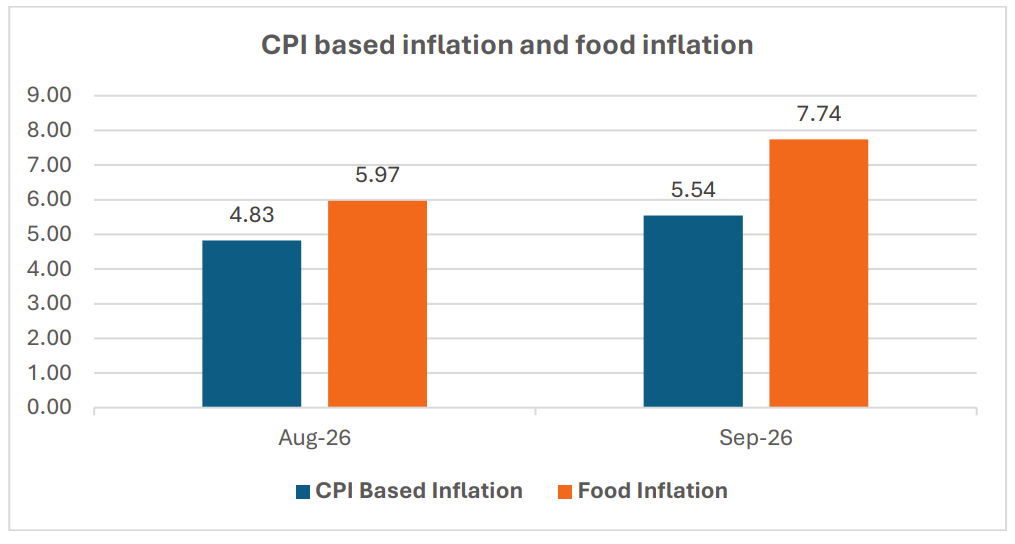
India’s retail inflation rose to 5.54% in September, from 4.83% in August. That’s how much more a typical basket of goods and services, as tracked by the consumer price index, costs compared to a year ago. Food inflation jumped even more sharply, from 5.97% to 7.74%.
Part of this story is painfully familiar. Food prices in India live and die by the weather, and the weather hasn’t been kind this year. We’ve written about this before on The Daily Brief, and its effects are now showing up clearly in the numbers.
India received about 13% less rainfall than normal this monsoon, partly because of El Niño, a warming of the tropical Pacific that tends to weaken India’s monsoon. A weak monsoon hurts twice. It damages the crops already in the ground, and it leaves less water stored up for the next season. You can already see this playing out. Rice prices are rising as acreage shrinks, and wheat acreage is expected to fall too. Edible oils are a separate headache. India relies heavily on imports for them, so their prices move with global markets.
CareEdge’s September inflation note flags these pressures, along with the risk a weak monsoon poses to farm output. On top of that, energy is getting expensive again, with crude climbing back up to $100 per barrel.
What really caught our eye, though, was how widely price rises are spreading.
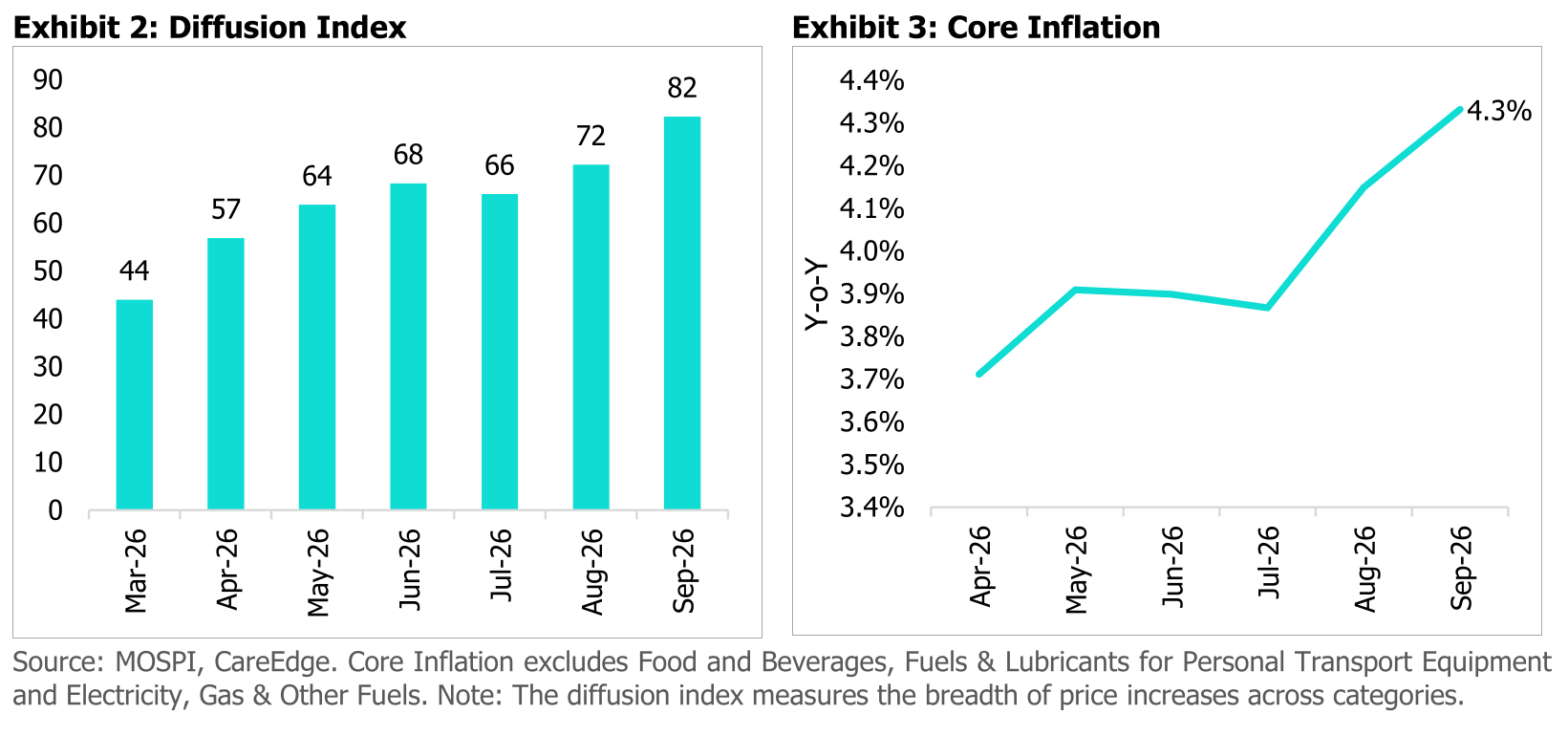
CareEdge estimates that core inflation, which strips out food and certain energy items, edged up from 4.2% to 4.3%. Meanwhile, its diffusion index jumped from 72 to 82. Think of this index as a measure of breadth: it tells you how many categories are seeing prices rise faster than before.
By the same report’s count, inflation picked up in 11 of the CPI’s 12 major categories.
It’s tempting to look at this and conclude that the economy is overheating, that people are simply buying more than the economy can produce. We’d be careful with that conclusion.
Prices can rise across the board even when demand is perfectly normal. If fuel gets expensive, almost every business feels it, whether or not its customers are buying more.
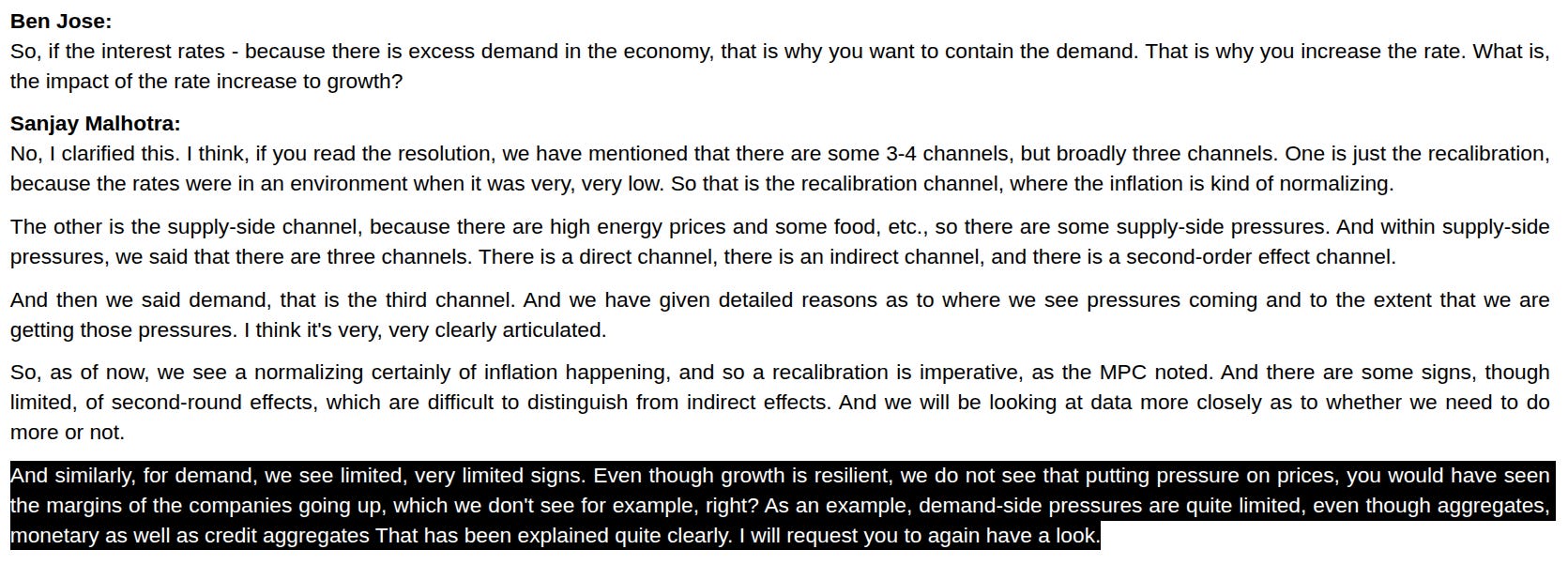
The RBI made this exact distinction in its press conference. Governor Sanjay Malhotra said there were very few signs of demand pushing prices up. In other words, this is supply-led inflation. The worry, instead, was that persistent supply shocks might start changing how businesses and people set prices.
Here’s how that works. Imagine a transport company whose fuel bill goes up. It raises its freight charges. Now a manufacturer that uses that transporter faces a bigger delivery bill, and raises its own prices.
Now imagine people start expecting prices to keep rising. Workers ask for bigger raises. Businesses build larger price hikes into their plans. At this point, the original shock is shaping decisions far beyond the businesses it first hit.
That’s when inflation becomes really hard to shake off.
Why raise interest rates?
Which brings us to a tricky question for the RBI. If inflation is mostly coming from supply problems, what can an interest rate hike actually do? Higher rates don’t make it rain, after all.
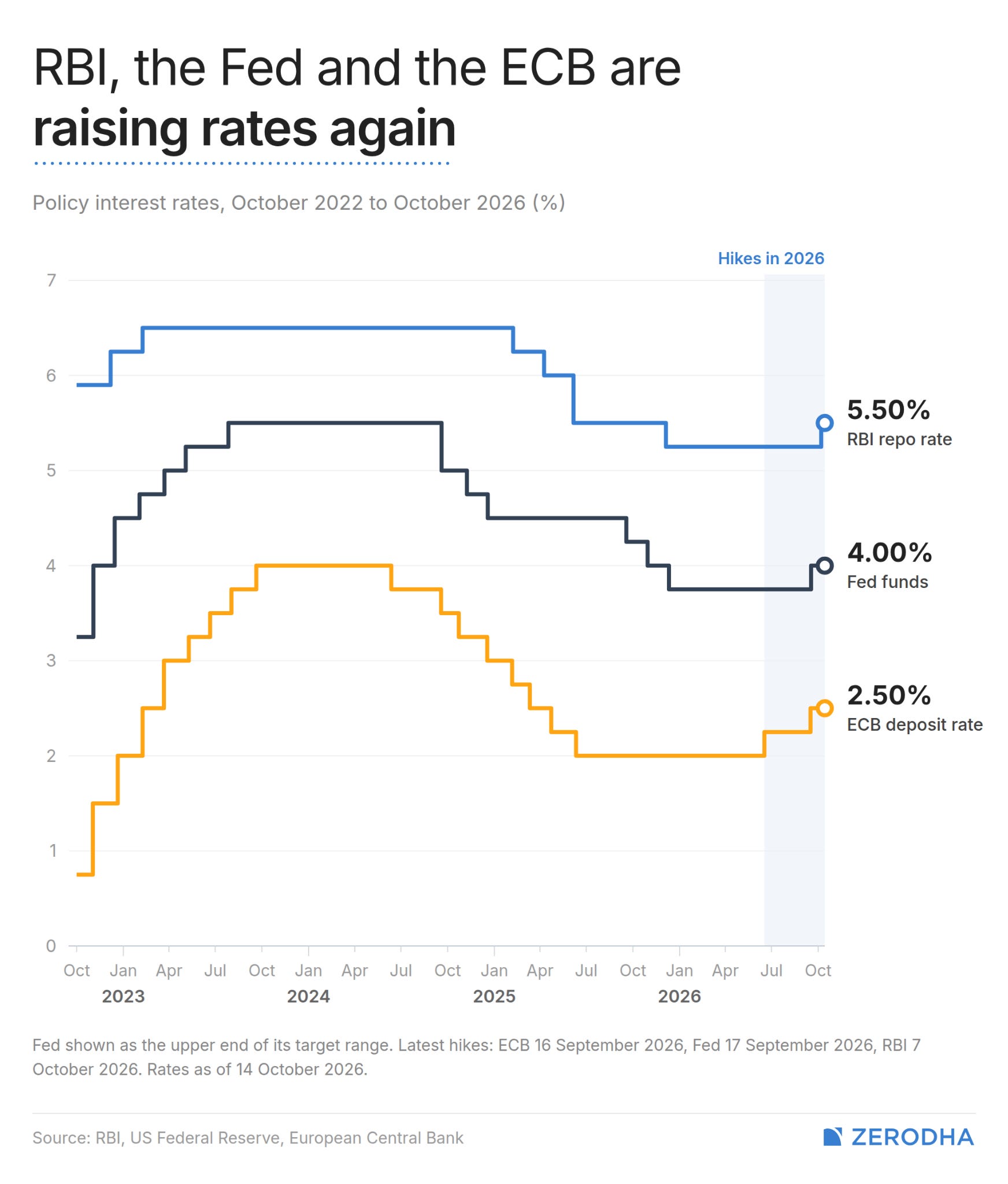
Still, on October 7, the RBI raised the repo rate by 0.25 percentage points to 5.50%, its first hike since February 2023. It also shifted its stance to “calibrated tightening.”
The repo rate is the rate at which the RBI lends to banks, and it ripples out into borrowing costs across the economy. When loans get pricier, households and businesses get more cautious about spending. And with buyers holding back, companies find it harder to keep raising prices.
But the bigger point is about expectations. Remember the spiral we just described, where people start treating inflation as permanent and bake it into wages and prices? A rate hike signals that the RBI won’t let that happen. It can cool expectations today, even if its effect on actual prices takes much longer to show up.
But there’s another reason the RBI can’t sit still, and it has to do with the rest of the world.
Why the rupee matters
In September, both the European Central Bank and the US Federal Reserve raised their rates by 0.25 percentage points.
Why does that matter for India? One reason is the India–US yield gap. Right now, India’s ten-year government bonds yield roughly 7.3%, against about 5.3% for US ones. So a foreign investor earns about two percentage points more by lending to India. But they weigh that extra return against the risk that the rupee falls, and against what it costs to protect themselves from that fall.
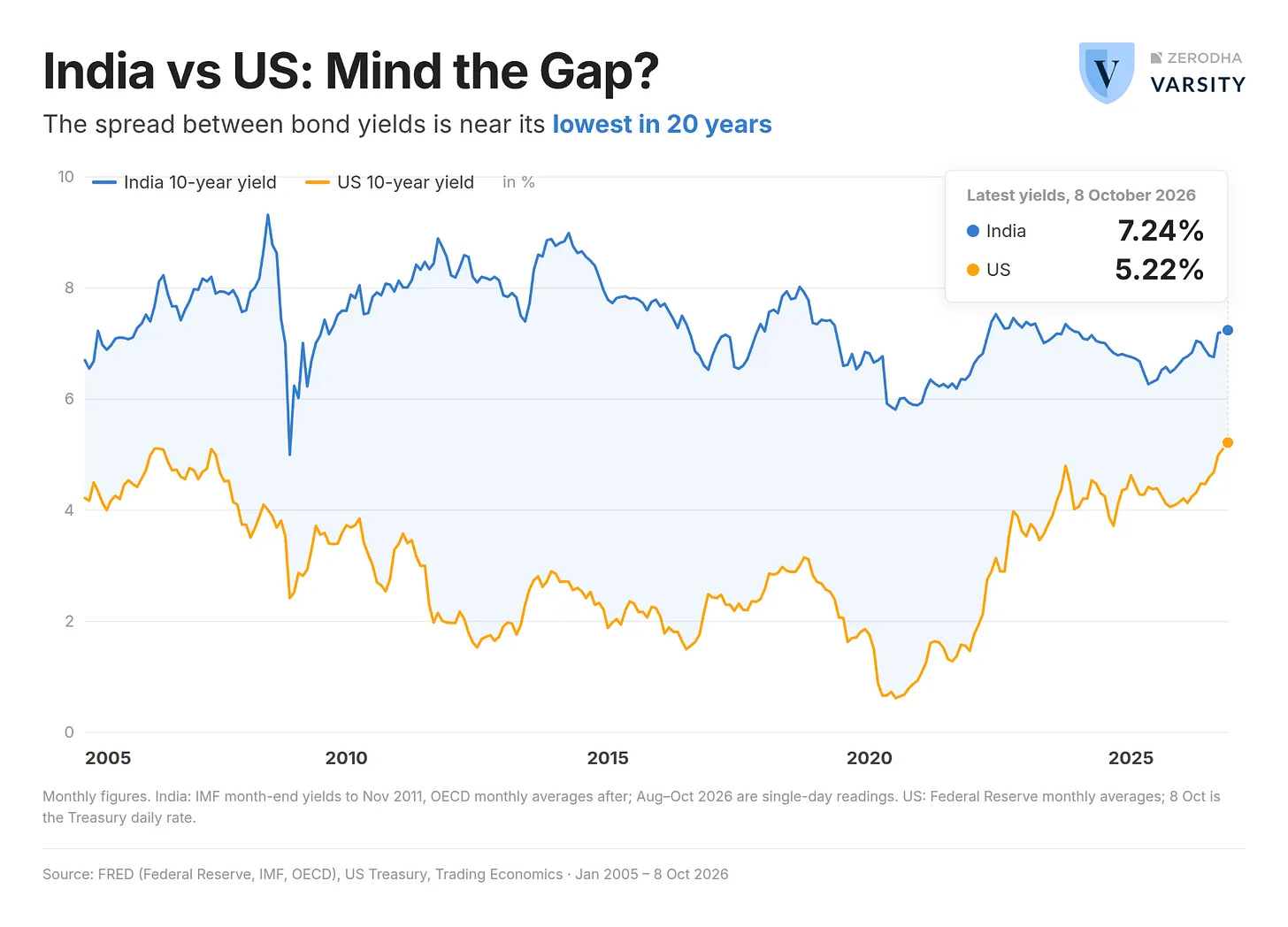
When US returns rise relative to Indian ones, that trade looks less attractive. Some investors may sell Indian assets and convert the proceeds into dollars. All that dollar buying puts pressure on the rupee.
By October 7, it had lost about 7.5% against the dollar during 2026.
Here’s why that matters for inflation. If you’re an importer, a weaker rupee changes your bill even if your supplier hasn’t touched its price. A $100 purchase costs ₹9,000 when a dollar costs ₹90. At ₹97 to the dollar, the same purchase costs ₹9,700.
Imports get more expensive in rupee terms, and some of that eventually reaches consumers. Think about what this means for energy. Oil was already expensive because of global factors. A weaker rupee makes it more expensive still.
This is how the currency becomes part of the inflation problem.
Higher Indian interest rates help here, by making rupee assets more rewarding to hold. But rate hikes are only one part of how the RBI is defending the currency.
How the RBI is supporting the currency
Think of the rupee’s value as a tug of war between those who need dollars and those who bring them in. Importers need dollars to pay their foreign suppliers. Foreign investors need them when they take money out of India. On the other side, export earnings, remittances and investment inflows bring dollars in.
When demand for dollars outstrips supply, buyers have to offer more rupees for each dollar. That’s what a falling rupee is.
The RBI has been working on both sides of this equation.
First, the supply of dollars. Earlier this year, the RBI encouraged dollars to flow into India through special swap facilities. One of them was linked to FCNR(B) deposits, which are foreign-currency deposits that non-resident Indians hold with Indian banks.
Here’s how it worked. Banks collected these dollar deposits, handed the dollars to the RBI in exchange for rupees, and agreed to reverse the trade later. The RBI offered favourable terms, which made it worthwhile for banks to go out and gather these deposits. More dollars coming in meant more support for the rupee.
And it worked. Revised figures put FCNR(B) deposits at about $133 billion.
But there’s a catch. These swaps have to be reversed eventually, and when they are, the RBI has to hand those dollars back. The RBI’s future dollar obligations stand at around $200 billion. Set against that, its $734 billion war chest of foreign exchange reserves looks less comfortable than it first appears. A temporary inflow of dollars doesn’t make currency pressure go away for good.
So the latest measures go after the other side: the demand for dollars.
Oil companies are among the biggest and most regular buyers of dollars. Normally, they go to banks to buy the dollars they need to pay for crude, and those purchases add to demand in the currency market.
The RBI has now opened a special dollar window for Indian Oil, Bharat Petroleum and Hindustan Petroleum. From October 12, it can meet their daily dollar needs directly, through designated banks. That takes a big, steady source of demand out of the open market.
The next set of measures deals with currency contracts.
Say an importer has to pay a supplier in dollars three months from now. If the rupee weakens in the meantime, that payment gets more expensive. So the importer can lock in an exchange rate with a bank today. This is called hedging, and it serves a real business need.
But the same contracts can also be used to bet on where the rupee is headed. And when companies rush to buy dollars, or take positions bigger than their actual needs, they add to the pressure on the currency. The RBI wants these contracts to more closely reflect genuine business needs.
So it has lowered the threshold for establishing the exposure behind certain currency positions from $100 million to $5 million. In plain terms, companies taking currency positions above $5 million now have to show the business need behind them. Larger hedges are still allowed, but they have to be backed by real exposure. The RBI has also banned companies from rebooking contracts they’ve cancelled.
Together, these steps aim to curb excessive bets on the currency, although genuine importers may end up paying more too. If they help steady the rupee, they also limit how much inflation comes in through costlier imports.
There’s one more piece to this. When the RBI defends the rupee by selling dollars, it also changes how much money sits in the banking system. That brings us to liquidity.
Making the rate hike work
Liquidity, here, means the readily available cash banks use to settle payments and meet their short-term funding needs.
Banks lend this cash to each other, often overnight. When there’s plenty of it going around, nobody has to scramble for funds, and short-term borrowing rates stay low. That’s a problem for the RBI. It can raise the repo rate, but if market rates stay low, the hike doesn’t really bite.
And right now, the system is flush with cash, partly because of those currency swaps. When banks handed dollars to the RBI, they got rupees back, and those rupees landed in the banking system.
The RBI’s October policy statement shows that, since the August meeting, the banking system has had an average daily surplus of roughly ₹5.9 lakh crore. Banks with that much money on hand also have little reason to raise deposit rates to attract more.
So the RBI is mopping up some of that surplus, to make sure market rates actually reflect its tighter stance. It’s using a few tools to do this.
The first is open market operation (OMO) sales. The RBI sells government bonds it already holds. Banks pay for them, and that money moves out of the banking system and into the RBI. On October 13, it accepted bids for ₹25,000 crore in face value of government securities.
This pulls money out for longer, since it doesn’t automatically flow back the next day. Another is a tweak to cash reserve requirements, and it works a little differently.
Banks have to keep a certain share of their deposits as cash with the RBI. This is the cash reserve ratio, or CRR, and it stays at 3%. But from October 16, banks must maintain at least 99% of their required cash reserve each day, up from 90%. What they have to hold on average over a fortnight hasn’t changed.
Here’s what that means. Say a bank has to keep an average of ₹100 with the RBI. Earlier, it could dip to ₹90 on a given day and make up for it later. Now, it can’t go below ₹99.
That gives banks less wiggle room to use those balances elsewhere in the meantime. They may need to borrow more in the short term, which nudges market rates closer to the RBI’s policy rate. So this isn’t a conventional CRR hike. It’s a stricter rule on how banks maintain their reserves every single day.
Currency intervention adds to this. When the RBI sells dollars to defend the rupee, banks pay for them in rupees. Those rupees leave the banking system, unless the RBI puts money back some other way.
This is where all three policies meet. Selling dollars supports the rupee while draining liquidity. And tighter liquidity helps the rate hike actually reach the wider economy.
How much room does the RBI have?
All this tightening has a cost. Costlier credit can make families put off big purchases and businesses delay investments. And a poor harvest is already a hit to rural incomes. Tighter financial conditions would add to that strain.
That said, the RBI does have some room. It raised its growth forecast for FY2026–27 to 7.1% from 6.7%. The World Bank increased its forecast to 7.1%, from 6.6%, while the IMF now expects 7%, up from 6.4%.
These upgrades suggest the economy is more resilient than expected. But they’re no guarantee that growth can take more tightening without getting hurt.
Nor does inflation being below 6% mean the RBI can relax. Its target is 4%; 6% is just the upper limit of what it can tolerate. Its own October projections put inflation at 6% in October–December, 5.7% in January–March and 5.6% in April–June. That’s a long stretch above target.
So the RBI is trying to stop inflation from settling in, without choking growth. How much more it needs to do depends partly on things outside its control: the next harvests, water availability, global commodity prices, and the government’s decisions on releasing food stocks.
That’s the balance we’ll be watching: whether supply pressures ease on their own before the RBI has to slow the economy much more sharply to contain them.

Will tougher pharma rules change who gets prescribed?
You visit a doctor, get a prescription and buy the medicine. But why did the doctor choose that particular brand when several companies might sell essentially the same drug?
For Indian pharma companies, that decision is worth fighting for. Sometimes, the competition goes well beyond explaining why one medicine is better than another, even involving buttering up the doctors in other ways.
On October 8, 2026, the Supreme Court directed the government to set up an expert committee to examine whether pharmaceutical marketing needs stronger legal enforcement.
Oddly, though, India already has rules against these practices. They’re called the Uniform Code for Pharmaceutical Marketing Practices, or UCPMP. India has spent more than a decade trying to stop drugmakers from offering doctors expensive gifts, sponsored holidays and other personal benefits.
The problem is that there are some misaligned incentives at the heart of how those rules are enforced.
What is UCPMP?
In an earlier edition, we covered in-depth how pharmaceutical companies use medical representatives, free samples and other promotional activities to influence doctors’ prescriptions. We also explained why drugmakers resisted restrictions on medical representatives visiting central government hospitals.
It’s the UCPMP that sets the rules for this marketing. When India introduced the code in 2015, it was voluntary, with little to compel drugmakers to follow it. The government finally made it mandatory in March 2024. The code regulates how drugmakers promote medicines to doctors.
Companies cannot offer doctors cash, personal gifts or sponsored holidays. They can provide certain educational materials worth up to ₹1,000 each. They can also distribute free medicine samples, but within quantity limits. The total value of samples cannot exceed 2% of annual domestic sales.
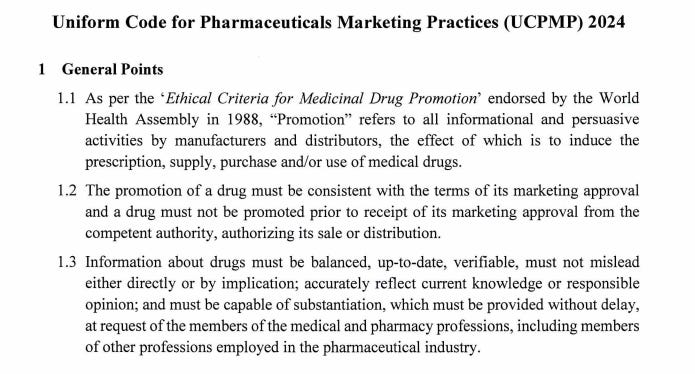
Medical conferences have their own rules. Companies cannot organise these events abroad. They can support educational programmes in India, but generally cannot pay for doctors’ travel and accommodation unless they’re speakers at eligible events. Companies must also maintain promotional records and disclose certain marketing expenses.
So UCPMP doesn’t stop drugmakers from promoting medicines. But what they cannot do is offer personal benefits to influence prescriptions.
What happens when the marketing machine slows?
Even without these restrictions, though, pharma marketing can be a bit capital-intensive.
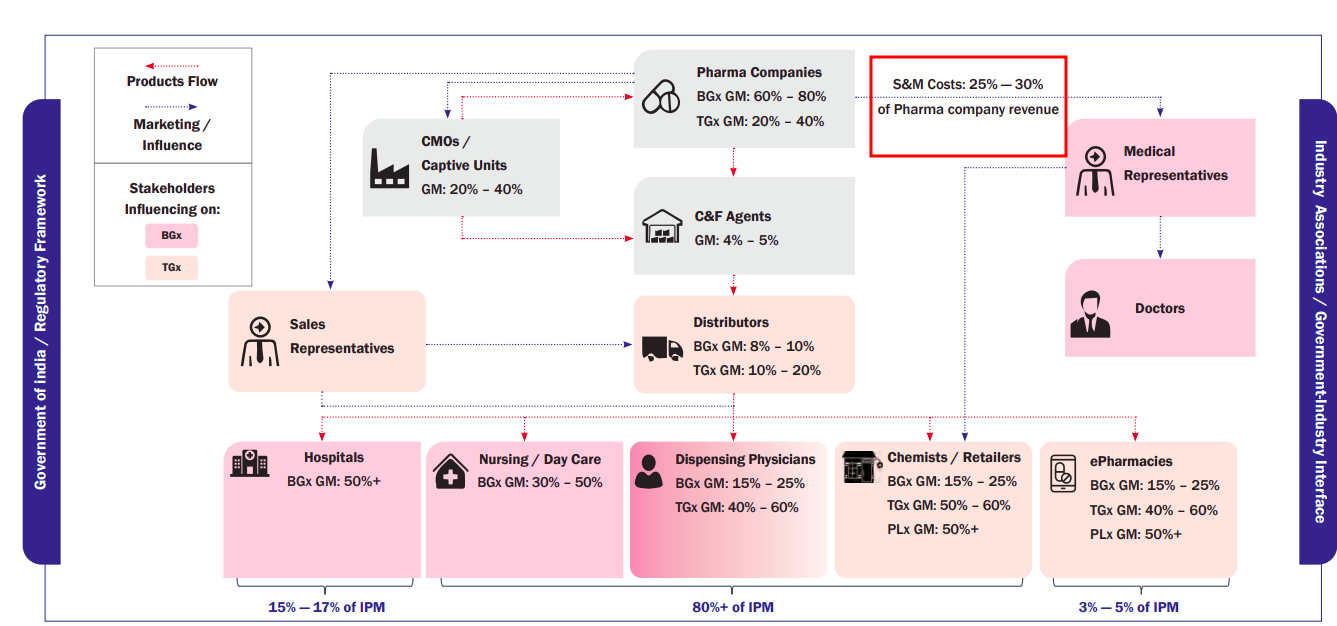
A June 2024 report by Avendus Capital estimated that Indian pharmaceutical companies spend roughly 25-30% of their revenue on sales and marketing. About half goes towards employees, largely the salesforce visiting doctors. The rest covers other selling and promotional expenses. Most of this spending is allowed under UCPMP.
But if companies cut back on improper promotional practices, could that affect their sales? We can’t answer that directly yet. But the COVID-19 lockdown gives us an interesting comparison.
From April to June 2020, medical representatives couldn’t visit doctors freely, and companies cut back sharply on promotional travel. Even today, there are restrictions on medical representatives visiting central government hospitals to limit the potential (mis)influence of pharma firms on doctors. During the lockdown, though, the disruption was much wider.
That year, on the Q1 earnings call of Alkem Laboratories, an analyst estimated that the company’s quarterly other expenses had fallen from the usual ₹500 crore to around ₹340 crore. But the company’s brands performed differently. For instance, Pan, which was one of Alkem’s biggest medicines, saw fewer new prescriptions written by doctors during the lockdown. Yet, its sales barely changed from the previous year. That being said, brands smaller than Pan weren’t nearly as fortunate.
A pharma company has two distribution channels: trade-generics and branded generics. The former refers to chemists and distributors, while the latter refers to doctor’s prescriptions. As a whole, Alkem’s trade-generics business grew during the pandemic. Trade generics’ share of Alkem’s domestic business rose from around 20% to nearly 28%, although partly because the branded business slowed down.
Of course, the lockdown affected patient visits, medicine demand and availability too. We can’t attribute everything to reduced marketing. But an established brand doesn’t need to win every sale from scratch. Doctors already know it, and chemists already stock it. A newer brand has to persuade doctors to try something unfamiliar, and doesn’t yet have the benefit of prescriptions.
A rulebook that struggles to enforce itself
Now, if you crack down harder on marketing, you might create conditions that may be similar, if not the exact same, to the lockdown. Which is where we come back to the enforcement problem UCPMP faces currently.
Consider what happened with AbbVie Healthcare. In May 2024, the Department of Pharmaceuticals received an anonymous complaint accusing the company of paying for travel and accommodation for 30 doctors attending medical conferences in Monaco and Paris. But the complaint never received a straightforward hearing on whether AbbVie had crossed that line.
The Department forwarded it to an ethics committee run by a pharmaceutical industry association. In September 2024, the committee rejected it because the complainant hadn’t revealed their identity. You see, under UCPMP, anonymous complaints aren’t allowed. They must also provide evidence and pay a ₹1,000 non-refundable fee. That protects companies against false accusations.

But say you work at a pharmaceutical company and discover improper payments to doctors. Would you want to put your name on a complaint against your employer? No, you’d rather do it anonymously.
The case then went to the government’s Apex Committee, which looked into the complaint anyway because the allegations were too serious for the anonymity condition to hold. In December 2024, the committee reprimanded AbbVie and asked the National Medical Commission to take action against the doctors involved.
The doctors challenged that decision. They argued that the committee shouldn’t have considered an anonymous complaint. In August 2026, the Delhi High Court temporarily stopped action against the doctors who had challenged the decision. It didn’t decide whether they had done anything wrong.
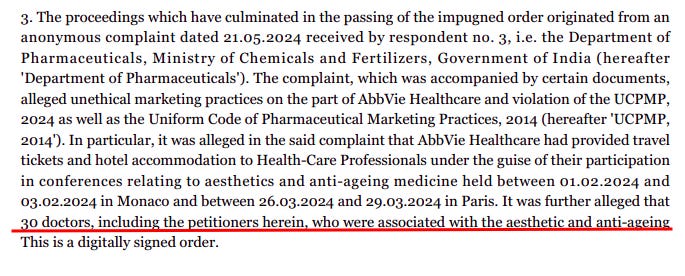
So instead of settling whether the payments broke the rules, the case ended up in court over whether an anonymous complaint could be investigated at all.
The wider enforcement system has a conflict-of-interest problem, too. Pharmaceutical industry associations run the committees investigating complaints, with their own executives in charge. These committees can warn companies, demand corrective action or suspend association membership. But they cannot directly impose penalties.
India has also used tax rules to discourage such spending. In 2022, the Supreme Court ruled that Apex Laboratories, the company behind Zincovit, couldn’t claim tax deductions for prohibited freebies given to doctors.
Meanwhile, in September 2025, after industry complaints about compliance burdens, the government relaxed some reporting requirements. Companies now submit standardised annual marketing disclosures through industry associations. Associations no longer have to upload those disclosures to the government’s portal.
The Supreme Court now wants the government to examine whether these rules need stronger legal backing. It has given the government two weeks to form a committee, which must submit its recommendations within two months. The government must then report its decision to the Court.
Nothing has changed for drugmakers yet. But if the government makes violations harder to get away with, companies may have to rethink how they spend money promoting their medicines.
Why the biggest brands might benefit
Stricter marketing rules could have an unexpected effect: they might improve profits for some of India’s largest drugmakers.
Avendus Capital estimates that lower doctor-related marketing expenses could potentially improve operating margins by 2-3 percentage points, with another 1-2 points possible from a more efficient salesforce. This is a way to protect profits as more medicine sales move towards trade generics and government-backed Jan Aushadhi stores.

But large companies may have a second advantage. If improper incentives to doctors become riskier, companies could put more effort into trade generics, where chemists and distributors play a bigger role in driving sales. And the economics there are different.
Take a medicine with a printed price of ₹100. As per Avendus’ calculations, in branded generics, distributors and chemists together receive about ₹30. In trade generics, their combined share can reach a little more than double that. That money is shared across the distribution chain, but it gives sellers a stronger reason to stock and promote trade generics.
Naturally, chemists cannot simply replace every medicine a doctor prescribes. And patients may pay less for trade generics, depending on their selling price and how much of the distribution margin retailers pass on. This is yet another version of the tradeoff between margins and growth. And distribution, they say, always comes first.
Neither outcome of higher margin or higher growth is guaranteed. Smaller companies could also benefit if improper inducements become less influential. But established drugmakers would still have the advantage of brand recognition and distribution networks built over decades.
Conclusion
The Supreme Court’s intervention raises a bigger question: who should police pharmaceutical marketing? The AbbVie case shows the limits of leaving it largely to the industry. But tougher penalties may not solve everything if companies simply shift their spending from doctors to chemists. India needs a system that can hold drugmakers accountable, while recognising the moving targets at play.
- This edition of the newsletter was written by Kashish & Mridula.
Tidbits
1. Shipping ministry unveils specialised credit risk insurance products for shipbuilders
The Union government has introduced two specialised credit risk insurance policies to support the domestic shipbuilding industry. Unveiled at the Maritime State Development Council, the policies will cover both export and domestic manufacturing projects, with the government subsidising premiums and offering direct support to insurers in the event of claims.
Source: Business Standard
2. India postpones rollout of UPI payment fee until after Diwali
NPCI has postponed the introduction of a 0.4% merchant fee on UPI transactions above ₹2,000 until after Diwali. The charge had been due to take effect on October 15, with NPCI citing the festive season for the delay.
Source: Reuters
3. Adani delays shifting Mumbai international flights after airline pushback
Adani Airport has delayed its plan to shift some international operations from Mumbai airport to the new Navi Mumbai International Airport by at least five months. The deferral follows opposition from airlines, which challenged a proposed reduction in their international departure slots and sought detailed explanations of capacity constraints.
Source: Livemint
4. Bangladesh seeks continued SAFTA tariff benefits and removal of anti-dumping duties
Bangladesh has urged India to withdraw anti-dumping duties on its jute products and PET film exports. Dhaka is also seeking to retain its existing tariff preferences under the South Asian Free Trade Area agreement after it officially graduates from the Least Developed Country category.
Source: Swarajya
5. Hyundai Motor Group to invest $15.5 billion in India by 2032
Hyundai Motor Group will invest about $15.5 billion in India between 2026 and 2032 to expand manufacturing, research and development, local sourcing and future mobility businesses. The group is positioning India as a major production and export hub for its Hyundai and Kia operations.
Source: Reuters
Want more tidbits? Catch up on last week’s recap!

Beyond Today’s Brief
There’s always more happening at Markets by Zerodha.
The Chatter: What strategic insights are management teams at HCLTech, RBL Bank, and Zetwerk sharing? How is HCLTech offsetting AI contract deflation with advanced AI offerings, while RBL Bank deploys massive FCNR liquidity and Zetwerk prepares its ₹5,012 crore IPO?
Points & Figures: What brings Indians to court? From 6.5 lakh cheque-bounce cases in Delhi to motor vehicle accidents, excise enforcement, and conjugal rights, what does district court data reveal about the everyday legal disputes clogging India’s judicial backlog?
Aftermarket Report: How did Nifty pull back near 22,600 as a 2% overnight surge in crude oil prices weighed on market sentiment? And what do 13 straight sessions of foreign institutional selling, a sharp drop in the Put-Call Ratio to 0.91, and FMCG outperforming as the top-gaining sector signal for the broader market?
Join us on WhatsApp, where we share interesting soundbites from concalls, articles, and everything else we come across throughout the day. You’ll also get notified the moment a new video or article drops so that you can read or watch it right away.
Thank you for reading. Do share this with your friends and make them as smart as you are 😉
Very nice explanation about RBI actions. 👍I think it would be nice to have an article detailing the work of this years Nobel Economics Prize winners. The current RBI actions essentially derives from these contributions made towards handling supply shocks on economy