


Hi everyone, I’m Mridula, and welcome to the eighth edition of Weekly Tidbits.
We spend a lot of time reading interesting stories that never make it into a full Daily Brief piece. So, once a week, we pick some of the best ones and add a little context.
We sort them into GEIC: Global, Economy, Industry and Company.
Let’s get started!
If you prefer watching the video, here’s the link:
G — Global
[1] Europe’s gas winter could tighten supplies for Asia
Europe is heading into winter with less gas in storage than usual. The European Commission says the region can still meet demand, but it may have to rely more on liquefied natural gas, or LNG.
Storage works like a winter savings account. Countries fill it during summer, when demand is low, and use it when heating demand peaks. With less stored gas, Europe may have to buy more during winter itself.
India and other Asian countries compete for many of the same LNG cargoes. If a cold winter pushes Europe to buy more, Asian buyers may have to pay more or settle for less. Europe has more import terminals and suppliers than it did during the 2022 energy crisis, but the weather will still decide how tight the market gets.
[2] America’s farm debt may be bigger than it looks
American farm debt is at a record, and a Reuters investigation suggests official figures may still be missing some of it. More farmers are borrowing from fertiliser sellers, equipment companies and cooperatives instead of banks.
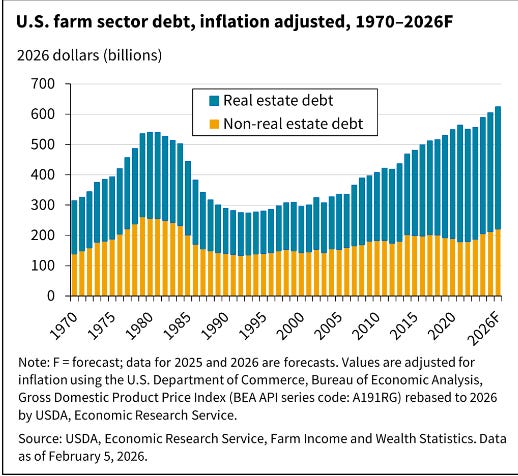
Farmers are earning less while spending more. Crop prices have fallen, but fuel, fertilizer and machinery remain expensive. Suppliers often let farmers pay later because it helps them sell more, which effectively turns them into lenders.
That makes the debt harder to track. A bank knows what a farmer owes it, but not what the same farmer owes a tractor dealer or fertiliser seller. The total stress can stay hidden until repayments start getting missed.
[3] Finland halts work at two Google data-centre sites
Finnish authorities have ordered Google to stop major preparatory work at two planned data-centre sites until environmental assessments are complete. The sites are part of Google’s €13 billion investment plans in Finland.
An environmental assessment studies how a project will affect land, water and wildlife before major work begins. At these sites, trees had already been cut down, soil removed, and roads and drainage changed. Google has admitted that this fell short of its own standards.
We wrote recently about how India’s data-centre boom is already running into another physical constraint: water. The Finland episode shows the same broader problem. Building more computing capacity isn’t only about finding enough chips and electricity. Companies also need land, water and permission to build, and those can become bottlenecks too.
E — Economy
[4] The GST Council wants to make compliance easier
The GST Council recommended a broad set of reforms on October 8. Last year’s overhaul, which we wrote about here, was mainly about tax rates. This round is about how the system works day to day: registration, refunds, tax credits, exports and enforcement.
A big part of the changes concerns input tax credit, or ITC. Businesses pay GST on what they buy and subtract that from the GST they collect on sales. The Council wants to allow this credit on more expenses, including employee insurance, telecom towers and some pipelines. It also wants faster and more automated refunds, easier registration and cancellation, simpler rules for small online sellers, and fewer disputes over whether some services qualify as exports.
Enforcement is being eased too. The Council recommended removing GST officers’ arrest powers, raising the prosecution threshold from ₹1 crore to ₹5 crore, cutting some penalties and reducing unnecessary checks on goods moving between states. Some changes can come through rules and notifications, while others still need changes to the GST law.
[5] India is aiming for $1 trillion in exports
India wants to export $1 trillion worth of goods and services this financial year, up from a record $863 billion last year. Commerce Minister Piyush Goyal said the government is also trying to get more companies to use India’s free trade agreements, which can lower the duties Indian goods face in overseas markets.
There is support on the cost side too. The government has extended the Remission of Duties and Taxes on Exported Products scheme, or RoDTEP, until December 31. It refunds some taxes and charges that remain built into exported goods, such as costs linked to fuel, electricity and transport. It has also extended insurance support for some shipments to West Asia, where wars and shipping disruptions have made trade riskier.
These measures solve different problems. Trade agreements can make Indian goods cheaper abroad, RoDTEP cuts some of the costs exporters carry at home, and insurance reduces the risk of selling into disrupted markets. The $1 trillion target will still depend heavily on global demand, but these policies are meant to make it easier for Indian firms to compete for that demand.
[6] Rice prices could push up food inflation
Rice prices are rising in parts of India. Millers say paddy has become more expensive, and a weak monsoon has widened the gap between how much rice is available and how much people want to buy.
Paddy is rice before it has been milled. When millers have to pay more for it, they can’t keep selling rice at the old price. Part of that extra cost moves down the chain to wholesalers, then to shops, and finally to the households that buy it.
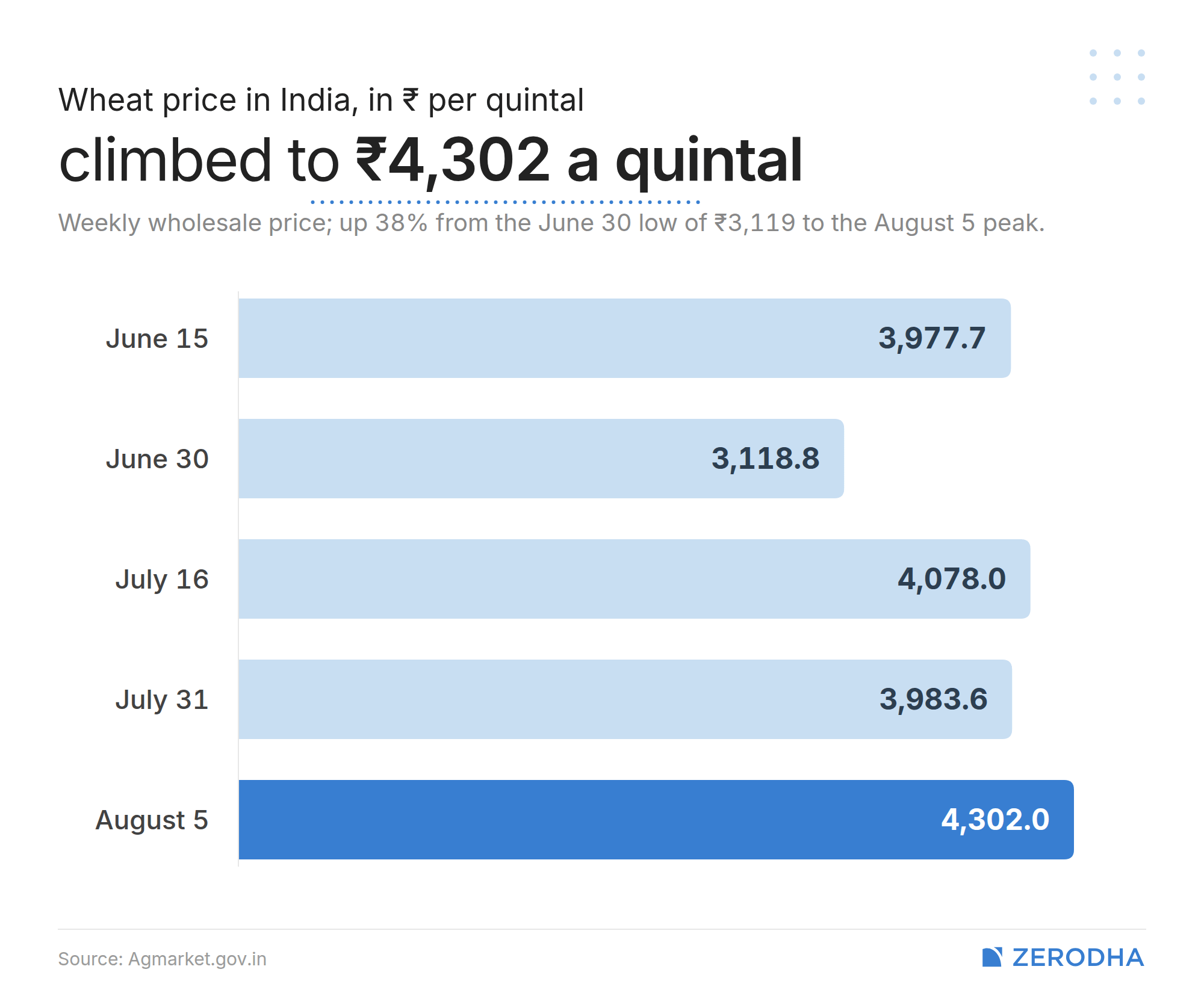
Farmers benefit, since they get a better price for their crop. But rice is a staple that most families buy every week or month, and it isn’t easy to cut back on. So even a small increase shows up quickly in food bills, and it can keep inflation high even if prices of other things start to cool.
I — Industry
[7] Gig platforms want a different social-security levy
IndiaTech, an industry group representing companies such as Ola, Swiggy, Zomato and Porter, wants the government to change how gig platforms pay towards worker social security.
Under the Social Security Code, platforms may have to contribute 1–2% of their annual turnover to a fund for gig workers, capped at 5% of what they pay those workers. We wrote about this system when the new labour codes came into force. A shared fund helps because gig workers can work across several apps instead of having one fixed employer.
IndiaTech’s objection is to using turnover. Platforms count revenue differently. One may record only its commission, while another records the full value of an order. That can make similar businesses pay very different amounts. IndiaTech wants the levy linked more closely to what platforms actually pay their workers.
[8] India wants to stockpile critical minerals
India is preparing a policy to stockpile critical minerals such as lithium, cobalt and rare earths. These are used in batteries, electronics and defence equipment, but India still depends heavily on imports for many of them.
We wrote recently about how concentrated these supply chains are, especially in China. A government reserve would give manufacturers some protection if imports are suddenly restricted or disrupted.
India is also planning four processing parks. The idea is to do more of the refining at home, instead of importing minerals that have already been processed elsewhere. The stockpile is the backup. The processing parks are the longer-term attempt to reduce that dependence.
[9] Textile output is rising while apparel output falls
India’s textile production rose 13.1% year-on-year in August, while apparel production fell 7.4% over the same period. Two parts of the same industry are moving in opposite directions.
Textile mills make yarn and fabric. Apparel companies turn that fabric into finished clothes and depend more directly on orders from retailers and global brands. Rising textile output alongside falling apparel output suggests the stronger growth is happening earlier in the value chain.
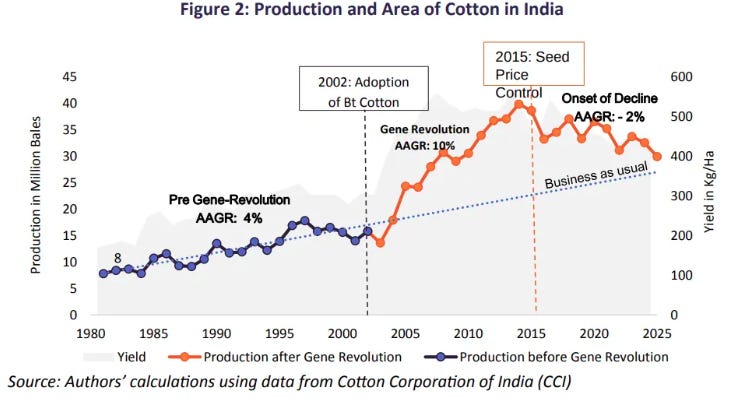
We looked at this gap in our deep dive into India’s textile industry. India is strong at cotton, yarn and fabric, but has struggled more with the final step of making clothes and selling them globally. August’s numbers reflect that same imbalance.
C — Company
[10] GQG Partners cuts its stake in ITC
GQG Partners has sold about ₹9,395 crore worth of ITC shares in a large block deal. It sold 36.5 crore shares on October 8, almost all of the 38.99 crore shares it held at the end of June.
The sale comes after a rough year for ITC. From February 1, cigarettes moved to a 40% GST rate based on retail price, while excise duties were also increased after the compensation cess was phased out. Cigarettes remain ITC’s most profitable business, so higher taxes can either force the company to raise prices and risk weaker sales, or absorb some of the cost and take a hit to margins. ITC shares are down more than 30% since the tax changes were announced.
GQG has also been reducing stakes in other Indian companies, including several Adani Group firms. But it is not pulling out of India entirely: it has added to holdings such as JSW Energy and JSW Steel. The ITC sale looks more like a reshuffling of where GQG wants to put its money.
[11] SpaceX is buying spectrum for its mobile service
SpaceX has agreed to buy a portfolio of US mobile spectrum from investment firm Grain Management for Starlink Mobile, its service that connects ordinary phones directly to satellites.
Spectrum is the radio frequency phones use to send and receive signals. SpaceX is buying frequencies in the 800 MHz band, which travel relatively far and are useful for mobile coverage.
Starlink’s direct-to-phone service has mostly relied on partnerships with telecom companies and their spectrum. Owning frequencies gives SpaceX more control over the network it wants to build in the US and makes it slightly less dependent on those partners.
[12] Schneider Electric is buying PTC for $22.6 billion
Schneider Electric has agreed to buy US software company PTC for $22.6 billion, roughly ₹2.1 lakh crore.
Schneider mainly makes electrical equipment for factories, buildings and data centres. PTC makes software that companies use to design products, run factories and maintain equipment. Buying PTC would let Schneider sell customers both the equipment running a site and the software managing it.
Schneider is paying about 42% more than PTC’s share price before the deal was announced. It also plans to fund the purchase with a mix of debt and new shares. The bet is that combining hardware and software will bring in enough extra business to justify that premium.
That’s it for this week.
A few of these stories are still developing, so we’ll be keeping an eye on them. But if there’s one you’d like us to write about properly, let us know in the comments.
See you next edition :)