

Our goal with The Daily Brief is to simplify the biggest stories in the Indian markets and help you understand what they mean. We won’t just tell you what happened; we’ll tell you why and how too. We do this show in both formats: video and audio. This piece curates the stories that we talk about.
You can listen to the podcast on Spotify, Apple Podcasts, or wherever you get your podcasts and watch the videos on YouTube. You can also watch The Daily Brief in Hindi.
In today’s edition of The Daily Brief:
No more critical minerals for the world?
While China’s dominance over refining and its tightening export controls are driving up global metal prices, recent Middle East sulphur disruptions and collapsing processing fees have triggered a drop in new mining investment, leaving import-dependent nations like India deeply vulnerable across their green energy and technology supply chains.The hidden gap in India’s mobile internet ecosystem
Despite crossing 1 billion broadband connections, less than 5% of India's internet runs on fixed wireline, an imbalance driven by high broadband costs, slow BharatNet execution, and over ₹1 lakh crore in unutilized public funds that leaves the country's mobile-heavy network lacking the reliable optical-fibre backbone needed to power advanced cloud AI, telemedicine, and digital governance.
No more critical minerals for the world?
Almost everything we imagine our future running on depends on a very specific set of metals.
Electric cars, solar farms, wind turbines, giant data centres and even modern weapons all need them. Lithium, cobalt and graphite go into batteries, while copper is the wiring that holds everything together. Rare earths make the magnets that spin inside electric motors and wind turbines.
Then there’s a long list of metals you’ve probably never heard of, like gallium and germanium, sitting inside your phone and every computer chip.
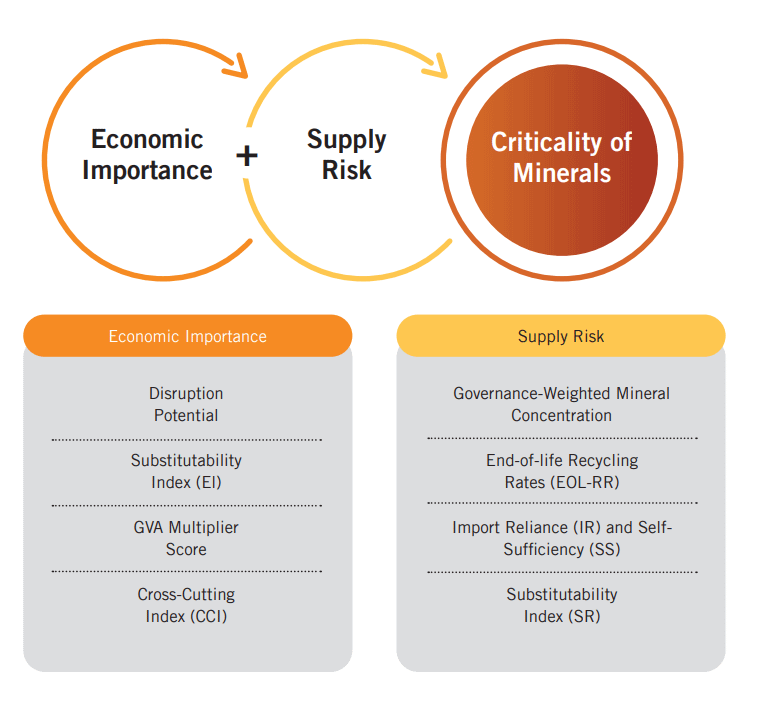
These are called “critical minerals.” They’re critical because, for one reason or another — whether geopolitical or geographic — they’re hard to secure, yet it’s difficult to imagine a modern economy without them. Every country has its own definition of what counts as “critical.” India does too, and its current list includes 30 minerals.
Every year, the International Energy Agency (IEA) publishes a major report on critical minerals. For most of the past decade, the big question was whether the world was mining enough of these metals to keep up with demand.
This year’s report puts emphasis on something else. Instead of worrying about how much is in the ground anymore, it highlights how a handful of countries control a lot of its supply. That became problematic, when last year, these countries started weaponizing this control.
To be fair, people had been warning about this for years. But it only grabbed everyone’s attention once it started disrupting industries around the world.
That’s just one takeaway from a report that runs over 300 pages. We can’t cover all of it, but here are five things that stood out.
Supply problem is much larger than just digging
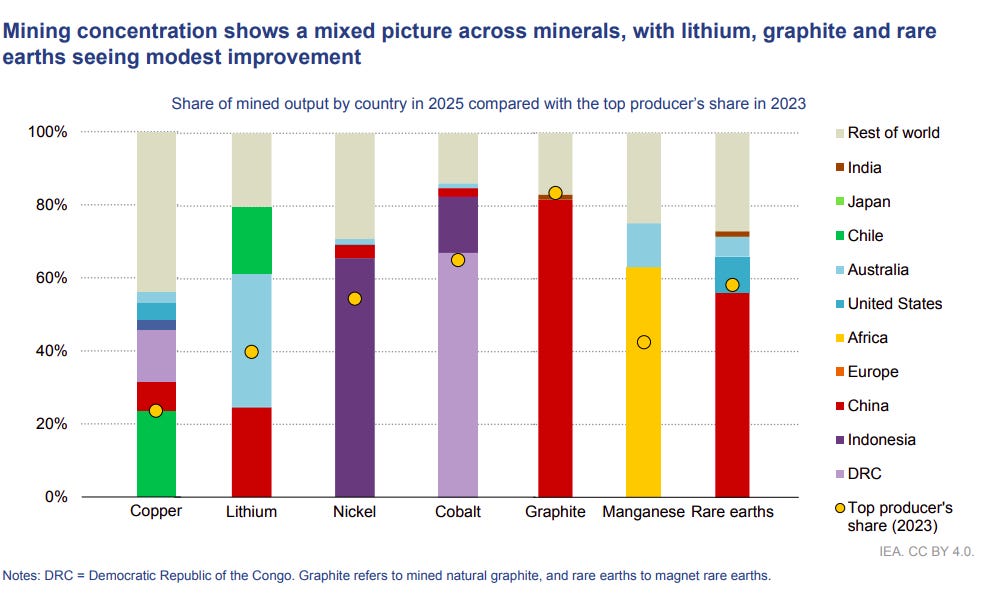
How critical minerals are distributed across the world is largely a geographic lottery. Some countries are simply more naturally endowed than others. But that’s not the real problem, nor are we running out of these minerals anytime soon. The problem is that a lump of raw ore is useless for any factory. It first has to be cleaned and refined into an extremely pure form, and that refining is a huge, difficult, dirty industry all on its own.
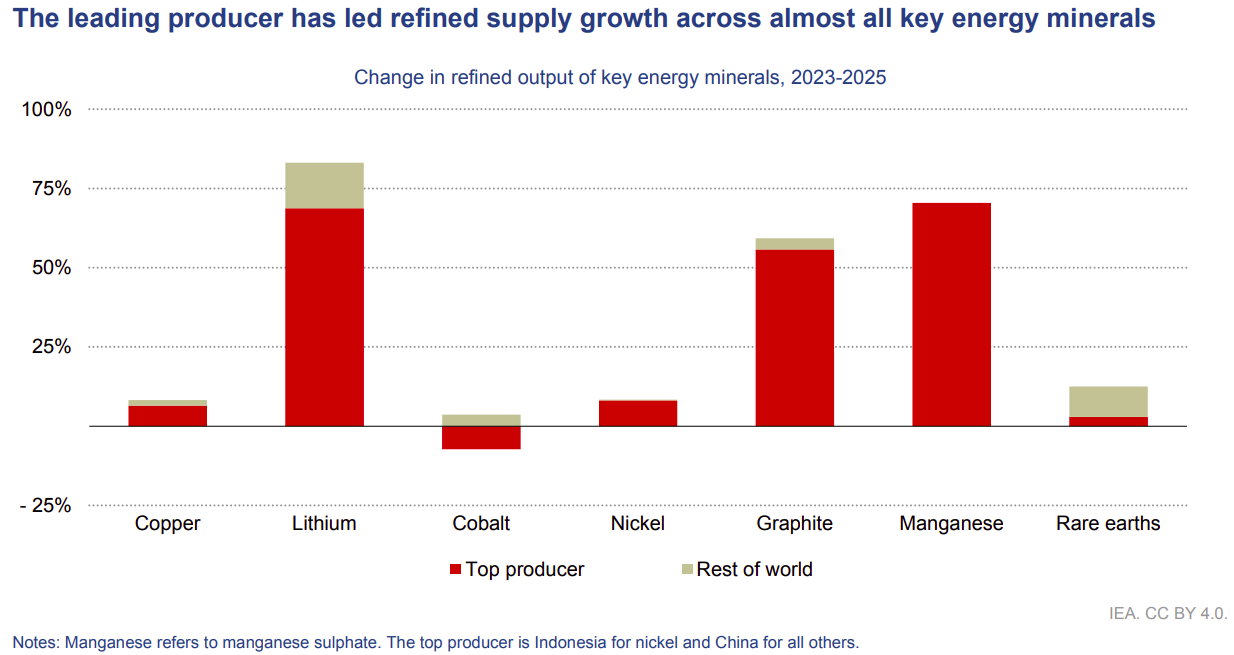
Unsurprisingly, China dominates this business. It refines most of the world’s lithium and cobalt, and almost all of its battery-grade graphite. Indonesia plays the same role for nickel. Together, over the past two years, those two countries accounted for more than three-quarters of all the new refining capacity added anywhere in the world.
In other words, the biggest players kept expanding their lead in the minerals they already dominated. That only made the world’s dependence on them even deeper—a concentration that should make any country uncomfortable.
So why doesn’t everyone else just build their own refining capacity?
For one, it’s expensive. China’s expertise has brought prices down within the country. The same refinery outside China, however, costs 20% to 150% more to build. It is also roughly 50% more expensive to run, in large part because power and materials are pricier everywhere else. On top of that, the by-products of refining rare earths are incredibly toxic, and many countries have simply been unwilling to subject their citizens to the same levels of pollution.
As a result, even though the world understands the importance of diversifying away from China in theory, its hold over critical minerals only grows stronger.
This creates a massive dependency, even for countries that have critical mineral raw materials. You can dig up your own lithium in Australia, for instance. But as long as China maintains its chokehold on refining the metal, the dependency remains.
That might be changing, however. Many countries that have critical mineral deposits are trying to prevent it from leaving their shores. For instance, Congo, Zimbabwe and Mozambique have all put controls on their raw cobalt, lithium and graphite. To access those deposits, investors have to set up refineries in those countries — giving them both investment and resilience.
Export controls becomes the new normal
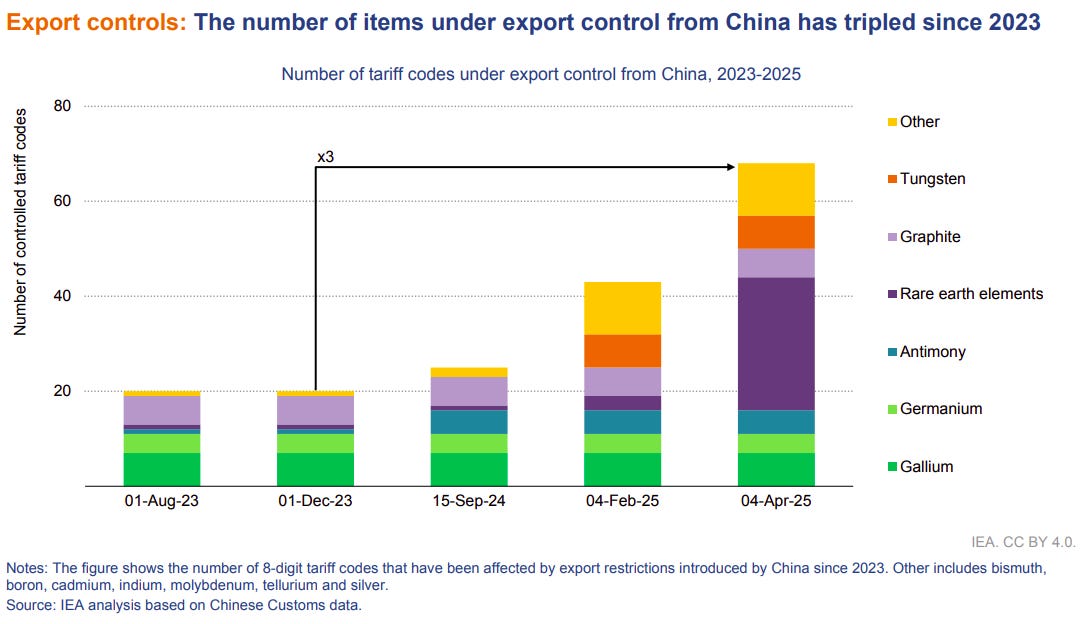
For years people knew that China’s dependency on refining was a huge deal and last year this became a little more evident. Then in April 2025, China put export controls on seven of the heavy rare earths. These rare earths make the magnets inside electric motors, and there’s no easy substitute for them.
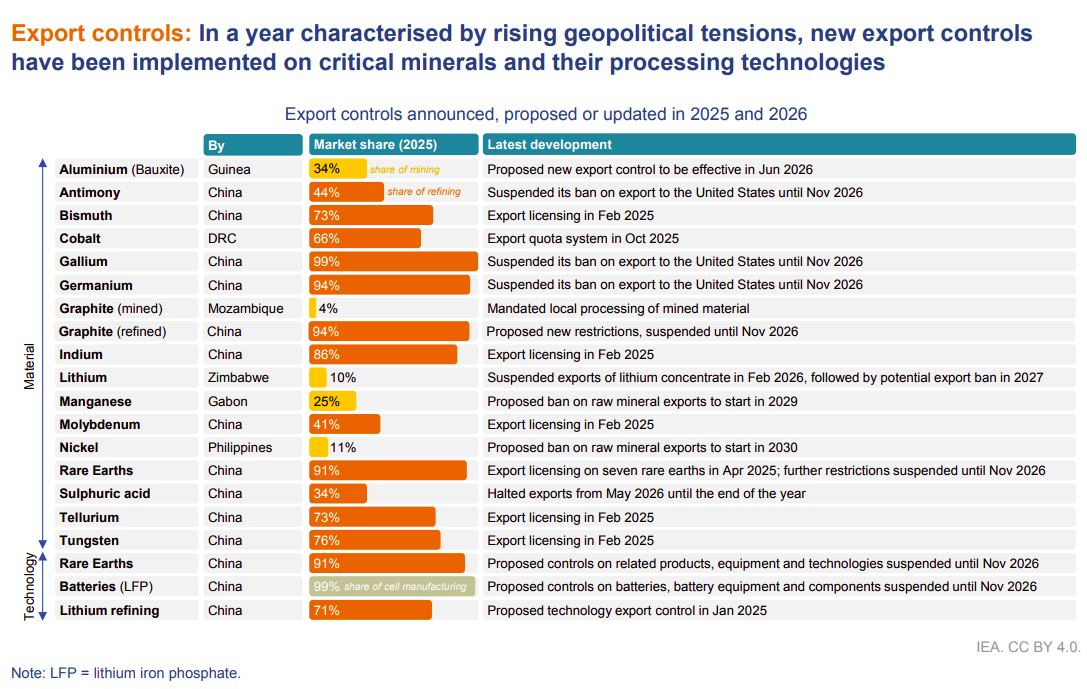
The Chinese exports to the world dried up and carmakers in the US and Europe couldn’t get the magnets they needed. Consequently, some automarkets slowed their production lines while others flat-out stopped building cars.
This also showed up in prices for these metals. For the minerals that China restricts, there are now basically two prices. A cheaper one inside China, while hefty premiums for the same metals in European markets.
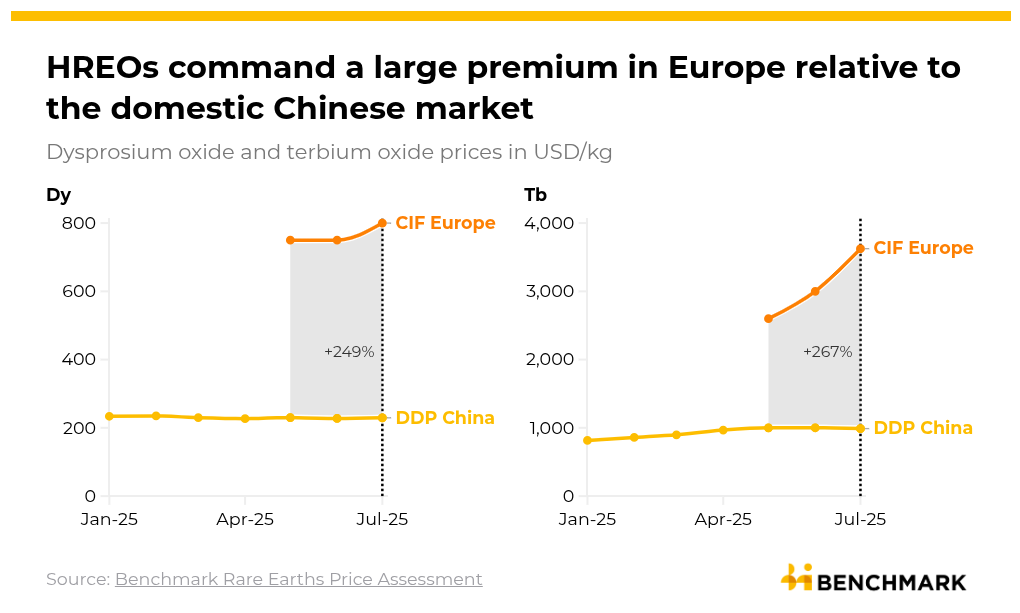
For context, in Europe, gallium and the heavy rare earths cost around five times the Chinese price. Across 2025, tungsten, used for making cutting tools, shot up sixfold and lithium more than doubled.
Then in October 2025, China went a lot further.
It floated rules saying that any product, made anywhere on earth, that contains Chinese rare earths, or was even made using Chinese technology, would need a Chinese licence to trade. That’s a wild reach, stretching into products that never even touch China.
The IEA estimated that if this were fully enforced, roughly $6.5 trillion dollars a year of production outside China would be at risk. China paused this tougher version for a year, until November 2026. Everyone rejoiced, but knew that the threat was not gone, just delayed.
China also announced controls on the battery supply chain, including graphite anodes and the machines used to make batteries, putting another 300 billion dollars a year of outside production at risk.
The dependency on Middle East
As we all know, the closure of the Strait of Hormuz broke a lot of things globally.
One such thing was sulphur. Its key use is in being converted into sulphuric acid, which is essential for processing copper, nickel, cobalt, lithium and rare earths. It’s also a key ingredient in fertilizers.
The Middle East supplies about a quarter of the world’s sulphur, and half the world’s shipped sulphur passes through the Strait of Hormuz. That’s because sulphur is recovered as a by-product when crude oil and natural gas are processed. Since the Middle East is a major producer of both, it has also become the world’s biggest hub for sulphur exports.
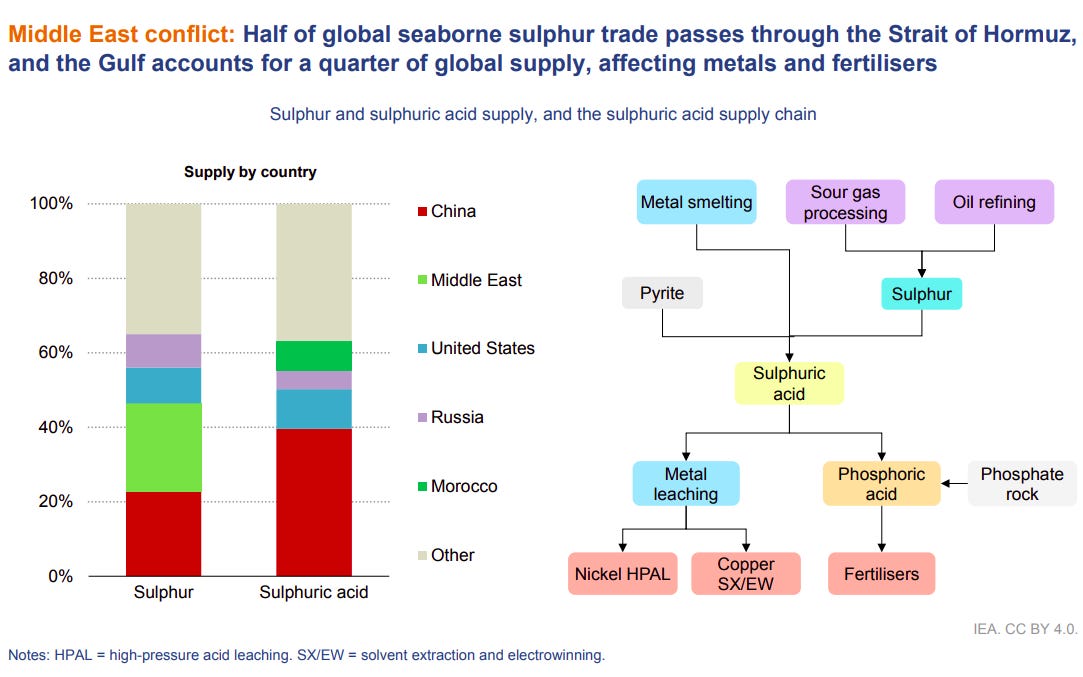
So what happened when the Strait was disrupted? Naturally, sulphur prices jumped. That pushed up the price of sulphuric acid as well. For lithium refiners, sulphuric acid, which had accounted for about 3% of production costs, suddenly rose to roughly 11%. That made lithium more expensive to produce. Higher sulphuric acid prices also raised fertilizer costs just as planting season began, creating a food security problem, especially for poorer countries.
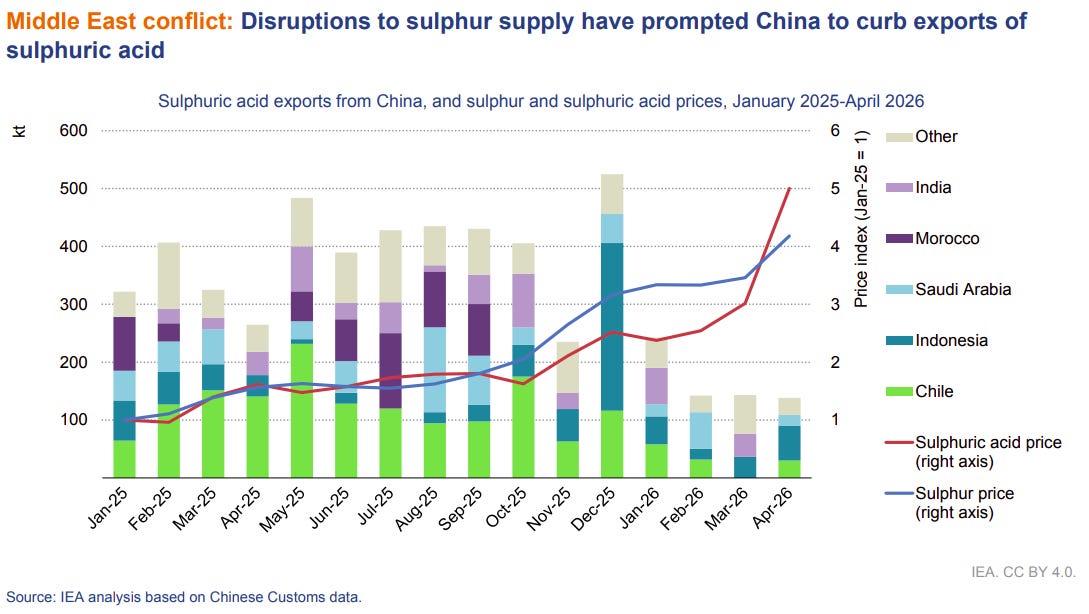
And it wasn’t just the well-known minerals that got caught up in this. Lesser-known metals like gallium, germanium, tungsten and antimony also rely on sulphuric acid during refining. These metals ultimately end up in AI hardware, data centres, defence equipment and clean energy technologies. In other words, a disruption in sulphur supply left industries ranging from automakers and chipmakers to defence firms competing for the same critical input.
The same turmoil in the Middle East also knocked out a meaningful share of the world’s helium supply. Now that’s a gas without which semiconductors can’t be manufactured.
Not a good time to be a middlemen
You’d expect that with all this chaos and prices rising, investors would be rushing to build new mines and refineries to cash in. After all, one person’s problem is another person’s opportunity. But the opposite happened. Investment in critical minerals actually fell 9% in 2025, the first decline in years. What stood out the most was lithium companies slashing their investment budgets by around 40%.
That raises an obvious question: how do refineries shy away from investing when metal prices are soaring?
Because refineries don’t make money by selling the metal. They make money by charging miners a fee to process raw ore. China built so many refineries that there simply isn’t enough ore to keep them all running at full capacity. So they started undercutting each other to win business. Those processing fees collapsed to zero in 2026, the lowest level on record. As a result, miners pocket the profits from high metal prices, while refineries process increasingly valuable ore for almost nothing and bleed cash.
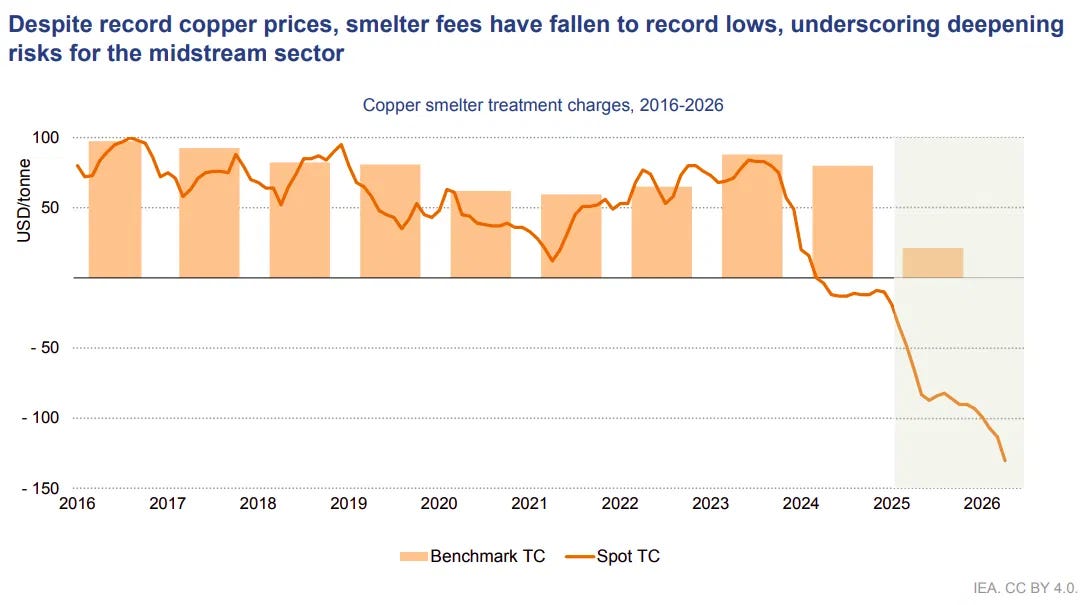
This is something that we looked at in our previous story on copper as well.
There’s another interesting angle. Many of the rarest critical minerals aren’t mined directly at all. They are recovered as by-products when base metals like copper and zinc are smelted. So if those refineries start shutting down because they aren’t profitable, the world also loses one of its few sources of these niche but essential minerals.
Where does India sit in all of this?
Put all of that together, and India is in a pretty awkward spot.
Our appetite for these minerals is only growing. India added renewable energy capacity at one of the fastest rates among major markets in 2025. That also makes us more vulnerable, because our solar farms, batteries and EVs all depend on supply chains we have little control over. We own almost none of the global refining capacity.
Then there’s helium. Qatar supplies more than half of India’s helium, and we need it to manufacture everything from MRI scanners to electronics. India is also a major producer of sulphuric acid, but it relies on imported sulphur to make it.
So we’re heavily dependent on importing the raw materials, yet we’re also struggling to stay competitive in exporting the products made from them.
India’s manganese-alloy exporters are a good example. They’re facing a difficult 2026 because Europe, their biggest market, is capping imports and introducing a carbon levy that could halve India’s shipments.
The one hopeful thread is recycling—recovering metals from used batteries and old electronics. It could significantly increase India’s domestic supply by 2040, and matters more for a country with limited mineral deposits than almost anywhere else. But that’s still a distant goal. Building a large-scale recycling ecosystem is a challenge in itself, with no easy answers.

The hidden gap in India’s mobile internet ecosystem
Without a doubt, India’s mobile internet story is one of the great infrastructure achievements of the last decade, especially after the advent of Jio. Today, India has over 1 billion broadband connections. Mobile data costs a fraction of what it does in most countries.
Of those 1 billion connections, only 47 million, or less than 5%, are fixed wireline. The rest is mobile data. That sounds fine; after all, for us, internet consumption was normalized through the smartphone.
But that’s not true for other countries, including and especially those at a similar stage of development as us. Elsewhere, fixed-line networks carry the bulk of internet traffic. India is one of the few countries in the world where mobile networks carry more total data than fixed-line ones.
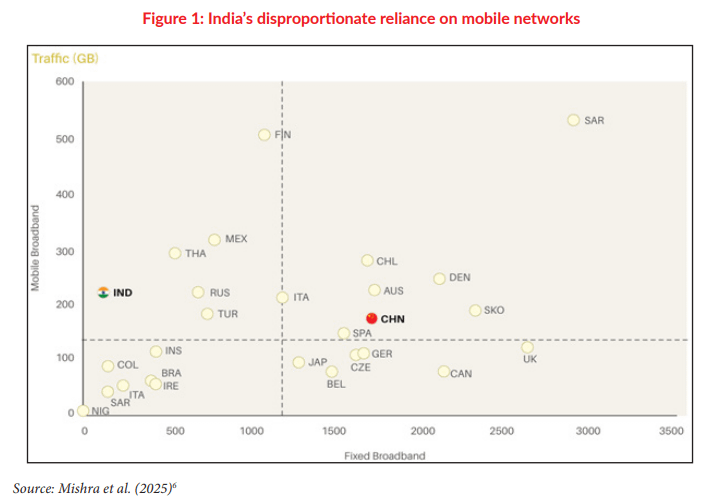
It’s an imbalance that didn’t matter much when the internet was mainly about WhatsApp messages and YouTube videos. But as cloud computing, AI applications, telemedicine, and digital governance scale up, the absence of a reliable fixed-line backbone may become a structural vulnerability. That is the hypothesis of a new policy brief from the think-tank ICRIER, that we’ll be looking into today. We recommend reading it in full if you have the time.
But, there’s a disclosure about the report that’s worth noting upfront.
This report comes from ICRIER’s InVict Centre, where “Vict” stands for Vodafone-Idea Centre for Telecom. This research centre is co-backed by Vi, the third-largest telecom operator in the country — a company with a troubled history, trying to make a comeback. It would directly benefit from many of the report’s recommendations. That doesn’t make the analysis dubious or incorrect, but it is worth keeping in mind as we get into the policy prescriptions.
Why wireline matters
So, if mobile data is cheap and widely available, why does India need wireline at all? The answer comes down to three things.
The first is capacity. When hundreds of people in a neighbourhood are streaming, working from home, or running cloud applications at the same time, a mobile network congests — because everyone in the cell tower’s radius is sharing the same airwaves. But a fibre connection to your home doesn’t have that problem. A single fibre-optic cable can carry orders of magnitude more data than a cell tower. The bandwidth is yours; it doesn’t degrade because your neighbour started a video call.
The second is reliability. Mobile signals are affected by weather, building walls, distance from the tower, and how many other people are connected. Fibre is a physical cable that delivers consistent speeds regardless of what’s happening around it.
That consistency matters enormously for the kind of applications India is betting its future on. Cloud-based AI services, remote healthcare where a doctor in a city hospital monitors a patient in a rural clinic in real time, factory automation, digital governance — all of these need connections that don’t drop or slow under strain.
The third factor is the most interesting of all: it’s that mobile networks themselves depend on wireline. The cell tower your phone connects to needs a fibre-optic cable running from it back to the core network. This is called “backhaul“. The last hop to your phone is wireless, but everything before that should be fibre. Without good fibre backhaul, even a 5G tower delivers mediocre speeds.
India’s tower fiberization rate, which is the share of cell towers connected to fibre, stands at roughly 36%. The government’s own target was 70% by 2024. In contrast, the same number in North America is 70%. In South Korea and Japan, where fibre broadband penetration exceeds 85%, the figure is even higher. Building wireline isn’t a separate agenda from mobile, but a precondition for the quality of mobile data itself.
Slow, expensive, and stuck in a loop
So, what is the state of India’s fixed-line infrastructure?
India’s average fixed broadband download speed is about 64 Mbps, while mobile broadband clocks in at around 101 Mbps. In essence, in India, your phone gives you faster internet than your home broadband. We’re one of the very few countries in the world where that’s the case. In most places, fixed-line speeds are two to four times faster than mobile.
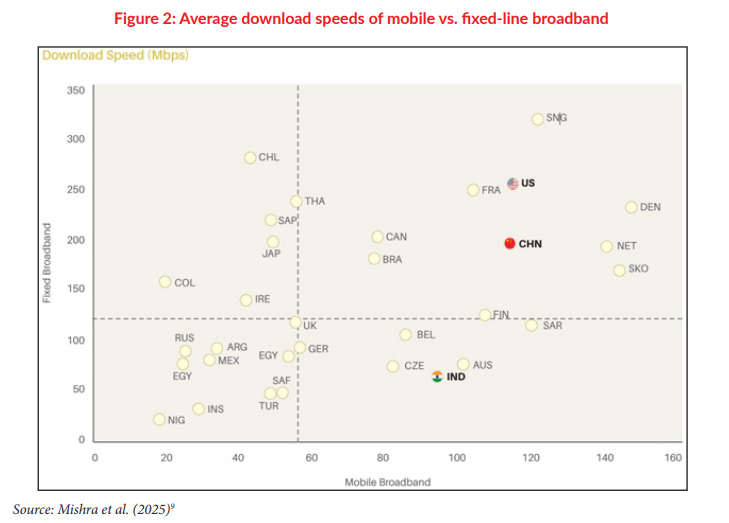
That’s less a reflection on India’s mobile internet, and more on the poor health of our fixed-line infrastructure. And some of the reason has to do with economics.
See, fixed broadband in India is expensive. A fixed broadband basket costs about three times the price of a mobile data plan as a share of monthly gross national income per capita, and about double the global average. So you have a product that’s slower than its mobile alternative while also costing significantly more. Why would anybody buy that?
Low demand, in turn, creates a vicious cycle. Service providers can’t justify investing in upgrading fixed-line networks when few people are subscribing. Without investment, quality stays poor. Poor quality keeps demand low. The cycle reinforces itself, and India’s wireline infrastructure falls further behind.
Jio and Airtel are the biggest fixed-line providers. But regional ISPs like Excitel and legacy cable operators like GTPL also play a role. BSNL, the state-owned operator, still runs much of its last-mile delivery on ageing copper lines laid decades ago.
BharatNet’s unfinished promise
It was to fill this gap that, in 2011, the Indian government launched BharatNet, a nation-wide programme with ₹1.3 lakh crore worth of commitment to bring fibre connectivity to every village in the country. By 2020, the scope had expanded to cover all inhabited villages, and a public-private partnership (PPP) model was approved for 16 states to bring in private operators for last-mile deployment.
The results have not matched the ambition, though. As of September 2025, only a little over 2 lakh villages out of a target of more than 6.5 lakh have been connected. The budgeted expenditure for BharatNet in FY 2025-26 was ₹22,000 crore, but only 25% of it was utilised.
Part of this underperformance is slow execution, but, as per ICRIER, the biggest reason lies in the flawed design of the funding mechanism itself.
India finances its broadband push partly through the Universal Service Obligation Fund, now renamed the Digital Bharat Nidhi (DBN). The fund is built on a simple idea: telecom operators pay a 5% levy on their revenue, and that money is used to extend connectivity to underserved areas. The problem is that this levy flows into the Consolidated Fund of India, which is the government’s general kitty. That, then, has to be re-allocated through the annual budget process before it reaches the DBN.
This creates a structural gap between collection and disbursement. Money collects in the fund, gets stuck in the budgetary pipeline, and sits unused. As of March 2026, over ₹1 lakh crore remains unutilised.
What the rest of the world did differently
Other countries faced similar challenges, and their approaches offer a useful contrast.
Chile, for instance, built its fibre backbone through PPPs. The Fibra Óptica Nacional, a 10,000-kilometre network, received about $120 million in government subsidies.
Chile’s network is wholesale access: meaning multiple ISPs, no matter how big or small, can access the same infrastructure on equal terms. This also implies that there is little duplication of fibre-laying efforts by operators. To incentivize the network buildout, the country also ran reverse auctions, where the operator that bid the lowest subsidy while meeting defined service levels won. By 2022, nearly 60% of Chile’s fixed connections were fibre, and its broadband speeds led Latin America.
Brazil, which is often compared with India for its size and development challenges, built a competitive and fragmented market where smaller providers hold more than half the fixed broadband base. Much like Chile, wholesale networks have been crucial to this. Fixed broadband connections grew by about 43% between 2020 and 2024.
Meanwhile, Singapore structurally separated the passive infrastructure (the fibre cables) from the active infrastructure (which are the routers and switches) in its nationwide broadband network, and mandated equal wholesale access for all downstream operators. This prevented the fibre owner from favouring its own retail services. Today, over 85% of Singapore’s homes have access to speeds of at least 1 Gbps.
South Korea used PPPs specifically for rural areas, bringing together central and local governments with major ISPs to connect about 1,300 villages between 2020 and 2022.
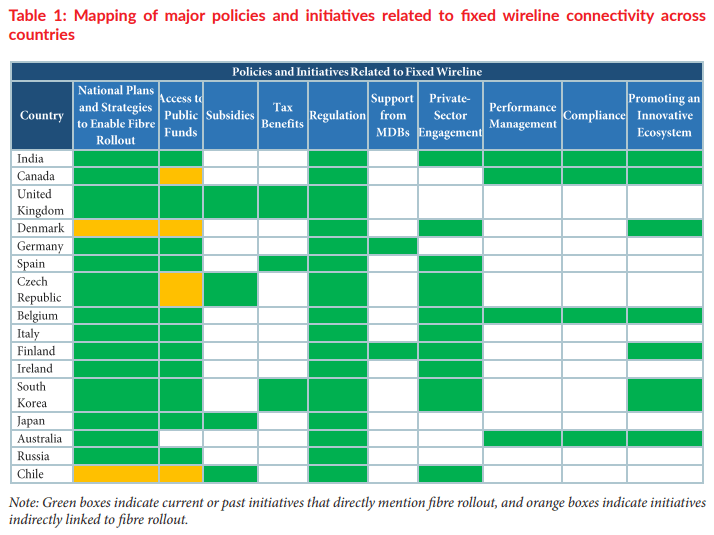
The fixes India needs
The ICRIER brief maps India’s existing initiatives against these international experiences and identifies several gaps.
The most fundamental fix is to ringfence the Digital Bharat Nidhi. That will involve either bypassing the Consolidated Fund entirely or establishing a time-bound transfer obligation backed by legislation. Without this, no amount of additional funding translates into outcomes.
The second fix that ICRIER recommends is accelerating BSNL’s copper-to-fibre conversion.
Combined, BSNL and MTNL have the largest fibre footprint of any single entity in India — roughly 15.85 lakh route kilometres when you combine their own network with BharatNet. BSNL alone accounts for about 37-38% of the country’s entire fibre footprint. Yet much of its last-mile delivery still runs on ageing copper, which caps broadband speeds and reliability.
So, while it continues to lay new fibre connections, the old ones keep rusting without being decommissioned, and effectively, it pays maintenance costs for both. And, given BSNL’s budgetary issues, those costs are unaffordable.
The conversion needs capital ringfenced from BSNL’s ₹1.64 lakh crore government revival package, measurable annual targets for copper retirement, and a defined schedule for decommissioning copper.
The third fix is on the question of competition, which is where the incentives behind the report come into play.
We all know that India’s telecom sector has gravitated towards a duopoly, with the two largest players capturing 75% of market share. India doesn’t impose wholesale access obligations on its dominant telcos — it is technically permitted under unified licence conditions, but it’s not mandated. Each large operator builds its own last-mile network, duplicating investment in profitable urban areas while leaving unprofitable areas unserved.
The brief recommends mandatory wholesale access, transparent interconnection pricing, and an offset in the AGR duty levied on telcos if they invest in rural fibre capex. These are legitimate policy ideas with international precedent.
But notice who benefits most. Mandatory wholesale access would let operators who haven’t built their own fibre (like Vi) piggyback on networks that Jio and Airtel spent billions constructing. An AGR levy offset gives proportionally more relief to a company whose AGR liabilities nearly bankrupted it. As such, Vi has been successfully lobbying for reductions in their AGR dues in the past few months.
None of this means the recommendations are wrong, though. The duopoly structure indeed discourages investment in unserved areas. These reforms are meant to help all competition, big or small. But Vi would be the most immediate beneficiary.
Conclusion
India built one of the world’s most impressive mobile-first internet ecosystems. The next challenge lies in building the second layer successfully across the whole country. The fixed-line backbone is what every mature digital economy relies on.
We don’t necessarily lack capital to make this happen. But the report highlights where we do lack institutional capacity. That includes fixing the plumbing of public funds, mandating infrastructure sharing, and recognising that cloud AI, smart manufacturing, and remote healthcare can’t run on mobile networks alone.
Tidbits
[1] RBI said it received $17.41 billion via FCNR(B) deposits swapped under a zero-cost facility, $1.97 billion through overseas foreign currency borrowings by banks, and $1.34 billion via external commercial borrowing swaps: totalling $20.7 billion. The crisis-era measures, announced amid sustained rupee pressure from elevated oil prices, were aimed at boosting dollar inflows. We covered the FCNR deposits here.
Source: Business Standard
[2] Minister of State for Finance Pankaj Chaudhary told the Lok Sabha that UPI processed 24,162 crore transactions worth ₹314.23 lakh crore in FY26, up from 18,587 crore transactions worth ₹260.56 lakh crore the year before. NPCI International is also expanding UPI’s global reach, with cross-border payments now live in Greece, Nepal, and Cambodia.
Source: Fortune India
[3] Honeywell Aerospace has landed a deal to supply Indigo’s new Airbuts A320neo jets with auxiliary power units, weather radar, traffic collision avoidance systems, and flight management systems. This was the largest new-aircraft-selectable equipment win in the history of Honeywell, which has supported IndiGo’s operations since 2015.
Source: ET Now
[4] Coca-Cola appoints JPMorgan, Citi, Kotak, and Morgan Stanley for its Indian bottler’s 2027 IPO. The beverage giant confirmed in June that it is preparing to list Hindustan Coca-Cola Holdings and may sell part of its stake, joining a broader wave of global companies — including Pernod Ricard and Carlsberg — looking to tap India’s equity markets.
Source: The Economic Times
[5] NPCI is developing an offline tap-and-pay UPI for flights and underground metros. The feature will let users load money onto an on-device UPI Lite wallet and tap their NFC-enabled phone on a certified PoS terminal to pay up to ₹2,000 — no internet needed on either end. NPCI is expected to begin certifying merchant terminals from leading PoS manufacturers this year.
Source: Business Standard
- This edition of the newsletter was written by Krishna & Manie.
Suyash Singh on the madness of the space business
Space is hard, a cliché that becomes reality when you try to build hardware that operates in a vacuum, extreme radiation, and wild thermal cycles with zero tolerance for failure. For Earth observation companies, this difficulty is compounded by a business reality: satellite imagery is essentially a data business hampered by inconsistent supply due to cloud cover. To make sense of all this, we spoke to Suyash Singh, Co-founder and CEO of GalaxEye, who is attempting to solve this by building India’s first OptoSAR satellite. Our conversation dives deep into the technical hurdles of synchronizing optical and SAR sensors traveling at seven kilometers per second, the realities of miniaturizing radars for drones as a frugal testing ground, how the IN-SPACe reorganization catalyzed the Indian private space ecosystem, and what it is actually like to book a launch slot with SpaceX.

You can also listen to the full conversation on Spotify and Apple Podcasts. Watch the full podcast episode below, where Suyash breaks down the technical hurdles of space hardware and the economics of Earth observation.
Points & Figures by Zerodha
We’re always chasing the day’s biggest stories. But every now and then, we come across a dataset that deserves a closer look than a Daily Brief allows.
That’s what Points & Figures is for.
It’s where we step back from the news cycle and use data visualisations to tell stories about the Indian economy, financial markets, and investing. Our latest edition traces how India’s power landscape is transforming, using electricity generation, capacity, and emissions data to reveal why simply building solar panels isn’t enough to dethrone coal.

What we’re reading
Our team at Markets is always reading, often much more than what might be considered healthy. So, we thought it would be nice to have an outlet to put out what we’re reading that isn’t part of our normal cycle of content.
So we’re kickstarting “What We’re Reading”, where every weekend, our team outlines the interesting things we’ve read in the past week. This will include articles and even books that really gave us food for thought.
Join us on WhatsApp, where we share interesting soundbites from concalls, articles, and everything else we come across throughout the day. You’ll also get notified the moment a new video or article drops so that you can read or watch it right away.
Thank you for reading. Do share this with your friends and make them as smart as you are 😉
Satellite may not be the perfect viable solution for dense urban area with heavy usage.
Do we need wired connections when we can move to satellite ones?