


Hi everyone, I’m Mridula, and welcome to the twelfth edition of Weekly Tidbits.
We read a lot of news that never makes it into a full Daily Brief story. Each week, we pick some of the best stories and add a little context.
We sort them into GEIC: Global, Economy, Industry, and Company.
Let’s get started!
If you prefer watching the video instead, here’s the link:
G — Global
[1] Qualcomm is helping SpaceX build a mobile network
Qualcomm has signed a deal to supply equipment for SpaceX’s new mobile network in the US. SpaceX plans to launch the service in 2027 and build tens of thousands of sites over the next few years.
SpaceX already runs Starlink, which sends internet signals from satellites. Now, it wants to add mobile towers on the ground. Qualcomm will supply the chips, radio equipment and software for these towers. The goal is to keep phones connected in places where towers have poor reach. We wrote earlier about SpaceX buying mobile spectrum, the radio frequencies needed to run a network. The new deal takes that plan a step further.
SpaceX will now compete more closely with AT&T, Verizon and T-Mobile. These firms already serve millions of users, so winning customers won’t be easy. For Qualcomm, the deal creates a new source of sales beyond smartphone chips.
[2] Hackers are attacking supermarket fridges in Europe
Hackers have disrupted fridges and freezers at stores across Europe. On November 2, shops in Sweden, Belgium and Ireland found that someone had changed their cooling settings from afar. Some fridges reached 50°C, and stores had to throw away food.
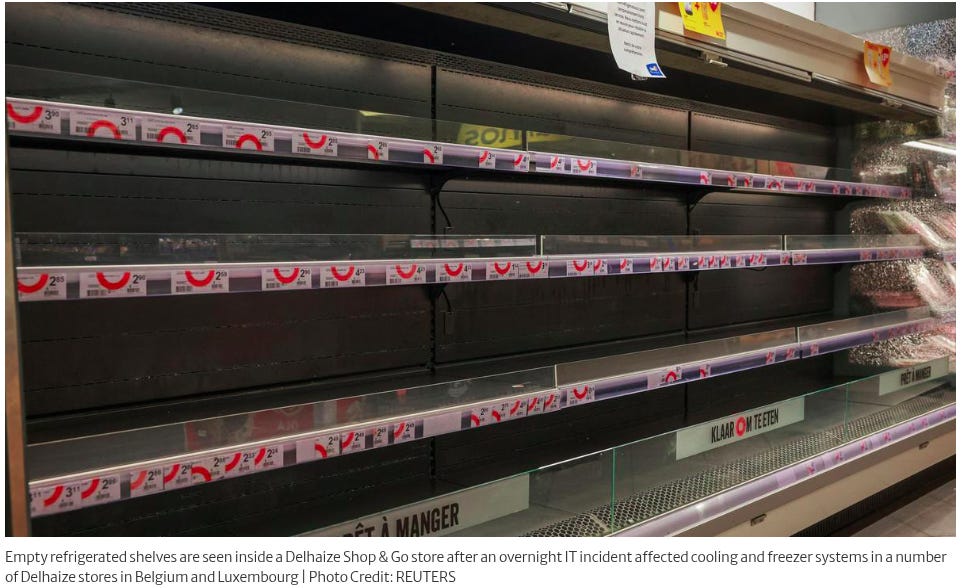
Large chains use computers to control fridge temperatures across many shops. This helps staff save time and keeps food fresh. Yet the same system gives hackers a way in. Once they gain access, they can change settings without entering a store. In some cases, they switched the fridges to defrost mode, which made them heat up.
A similar attack hit French stores in October. Some chains have now cut their cooling systems off from the internet while they fix the problem. One breach can spoil food across many stores, even if the hackers never set foot inside them.
[3] The Bank of England raises interest rates
The Bank of England has raised its main interest rate from 3.75% to 4%. This is its first rate hike since August 2023. The bank wants to stop inflation from rising as the war in West Asia pushes up energy costs.
Higher oil and gas prices mean people pay more for fuel and power. Firms also spend more to make and move goods. Some pass these costs on to buyers. UK inflation has reached 3.5%, and the bank expects it to hit 5% by mid-2027. Its target is 2%.
Raising rates makes loans cost more. People may then spend less and save more, which can slow price rises. But higher rates cannot make oil or gas cheaper. They can also hurt firms and people with home loans. The bank must now control inflation without putting too much strain on the economy.
E — Economy
[4] Foreign investors are buying Indian stocks again
Foreign investors bought ₹14,796 crore of Indian stocks on November 5, based on early exchange data. That was their biggest one-day purchase in nearly six years. The buying came as oil prices fell and some investors moved away from AI stocks.
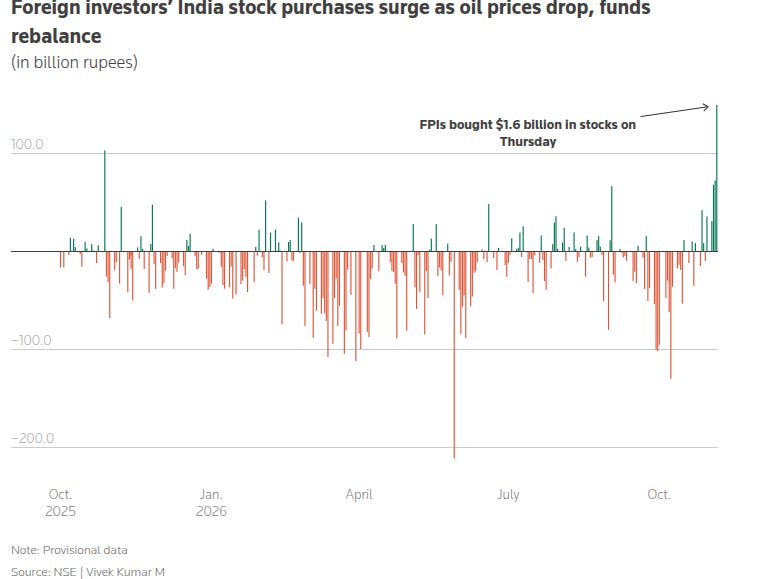
Foreign investors move money to markets where they hope to earn more. For much of 2026, they had been selling Indian shares. High oil prices hurt India’s economy, while the AI boom drew funds to other markets. Through October, foreign investors had sold around $30 billion of Indian stocks, or ₹2.85 lakh crore.
Now, both trends are starting to change. India buys most of its crude oil from abroad, so cheaper oil helps cut its import bill. Some investors are also looking beyond big AI stocks. Fresh inflows can lift Indian share prices and support the rupee. But one strong day does not tell us if this shift will last.
[5] Indian banks are starting to pay more on deposits
Indian banks have started raising rates on some fixed deposits, about a month after the RBI raised its main rate. Bank of India has raised rates by 0.10 to 0.35 percentage points on certain deposits.
Banks use much of the money people deposit to give loans. When they have enough cash, they don’t need to offer higher rates to attract more. But when funds run low, they must compete for deposits. Paying savers more is one way to do that.
We wrote earlier about how the RBI is trying to control inflation. Along with raising rates, it has been taking extra cash out of the banking system. This makes money harder for banks to get and pushes up loan costs. Now, the squeeze is reaching deposit rates too. If cash stays tight, more banks may follow.
[6] India won’t open its dairy market in trade deals
Commerce Minister Piyush Goyal said on November 3 that India will not open its dairy market or allow genetically modified imports through trade deals. India is still in trade talks with countries such as the US.
Trade deals often cut taxes on goods from other countries. That makes imports cheaper, but it can hurt local sellers who cannot match those prices. India has millions of small dairy farmers who rely on milk sales. In the US, many farms are much larger and can produce milk at lower costs. India wants to shield its farmers from that competition.
Genetically modified, or GM, crops have had their genes changed to give them traits such as pest resistance. India has long kept tight rules on these products. The US wants easier access for some of its farm goods. Goyal’s remarks show that India plans to keep these limits while seeking better access for its own exports.
I — Industry
[7] India may spend ₹8,000 crore on khadi and handicrafts
The government is considering an ₹8,000 crore plan to help khadi, handloom and handicraft makers grow. Called the Mahatma Gandhi Gram Swaraj Initiative, it could run for five years. The plan would support new tools, more sales and better access to buyers. It has not been approved yet.
Millions of Indians make clothes and other goods by hand. Many work from home or in small units. They often lack the money to buy better machines or take on large orders. Buyers abroad also want the same quality across thousands of items. Small makers can struggle to meet those demands.
India’s trade deals are opening new markets for these goods. Yet lower import taxes won’t help much if firms can’t make enough to meet orders. The plan could pay for shared workspaces, new tools and better ways to sell products. That may help small makers reach more buyers while keeping their craft alive.
[8] India wants faster action against poor-quality medicines
India has proposed new rules to act faster when medicines fail key quality tests. Officials could suspend a drugmaker’s licence right away if a test finds too little active drug, harmful chemicals or germs in the medicine.
At present, officials must first ask the company to explain the failure. This takes time, and the factory may keep making the same drug during that period. Under the new plan, regulators could stop production as soon as a government lab finds a serious fault. The company would then have to find and fix the problem before it could start again.
We wrote earlier about why India struggles to check medicine quality. One problem is that state and central regulators share the job, which can slow action. The new rules aim to cut that delay. They are still open for public feedback, so they have not taken effect.
[9] India may sell more BrahMos missiles to the Philippines
India is close to another deal to sell BrahMos missiles to the Philippines. The order could be worth $700 million to $800 million, or about ₹6,600 crore to ₹7,600 crore. It may cover nearly 60 missiles. The two sides have not signed a new contract yet.

BrahMos is a fast cruise missile that India and Russia developed together. It can hit targets at sea or on land. The Philippines bought its first BrahMos systems in 2022 for around $375 million. It wants to guard its coast as tensions with China grow in the South China Sea. Missiles fired from land can help it defend its waters without relying only on ships and planes.
A second order would help India’s defence exports grow. It would also bring more work to local factories. Repeat orders can make it easier to win new buyers, since other countries can see that an existing customer has chosen to buy more.
C — Company
[10] Adani is seeking $1.5 billion for data centres
AdaniConneX is in talks to borrow about $1.5 billion, or ₹14,250 crore, to build new data centres, according to reports. It is a joint venture between the Adani Group and US firm EdgeConneX. The company is speaking with banks in Asia and West Asia, but it has not agreed on the loan terms yet.
Data centres are large buildings full of computers. They store and process data for apps, websites and AI tools. They need a steady supply of power, cooling and fast internet. They also cost a lot to build before they can earn money. Firms often borrow to build them and then use fees from customers to repay the loans.
Adani plans to spend more on AI and data centres over the coming years. This loan would help pay for that growth. The company will need enough paying customers to cover its costs and repay the debt.
[11] Kotak gets approval to buy Deutsche Bank’s India business
The Competition Commission of India (CCI) has approved Kotak Mahindra Bank’s plan to buy Deutsche Bank’s retail and wealth business in India. The deal covers 16 branches, around 1.5 lakh customers and nearly 1,000 staff. Kotak will also take over about ₹29,000 crore in loans and ₹16,000 crore in deposits.
Kotak wants to serve more wealthy customers and small firms. Buying an existing bank’s business helps it grow faster. It gets customers who already have accounts, loans and investments. It also gains staff who know these customers and can offer them more services.
Deutsche Bank wants to focus on other parts of its business. Kotak agreed to the deal in June, but it needed the CCI’s approval. That approval has now come through. The banks must still finish the transfer before Kotak can take over.
[12] IndiGo wants lower taxes and airport charges
IndiGo CEO Willie Walsh has asked for lower taxes and airport fees as fuel costs stay high. He warned that jet fuel may remain costly even if crude oil prices fall. Fuel makes up about 40% of IndiGo’s running costs.
We wrote recently about IndiGo’s quarterly results, when the airline lost ₹1,879 crore as its fuel bill rose by two-thirds from a year earlier. Refineries turn crude oil into jet fuel. Airlines pay for the crude and the cost of turning it into fuel. Walsh says this extra cost has jumped as jet fuel supply has become tight. Airlines must also pay taxes on fuel and fees to airports.
IndiGo could raise ticket prices to cover these costs, but that may put off some flyers. Walsh wants the government and airports to help cut the bill. He says lower costs would make it easier for India’s aviation market to grow.
That’s it for this week.
A few of these stories are still developing, so we’ll be keeping an eye on them. But if there’s one you’d like us to write about properly, let us know in the comments.
See you next edition :)