



Our goal with The Daily Brief is to simplify the biggest stories in the Indian markets and help you understand what they mean. We won’t just tell you what happened; we’ll tell you why and how too. We do this show in both formats: video and audio. This piece curates the stories that we talk about.
You can listen to the podcast on Spotify, Apple Podcasts, or wherever you get your podcasts and watch the videos on YouTube. You can also watch The Daily Brief in Hindi.
In today’s edition of The Daily Brief:
1. Did 50 crore Indians really escape poverty?
The World Bank reported that extreme poverty in India plunged from 27.1% to 2.6% between 2011-12 and 2023-24, lifting 49.6 crore people above the threshold. However, economists remain deeply divided over how much of this drop reflects real progress versus major methodological changes in the consumption survey, which introduced multiple visits and expanded item lists that naturally raise recalled spending. Furthermore, without an official domestic poverty line since 2014, lifting the yardstick to the upper-middle-income benchmark of $8.30 a day reveals that nearly four in five Indians still remain economically vulnerable.
2. IndiGo finds that higher fares aren’t enough
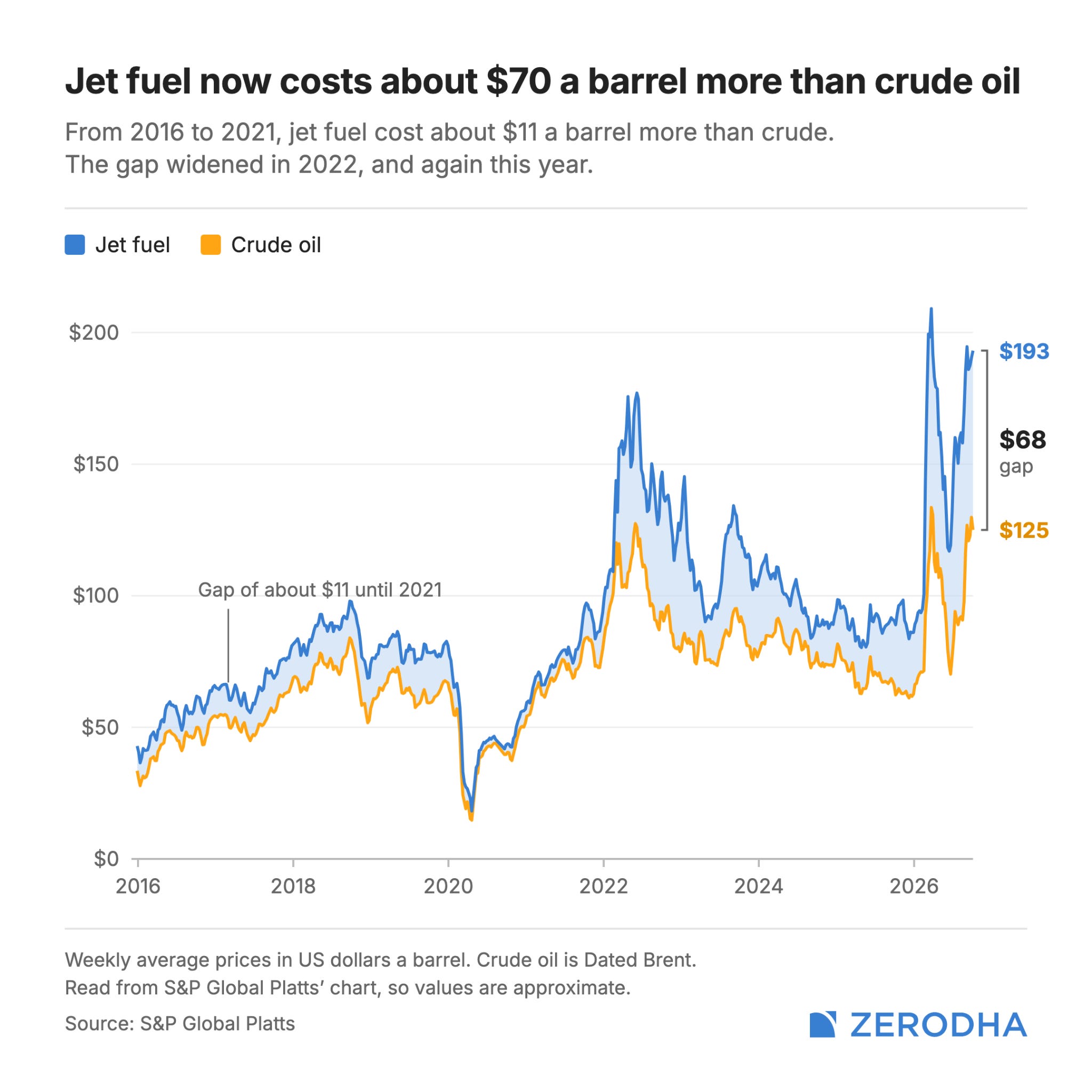
Under new CEO Willie Walsh, IndiGo trimmed capacity and raised passenger yields by over 34%, yet still slipped into an underlying loss of around ₹700 crore during the seasonally quiet monsoon quarter. A 67% surge in the airline’s fuel bill—amplified by blown-out refining margins that pushed jet fuel to a $70 premium over crude oil—more than outran fare hikes and burdened seat economics. In response, the carrier has returned its leased Boeing 787s to curb fixed overheads, opting to protect long-haul airport slots with smaller Airbus A321XLRs while keeping focus on its high-density domestic network.
Did 50 crore Indians really escape poverty?
Last week, India got a number most governments only dream of. The World Bank’s India Poverty & Equity Brief said that between 2011-12 and 2023-24, about 49.6 crore Indians crossed the poverty line, and extreme poverty fell from 27.1% of the population to just 2.6%.
And yet, India’s poverty economists have spent over two years fighting about numbers like this one. That’s because nobody, including the World Bank, can say for sure how much of that drop is real progress and how much is a change in how India measures it.
So let’s build this up from scratch.
First, how do you count a poor person?
When economists count the poor, they can’t judge how anyone’s life feels. They do arithmetic by picking a number, say ₹X a day per person, and calling it the poverty line. Anyone whose daily spending falls below it gets counted as poor.
Notice the word spending, not income. In a country where most people don’t draw a monthly salary, income is a slippery thing. A farmer may earn nothing for months and then everything at harvest. What a household spends on food, rent, fuel and school fees moves far more steadily, and people can actually tell you about it.
So counting poverty takes exactly two ingredients. First, a giant survey that asks lakhs of households what they spent. In India, that’s the Household Consumption Expenditure Survey, or HCES, run by the government’s statistics office. Second, a line to measure that spending against, which means deciding how much a person needs to spend to not be poor.
This entire fight is about both of them going wobbly at the same time.
The World Bank’s good news (and the world’s bad news)
The World Bank counts poverty for every country, so it needs one yardstick for everyone. The trouble is that a dollar buys a lot more dal in Patna than in Paris. So the Bank converts money using purchasing power parity, or PPP, an adjustment for what money actually buys in each country.
It then sets two lines that matter for India. The “extreme poverty” line sits at $3 a day per person, which works out to roughly ₹58 a day in 2021 prices. The second, meant for lower-middle-income countries like India, sits at $4.20, or about ₹82 a day in 2021 prices. A third line, $8.30, is the bar for upper-middle-income countries, the club India hopes to join.
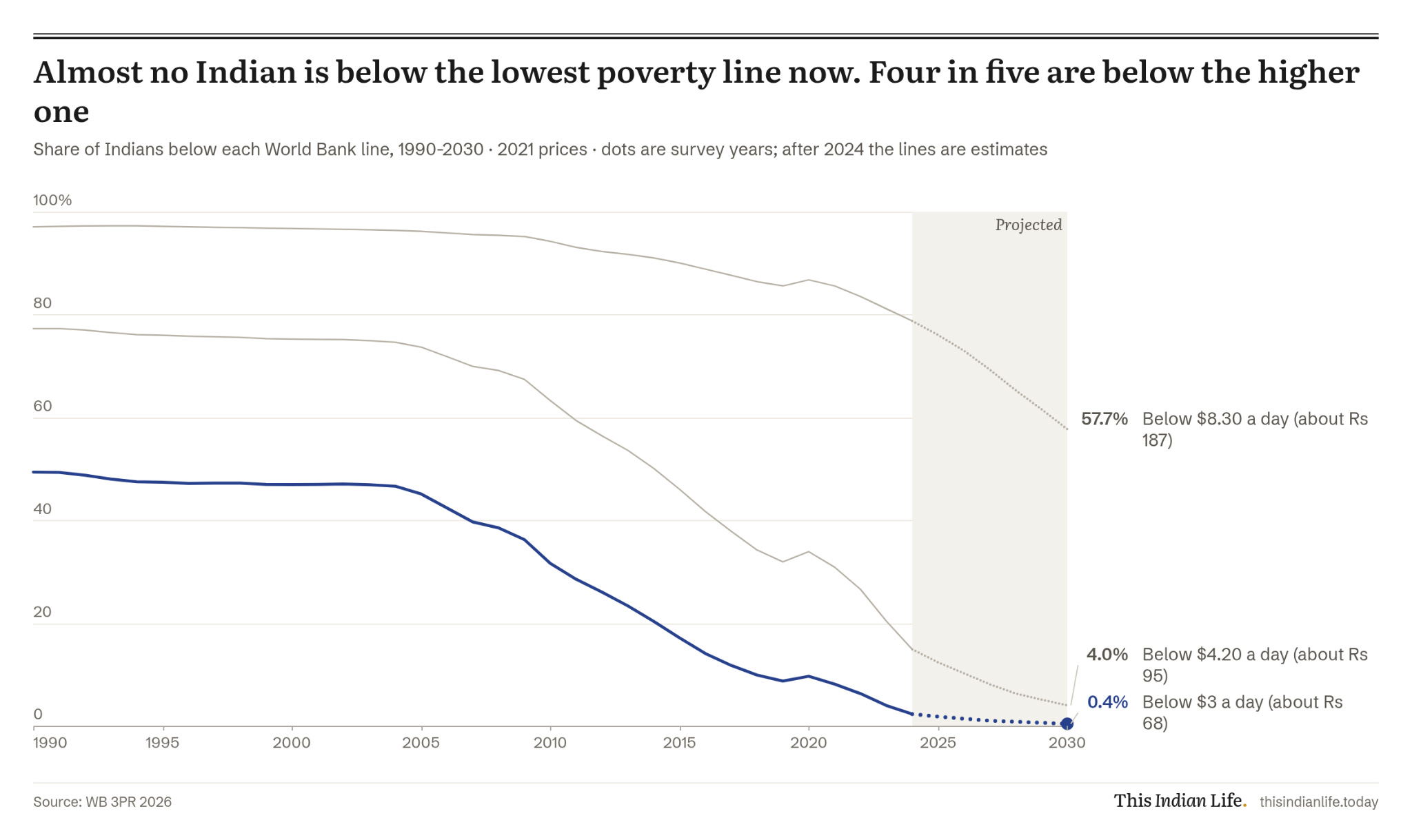
The $3 line is a floor built for the world’s poorest countries, which is why the Bank itself considers it a poor fit for a middle-income country like India.
Last month, the World Bank put out two documents.
The first, the Poverty, Prosperity, and Planet Report 2026, is its big global report card, and it reads like a warning. About 81 crore people, one in ten, still live on under $3 a day. This share hasn’t budged since 2019. Without faster growth, it expects even more extremely poor people by 2030. Its prescription is jobs: more of them, and better-paid ones. Not a new idea, but one the world still hasn’t cracked.
The second, the India brief, reads like a victory lap. At the $4.20 line, India’s poverty rate fell from 57.7% to 16.1% between 2011-12 and 2023-24. That’s where the 49.6 crore comes from.
But the same global report carries a less flattering number. The Bank also tracks a prosperity gap: how far people fall short of about $28 a day, roughly what a typical person earns in a country that has just turned rich. In 1990, China accounted for 37.5% of the world’s total shortfall and India for 15.7%. By 2026, China’s share had shrunk to 7.9%. India’s had grown to 18.5%, the largest of any country.
So the world seems stuck, while India is progressing, at least at the bottom. That contrast is why India’s number deserves a closer look.
New tape measure, no mark on the wall
To see why that number is contested, go back to the two ingredients, because both have quietly broken since 2011. Start with the first, the survey.
India ran its consumption survey in 2011-12, withheld the 2017-18 round over “data quality” concerns, and didn’t publish another until the back-to-back 2022-23 and 2023-24 rounds. That left an eleven-year hole in the one dataset India uses to count its poor. Leaked findings from the withheld round suggested real spending per person had actually fallen 3.7% since 2011-12.
When the new survey finally arrived, it had changed a lot. In 2011-12, an interviewer visited a household once and asked about everything in a single sitting. Starting in 2022-23, interviewers visited three times, each time covering one category: food first, then consumables and services, then durable goods like phones and fridges. The list of items they asked about grew from 347 to 405. Interviewers swapped paper for tablets. Even the way households got picked for the sample changed.
Think about how you’d answer if someone asked what you spent last month. Asked once, in one go, you’d forget things: the chai, the auto ride, the phone recharge. Asked three times, item by item, from a longer list, you’d remember far more. Your spending would look higher, even though you didn’t spend a rupee extra.
Survey research has consistently found exactly this, and when reported spending goes up, measured poverty goes down.
To be fair, the World Bank tried to correct for this. Back in 2011-12, the survey had quietly run a second version of its questionnaire on a separate set of households, using the same recall periods as the new survey. But it couldn’t undo everything else that changed. Its own methodology note admits the new sampling design is likely to push spending estimates up and understate inequality.
The standard fix for this kind of problem is a bridge survey, where you run old and new methods side by side on similar households and measure the gap. India never ran one. Without it, the World Bank concedes, there’s no way to conclusively measure how much the changes distort the comparison.
Now the second ingredient, the line.
India has never found this easy, and every attempt has ended in a fight. In 1979, a Planning Commission task force tied the line to food: whatever it cost to buy 2,400 calories a day in villages and 2,100 in cities. That held until Angus Deaton and Jean Drèze showed that Indians were eating fewer calories even as their real incomes rose, possibly because their work had become less physically demanding. Calories stopped telling you who was poor.
So in 2009, the Tendulkar Committee dropped calories altogether and built its line around a broader basket of spending. It put poverty in 2011-12 at 21.9%. Then, in 2011, the Planning Commission told the Supreme Court that anyone spending more than ₹32 a day in a city or ₹26 in a village wasn’t poor, and the country erupted. A member of the National Advisory Council called it a starvation line.
The government handed the job to a new committee under former RBI governor C Rangarajan, which in 2014 proposed roughly ₹47 a day in cities and ₹32 in villages, counting 29.5% of Indians as poor in 2011-12. The government never adopted it. A NITI Aayog task force tried again in 2016 and couldn’t reach a consensus. So for over a decade, India has had no official answer to the most basic question here: how much does a person need to spend to not be poor?
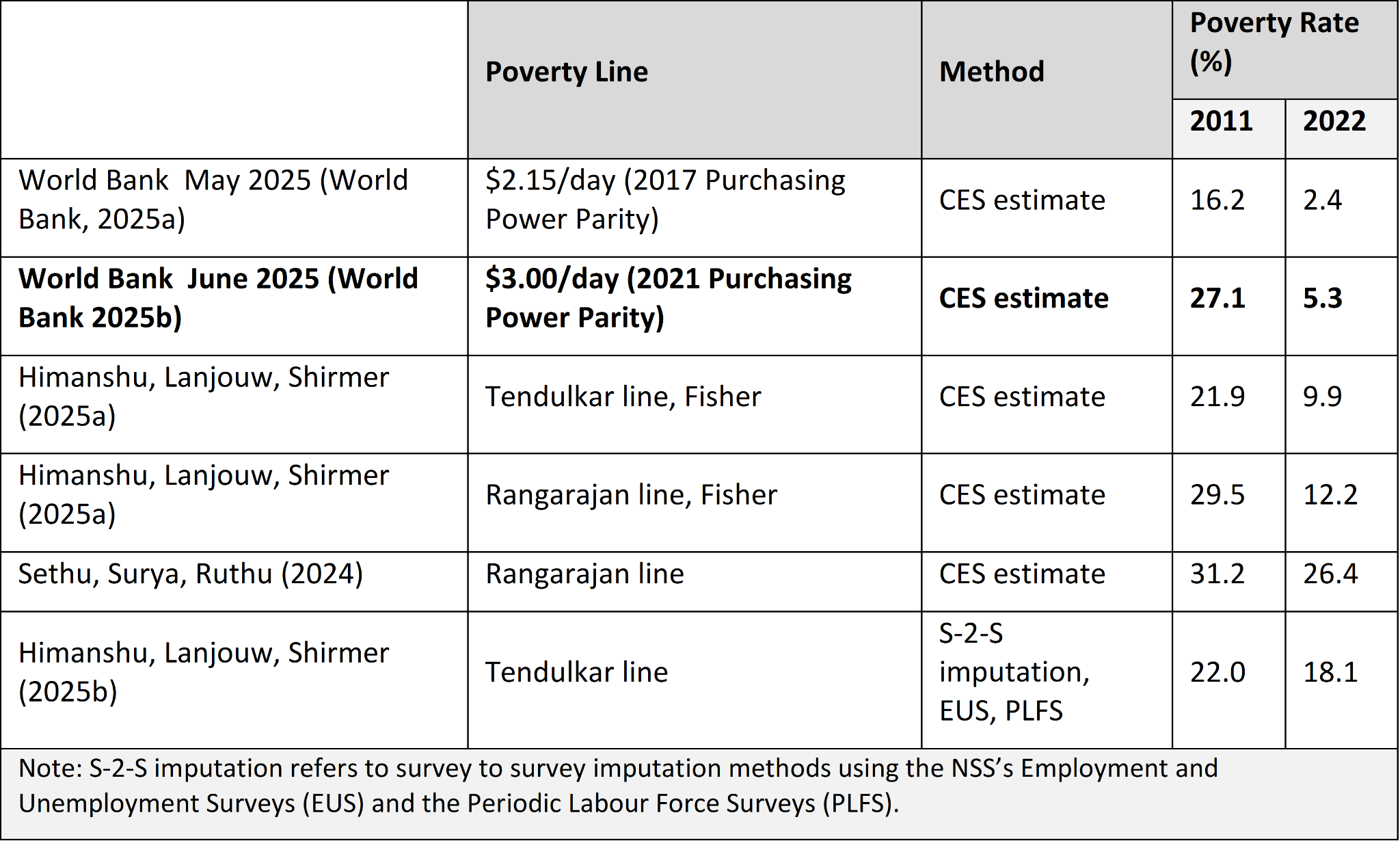
Into that vacuum, everyone brought their own answer. Some updated the Tendulkar or Rangarajan lines for inflation, some rebuilt one from scratch, and some borrowed the World Bank’s. A changed survey plus a choice of lines means wildly different answers. Estimates of India’s poverty in 2022-23 alone run anywhere from 2.4% to 26.4%. Same country, same year, a tenfold gap.
Same data, two Indias
So which number should you believe? This argument didn’t start last week. It began when the 2022-23 survey came out, and the new brief simply extends the same contested method to 2023-24. At its heart is one question, how much to trust the new survey, and on that, economists have split into two camps.
The first camp says poverty has collapsed. Its most forceful voices are the economists Surjit Bhalla and Karan Bhasin, and Bhalla is a veteran of the first great Indian poverty debate two decades ago. They trust the new survey as it is. In their numbers, fewer than 1% of Indians lived below the international extreme poverty line by 2023-24. They’d already declared back in 2024 that India had eliminated extreme poverty. Reacting to the new data, Bhalla told that, coming from the World Bank, its credibility is beyond question.
Their answer to the comparability worry is also straightforward. The new survey, they argue, is simply a better survey that catches spending the old one missed, which makes it closer to the truth, not further from it.
They also have a neat check. India measures household spending in two separate ways. The survey asks families what they spent. GDP data estimates the same thing from the other end, using what the economy produced and sold. The survey always comes in lower, because families forget things and rich households rarely answer fully.
In 2011-12, it captured about 63% of what GDP data recorded. If the new questionnaire had artificially inflated spending, that share should have jumped. Instead, in 2022-23 it fell to about 59%. Measured against an independent benchmark, the new survey isn’t over-counting. SBI Research, using updated Tendulkar lines, puts 2023-24 poverty under 5%. And this camp points to everything else that improved alongside: free grain, electricity, toilets, bank accounts.
The second camp agrees poverty fell. It just doesn’t believe it fell by that much, or that the World Bank’s method can tell us. Its sharpest critiques come from Himanshu at JNU and Gaurav Datt at Monash University. Reacting to the new numbers, economist Santosh Mehrotra asked why the government no longer sets its own poverty line or counts its own poor.
Himanshu argues that the World Bank made a string of changes to its method, some unique to India, and departed from the principles its own expert commission had laid down for measuring global poverty. Datt’s dissection gets specific. For both years, the World Bank strips out spending on durable goods, hospital bills, and things like jewellery and furniture, on the grounds that these aren’t really everyday consumption. Together they make up only about 3.5% of total spending.
But richer households spend a far bigger share of their budgets on them. Remove those items, and the rich look poorer than they are, so the gap between top and bottom shrinks on paper. Datt thinks this is why the World Bank’s numbers give India a Gini inequality score of around 0.25, which the government promptly turned into a claim that India is the world’s fourth most equal country.
To sidestep the new questionnaire, a Tinbergen Institute paper predicts household spending from details captured in India’s employment surveys instead. Their model puts 2022-23 poverty at roughly 18% on the Tendulkar line, down from 22% in 2011-12. Poverty kept falling, but far more slowly than in the decade before.
Even taking the new survey at face value, the same researchers find that inflating the official lines puts 2022-23 poverty much higher than what World Bank suggests. If you rebuild the Rangarajan line from scratch instead of just inflating it, you land at 26.4%, or roughly one in four Indians.
Then there’s the jobs puzzle, which may be this camp’s strongest card. The World Bank’s own brief acknowledges that real earnings stayed broadly flat and that most new jobs came in low-productivity work. Economists found that farm labourers’ real wages grew just 0.8% a year over the past decade, which they called “virtual stagnation.” Crores of workers moved back into farming, the opposite of what usually happens as a country gets richer. Much of the rise in women’s employment came through unpaid work on family farms and in family businesses.
We’ve written before about why India’s job market is broken. If wages stagnated and workers retreated to the farm, what drove a historic leap in spending? Part of the answer is welfare itself: free rations and subsidies count as spending in the survey, valued at what they would have cost, and they free up cash for families to spend on other things.
So what’s actually being fought over?
Almost nobody is arguing that India got poorer. The real argument boils down to three narrower questions.
The first is size. Did extreme poverty shrink from one in four Indians to one in forty? Or did poverty fall from about one in five to somewhere between one in ten and one in six? Both describe progress, but very different countries.
The second is speed, and this is where the politics lives. Even on the World Bank’s numbers, the pace of poverty decline slowed from about 2.8 percentage points a year between 2004-05 and 2011-12 to around 2 points a year after that. Whether poverty reduction sped up or slowed down after 2011-12 is, in effect, a verdict on two different governments.
The third is the bar itself: the gap between ending extreme poverty and ending poverty. Is ₹82 a day, let alone ₹58, a meaningful line for India today? Even on the Bank’s numbers, about 23 crore Indians still live below $4.20 a day. And as one editorial asked this week, if 49.6 crore people escaped poverty, why does the government still hand free grain to over 80 crore?
Raise the bar to $8.30, and the picture flips. By the World Bank’s 2024 estimates, 79% of Indians fall below it, and India is home to 30% of everyone on the planet below that line, against just 4% of those below $3.
Compare it with its peers and the same flip shows up. India beats Bangladesh and Indonesia at the bottom, with 2.3% below $3 to their roughly 5%, but trails them at the top, where they sit near 68%. Vietnam, at 18%, is in another league.
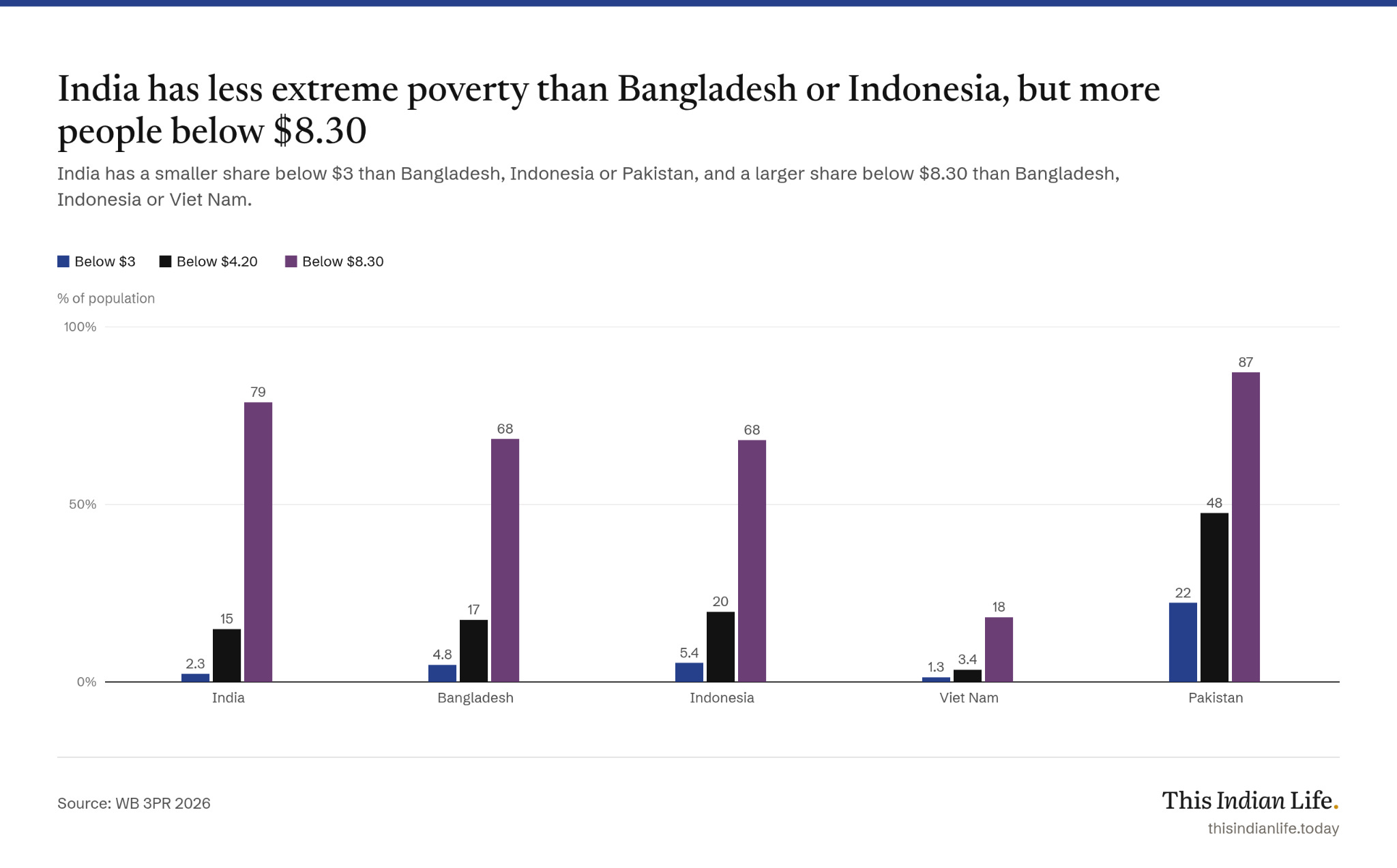
Most Indians, in other words, live just above the floor. In a simple test on the World Bank’s data, cutting everyone’s spending by 10%, the kind of hit a bad harvest or an illness can deliver, pushes the share below $4.20 from about 15% to 23%, and nearly doubles the share below $3.
On the bar itself, the camps quietly agree. Bhalla and Bhasin, the loudest voices declaring extreme poverty over, argue that a sensible new Indian poverty line would count somewhere between 25% and 33% of the population as poor.
The way out isn’t mysterious. India needs a bridge survey to measure how much the new questionnaire inflates spending, and a fresh committee to draw an official poverty line for the country India has become. Until it does both, every new report will reopen the same fight, just with fresher numbers.

IndiGo finds that higher fares aren’t enough
In the second quarter of this financial year, IndiGo charged its passengers a lot more than it did a year ago.
You’d expect this to improve profits, but instead, the airline ended the quarter with a loss. And once you look past some accounting effects, the business is doing worse than it was a year ago.
This was also Willie Walsh’s first quarter as IndiGo’s chief executive. Walsh earlier ran British Airways. And his first earnings call as part of Indigo has not been short of changes.
With that, let’s dive into the Q2 earnings of IndiGo.
Higher fares, higher costs
IndiGo went into July with a problem. Jet fuel had become far more expensive, and July-September is a quiet time for travel in India. When fewer people are travelling and fuel is costly, every extra flight burns money without filling up.
So, IndiGo cut back on variable costs. It kept its domestic flying at last year’s level and trimmed international flying by about 3%. Other airlines did the same, and the number of seats on offer across the industry fell about 5%. With fewer seats to go around, every airline could charge more.
IndiGo earned over 34% more from each passenger for every kilometre flown, partly through fuel surcharges. But some travellers walked away, and IndiGo filled about 2 percentage points fewer of its seats. So once you count the empty seats too, revenue per seat rose a little less, by 31%. Impressively, that still beat IndiGo’s own forecast of the same metric of over 25%.
Unfortunately, though, this revenue growth wasn’t even close to matching the rise in jet fuel costs. IndiGo’s fuel bill jumped about 67% to about ₹9,970 crore, while IndiGo’s total income only rose by 24% to ~₹24,300 crore.
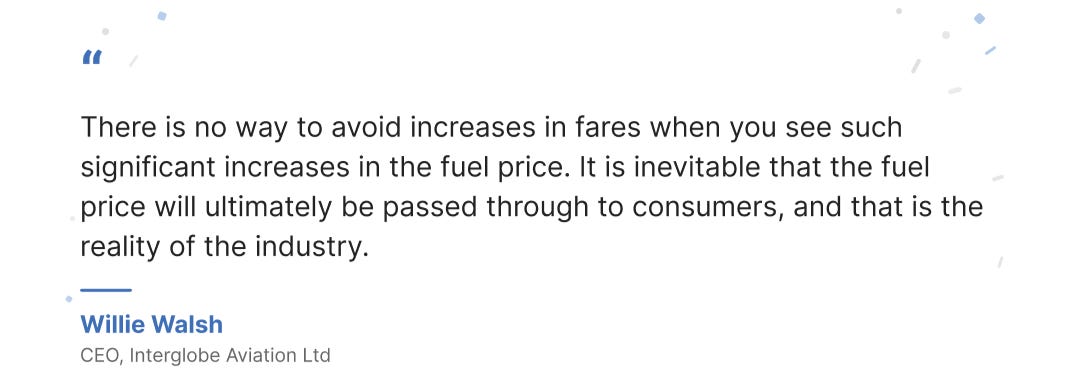
Jet fuel prices have risen far faster than that of crude oil, which trades at around $110-115 (roughly ₹10,500-11,000) a barrel. But Walsh’s justification for it confirmed what we saw in our own recent oil-roundup: the gap came from refining. Normally, jet fuel costs a little over 20% more than the crude oil it’s made from, which is the refiners’ margin. This year, Walsh expects that gap to spike because some refineries have been disrupted.
This quarter, it also spent nearly ₹3,600 crore on aircraft upkeep, ~₹3,100 crore on the wear and tear of its planes, nearly ₹2,300 crore on staff and ~₹1,700 crore on airport charges. Spread across every seat it flew, these non-fuel costs came to ₹3.45 per seat per kilometre, up about 15% from ₹3.01 last year.
Part of that rise came from a weaker rupee, and an airline’s maintenance and rent bills are paid in dollars. Suppliers also raised their prices by the usual few per cent a year.
But the main reason the jump was so sharp this quarter was the same capacity cuts that helped cut IndiGo’s variable costs. After all, many of an airline’s costs are fixed — salaries and rent won’t change no matter whether the plane flies 5 trips a day or 4. Fewer trips increase the fixed component of what it costs to service a seat.
It’s also very reasonable to believe that IndiGo was aware of this trade-off, which should only tell you that this was no easy decision to make in the face of a crisis.
Now, all of this added up to a loss of about ₹1,880 crore. That’s smaller than the loss of the same quarter last year, but only because last year’s loss was swollen by currency swings. Set those aside, and IndiGo went from a profit in Q2 of last year to a loss of about ₹700 crore this time.
The fight over fares
With costs this high, raising fares has been IndiGo’s main way to protect itself. But fares have become a sore point across the country. Fares across Indian airlines spiked ahead of Diwali, with some routes costing several times their usual price.
A plea in the Supreme Court claimed fares had risen by up to 700%, but the court declined to hear it urgently, suggesting the petitioner could simply choose not to fly. Earlier this year, the same court had called festive fare hikes exploitation and pushed the government to act.
That push led to new aviation rules effective from January 2027. They let the government step in only in an extraordinary situation, for a limited time, and make airlines show their own charges separately from government taxes. In a way, they’re softer than the old rules, which let the regulator act directly against excessive pricing.
Walsh made it clear IndiGo won’t give up pricing freedom easily. Asked about the government’s plans to curb fare surges, he said he didn’t expect them to affect IndiGo.

In fact, between April and June 8, the government capped domestic jet fuel prices at 25% above March levels. When the cap ended, it set up a ₹10,000 crore fund to help state-run oil companies sell jet fuel to airlines at fixed prices. The catch was that airlines joining it had to buy their fuel only from those companies for up to three years.
IndiGo chose to stay out and pay market prices. This ties down to its unwillingness to give up pricing power. Walsh did praise the fund as an innovative idea, but expressed doubts about its terms.
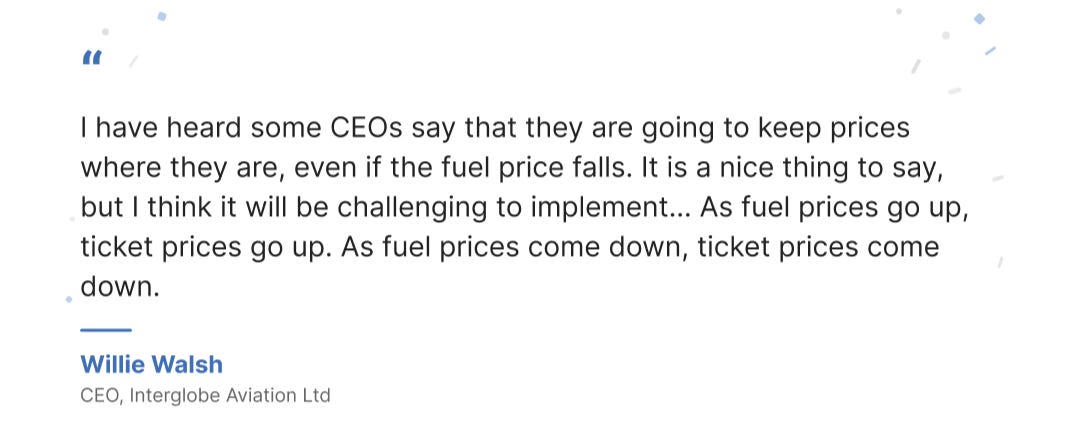
IndiGo also doesn’t think today’s fares can last. In Walsh’s long, international experience, airlines can’t hold on to high prices once fuel gets cheaper. The boomerang will certainly swing back the other way if fuel prices come down.
Now, IndiGo isn’t just merely pursuing an expansion of the seat fare. It is also trying to create new offerings to create more growth.
One such avenue is its premium Stretch seats, which offer more room at a higher price. Stretch made only a small difference this quarter, but Walsh expects it to grow.
A second offering is extras, such as seat selection and meals. IndiGo earned about ₹590 per passenger from these in the quarter, up from about ₹525. Walsh compared this with Ryanair, Europe’s biggest budget airline, which earns five to six times as much per passenger.
The third is IndiGo’s BluChip loyalty program, which is nearing 20 million members. Walsh wants to run it like Avios, the points programme of the parent company of British Airways. In his experience, active members spend several times more than casual flyers, and he sounded very positive about this opportunity.

Giving back the big jets
Now, while fares can’t stay high forever, IndiGo had to find a spot where they could cut some expenses. And we know that fixed costs remained the chink in the armour.
But that’s also where the quarter’s biggest strategic call comes in. Starting November 1, IndiGo stopped flying the Boeing 787s it had been leasing from Norse Atlantic. These are the large, two-aisle jets that had been flying to Amsterdam, London, and Copenhagen. IndiGo had rented the plane along with part of the crew.
This was a quick way to launch long-distance routes while IndiGo waited for its own wide-body jets (A350), which are due to arrive only in 2028. So IndiGo always saw this as temporary. In the previous quarter itself, IndiGo had already returned 13 such aircraft. On top of the rent, big jets also burn a lot of fuel compared to smaller ones. Walsh called ending the lease “an easy decision“.
There is one downside to this move, though. Passenger planes also carry cargo in the hold below the cabin, and a big jet like the 787 has far more room than IndiGo’s smaller planes. Cargo has been a bright spot on IndiGo’s business, with revenue up 37% y-o-y this quarter. Without the 787s, IndiGo will carry less cargo on long routes, though Walsh said the wider cargo trend still looks good.
For its international flights, IndiGo will lean on the Airbus A321XLR, a single-aisle plane that’s much smaller than a Boeing 787, but built to fly unusually far.
The XLR’s job is to protect something valuable. At busy airports like Amsterdam, airlines get fixed time windows to take off and land, called slots. An airline that stops using its slot can lose it to a rival, and getting it back isn’t easy. So IndiGo is flying the XLR to Amsterdam to keep its slot until the A350s arrive.
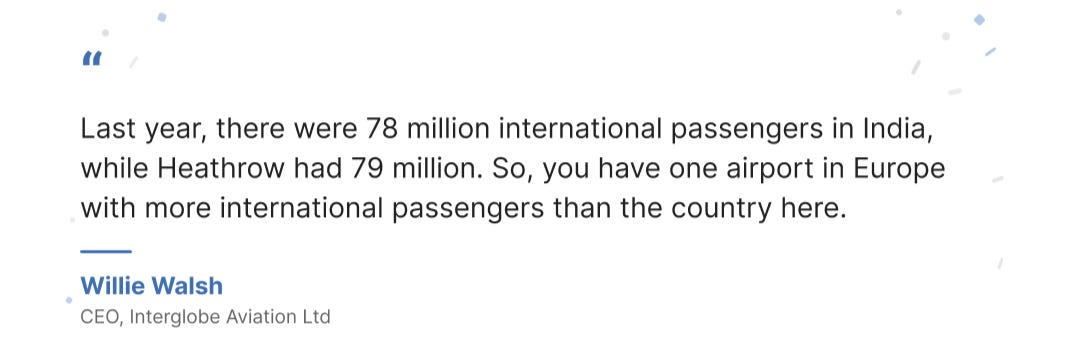
Walsh insists this isn’t a retreat. He sees India’s international market as vastly underserved.
But he also knows how airlines have stumbled at this before. Many big airlines often design their short domestic flights around feeding passengers into their long international ones. But that hurts the timings of the domestic flights. Walsh said IndiGo won’t make that trade, because its cheap domestic network is what gives it an edge.

For now, though, international flying has taken a strategic backseat. In the October-December quarter, IndiGo plans to fly only about 3% more than a year ago. Walsh said that holding back will fall more on international routes than domestic ones, because the festive season makes this the busiest time for travel within India.
What the next quarter will show
Whether it’s fares, costs or new sources of income, the first real test of Walsh’s plan comes in the October-December quarter with Diwali and the winter holidays. IndiGo expects to fly a few per cent more than a year ago, earn over 25% more per seat, and fill about the same share of seats as last year. That forecast leans heavily on festive pricing, at the very moment courts and the government are watching fares most closely.
For the full year, IndiGo expects non-fuel costs per seat to rise by high single digits to low double digits. It has kept its target of mid-teens growth in flying next year, and Walsh said he still sees the airline’s longer-term goals as achievable.
Fuel remains the big unknown, and Walsh didn’t pretend otherwise.

IndiGo holds about ₹39,900 crore in cash it can freely use. But in the airline business, where margins come hard-fought even without a crippling oil crisis, no amount of cash is ever enough.
- This edition of the newsletter was written by Kashish & Vignesh
Tidbits
1. TRAI fines Vodafone Idea ₹89.16 lakh over commercial communication violations
TRAI has imposed a ₹89.16 lakh penalty on Vodafone Idea for alleged violations of rules governing unsolicited commercial communications for the quarter ended December 2024. The telecom operator said it is reviewing the order, which marks its second TRAI penalty in two months.
Source: The Times of India
2. Razorpay receives SEBI approval for proposed IPO
Fintech unicorn Razorpay has reportedly received approval from the Securities and Exchange Board of India for its initial public offering, after confidentially filing draft papers in June. The Bengaluru-based payment gateway is targeting to raise between ₹5,500 crore and ₹6,500 crore at an expected valuation of $5 billion.
Source: Business Today
3. CERT-In gains access to Anthropic’s Mythos AI model for cybersecurity
CERT-In has gained access to Anthropic’s Mythos model through Amazon Bedrock and will begin testing its cybersecurity capabilities in a cautious, phased manner. The agency plans to assess how the model can help identify vulnerabilities while limiting exposure of sensitive government systems and code.
Source: ThePrint
4. Jio Platforms explores tech-for-equity talks with US cable operators
Jio Platforms is reportedly negotiating with US cable operators Comcast and Charter Communications to license its unlicensed-band wireless broadband technology in exchange for equity stakes. The strategy aims to leverage Jio’s intellectual property for global expansion, following the breakdown of similar talks with South Africa’s MTN Group over valuation.
Source: Reuters
5. Indus Towers plans to expand solar-equipped sites to 100,000 by FY29
Indus Towers aims to double its solar footprint, targeting 100,000 solar-equipped tower sites by the 2028-29 financial year. The planned expansion from its current 50,000 solar-equipped sites is part of the telecom infrastructure provider’s broader effort to reduce operating costs and cut diesel consumption.
Source: The Economic Times
Want more tidbits? Catch up on last week’s recap!

Cash & Copium
Are credit cards a free lunch or a debt trap? On Cash & Copium, Pranay Kapoor reveals hidden forex markups, minimum-due interest traps, chargebacks vs UPI, and smart CIBIL building.
Watch the full episode here.
Beyond Today’s Brief
There’s always more happening at Markets by Zerodha.
The Chatter: How is Bajaj Finserv navigating distribution fee reforms while deploying ₹4,700 crore in surplus cash into new ventures? Why is Bharat Electronics 99% confident of bagging the massive QRSAM order alongside ₹20,000 crore from Next-Gen Corvettes, and how are Zydus and Marico reshaping their growth models around US speciality launches and rural distribution?
Aftermarket Report: How did Nifty extend its winning run to five straight sessions, recovering from a gap-down open to close past 23,950 at 23,961 despite US election uncertainty? And what do 14 rising sectors led by Media’s 5.2% surge, a 4-to-1 market breadth blowout, and the Fear & Greed Index crossing back into neutral at 53 indicate as the index tests its 200-day moving average?
Join us on WhatsApp, where we share interesting soundbites from concalls, articles, and everything else we come across throughout the day. You’ll also get notified the moment a new video or article drops so that you can read or watch it right away.
Thank you for reading. Do share this with your friends and make them as smart as you are 😉
Good one ….. most of forecast and report by WB or IMF are like that …. A different outcome depending on the assumptions….. added to it is the dollar conversion and the PPP assumptions . On the jet fuel i being a retired oil man remember those days we export in a loss ….. it may take more time for this to settle …