


Our goal with The Daily Brief is to simplify the biggest stories in the Indian markets and help you understand what they mean. We won’t just tell you what happened; we’ll tell you why and how too. We do this show in both formats: video and audio. This piece curates the stories that we talk about.
You can listen to the podcast on Spotify, Apple Podcasts, or wherever you get your podcasts and watch the videos on YouTube. You can also watch The Daily Brief in Hindi.
Just a quick heads-up before we dive in. The Jio Platforms IPO opened yesterday. We wrote about it then, and you can read the full story here.
In today’s edition of The Daily Brief:
1. India’s AI boom runs through a strand of glass
AI data centers are driving a massive stock rally for Indian optical fiber makers like STL and HFCL. While manufacturing the highly precise glass “preforms” for these cables yields massive profit margins, companies face a severe bottleneck: China controls 91% of the germanium refining needed to make them. Caught between soaring raw material costs and delivery delays stretching up to a year, Indian manufacturers are now walking a dangerous tightrope—locking in lucrative, multi-year contracts with US tech giants without being able to secure long-term raw material guarantees from their own suppliers.
2. Who really gains from India's push for maize ethanol?
India's latest ethanol tender forces distilleries to shift from sugarcane to grains like maize and rice, but strangely cuts the price paid for maize ethanol to ₹69 per litre. Previously, fixed high ethanol prices allowed distilleries to reap massive margins whenever actual maize market prices fell below the Minimum Support Price (MSP), leaving farmers to absorb the volatility. With fuel targets now directly competing against poultry feed demand and volatile rice prices, the government's shifting price mandates highlight the delicate balancing act between fueling cars, feeding livestock, and protecting farmer incomes.
India’s AI boom runs through a strand of glass
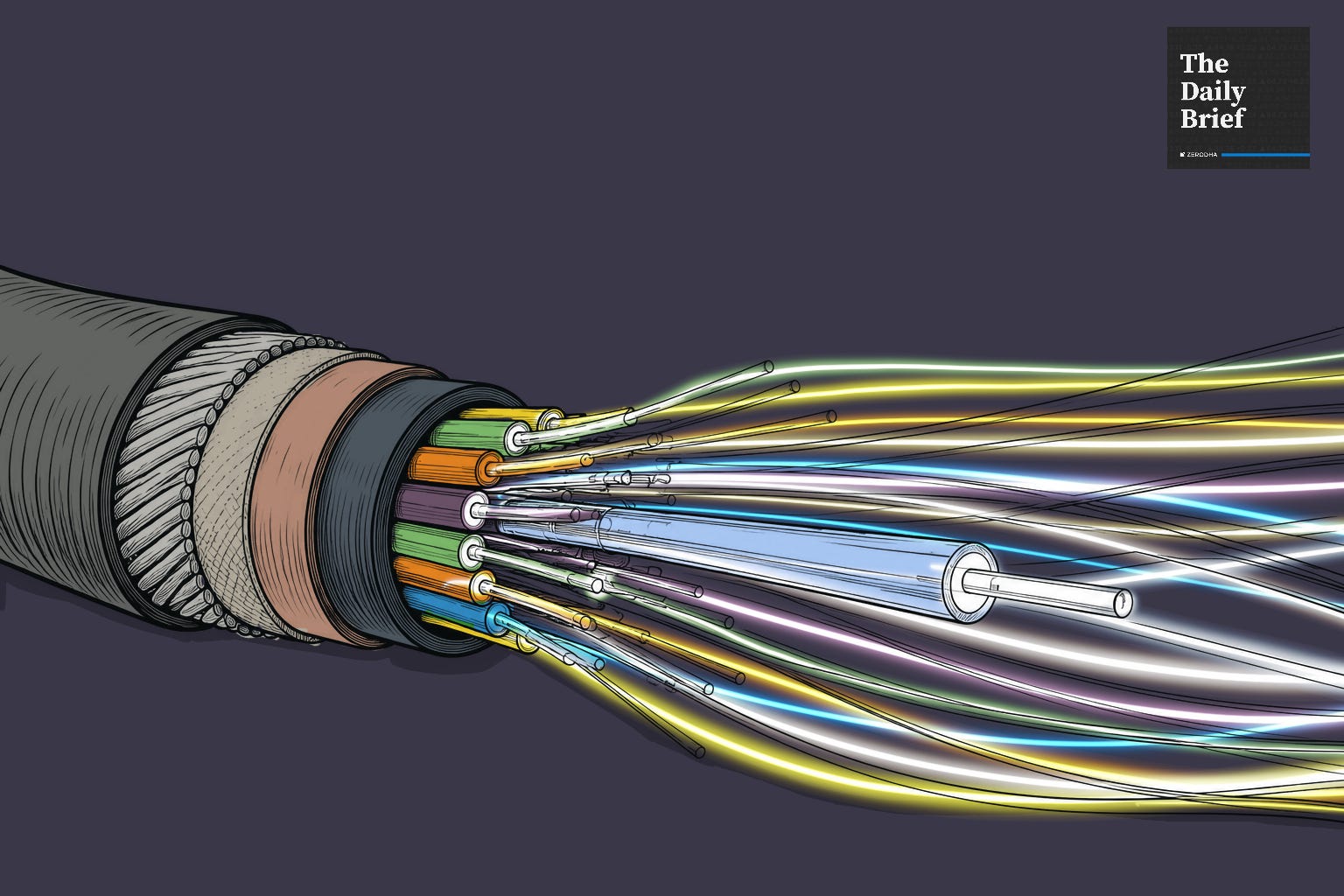
Every message you send, every video you stream, and every answer you get from ChatGPT travels across the internet as pulses of light, through optical fiber cables, which contain highly-precise, fine strands of glass.
This year, while India’s benchmark Nifty 50 index is down 13%, Sterlite Technologies (STL) a company that makes this glass and the wires that cover it, is up 804% to-date from January 2026, making it the single best performer on not just the Nifty 50, but also 500. Its competitor, HFCL, has more than doubled in the same period.
Procedurally, though, making that glass is its own difficult ordeal. On top of that, it also depends on a critical mineral called germanium. But these hardships act as their own barriers of entry, affording a moat to these companies. What also helps is that much of this hyper-growth has to do with the fact that AI data centers require lots of these cables.
So, what does it take to build the humble fiber optic cable, and where do we stand in its value chain?
From copper to light
Before we get into that, it’s worth understanding why we need fiber optics.
For most of the history of telecom, data travelled as electrical signals down copper wires. But copper has a physical limit: the faster you push data through it, the quicker the signal fades over distance. Copper wires also pick up stray electrical noise from their surroundings, which affects the transmission of data signals.
However, light moving through glass has neither problem, so theoretically, it can carry far more data. That is why optical fiber quietly took over the world’s telecom backbones between cities, undersea cables across oceans, home broadband, and mobile towers.
Naturally, fiber is taking over the insides of data centres. Connection speeds inside AI servers climb towards 800 gigabits and 1.6 terabits per second, enough to download a dozen 4K movies in one second, but copper signals fade out within a couple of metres. Copper still links chips inside a single rack, but anything longer than that needs fiber.
(Pre)form is temporary, glass is permanent
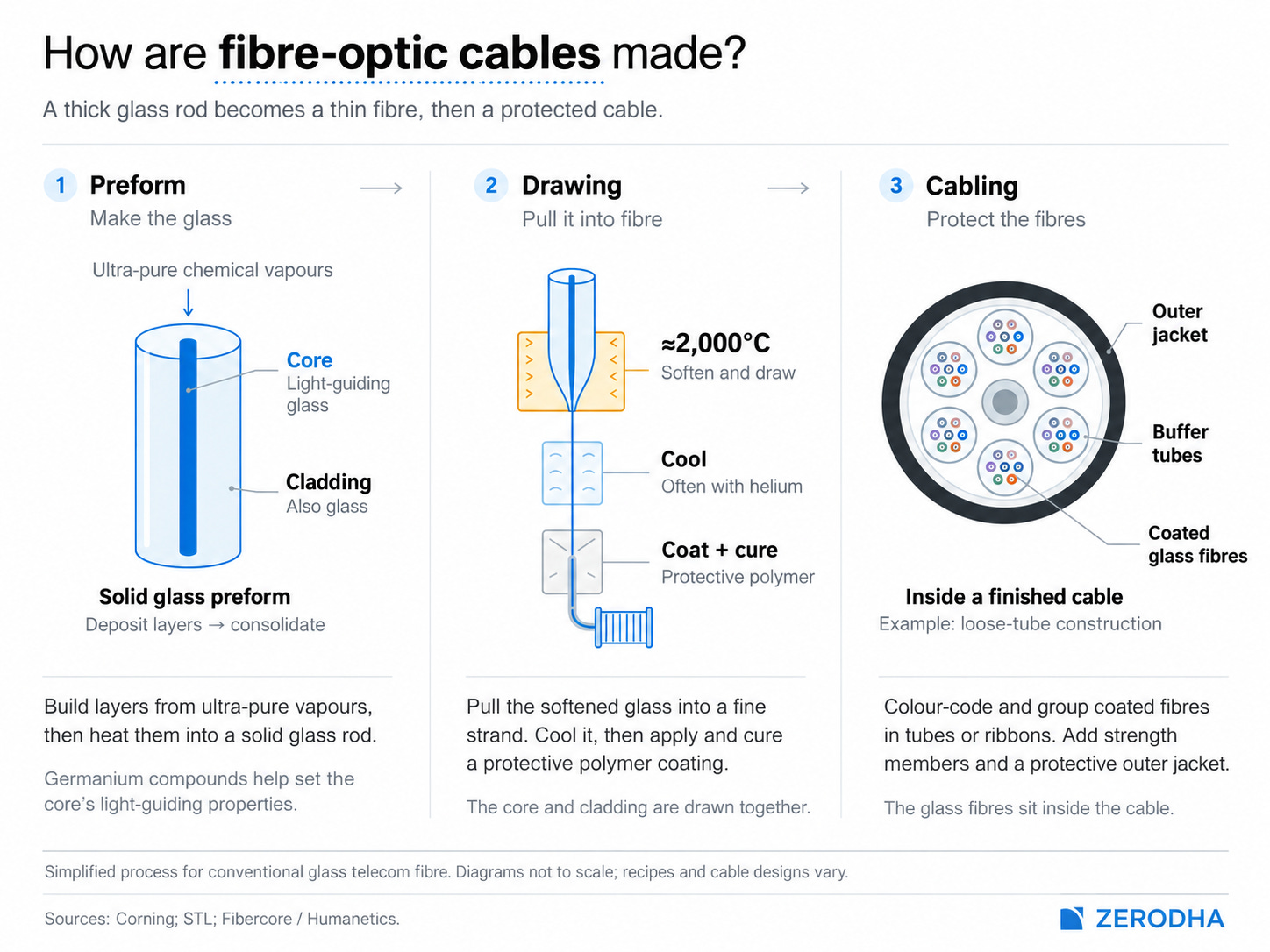
Making fiber optics is a hyper-precise chemical process that happens in three distinct stages.
The first phase finds itself inside a clinical room, where a compound of silicon and chemical vapours are deposited microscopically layer by layer, and then heated at high temperatures into a thick, solid, crystal-clear glass cylinder. This rod is called a preform, and it is the most important building block of a fiber optic.
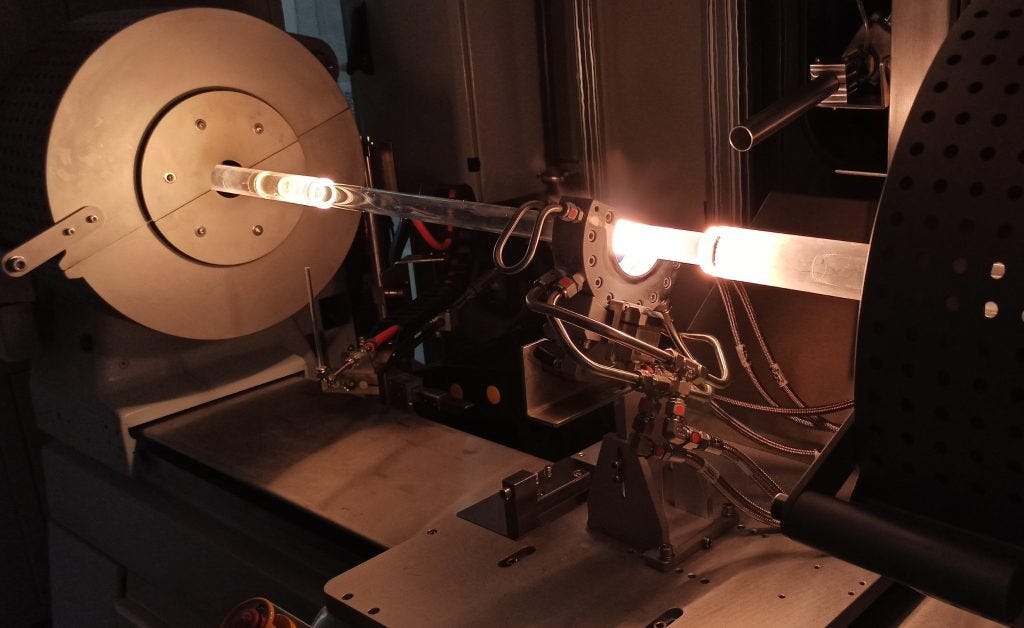
To make sure light actually stays inside the fiber rather than leaking out the sides, the core of the preform is laced with a compound of germanium, while the outer cladding is laced with fluorine. This is done to change the glass’s refractive index, which affects how much it slows down and bends light.
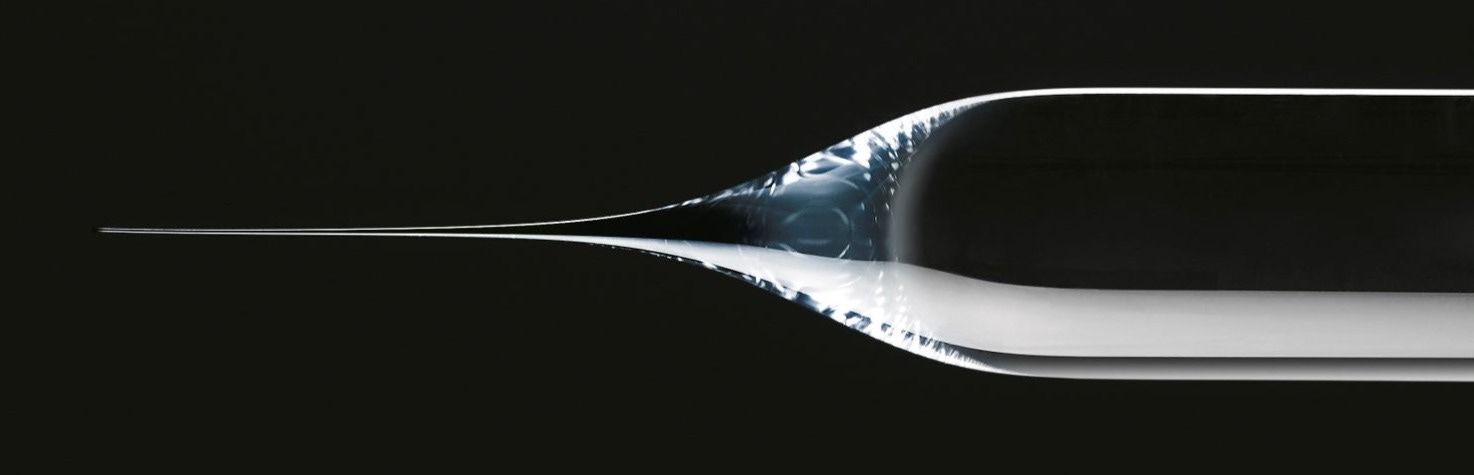
Next, this preform is heated to roughly 2,000°C. As the tip melts, gravity pulls down a single, continuous, hair-thin strand of glass. Because the glass is blazing hot and fragile, it has to be cooled down in fractions of a second using helium gas. A single kilogram of preform can be drawn into roughly 35 kilometres of fiber.
Finally, these individual glass strands are colour-coded, bundled together into loose tubes or flat ribbons, and wrapped in rugged plastic and steel jackets into a cable.
A standard telecom cable running down a highway holds 144 or 288 individual fibers. But now, data centres are a different beast entirely, and an NVIDIA Hopper AI computing rack needs about 4,000 fibers. The newer Blackwell architecture pushed that to 16,000.
Making a preform requires years of proprietary clean-room chemistry and vapour-deposition know-how, and building a greenfield preform plant takes 18 to 24 months just to construct and stabilise. Even if you build the factory, you have to secure the raw inputs, germanium and helium, which are themselves in a global stranglehold; we’ll come to this eventually.
As a result, very few companies have the engineering know-how to build them. According to HFCL’s management, out of roughly 20 optical fiber cable makers in India, only two can actually manufacture high-density cables with ~7,000 fibers.
Where does the money lie?
In this whole sequence of activities, the preform is where most of the value lies. It accounts for 60-70% of the total value added in a single bare fiber. Drawing that fiber from a preform adds about 15-20%, and bundling it into a cable adds the rest.
Now, a single finished cable has hundreds, even thousands of bare fibers. One of those fibers makes up about 60% of the cost of a finished cable. So, a preform accounts for roughly 45% of the cost of a finished cable with many bare fibers.
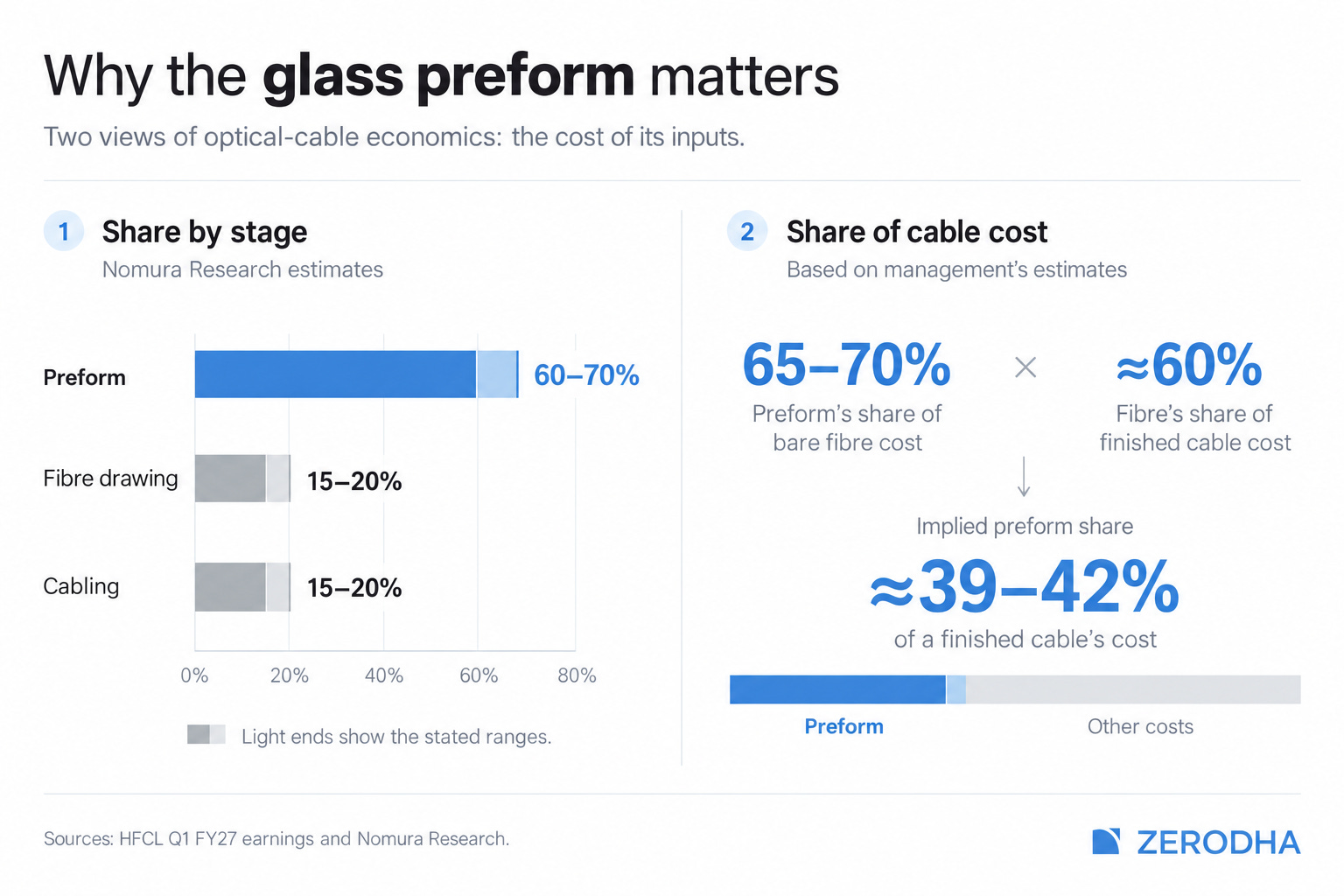
Now, from the perspective of a customer installing these cables (like a telecom company), the cost picture changes. Most of the budget goes into digging trenches, getting municipal permits, and labour charges. There, according to The Ken, the finished cable is only 15-20% of the total project cost, which means a preform would make up 6-8% of the final bill.
Barring a few exceptions, most wire and cable companies in India operate in this final stage, buying ready-made glass fiber from outside and simply wrapping it into cables.
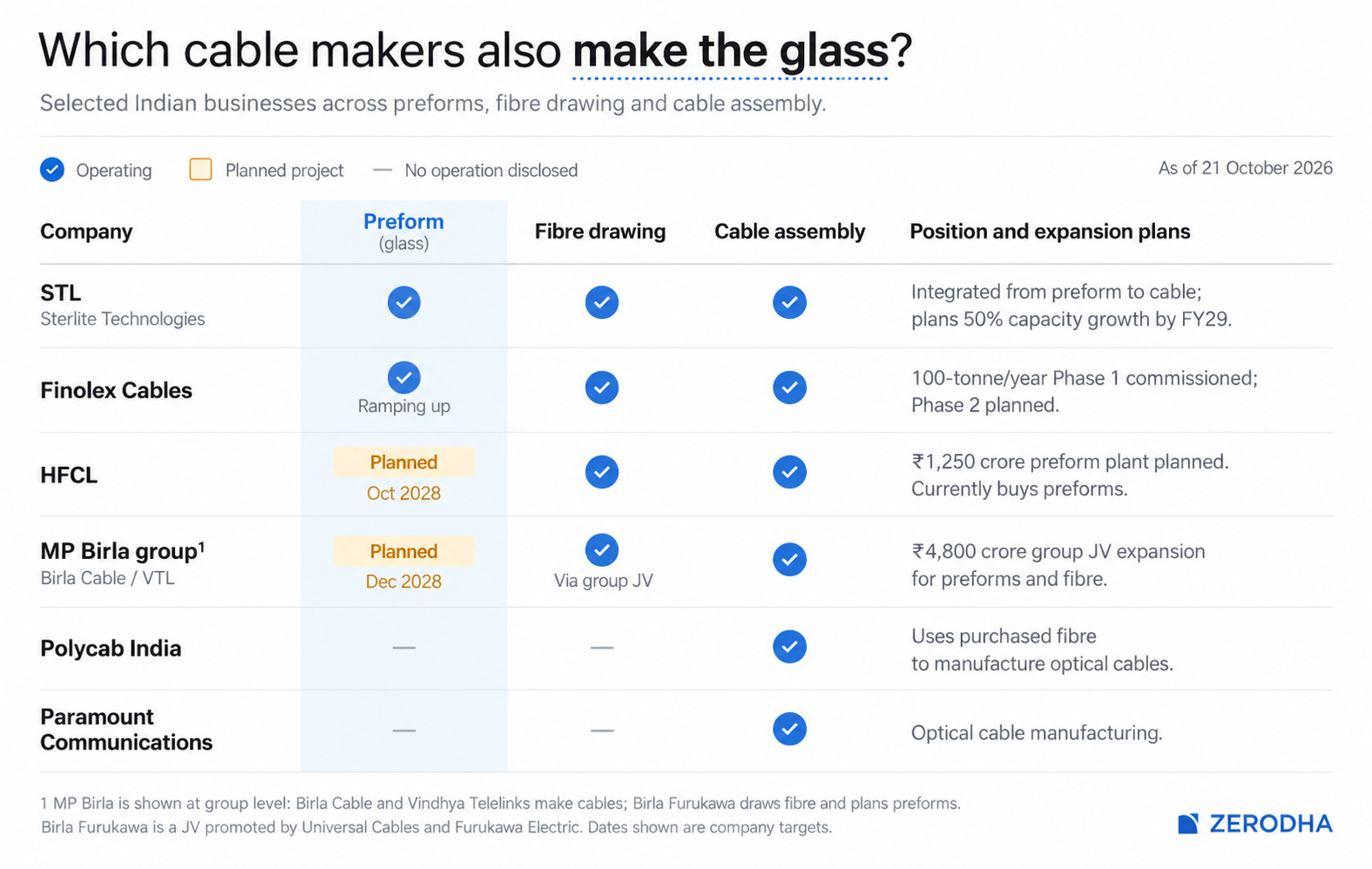
Making your own preforms captures the fattest margin in the value chain, simply because it involves technical know-how the most. But besides that, you also have to find a secure supply of helium (which we’ve covered before) and germanium.
The germanium bottleneck
Optical fiber is germanium’s single biggest customer. Out of the 343 tonnes of germanium the world consumed in 2025, roughly 40% went into fiber optics, according to an August 2026 report by S&P Global. The rest goes mostly into military-grade night-vision goggles and high-efficiency solar cells for satellites.
Germanium is a critical mineral with a quirky supply problem: nobody mines it directly. It exists in trace amounts inside zinc ores and coal fly ash, and is recovered almost entirely from the leftover residue at zinc smelters. It doesn’t economically make sense for mining companies to strip a new zinc mine purely for the purpose of obtaining some germanium.
So, who actually goes through the trouble of extracting and refining this leftover smelter sludge?
Well, much like many other critical minerals, China has a chokehold on not just germanium mining, but also refining; 91% of the world’s primary germanium metal refining happens inside China.
Yet again, to no one’s surprise, Beijing has turned this monopoly into a geopolitical lever with export controls.
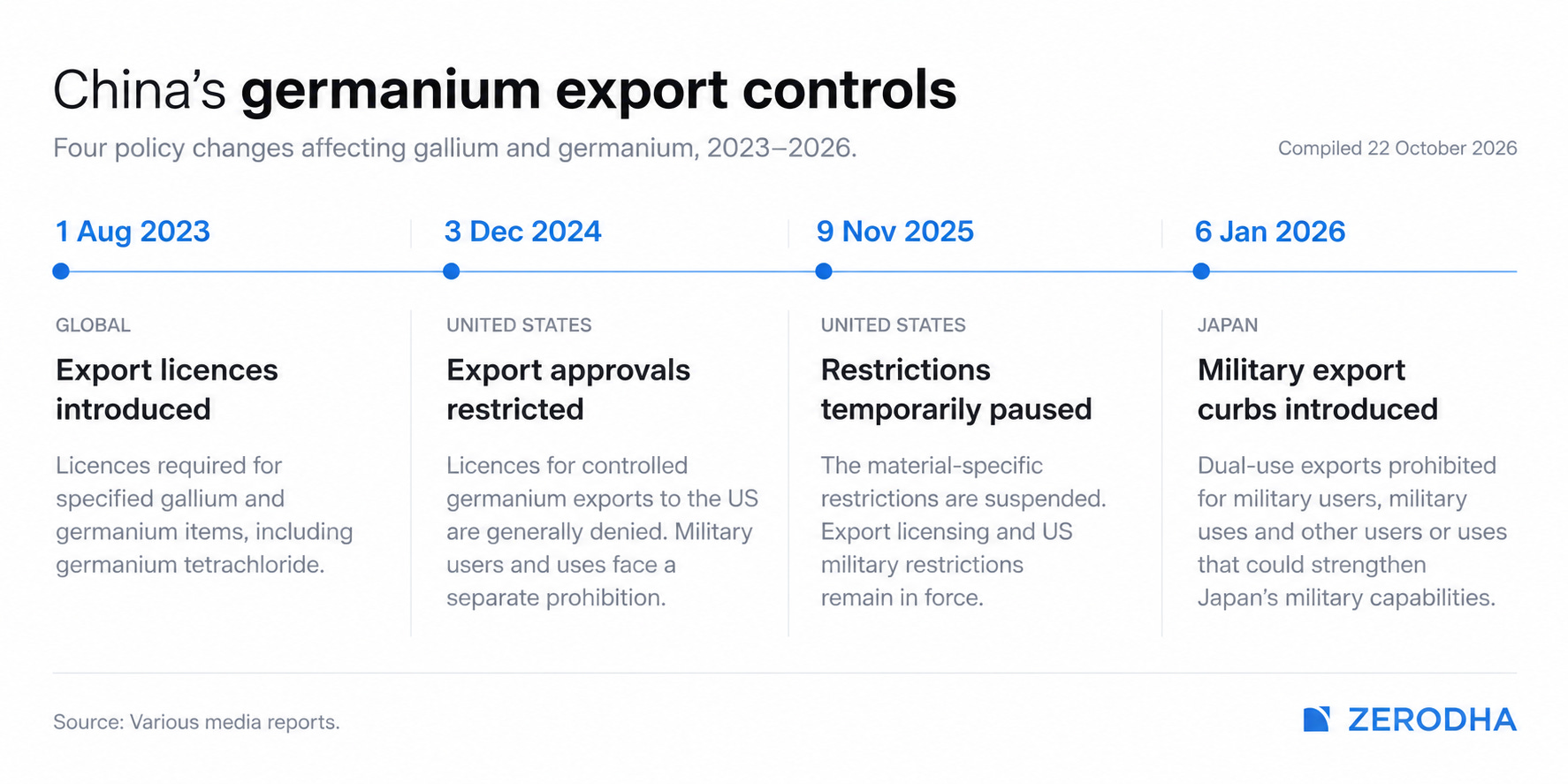
Indian executives are already feeling the heat on their earnings calls. Finolex Cables’s management noted that germanium is now a restricted item with long lead times. STL’s management similarly admitted that they now book new customer orders keeping in mind the availability of their raw materials. Naturally, as downstream of that, bare fiber is also seeing a shortage.
There do exist alternatives; HFCL, for instance, imports over 90% of its glass preforms from Japan. But outside of China, germanium prices have increased, and for companies buying germanium directly, the market is competitive.
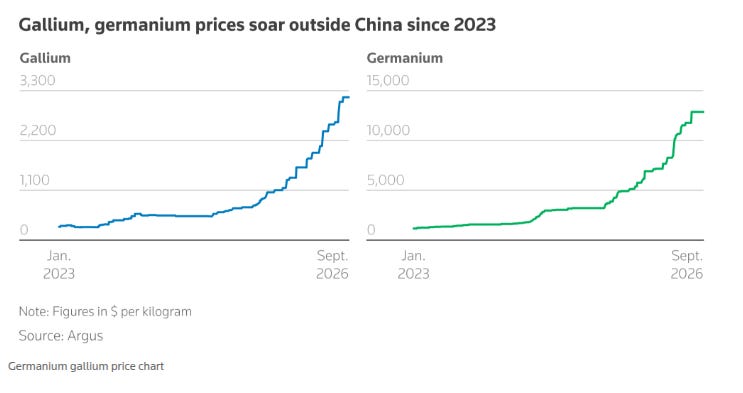
Then, in late 2025, a flurry of massive AI data centre orders skyrocketed demand, which only exacerbated a supply crunch.
Standard telecom bare fiber leaped from $5-6 (₹474–569) per kilometre in December 2025 to a peak of $17-18, before settling around $12-13. Within this, ultra-thin data-centre fiber (200-micron A2 fiber) has fetched $18-28 per km, and up to $50 per km in spot deals. In the US, if you place a new order for optical fiber cable today, you may have to wait 40 to 52 weeks for delivery.
While hyperscale data centres are the largest buyer in the room, demand is pulling from two other new directions at once.
One, there is a type of military drone that rolls out optical fiber up to 20 kilometres long in order to prevent enemy electronic warfare systems from jamming their radio signals. Next is rural broadband telecom: India currently deploys only about 25 million kilometres of optical fiber a year, compared to over 400 million kilometres in China, leaving a long-term runway at home.
So, naturally, every major player is racing to pour concrete and build new capacity. STL has planned a INR 3000 crore manufacturing plant, while HFCL has planned a INR 1800 crore optical-chain investment. But since building and stabilising a preform plant takes 18-24 months, new glass supply won’t meaningfully hit the market until late 2027 or 2028.
India’s AI game
This year-long waiting list is now showing up in the quarterly results of India’s two biggest export-ready cable makers, STL and HFCL.
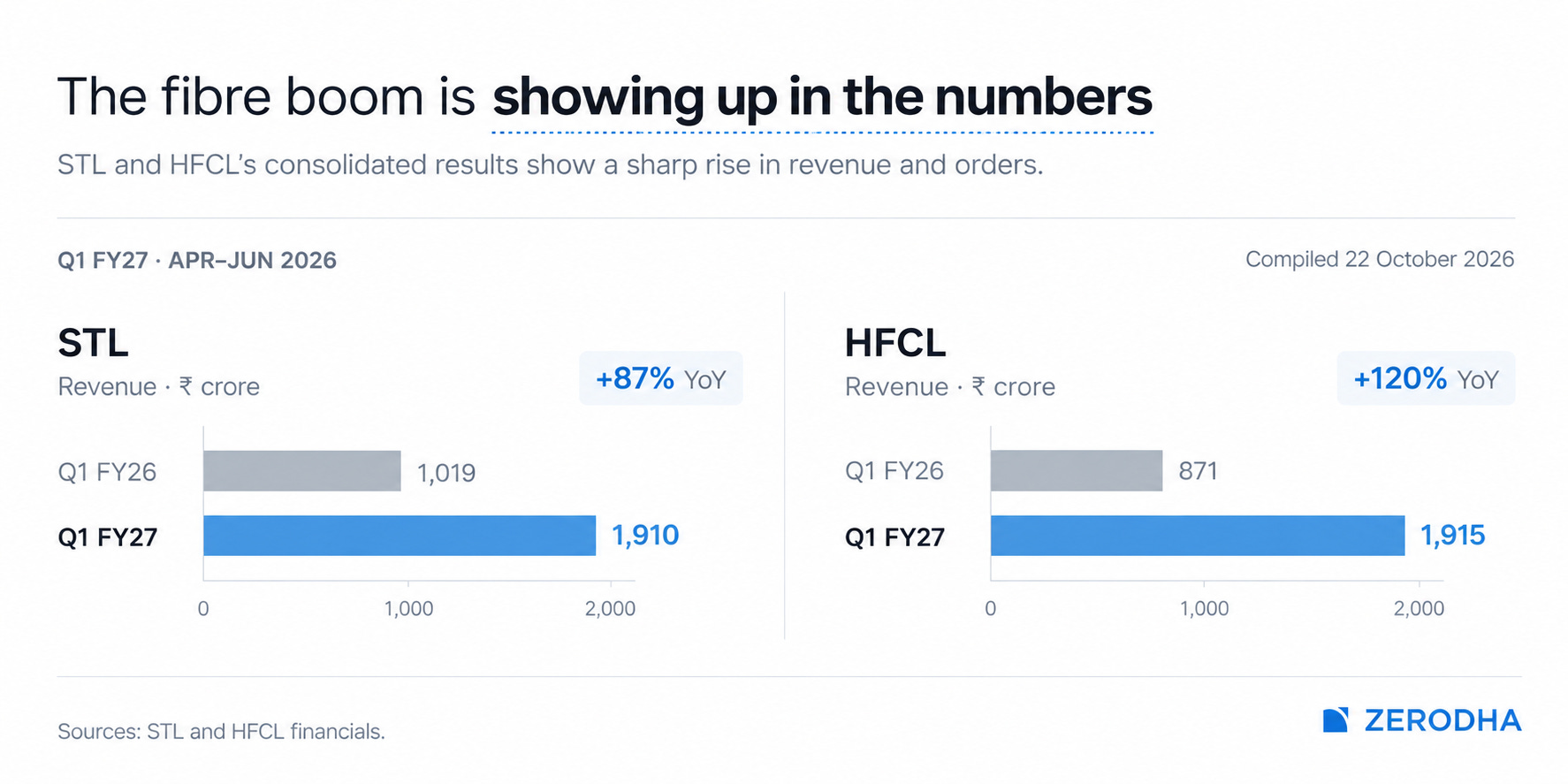
In Q1 FY27, STL’s revenue jumped 87% year-on-year to ₹1,910 crore. In FY26, data centres made up just 1% of STL’s revenue, but now that share has jumped to 21%, and management expects data centres and enterprise together to reach up to 50% of revenue. Over half its revenue came from North America.
HFCL’s numbers show a similar surge. In Q1 FY27, its revenue more than doubled from ₹871 crore to ₹1,915 crore, while its EBITDA margin jumped from ~5% in Q1 FY26 to ~23%. This current quarter was HFCL’s best ever, as revenue surged 144% over the same quarter last year to ₹2,542 crore, EBITDA margins expanded further to ~26%, and net profit jumped more than five-fold to ₹394 crore. Much of this growth is owed to demand from hyperscalers like Microsoft, Amazon, and Google.
Now, a good chunk of this profitability is owed to smart past purchases. Finolex Cables, for instance, saw its communication cable operating profit jump 40x over last year, but part of it was selling cables at today’s prices using cheap fiber inventory it bought last year. But that cheap inventory will eventually run out. That’s why, in the face of expensive germanium and preforms, Finolex’s management now expects its margins to normalise back to the low double digits.
Interestingly, Indian cable makers are also turning customers away simply because they can’t handle this overflow of demand without adequate demand. HFCL’s Managing Director Mahendra Nahata put it bluntly on an earnings call:
“If I say yes to one, I have to say no to the other one.”
And that explains the catch: While Indian cable makers are locking in multi-year commitments to sell finished fiber cables to American tech giants, their own upstream suppliers of glass preforms and Chinese germanium still refuse to commit to prices or volumes beyond a single year.
That is the real tightrope Indian cable makers are walking today. On the surface, these companies are high-margin plays in the data-centre boom. Underneath, they are navigating a delicate industrial squeeze, caught between tech giants demanding five-year guarantees on glass, and a raw material bottleneck.

Who really gains from India’s push for maize ethanol?
On October 16, as part of the push to blend our petrol with ethanol, India’s oil companies invited bids for around 1,100 crore litres of ethanol for 2026-27.
This tender also has an interesting caveat: oil companies will no longer buy ethanol made from sugarcane juice or B-heavy molasses, which are traditionally used to make sugar. Most of their procurement has to come from ethanol made from foodgrains like rice or maize, or from C-heavy molasses, the syrup left after most of the sugar has been extracted.
You’d think grain distilleries would be delighted with this news. India has been shifting most of its ethanol production away from sugar, towards maize and rice, and this condition would only accelerate it.
But shockingly, that same tender cuts the price paid for maize ethanol from ~₹72 to ~₹69 per litre.
Why cut a price that oil companies had spent years raising to encourage maize production? To understand that, we need to look at what the earlier incentive achieved, and what it didn’t.
The maize promise
In January 2024, oil companies raised the price paid for maize ethanol. India needed more fuel without relying only on sugarcane, and farmers could use another buyer for maize beyond poultry farms and food companies. If you paid distilleries more for ethanol made from maize, they’ll buy more of the crop. That extra demand could help farmers get better prices.
This did help build a market. According to the All India Distillers’ Association, maize supplied more ethanol than any other single crop in the 2025-26 supply year through September. The Economic Survey also says that, among other things, higher ethanol prices helped make maize farming more attractive.
But the government had another hope. Since maize requires less water than paddy, the government wanted farmers to switch from paddy to maize. But The Economic Survey found that paddy farming hadn’t fallen as expected. Instead, in states like Maharashtra and Karnataka, maize was competing with crops besides paddy (like pulses, oilseeds and cotton) for land.

Funnily enough, this might set up a weird trade-off within India’s import mix. Ethanol is a bet against our import crude bill. But we also import a lot of edible oil (like soybean and sunflower), which comes from oilseeds. If farmers grow maize instead of oilseeds, India could end up easing one import problem while putting pressure on another.
There’s also another catch. Supply of maize might still be outpacing the increasing demand.
As per farm-price data, government mandi figures show that average maize prices stayed below the government’s Minimum Support Price (MSP) for much of 2025 and 2026. In November 2025, maize sold for around ₹1,635 per quintal, against an MSP of ₹2,400. That is a massive gap between the price floor mandate and the going market rate.
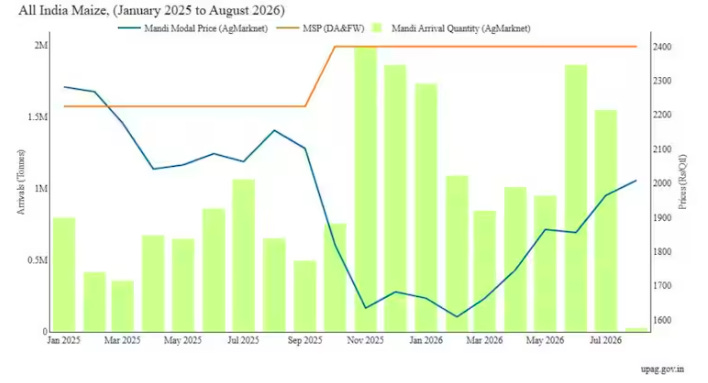
Now, farmers and distilleries faced two very different prices. Farmers sold maize to traders and other buyers at market rates, which changed with each harvest. Distilleries, however, sold ethanol to oil companies at a price set in advance.
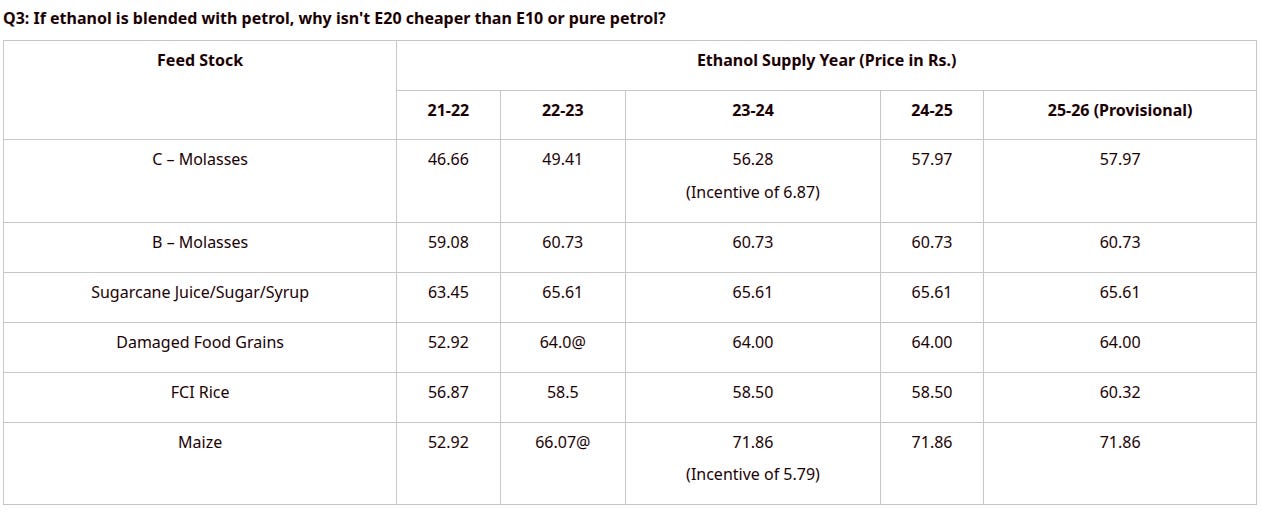
The government’s own data shows that maize ethanol stayed at ~₹72 per litre through the 2025–26 supply year, even as crop prices rose and fell. This meant distilleries could spend less on maize when it became cheaper, while still receiving the same price for their ethanol. A fixed selling price doesn’t offer a guaranteed profit to them, though, since costs can increase. But on a good day, it gives the best of two worlds: certainty and expanded margins.
This was evident in the earnings call of a publicly-listed grain-based ethanol producer, Gulshan Polyols. It said lower maize and broken-rice costs helped improve its operating margins, which more than doubled in FY26, with ethanol making up most of it. Gulshan uses both maize and rice, so we can’t tell how much of that gain came from maize alone. But it shows how much grain costs matter, even when the price paid for ethanol stays the same.
But on the flip side, what does this imply for farmers? A lower maize cost for a distillery basically eats into the surplus a farmer earns. Their crop prices are more volatile, often determined by what the distillery market demands.
Still, this doesn’t mean ethanol failed to help farmers. Without demand from distilleries, maize prices might have been lower. And prices below MSP don’t always mean farmers made losses.
Oddly enough, the poultry industry has the opposite complaint: feed makers say maize has become too expensive. In late September this year, poultry buyers were paying ₹27–28 per kg, well above the government’s support price. They blamed some of the pressure on ethanol plants competing for grain.
That sounds odd when we’ve just seen farmers selling below MSP. But the two figures come from different months and markets.
You see, the low mandi average was from November 2025. Poultry buyers were reporting higher costs nearly a year later, after weak rains had raised fears of a smaller harvest. They also need grain of the right quality, often delivered far from where it was grown.
So both accounts can be true. Ethanol demand may support farmers in some places while raising costs for feed makers elsewhere. It’s hard to judge a national policy using one crop price. But what it does speak to is volatility in crop prices.
Distilleries also face a problem that has little to do with maize prices. India has built more ethanol-making capacity than its blending programme needs. Even a profitable plant can struggle if it doesn’t receive enough orders.
The trouble with cheap rice
So far, we’ve only mentioned maize. But that way, rice runs into the same issue that maize did.
Under the new tender, oil companies pay about ₹69 for a litre of maize ethanol, ₹64 for ethanol made from damaged grains, including some broken rice, and about ₹60 for ethanol made from government rice. Rice is generally considered cheaper than maize, hence the prices.
But those are the prices paid for ethanol. They don’t tell us what it exactly costs to produce ethanol using rice.
Take rice stocked by the Food Corporation of India (FCI). The government releases some surplus rice to distilleries at a price it sets. A July parliamentary reply showed that FCI sold rice to ethanol plants at 40% below its average acquisition cost. The government says this isn’t a direct subsidy to distilleries because the rice is sold under its existing pricing scheme.
But FCI rice is set to become costlier for distilleries from November, while the latest tender keeps the FCI-rice ethanol selling price unchanged. So what looks like cheap ethanol to an oil company may come with thinner profits for its producer.
Broken rice, which is used in food, animal feed and ethanol, has a different problem.
Until March 2025, broken rice was banned from being exported. But India had built up such a huge stockpile as a result that it only made sense to reverse the ban.
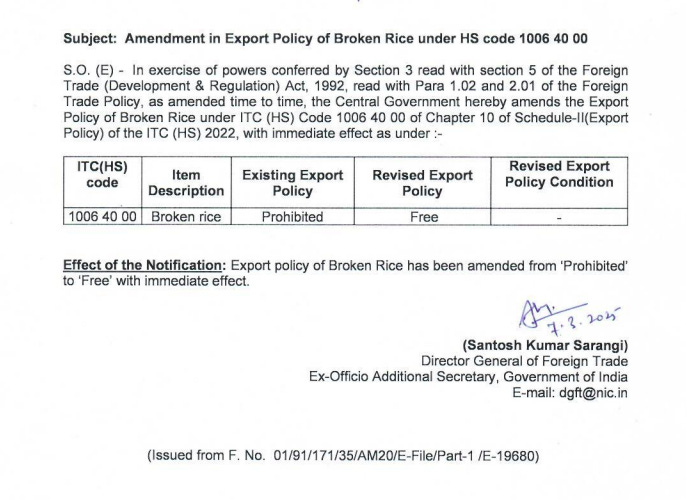
However, that also opened up distilleries to external competition with other buyers for the same grain. S&P Global reported that export prices had risen by early October as overseas buyers and ethanol plants competed for supplies.
If more distilleries turn to broken rice, its price could rise further. And even then, oil companies can’t simply choose every cheap offer. Existing supply deals, transport needs and other tender rules also affect who gets an order.
Each crop, then, has its own set of problems that they face now. Maize distilleries face a structurally-lower selling price, plants dependent on FCI rice will face higher input costs, and broken-rice plants face export competition. The cheapest ethanol to buy may not always be the cheapest to make.
- This edition of the newsletter was written by Zarieus & Mridula.
Tidbits:
[1] RBI signals rate cuts are off the table as inflation risks rise
Minutes from the RBI’s October MPC meeting show all six members backed the 25-basis-point repo rate hike to 5.5%, while two opposed the shift to a calibrated tightening stance. The committee expects inflation to reach 6% in the third quarter and indicated that rate cuts are unlikely in the near term.
Source: Business Standard
[2] Finance Ministry gives in-principle nod to solar polysilicon manufacturing scheme
The Ministry of Finance has given in-principle approval to a proposed incentive scheme for solar polysilicon manufacturing. The initiative aims to build domestic capabilities in the critical upstream solar supply chain, though it still requires final clearance from the Union Cabinet.
Source: Business Standard
[3] Large non-bank lenders flag early signs of stress in gold loans
Bajaj Finance and Piramal Finance have flagged emerging repayment risks in the fast-growing gold loan market. Concerns include rising overdue loans and borrowers using fresh gold-backed credit despite already having delinquent debt elsewhere.
Source: Business Standard
[4] India’s infrastructure output rises 7.9% year-on-year in September
India’s core infrastructure output grew by 7.9% year-on-year in September, accelerating from an upwardly revised 5.9% in August. The expansion was driven primarily by strong growth in electricity generation, coal, steel, iron ore, and refinery production.
Source: Reuters
[5] Centre plans 5 GW agrivoltaics push under PM-KUSUM 2.0
The government plans to add about 5 GW of agrivoltaic capacity over three years under PM-KUSUM 2.0, allowing solar generation and farming on the same land. MNRE is considering support to offset the roughly 25% higher installation cost of such projects and make them competitive with conventional ground-mounted solar.
Source: Livemint
Want more tidbits? Catch up on last week’s recap!

Beyond Today’s Brief
There’s always more happening at Markets by Zerodha.
The Chatter: What are executive teams across real estate, cement, and metals signalling for Q2 FY27? How is DLF establishing a new ₹100 crore benchmark per apartment at Dahlias, while UltraTech Cement sees spot price realisations rise 5% and Hindustan Zinc delivers a record 62% EBITDA margin?
Points & Figures: Why are fewer Indians flying? From a 6.5% drop in domestic air passengers to a 170% surge in jet fuel prices and severe disruptions on West Asia routes, what do airline cuts and empty seats reveal about the true cost of air travel?
Aftermarket Report: How did persistent concerns over elevated crude oil prices overshadow late recovery attempts as Nifty fell for a third straight day to settle near 22,690? And what does the Fear & Greed index remaining firmly in extreme fear signal for broader market sentiment?
Subtext by Zerodha: What is the true cost of India’s government job exams? In our latest episode, former development economist and AI engineer Kunal Mangal breaks down why millions of aspirants take multiple attempts at the UPSC, how they assess risk, and what this reveals about unemployment, skill development, and state capacity in India.
Join us on WhatsApp, where we share interesting soundbites from concalls, articles, and everything else we come across throughout the day. You’ll also get notified the moment a new video or article drops so that you can read or watch it right away.
Thank you for reading. Do share this with your friends and make them as smart as you are 😉