



Our goal with The Daily Brief is to simplify the biggest stories in the Indian markets and help you understand what they mean. We won’t just tell you what happened; we’ll tell you why and how too. We do this show in both formats: video and audio. This piece curates the stories that we talk about.
You can listen to the podcast on Spotify, Apple Podcasts, or wherever you get your podcasts and watch the videos on YouTube. You can also watch The Daily Brief in Hindi.
In today’s edition of The Daily Brief:
1. Is GTA VI the last hope of a struggling industry?
Grand Theft Auto VI is finally here and tracking to be the biggest launch in history, but it masks a brutal macroeconomic reality for the broader video game industry. AAA development costs have skyrocketed past $1 billion and timelines now stretch over a decade, forcing studios into massive layoffs just to survive. Meanwhile, gamers are spending 14% less overall, largely ignoring expensive new console releases to spend 54% of their time on older, live-service games or flocking to highly profitable indie titles. Ultimately, the staggering financial and human cost required to build GTA VI proves it is a singular masterpiece in an industry whose big-budget business model is rapidly shrinking.
2. India's greener jet fuel comes with a bill
The government recently cleared Indian Oil Corporation to sell Sustainable Aviation Fuel (SAF) made from used cooking oil, but prohibitive costs remain a critical barrier. At two to three times the price of regular jet fuel, voluntary airline adoption is virtually nonexistent. To meet UN emission targets, India is drafting a mandate to enforce 1% SAF blending on international flights by 2027, scaling up to 5% by 2030. While this policy would guarantee a massive domestic market for refiners and engineering firms, it also introduces steep economic challenges. Airlines face permanently higher fuel bills—particularly on nonstop long-haul routes—while producers must navigate a highly fragmented supply chain where only 6% of India's used cooking oil is formally collected, sparking fierce competition with foreign buyers.
Anthropic has officially gone public, and it’s an unusual business to make sense of. To understand how it actually makes money, why public shareholders get almost no voting power, and the hundreds of billions in compute bets behind it, do check out our breakdown of Anthropic’s S-1.
Is GTA VI the last hope of a struggling industry?
Grand Theft Auto VI is finally here.
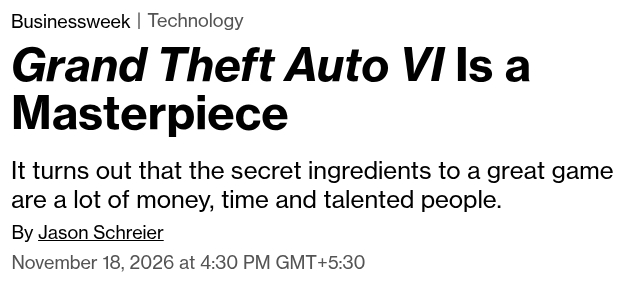
The early verdict is that, yet again, like every other time, Rockstar has pulled it off. Most reviews have called it a masterpiece, and the shares of Take-Two, Rockstar’s parent company, jumped more than 6% yesterday.
Take-Two has guided for $3.35-3.5 billion in net bookings for the December quarter, against $1.76 billion just a year ago. It is already the most pre-ordered game of all time on PlayStation and XBOX, and it might also eventually become the best-selling game of all time on those platforms.
Yet, two days before the launch, Take-Two laid off a third of its subsidiary Firaxis, which makes the Civilization series of strategy games.
This is not just a Take-Two story, either. Since 2022, game studios across the world (especially Western economies) have been firing more and more people every year. Around 24,000 people have been estimated to have been fired over the last 2 years alone.
This is all symptomatic of an even gloomier macroeconomic picture for the industry.
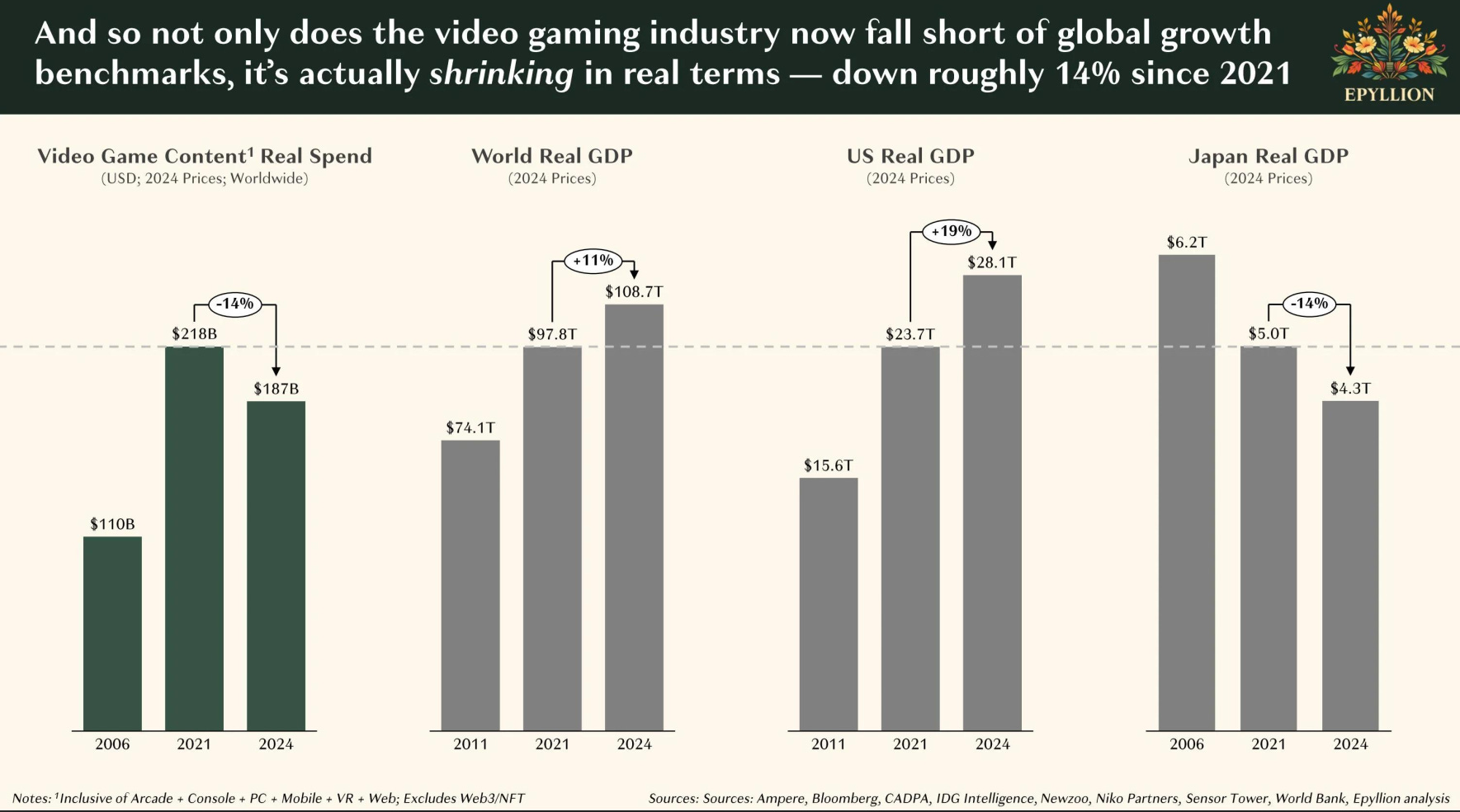
Matthew Ball, the Chief Strategy Officer at Microsoft XBOX, maintains a fantastic annual report on the state of gaming. Between 2011-2021, he says that the video game industry’s growth outpaced that of the global economy. In those 10 years, people almost doubled their total expenditure on all things video games. The expectation post-COVID was that this rate of growth will only continue.
Except, since then, it has been shockingly disappointing. Since 2021, people have spent 14% less on video games in real terms. Forget growing slower than the world economy; the gaming industry has been shrinking.
Meanwhile, the games themselves keep getting more expensive.
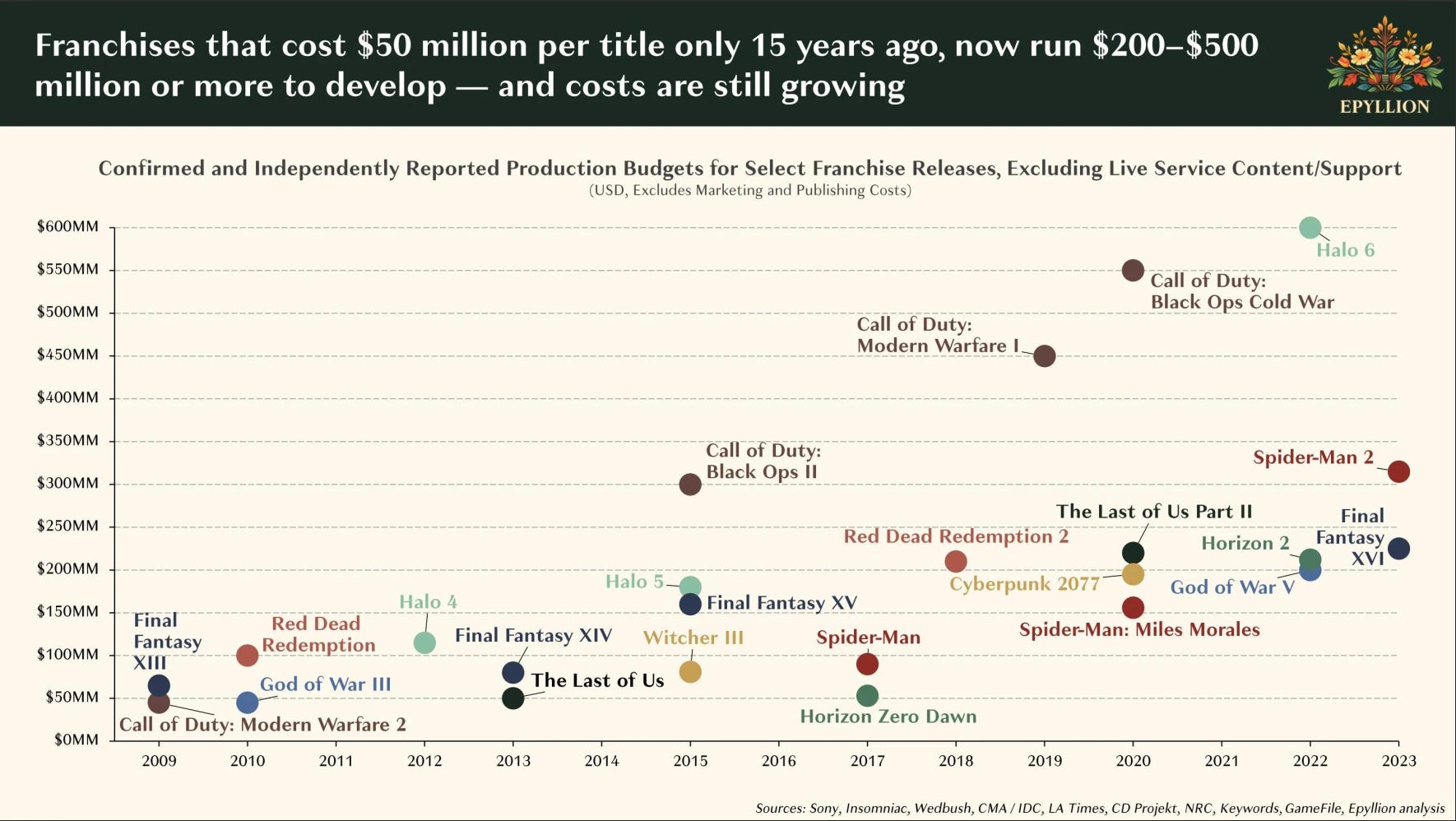
In 2006, Take-Two told its investors that a frontline game generally cost $5-20 million to make. Two years later, that range had moved to $10-30 million. Take-Two has never disclosed what GTA VI cost, but most estimates assume at least $1 billion. Jurassic World: Dominion, the most expensive movie ever (in nominal dollar terms), cost just ~$549 million (after tax rebates).
And this has been a trend over the last 15 years. Shawn Layden, the former boss of Sony PlayStation, has pointed out that game costs roughly doubled with each new generation of game consoles, from the PS2 to the PS5.
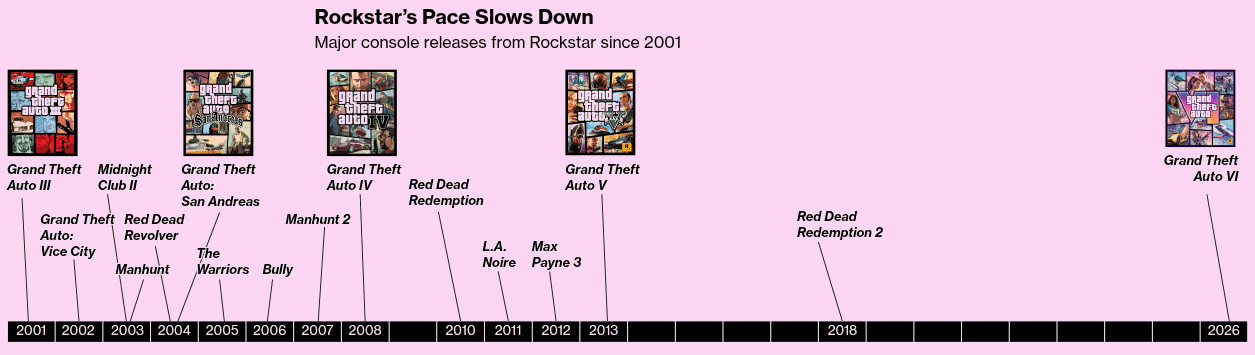
It’s not just money, but also time, which has continuously lengthened for each release. Rockstar’s pace of game development has markedly slowed down since 2010.
So, what does the world’s biggest single-player video game say about the state of blockbuster gaming? Not to spoil much, but this story isn’t pretty.
The cost of ambition
Let’s start with what is really behind that hefty price tag for a game like GTA VI.
Games have become so costly to make primarily because they became more complex, realistic-looking, and gorgeous.
No easy pixel
Steve Theodore, an artist who worked on the games Half-Life and Halo 3, has given numbers behind this. A game character he built in 1997 took 10 working days. A decade later, a comparable character took 35. By the late 2010s, it took him 100.
Earlier, the characters were far less intricate and lower in resolution. Today, a single character now needs several separate image layers, each 4096 pixels across, telling the game how its surface should look and interact with light and shadows.
If you want to add more complex animations, that means more man-hours. Take a look at the animator list of Rockstar’s previous game, Red Dead Redemption 2 (RDR 2). It had gameplay animators, cinematic animators, facial animators, animators specifically for animals, and then motion-capture and voice actors.

You’d expect better tools to bring this cost down, which they did, but only up to a point.
In 2018, veteran game designer Raph Koster compiled data on 250 games. Between 1985-2005, he found that games got ~120 times bigger in size while costs rose only 22 times. The industry did get much more efficient at producing each gigabyte of a game. But after 2005, that improvement seemed to stall. And since games kept getting humongous, budgets kept climbing.
Procedural generation
What about reusing game assets across games, which should certainly help keep costs down? Well, it does happen. Ubisoft’s hit game Assassin’s Creed IV: Black Flag reused about 80% of its predecessor. The Yakuza series of games is also well-known for game asset reuse.
But it doesn’t happen often enough to bend the cost curve. That’s partly because, compared to normal software engineering, creating repeatable systems for visually-appealing games is technically harder.
It’s easy to scatter a bunch of shiny rocks in-game. But it’s a mammoth task to have it interact with, say, a car crash, missiles, or other game mechanics. There are too many code dependencies where changing a single thing affects everything else. That makes iterations — and testing them — more and more difficult as studios chase highly-realistic graphics.
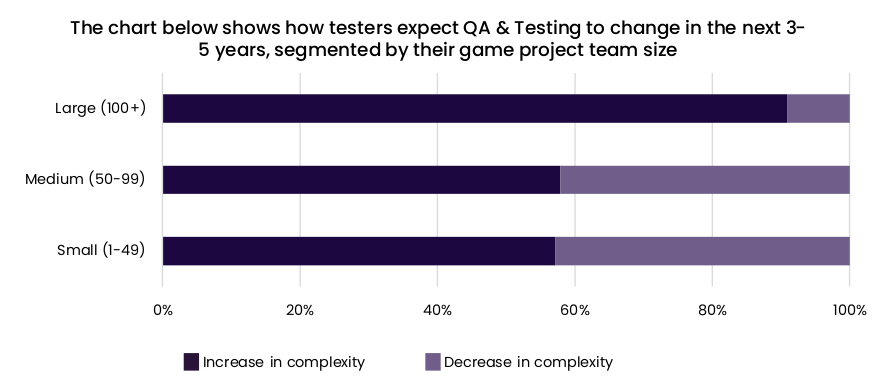
Interestingly, there is a separate line of argument that says that the incentives to create system loops have always been skewed.
Before digital-only games like Fortnite, which are constantly updated, studios only needed to ship a game once, that too on a CD. So developers would build lots of custom tools and integrations that otherwise couldn’t be reused without tweaking. Barring large firms like Rockstar, most studios won’t have dedicated teams for tool maintenance, so developers would rework these tools themselves, eating into time that could have been used more productively.

Raph Koster goes even further, saying that the industry might have been locked into a focus on making fancy assets. An artist would create a sleek-looking car that an Unreal or Unity Engine made easy to host. But this was a highly labor-intensive process that didn’t focus on systems architecture.
Accordingly, the amount of labour required in one large game has exploded. Salaries are the biggest line item in game production costs. And a delay in the game bloats up payroll.
GTA VI itself is the most informative example of this. Take-Two had first hoped to launch GTA VI in FY25. When it postponed the launch to FY26, its operating cash flow forecast for FY25 went from an inflow of over $1 billion, to an outflow of $200 million. There was also additional overrun in game technology capex. Then, of course, it got delayed again.
Moreover, development costs of a AAA game often do not include marketing expenses, which often matches what development alone costs.
What do players like?
Rising costs would probably be fine if players kept paying more for bigger games. The trouble is, they aren’t, and the value they derive from games has morphed.
For one, people are spending most of their time on old games. In 2025, according to research firm Newzoo, players spent 54% of their gaming time on games more than 6 years old, and just 13% on new releases. And since today’s consoles can play the last generation’s games, there’s little pressure to move on.
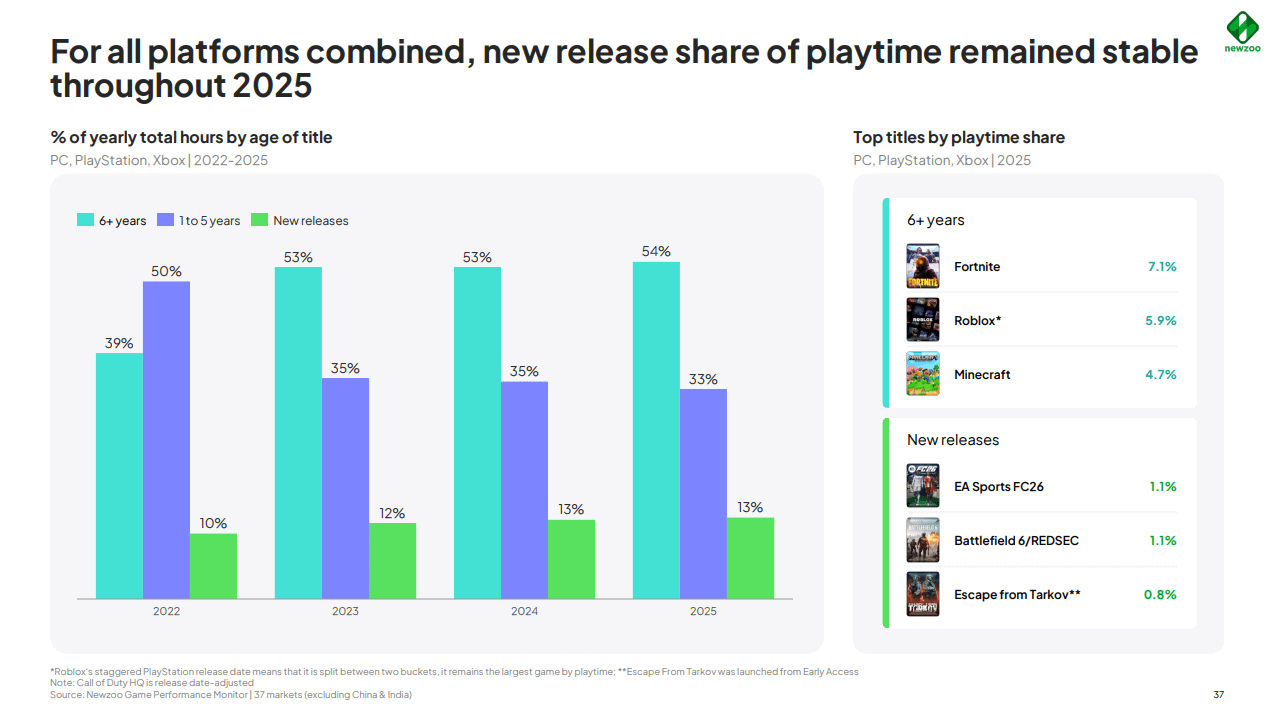
A large share of this 54% goes to online-first games like Roblox, Fortnite, Minecraft and Call of Duty. They don’t have one story, but work somewhat like social media. You play it because your friends do, your social status increases as you notch up wins and buy small game collectibles, and new updates to the game keep interest up.
Take-Two itself is a standout example of this. Around 81% of its net bookings last quarter came from recurrent spending on in-game purchases. Much of them occurred in the online version of GTA V, which gets you new heists, new cars, new weapons, and the ability to sell new drugs. It is this, rather than new game sales, that has helped keep Rockstar afloat. Funnily enough, GTA Online was first considered an afterthought by its developers.
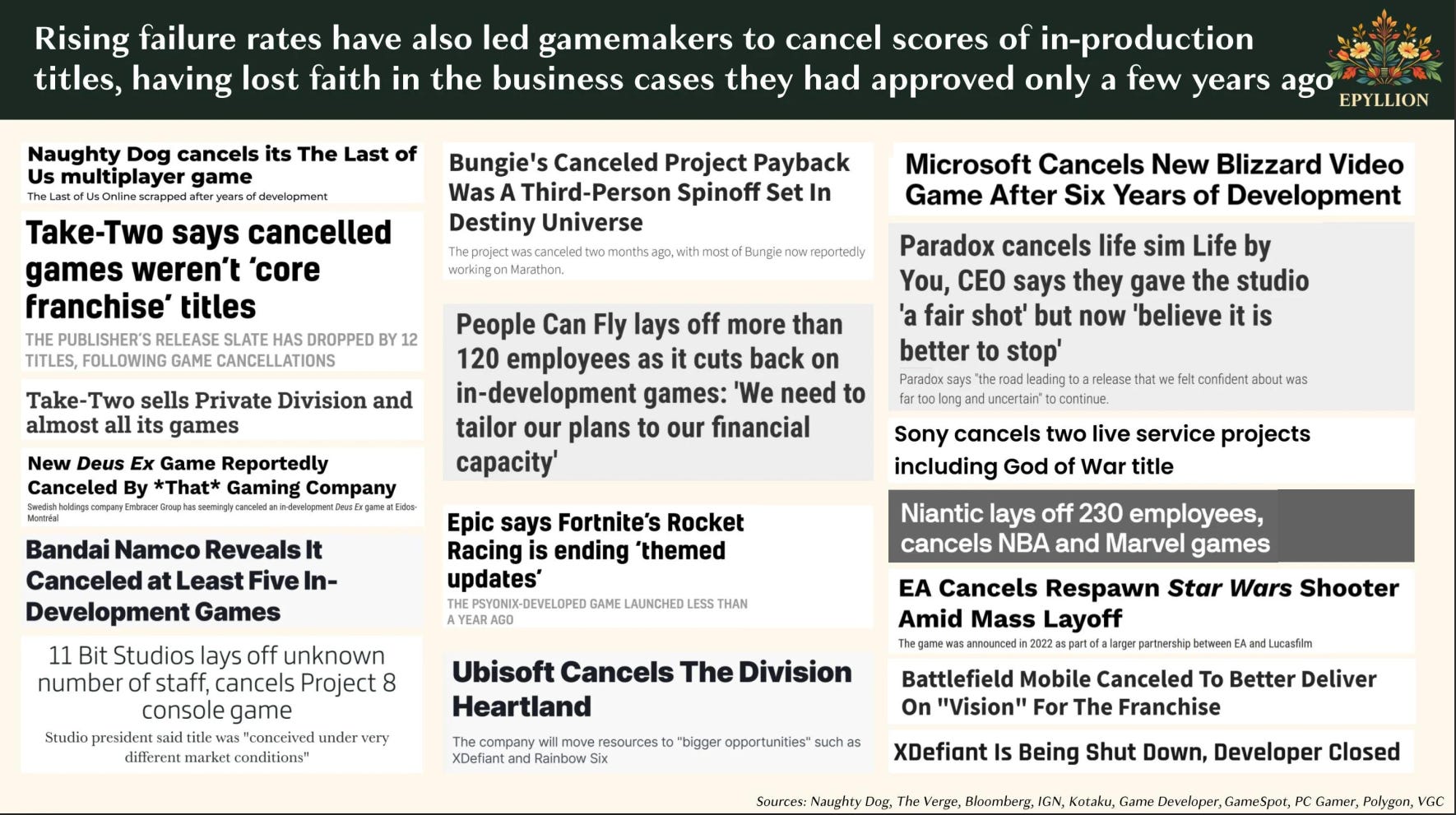
Unfortunately, most studios don’t have a GTA Online or Call of Duty paying for their next game. Instead, each of them bets that its next big release will be the one players adopt for years. But players only have so many hours, and between old games, YouTube and reels, most of those are already spoken for. Too many expensive games are chasing too little attention. When a game costs hundreds of millions to make, a single flop can sink a studio. And the last few years have not been short of cancellations of expensive games.
There is yet another way to make games: go small. Indie games are often far more simplistic (and much less realistic) in their look, but try to hook players in entirely through gameplay. As per Bain, studios making indie games have seen a far faster revenue growth than large game studios.
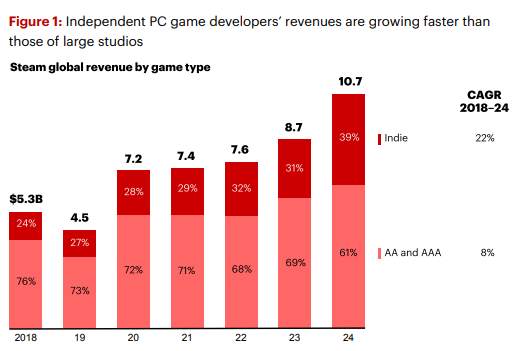
For instance, Schedule I, a drug-dealing simulator made by a solo developer, made over $50 million in its very first month, and is estimated to have outsold many AAA games. Clair Obscur was built by a core team of about 30 people for under $10 million (₹93 crore) and sold over five million copies. Minecraft also started out as an indie game.
What makes things worse for large game studios is that people are not buying enough advanced gaming consoles, which, besides PCs, are the only machines that can run games like GTA VI.
As per Matthew Ball, each subsequent generation of consoles came with slower rates of sales growth. In fact, much of the sales of a brand-new console comes from those who owned the previous generation and want to upgrade. In essence, the market for consoles has not expanded meaningfully. What few pockets of growth remain are located in Japan and other parts of the world, and that too confined to Nintendo much more than XBOX or PlayStation.
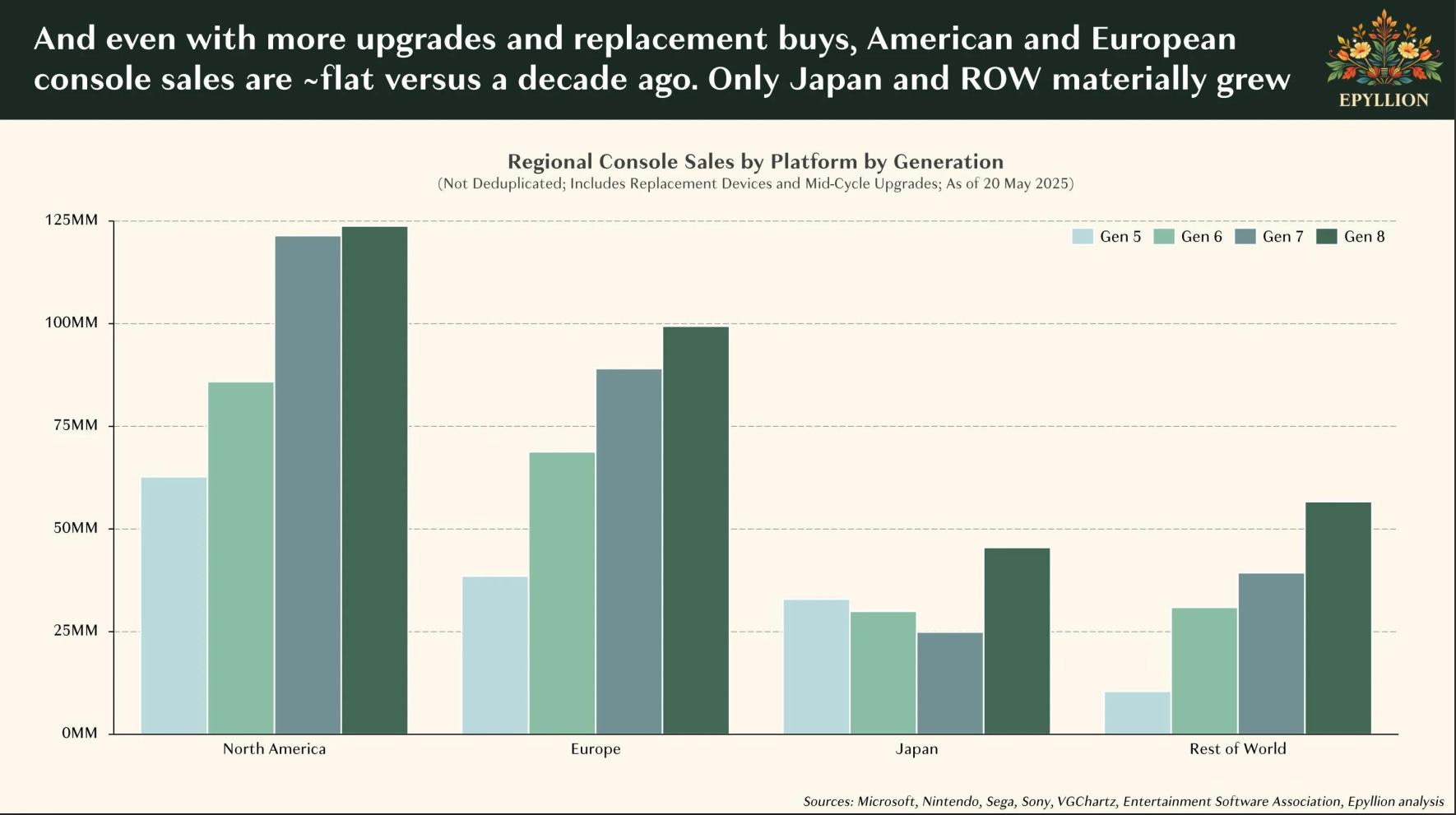
People aren’t rushing to upgrade partly because a Roblox or Fortnite runs fine on machines they already own. But the most recent generation of consoles have become more expensive. Even Shawn Layden admitted that real innovation would involve making the PS6 incredibly cheap. But that looks difficult with a memory chip shortage and diversion of computing resources to AI.
The squeezed middle
The big-budget business is shrinking, smaller studios are taking the space it leaves behind, and the machines most capable of handling such games aren’t selling as well as their predecessors. If this is what it takes to make a successful AAA game, most studios simply can’t play.
Ubisoft, the maker of Assassin’s Creed, is the clearest example. It reported a record loss of almost $1.7 billion (~₹15,800 crore) in FY26. It has cancelled seven games, moved its biggest franchises into a new company, and shed around 4,000 jobs since 2022.
When the cash runs dry, employees are let go. In the GDC’s 2026 game industry survey, 34% of workers surveyed said they had been laid off in the past two years, and those who worked in AAA studios were particularly badly hurt.
With how strenuous game development can be, it can be difficult to meet immediate deadlines. But working without overtime pay to do so has become an all-too common practice in the industry. Rockstar itself has faced lots of heat for crunching during the development of RDR2, and avoiding the same for GTA VI was a priority.
Part of the layoff story is a hangover from the pandemic era, when people were stuck at home playing games, and money was cheap because of low interest rates. Naturally, studios hired in a frenzy, but when interest rates rose and players went back outside, the bills came due.
But part of it is structural. A game studio will only need hundreds of developers and animators for only a few years at a time for one game, so why keep them all on long-term payroll? That’s why game studios are increasingly either hiring workers on a contract basis, or offshoring to cheaper regions. India is a big part of the latter. By some estimates, Bengaluru is one of Rockstar’s largest branches by headcount.
End of the line
For the next few months, GTA VI will make the industry look healthy. It may well carry Take-Two for a decade, the way GTA V did.
But it can’t be copied. The game required back-breaking effort, coordination across offices in different countries, mind-boggling finances, and trust it has earned from fans across an entire franchise. Almost no one else has it all.
We have not even addressed AI’s role yet. Undoubtedly, AI is already making small games cheaper than ever to build. On Roblox alone, games built largely with AI have already begun breaking into the top charts. What might prevent the same for AAA games is token costs, but players’ attention continues to drift towards cheaper, smaller games, making the case for the next billion-dollar bet only weaker.
These next few months, many of us will happily lose ourselves in Vice City, or go to the house of a friend who owns the game. But once we’re out, it’s worth remembering that GTA VI is probably the last of its kind, for more worrying reasons than good ones.

India’s greener jet fuel comes with a bill
This week, the government cleared Indian Oil Corporation (IOC) to sell a new kind of jet fuel from its Panipat refinery. It’s made from used cooking oil collected from hotels and restaurants, and Panipat is expected to make about 35,000 tonnes of it a year.

It’s called SAF, or sustainable aviation fuel. As the name suggests, the point is that it’s greener. Batteries can power small planes on short hops, but they’re far too heavy for the big jets that carry people across countries and continents. So for most flying, a cleaner version of the same liquid fuel is one of the few real options for cutting emissions.
But nobody in India has to use it. Since April 2026, fuel suppliers have been allowed to sell jet fuel blended with SAF, just like regular jet fuel. Allowed, not required. The government has also set targets for SAF to make up 1% of the fuel on international flights leaving India in 2027, 2% in 2028 and 5% in 2030. For now, those are only goals.
And an option nobody has to take is one that few will take, unless the numbers work. Right now, they don’t. SAF costs two to three times as much as regular jet fuel, so an airline buying it voluntarily is choosing to pay more for the same flight. That’s why IOC has said it wants airlines to sign purchase deals before it builds more SAF plants. Without a rule, it can’t be sure anyone will buy.
So the government is looking at forcing the issue. A draft policy would make those targets compulsory. It also sketches a second phase with much bigger targets up to 2040. The draft hasn’t been released for public comment yet, so all of this could change.
Why only international flights? Because that’s where the global pressure is. From 2027, a UN aviation scheme called CORSIA becomes compulsory for countries including India. Under it, airlines must offset emissions on international flights above a set level, mostly by buying carbon credits. CORSIA doesn’t force anyone to use SAF. Using it does cut the number of credits an airline needs, but credits are usually cheaper than SAF, so CORSIA alone won’t push airlines towards it. A mandate would.
Domestic flights, which make up most of Indian flying, are left out entirely. It’s unclear whether the second phase would include them. That makes the first phase smaller than it sounds. India burns about 8.2 million tonnes of jet fuel a year, and that’s expected to reach 14.2 million tonnes by 2030. Even in 2030, the SAF needed for international flights would be under 2% of that.
Still, if India makes SAF compulsory, someone has to pay the extra cost, and someone else gets to earn it. This piece looks at both.
What it could cost airlines
As we wrote earlier this year, jet fuel is already the biggest cost for Indian airlines, thanks to heavy taxes and this year’s price spike. SAF adds to that bill.
At two to three times the price of regular jet fuel, here’s roughly what blending does to the cost of a tank.
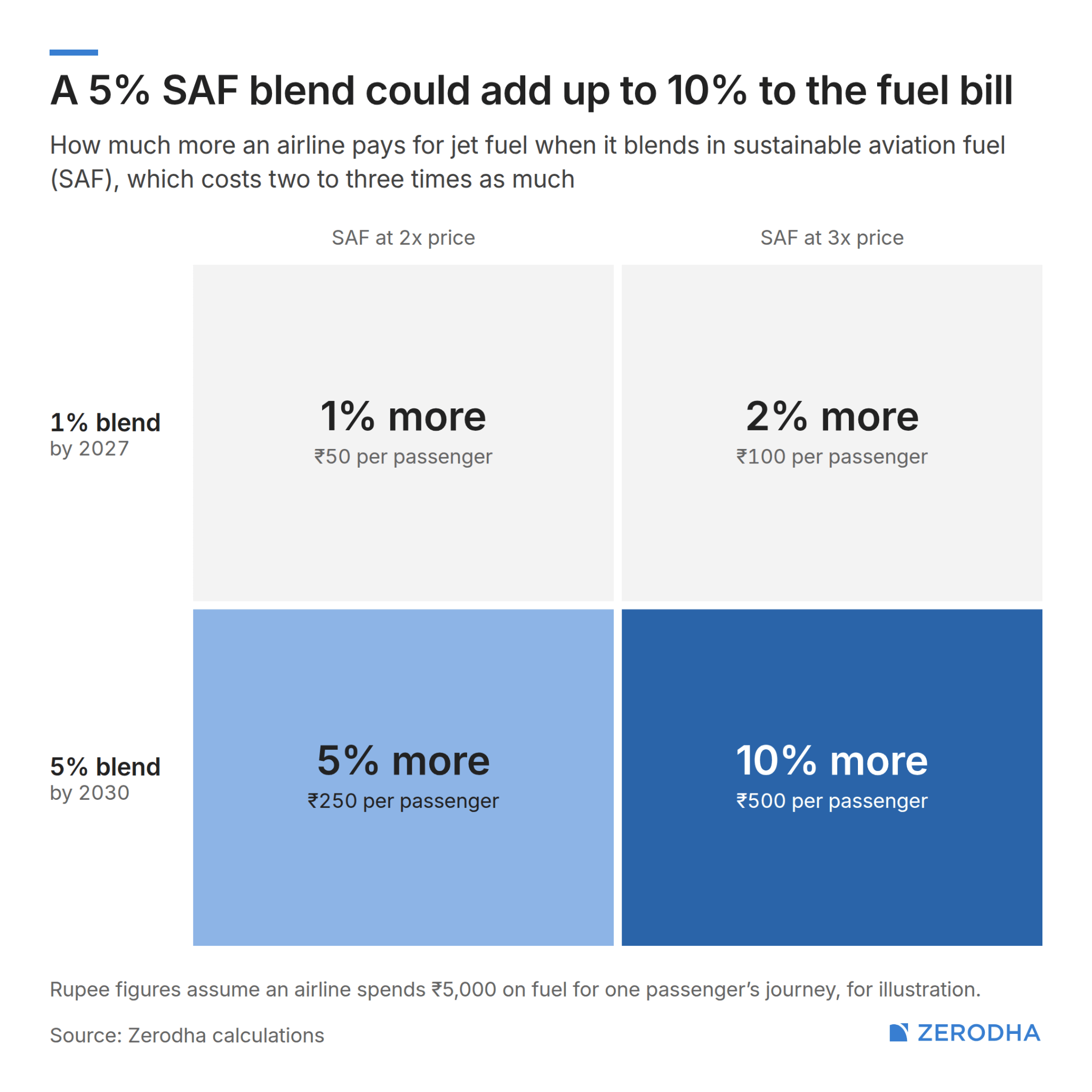
In plain terms, every percentage point of SAF adds one to two percent to the fuel bill. Airlines may not pass all of it on, but on price-sensitive routes, even that can move fares.
The draft also closes an obvious escape route. If fuel in India gets costlier, an airline could fill up extra abroad and fly back with it, a practice called tankering. So the draft says airlines flying international routes from India, Indian or foreign, must buy at least 90% of their annual fuel for those flights at Indian airports.
That rule has an interesting side effect. Take someone flying from Delhi to London. On a nonstop flight, the airline buys fuel in Delhi for the whole long journey, so every litre carries the SAF cost. On a flight via Dubai, only the short Delhi–Dubai hop runs on Indian fuel. The long leg to London is fuelled in Dubai, outside India’s rule.
So the mandate could weigh more on nonstop long-haul flights. That’s exactly where Air India and IndiGo are trying to win passengers from Emirates and Qatar Airways.
Who could make money from SAF?
One airline’s extra cost is another company’s new market. S&P Global and the SAF Association estimate India’s SAF demand at about 46,000 tonnes in 2027, rising to about 250,000 tonnes by 2030. And because the draft says only SAF made in India counts, all of that demand has to be met at home.
But before getting excited, note one detail in the draft. It proposes a government-set SAF price, based on production cost plus a profit margin. If that holds, SAF won’t be a high-margin business. Producers would earn a steady, regulated return, and the money would come mostly from volume. That makes the bigger prize the long game. The draft estimates India could make about 10 million tonnes of SAF a year by 2040, needing $70–85 billion of investment.
The companies in line for that fall into three groups based on our understanding.
The makers, obviously. The oil marketing companies already supply jet fuel to airports, so they’re the natural blenders and producers. Beyond IOC‘s Panipat unit, BPCL is revamping a unit at its Mumbai refinery to process used cooking oil alongside its regular feed, aiming to start by the end of 2026. It has also teamed up with Akasa Air to push SAF use. HPCL has developed its own technology to make SAF from used cooking oil, and is building a small commercial unit. None of these is a commercial business yet.
Outside the oil companies, TruAlt Bioenergy plans an 80,000-tonne-a-year plant using Honeywell’s ethanol-to-jet technology. But its management said in October that construction spending would wait for policy clarity. Like IOC, it wants the rules settled before it spends.
The builders, next. Someone has to design and build these plants. Engineers India‘s annual report describes engineering work on SAF projects, including IOC’s Panipat unit. Praj Industries earns by supplying technology, engineering and equipment, and is already doing engineering work for an overseas ethanol-to-SAF plant. On its October 30 earnings call, Praj said an overseas ethanol-to-SAF customer was expected to make its investment decision in April–June 2027. Bigger equipment orders depend on it.
But every one of these plants depends on something more basic: a steady supply of raw material.
The problem with finding enough raw material
Used cooking oil sounds like something India has plenty of. It does. The problem is getting it. Industry participants told S&P Global that only about 6% of India’s used cooking oil enters formal collection channels. The rest is thrown away, or reused in kitchens and street food.
Collecting it properly is hard work. Someone has to arrange pickups from thousands of restaurants, hotels and dhabas, test each batch, and keep records proving where it came from. That paperwork matters, because SAF only counts as green if its raw material can be traced. Europe has already run into cases of fresh palm oil being passed off as used cooking oil.
And Indian refiners aren’t the only buyers. Foreign companies have been buying Indian cooking oil for years, so local refiners still have to outbid overseas customers for it.
That competition will only grow. Europe requires 6% SAF in jet fuel by 2030, and Singapore will fund central SAF purchases through a passenger levy on flights from January 2027. Both need far more raw material than they have. That’s an opportunity too, since Indian producers could export SAF to them. But it means the oil is wanted everywhere.
Export markets also come with their own rules, and this is where the ethanol story gets a catch. Europe doesn’t count fuel made from food and feed crops towards its mandate. So SAF made from sugarcane juice or grain ethanol wouldn’t count there, even though it can safely fly a plane. Most of India’s ethanol comes from exactly those sources. That means ethanol-based SAF could largely serve India’s own mandate, while exports would have to come from waste oils and crop residue.
So, for anyone building an SAF plant in India, the question isn’t just whether they can make the fuel. It’s whether they can source raw material cheaply and cleanly enough, and whether the finished fuel counts in the global markets.
Where does this leave India?
For now, IOC has permission to sell SAF, and nobody has to buy it. Three things will decide whether that changes: the final blending rule, whether airlines sign purchase deals, and whether Panipat actually starts delivering.
- This edition of the newsletter was written by Manie & Vignesh.
Tidbits:
[1] SEBI revises margin and risk norms for commodity derivatives
The Securities and Exchange Board of India has revised the minimum initial margin and Margin Period of Risk (MPOR) requirements for the commodity derivatives segment, effective December 1. The regulator set tiered initial margin thresholds of 6%, 8% and 10% for low-, medium- and high-volatility commodities respectively, applying the framework uniformly across agricultural and non-agricultural contracts.
Source: The Economic Times
[2] Nitin Gadkari urges states to allow private bike taxis under 2025 guidelines
Union Road Transport Minister Nitin Gadkari has asked state governments to implement the Motor Vehicle Aggregator Guidelines 2025, which allow privately registered motorcycles to operate as passenger bike taxis through app platforms. The provision aims to provide regulatory clarity for operators like Uber and Rapido, who have faced ongoing legal challenges in several states over the commercial use of private two-wheelers.
Source: The Hindu BusinessLine
[3] SpiceJet board approves plan to raise ₹5,500 crore to drive revival
The board of SpiceJet has approved a proposal to raise up to ₹5,500 crore through equity and other financial instruments to strengthen the airline’s balance sheet and rebuild operational capacity. The board also cleared a move to increase the carrier’s authorised share capital from ₹2,000 crore to ₹7,500 crore, subject to shareholder and regulatory approvals.
Source: Business Standard
[4] Aditya Birla Renewables to reach 9.3 GW portfolio with Sprng Energy acquisition
Aditya Birla Renewables is acquiring Shell’s Sprng Energy platform at an enterprise value of ₹17,200 crore. The deal would take its combined renewable portfolio to about 9.3 GWp, including operating and under-construction projects, once the transaction is completed.
Source: Aditya Birla Group
[5] Bulk Scotch imports face 162.5% duty amid India-UK trade dispute
India is imposing an effective duty and tax of 162.5% on some bulk Scotch imports, even though the India-UK trade deal cut tariffs on eligible Scotch to 75%. The dispute is over how bulk Scotch concentrates should be classified, with Indian authorities arguing that some shipments should face the higher rate.
Source: Reuters
Want more tidbits? Catch up on last week’s recap!

Beyond Today’s Brief
There’s always more happening at Markets by Zerodha.
The Chatter: Why does SEBI see India’s securities investor base nearly tripling to 380 million over the next five years while piloting corporate bond tokenisation under ‘Demat 2.0’? And how are Eicher Motors, Ashok Leyland, Cummins, RVNL, Vodafone Idea, Patanjali Foods, and Oil India navigating supply constraints, data centre demand, Vande Bharat timelines, 4G tower rollouts, and offshore oil discoveries?
Aftermarket Report: How did Nifty buck weak Asian cues to surge nearly 1.3% and close near its intraday high at 25,514.30 as easing raw material costs lifted market sentiment? And what do 14 advancing sectors led by Auto’s 4.40% rally, improving medium-term breadth with 58.4% of Nifty 500 stocks reclaiming their 50-day moving average, and the Fear & Greed Index cooling from 72 to 69 signal for the near term?
Zero1 by Zerodha: Ready to build a customised early-retirement plan from scratch? In the opening episode, we cover conducting a money audit, why fixed deposits barely beat inflation post-tax, how different asset classes work, and four essential safety nets emergency funds, clearing high-interest debt, insurance, and account setup before investing your first rupee.
Join us on WhatsApp, where we share interesting soundbites from concalls, articles, and everything else we come across throughout the day. You’ll also get notified the moment a new video or article drops so that you can read or watch it right away.
Thank you for reading. Do share this with your friends and make them as smart as you are 😉