


Our goal with The Daily Brief is to simplify the biggest stories in the Indian markets and help you understand what they mean. We won’t just tell you what happened; we’ll tell you why and how too. We do this show in both formats: video and audio. This piece curates the stories that we talk about.
You can listen to the podcast on Spotify, Apple Podcasts, or wherever you get your podcasts and watch the videos on YouTube. You can also watch The Daily Brief in Hindi.
In today’s edition of The Daily Brief:
1. Claude, go public, make no mistakes!
Anthropic filed its prospectus for a record IPO, revealing an unusual governance model as a public benefit corporation where retail investors hold no legal mechanism to unseat the board. While revenue surged thirtyfold in five quarters to $11.6 billion in Q2 2026—driven by high-consumption agentic coding tools like Claude Code—the company faces massive structural headwinds. Beneath headline net losses driven by convertible note revaluations sit nearly $266 billion in fixed long-term compute commitments, an intricate multi-role dependency on Amazon, and mounting margin pressure as open-weight models rapidly close the capability gap.
2. How state politics drove liquor sales this quarter
September-quarter earnings across India’s listed liquor makers showed wide performance divergences dictated primarily by state excise policies rather than consumer drinking habits. In Karnataka, a historic shift to taxing alcohol content rather than total liquid volume triggered a 60% volume surge for beer while squeezing lower-end spirits. Meanwhile, in Tamil Nadu, TASMAC’s introduction of automated, demand-based store ordering offered national brands an operational breakthrough in the country’s largest brandy market, even as a customs dispute over bulk Scotch imports threatens industry-wide blending margins under the India-UK trade pact.
Claude, go public, make no mistakes!
Finally, Anthropic has filed its prospectus for what might be a record IPO. And that’s hardly the only thing making it unusual.
The prospectus asks investors not to think of their purchase in purely transactional terms.

The aspect of the S-1 that explains this sentiment the best are the three letters attached to Anthropic’s name: PBC, which stands for “public benefit corporation”.
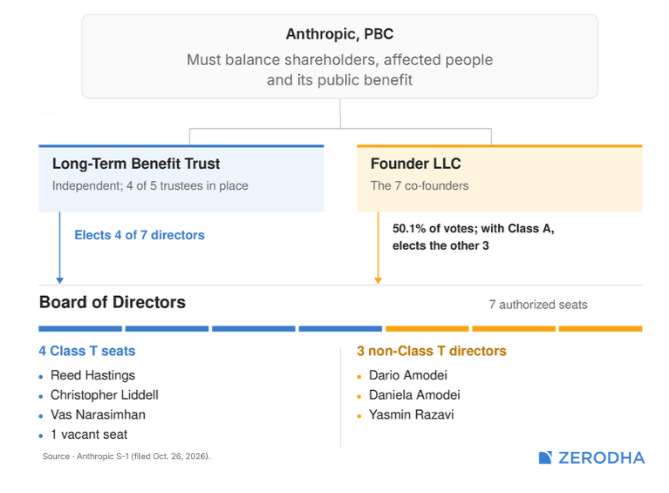
A PBC is a for-profit company, but its board is legally required to weigh three things: a specific public benefit written by the company, interests of people materially affected by that, and shareholders’ financial interests.
Vital Farms, for instance, is a listed PBC whose stated benefits include bringing ethically produced food to the table. So is OpenAI’s for-profit arm. Anthropic’s stated public benefit revolves around responsibly developing and maintaining advanced AI for the good of humanity.
The major trade-off with PBCs is that decisions that hurt shareholders can still be justified as serving the company’s stated public benefit. So, if making a model safer clashes with making more money from it, the board is required to consider the PBC’s purpose alongside financial interests, citing it might delay LLM releases, or give up revenue for AI safety.
Anthropic’s corporate governance structure goes one step further in handling this tradeoff.
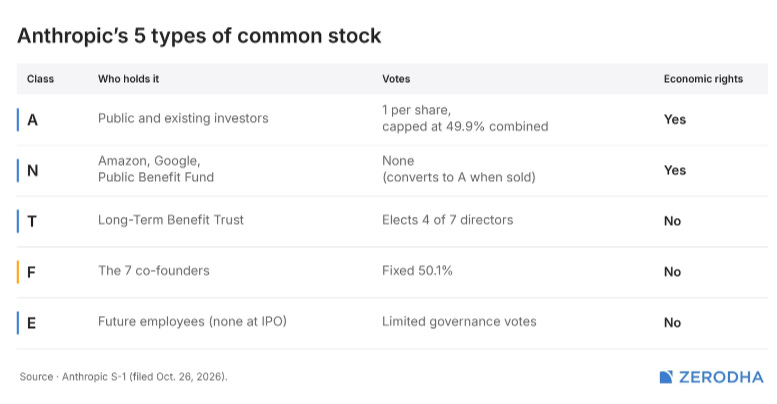
You see, in a normal public company, if the management gives up revenue to pursue a mission, shareholders can vote out the board. But Anthropic’s public investors hold no legal mechanism to elect or remove the board majority.
This is because Anthropic has two major non-economic shares that carry voting rights but no financial ownership. One belongs to an independent body which gets to elect a majority of the board. The other is a Class F share held by Anthropic’s seven co-founders, and it carries 50.1% of the votes on general shareholder decisions.
There is one other unusual, mind-boggling feature we’d like to highlight before we dive into the S-1. In all the stories we’ve done in The Daily Brief so far, we can’t recall a company this young where the unit of measurement is already in the hundreds of billions.
The price of intelligence
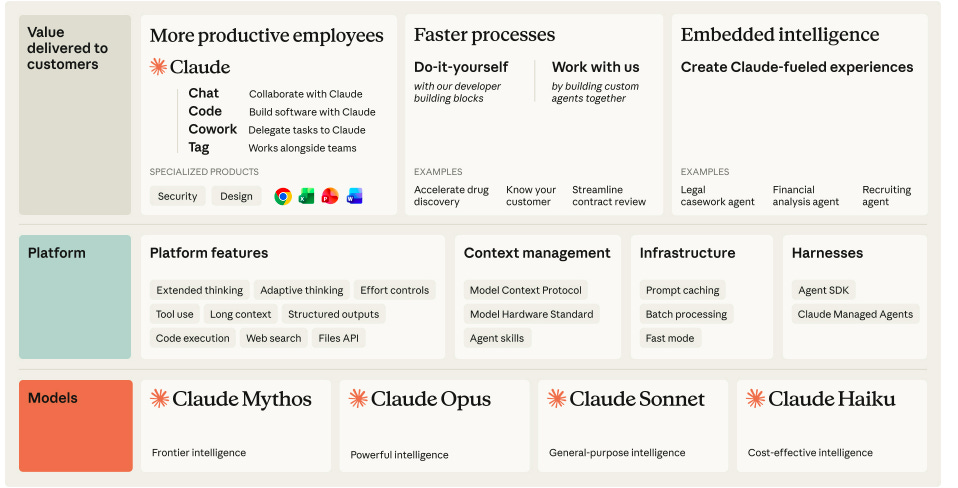
At its core, Anthropic sells access to Claude, its family of four LLMs in two main forms. One is access to APIs (programming interfaces) for developers and enterprises to build their own products on. The other is Anthropic’s own apps, like the Claude chatbot and the coding agent Claude Code.
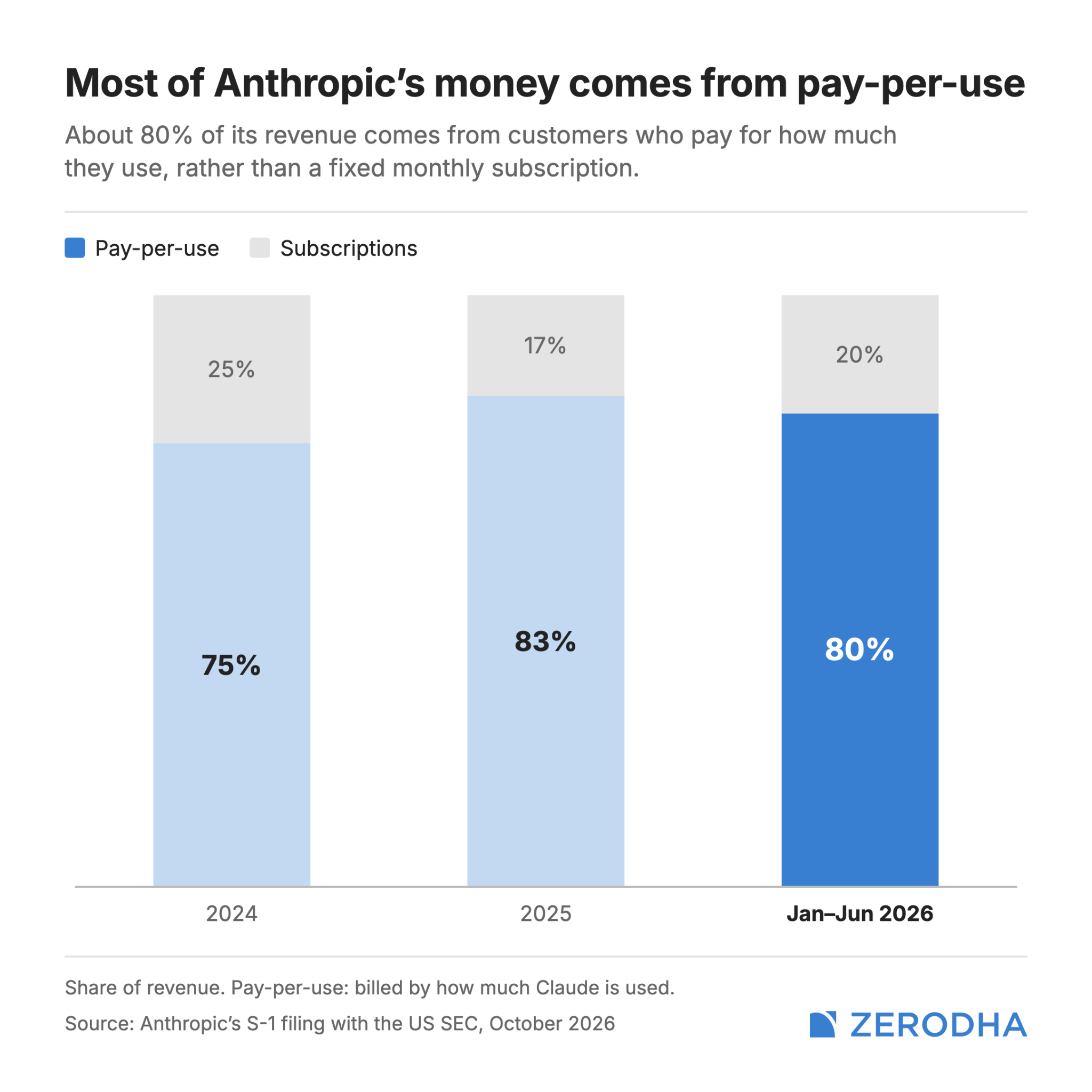
In both cases, Anthropic mostly charges by tokens, which are the small chunks of text a model reads and writes. Usually, the more capable the model, the higher the price per token. In the first half of 2026, this token usage-based billing, where users pay for what they use, made up 80% of revenue. The other 20% came from take-or-pay subscription models like Claude Pro and Max.
Anthropic’s revenue grew from $41 million in 2023 to ~$16 billion in the first half of 2026, and ~72% of revenue was billed in the US. Over 80% of September-quarter revenue came from models released in the prior 6 months, such as Opus 5.5.
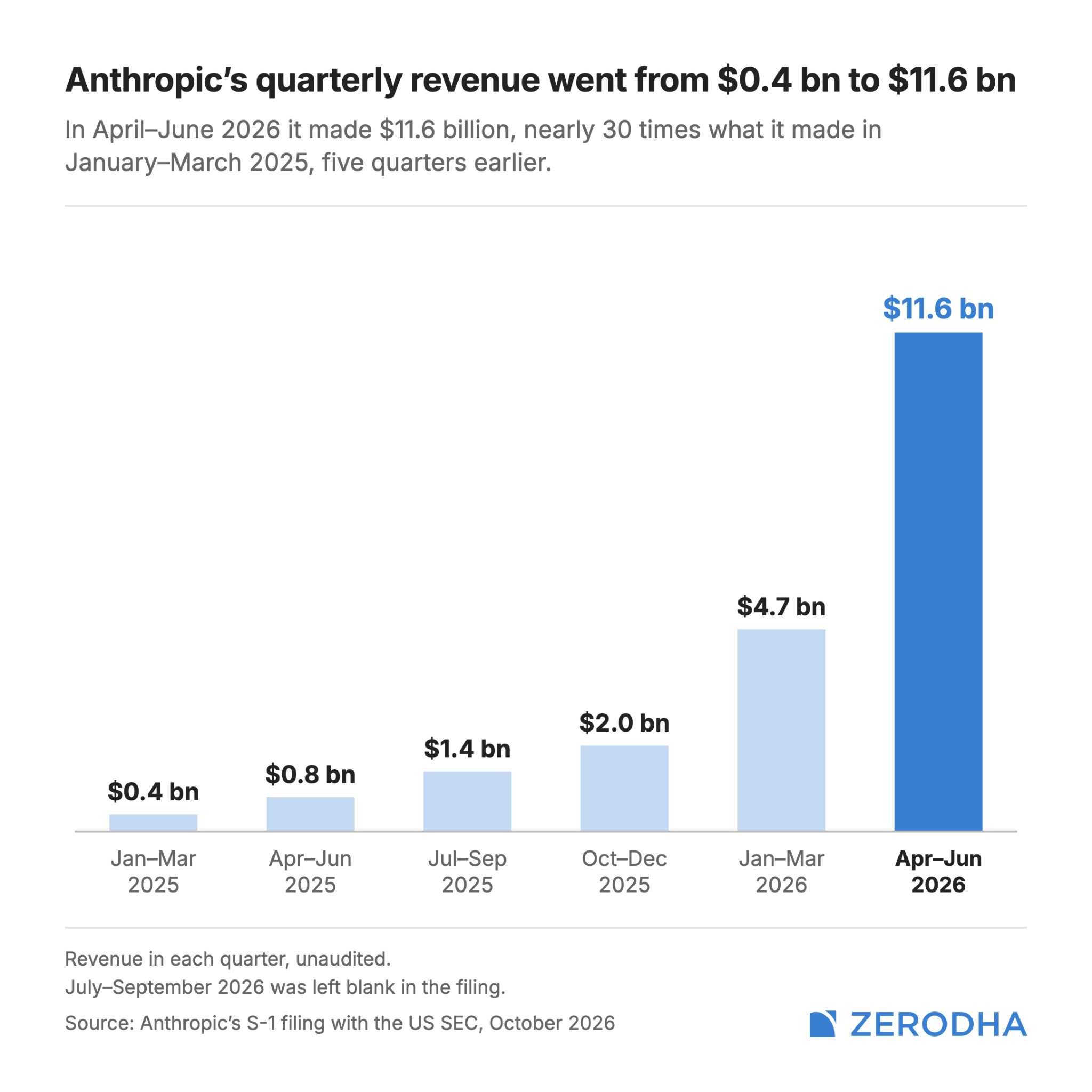
Now, why has revenue grown this fast?
The first reason is that people moved from using models for chatbots that answered one-off questions, to agentic tools like Claude Code which carry out long, multi-step tasks on their own, thus burning far more tokens. In the September quarter, enterprise users who didn’t use Claude Code spent under $75 a month on average, while the top 5% of those who did spent 20 times more.
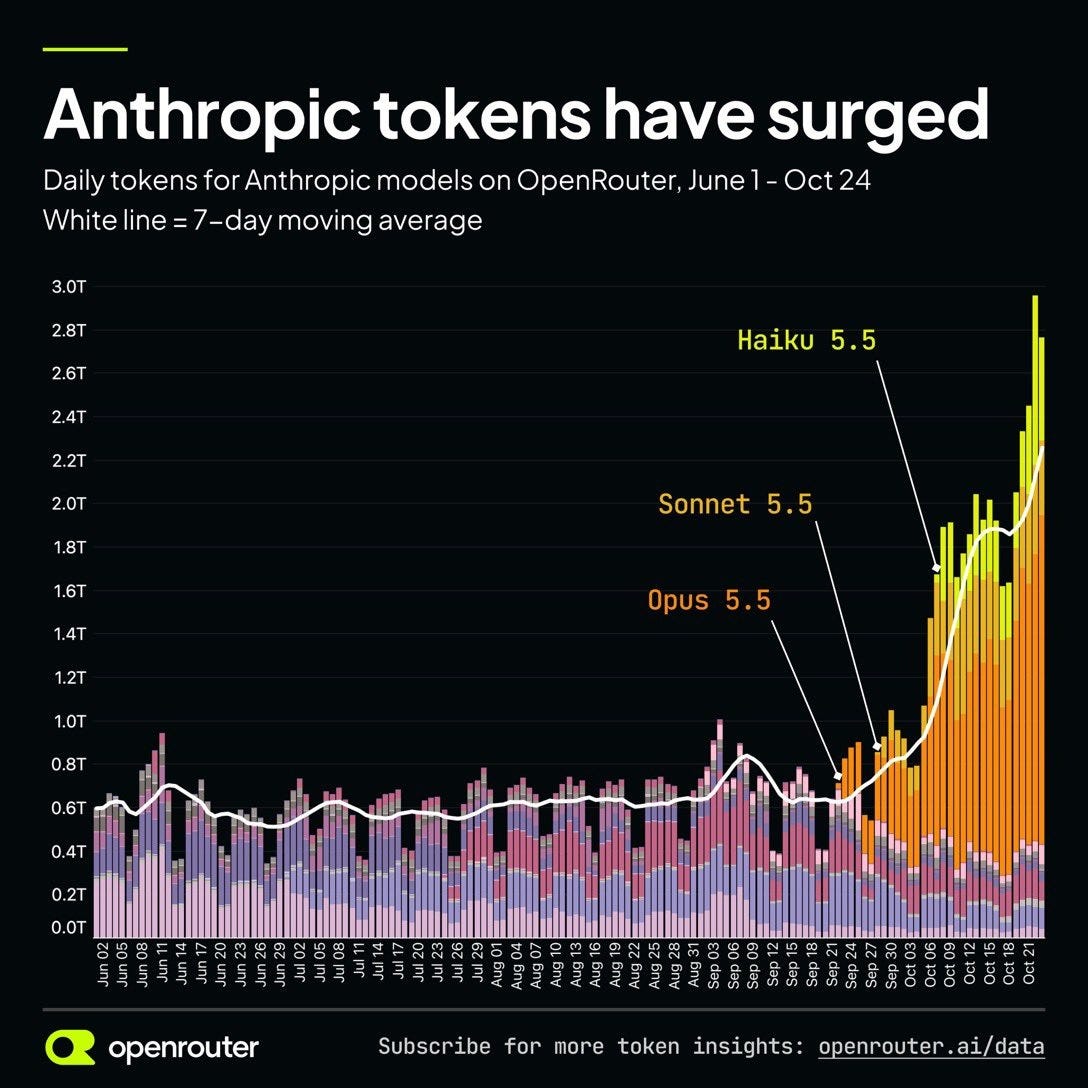
The second reason is that newer Anthropic models do the same task for fewer tokens. You’d think lower tokens means lower revenue, but Anthropic says cheaper tasks have made wholly new use cases worth paying for, raising total spending. Further, new technology features such as prompt caching, which saves a model from re-reading the same long instructions or documents with every request, cut the computing needed per task. A task costing $1 in tokens on Opus 5 costs about 60 cents on the newer Opus 5.5.
But this increase in revenue is risky to take at face value.
An estimated 5-7% of revenue between January-September 2026 came from customers that broke Anthropic’s rules, and Anthropic cut them off in August. The S-1 doesn’t say what those customers did. But one known abuse is distillation, which refers to using a model’s answers to train a cheaper copy. Anthropic has repeatedly accused China-based labs like DeepSeek and Moonshot of this.
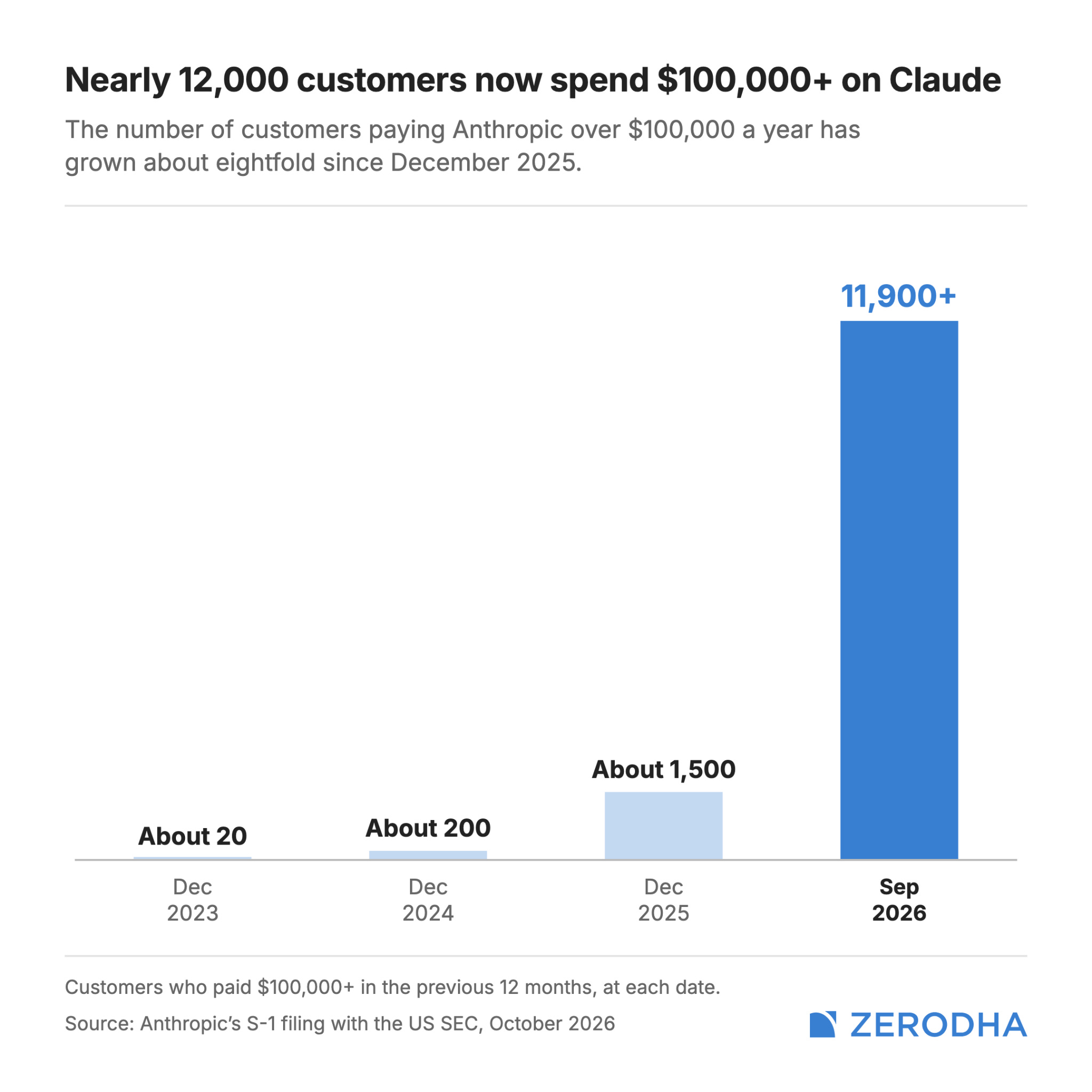
Anthropic’s most valuable customer base is enterprises. Nearly 12,000 customers now spend over $100,000 a year with Anthropic, up from about 950 a year earlier. Customers in that bracket brought in 74% of first-half revenue.
That has also fixed one of Anthropic’s old weaknesses for non-diversification. In 2023, a single customer made up 43% of its revenue, and in 2025, two customers were about 12% each. Over the first nine months of 2026, no single customer accounted for more than 10%.
But the dependence hasn’t disappeared so much as moved. Nearly half of revenue, 48%, comes through cloud stores run by Amazon, Google and Microsoft — the hyperscalers building data centers (or their own LLMs) at frenetic pace. It isn’t clear how sticky the rest is. Most customers pay by the token, many top customers aren’t on long-term contracts, and as rivals’ models catch up, switching gets easier.
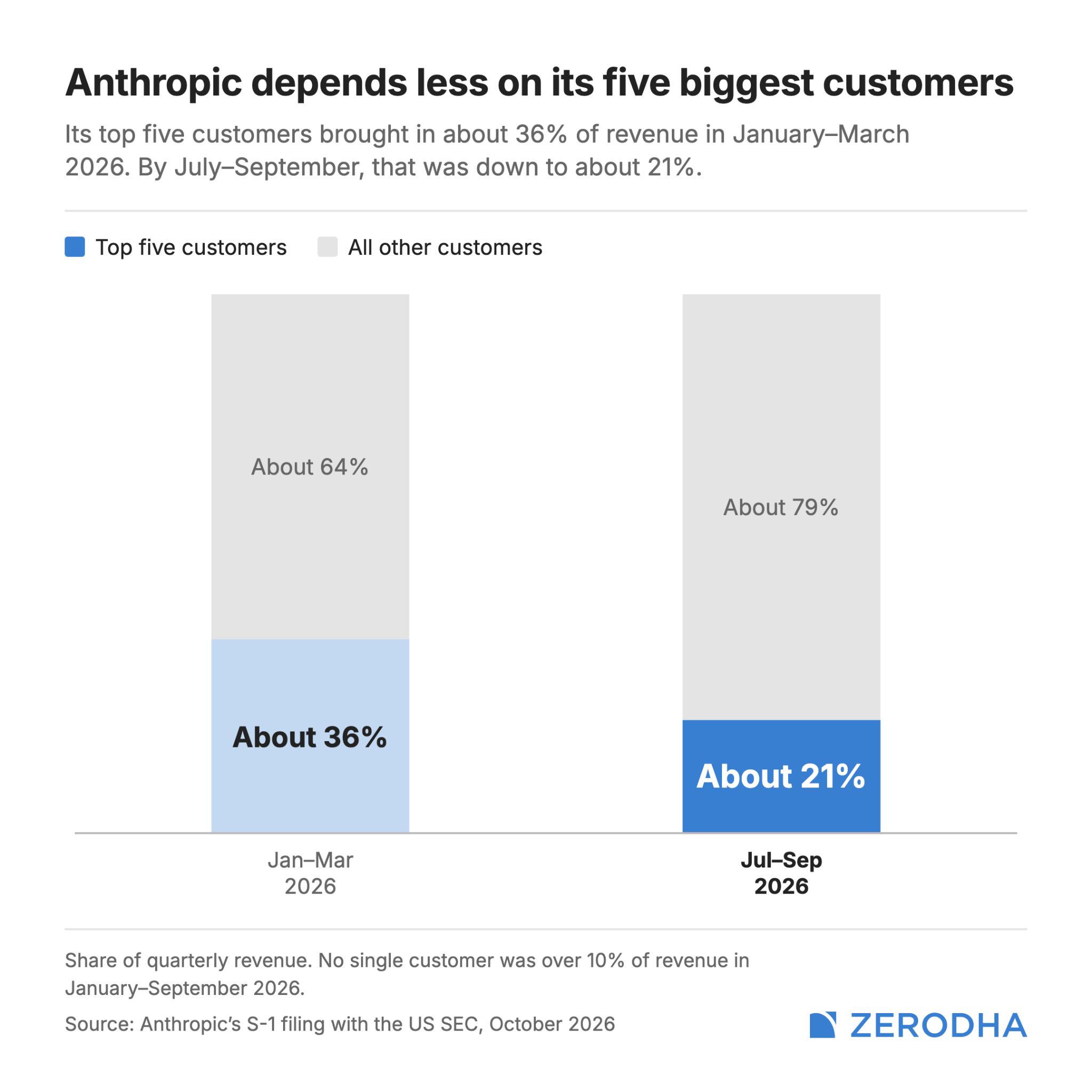
Growth seems to be slowing, too. Revenue rose by about half in the September quarter, after more than doubling in each of the two before.
The cost of intelligence
Now, what does it cost to earn that revenue?
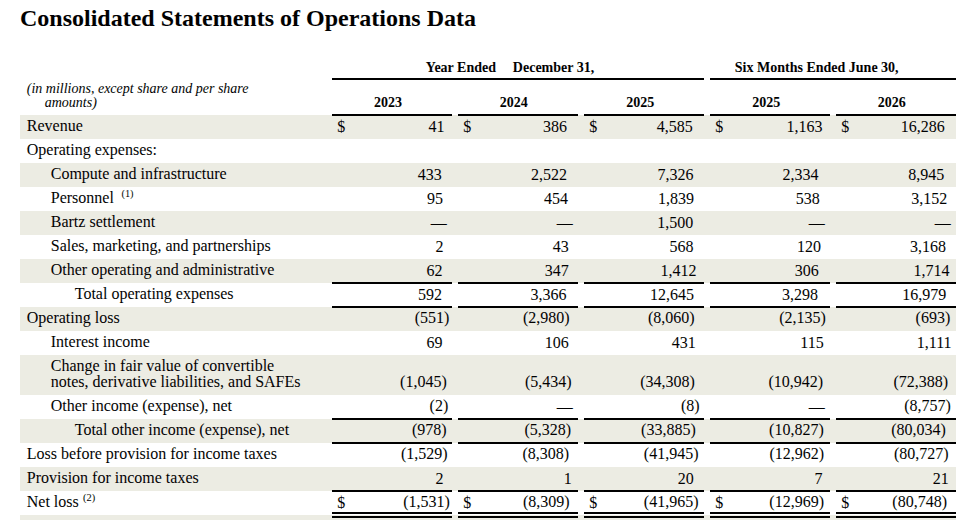
In the first half of 2026, Anthropic spent nearly $9 billion on compute, of which ~$2.4 billion of it went into answering paying customers’ requests. The other ~$6.6 billion went mostly into training new models and research, plus running Claude for free users and its own staff.
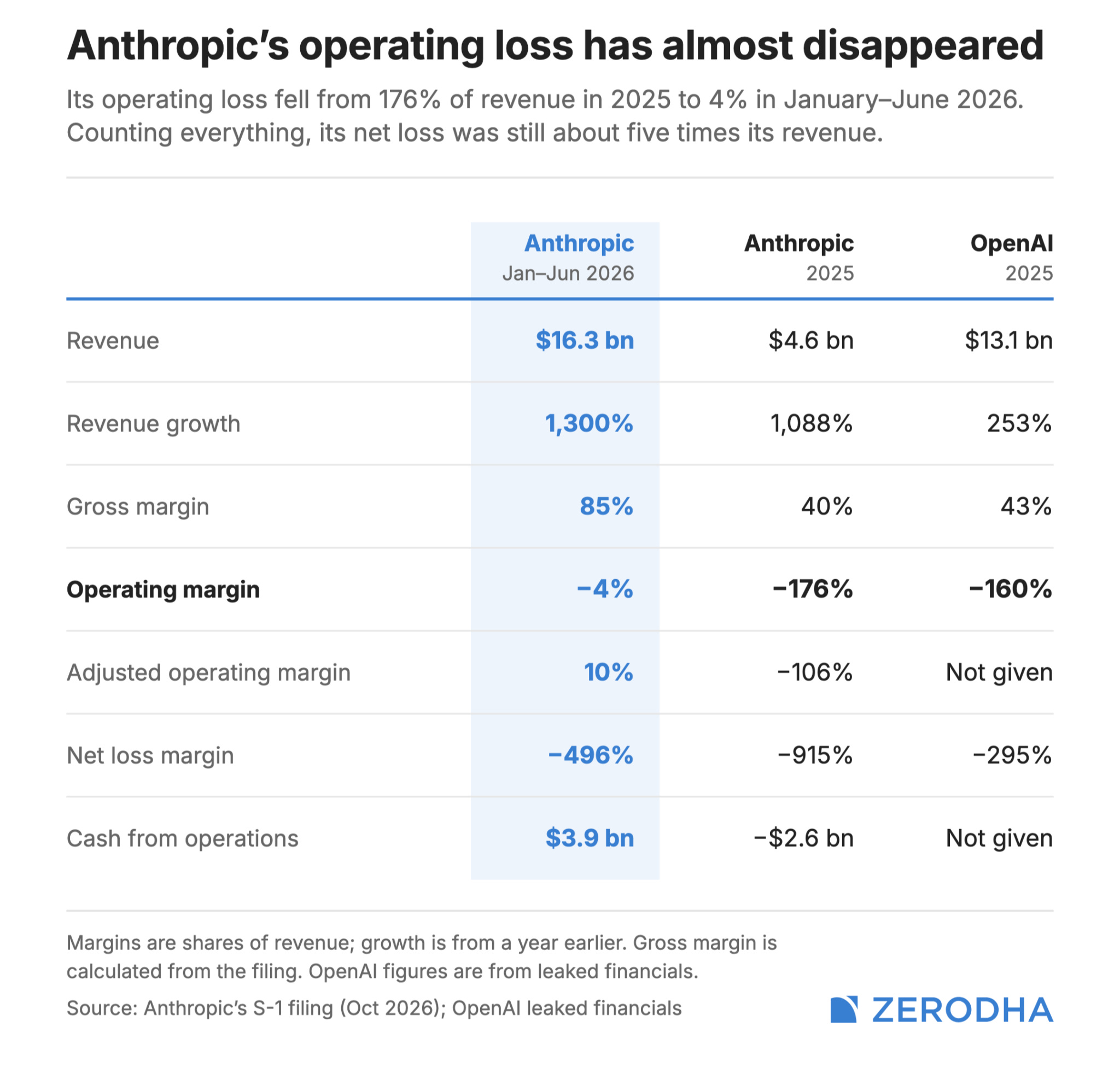
Count just the amount spent on paying customers, and Anthropic kept an impressive ~85 cents of every dollar. But after research and other expenses, only ~28 cents of each dollar was left for staff, offices and marketing. After everything, Anthropic lost ~4 cents on every dollar of revenue earned.
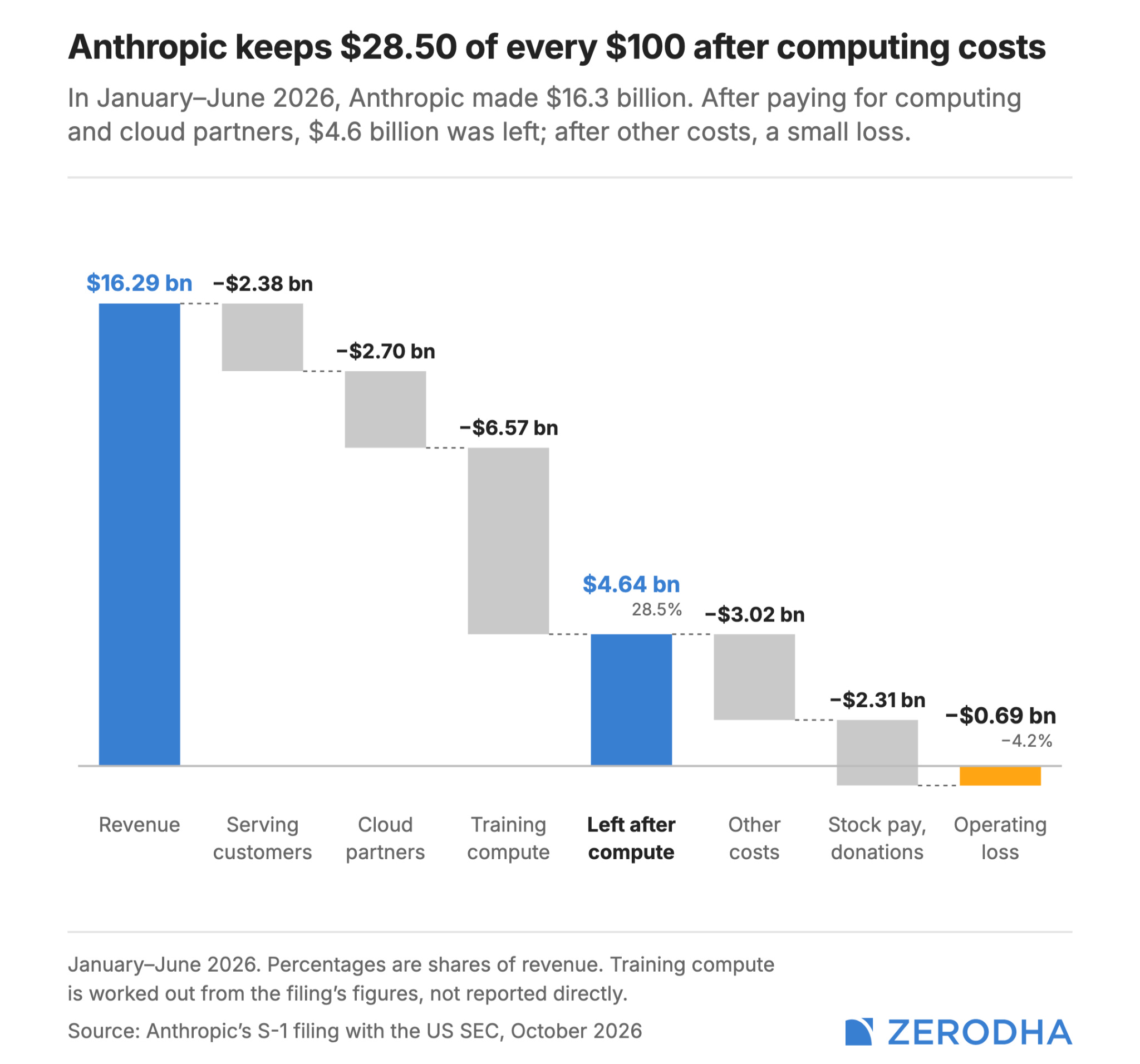
Anthropic’s net loss is far bigger, growing from $1.5 billion in 2023 to $42 billion in 2025, and $80.7 billion in just the first half of 2026 — nearly double the entire figure of 2025.
Part of the 2025 loss was a one-off $1.5 billion to settle a class action by authors whose books were illicitly used to train Claude. That payment alone was nearly four times Anthropic’s entire 2024 revenue.
As of the 2026 loss so far, 90% of it comes from a single, peculiar line item referring to the “change in fair value” of its convertible notes.
A convertible note is a loan that turns into shares later instead of being repaid. Anthropic’s notes were issued to Amazon. As Anthropic’s valuation rose, so did the repayable value of those convertible notes, and accounting rules require Anthropic to record that as a loss on its books. The notes were valued at $108.6 billion at the end of June
But besides these occurrences, the business underneath has improved fast. In the March 2025 quarter, Anthropic earned 40 cents of revenue for every dollar it spent on compute, which improved to $2.08 by the April-June 2026 quarter, meaning it now earned more than double what it spent.
We can also make a few comparisons with OpenAI. First, the two count revenue differently. As we saw, nearly half of Anthropic’s revenue comes through cloud stores run by Amazon, Google and Microsoft. Anthropic counts the full price of those sales as revenue and records the store’s cut as an expense; those fees came to $2.7 billion in the first half of 2026. OpenAI does the opposite and counts only what it keeps.So Anthropic’s revenue looks bigger next to OpenAI’s than it would if both counted the same way.
Cash in the bank
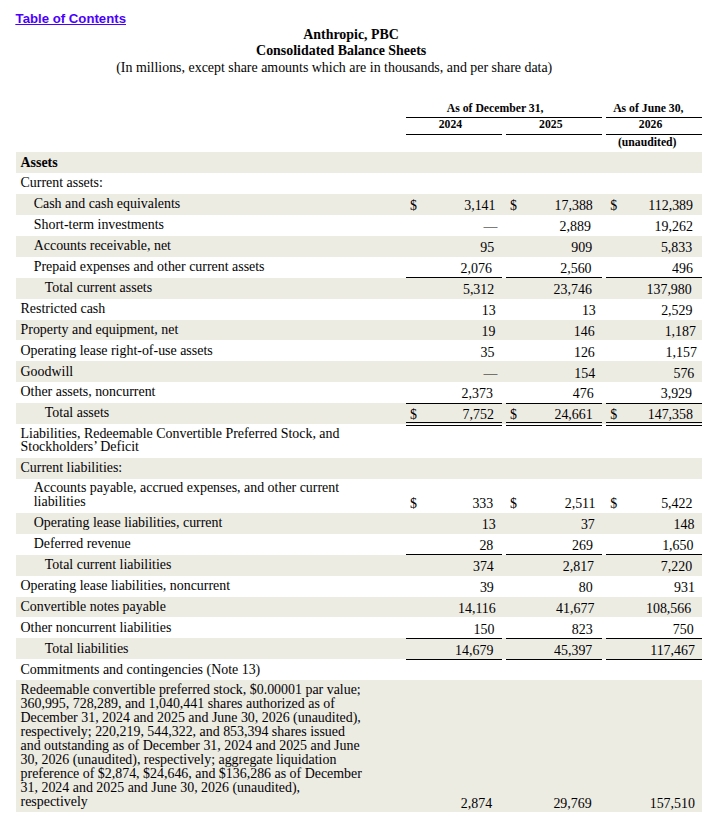
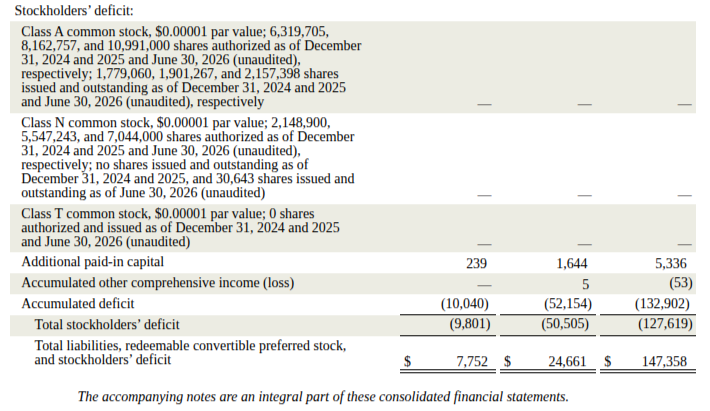
Cash is the lifeblood of all business. This is perhaps even more true of a world where Big Tech companies, which have infamously been asset-light and cash-rich, now find themselves starving of cash.
Of Anthropic’s ~$147 billion in assets, ~$132 billion is cash and short-term investments. Anthropic doesn’t own as much because it rents nearly all its compute. On the other side, most of its liabilities are Amazon’s convertible notes, which eventually get converted into shares rather than being paid back in cash.
You might think that Anthropic is swimming in cash, but that completely ignores the bigger obligations sitting in the footnotes.
As of June, Anthropic had nearly $266 billion in fixed or minimum compute commitments, with terms of up to 20 years. At the end of 2025, that figure was ~$55 billion. On top of that sat ~$321 billion in signed leases that hadn’t started yet. And Anthropic has only signed more since.
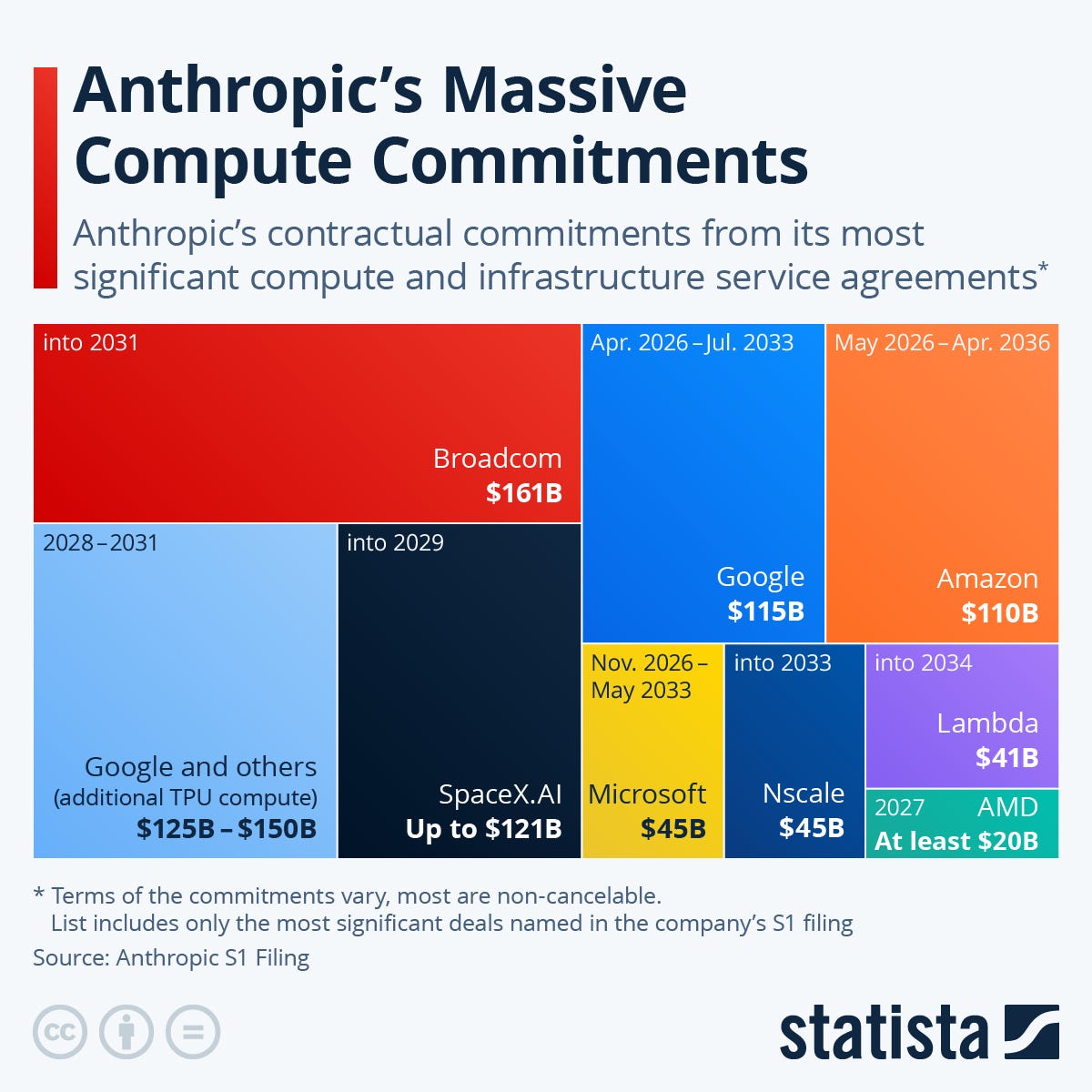
Most of these contracts land over the next few years, but it is the timing that makes them tricky. Anthropic books most of its compute 12-18 months before it arrives, so the cost is generally fixed in the near term. In early 2026, that worked in its favour as revenue more than doubled in each of the first two quarters, while a compute bill set a year earlier rose more slowly.
But now, the bigger contracts are starting to come due. Between May-October 2026, Anthropic signed deals worth up to $120.5 billion with SpaceX’s AI arm. Once fully delivered, which Anthropic expects by December, that deal alone will cost $3 billion a month, or over $9 billion a quarter, against $5.6 billion for its entire compute bill in April–June.
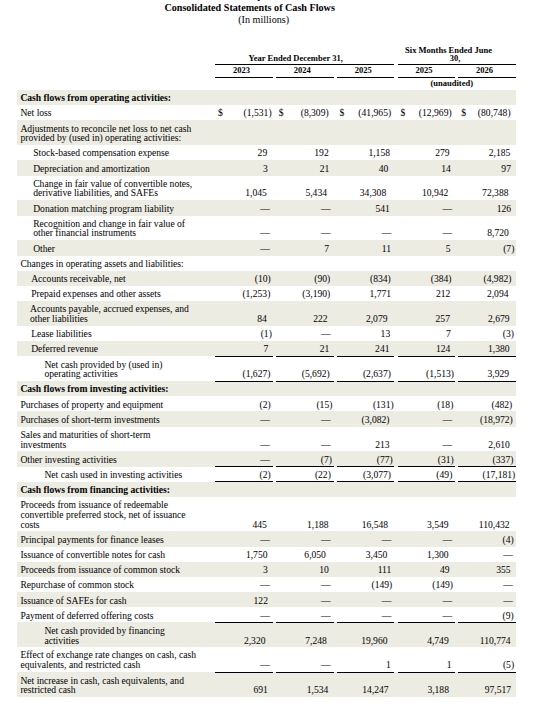
So how is Anthropic paying for all this? After three years of cash burn, its operations finally brought in $3.9 billion worth of cash in the first half of 2026, though the S-1 says that was partly down to the timing of payments. Most of that cash came from investors. Capital spending was just $482 million. Interest on its cash pile brought in $1.11 billion, more than its entire operating loss.

Some of that money comes from the very companies Anthropic pays. For instance, beyond the convertible notes, Amazon put $5 billion into Anthropic’s latest funding round and will provide up to $15 billion more, to be released in chunks depending on Anthropic hitting certain compute milestones on Amazon’s cloud. Anthropic, in turn, has promised to spend at least $110 billion on that same cloud. Amazon also sells Claude through its cloud store, buys Claude itself, and builds rival AI models.
In other words, Amazon is Anthropic’s lender, investor, landlord, shopkeeper, customer and rival, all at once.
Anthropic is also starting to lease chips itself and host them in dedicated data centres, which it hopes will “change the cash flow profile” of the business.
Existential threat
Finally, we come down to the risks, which the S-1 spends more pages on than on the business itself.
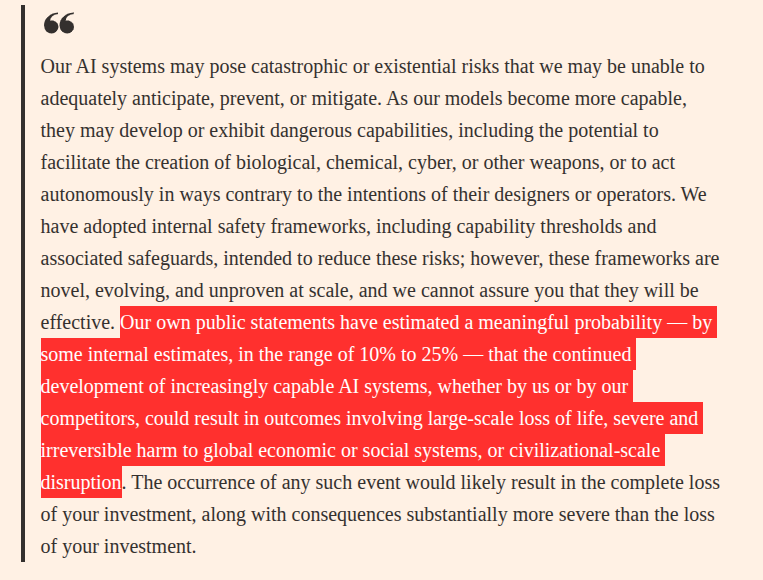
For long, Anthropic has been beating the drum on the existential risks that advanced AI could pose to humanity. Which is why it also takes care to tell us that even the entire might of the American insurance industry may not be able to cover a catastrophic incident.
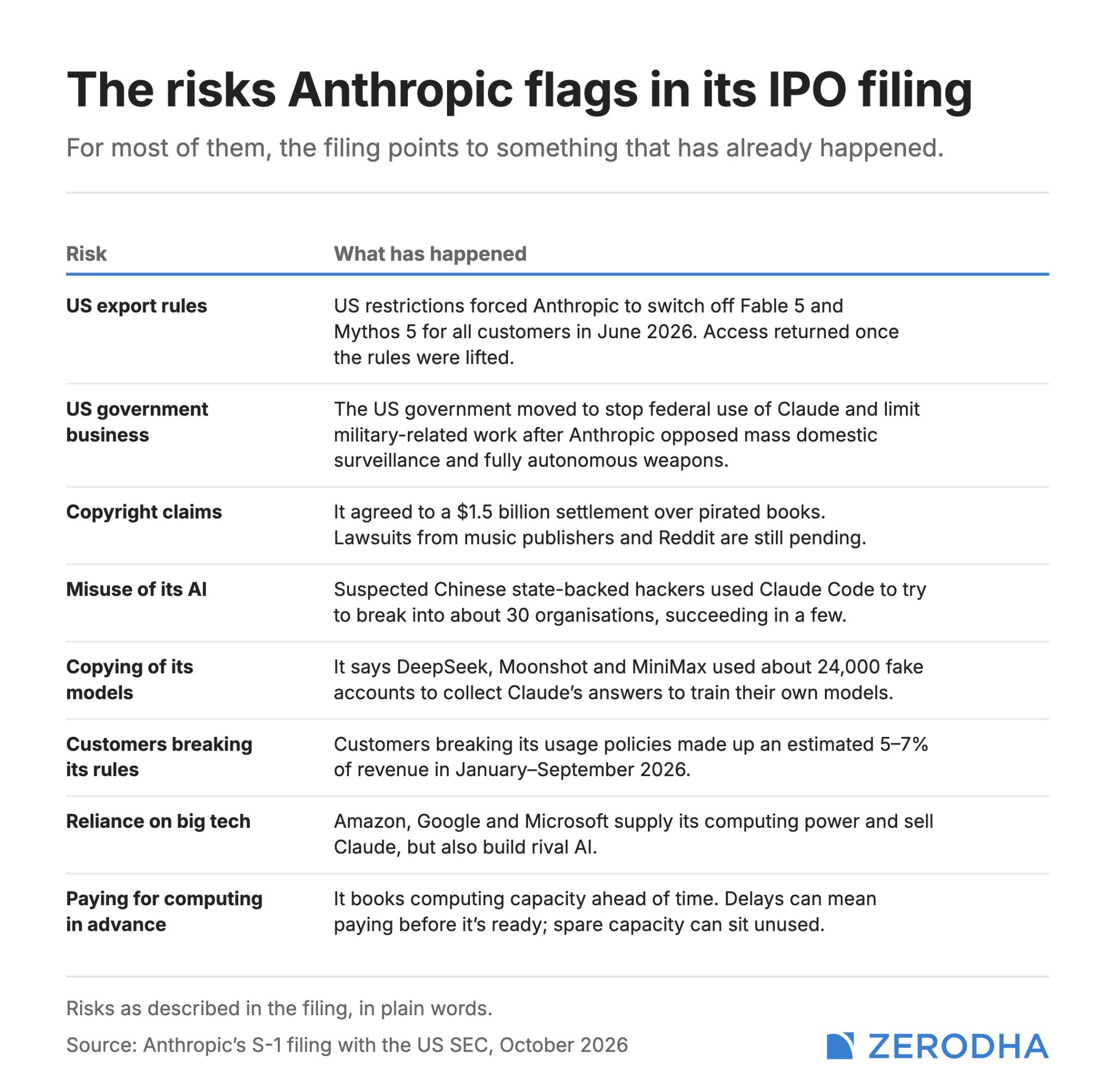
Other risks are more down to earth, and several have already played out — like, for instance, the US putting export controls on Fable 5 and Mythos 5.
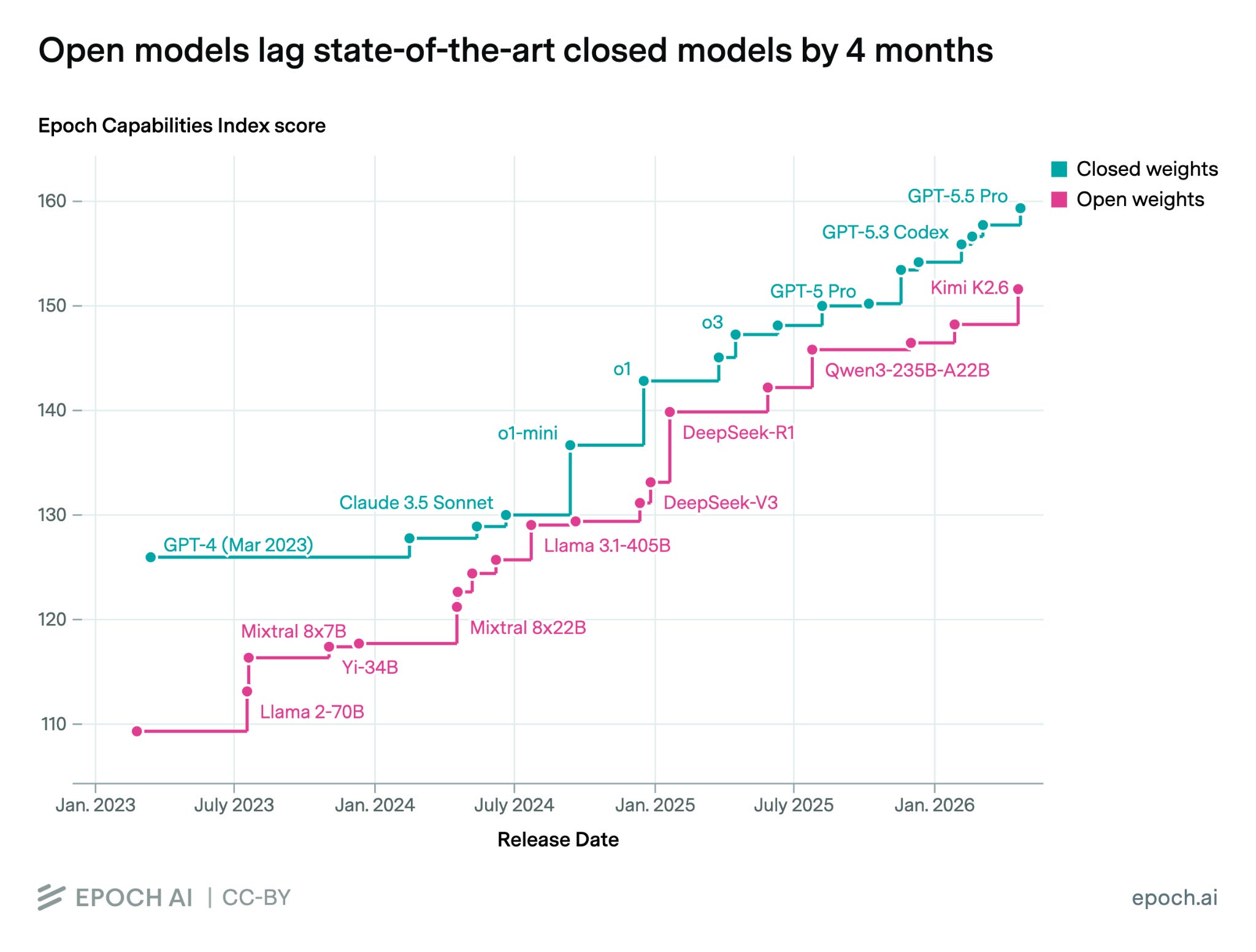
Anthropic’s revenue comes mostly from models less than six months old. Meanwhile, the best open-weight models, which anyone can freely download, have trailed the best closed models by only about four months since January 2026. And they might only get closer.
Conclusion
Despite its cash flow and operating losses (which are already narrowing), Anthropic doesn’t really face a capital constraint in a meaningful sense. Institutions and hyperscalers seem more than happy to lend to it in what they perceive to be an opportunity like no other.
But there is a growth question that surrounds it.
Intelligence has been increasingly commoditised because of both Anthropic’s American and Chinese competitors. Anthropic signed up for hundreds of billions of dollars in compute, most of it payable whether or not anyone uses Claude. Most of its revenue, though, comes from pay-as-you-go customers who can cut back anytime.
Where does new growth, then, come from?
First, it could achieve growth by winning more customers who already buy subscriptions. But that means competing on price and constantly benchmarking who’s the best LLM. And this happened in June, when OpenAI was considering a cut to token prices. Besides, open-weight models like DeepSeek are dirt-cheap.
Secondly, Anthropic could build new AI use cases in different industries. For instance, in biotech, Anthropic acquired Coefficient Bio, and built its own molecular biology lab. It has also launched versions of Claude for life sciences, healthcare, finance and law. For OpenAI, other use cases look to change form factors altogether, even providing a replacement to a smartphone.
This is an IPO like no other, from its governance structure right down its finances. In fact, legendary finance expert Aswath Damodaran criticises Anthropic for the same, pointing out that public investors supply capital while control is concentrated between the founders and the benefit trust, while retail investors can’t even expect dividends.
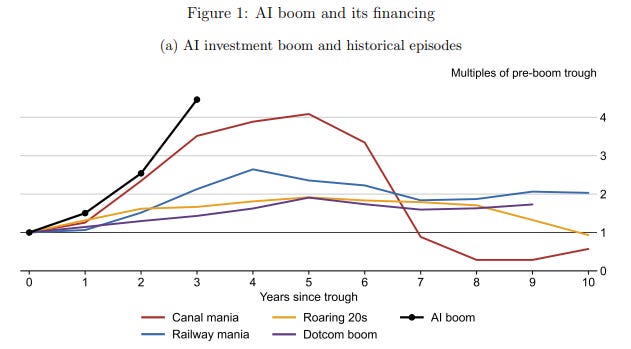
But for better or worse, this is a steamroll that won’t end anytime soon.
There is a line from the hit movie Slumdog Millionaire, where one of the characters says that he’s “at the center of the center.” AI is projected to be the largest wave of capex for any technology in human history. And this quote does a succinct job of laying down Anthropic’s position in the wave.

How state politics drove liquor sales this quarter?
We went through the September-quarter results of India’s big listed liquor makers, United Spirits, United Breweries, Radico Khaitan, Allied Blenders and Tilaknagar Industries, looking for what was interesting. On the surface, it was a quarter of mixed fortunes.
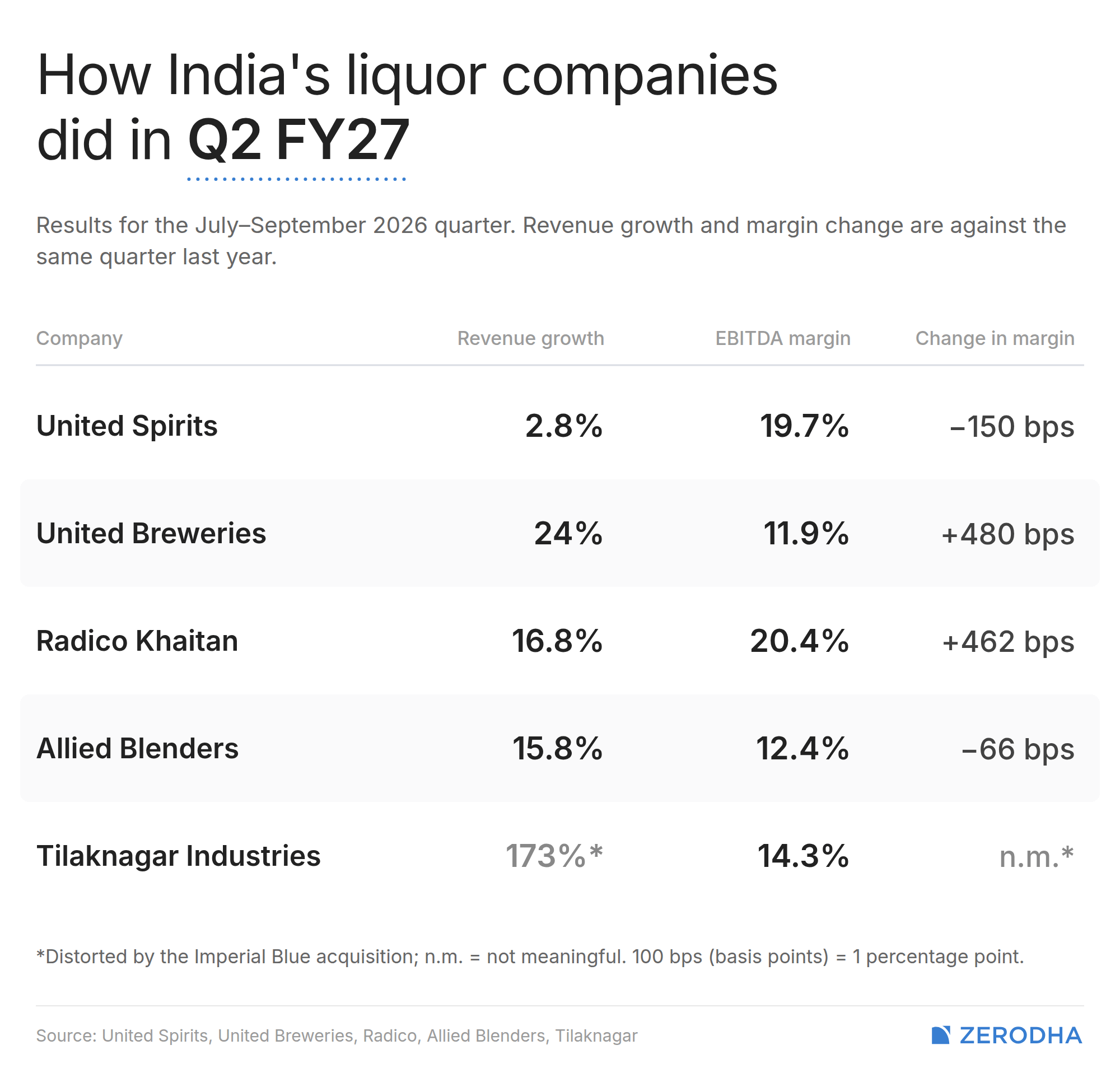
But listen to their earnings calls, and a pattern emerges. The biggest swings had little to do with what people wanted to drink, and almost everything to do with what governments decided.
That isn’t new. Because alcohol sits outside GST, every state taxes it, prices it and decides who gets to sell it. Which is why, as we’ve written before, a national liquor company is really running 28 different businesses.
That reaches into the most ordinary decisions. When packaging costs jumped this year, a soap company could simply have raised prices. A liquor company can’t. As Allied Blenders’ management put it, the industry “does not allow you to change prices whenever you want”.
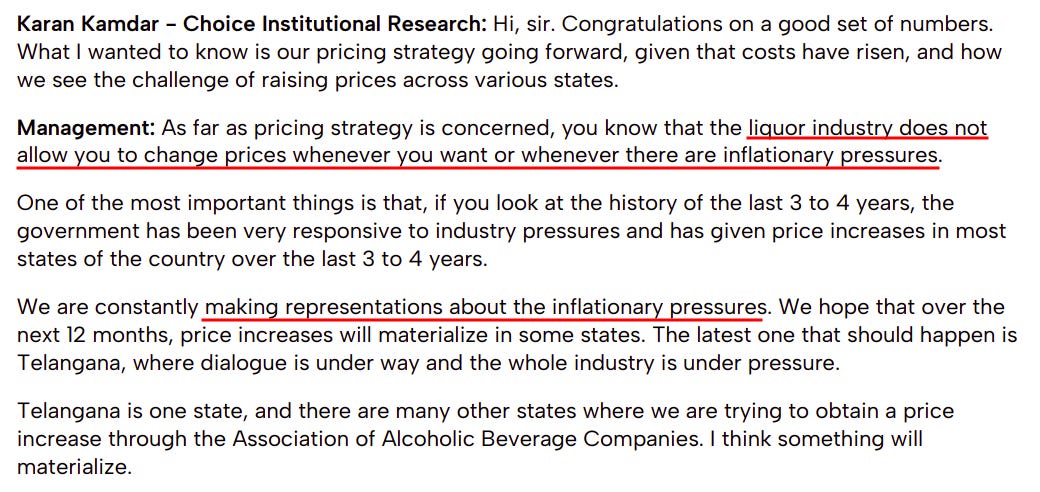
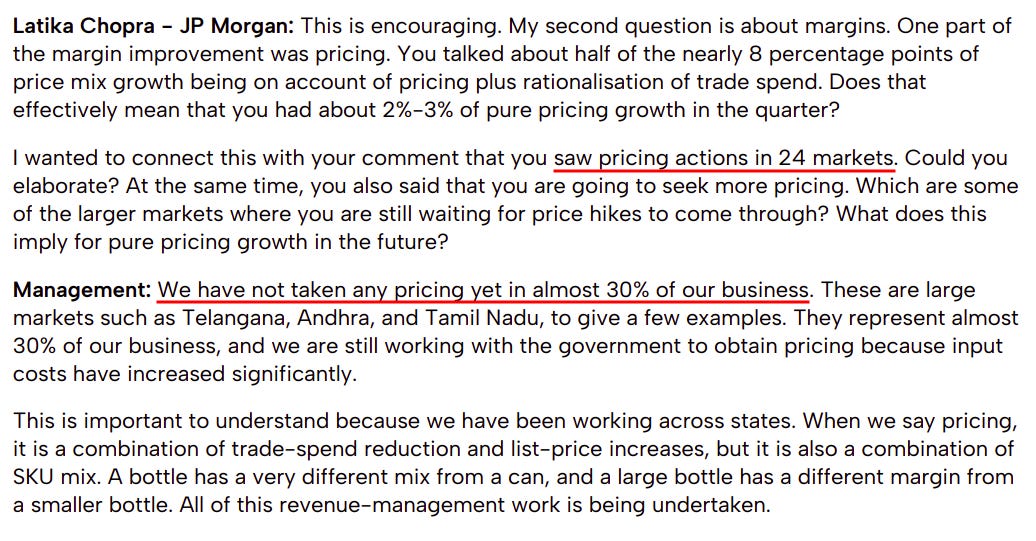
It files its costs with each state and waits. For example, United Breweries has won price hikes in 24 markets this year, but none in states making up nearly 30% of its business.
This quarter, though, two states mattered more than the rest.
Karnataka taxes the alcohol, not the bottle
Last quarter, we wrote about Karnataka cutting its tax slabs. But the bigger change, which took effect on May 11, was that it became the first Indian state to tax a drink by how much alcohol is actually in it.
Until then, a litre of lager and a litre of whisky were both taxed as a litre of liquid. Now, the tax follows the alcohol. A litre of 5% beer holds about 50 ml of pure alcohol, while a litre of standard Indian whisky holds more than eight times as much, so beer suddenly became far cheaper relative to spirits.
At the same time, the state reworked its price slabs, the bands that decide how much extra duty a bottle pays based on its price. It cut them from 16 to 8, raising duty on the cheapest bands by 20–30% and cutting it on premium ones by 10–15%. In one stroke, Karnataka made beer and premium spirits cheaper, and the cheapest spirits costlier.
Companies adjusted quickly. United Breweries cut the price of Kingfisher Ultra in the state, a move its management said was only possible because of the tax change. At the cheap end of spirits, brands found a cleverer workaround: they reduced the alcoholic strength of their products. If the tax follows the alcohol, the simplest way to cut the price is to put less of it in the bottle.
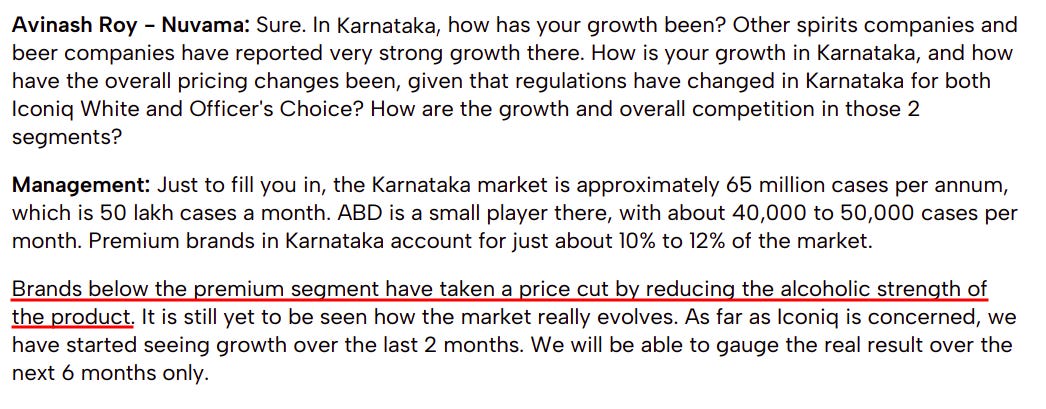
The results came within a single quarter. UBL’s volumes in Karnataka grew over 60%. United Spirits’ premium brands in the state grew 27–28%, even as its cheapest whiskies took a hit, and Radico’s premium volumes there more than doubled. Still, last year’s base was weak, and UBL’s management cautioned against reading too much into it.
Interestingly, the state still came out ahead, with its excise revenue going up. But as beer got cheaper, beer drinkers paid less tax, and the tab was picked up by spirits drinkers, mostly at the cheap end. Spirits supplied 82% of the extra revenue, despite barely selling more.
Tamil Nadu fixes the shop before opening the door
If Karnataka shows what a policy change can do, Tamil Nadu shows why the industry is so excited about the next one. Allied Blenders’ management called it “the biggest phenomenon that is likely to affect the liquor industry”. The state sells over 5 million cases a month and is India’s largest brandy market, yet national brands barely figure in it.
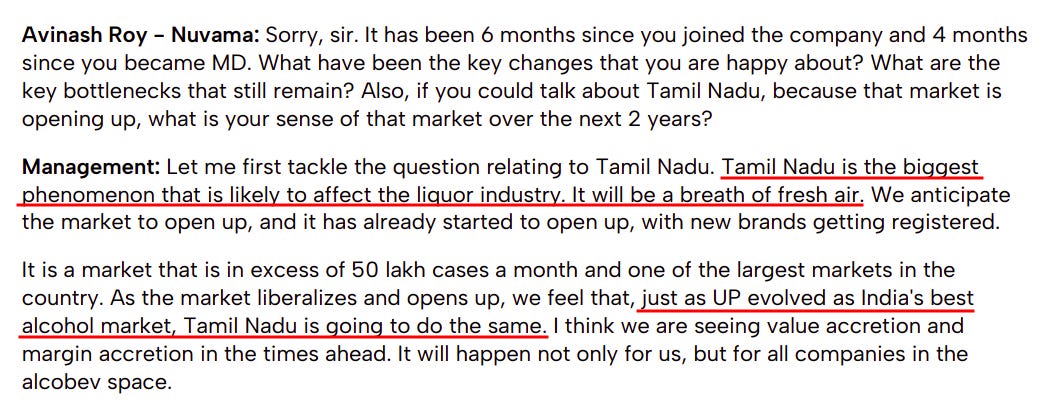
That’s by design. Since 2003, the state-owned TASMAC has run every liquor shop in Tamil Nadu, and it’s the only wholesaler too. According to HDFC Securities, most cheaper national brands can only be sold if they’re made locally, by a handful of state distilleries, under franchise deals. Even then, what reached the shelves was decided by a manual allocation system that favoured local distilleries.
The government elected this year has started with the shops. Alongside a pay hike and a digital-payment rule meant to curb overcharging, it changed how stock is ordered. Since late September, each shop gets what it actually sells. That sounds administrative, but it matters for national brands. Their problem in Tamil Nadu was often not whether people wanted their bottles, but whether those bottles ever reached the shop.
The early signs are good. September was Tilaknagar’s best month ever for Mansion House Reserve brandy in the state, and Radico’s volumes there rose about 20%. But Tilaknagar’s management also made clear how much ground there is to recover. At their peak in Tamil Nadu, they sold around 3 million cases of prestige and above brandy. Currently, they sell less than half a million.
Getting back there will take more than better shops, because the bigger question is untouched: who is allowed to make and sell liquor in the state. On November 2, the excise minister said the government is examining whether to privatise liquor sales, but cautioned that it “cannot be considered a solution to all problems”.
For now, Tamil Nadu has made its shops more honest. It hasn’t opened its doors yet.
Cheaper Scotch, but which Scotch?
The quarter’s other big rule question came from Delhi, over a tailwind the industry thought was settled. On July 15, the India–UK trade deal halved India’s import duty on Scotch from 150% to 75%. Three months in, it has become the deal’s first real dispute, though the government hasn’t commented on record.
To see why, consider the three ways Scotch enters India.
Some arrive bottled in Scotland, like Johnnie Walker. Some arrive in bulk and is bottled here as Scotch, like Black Dog. And a lot arrives in bulk to be blended, as an ingredient, into Indian whiskies like Royal Stag and McDowell’s. This is what the industry calls Indian made foreign liquor.
Around 80% of it comes in bulk, and that’s where the trouble lies. A tariff cut applies on Scotch-specific codes, but most bulk Scotch travels to India under “others” code that wasn’t cut as deeply. The Scotch Whisky Association had flagged this to British MPs.
In October, customs investigators visited Pernod Ricard and searched United Spirits’ premises. They have since told companies that bulk Scotch doesn’t qualify for the lower rate, even though companies say they’ve declared these imports the same way for years. United Spirits has the most at stake: it has been clearing consignments at the lower rate since July, and concedes an adverse ruling would hit it materially.
Our read is that the deal was always going to be smaller than its headline. For drinkers, bottled Scotch gets only 8–10% cheaper, since state taxes make up much of the shelf price. Even that cut needs each state’s sign-off, which some have yet to give. For companies, the gain is a modest bump in margins. But if bulk is ruled out the deal makes the foreign bottle cheaper while keeping the key ingredient of Indian whisky expensive. That’s the reverse of what India usually wants from a trade deal.
Premiumisation remains the industry’s long game. In the short run, though, what matters most is how quickly a company can move when the rules do. United Spirits was selling in Andhra Pradesh within 45 days of that state’s policy change. If Tamil Nadu truly opens, we’ll find out who else can.
- This edition of the newsletter was written by Zarieus & Kashish.
Cash & Copium
Are credit cards a financial free lunch or an aggressive lending machine? In our latest episode of Cash & Copium, Pranay Kapoor unpacks the industry’s “reverse Robin Hood” model, hidden forex markups, and how minimum due traps trigger backdated interest. We also compare chargebacks to UPI and share how to build your CIBIL score safely.
Watch the full episode here.
Tidbits:
1. Vizhinjam International Seaport handles its first import container
Vizhinjam International Seaport received its first import container on October 31, shipped from Ningbo, China. The development expands the port beyond transhipment, allowing overseas cargo to be cleared directly into Kerala.
Source: Economic Times
2. Government raises windfall tax on diesel and aviation turbine fuel
The central government has increased the special additional excise duty on diesel exports from ₹8.5 to ₹11.5 per litre and on aviation turbine fuel from ₹10.5 to ₹11 per litre. The revised rates took effect on October 31, while the ₹2.5 per litre levy on petrol exports was removed.
Source: Business Standard
3. Centre releases extra ₹1.09 lakh crore tax devolution tranche to states
The Union government has released an additional tax devolution instalment of ₹1,09,019 crore to states in October, over and above the regular monthly transfer. The extra funds are intended to help states accelerate capital expenditure and finance development and welfare spending ahead of the festive season.
Source: Business Standard
4. Net GST collection climbs 25.6% year-on-year in October
India’s net GST revenue rose 25.6% year-on-year to ₹2.03 lakh crore in October, while gross collections increased 22.9% to ₹2.31 lakh crore. The surge was driven partly by a 42.2% jump in import-linked revenues, while refunds rose more modestly.
Source: Reuters
5. UPI average daily transaction value crosses ₹1 lakh crore in October
The average daily value of transactions on UPI crossed ₹1 lakh crore for the first time in October, reaching ₹1,01,707 crore. Total monthly transaction value hit a record ₹31.53 lakh crore across 25.47 billion transactions.
Source: Business Standard
Want more tidbits? Catch up on last week’s recap!

Beyond Today’s Brief
There’s always more happening at Markets by Zerodha.
The Chatter: What is SEBI focusing on in its latest regulatory moves? How is Asian Paints navigating competitive pressures and shifting market demand? And what are the key takeaways from Motilal Oswal and Gulf Oil’s latest business updates?
Aftermarket Report: How did Reliance Industries’ record quarterly earnings and an 11.6% stock surge propel Nifty past 23,400 to close at 23,441 as cooling oil prices lifted market sentiment? And what do 11 gaining sectors led by Oil & Gas, broad market breadth favouring advancers 2.6 to 1, and the Fear & Greed Index advancing to 32 signal as markets head into the November 3 expiry?
Join us on WhatsApp, where we share interesting soundbites from concalls, articles, and everything else we come across throughout the day. You’ll also get notified the moment a new video or article drops so that you can read or watch it right away.
Thank you for reading. Do share this with your friends and make them as smart as you are 😉