


Our goal with The Daily Brief is to simplify the biggest stories in the Indian markets and help you understand what they mean. We won’t just tell you what happened; we’ll tell you why and how too. We do this show in both formats: video and audio. This piece curates the stories that we talk about.
You can listen to the podcast on Spotify, Apple Podcasts, or wherever you get your podcasts and watch the videos on YouTube. You can also watch The Daily Brief in Hindi.
In today’s edition of The Daily Brief:
1. India’s food inflation story gets worrisome
India's official retail inflation looks safe at 5.5%, but September's 7.7% spike in food inflation reveals a synchronized price surge across staples like pulses, cooking oil, and sugar. This grocery shock was temporarily masked by a high base effect last year, but compounding systemic pressures are now exposing the true cost of the shortfall. Between a lopsided monsoon depleting reservoirs, a strong El Niño driving up global agricultural prices, and West Asian tensions inflating fertilizer costs, these supply-side shocks leave the central bank with little room to cut interest rates until everyday grocery bills settle.
2. Healthy sales but ailing profits for pharma companies
India’s pharma market just saw its best stretch in six quarters, with sales jumping 12%. But for giants like Sun Pharma, Zydus, and Torrent, surging revenues aren’t boosting profits. Instead, these drugmakers are taking massive margin hits to fund their next phase of growth. Torrent is absorbing heavy interest from its JB Pharma buyout, Zydus is spending millions on an upcoming US drug launch, and Sun is bankrolling an $11.75B Organon acquisition. Toss in brutal generic price wars and tightening government margin caps, and it’s clear: Indian pharma is paying a steep upfront price today to secure tomorrow’s pipeline.
India’s food inflation story gets worrisome
In September 2026, India’s retail food inflation jumped to 7.7%, up from 6.0% in August. In rural India, overall inflation crossed 6% for the first time this fiscal year.
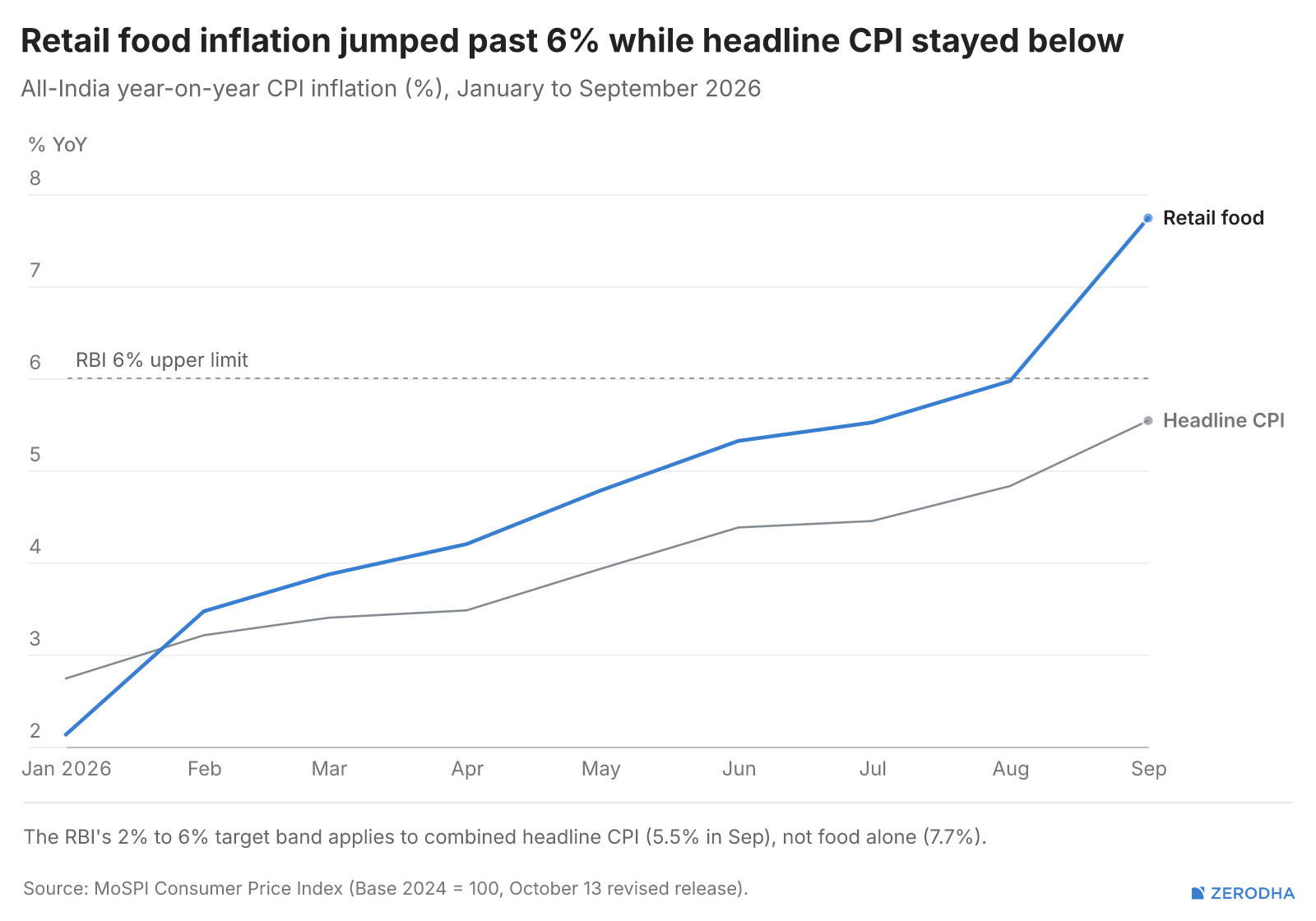
However, India has not yet breached its official inflation band of 2-6%, which is set by the RBI. That band applies to national combined inflation, which stands at 5.5% in September.
Even so, there is sustained pressure on food prices that goes beyond merely just onions or tomatoes alone going rogue as they do every once in a while — although, onions did lead the charge this time as well. There are more systemic problems affecting all food, and they all move too slowly and unpredictably for us to have an immediate solution for. And we’ll get to what they are eventually.
However, if you looked at just the headline inflation number in August, you would probably feel a mismatch between how little it moved and how much more you seemed to be paying for groceries.
That’s because of how it’s calculated, and that’s what we’ll start with.
Calm before the storm
See, the headline inflation figure compares prices this month with the same month a year ago. This helps wash out normal seasonal swings. However, that also means it can’t capture abnormal swings. Then, if last year’s base is at an unusual peak or trough, the annual rate calculation can mislead you.
Imagine that your electricity bill climbs all summer this year, and August of last year was unusually high because three ACs ran day and night. If you compare this August with the last, your bill would look flat on paper even though your pockets took more of a hit each passing month.
That is what happened to MoSPI’s retail index for vegetables, tubers, and pulses. From April to August 2026, retail prices in this group rose every single month, climbing 19% over four months. Households felt that pinch, yet August’s annual inflation rate was at 1.6% simply because prices in August 2025 were also abnormally high.
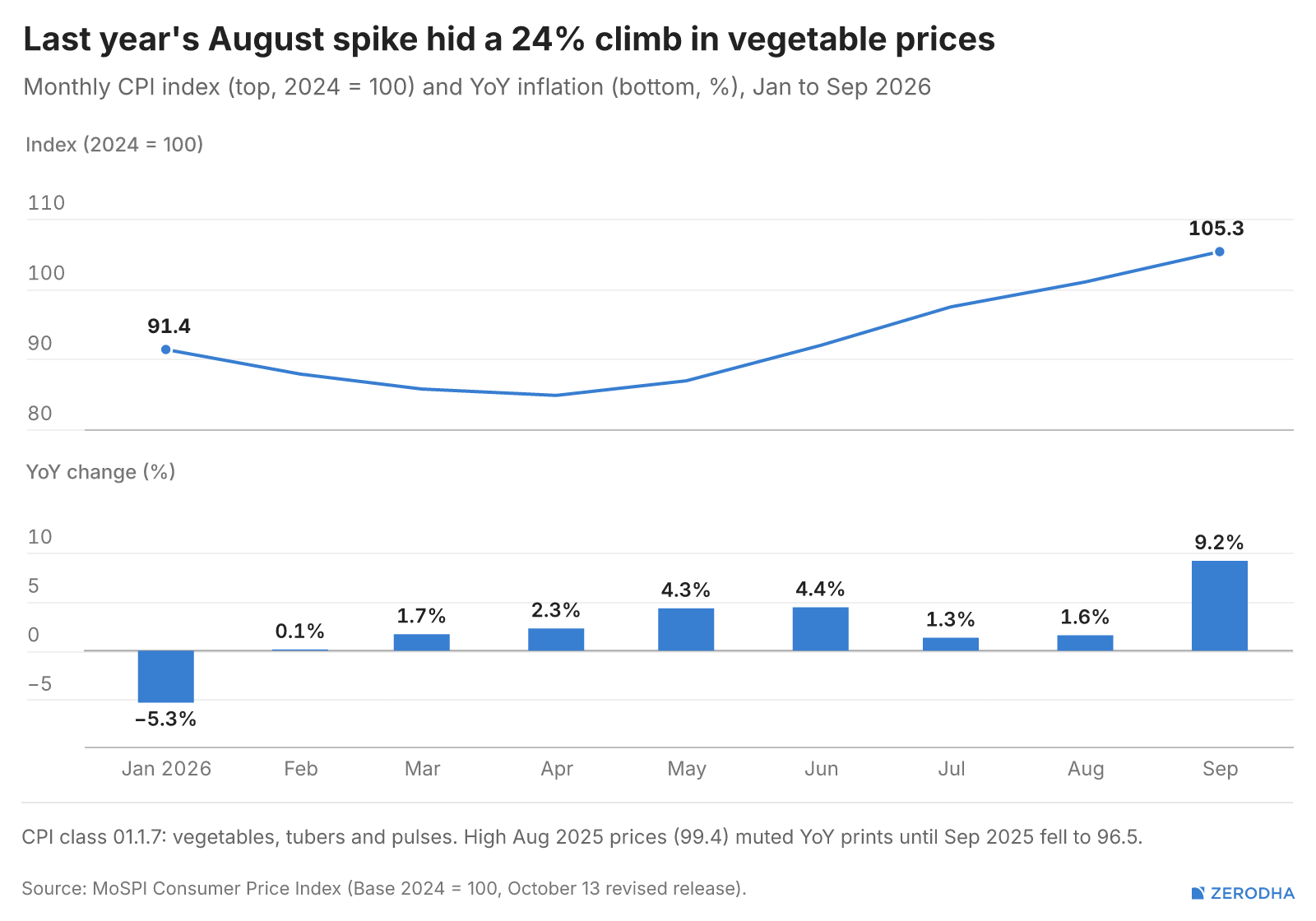
In September, though, that cushion vanished. Retail prices in the group rose another 4.3% over August, taking the climb since April to 24%. Last year’s September base was also lower than the index in August 2025. Those two effects combined to spike annual inflation in the group from 1.6% to 9.2%.
Onions have been the primary culprit in the inflation surge. Retail onion prices jumped nearly 36% in September alone, while wholesale onion prices have nearly tripled. Tomatoes, while still 8.6% cheaper on an annual basis, actually rose by 42% between April and September. Price indices alone cannot tell us each vegetable’s exact share of the jump, yet they clearly indicate that since spring, prices have mostly been going one way: up.
A crooked basket
But this is not just an onion or tomato story, either. Prices are rising across several everyday staples at once.
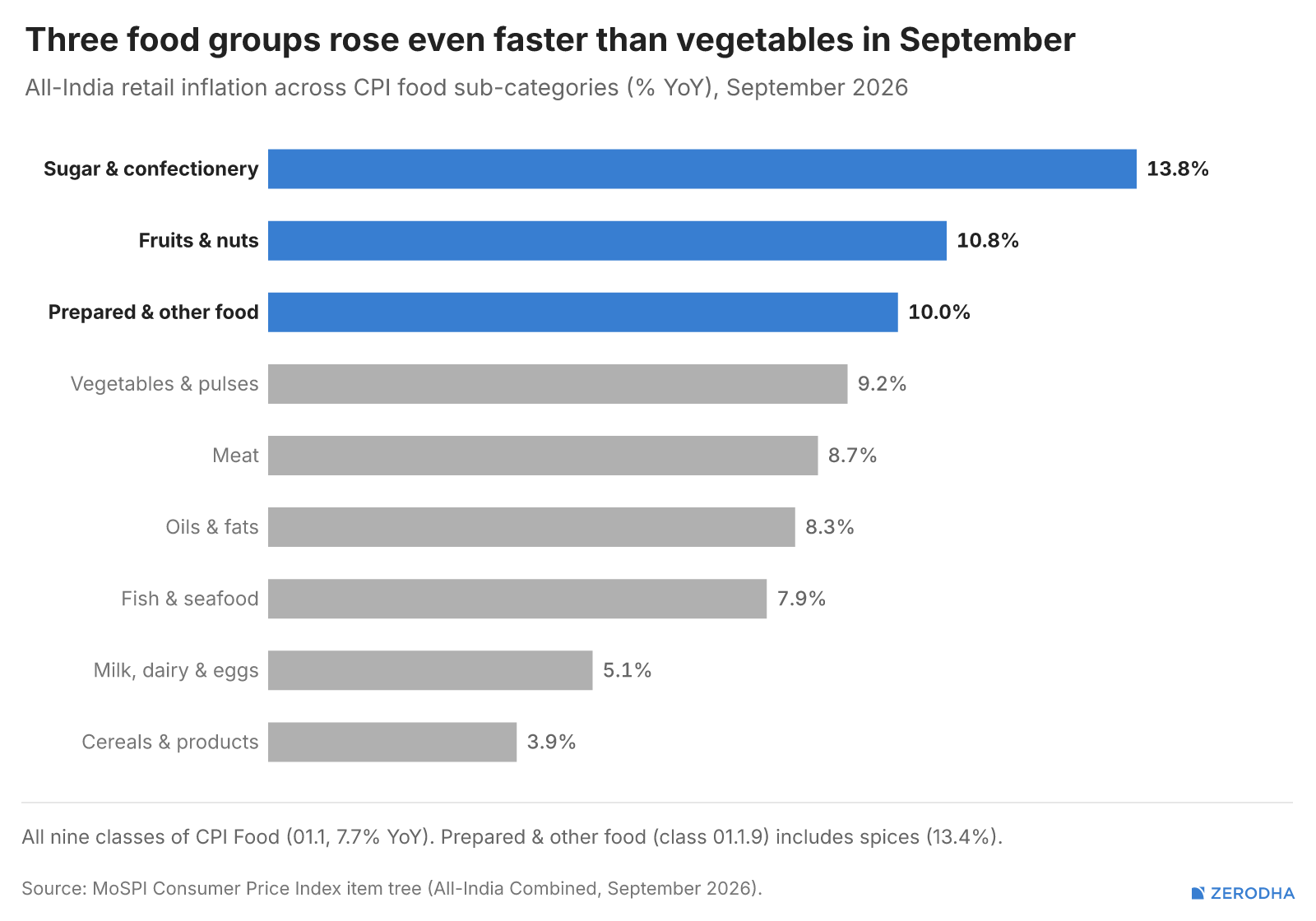
In the case of grains, overall inflation was a mild 3.9% in September. Yet, open-market rice was up more than 8% from a year earlier, and rural jowar and small millets rose much faster.
The headline average stayed low because of two reasons. One, wheat rose less than 2%. Secondly, under MoSPI’s revised CPI rules, free welfare grain is excluded from the index while paid ration-shop grain, which is tracked separately, barely moved.
The broad average masked sharp jumps in pulses, cooking oils, and sugar too. Urad and tur dal rose more than 8%, refined cooking oil climbed 15%, and retail sugar jumped nearly 30%.
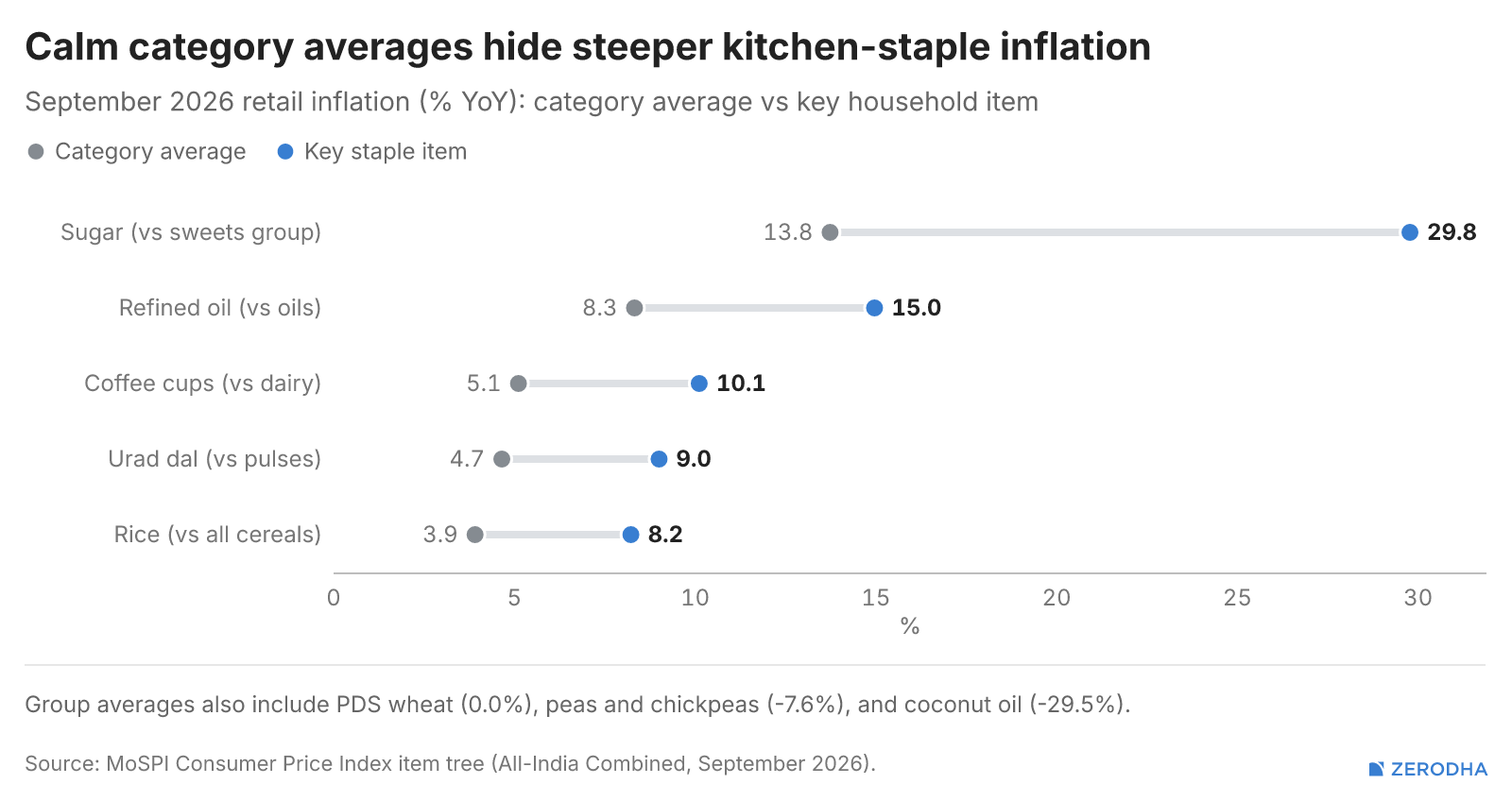
Milk, sugar, cooking oil, and commercial fuel are the daily inputs for every tea stall and canteen. When all four rise together, vendors get squeezed and raise menu prices. By September, a cup of prepared tea or coffee cost about 10% more than a year earlier, and served food in cities was up 8.7%.
Eating out has also become a larger part of an Indian family’s food bill compared to before. Urban households now spend 11.1% of their entire budget on beverages, snacks, and cooked meals, almost three times what they spend directly on grain.
And households are much less optimistic about their situation. In the RBI’s September urban survey, nearly 85% of households expected food prices to rise over the next three months, and more than three in five expected food inflation to pick up pace.
What did a lopsided monsoon do to winter water?
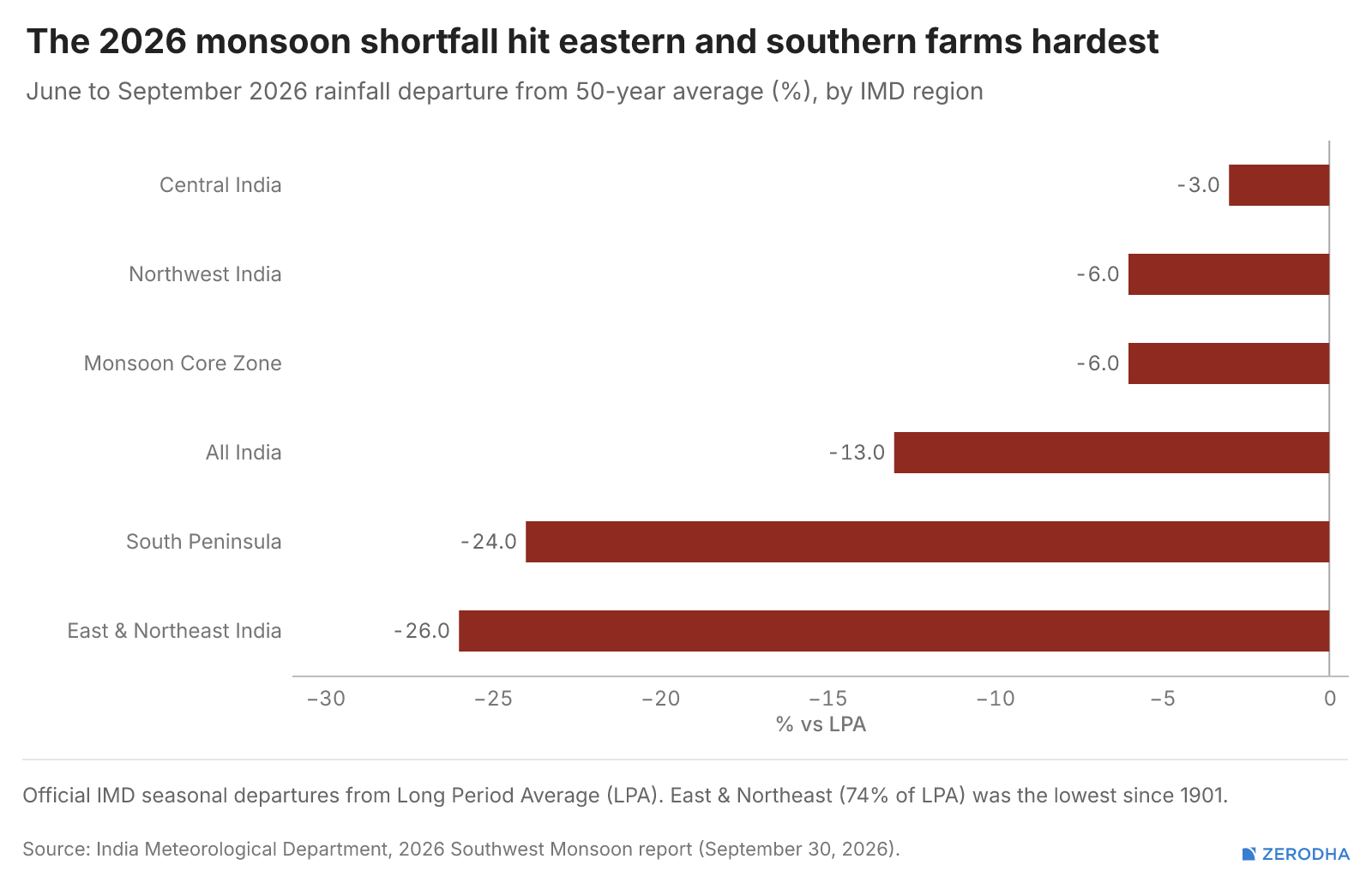
Why are grain, pulses, oilseeds, and sugar, all tightening at the same time? The answer lies in the summer monsoon. According to the Met Department, India ended the June-to-September season 13% below its 50-year average rainfall, leaving more than two-fifths of the country short of rain.
Even that national shortfall hides how certain regions had it much worse than others. While central and northwest India finished close to normal, East and Northeast India received 74% of normal rain, its lowest monsoon total since 1901, and the South Peninsula received just 76%.
As a result, farmers planted less summer rice. As of September, the sown kharif paddy area stood at 42.2 million hectares, down from 43.8 million a year earlier. In the same month, retail food inflation had already topped 10% in Tamil Nadu and Andhra Pradesh.
States have also begun invoking formal drought rules of late. Maharashtra, for instance, declared initial Kharif drought across 265 talukas (which are divisions smaller than districts). Meanwhile, Andhra Pradesh declared drought across 388 mandals after losing over half its rain in the June-to-August period.
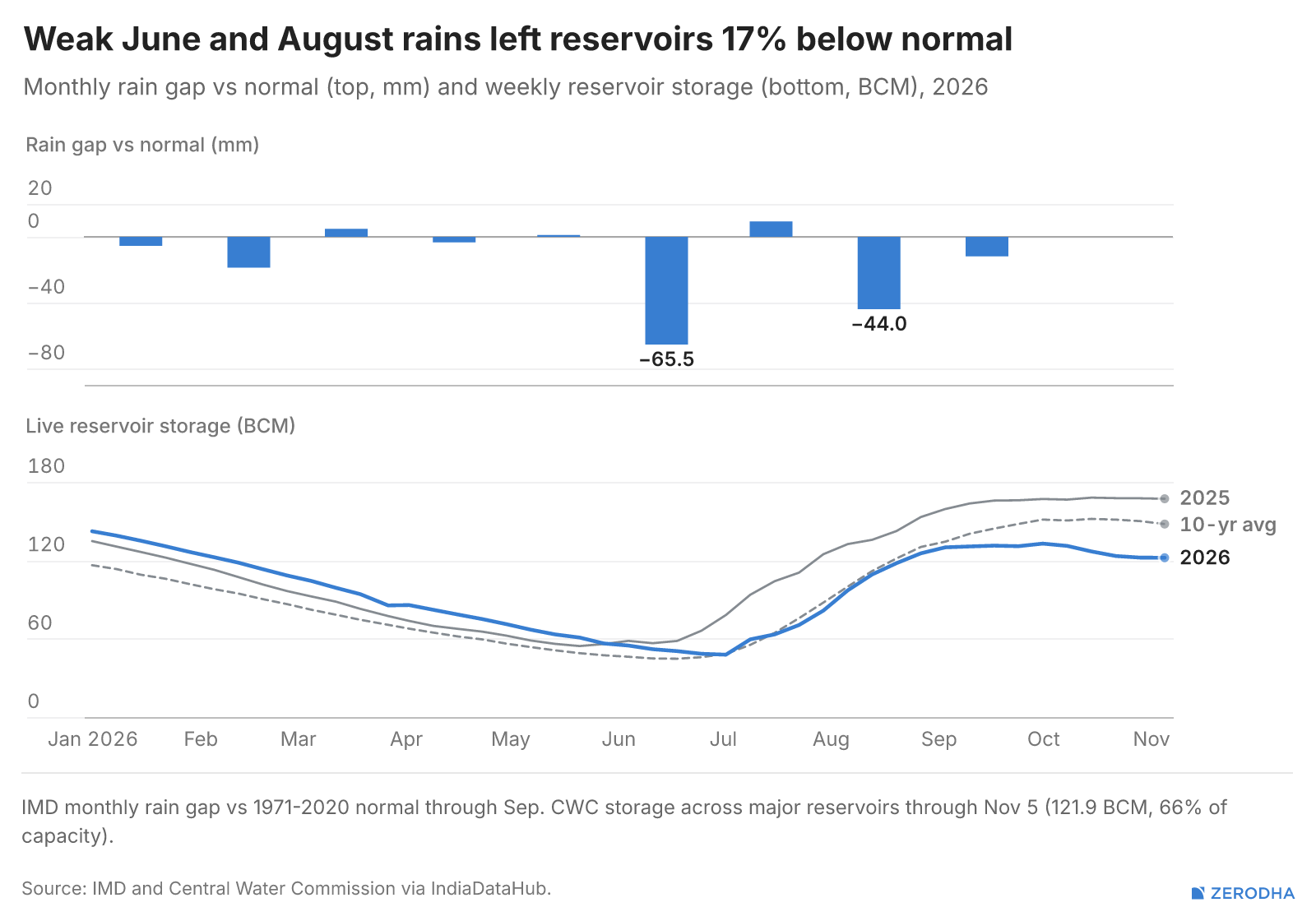
Poor summer rain also hurts the winter Rabi crop. You see, dry summer weather leaves less water in the reservoirs that irrigate winter wheat, gram, and mustard. By November 5, Central Water Commission data showed major reservoirs holding 121.9 billion cubic metres of water, or 66% of capacity. Storage fell for five straight weeks after the 1st of October, leaving water levels 27% lower than a year ago.
Little boy, lots of pain
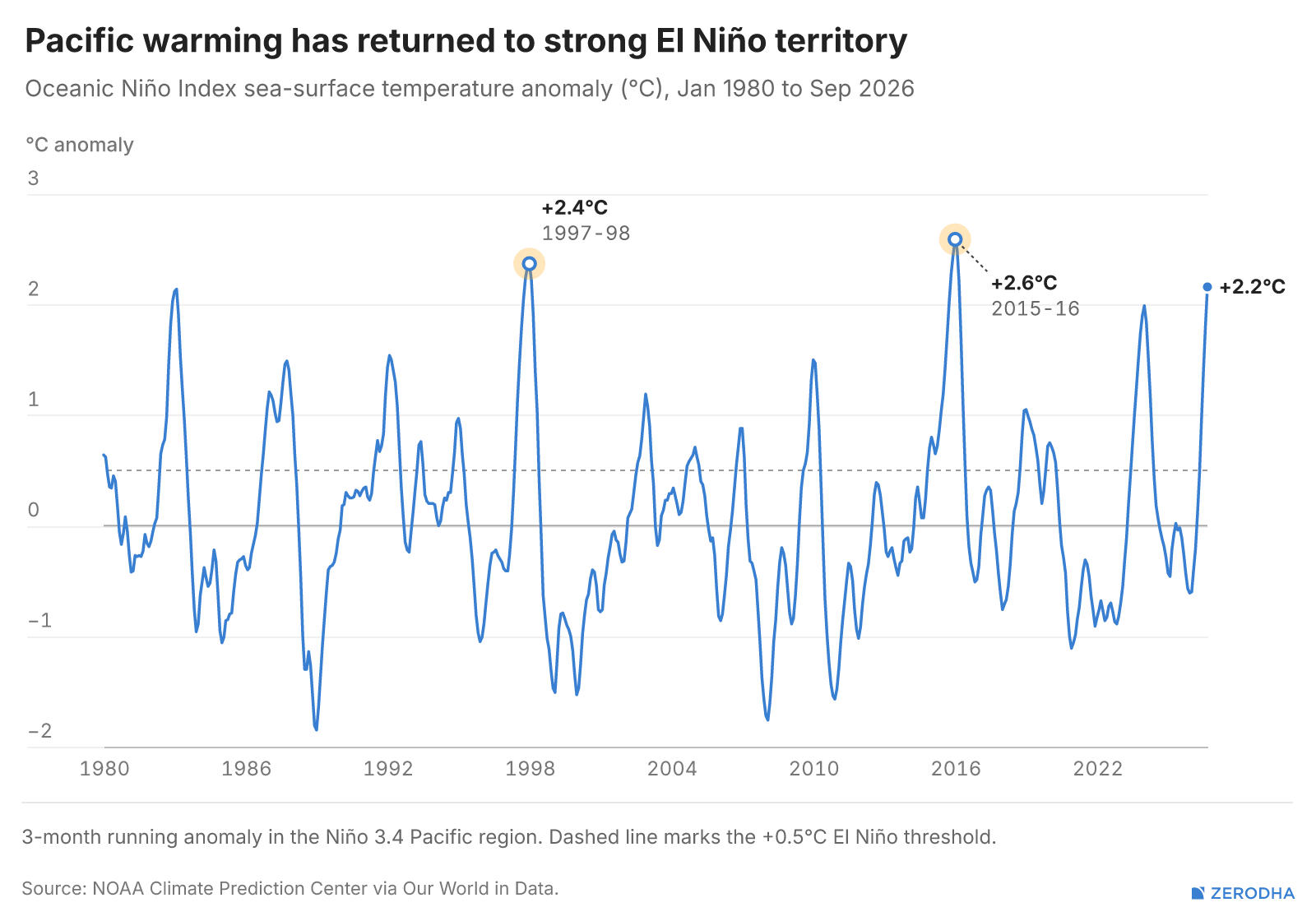
Normally, when Indian harvests fall short, India cuts import duties on cooking oil or pulses to improve access to necessities. However, imports might not bail us out this time, because a strong El Niño is pushing up the prices of what our suppliers grow as well.
As per official data from India and the US, 7 of India’s 10 deficient summer monsoons between 1965 and 2025 happened during an El Niño year. And as we’ve covered before, it is already making its presence felt this year, even if it isn’t the only cause behind the shortfall.
However, this El Niño (and its effects) might be set to last through winter. In early October, official estimates from the US put the chance of a “strong or very strong” El Niño continuing from January through March 2027 above 83%. There are signs that the coming winter might also be hotter; in September this year itself, India was 0.6°C warmer than its 1991-to-2020 average.
A strong El Niño can hit several tropical farm belts at once, tightening supply in the very countries importers rely on. In World Bank monthly data for October, Malaysian palm oil cost $1,120 a tonne, up 14.3% from $980 in December 2025, and Thai broken rice reached $489 a tonne, up more than 28% since March.
However, not every such price rise in India comes from abroad. Take coffee; global Arabica and Robusta coffee beans were cheaper in October than in January. World bean prices do not explain why a coffee cup in India is more expensive now. Where India relies heavily on imports, especially cooking oil, overseas supplies are already expensive.
The fertilizer shock
The El Niño is hardly the only external crisis out of our control. There is a looming war in West Asia which has pushed up energy prices. Between December 2025 and October 2026, Brent crude nearly doubled in World Bank data to $125 a barrel, while European natural gas prices tripled.
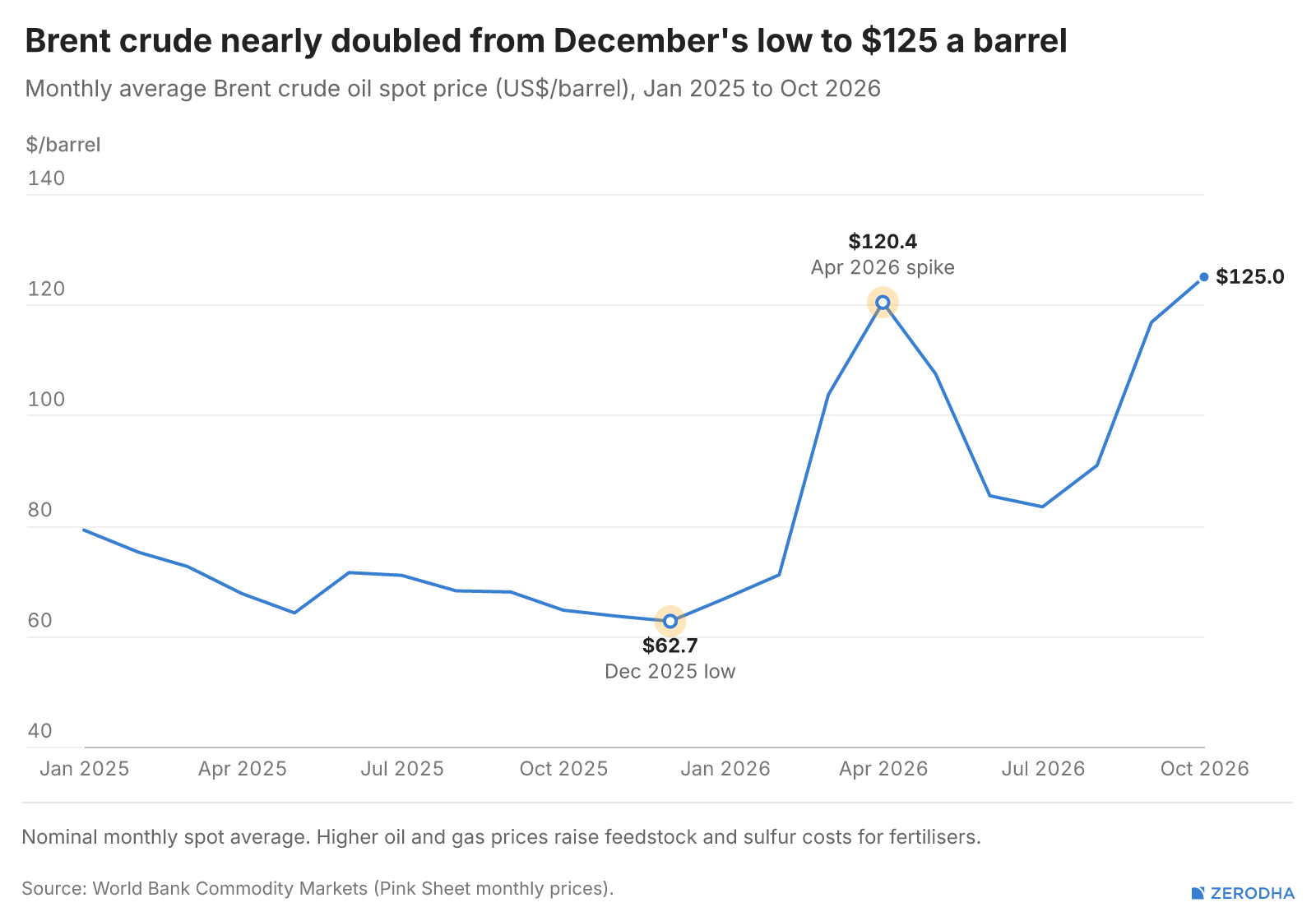
Oil and gas go directly into modern fertilisers used in farms. Natural gas is the main raw material for ammonia, which is the key component of the fertilizer urea. Meanwhile, sulphur, which is an input into a fertilizer called DAP, is extracted by oil refineries and gas plants, and nearly half of the world’s traded sulfur normally ships through the Strait of Hormuz.
In 2026, world prices for those two fertilisers moved in opposite directions. Global urea surged to nearly $857 a tonne in April before falling back to $420 by October, while global DAP climbed nearly 30% between January and October to reach $803 a tonne.
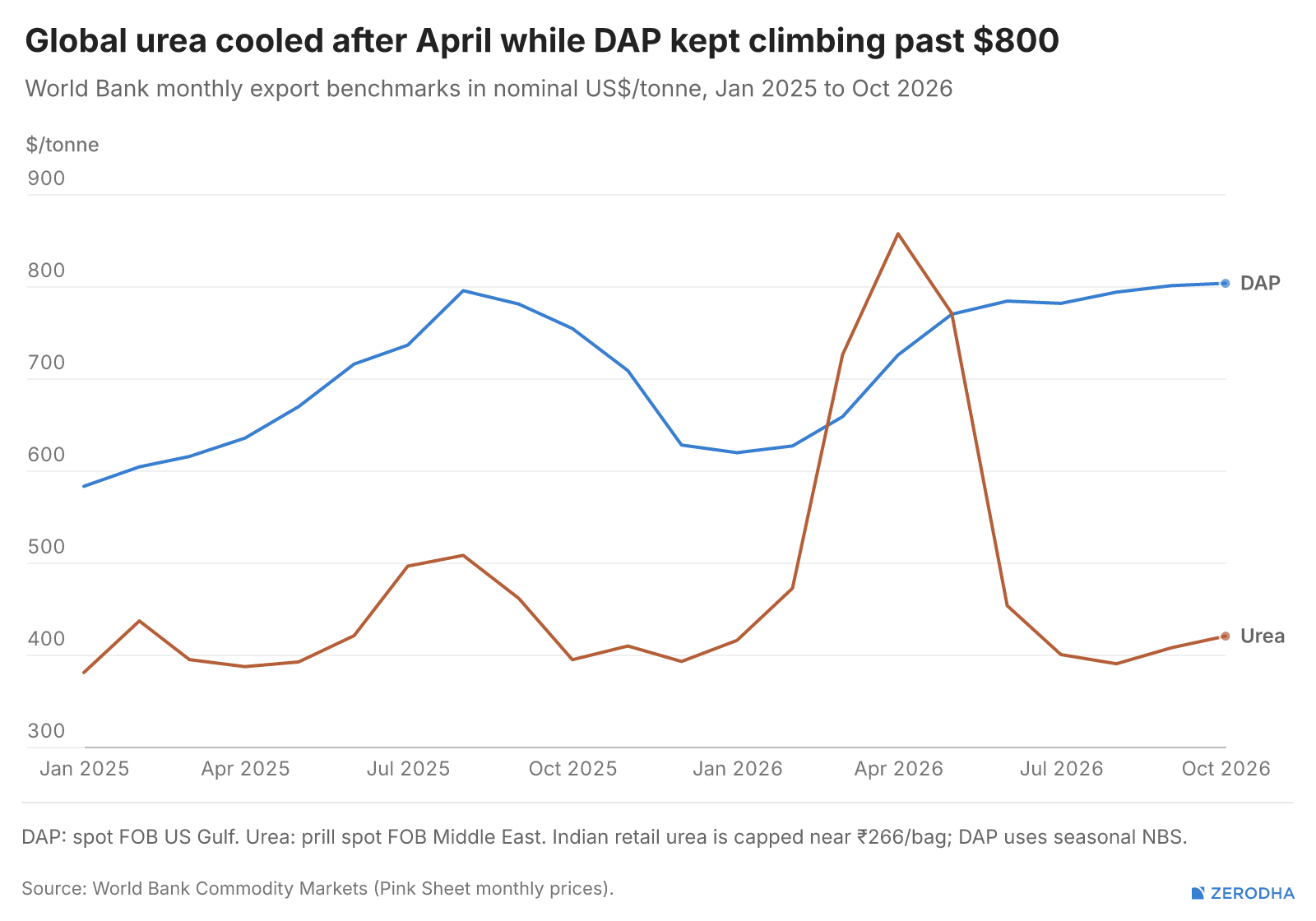
Indian farmers feel the shocks of those two world prices very differently because the Centre subsidises urea and DAP under separate frameworks. For urea, a statutory retail base price keeps a standard bag near ₹266, and the central budget absorbs global price swings. That kept India’s wholesale urea prices relatively at bay recently.
DAP, meanwhile, does not have a fixed retail cap. Under the Nutrient Based Subsidy scheme, India sets per-kilo nutrient subsidies each season to keep DAP near ₹1,350 a bag. Plus, on November 11 the Cabinet approved ₹62,370 crore in winter subsidies, up 64% from last winter. On top of that, shipments of DAP are already slowing. Between April-July 2026, India imported ~18% less compared to the same period in 2025.
What should we watch from here?
Will India’s food inflation situation remain persistent? Not all hope is lost there. A fresh winter vegetable crop usually cools perishable prices by December, but, as we’ve just seen, that does depend on a successful rabi crop in a situation more fragile than before. Additionally, the Cabinet has also raised winter fertiliser subsidies, and if push comes to shove, the Centre can release its foodstocks.
Even so, this episode is too serious to be considered a mere on-off driven by a crop or two. Over the next three months, there are three signals worth observing to tell us how structurally difficult it’ll be to dislodge this food inflation.
First, we should watch rabi crop sowing. IMD’s post-monsoon outlook forecasts below-normal rain nationwide in October, alongside normal October-to-December Northeast Monsoon rain across southern India. Weekly reservoir reports and November sowing of wheat, gram, and mustard will show whether farmers have enough water and DAP to make up for a weak summer harvest.
The second signal would be to watch whether high wholesale prices pass through to neighbourhood shops. Wholesale inflation for food grains, pulses, and cooking oils ran ahead of retail inflation in September. Because wholesale and retail indices track different baskets and weights, it would be worthwhile to check them alongside the government’s daily retail price tracker.
Lastly, we should watch whether dearer food pushes up rural wages and broader inflation outside food and fuel, which the RBI expects to average 4.4% this fiscal year. With the repo rate now at 5.5%, the central bank will have little room to cut interest rates until reservoirs recover and everyday grocery bills settle down.

Healthy sales but ailing profits for pharma companies
India’s pharma market just had its best stretch in six quarters. According to Pharmarack, sales rose 12% between July and September. Higher prices drove much of that growth, but more medicines were being sold too.
The country’s biggest drugmakers did even better at home. Sun Pharma‘s India business grew 17%, Zydus Lifesciences’ grew 19%, and Torrent Pharma’s existing Indian business grew 20%.
Their overall results, though, tell three different stories. Sun’s operating profit grew, but one-time charges pulled its net profit down. Torrent’s operating profit jumped 54%, yet the costs of buying JB Pharma left its net profit 10% lower. Zydus’s overall revenue grew 29%, but even its operating profit fell.
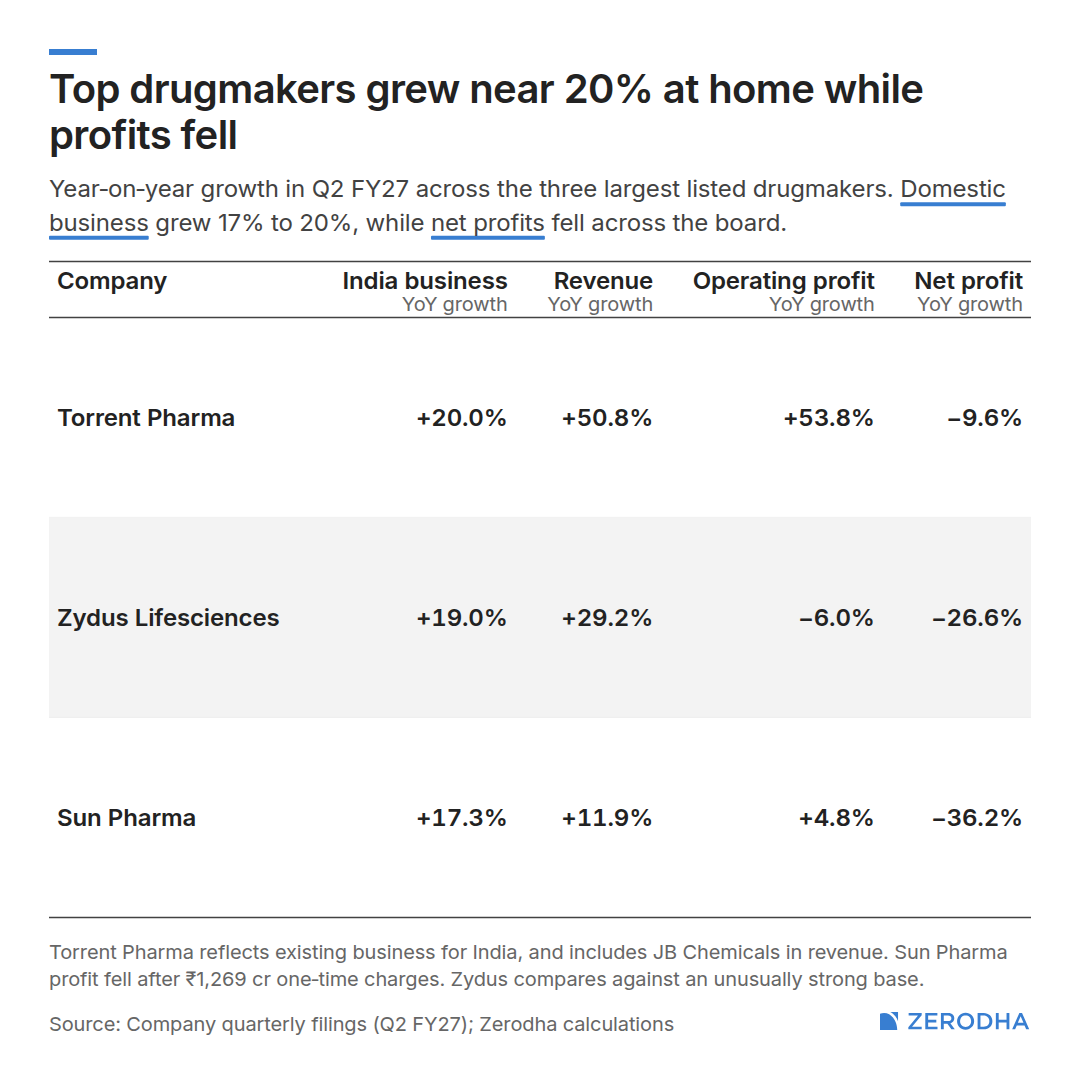
That’s the puzzle. These companies are selling more medicines, but keeping very different amounts of money. And since India is only about a third of Sun’s sales and a quarter of Zydus’s, the answer lies mostly outside India.
Abroad, the bills arrived before the payoff
Each company is paying for its next phase of growth, but each is paying a different bill. Torrent is paying for a company it has already bought. Zydus is paying for a drug it hasn’t launched yet. And Sun is paying for a deal that hasn’t even closed.
Torrent’s bill is for JB Pharma. The purchase explains much of its 51% revenue growth, though Torrent’s own business grew a healthy 18% too. JB itself stalled this quarter, with growth slowing to almost nothing, as Torrent folded JB’s brands into its own sales teams and reorganised operations. Overseas deliveries were hit hardest. The upside of that disruption is savings: Torrent now expects to reach ₹450 crore a year within two years instead of three.
The real cost shows up below operating profit. Torrent borrowed heavily for the deal, so its quarterly interest bill jumped from ₹48 crore to ₹300 crore. It also now has to write down the value of the JB brands it bought, every quarter. That is how a 54% rise in operating profit became a 10% fall in net profit.
Zydus’s bill is for a drug it hasn’t launched yet. It is preparing to sell saroglitazar, its treatment for a rare liver disease, in the US, pending approval. That preparation alone cost about 1.5 percentage points of margin this quarter. And it’s only the start: Zydus expects to spend around $100 million (about ₹940 crore) a year selling the drug, with meaningful revenue unlikely before FY29 or even FY30.

But the launch explains only a small part of why Zydus’s operating margin fell from about 33% to 24%. The bigger part is old profits fading. Some US medicines that were unusually profitable last year now face competition, and its fast-growing consumer-wellness business earns thinner margins than prescription drugs. That’s despite North American sales growing 21%, helped by Rolvedon, a drug that protects cancer patients from infections, which came with its acquisition of Assertio.
Sun’s bill is for a deal that hasn’t closed, and it has the most riding on it. Sun needs new growth more than the others. Its US sales have shrunk for two straight quarters, mostly because of one fading blockbuster we’ll come to. Even its own patented medicines, the specialty push we’ve written about, slowed, as psoriasis treatment Ilumya stumbled in the US. Sun’s US head blamed the market in part, and, unusually candidly, the company’s own sales execution.

So Sun is buying Organon for $11.75 billion including debt, and expects the combined business to earn nearly twice Sun’s current EBITDA. But the deal closes only early next year, so for now it’s all cost. Deal expenses and an unrelated US legal settlement cut Sun’s reported profit to around ₹1,990 crore, against around ₹3,160 crore on an underlying basis, and the CFO warned of more such charges before closing. And once the deal closes, Sun, which today has more cash than debt, expects to become a net borrower.
Semaglutide won’t be another lenalidomide
A drug’s profits depend less on how many people buy it than on how few companies are allowed to sell it. Lenalidomide and semaglutide show both sides of that rule.
Lenalidomide, a blood-cancer drug, is the fading blockbuster behind Sun’s US slide, and it shows what scarcity is worth. Under settlements with the original drugmaker, companies could sell only limited amounts of generic lenalidomide in America from 2022 until January 2026. With few copies around, prices stayed unusually high. Once the limits ended, so did the extra profits. Sun’s CFO said that without them, its operating profit actually grew faster than its sales.

Semaglutide, the molecule behind Ozempic, shows the opposite. It looked like the next big earner, and Torrent called it the biggest launch it had ever seen. But as we’ve written, it came off patent in India in March with the door wide open. By the end of that month, 26 brands from 13 companies were on sale, and by September generics made up about three-quarters of its monthly volumes. Torrent expects the whole generic market to be worth only about ₹800 crore in its first year, split among all of them.
Even an early leader is finding it hard going. Torrent said in May that semaglutide earned much lower margins than its other medicines, because the main ingredient was expensive and the launch needed heavy marketing. It chose market share first, hoping profits would follow. Then a supplier problem kept some of its injections off shelves for nearly two months. Its share of generic semaglutide sales slipped from 36% in the June quarter to 32% and it dropped its ₹250 crore sales target for the year.

Sun and Zydus are trying other ways in. Sun overtook Torrent in pre-filled pens by July, helped partly by Torrent’s supply troubles. Zydus also makes semaglutide for rivals like Lupin and Torrent, so it earns even when patients pick a rival’s brand. Neither has said how much semaglutide earns them.
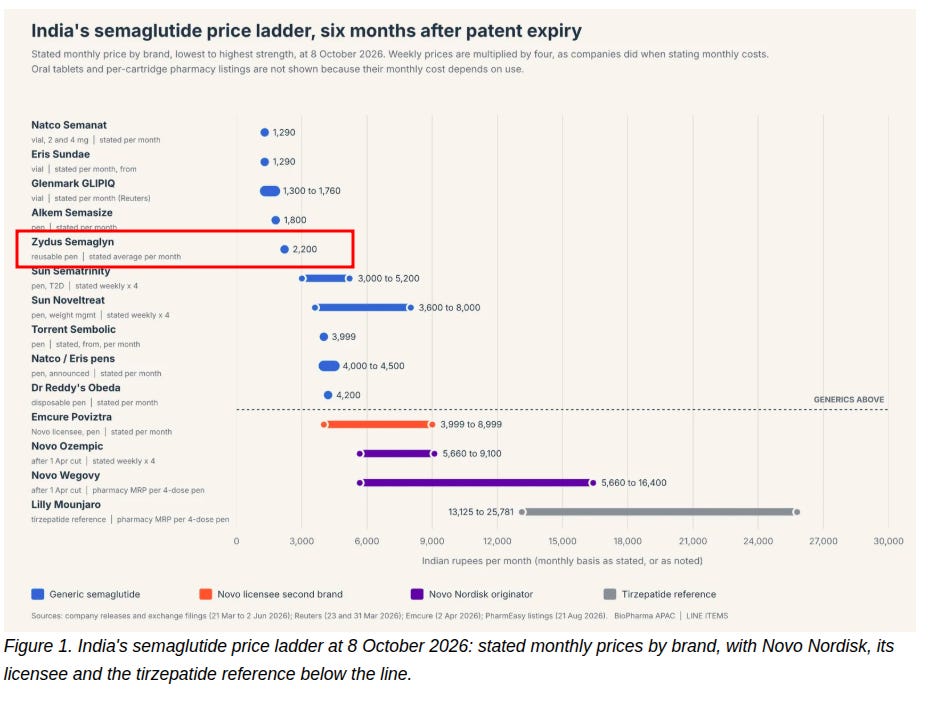
That’s the trouble with generics in general: once many companies can make a drug, it becomes a price war. As Torrent’s management noted, just three or four buyers control about 90% of the US market, so no seller’s advantage lasts. Even after a strong US quarter, Zydus expects only single-digit growth there this year, partly because last year’s sales were unusually high.
So drugmakers are trying to rebuild scarcity, by moving into medicines that are harder to copy. Only 10 to 12 of the roughly 30 products Zydus files for approval each year are now simple generics. It also holds the US and Canadian rights to a biosimilar version of the cancer drug Keytruda, now under FDA review, though its launch depends on the outcome of patent litigation.
But rivals aren’t the only ones deciding what a medicine can earn anymore.

Governments want a bigger say in the price
In October, India capped trade margins at 30% of the retail price on 137 cancer medicines. That’s the mark-up between what a drugmaker charges distributors and what a patient pays, an issue we covered earlier. On paper, the cuts are dramatic. Zydus’s Bryxta, a cancer biosimilar, fell from ₹25,995 a vial to ₹3,318.

For drugmakers, though, the cuts aren’t as damaging as they look. The new retail prices were worked out from what manufacturers charged distributors in March 2026. So much of the cut falls on distributors and hospitals, where a government committee had found mark-ups of 170% to 700%.
Hospitals have long had a reason to favour medicines that gave them a bigger cut. With those margins now capped, brands may have to compete more on price and doctors’ preference. That matters most for Zydus, which sells many cancer biosimilars, and Sun, which sells cancer generics. Torrent has less at stake, since much of its Indian business comes from heart and diabetes medicines.
The bigger worry is what comes next. Officials have said margin caps could eventually extend beyond cancer drugs, and the Supreme Court has asked why they shouldn’t. That would reach into the part of these companies that’s growing fastest.
America is taking a different route. Since September 29, it has imposed a 100% tariff on certain imported patented medicines. Generics are exempt, as are some Indian specialty medicines. The US has also proposed tariffs on imported generics from 2028. Those aren’t in force yet, but they could matter a lot to Zydus, which earns more than two-fifths of its revenue from North America.
Sun faces a different risk. A growing share of its US business comes from its own patented medicines, which fall under the current tariff rules. So, like around 25 other drugmakers, Sun struck a deal with Washington. It will offer state Medicaid programmes prices similar to those in other rich countries. In return, it gets more than two years of relief from tariffs on its patented medicines, and exemption from two proposed Medicare pricing rules that could have hit clinic-administered medicines like Ilumya.
The next few quarters will show how these bets play out. Torrent needs JB back at double-digit growth. Sun needs Ilumya to recover as it closes the Organon deal. And Zydus needs to launch saroglitazar without putting more pressure on its margins. Their Indian businesses are already growing well. The question is whether the money they’re spending elsewhere will pay off.
- This edition of the newsletter was written by Bhuvan & Mridula
Tidbits:
[1] Cabinet approves ₹62,370 crore fertiliser subsidy for Rabi 2026-27 season
The Union Cabinet has approved a budgetary requirement of ₹62,370 crore for Nutrient Based Subsidy rates on phosphatic and potassic fertilisers for the Rabi 2026-27 season. The allocation, which covers the six months through March 2027, is about ₹24,418 crore higher than the previous year’s budget and is intended to shield farmers from global price fluctuations.
Source: India Today
[2] RBI tightens domestic money transfer rules, retains ₹50,000 cash NEFT limit
The Reserve Bank of India has issued consolidated directions for domestic money transfers, maintaining the existing ₹50,000 limit for cash-based NEFT remittances by walk-in customers. The updated framework mandates stricter fraud-prevention safeguards, requiring banks and non-bank entities to implement transaction velocity checks, customer alerts for received credits, and distinct identifiers for cash-based transfers.
Source: The Economic Times
[3] Adani Group plans $1.45 billion equity infusion for Evos Terminals takeover
Adani Group is expected to inject up to $1.45 billion in equity to help finance its proposed $2.9 billion acquisition of European liquid-storage operator Evos Terminals. As part of the transaction’s funding structure, the conglomerate is also reportedly working with global lenders to refinance approximately €1.3 billion of Evos’s existing debt.
Source: Business Standard
[4] Bajaj Finance plans to raise up to ₹11,700 crore through QIP
Bajaj Finance is preparing to raise as much as ₹11,700 crore, or about $1.2 billion, from institutional investors through a qualified institutions placement. The company has completed investor roadshows and could launch the share sale soon, though the final size and timing may still change.
Source:Livemint
[5] Foreign airlines oppose proposed capacity cut at Mumbai airport
Foreign carriers are opposing Adani Airport’s plan to reduce capacity at Mumbai airport and shift some international flights to Navi Mumbai from summer 2027. The operator says the cut is needed during the redevelopment of Terminal 1, while airlines argue that removing long-held slots could disrupt their networks and passenger connections.
Source: Livemint
Want more tidbits? Catch up on last week’s recap!

Beyond Today’s Brief
There’s always more happening at Markets by Zerodha.
The Chatter: Why is SEBI mandating mutual fund direct plans as the digital default while the RBI flags shifting household savings preferences and deposit franchise risks? And how are Bharti Airtel, Tata Steel, Hindalco, LG Electronics, and ONGC driving massive structural bets—from 1 GW data centre expansions and European steel margin turnarounds to ₹5,000 crore appliance manufacturing hubs and direct crude offtake rights in Venezuela?
Aftermarket Report: How did markets navigate a narrow, range-bound session as Nifty closed near the 25,300 mark? And how do options strategies like selling a naked straddle or an iron condor after earnings results perform in current conditions?
Join us on WhatsApp, where we share interesting soundbites from concalls, articles, and everything else we come across throughout the day. You’ll also get notified the moment a new video or article drops so that you can read or watch it right away.
Thank you for reading. Do share this with your friends and make them as smart as you are 😉