


Our goal with The Daily Brief is to simplify the biggest stories in the Indian markets and help you understand what they mean. We won’t just tell you what happened; we’ll tell you why and how too. We do this show in both formats: video and audio. This piece curates the stories that we talk about.
You can listen to the podcast on Spotify, Apple Podcasts, or wherever you get your podcasts and watch the videos on YouTube. You can also watch The Daily Brief in Hindi.
In today’s edition of The Daily Brief:
1. Does Indian steel really need so much protection?
Despite being the world’s second-largest steel producer, India’s steel sector relies heavily on domestic policy architecture—including 30% export duties on iron ore that keep local raw material costs artificially low, alongside elevated import tariffs and 169 Quality Control Orders. Recent CSEP studies show that while these protections generate above-average margins for domestic steelmakers, domestic prices remain 15%–30% above Chinese levels, inflating input costs across downstream manufacturing like auto and machinery.
2. How CAFE 3 ended India’s small-car fight
India has finalised its CAFE 3 fuel-efficiency norms starting April 2027, resolving a dispute over proposed small-car concessions. While the government dropped the specific 3 g CO2/km emission discount for small petrol cars, it revised the core weight-based formula to give lighter vehicle fleets higher permitted emission limits while raising compliance targets for heavier SUV fleets. The framework also introduces super-credit multipliers for EVs and hybrids, along with a compliance credit-trading system to drive fleet decarbonization.
Does Indian steel really need so much protection?
In The Daily Brief, we’ve covered the immense protections enjoyed by India’s steel industry, like the safeguard duties and QCOs that shield domestic producers from imports, and the broader pattern of quality control orders functioning as non-tariff barriers across Indian manufacturing.
While learning about this, we couldn’t help but ask ourselves this: does the world’s second-largest steel producer, which has grown fivefold to 152 million tonnes over two decades, actually need to be so highly protected?
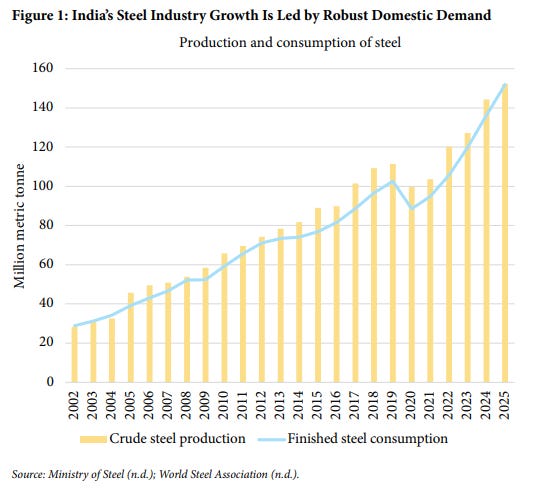
A pair of recent working papers from the Centre for Social and Economic Progress (CSEP), whose papers we’ve covered before, steps back and tries to answer this question with some new analysis.
Across both papers, the conclusion is the same. Indian steel’s profits may be a product of increasing technological efficiency, but they owe quite a lot to policy architecture too. Keeping that architecture in place is not just costing many other parts of the economy, but is also making Indian steel itself less attractive to global buyers compared to China or Japan.
Profitable, efficient, still uncompetitive?
Let’s start with the good news. Indian steel is genuinely cheaper to produce than steel in most developed countries.
CSEP makes a direct comparison of the major cost heads between who they call Japan’s largest steel producer and India’s most profitable steel firm in FY25 — both were unnamed, but they’re most likely Nippon Steel and Tata Steel respectively. The per-tonne cost for the Indian firm was found to be lower by ~20-40%. This is largely because Indian labour costs are a fraction of Japanese ones, but additionally, the costs of logistics and coking coal have also narrowed over time with Japan.
This isn’t a recent development, either. India’s steel sector has made real productivity gains since liberalisation in the 1990s. When tariffs on steel were slashed after 1991, the prevailing wisdom was that cheaper foreign steel would overwhelm domestic producers. However, firms like Tata Steel responded with cost-cutting and modernisation measures. By 2001, Tata Steel was ranked the world’s number one steel company by World Steel Dynamics.
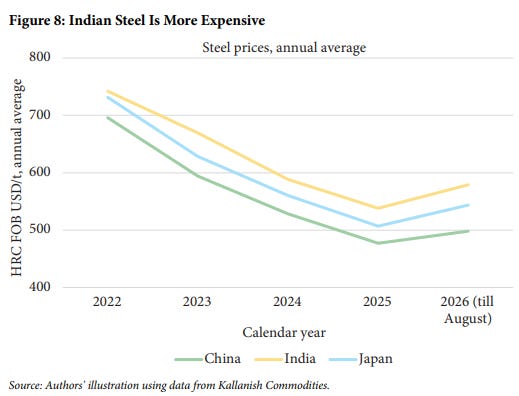
The steel industry’s average EBITDA margin has always been consistently above its global peers. In 2024, the top three Indian steelmakers posted EBITDA margins of 13%, against a global average of 9% among the world’s 49 largest steel firms. It has also been 3-4 percentage points higher than the rest of Indian manufacturing.
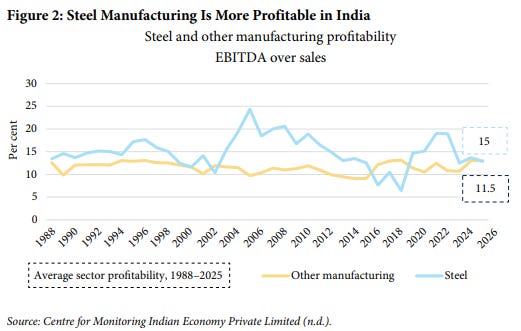
High margins could simply reflect superior efficiency. But the problem is that Indian steel is more expensive than steel in almost every comparable market. For instance, Indian hot-rolled coil prices (HRC) are roughly 6% higher than Japanese HRC prices and 15-30% above Chinese levels. You’d expect a low-cost producer to sell cheaply and win on volume. But instead, Indian steelmakers sell at a premium while enjoying fatter margins than their foreign peers.
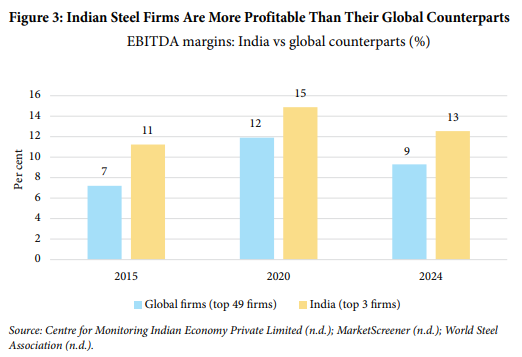
This means that something other than efficiency is propping up those profits. One such cause is the cost of financing, which is higher in India. But CSEP identifies two more important pillars, and the first one has to do with the raw material required to make steel.
The hidden iron ore subsidy
India is 100% self-sufficient in iron ore, the foundational material steel requires. We account for ~10% of global iron ore production. Until the mid-2000s, we also exported ~60% of all domestically mined ore, and domestic iron ore prices tracked global benchmarks.
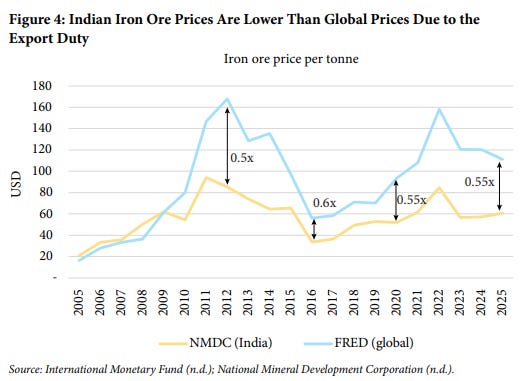
That changed in 2007, when the government began imposing export duties on iron ore. The duty was ratcheted up to 30% of the selling price by 2011. The duty remains even today for ores with more than 58% iron content.
The stated objective of this duty was to discourage exports in favor of ensuring domestic availability for steelmakers at subsidized prices. Which was achieved, but at a certain cost to the iron ore industry.
Since the export duty kicked in, domestic iron ore prices have consistently sat at a 30-40% discount to global prices. Iron ore expenditure accounts for ~20% of the total cost of steelmaking. By suppressing the domestic price, the government transfers value from the iron ore industry to the steel industry.
The distortion doesn’t stop here, either. Low iron ore prices mean low returns for miners, which means limited incentives to invest in new exploration of iron ore mines. This problem is only compounded by India’s mining policy, where, if you discover a new mine, you can’t sell the mining rights or develop it yourself. You only receive a share of the auction premium, that too only when the state eventually auctions the mine and it becomes operational.
The result, as CSEP notes, is that exploration has virtually stopped. Only 22% of deep-seated minerals in areas with obvious geological potential have been mapped.
India’s policy of keeping iron ore cheap for steelmakers has, over time, stunted the very industry that supplies them.
Protected collusion
Cheap iron ore is the input side of the equation keeping steel prices artificially elevated. On the output side, a layered wall of tariff and non-tariff barriers, that was meant to keep foreign competition at bay, also allows domestic steelmakers to charge prices that a more open market would not tolerate.
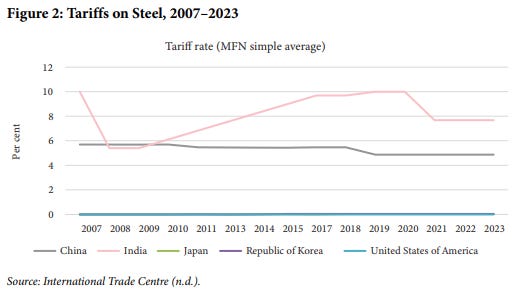
During liberalisation, India’s steel tariffs were brought down sharply from about 93% in 1990 to under 7.5% by 2008. But since then, the industry has shown signs of reversing.
In April 2025, for instance, the government slapped an additional 12% safeguard duty on certain non-alloy and alloy steel flat products, citing a surge in imports that threatened ‘serious injury’ to the domestic industry. We covered this safeguard duty sometime last year as well. The combined tariff burden is now roughly 19.5%, which is far above China’s 4.5%, and even further from Japan and South Korea, which charge less than 1%.
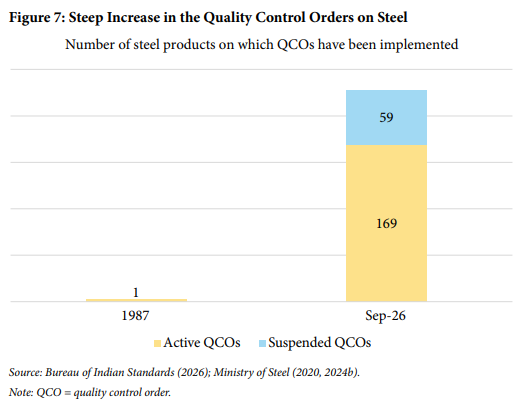
Then, there are the Quality Control Orders (QCOs), that we’ve also covered before. They’re technical standards that require BIS certification before a product can be sold in India. On paper, they’re about quality, but really, they function as non-tariff import barriers. The number of QCOs on steel products has ballooned from just 1 in 1987 to 228, of which 59 have been suspended as of September 2026.
For downstream manufacturers — particularly MSMEs and exporters — these price differentials translate directly into reduced competitiveness. Steel accounts for about 15% of total project costs in construction and roughly 5% of raw material costs in automobile manufacturing. Every percentage point of inflated steel pricing ripples further down the value chain. That would explain why India’s steel sector has higher margins than the rest of our manufacturing.
Usually, the justification for these barriers is that countries like China and Japan dump their excess steel output within our border. But even the anti-dumping toolkit has been stretched beyond its purpose.
Consider low-ash met coke (LAM coke), an essential blast furnace input that India cannot produce domestically in sufficient quality because of high-ash domestic coal. As per trade think-tank GTRI, when the government launched an anti-dumping investigation on LAM coke, it benchmarked freight costs using container shipping rates. However, LAM coke ships almost entirely in dry-bulk cargo, whose rates are 8-10 times lower than container shipping.
This error inflated the provisional duties to $60-120 per tonne. And since LAM Coke accounts for 35-40% of steelmaking costs, it pushed finished steel prices up by 3-5%. The anti-dumping regime, in other words, hurt the steel industry’s own inputs.
On top of that, usually, one worry of an industry that’s highly protected is that firms in the industry can often collude to keep profits up without the threat of outside competition. In Indian steel’s case, that might be true.
Earlier this year, the Competition Commission of India (CCI) found that 28 steel companies (including Tata Steel, JSW Steel, and SAIL) had breached antitrust law by colluding on steel selling prices between 2015 and 2023. The case originated in 2021 after a group of builders alleged that steel companies were collectively restricting supply and hiking prices. JSW and SAIL have denied the allegations, and the case is ongoing.
What happens when the shield comes off?
Now, what happens if you remove some of these protections? The CSEP papers indeed try to model what that could look like.
The first paper, by Shishir Gupta and Rishita Sachdeva, builds two counterfactual scenarios.
In the first, domestic steel prices fall by 6% to equalise with Japanese levels. That caused the profitability of the biggest private steelmaker to drop by 25%. The fastest-growing private player and the largest PSU each lose 40-50% of their profitability. A 6% price correction, which would still leave Indian steel more expensive than Chinese steel, is enough to put serious pressure across the industry.
The second, more important scenario involves removing the 30% export duty on iron ore. If that happens, steelmakers have to buy all their iron ore at the higher global prices. As a result, the biggest private player’s profitability potentially falls by ~70%. The fastest-growing private player barely breaks even, scraping by at less than 1% margin. SAIL goes loss-making.
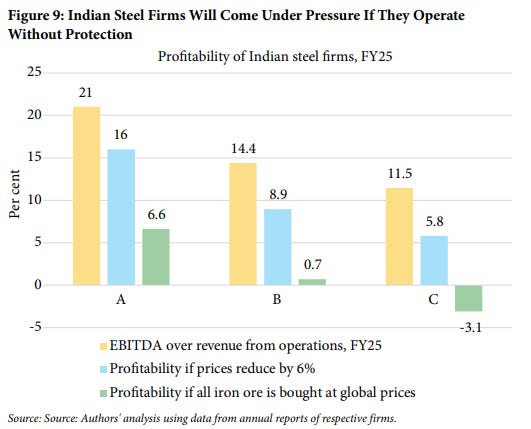
Now, one might point out the fact that Tata Steel and SAIL source all their iron ore from captive mines, so they’d never need to buy on the open market. This is true, but CSEP argues further that even captive miners forgo the revenue they could earn by exporting ore at global prices. That opportunity cost isn’t included in the steel price.
The second paper, by Aparna Preethan and Badri Gopalakrishnan, approaches the question from the other direction: what does steel protection cost the rest of the economy?
They create a model to estimate what a tariff reduction would do to steel output. Now, it’s hard to truly quantify such a scenario, and models are imperfect. But across tests and different tariff reduction rates, the authors find that domestic steel output doesn’t fall by too much. The Indian steel sector, in their view, is resilient enough to absorb such a change.
However, the gains elsewhere are significant. They see stimulation in exports and meaningful employment gains, all primarily in downstream sectors like machinery, automotive, electronics, and fabricated metals that benefit from cheaper steel inputs. The country’s overall price index also falls. Note that this model doesn’t touch non-tariff barriers at all.
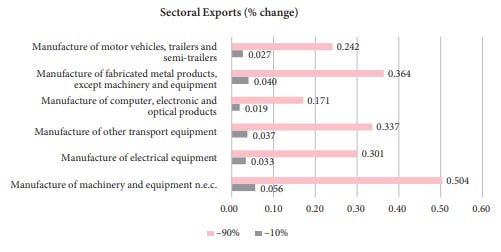
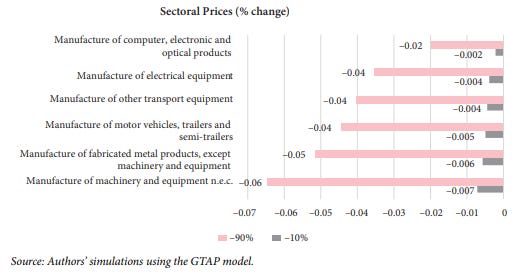
One could counter-argue that even if a tariff reduction is necessary, the Indian steel sector can only handle such a change in the long run. An immediate cut would come as a brutal shock to them.
Which is why the authors create a scenario where tariffs are phased out gradually. In their model, the industry barely notices these changes, but downstream sectors get cheaper inputs.
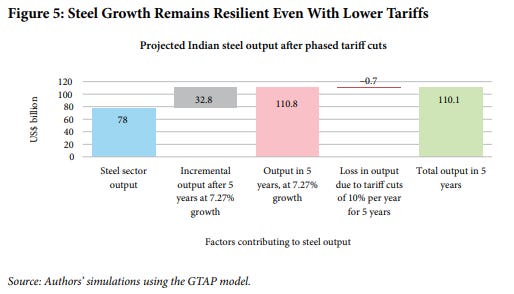
India has done this before. For instance, tariffs on both pharma and auto components fell post-liberalisation, but their respective industries only grew bigger. To be sure, this was complemented by other policies, and import tariffs weren’t bluntly removed across the board. But both sectors are much less insulated than Indian steel today.
The real steel test
None of this means India should fling open its steel market overnight.
China’s massive overcapacity in many industries — including and especially steel — is well known, and anti-dumping duties against a force like that can be considered a rational tool. The CSEP authors themselves recommend a calibrated multi-year roadmap to bring tariffs down to ASEAN-equivalent levels, not a sudden liberalisation shock.
But the current regime is extracting a cost from the broader economy. Every road, bridge, factory, and car built in India costs more than it needs to. Our vision of scaling manufacturing fundamentally requires steel which is more competitively priced than what it is right now. And that requires making a dent in the distortions mentioned above.

How CAFE 3 ended India’s small-car fight
The last time we looked at India’s next fuel-efficiency rules, carmakers were fighting over what the third phase of Corporate Average Fuel Economy, or CAFE, would require.
CAFE limits how much fuel a carmaker’s cars can consume on average. Since burning fuel produces CO₂, we can express this as grams of CO₂ emitted per kilometre. The rules compare two numbers: the average emissions of all the cars a company sells, and its permitted limit. A formula sets that limit based on the cars’ average weight. Heavier fleets get a higher allowance because heavier cars generally need more fuel.
The final framework is here, and CAFE 3 starts in April 2027. But getting here involved a fight over small cars.
Maruti Suzuki wanted an extra 3 g CO₂/km benefit for petrol cars weighing up to 909 kg, with engines no larger than 1,200 cc and a length no greater than 4 metres.
Put simply, a qualifying car emitting 100 grams of CO₂ per kilometre would count as emitting 97 grams. Its actual emissions would stay the same, but the lower figure would help Maruti meet its fleet-average limit.
Tata Motors, Mahindra and others opposed it, arguing that it would mostly favour Maruti. They also questioned a cut-off that would treat cars just above and below 909 kg differently. The dispute reportedly reached the Prime Minister’s Office, which we wrote about at the time.
So where did the government land?
The compromise inside the formula
The final framework dropped the proposed extra 3 g/km benefit for qualifying small petrol cars.
Instead, it changed how much the permitted limit rises with a fleet’s average weight.
Under the earlier proposal, the allowance rose more sharply as fleets became heavier. The final formula reduces that advantage. Heavier fleets still get a higher allowance, but the gap between light and heavy fleets is smaller.
Take two hypothetical carmakers whose cars average 909 kg and 2,500 kg. These are extreme examples, and the following limits apply to FY28, the first year of CAFE 3. Remember, these are their permitted limits, not their actual emissions. A higher limit gives a company more room to comply.
Under the September 2025 proposal, the lighter fleet’s limit would have been roughly 76 grams of CO₂ per kilometre. The final formula raises it to roughly 82.8 grams, giving it nearly 7 grams of extra room. The heavier fleet goes the other way: its limit falls from roughly 151.4 grams per kilometre to about 142.4 grams. Its target becomes tougher.
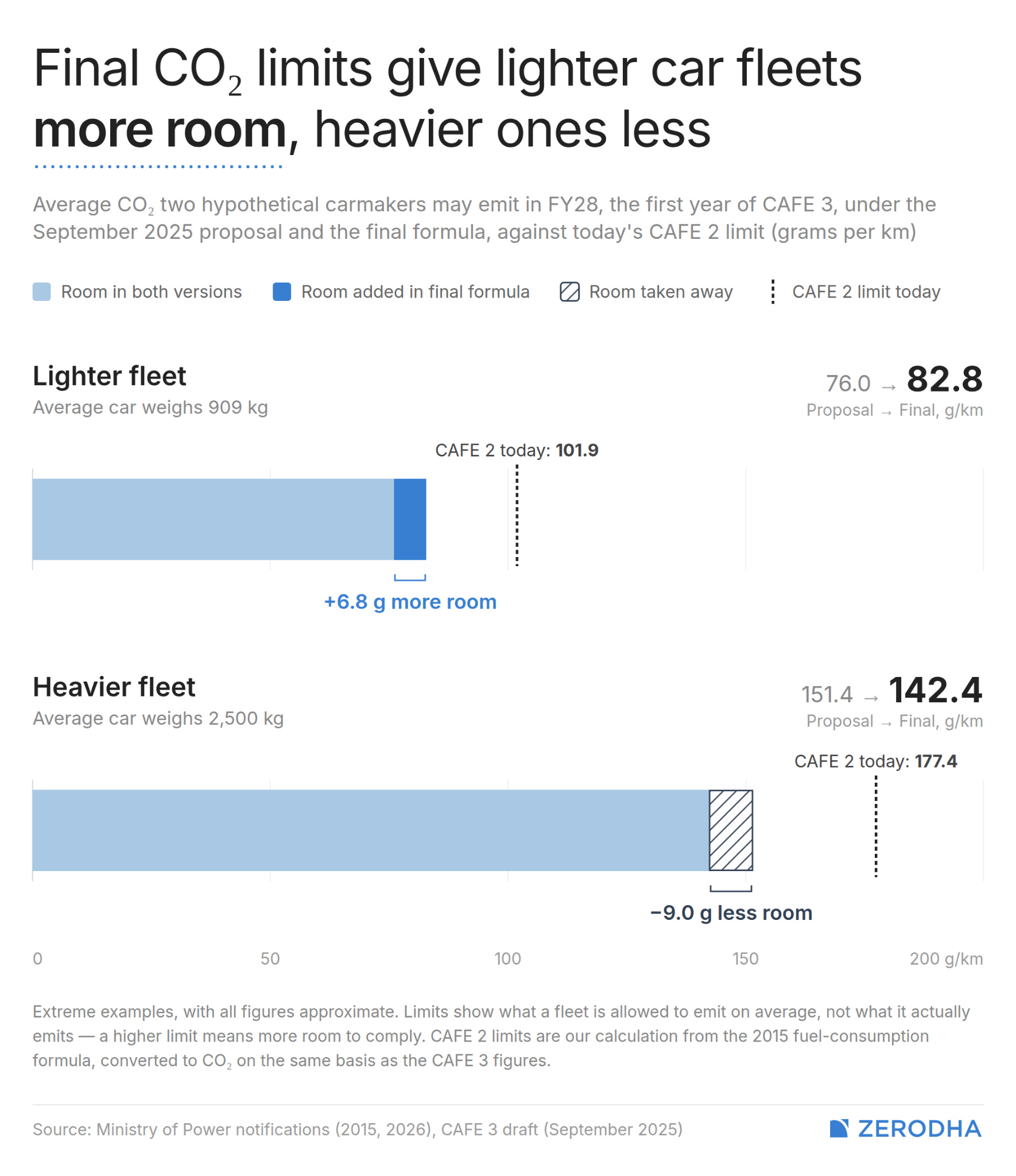
The difference is where the relief applies. The proposed 3 g/km concession would have lowered a qualifying car’s counted emissions. The revised formula raises the permitted limit for lighter fleets instead. The figures above compare only those limits; the proposed discount would have applied separately.
So Maruti did not get its special small-car category. But lighter fleets like its own got some relief through the broader formula.
That relief is relative to the earlier proposal. CAFE 3 still gets tougher each year: its fuel-consumption benchmark falls by around 16.7% over its five years. Even lighter fleets will have to keep improving.
The regulatory toolbox
The formula sets the target. Carmakers can meet it by selling more efficient cars, using cleaner fuels and fuel-saving technologies, or using compliance credits.
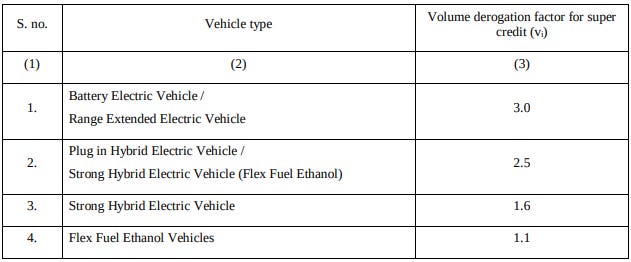
Some vehicles receive “super credits”: they count as more than one vehicle when the fleet’s performance is calculated, giving their lower fuel consumption more weight.
A battery EV is counted as three vehicles. Plug-in hybrids, which can charge from a socket, and flex-fuel strong hybrids, which can run on high-ethanol blends, count as 2.5 vehicles.
Regular strong hybrids count as 1.6 vehicles. Their batteries recharge while driving, so they do not need plugging in. Flex-fuel vehicles, which can run on petrol or high-ethanol blends, count as 1.1 vehicles.
Cleaner fuels also get a benefit in the calculation. Petrol cars running on 20% ethanol blends get an 8% adjustment, reducing their counted emissions. CNG cars get a discount of at least 5%, or the notified biogas blending percentage if higher. Biogas comes from sources such as agricultural waste, food waste and animal manure.
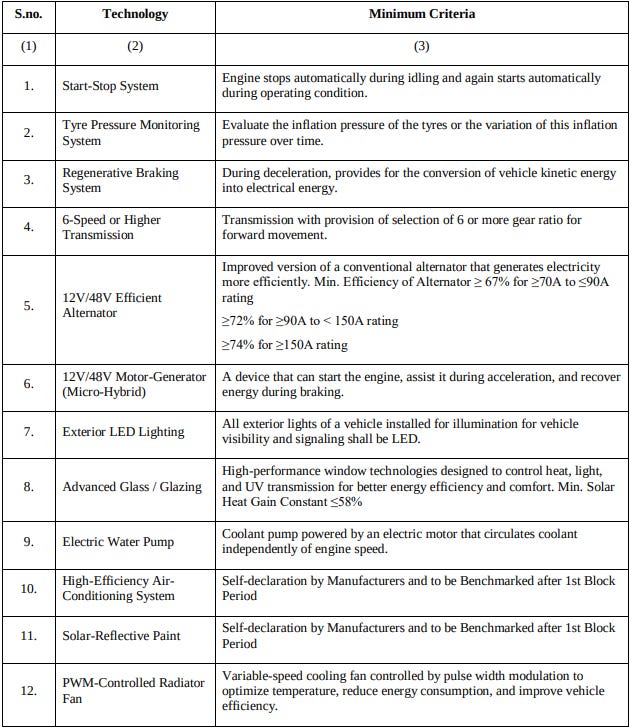
The list of recognised fuel-saving technologies has grown from four to twelve, including stop-start systems, regenerative braking, heat-reflecting paint and efficient air-conditioning. Each eligible technology earns a 1 gram CO₂/km reduction in calculated emissions, capped at 9 grams CO₂/km per vehicle.
Carmakers that beat their targets also earn compliance credits. They can carry these into later years within set multi-year periods, or trade them with other carmakers.
Those still short can buy credits from the Bureau of Energy Efficiency, with rates starting at ₹2,500 per gram in FY28 and rising to ₹4,500 by FY32. The rate applies to each gram-per-kilometre shortfall, multiplied by the number of vehicles sold. A bigger shortfall or more sales therefore means a larger bill.
Each company can choose how much to rely on improvements to its cars, changes in its sales mix, and credits.
Different fleets, different problems
This framework forces different companies to solve very different strategic problems.
For Maruti, the revised weight formula offers relief, while its CNG cars get a separate emissions adjustment. Strong hybrids get super credits, and its recently launched e Vitara gets the largest multiplier. The question is how far small cars and CNG can take it, and how much it will need hybrids and EVs.
Mahindra sells many larger SUVs, so the revised formula gives it a tougher target than the earlier proposal. Selling more electric SUVs can help lower its calculated fleet consumption, with each EV counting as three vehicles. That is why its growing electric SUV lineup matters.
Toyota has long argued for multiple technologies to cut emissions. The benefits for strong hybrids, plug-in hybrids and flex-fuel vehicles give it several routes to compliance without relying mainly on battery EVs.
And that is perhaps the bigger point. Every carmaker starts with a different mix of vehicles, so there is no single winning strategy under CAFE 3. The target may be the same kind of rule for everyone, but the easiest way to reach it will look very different for Maruti, Mahindra and Toyota.
The next fight
Carmakers now have clearer rules for the cars they are planning. From April 2027, each will have to find the right combination of vehicles and technologies for its business.
The fight over what CAFE 3 should look like is largely settled. Now comes the work of adapting to it.
- This edition of the newsletter was written by Manie & Vignesh.
Tidbits:
1. Adani Airports stops handling certain Russian-linked cargo at Mumbai airport
Adani Airports has stopped handling some cargo linked to Russian carriers at Mumbai airport, citing sanctions-related compliance concerns. The move has triggered a dispute with representatives of Aeroflot and Volga-Dnepr, with about 2.5 tonnes of cargo reportedly stuck at the airport warehouse.
Source: The Economic Times
2. Several Indian states seek extra power allocations to avoid outages
Several states, including Rajasthan, Gujarat, Maharashtra, and Tamil Nadu, have sought additional power allocations from the central government to avert electricity outages. India’s power supply has tightened due to weak hydropower generation resulting from an El Niño-related rainfall decline and maintenance at some plants, increasing reliance on coal-fired generation to meet demand.
Source: Business Standard
3. Zimbabwe central bank in talks to adopt India’s UPI technology
Zimbabwe’s central bank is negotiating with NPCI International to build a UPI-based real-time payments system. The proposed infrastructure would connect banks, mobile-money operators and fintechs, with talks potentially concluding by October 31.
Source: Bloomberg
4. Boeing wins US Navy’s next-generation fighter contract
Boeing has won the US Navy’s F/A-XX sixth-generation fighter development contract, worth more than $20 billion in its initial phase. The award follows its selection last year for the US Air Force’s F-47 program, giving Boeing both of the Pentagon’s major next-generation fighter programmes.
Source: Reuters
5. India explores Colombia for palm oil imports as traditional suppliers boost biofuel blends
India is seeking to diversify its palm oil sourcing to Colombia amid concerns that top suppliers Indonesia and Malaysia are raising their biodiesel blending ratios. The Solvent Extractors’ Association of India is exploring new trade avenues to ensure long-term edible oil security, as the shift toward higher biofuel blends in Southeast Asia could divert significant volumes of palm oil from food to fuel applications.
Source: Business Standard
Want more tidbits? Catch up on last week’s recap!

Beyond Today’s Brief
There’s always more happening at Markets by Zerodha.
The Chatter: What regulatory shifts is the IRDAI Chairman prioritising to deepen insurance penetration and drive industry growth? And how is Bajaj navigating the evolving landscape of credit and financial services?
Points & Figures: What does having a job even mean in today’s economy? And how are the blurring lines between formal employment, gig work, and underemployment complicating India’s labour market data?
Aftermarket Report: How did Nifty rally nearly 170 points from the open to close near the day’s high ahead of the RBI policy? And what do improving breadth, stronger put writing, and easing volatility signal even as FII positioning remains heavily bearish?
Join us on WhatsApp, where we share interesting soundbites from concalls, articles, and everything else we come across throughout the day. You’ll also get notified the moment a new video or article drops so that you can read or watch it right away.
Thank you for reading. Do share this with your friends and make them as smart as you are 😉