



Our goal with The Daily Brief is to simplify the biggest stories in the Indian markets and help you understand what they mean. We won’t just tell you what happened; we’ll tell you why and how too. We do this show in both formats: video and audio. This piece curates the stories that we talk about.
You can listen to the podcast on Spotify, Apple Podcasts, or wherever you get your podcasts and watch the videos on YouTube. You can also watch The Daily Brief in Hindi.
In today’s edition of The Daily Brief:
1. The $133 billion deposits that made India’s banks look less profitable
A special RBI swap window brought in an unprecedented $133 billion in NRI deposits, but much of the influx came through leveraged carry-trade structures funded by banks’ overseas and GIFT City units. While these dollar deposits supplied cheap, fixed-rate funds ahead of central bank rate hikes and strengthened sovereign forex reserves, the thin spreads on foreign lending and optical dilution of CASA ratios compressed net interest margins across major private banks.
2. Where are India’s rare magnet plans headed?
To break a total import dependence on China for sintered neodymium magnets—critical components in EV motors, wind turbines, and defense hardware—the government launched a ₹7,280-crore incentive scheme attracting 20 diverse bidders. However, the domestic industry faces steep execution hurdles, including an annual 1,500-tonne raw material deficit beyond state-run IREL’s limited processing capacity, an absence of high-temperature heavy rare earths, and unconfirmed commercial offtake from automakers.
The $133 billion deposits that made India’s banks look less profitable
Three months ago, every big private bank was excited about a special RBI window to raise dollar deposits from NRIs. On its June-quarter call, HDFC described its team as “quite gung-ho.” ICICI did mention a catch, though. Taking in this much money might drag on margins, even as it added to absolute profits.
That’s exactly what happened.
This quarter, deposits jumped, and at every big private bank, net interest margin, the gap between what a bank earns on its money and what it pays for it, fell.
Which is odd, because this money was supposed to be the cheapest banks had seen in years. Both things are true. To see why, you have to follow the money.
RBI picks up the tab in June
An FCNR(B) deposit is a dollar term deposit that an NRI keeps with an Indian bank. The NRI gets repaid in dollars, so if the rupee falls, the bank takes the hit. Hedging that risk usually costs enough that this money isn’t worth chasing.
In June, with the rupee under pressure, RBI took that cost on itself. Banks could hand their FCNR dollars to RBI, take rupees, and buy the dollars back at the same exchange rate when the deposit matured. Whatever the rupee did in between was RBI’s problem. The deposits just had to be new, and locked in for three to five years.
Banks rushed in. With the hedge gone, this was suddenly cheaper than raising deposits at home. IDFC First later put its all-in cost at about 6.8%, against roughly 7.8% for a comparable rupee deposit once reserve rules are counted. RBI shut the window a month early, and nearly half the money came in the last ten days.
The final count was around $133 billion, roughly five times what RBI’s last such window, in 2013, managed.
Follow one dollar
$133 billion of NRI deposits sounds like NRIs moving their savings home. Some of it was, but a lot of it wasn’t. It’s called a leverage deposit.
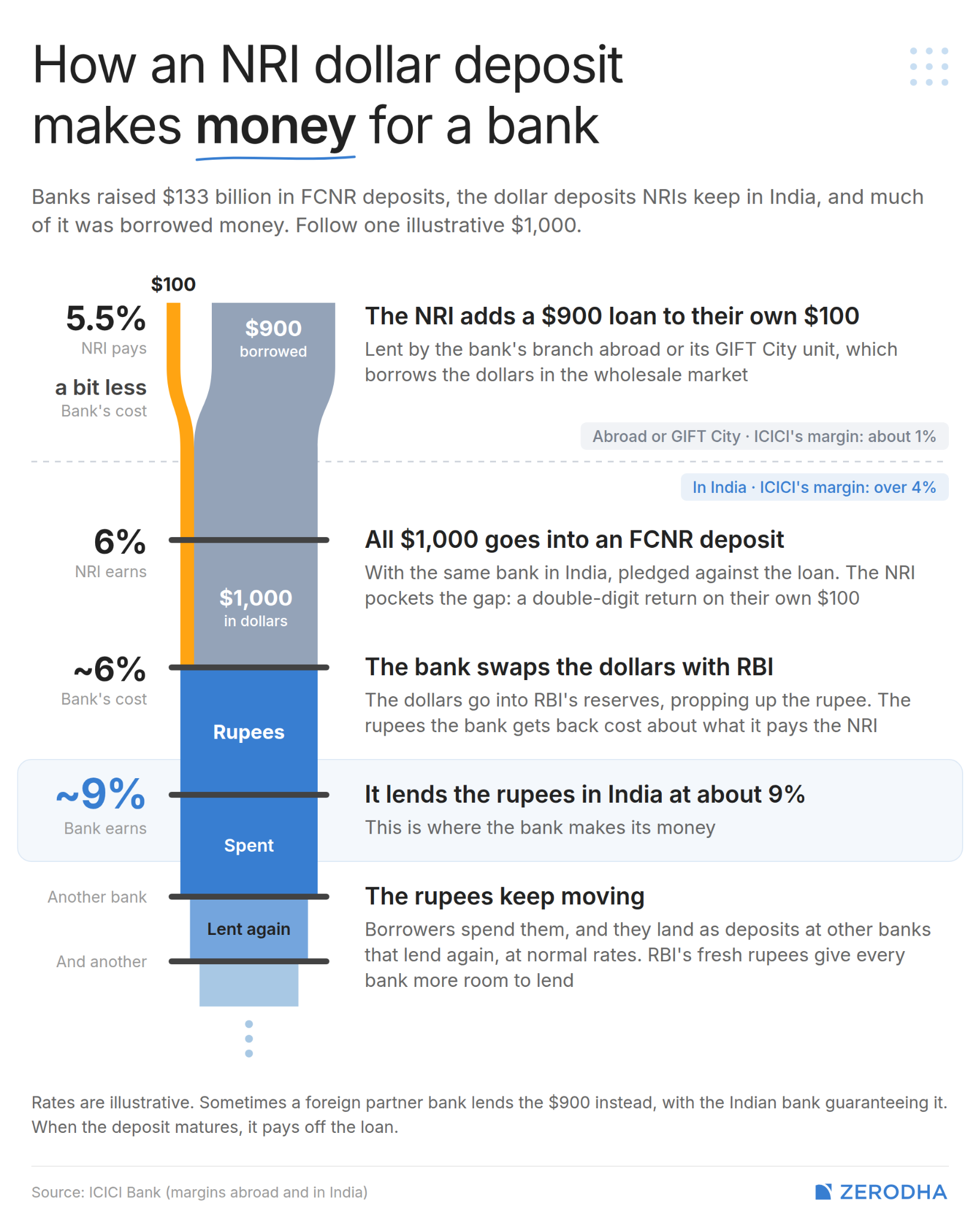
Say an NRI has $100. A bank’s branch abroad, or its unit in GIFT City, borrows dollars in the wholesale market and lends the NRI another $900. The whole $1,000 goes straight into an FCNR deposit with the same bank in India, pledged against the loan. Sometimes a foreign partner bank does the lending instead, with the Indian bank guaranteeing it.
The NRI isn’t borrowing to spend. It’s a carry trade: borrow at, say, 5.5%, park the money at 6%, and pocket the gap. Earning 6% on the whole $1,000 while paying 5.5% only on the $900 borrowed works out to a double-digit return on their own $100, by some calculations. When the deposit matures, it simply pays off the loan.
ICICI, which raised about $18 billion, said only about a quarter of it was plain NRI money. Across the system, loans from banks’ GIFT City units alone backed close to half the haul.
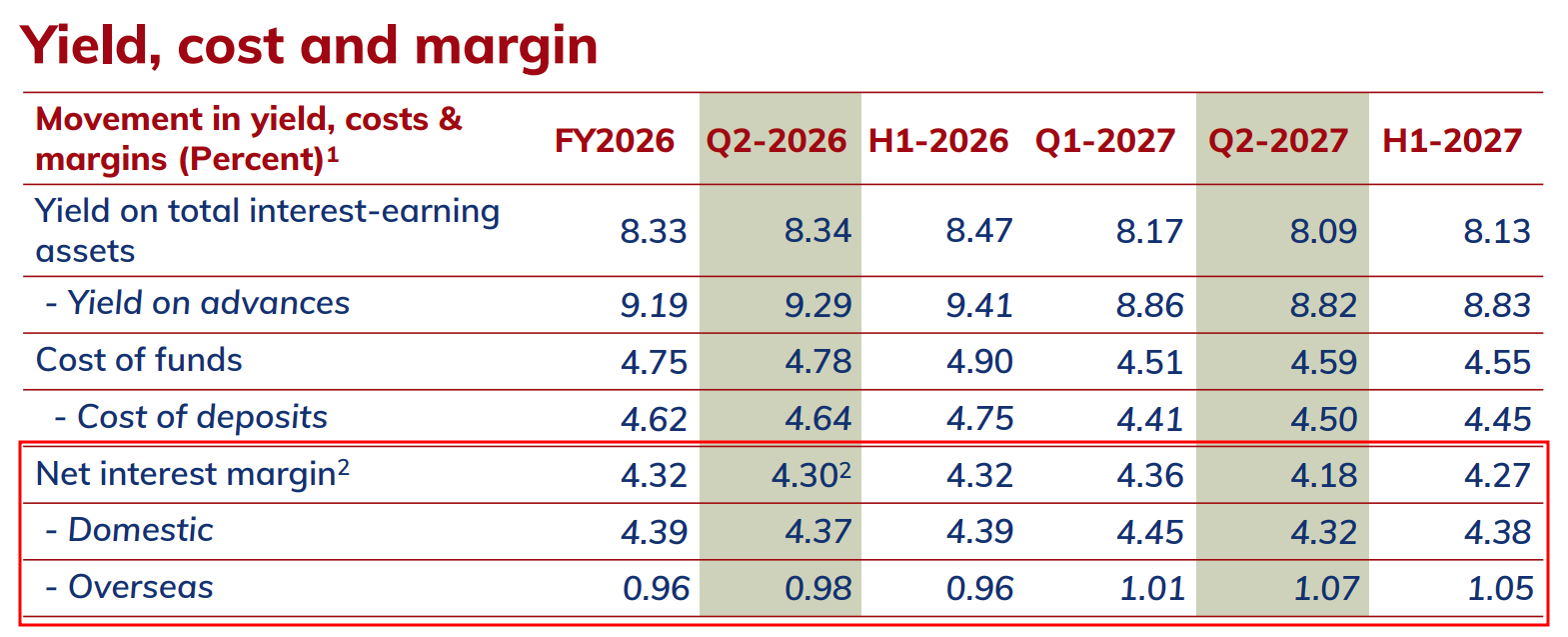
The bank makes very little on this leg. It lends to the NRI for very little over what it paid to borrow. That’s typical of a bank’s international book. Abroad, there’s no pile of near-free current and savings account money to lend out, so a bank borrows at market rates and lends at market rates. ICICI earns a margin of about 1% abroad, against over 4% at home.
Then the dollar comes home. The bank hands it to RBI under the swap and gets rupees back. The dollar sits in RBI’s reserves, propping up the rupee, and the bank now has rupees that cost it roughly what it pays the NRI.
Those rupees are where the money is made. The bank lends them in India at Indian rates, around 9% on a typical loan, which is why it can afford to pay the NRI more than dollars earn elsewhere. This is the domestic book, and its margin is fat.
And it keeps going. Whoever borrows those rupees spends them, and the money lands as a deposit in another bank, which lends most of it out again. Economists call this the money multiplier. This is when loans create deposits, which fund more loans.
Only that first round runs on cheap FCNR money, though. After that, the money moves as ordinary deposits, at normal rates and with the usual reserve rules. The real engine is that RBI created fresh rupees when it took the dollars, which gives the whole banking system more room to lend, not just the bank that raised the deposit.
Bigger banks, on paper
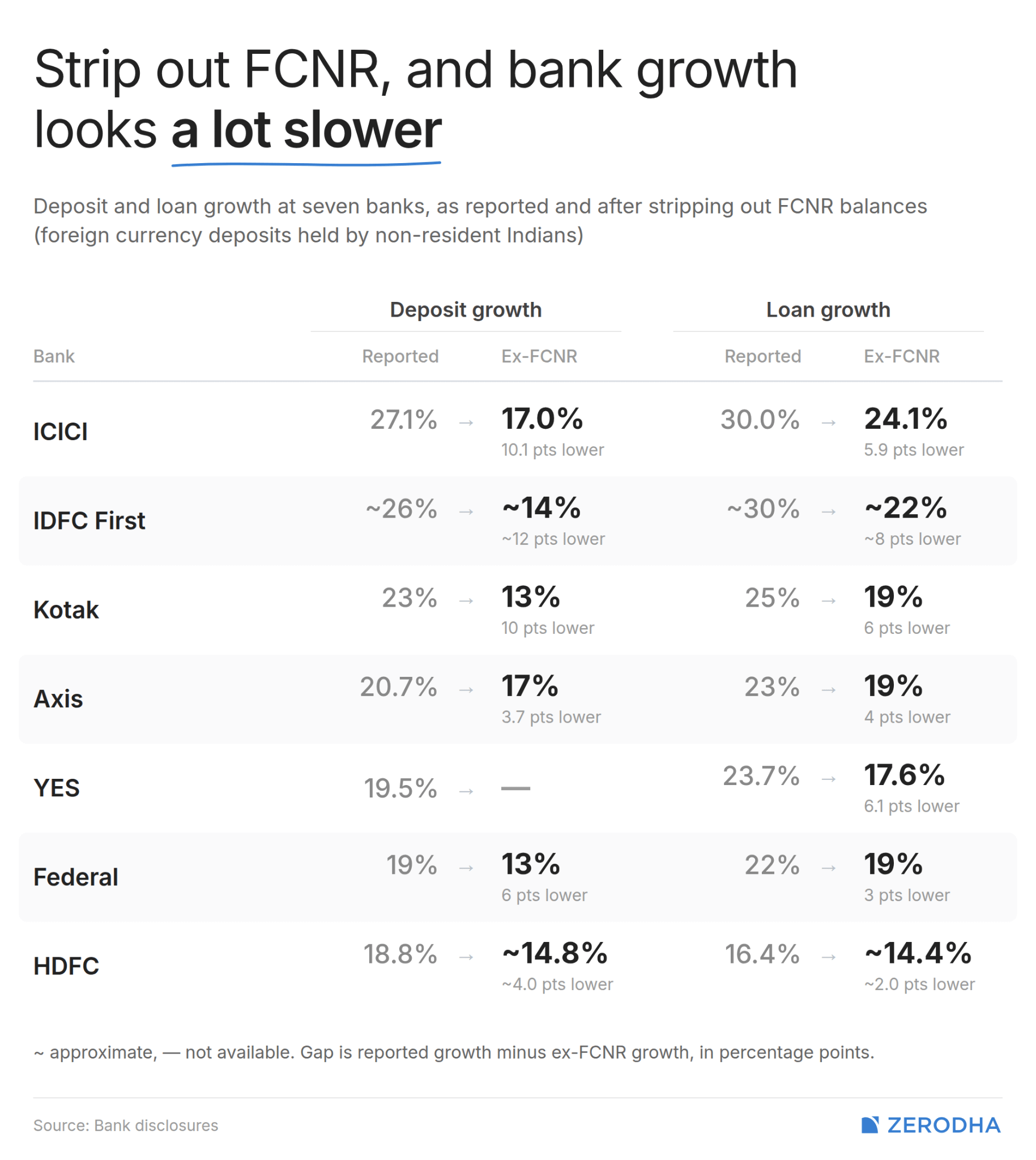
The first thing all this money did was flatter growth. Every FCNR rupee is a deposit, and every leveraged one comes with a loan. ICICI’s deposits grew 27% over the year; take out FCNR and it’s 17%. Banks even file the NRI loans in different buckets, so the honest comparison this quarter is the one without FCNR.
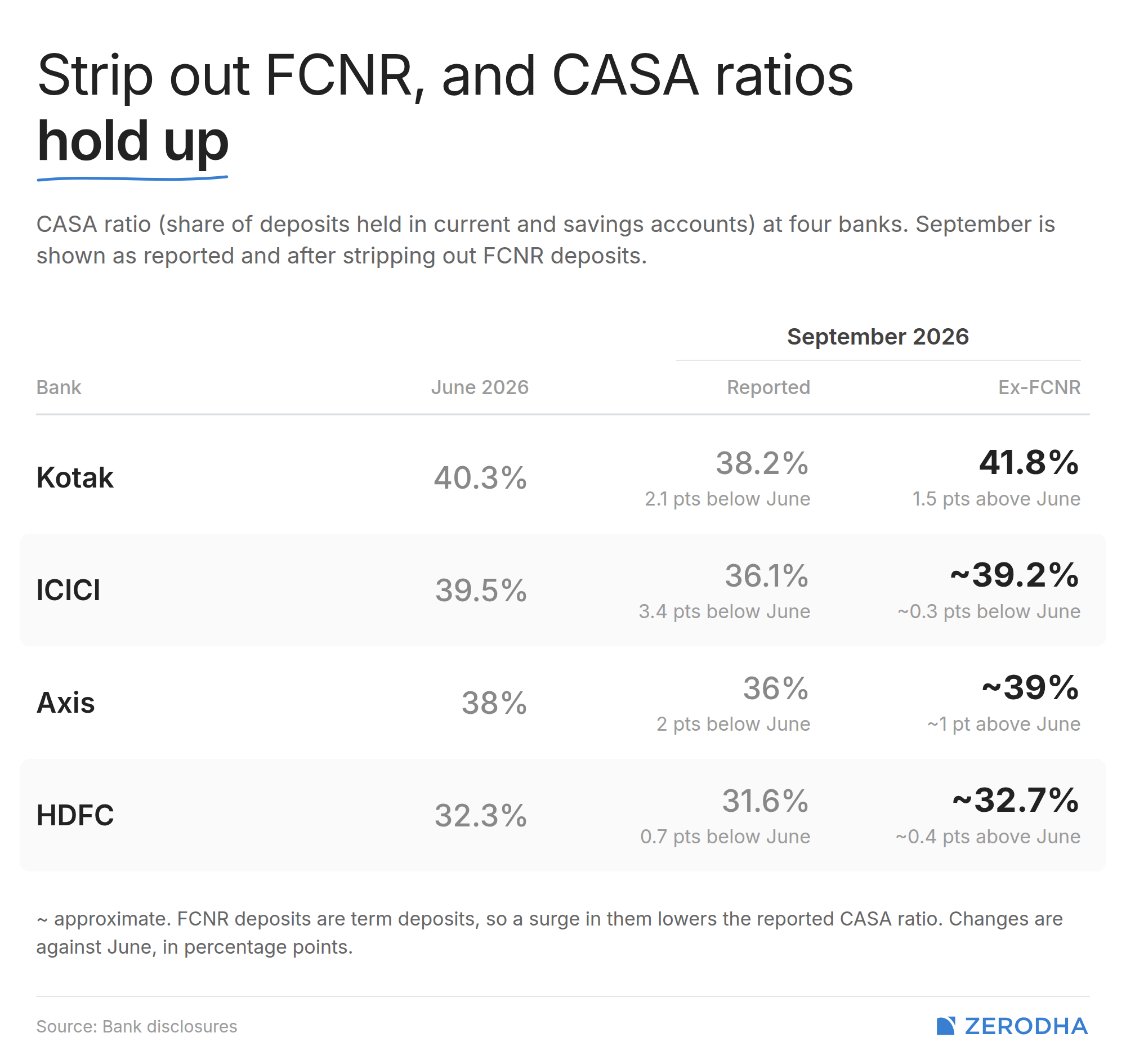
Then there’s CASA, the share of deposits in current and savings accounts, the cheapest money a bank has. FCNR deposits are term deposits, so CASA ratios fell across the board. Strip FCNR out, though, and they barely moved. Kotak’s actually went up. So this dip is arithmetic.
Cheaper money, thinner margins
Margin is a ratio. It is the net interest income over the assets that earn it. This quarter, the trouble was mostly in the bottom half.
Say a bank has ₹100 earning a 4% margin, which is ₹4 of net interest income. It adds ₹10 of those thin NRI loans, earning 0.5%. Its income rises a little, to ₹4.05. But its margin drops to about 3.7%. In one quarter, ICICI’s overseas book went from about 5.5% of its loans to nearly ~10%.
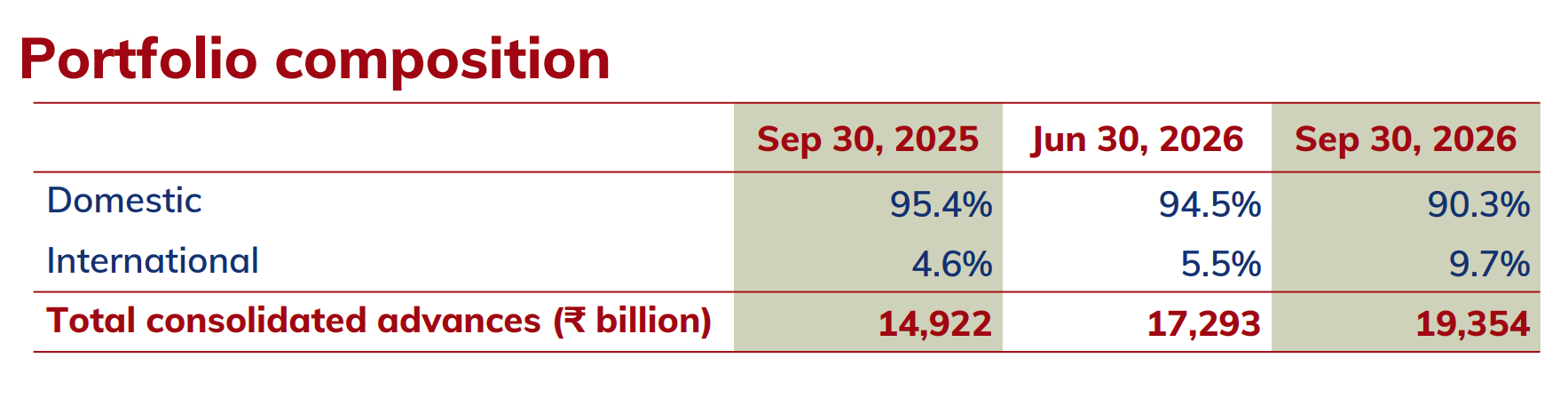
That’s the first drag: thin loans swelling the bottom half. The second is timing. Nearly half the FCNR money came in during the last ten days of August, and you can’t lend tens of thousands of crores that fast. So banks parked it in short-term instruments that earned less than the deposits cost.
Both of those drags are about where the money went. The cost side is where it gets counterintuitive. If this money was so cheap, why didn’t it bring banks’ funding costs down?
Because it was only cheap compared to the alternative. A regular deposit in India comes with strings. A slice has to sit with RBI as a cash reserve, earning nothing, and another slice has to go into government bonds. RBI waived both for these deposits. Loans made with this money also don’t add to the share a bank must lend to farmers and small businesses. Put together, that’s how IDFC got to its one-percentage-point saving.
But cheaper than a new deposit isn’t the same as cheaper than the deposits a bank already has. A bank’s average cost of money leans on its nearly free CASA. Pour in a lot of term money, however reasonably priced, and that average goes up. ICICI’s cost of deposits rose. HDFC’s stayed flat, and its CFO said it would have fallen if not for FCNR. At ICICI, strong growth in ordinary retail term deposits played a part too, so FCNR wasn’t the only factor. But it pushed the same way.
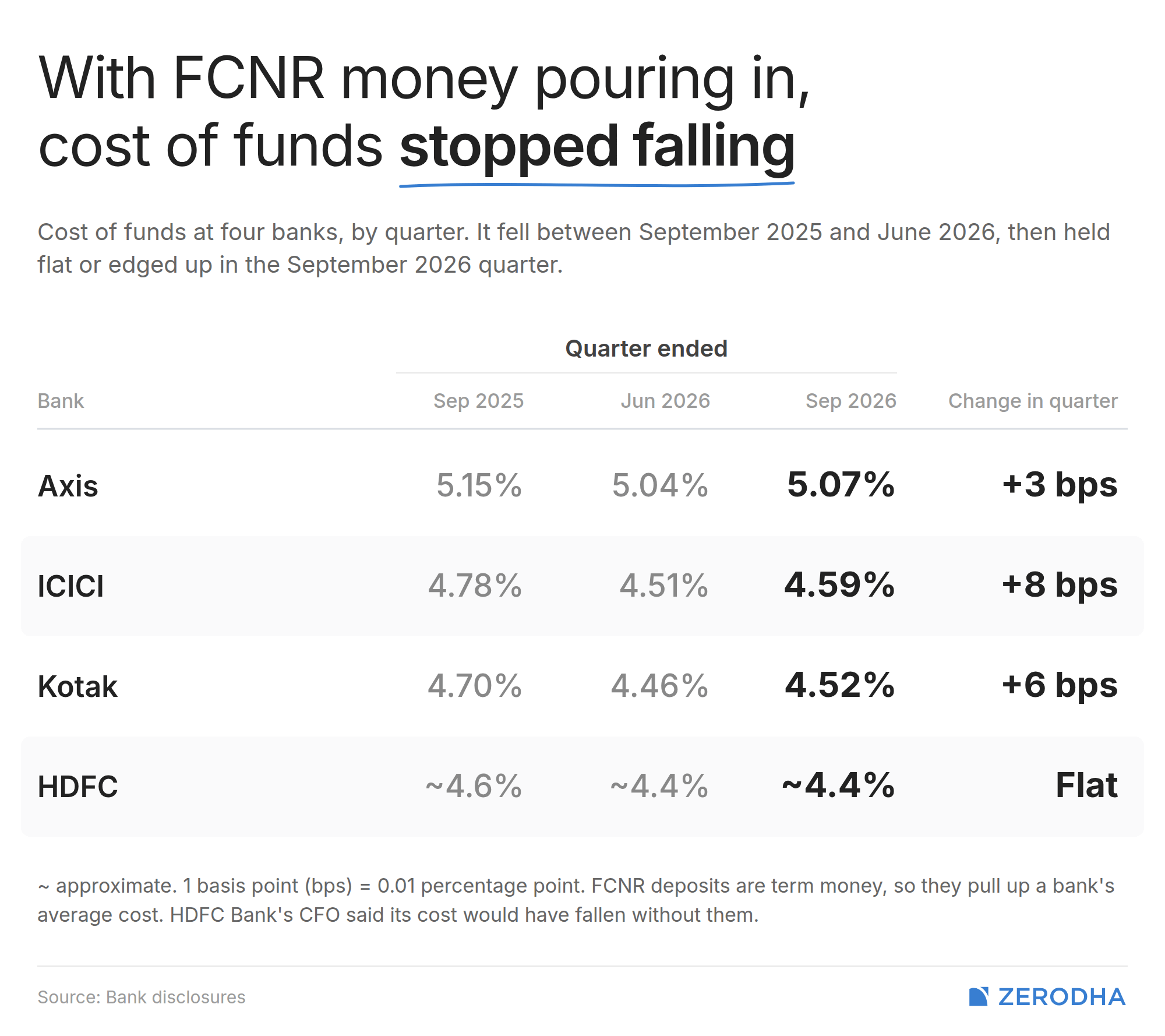
So how much it hurts depends on what a bank already pays. For one that leans on expensive bulk deposits, it’s a straight upgrade.
Banks did use some of it to pay off that expensive funding, like bulk deposits and certificates of deposit. But that mostly happened in the last weeks of the quarter, and it was a small slice of what came in. Axis said the benefit would show up next quarter.
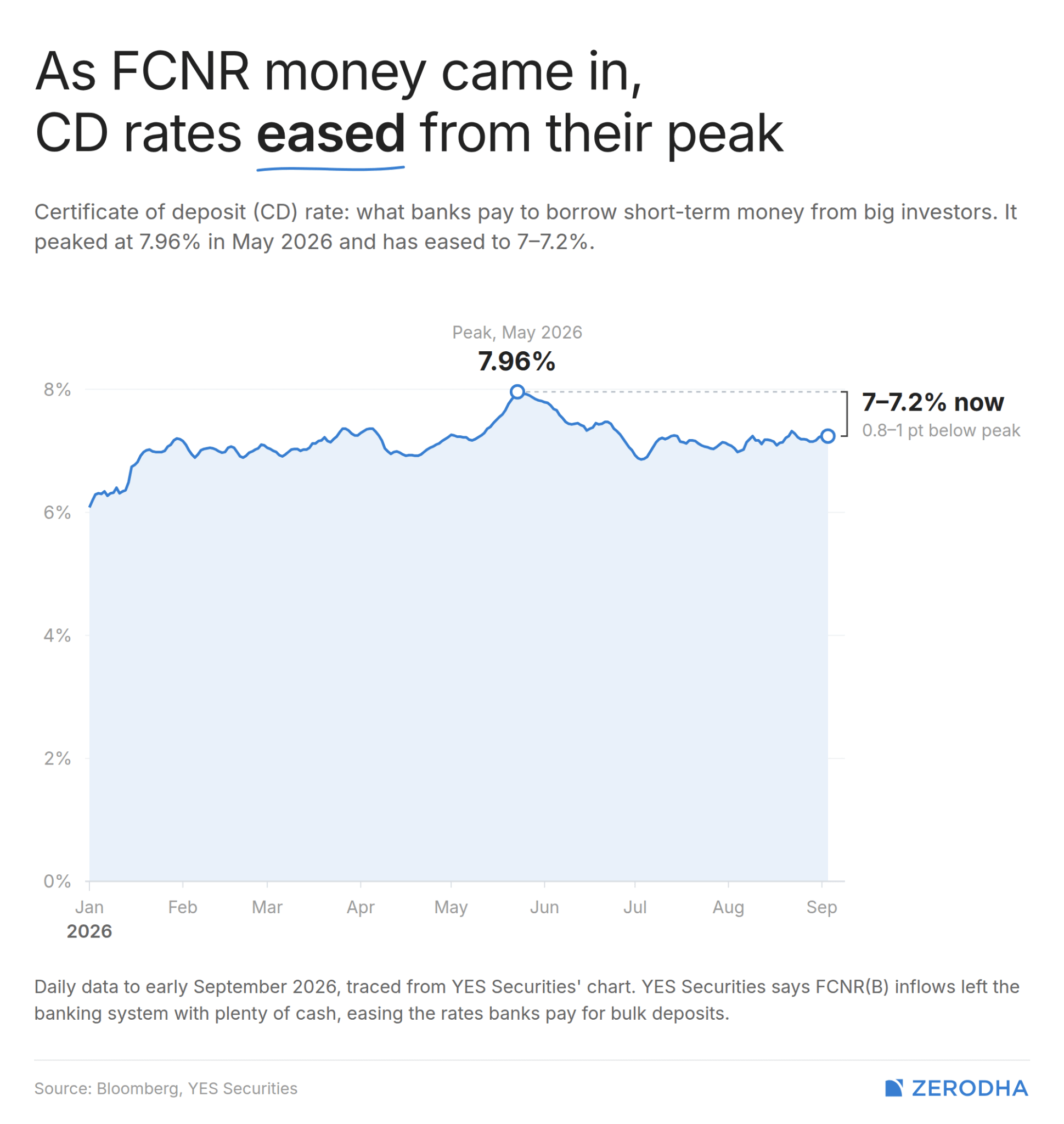
There’s a quieter benefit too. With so much money around, banks stopped scrambling for short-term funds, and certificate-of-deposit rates fell from about 8% in May to around 7%. So even money banks didn’t raise from NRIs got cheaper.
Why banks wanted it anyway
So why did every bank chase this? Because a thin margin on a much bigger book is still more business, and margin is the wrong yardstick for it.
The better one is return on assets: profit, after all costs and bad loans, as a share of everything on the balance sheet. Margin ignores costs and bad loans, and the NRI loans have almost neither. So what looks like a big hit to margin is a small one to returns.
And the cheap rupees, once lent at home, earn well above what they cost, which adds to returns over time. Even this quarter, with plenty of cash still idle, IDFC reckons its return on assets barely moved. Net interest income, the actual rupees, kept growing at every big bank.
The money was also cheap to gather, needing no new branches or staff, and it brought in wealthy NRI customers banks can sell more to. These deposits can’t be pulled out in a panic for the first year, so banks needn’t hold a liquid cushion against them. The NRI loans don’t eat into the bank’s capital either. And the timing was good: banks locked in years of fixed-rate funding just before RBI raised rates in October.
There were small costs, like commissions and provisions, but fees on the new loans roughly covered them.
Worse before better
So when do margins come back? Probably not right away.
Most of this money sat on the books for only about a month of the September quarter. In the December quarter, it’s there for all three months. The parked cash should get lent out, which helps. But the NRI loans now weigh on a full quarter.
Banks disagree on how this nets out. ICICI and Kotak expect a weaker December quarter before things improve. HDFC, having already put its money to work, thinks the worst is behind it. Part of the difference is how much idle cash each bank still has.
The money multiplier cuts both ways. Spare cash across the banking system jumped more than tenfold after July, and every bank wants to deploy it at once. That could mean banks crowding into the same safe borrowers and undercutting each other on rates. Or worse, lending in a hurry.
The October rate hike will help as floating-rate loans reprice, though it will also blur what’s FCNR and what isn’t.
And one part won’t fade. The NRI loans last as long as the deposits, three to five years. Until then, margins will look a little lower than they otherwise would.
When the dollars go home
The deposits start maturing in mid-2029. Banks haven’t said how much is three-year money and how much is five. Given how much arrived in those last ten days, a lot of it could come due at once.
We’ve seen this before. Raghuram Rajan, who launched the 2013 window as RBI governor, later admitted he had first thought the idea was “idiotic.” Those deposits matured in late 2016. RBI had bought dollars in advance, India’s FCNR pool more than halved in a single quarter, and it passed without much fuss. About a quarter of the new money even stayed on. Rajan later said RBI had made money on the deal.
For banks, the unwind will look like this quarter in reverse. Some plain deposits may stay, but the leveraged ones leave with their loans, the balance sheet shrinks, and margins jump without anything really changing. The hard part is the rupees. The money that came in is now funding loans in India, and those don’t mature on RBI’s schedule. Banks will have to replace cheap, strings-free money with whatever deposits cost in 2029.
And this time, the pile is far bigger.
Banks have bought a few years of cheap, steady money, and paid for it with a couple of quarters of ugly-looking margins. Whether that was a good trade depends on what they build with it before the dollars leave.

Where are India’s rare magnet plans headed?
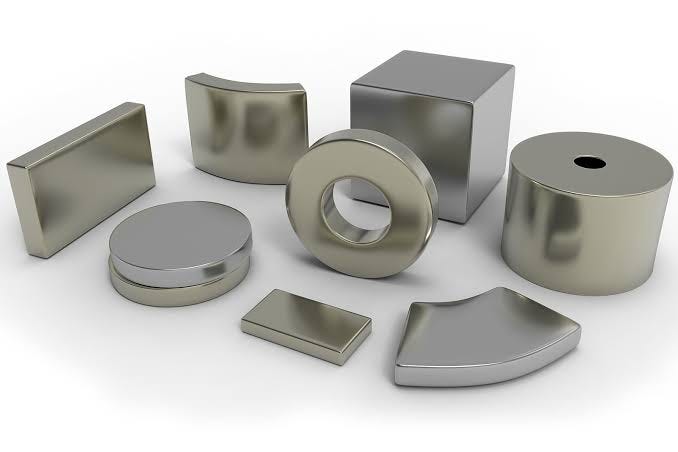
Last week, Nexon Geochem announced it would invest ₹1,250 crore in Andhra Pradesh to build a plant that makes 600 tonnes of rare earth magnets a year: specifically, sintered neodymium-iron-boron (NdFeB), or simply neodymium magnets. This is the high-performance kind of magnet that sits inside EV traction motors, wind turbines, and defence hardware.
Nexon is one of 20 companies that bid for a ₹7,280 crore government scheme to build this industry from scratch. The scheme will pick just five winners. The bidders’ list includes India’s largest coal miner, a finance company, two battery recyclers, and a highway builder. You wouldn’t expect all of them to try their hand at making technically-demanding magnets.
But that mix of companies tells us something interesting. India doesn’t yet have a large-scale neodymium magnet industry, and the companies trying to build one come from very different businesses. So why are they all interested in making magnets, and what’s stopping India from producing them in the first place?
The missing middle
We’ve covered India’s dependence on Chinese magnets before and how it hurts Indian motor makers. We’ll just briefly touch upon what it takes to make them understand where we fall short.
Think of making magnets as four factories chained together. The first digs up special sand and pulls out a rare earth element in the form of an oxide compound. The second dissects that compound into pure metal. The third melts the metal with iron and boron and grinds the result into a fine powder. The fourth presses that powder into shape using heat while running a magnetic field through it, so every grain lines up the same way, gets solidified, and finally magnetised.
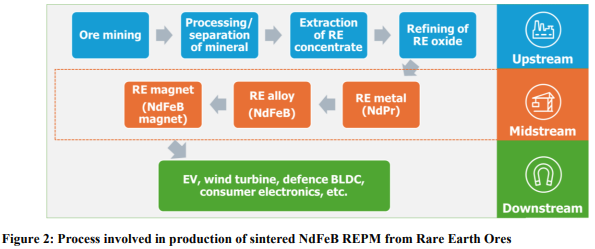
India can do the first step. Government-owned IREL (Indian Rare Earths Limited) mines monazite sand and produces rare earth oxides. But we lack the capacity to carry out the remaining steps at a commercial scale. In fact, the Ministry of Heavy Industries acknowledged in July 2026 that India imports all of our sintered neodymium demand.
The government’s scheme is meant to address this gap, but it focuses only on sintered neodymium magnets. One bidder asked whether bonded NdFeB, which is a weaker variant used in appliances, could also count, but the ministry said no.
However, building this industry requires more than just setting up factories. Companies also need the technology and experience to make these magnets.
Reading the bidder list
Now, the 20 companies competing for the scheme come from very different backgrounds. Some already have experience making magnets, while others have never made one.
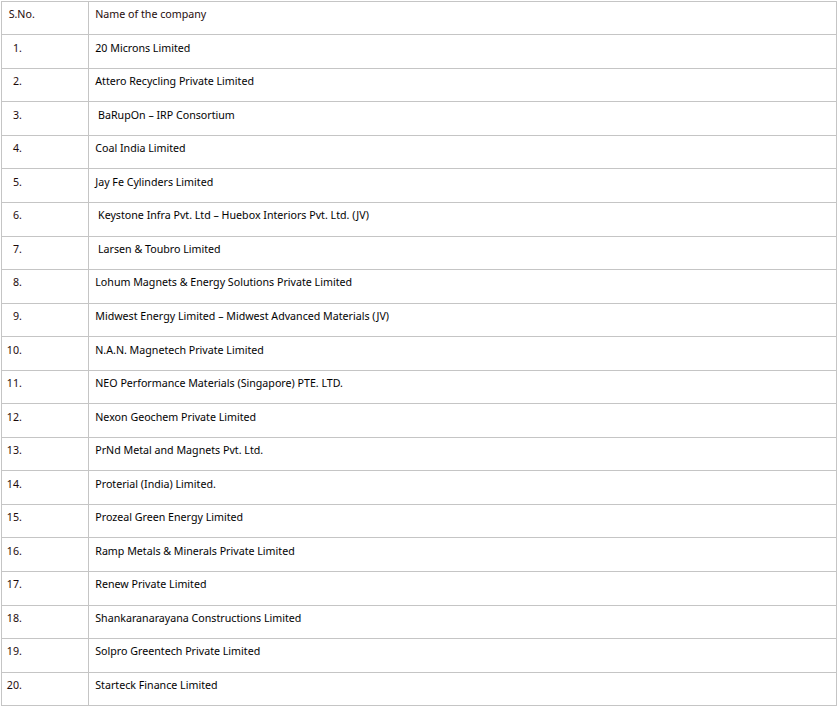
At the top are the two bidders who actually make these magnets today. Neo Performance Materials is a Canadian firm which already runs a commercial magnet plant in Estonia. Proterial India is the Indian arm of a Japanese company with a long history in magnet manufacturing. Proterial also owns the intellectual property for making high-grade magnets with lower levels of dysprosium and terbium, two scarce ingredients we’ll come back to in a moment.
In the middle are the Indian players who have spent years working towards it. There’s Hyderabad-based Midwest Advanced Materials, which uses a process developed at a government research centre called NFTDC. It’s targeting a 500-tonne commercial line in late 2026. Then, there’s NAN MagneTech, which has signed a ₹1,250 crore Andhra Pradesh plant with a Japanese technology partner. Nexon Geochem has an agreement with Russia’s Giredmet for the processing technology.
These are the real contenders, but none has publicly demonstrated sustained commercial-scale production. Midwest, however, had already begun trial production by September 2026.
There’s another interesting difference. Both Proterial and NAN have announced plans to build factories in Andhra Pradesh, each capable of producing 1,200 tonnes of magnets a year. But Proterial plans to spend ₹2,250 crore, while NAN has budgeted ₹1,250 crore. That’s a ₹1,000 crore difference for the same production capacity. Neither announcement explains why. It could come down to the equipment, technology or how much of the manufacturing process each factory will handle. For now, there’s no way to tell.
At the bottom are the 13 bidders whose magnet manufacturing experience isn’t publicly established. They come from different industries, each bringing a different missing piece, which is itself a clue to what India’s magnet industry would actually need.
Coal India is already a preferred bidder for a rare earth exploration block, so it brings adjacent muscle. L&T brings industrial execution at scale. 20 Microns does mineral processing. ReNew Energy is a wind player and could become its own captive customer. Attero and LOHUM are battery recyclers who could, in principle, feed the plant with rare earth oxide recovered from scrap.
Each is betting it can hire the engineers, license the know-how, and buy the equipment to meet the scheme’s production milestones. The scheme provides a two-year gestation period, with specific commissioning requirements.
What the subsidy really covers
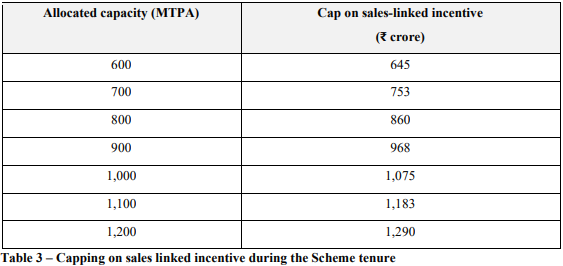
The government isn’t simply handing out the same amount of money to every company. The ministry will first check whether each bidder can build the entire manufacturing chain. Those that qualify will then compete in a reverse auction, where companies bid for how little subsidy they need. The five asking for the lowest subsidy per kilogram of magnets will be selected, with a maximum of ₹2,150 per kg.
There’s another limit too. The subsidy cannot exceed 40% of the magnet’s selling price. At the maximum rate, a company producing 1,200 tonnes a year could receive around ₹1,290 crore over five years, assuming it meets the scheme’s conditions. That’s a substantial amount of government support.
But will it be enough?
That depends on how much more it costs to make magnets in India than to import them from China. The ministry hasn’t published a cost comparison, but reports published while the scheme was being finalised suggested Indian magnets could cost around 43% more than Chinese imports. The subsidy could help reduce this gap, but not if Chinese manufacturers cut their prices sharply.
There’s also a risk in how the winners are selected. Since companies compete by asking for the lowest subsidy, some might bid for less support than they actually need to run their factories. But winning a bid comes with responsibilities. The scheme allows the government to impose penalties, cancel the award, claim the bank guarantee provided as security or withdraw incentives if a company fails to meet its targets or other obligations.

The gaps that remain
But even if all five winners build their factories on time, India still has three problems to solve.
The first is getting enough raw materials. The scheme targets 6,000 tonnes of magnet capacity, which needs roughly 2,000 tonnes of NdPr (Neodymium-Praseodymium) oxide a year to feed it. IREL can only supply a maximum of 500 tonnes with its current capacity.
Of that 500 tonnes, the scheme hands all of it to only the three lowest bidders. The fourth and fifth winners get nothing from IREL. This is a deliberate design choice. By tying assured feedstock to the cheapest bidders, the ministry makes the reverse auction more cut-throat. If you want IREL oxide, you have to bid lower than at least two other players.
So, what about the remaining 1,500 tonnes? Where do they come from? Some firms from Australia and the UK have offered to fill the gap. That’s a politically safer dependency than China, but is still a dependency.
Now, one potential alternative lies in the fact that recyclers like Attero and LOHUM are in the race. They could help generate recycled oxide from end-of-life magnets. But whether recycling can meaningfully make up for the lack of secure first-hand supply, let alone be able to scale within the scheme’s five-year incentive window, is another question.
Even then, we lack a supply of heavy rare earths like dysprosium and terbium. These elements let magnets hold their strength at the 150-200°C temperatures inside an EV traction motor or a missile guidance system. But as per the Department of Atomic Energy, heavy rare earths aren’t economically extractable from Indian deposits. The scheme offers no supply mechanism for them.
So, even if the scheme hits its target, EV traction motors above a certain spec, defence, aerospace, remain structurally dependent on imports. Proterial’s IP, though, could meaningfully reduce that dependence.
Lastly, there’s no public offtake agreement yet. As per Reuters, Mahindra and Uno Minda told the ministry in July 2025 they were “open to partnering“ with a local magnet maker or signing long-term contracts; five days after this piece of news, Mahindra denied any talks they had with Uno Minda about a partnership. The proposed Indian plants haven’t disclosed any confirmed offtake agreements with any other car or wind turbine OEM.
What to watch next
Even if automakers agree to buy Indian magnets, they’ll need to test and approve them before using them in their vehicles. And that takes time.
The winners are expected to be announced in early 2027, after which they’ll have two years to get their factories running. So production could begin around 2028–29. But the first magnets produced won’t necessarily be ready for use in cars. For example, Canada’s Neo began commercial production and deliveries to automotive customers from its Estonia plant in September 2026, a year after the plant was commissioned.
If Indian manufacturers follow a similar timeline, we might not see a Tata or Mahindra EV using locally made, approved magnets until 2030 or 2031. By then, India’s annual demand for these magnets is projected to reach 8,220 tonnes, while the scheme aims to create production capacity for 6,000 tonnes a year.
Even if the five selected firms build their factories, India will still need enough raw materials, reliable production and automakers willing to use the finished magnets. There are plenty of known unknowns that need to go India’s way to make the scheme work.
- This edition of the newsletter was written by Kashish & Vignesh.
Tidbits
1. PM Modi inaugurates RBI’s ₹169 crore data centre and cybersecurity training institute
Prime Minister Narendra Modi has inaugurated the Reserve Bank of India’s new data centre and cybersecurity training institute in Bhubaneswar, Odisha. The ₹169-crore facility is designed to strengthen the central bank’s digital infrastructure and enhance the financial sector’s resilience against cyber threats.
Source: Times of India
2. Centre approves ₹27,370 crore power transmission project for Andhra Pradesh
The central government has approved a ₹27,370 crore project to upgrade and expand Andhra Pradesh’s power transmission network. The project will expand the state’s transmission network to handle rising demand and evacuate power from new renewable-energy zones.
Source: Business Standard
3. IndiGo and Air India break ranks with foreign carriers over Navi Mumbai airport shift
IndiGo and Air India have agreed to shift some operations to the upcoming Navi Mumbai International Airport, breaking ranks with foreign airlines that have opposed the transition. International carriers recently pushed back against the move, citing concerns over proposed departure slot reductions at the existing Mumbai airport.
Source: Hindu
4. Government will not recover Samudra Manthan support for unsuccessful deepwater wells
Under the ₹84,084 crore Samudra Manthan scheme, the government will not recover its financial support if an exploratory deepwater well is dry or commercially unviable. The risk-sharing model is intended to encourage companies to drill in underexplored offshore basins, with government support covering up to half of eligible drilling costs.
Source: PSU Watch
5. ITC Hotels shares surge 8% as second-quarter profit jumps 52%
ITC Hotels reported a 52% year-on-year increase in its consolidated net profit to ₹201 crore for the September quarter, driving its stock up by nearly 8%. Revenue from operations grew 26% to ₹1,054 crore, driven by a 21% rise in revenue per available room (RevPAR) and robust occupancy rates across key markets.
Source: Business Standard
Want more tidbits? Catch up on last week’s recap!

Beyond Today’s Brief
There’s always more happening at Markets by Zerodha.
The Chatter: What strategic priorities are leaders across internet consumer platforms, hospitality, and banking highlighting for Q2 FY27? How is Eternal re-accelerating Blinkit dark store expansion into tier-two cities, while Swiggy drives toward EBITDA break-even and HDFC Bank navigates net interest margin headwinds?
Points & Figures: Where did India’s international flyers go? From a 9% drop in total international passenger traffic to Indian airlines losing a decade of market share gains to foreign rivals, what does flight data reveal about post-conflict travel demand and carrier resilience?
Aftermarket Report: How did Nifty stage a sharp rebound from morning lows of 22,387 to reclaim 22,750 and snap its four-day losing streak? And what do 13 sectors ending in the green led by Metals, a rebound in the Put-Call Ratio to 1.11, and the Fear & Greed Index lingering in extreme fear at 20 signal as markets head into monthly expiry?
Join us on WhatsApp, where we share interesting soundbites from concalls, articles, and everything else we come across throughout the day. You’ll also get notified the moment a new video or article drops so that you can read or watch it right away.
Thank you for reading. Do share this with your friends and make them as smart as you are 😉
The margin-versus-income distinction is useful. The 2029–31 maturity window seems like the harder test: has RBI published a split between three- and five-year FCNR deposits, or will that only become clear through bank disclosures?
The timing point is the one I keep coming back to. Most of this money only sat on the books for about a month of the September quarter, so the margin hit we have seen so far is probably not the full story. If ICICI and Kotak are right about a weaker December quarter first, then judging these banks on this quarter alone would be misleading. The better test, as you lay out, is return on assets over the next few quarters, not the headline margin. A thin loan on a much bigger book can still add up, but only if the cheap rupees keep earning well above their cost once the December quarter is fully loaded.