


Hi everyone, I’m Mridula, and welcome to the tenth edition of Weekly Tidbits.
We spend a lot of time reading interesting stories that never make it into a full Daily Brief piece. So, once a week, we pick some of the best ones and add a little context.
We sort them into GEIC: Global, Economy, Industry and Company.
Let’s get started!
If you prefer watching the video, here’s the link:
G — Global
[1] France is paying more to borrow money
France’s 10-year government bond yield crossed 5% on October 21. That’s its highest level since 2002. Investors are worried about France’s growing debt and its struggle to control spending.
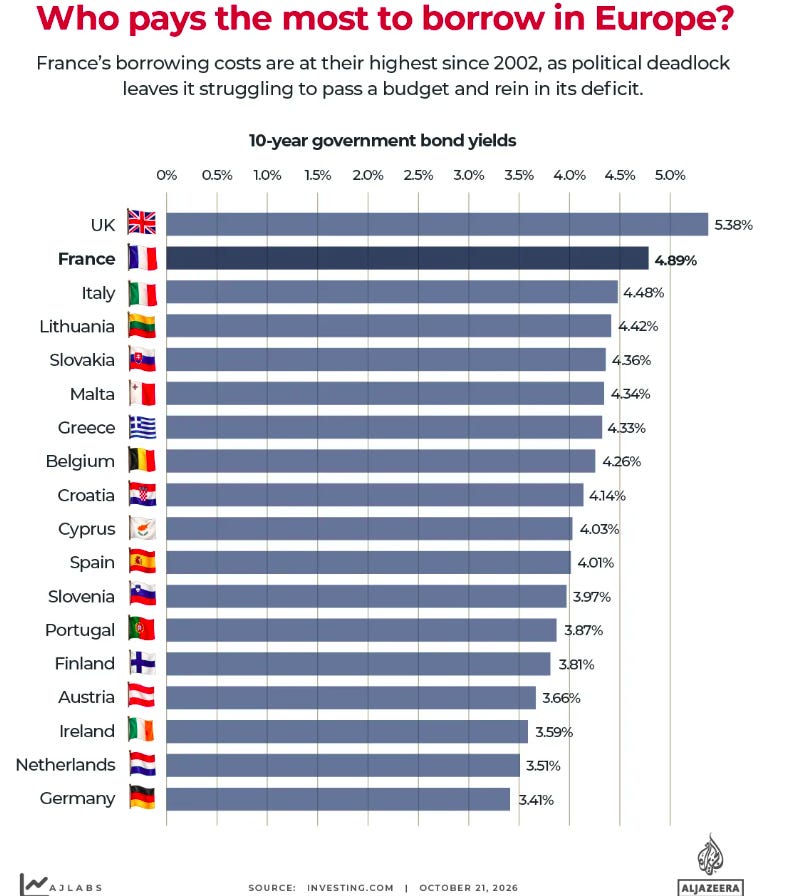
Governments borrow money by selling bonds. Buyers earn interest in return. When they lose faith in a country’s finances, they may start selling its bonds. Prices fall, and yields rise. A yield is the return a new buyer can earn. Higher yields also make fresh loans more costly for the government.
France already spends more than it collects in taxes. Its leaders have struggled to agree on a plan to close that gap. Political fights and protests have made it harder. Now, higher interest costs will put more strain on its budget. Bond buyers also want a much higher return from France than from Germany. Both use the euro, but lenders see France as a greater risk.
[2] SK Hynix drops plans to list its US chip business
South Korean chipmaker SK Hynix has dropped plans to list its US business, Solidigm, on the stock market. The company had been looking at an initial public offering, or IPO, to raise money for growth. Its shareholders raised concerns about the plan.
Solidigm makes chips and drives that hold large amounts of data. Data centres use them to run their systems. Demand for these products has grown as companies spend more on AI. SK Hynix wants to expand, but making chips takes costly machines and factories.
An IPO would let SK Hynix sell part of Solidigm to outside investors. It could use that money to grow the business. The price of those shares would matter a lot. If investors valued Solidigm too low, SK Hynix would have to give up a larger stake to raise the same amount. The company has now stopped the IPO review and will have to find other ways to fund its plans.
[3] Japan’s factory growth has slowed
Japan’s factories grew at their slowest pace in seven months in October. Its manufacturing Purchasing Managers’ Index, or PMI, fell from 54.1 in September to 53.3.
PMI is a monthly survey that tracks how businesses are doing. A reading above 50 means activity is growing. Below 50 means it is shrinking. Japan’s factories are still growing, but not as quickly as before.
Factories also reported weaker growth in new orders. Orders give them an idea of how much they may need to make in the coming months. When fewer orders come in, companies may buy less raw material or delay plans to expand. Japan sells cars, machines and electronic parts across the world. Weak demand from buyers abroad can hurt its factories at home. The survey showed that firms still hired workers in October, but new orders rose the least since March.
E — Economy
[4] RBI rejects every bid at a government debt auction
The Reserve Bank of India rejected all bids at a Treasury bill auction. The government wanted to borrow ₹23,000 crore. Investors asked for higher returns than the RBI was ready to accept.
Treasury bills let the government borrow for less than a year. They don’t pay regular interest. Instead, buyers get them at a discount. Say you buy a bill worth ₹100 for ₹95. When it matures, the government pays you ₹100. You earn ₹5. If you want a higher return, you might offer only ₹94. That means the government has to pay more for the same loan.
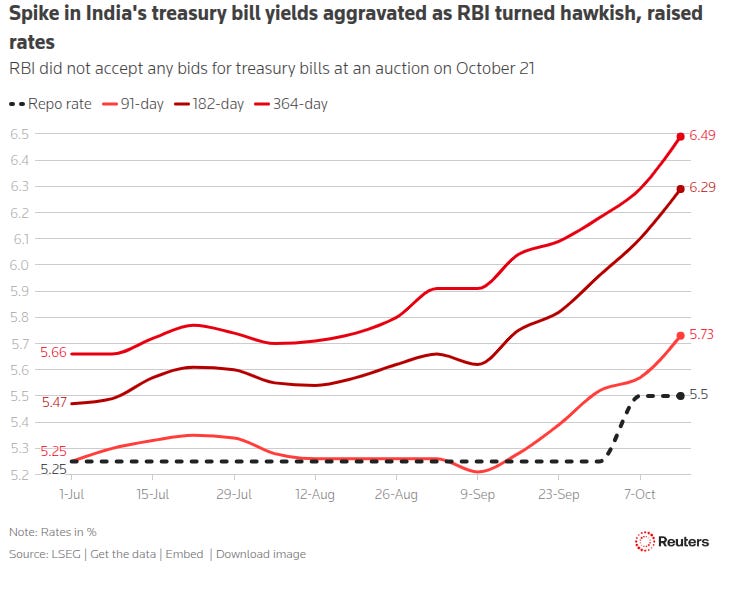
India’s short-term borrowing costs have been rising since the RBI raised interest rates earlier in October. Investors expect more rate hikes too. The RBI runs these auctions for the government and chose not to accept the bids. It can reject an auction, but the government still needs funds. Future auctions will show how much it has to pay to borrow.
[5] India’s businesses are growing, but hiring has stalled
India’s business activity grew at its fastest rate in four months in October. The country’s composite PMI rose from 55.9 in September to 56.7. This measure tracks both factories and service firms. Both reported more orders.
Hiring told a different story. Service firms stopped adding workers after nine months of hiring growth. They told the survey that their current staff could handle the extra work. Companies can often take on more orders without hiring. They may use their teams more fully or bring in tools that help people work faster. Some also wait before hiring to see if the extra work will last.
Firms got some relief from rising costs too. Raw materials and other inputs became more expensive at a slower rate than before. Businesses also raised their own prices more slowly. For now, the survey shows more work coming in, but very few new jobs.
[6] India’s trade deal with New Zealand takes effect
India’s free trade agreement with New Zealand came into force on October 20. New Zealand will now let Indian goods enter without import duties. India will also cut taxes on several goods coming from New Zealand.
An import duty is a tax on goods from another country. Take an Indian company selling shirts in New Zealand. A duty makes those shirts cost more. Removing it helps the company sell at a lower price and compete with other brands. The deal could help Indian firms selling clothes, leather goods, machines and processed foods.
India has kept some farm goods out of these tax cuts. Dairy is one of them. New Zealand is a major dairy exporter, while millions of small Indian farmers depend on milk sales. Cheaper imports could hurt their incomes. The deal also opens work routes for some Indian students and skilled workers. New Zealand has agreed to help bring $20 billion into India over 15 years. That’s roughly ₹1.88 lakh crore at ₹94 to the dollar.
I — Industry
[7] Indian refiners are exporting more diesel
Indian refiners exported 596,000 barrels of diesel a day in September. That’s up from an average of 482,000 barrels a day earlier this year. Global diesel supplies have tightened, and more buyers are turning to India.
India buys crude oil from abroad and turns it into petrol, diesel and jet fuel. Refineries then sell these fuels at home or overseas. They earn money from the gap between the cost of crude and the price of the fuel they sell.
Diesel prices can rise when the world has less of it. Russia and China have limited some exports. The conflict in West Asia has also hurt supplies. This has pushed more buyers towards Indian diesel. Refineries can earn more from these sales, though their costs have risen too. India still imports most of its crude oil, and those imports have become more expensive. The same supply problems that help Indian refiners sell diesel at higher prices can also raise the country’s oil import bill.
[8] Poultry farmers are losing money as feed gets expensive
Poultry farmers in India are facing losses of around 15% as animal feed gets more expensive. Prices of some feed items have risen by as much as 75%.
Feed is one of the biggest costs of raising chickens. Farmers use maize to help the birds grow. But ethanol makers now want more of the same crop. India turns maize into ethanol and blends it with petrol. We wrote earlier about India’s ethanol push and the growing amount of grain going into fuel. A weak monsoon has also hurt maize output. With more buyers chasing less grain, feed prices have climbed.
Farmers can’t always charge more for eggs and chicken to cover these costs. People may buy less if prices rise too much. Industry groups have asked the government to make maize imports easier. They also want grain that people can’t eat to be made available for animal feed.
[9] Starlink and Reliance disagree over satellite internet
Starlink has responded to Reliance Industries over the rules for satellite internet in India. Starlink says it has spent more than five years working with Indian regulators. Reliance says it wants fair rules for all companies.
The fight centres on the spectrum. These are the radio frequencies that carry mobile and internet signals. Jio and Airtel use towers on the ground. Starlink sends signals from satellites in space. Both need these frequencies, but they get them in different ways. Telecom firms have spent large sums buying spectrum at auctions. Satellite firms are set to get theirs directly from the government for a fee. Reliance says this could give them an unfair edge.
We wrote earlier about Starlink’s deals with Jio and Airtel. Both firms plan to help sell its services in India. They may also compete with it for users. Starlink says it is ready to launch, but it still has to clear the last steps before it can start serving customers.
C — Company
[10] Coal India and BHEL begin work on a ₹25,000 crore project
Coal India and BHEL have started work on a ₹25,000 crore coal gasification plant in Odisha. Their joint venture, BCGCL, has already awarded contracts worth ₹15,000 crore. BHEL has won ₹10,000 crore of that work and Larsen & Toubro ₹5,000 crore.
Coal gasification means turning coal into gas instead of burning it. Companies can then turn that gas into chemicals. The new plant will produce ammonium nitrate, which is used in explosives for mining and construction. Once ready, it aims to make 6.6 lakh tonnes a year.
India has plenty of coal but still imports many chemicals. The government wants to use more local coal to produce them at home. It has set a target to gasify 100 million tonnes of coal a year by 2030. This plant is part of that plan. It could help cut imports, though much will depend on whether it can make chemicals as cheaply as buying them from abroad.
[11] DLF plans ₹58,000 crore of new housing projects
DLF plans to launch housing projects worth more than ₹58,000 crore over the next two to three years. Most will target buyers looking for costly flats in Gurugram and Mumbai.
That figure is the total price DLF expects to sell these flats for. It isn’t the amount the company will spend to build them. Builders often start selling flats before they finish work. Buyers pay in stages, which helps fund construction.
DLF is focusing on luxury housing because wealthy buyers have kept spending. We wrote recently about how India’s housing boom has narrowed. Sales of cheaper homes have fallen, while the ₹2–5 crore segment has grown. DLF’s plans follow that shift towards more costly homes.
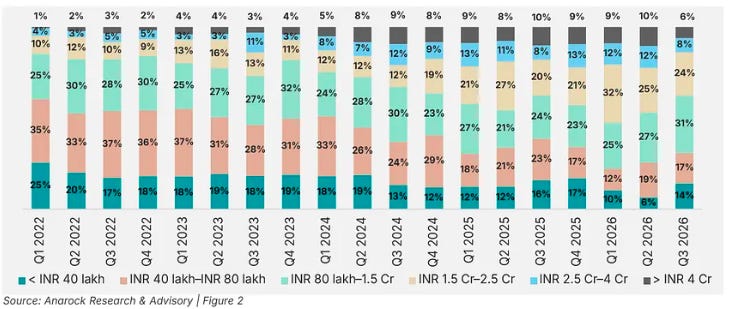
These projects take years to build and need a lot of money. DLF expects wealthy buyers to keep buying as it puts more flats up for sale. If it builds too many at once, it may struggle to sell them all.
[12] SRF is investing ₹600 crore in battery foil
Chemical company SRF has announced a ₹600 crore plant in Madhya Pradesh to produce aluminium foil for batteries. Its subsidiary, SRF Altech, will build it in two stages. The first is due by September 2028. Once complete, the plant will turn out about 12,000 tonnes of foil a year.
Battery foil is far thinner than the kind used to wrap food. In a lithium-ion battery, it forms the base of the positive side, called the cathode. It collects electric current and carries it to the outside circuit. Even small flaws can affect how well the battery works, so the foil must meet strict quality standards.
India is building more batteries for electric vehicles and power storage, which will raise demand for the materials inside them. SRF Altech already produces aluminium foil for packaging, so this is a step into a harder product. Battery makers test and approve new vendors before placing large orders, and SRF will have to prove its foil can match the quality and price of established players.
That’s it for this week.
A few of these stories are still developing, so we’ll be keeping an eye on them. But if there’s one you’d like us to write about properly, let us know in the comments.
See you next edition :)