

Our goal with The Daily Brief is to simplify the biggest stories in the Indian markets and help you understand what they mean. We won’t just tell you what happened, we’ll tell you why and how too. We do this show in both formats: video and audio. This piece curates the stories that we talk about.
You can listen to the podcast on Spotify, Apple Podcasts, or wherever you get your podcasts and watch the videos on YouTube. You can also watch The Daily Brief in Hindi.
In today’s edition of The Daily Brief:
Monkey business
Inside India’s visa rules for foreign workers
Monkey business
We recently saw a Financial Times headline that threw us off completely. It went: “Prices for lab monkeys surge on China biotech boom.”
We didn’t know what to make of it. Monkeys aren’t exactly something you expect to see in a business story, let alone one about soaring prices. We simply had to indulge ourselves and jump down this rabbit hole. The further we went, the more questions it threw at us. How important are lab monkeys to the field of biotechnology? What does a market for live animals even look like? What happens when they get too expensive, or there aren’t enough?
This story is our attempt to ask those questions and answer them. We’ll go from the demand story to the supply bottlenecks, into the strange economics of monkey business, and all the way down to the outright weird stuff in between.
Why is biotech going bananas for monkeys?
Let’s start with the basics. What exactly are “lab monkeys”?
These are usually macaque monkeys used for biomedical research. Crucially, they are not captured randomly from the jungle. They’re born and raised in controlled breeding facilities, screened, documented, and kept disease-free, so that labs doing tests on them can trust their data.
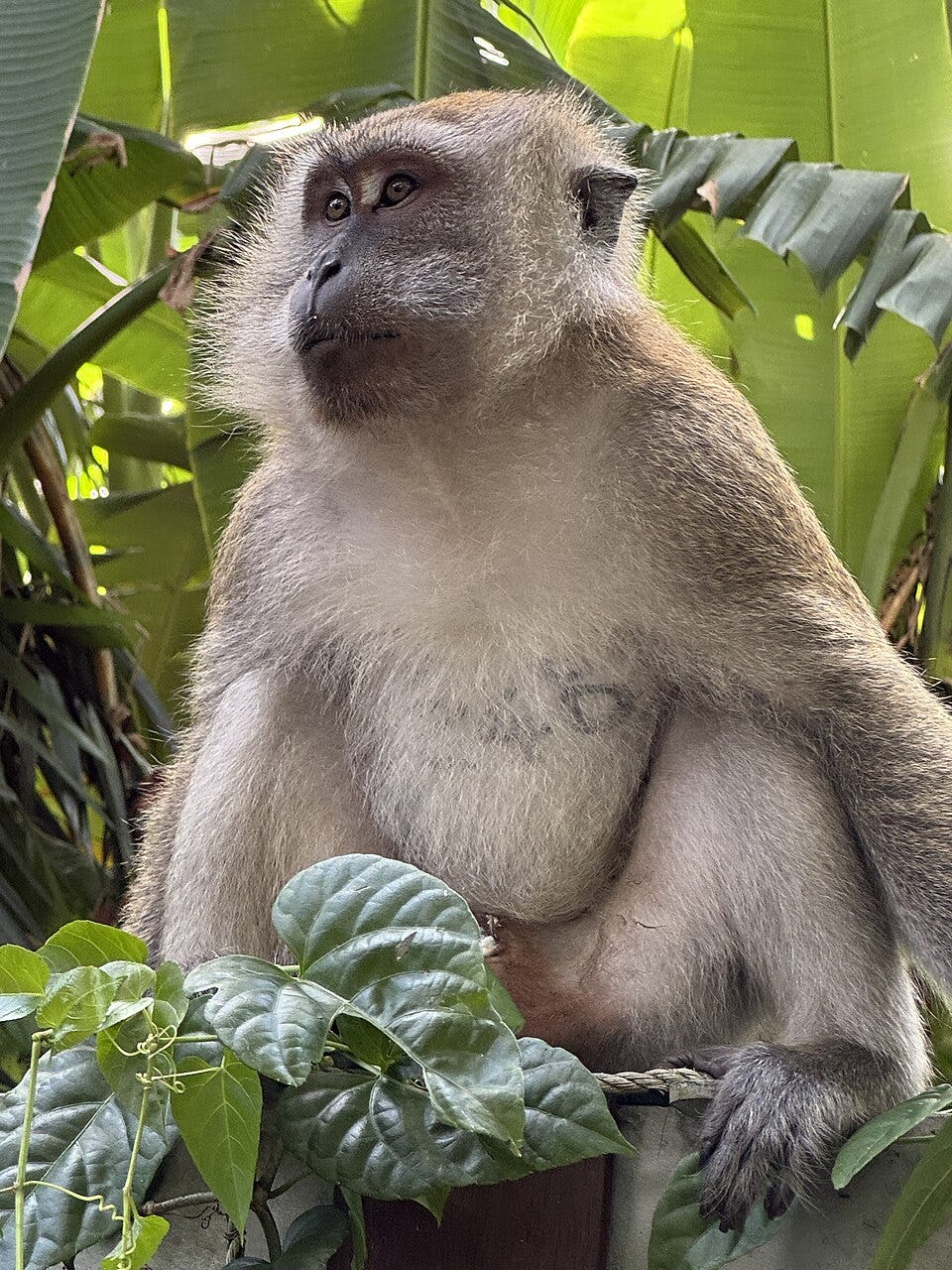
But why macaques specifically?
Well, before you can start testing a drug on humans, drug development rules need you to test two other animals: one rodent (mice/rats) and one non-rodent (often a dog, pig, or monkey). If you’re building a drug for real humans, naturally, you pick the animal that behaves most like one. Non-human primates are closer to us in biology than most other lab animals, so they’re often the “safest” non-rodent bet.
That said, apes are even closer to humans than macaques. But are more practical to house, handle, and scale, while still giving results regulators tend to take seriously.
In short, macaques are close enough to humans, while being easy enough to handle. This is why most labs end up using monkeys, even though there’s nothing specific asking them to do so.
Where do the monkeys fit into the drug development pipeline?
Well, finding new drugs is a three-step process. First comes discovery, where scientists tinker in labs to find a promising molecule. Next is pre-clinical testing on animals to assess its safety. Finally, if animal data looks good, the project moves into clinical trials on humans. Monkeys come in during that second, pre-clinical stage, after initial tests in rodents, to check for toxicity or efficacy.
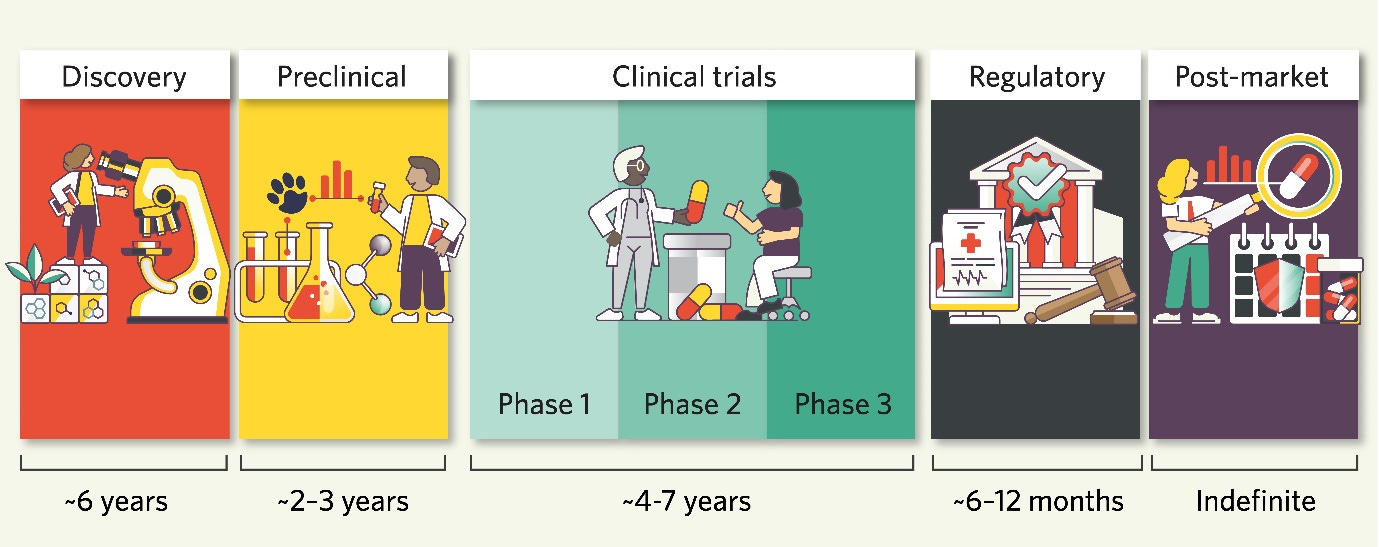
This stage is expensive and time-consuming — and worse still, it does harm a lot of animals. But it’s non-negotiable. The alternative is to jump straight to people before you know how living things, in general, react to it. That would be even worse.
The farther a drug progresses, the more monkeys are needed. Early in development, a lab might run a quick feasibility test on a handful of rodents and a couple of monkeys. But if the drug shows promise, animal testing ramps up significantly. Doses get larger, study durations longer, and sample sizes are increased. For instance, one report from China suggests that a standard 28-day toxicology test uses around 40 monkeys on average.
The bottom line? Monkeys are tied in, fundamentally, to the creation of medicine.
Mapping the monkey market
Whenever you hear about a record number of new drugs in development, somewhere, there are hundreds of monkeys in a lab being given that drug. They might or might not make it through. That ugly fact is the cost of making things that are meant to interfere with what’s happening inside your body.
How do those monkeys get there? Well, there’s a massive international market for them.
Scrambling for specimens
So, who buys those monkeys?
By and large, its drug developers themselves — biotech start-ups and big pharmaceutical companies racing to bring new treatments to market. Often, they outsource hands-on animal work to specialized Contract Research Organizations (CROs). These large CROs either run their own primate colonies or source animals from breeding centers.
The biggest consumers of lab monkeys, traditionally, have been major research hubs like the United States and Europe. But today, Chinese labs are an equally hungry customer. China’s biotechnology sector has exploded in the past few years, buoyed by record venture funding and partnership deals with Western pharma. Flush with cash, Chinese companies have launched a wave of new drug programs, all needing preclinical tests.
Breeding supply
Right now, the demand for monkeys is bananas. But can’t we just produce more lab monkeys to meet it?
If only it were that simple.
Any market dealing in living creatures is a terribly complicated space to be in. And the larger the creature is, the more convoluted things become.
You can’t suddenly raise a massive number of monkeys. They are slow to reproduce, and costly to raise. A female monkey typically gives birth to only one or two infants a year. Following that, there’s a gestation period of around 5.5 months. And mothers often need a recovery period before conceiving again.
And then, those monkeys have to be raised. In China, breeders claim it takes about four years to raise a monkey from birth to when it’s suitable for research trials. Some sources even estimate that you need up to 5–8 years to fully expand a colony to commercial scale. That is, if a supplier decides to double their output today, it could be the end of this decade before those animals are ready. Until then, you need to provide them specialized care — like spacious cages, veterinary oversight, and disease screening. All those overheads limit how fast you can scale up.
Because of this, dealing in lab monkeys simply doesn’t work like a standard business. It’s rather like animal husbandry. If demand spikes, you can’t flip a switch and make more monkeys. This set the stage for the crunch we’re seeing now.
Let’s assume that you have enough monkeys, though. Transporting them, too, is difficult.
Take the United States, for example. For one, the U.S. Centers for Disease Control (CDC) tightly regulates primate imports. Non-human primates can only be imported for bona fide scientific, educational, or exhibition purposes. To ensure this, every single shipment of monkeys must be registered in advance, and then inspected upon arrival. They must then undergo a 31-day quarantine, during which they need to be cared for.
All this makes for a fragile global supply chain for lab monkeys. And lately, it has been worse than ever.
The food supply chain, today
Most of the world’s lab monkeys, traditionally, come from Asia.
Back in the 1950s–70s, India was actually the world’s largest exporter of rhesus monkeys for research. In 1978, however, we banned the export of monkeys, on ethical and conservation grounds.
But others quickly took our place. China rose to dominate the market by the 1990s, leveraging its large native macaque populations and lower labour costs. By the 2010s, it was supplying the bulk of the monkeys for American and European labs.
But in early 2020, as COVID-19 hit, China banned the export of all wild animals. This included lab monkeys, including those bred in captivity. The world’s biggest monkey supplier had shut its doors overnight.
This was precisely when the global demand for monkeys was spiking for vaccine research. As China withdrew, there was sudden chaos in Western labs. Importers began scrambling for alternate sources — leaning harder on Cambodia, Vietnam, and Mauritius. Prices for imported monkeys skyrocketed, while waiting times lengthened.
This was a boon for Chinese research — they had a large supply of domestic monkeys, with no competition from foreign buyers. They effectively got first dibs on homegrown primates, while U.S. and EU researchers were left bidding up limited supply elsewhere. That export halt has never been fully lifted.
As China stopped exporting, Cambodia rushed in. But that made an already ethically grey business even more murky. Their exports began rising faster than breeding biology allowed. It eventually turned out that many of those monkeys were smuggled, with wild monkeys being laundered as captive-bred. Not only was this inhumane, it also meant these monkeys weren’t fit for actual tests.
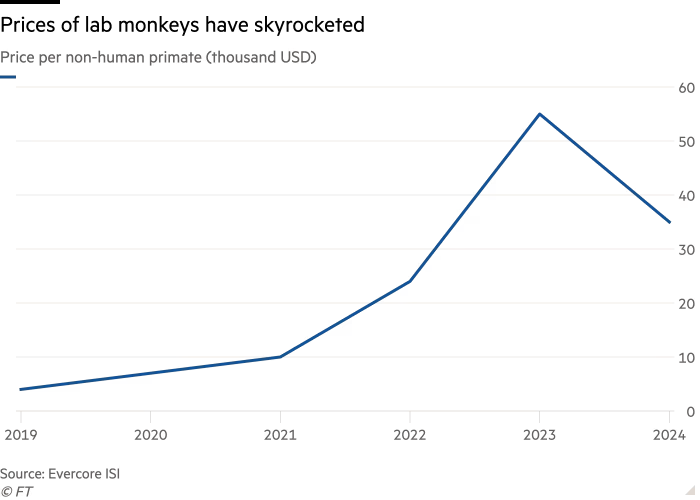
These demand-supply shenanigans have made lab monkeys astonishingly expensive. Pre-pandemic, a cynomolgus macaque would cost a lab about $4,000. By 2022, the price had exploded to $20,000 or more. A monkey was literally more expensive than a car.
Prices then dipped, as biotech funding dried up in 2023 — only to surge again in 2025 as research roared back.
Why these wild swings? It goes back to the 4-year (or longer) breeding lag. When prices shot up in 2020-2022, everyone tried to breed more monkeys. But by the time new monkeys had been reared, demand had cooled off. Breeders who over-invested got burned when prices fell in 2023. Fast forward to 2025: demand spiked again, but now too few monkeys are available because breeders hadn’t kept expanding during the lull.
This cycle hints at why prices don’t stabilise. You’re dealing with living creatures that keep eating (and aging) regardless of market conditions. Producers can’t just stockpile monkeys in the freezer until the market improves. So, supply never follows demand neatly — it’s inelastic.
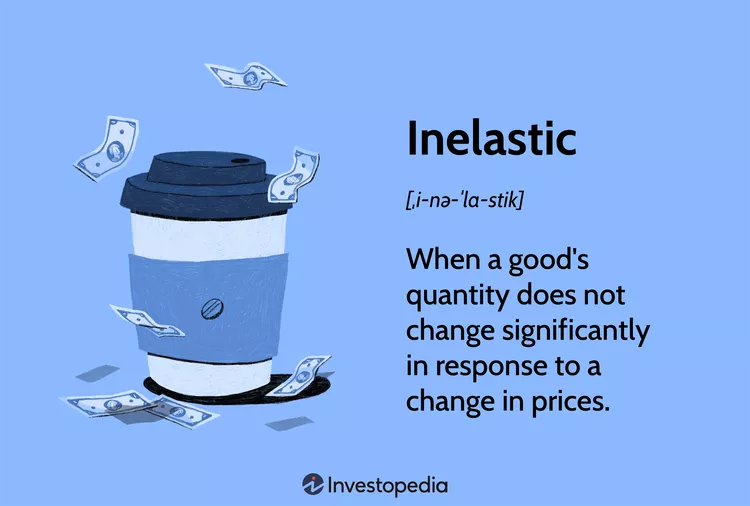

This causes real economic friction in the biotech and pharmaceutical industry. Moreover, contract researchers can’t always pass costs on to clients — since many are fixed-price.
The hack
How does one get around a global monkey shortage?
There are the standard supply-side answers. Stakeholders are pushing for expanded supply — ranging from encouraging more countries to set up ethical breeding colonies, to what, in our eyes, is basically a state-backed monkey reserve (yes, we’re joking, but only a little).
Meanwhile, a more immediate adjustment has been to re-use monkeys. Usually, a monkey is used in a single study, and then “retires”. But desperate times call for desperate measures. After using a monkey for one test, some labs have been using them again in others after a “washout period” — once the animal’s system is cleared of any drugs. This isn’t a perfect solution: it’s only feasible for some studies, where the previous test can’t interfere with the new one. But it effectively “stretches the supply”, making it possible to run multiple tests on the same animal. Regulators do allow this practice in some cases.
Regulators, too, are coming to see the difficulties involved. In a notable move, the U.S. Food and Drug Administration (FDA) recently relaxed some requirements for safety testing that traditionally involved monkeys.
In the long-term, AI might come to the rescue of both labs and monkeys. The UK, for instance, is investing in computer models and AI tools that can predict drug safety without using animals. However, that won’t solve the immediate problem.
Before we wrap up, a quick note on India: ever since India banned monkey exports in 1978, it has largely stepped away from primate research — becoming a bystander in this saga. Indian CROs, too, don’t rely heavily on primates. We still feel the ripple effects, though. As a global pharmaceutical hub, any trend that touches drug development, downstream, trickles down to us.
Inside India’s visa rules for foreign workers
Last month, India introduced a major visa rule.
The government launched an e-Production Business Visa (or e-B-4) visa that lets foreign engineers and technicians enter India for short-term production work — like equipment installation, commissioning, quality checks, and training local staff. For the first time, Indian manufacturers could instantly generate sponsorship letters online, without the cumbersome ministry approvals that had long plagued the process.
This wasn’t entirely random timing, though. Just a few months prior, Foxconn had pulled over 300 Chinese engineers out of its Indian iPhone factories, seemingly on the order of Beijing. One possible reason (among many) for this callback could be that it is retaliation for India’s strict visa norms for Chinese nationals.
Keeping this incident aside, a case has been building for India to relax its strict immigration norms for a while. We decided to dive into why this matters: how our visa rules work, how restrictive they are, and how far our new fixes go.
Closed borders
India’s primary route for foreign professionals is the Employment Visa (E-Visa). It comes with strict conditions: it excludes routine roles, and only applies for a maximum of 5 years. What that basically means is for low-value, labor-intensive jobs, foreign workers are not allowed to be on Indian payroll. This is also reflected in the massive salary floor of the visa. For a long time, you could only get an E-Visa if you earned more than $25,000 a year (~₹23 lakh today).
Why was the benchmark in dollars rather than rupees? Perhaps, this was meant to be a hedge against rupee inflation, the dollar being less volatile. Additionally, if the rupee depreciated against the dollar, Indian employers would have to pay foreign workers more in rupee terms to meet the same dollar benchmark. If they couldn’t, those workers might become ineligible for a future visa renewal. This automatically strengthened the strictness of the filter.
However, in late 2016, this benchmark was localised into the rupee-denominated threshold of ₹16.25 lakh a year. This is quietly reflected in many official embassy guidelines, but somehow, not the original documents.
Then, there are Project Visas, where foreign workers, who must be highly-skilled, can only reside in India for a year at maximum. It also limits the number of foreign workers to 1% of the workforce per project. Meanwhile, the Business Visa (B-Visa) is meant for more temporary purposes like conferences. You can’t really use a B-Visa to do technical work.
Lastly, for academics, there are research visas. You only get one if you’re already linked to an Indian university, and the visa only lasts for the duration of the research project. It requires a detailed application where you have to mention past visits to India, which places you need to visit in India for your project, etc. You might even require clearance from a central ministry in some cases.
From all this, we get a sense that Indian visa policy for foreign workers and researchers can be pretty restrictive. It is also very hard to convert any one type of visa into another, or even use one visa under the garb of doing work covered under another visa.
To some degree, this restriction makes sense. After all, India is a labour-abundant economy with millions of young job-seekers, so our own labour markets should take priority. However, some of this is also politically-driven. When low-skilled foreign workers, mostly from China, flooded Indian projects in the 2000s, Indian job-seekers (and authorities) were left unhappy. How can one hire from abroad when many Indians remain unemployed, or employed in worse-off jobs? The high $25,000 floor was partly a response to this.
The manufacturing bottleneck
These rules did make some sense, until it met India’s manufacturing ambitions head-on. India’s push for industrialization required exactly the kind of foreign expertise these rules blocked.
In the wake of the Galwan Valley clash in 2020, India effectively froze all visas for Chinese citizens. But, since then, the damage has been severe. As per one estimate, in the last 4 years, visa-related delays caused losses worth billions of dollars to our electronics industry. The solar energy industry was hit by shortages of skilled labour as Chinese specialists couldn’t enter easily. As a result, our assembly lines sat idle.
Such a situation was hardly new. Even back in 2009-10, when India enforced rules requiring Chinese workers on power plant projects to obtain proper E-Visas, many working on other visas had to leave abruptly. This sudden departure affected the commissioning of nearly 17 GW of power plant capacity slated for India’s 11th Five-Year Plan, as these projects were stranded without key technical staff.
You might ask: didn’t we relax the rules when companies like Samsung and LG came onboard? We did, but the situation with Chinese technicians is different for a few reasons besides geopolitical rivalry.
For one, many Korean and Taiwanese professionals who came to India were senior managerial and engineering staff — people who likely cleared the salary floor. Chinese technicians, by contrast, often work on the factory floor, and are far cheaper than their Korean or Taiwanese counterparts. The expertise gap India faces is at the factory floor more than the boardroom.
Secondly, we import advanced capital machinery far more from China than either Taiwan or South Korea. The manuals of these machines are also in Chinese. So, they need specialized vendor technicians from China to calibrate this equipment.
The latest e-B-4 visa addresses this gap directly. It removes the salary floor for factory work and allows stays of up to-6 months. It has made the processing of Chinese business visas much faster than ever before.
But does more need to be done? The e-B-4 visa is a short-term, sector-specific fix. It doesn’t create a pathway for foreign experts to stay longer, train more Indians, or build institutional knowledge. The standard visa rules outlined above continue to be applicable.
At the same time, though, it reflects a clever geopolitical hedge. The E-B-4 visa covers Chinese professionals who are not on Indian payroll and can’t stay for long. The idea is to make use of their expertise without creating a long-term dependency on them. We have discussed this idea before in a previous edition, as Indian and Chinese firms explore joint ventures between them.
The research visa problem
While manufacturing gets the headlines, India’s research ecosystem faces similar constraints.
Unlike countries that offer researcher visas that are more open-ended in nature, India binds foreign scholars to specific projects and institutions. There’s no Indian equivalent of the US’s O-1 visa for “individuals with extraordinary ability“ — no pathway for a talented foreign scientist to simply come here on the back of what they’ve already proven.
The result of that is quite predictable: India has very few foreign professors or researchers in permanent posts. Even the elite IITs have struggled to hire international faculty. Until recently, any foreign faculty appointment required case-by-case clearance from multiple ministries — a process that could take 6-18 months. In 2016, the government relaxed some rules for IITs and even considered lowering the $25,000 salary bar for academics. But foreign faculty remain a rarity.
Part of this reflects deeper issues. Indian universities pay poorly by global standards, and a foreign professor might have to take a significant pay cut to work here. And the links between Indian industry and academia remain weak. So, there’s not enough demand for cutting-edge researchers — especially since the Indian private sector spends very little on R&D. Maybe, these domestic problems need fixing first before we can import other researchers.
However, India is trying to change that, starting with our own diaspora. We’ve realized that there are extremely skilled Indian professionals who work abroad, and we’re attempting to reverse that “brain drain”.
For instance, the government launched the VAJRA scheme primarily for overseas Indian researchers. A scientist of Indian origin but based abroad can spend 1-3 months a year in an Indian institute, with the government paying a generous stipend. Additionally, the government also launched the G20 Talent Visa, a special sub-type of India’s Student Visa inspired by the US’ O-1 visa.
Both schemes seem to be useful, but are merely patchworks over the existing rule framework. In fact, even G20 Talent Visas are only granted to those who are invited by Indian institutions, irrespective of how talented they are. Neither scheme is the same as building a permanent international research or faculty base, and will not be useful without India fixing its domestic links between industry and academia first.
When did others open up?
How did India’s peers seem to fare when it comes to opening up to foreign skilled workers?
China, for instance, was actually quite closed to foreign workers for decades. But, as it aimed for cutting-edge sectors, it pivoted. By the 2010s, China introduced the “Thousand Talents Plan” to recruit overseas Chinese scientists and top foreign researchers. Just last year, they introduced the K-Visa which allows gifted international students to stay in the country even if they don’t have a job offer upfront.
Vietnam provides another telling comparison. Facing high-tech skill shortages, Vietnam streamlined its labor market tests last year and launched a 5-year “Talent Visa” for top technology experts. Taiwan, too, has only recently eased rules to attract foreign students as well as remote workers.
Interestingly, none of them opened up immediately. Much like India, they waited until they were competing on not just cheap labour, but actual product innovation. Additionally, in the case of China and Taiwan, their declining birth rates may also be a motivation. As their demographic dividend dwindles, they would have more incentive to allow immigrants.
What comes next
India’s recent visa reforms acknowledge what was long denied: that overly-restrictive policies were self-sabotaging. However, India also has to ensure that easing visa rules fits within its geopolitical security, and that’s no easy task. The e-B-4 visa, in that respect, seems like a pragmatic fix for a tense, high-wire situation.
To a degree, our experience with importing talent is also guided by our stage of economic development. This is validated by the experiences of our emerging-market peers who faced similar trade-offs.
However, India still faces steep challenges. We rely almost entirely on our homegrown talent pool for research and high-skill work, tapping the diaspora for occasional knowledge transfer rather than building something more long-lasting. Whether that’s good enough depends on India’s ambitions to build high-tech hubs, like semiconductors or biotech.
Tidbits
Warner Bros rejects Paramount’s $108 bn hostile bid
Warner Bros Discovery has rejected Paramount’s $108 billion takeover offer, calling it inadequate and too risky due to heavy debt financing. The board said its $83 billion deal with Netflix is a better option and warned that accepting Paramount’s bid could add $54 billion of debt and trigger $4.7 billion in exit costs.
Source: Financial Times
India expects strong growth despite US tariff hit
India’s economy is projected to grow 7.4% in FY26, beating earlier forecasts, despite 50% US tariffs on some exports. Strong government spending, private consumption, and reforms are cushioning the impact. India has also overtaken Japan to become the world’s fourth-largest economy.
Source: Reuters
African states eye stake in De Beers
Several African governments—including Botswana, Angola and Namibia—are exploring buying a stake in De Beers as parent Anglo American looks to exit. Business groups and global investors have also shown interest, valuing De Beers at about $4.9 billion. The diamond major is doubling down on India, where demand is expected to surge.
Source: Reuters
- This edition of the newsletter was written by Kashish and Manie.
Tired of trying to predict the next miracle? Just track the market cheaply instead.
It isn’t our style to use this newsletter to sell you on something, but we’re going to make an exception; this just makes sense.
Many people ask us how to start their investment journey. Perhaps the easiest, most sensible way of doing so is to invest in low-cost index mutual funds. These aren’t meant to perform magic, but that’s the point. They just follow the market’s trajectory as cheaply and cleanly as possible. You get to partake in the market’s growth without paying through your nose in fees. That’s as good a deal as you’ll get.
Curious? Head on over to Coin by Zerodha to start investing. And if you don’t know where to put your money, we’re making it easy with simple-to-understand index funds from our own AMC.
Thank you for reading. Do share this with your friends and make them as smart as you are 😉
Just wanted to share some appreciation for The Daily Brief. I love that this level of knowledge is being distributed so freely. It’s a true treasure trove for people like me. I’m a huge fan of the writing style and really appreciate the immense time and research that clearly goes into every piece. Hope it never stops!
The fact that for conducting a medical trial - you need to use it on one rodent and one non rodent was completely new to me.
Really appreciate the information that you guys are doing. 😊