



Our goal with The Daily Brief is to simplify the biggest stories in the Indian markets and help you understand what they mean. We won’t just tell you what happened; we’ll tell you why and how too. We do this show in both formats: video and audio. This piece curates the stories that we talk about.
You can listen to the podcast on Spotify, Apple Podcasts, or wherever you get your podcasts and watch the videos on YouTube. You can also watch The Daily Brief in Hindi.
In today’s edition of The Daily Brief:
1. Where’s the last-mile of India’s LPG revolution?
Despite Pradhan Mantri Ujjwala Yojana expanding LPG coverage to over 10.5 crore women, many low-income households continue to rely on traditional firewood and “fuel stacking” due to high refill costs. CEEW studies highlight that while 80% of surveyed households expressed a willingness to transition fully to clean energy at ₹400 per cylinder, current subsidised prices remain significantly higher, leaving families caught between high fuel expenses and dangerous indoor air pollution.
2. Why are airlines opposing the move from Mumbai to Navi Mumbai?
Mumbai International Airport’s planned redevelopment of ageing Terminal 1 structures starting January 2027 requires moving displaced domestic flights into T2, forcing a 33% reduction in international flight capacity to Navi Mumbai. The International Air Transport Association (IATA) and global carriers strongly oppose this mandatory shift, citing operational inefficiencies, doubled ground setup costs, loss of connecting traffic, and concerns over historic slot allocations.
Where’s the last-mile of India’s LPG revolution?
Imagine the gas cylinder in your kitchen runs out tonight. For most households that use LPG, what happens next is almost automatic. You book a refill, pay when it arrives, and go back to cooking.
But that decision looks very different when you move down the income ladder. There is food to buy, rent to pay, medicines and school fees to cover. In fact, many would prefer to cook food using firewood, which is far cheaper than LPG. It can cook the night’s dinner without costing you anything right now.
That small decision, repeated across millions of kitchens, sits at the heart of India’s clean-cooking problem.
Over the last decade, India has worked hard to make LPG available to poorer households. Under the Pradhan Mantri Ujjwala Yojana, more than 10.5 crore women have received gas connections. LPG coverage rose from 62% of households in 2016 to, on paper, more than 100% by 2024.
But owning a cylinder is not the same as cooking with it every day. An average Ujjwala household uses fewer than five cylinders a year, while a household cooking entirely on LPG would typically need 7-8. In many homes, the chulha comes back on for cooking.
In June, the government reduced the annual number of refills on which an Ujjwala household gets a ₹300 subsidy from 9 to 4. As per the logic of the petroleum ministry, four refills are broadly what a typical household uses in a year. On those four, a 14.2 kg cylinder in Delhi costs ₹642 instead of ₹942. From the fifth refill onwards, the household pays full price.
There is a strange loop here. Poorer households use less LPG partly because refills are expensive. Now that low usage is also being used to decide how many refills should get support.
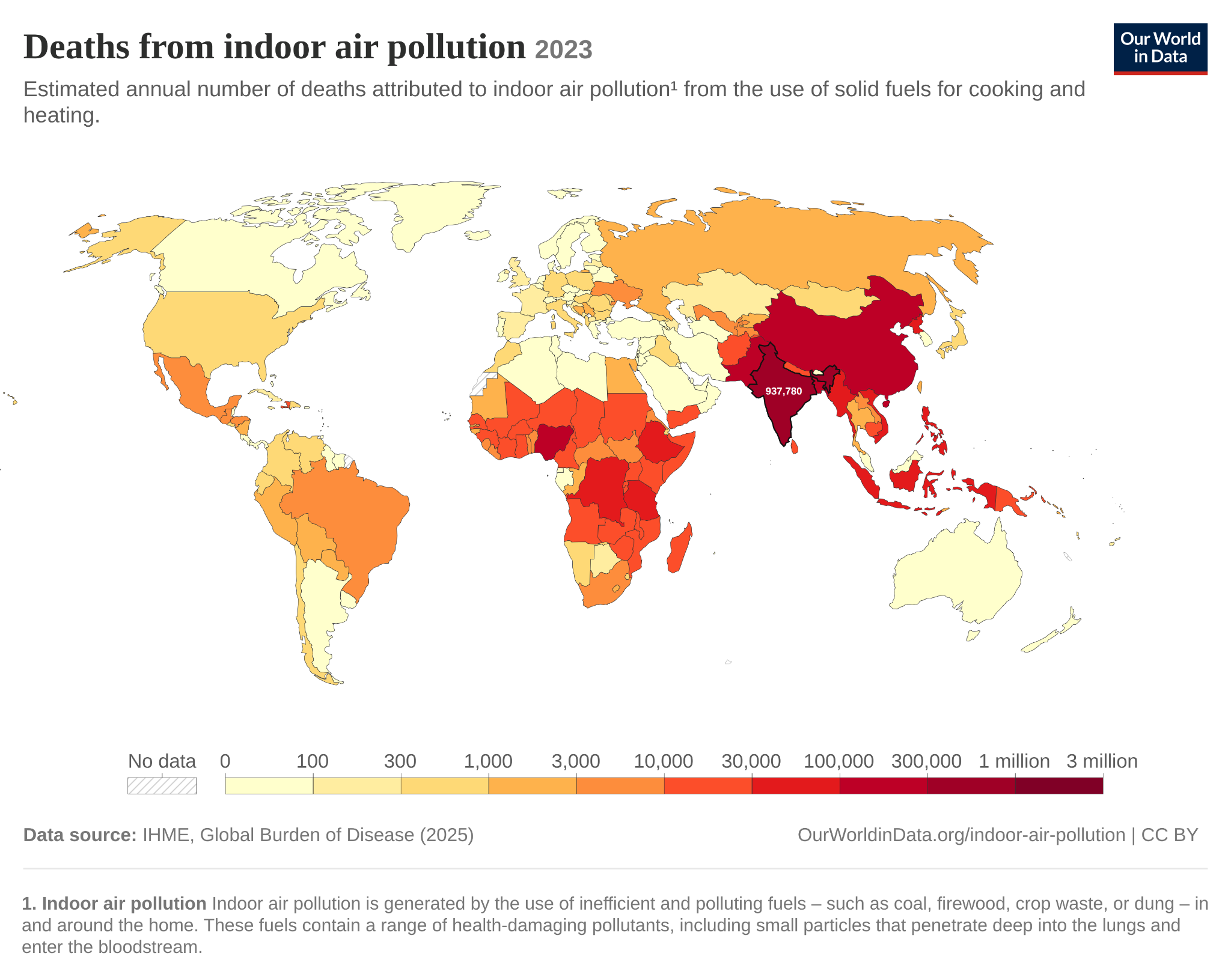
And the alternative is not harmless. Household air pollution from burning wood, dung and crop waste was linked to more than 9 lakh deaths in India in 2023.
So why, after getting LPG into so many poorer homes, are so many families still lighting a chulha?
Three new studies from the Council on Energy, Environment and Water, or CEEW, help answer that question. Together, they surveyed more than 4,000 people across rural households, urban informal settlements and migrant workers. Our story is an amalgamation of their findings.
A cylinder isn’t a transition
The headline Ujjwala connection numbers can be misleading. Ujjwala made it easier to enter the LPG system, but after the first connection, gas becomes a purchase the family has to make again and again.
You can see this most clearly in rural India. Nearly 75% of the rural households CEEW surveyed across six states had used LPG in the previous three months. But fewer than a quarter cooked only with it. Half still relied mainly on firewood.
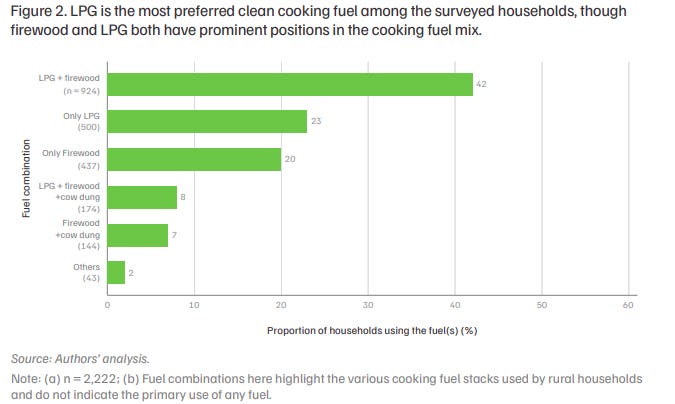
These families hadn’t really substituted one fuel for another, but merely added LPG to a kitchen that continued burning wood and dung alongside it. Researchers call this fuel stacking.
From a rural household’s perspective, collecting firewood is far cheaper than the alternative. Think about when income arrives seasonally from a harvest, or unpredictably through daily-wage work. If the cylinder empties during a bad week, another LPG refill has to compete with groceries, medicines and other critical expenses.
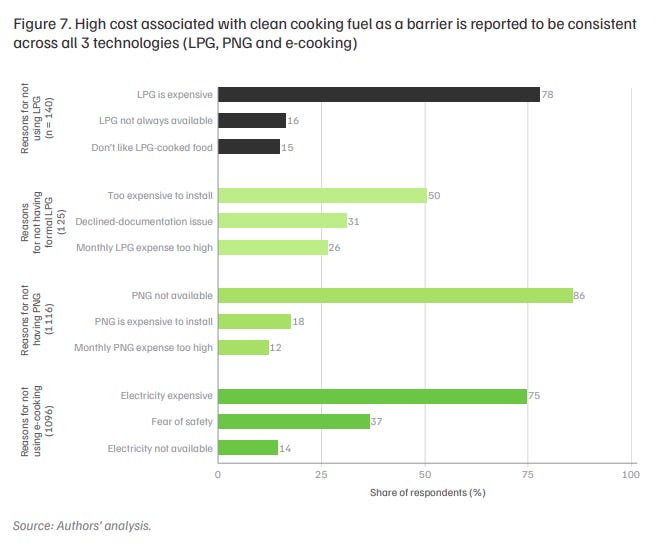
That is also why 70% of the rural households surveyed that didn’t use LPG named refill cost as a major barrier. And these families stretch one cylinder for as long as possible. LPG might handle a quick meal while the chulha handles food that takes much longer.
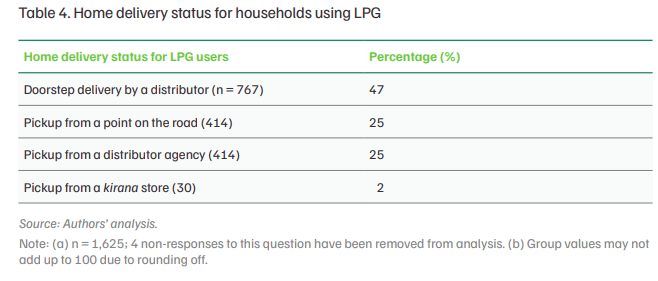
Forget ordering another cylinder, even picking it up from a center adds to the cost. Only 47% of rural LPG users surveyed had cylinders delivered home. Everyone else had to travel to a distributor or pickup point, and that added to the bill beyond the cost of a refill.
Close to the cylinder, outside the system
Now, how does the picture change when you move from a village to a city?
In a city, many poorer families live in what are called informal settlements. These are neighbourhoods that have grown outside the city’s formal housing system, where residents may not have recognised addresses, secure property rights or the same access to basic services as people in formal areas.
However, lighting a smoky chulha in a crowded neighbourhood is far less practical, and that is assuming the city is close to a forest area. LPG, meanwhile, is usually much easier to get.
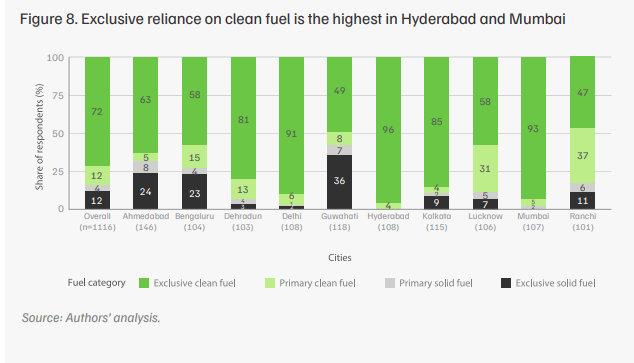
CEEW surveyed households in these settlements across ten cities. Among them, 70% cooked only with LPG, compared with 23% in its rural sample. These are different groups, so this isn’t a clean urban-rural comparison, but a city does seemingly make access to gas easier.
Even then, a connection doesn’t guarantee a full transition, and fuel stacking exists among poorer households here as well. Of the 10 cities, Ranchi had the highest rate of fuel stacking at around 50% despite also having the highest share of Ujjwala connections.
Yet, affordability is only half the urban story.
About one in ten households got LPG without a formal connection through unauthorised dealers. Very simply, there is an additional cost to securing a cylinder connection informally. Formal users reported paying a median ₹850 for a standard 14.2 kg cylinder, while informal users paid ₹1,040.
Many of them had previously been refused a formal connection because they lacked required documents, including proof of current address. In fact, most of the formal users got their cylinders delivered home, but 79% of informal users did not enjoy the same privilege. Then, to serve the demand existing outside of the formal system, informal gas sellers stepped up. But they clearly will want extra for supplying a cylinder without the need of proper verification.
Half of the informal users also said they couldn’t afford the upfront cost. CEEW estimates that 13% of all households in its urban sample were eligible for Ujjwala but hadn’t enrolled.
What if your home keeps moving?
Every year sees millions of Indians move from their rural households to cities which house many of these jobs. So, many of these urban informal settlements are often inhabited by migrants, who primarily work in construction, sanitation and transport. CEEW surveyed them as well and found unique patterns in their fuel use.
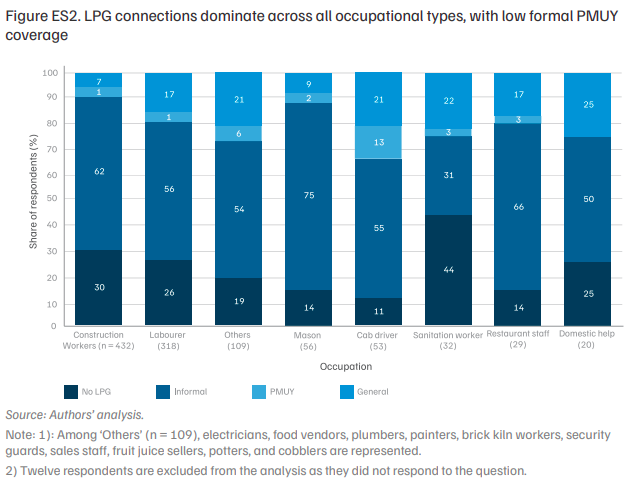
Around 79% of those who used gas relied on informal connections, while only around 4% were beneficiaries of the formal scheme. This tracks with the fact that migrants form a large chunk of informal workers in the Indian economy. There is no national data on how many migrants the scheme reaches, so that 4% isn’t a national figure. But perhaps, there is a reason for it.
You see, the LPG scheme was built around the idea of a settled household. Food subsidies faced a similar problem, which was tackled by the introduction of the “One Nation One Ration” Card. The newer version of the Ujjwala scheme similarly made LPG connections transferable, but getting into the formal system itself after moving still takes effort. And migrants without a proof of address are the most vulnerable to this reality.
There is also a marketing barrier, as migrants are often unaware that either such schemes exist, or that they’re eligible for it. This is not dissimilar to the finding of another CEEW study on stubble-burning, where farmers in Punjab were unaware of the state’s efforts to promote clean stubble disposal. We covered that report as well in the recent past.
Moreover, the opening hours of a gas distributor can overlap with the working day of a migrant. For a daily-wage worker, visiting a gas agency can mean losing income.
But even when migrants can get LPG, they often buy it differently. Informal buyers purchasing a full 14.2 kg cylinder paid around ₹71 per kilogram. But even among informal users, those buying smaller 5 kg cylinders paid around ₹100 per kilogram. The smaller purchase was the most expensive.
But this is no irrational decision. A full cylinder may be better value, but that doesn’t help a daily-wage worker who doesn’t have a thousand rupees of cash on hand. It’s the same reason people buy shampoo in sachets instead of larger bottles, which are cheaper on a price-per-gram basis. That is why CEEW suggests testing pay-as-you-go “LPG ATMs”, where people could buy smaller amounts through formal channels instead of paying extra to informal sellers.
Who pays for the cleaner kitchen?
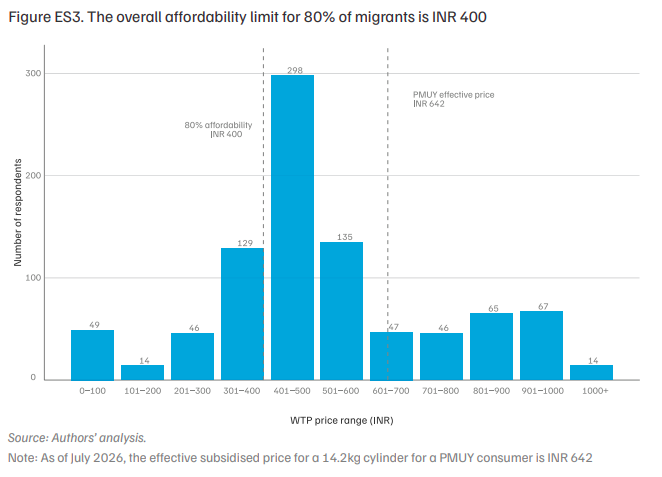
Across all three surveys, CEEW found the same broad affordability threshold: at ₹400 for a 14.2 kg cylinder, at least 80% of respondents said they would cook entirely with LPG.
It isn’t a magic number. The surveys were conducted between late 2024 and early 2025, before prices rose in April 2025 and again in 2026. And ₹400 is what people said they would pay, not necessarily what they would spend when money gets tight.
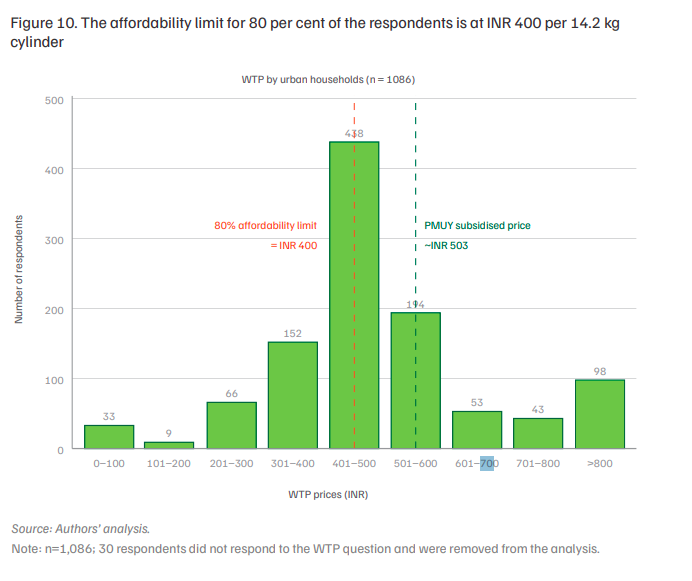
Still, it tells us something about the size of the affordability gap. An Ujjwala household today pays ₹642 for its first four refills and ₹942 after that. Getting anywhere close to ₹400 would mean somebody else absorbing much, much more of the cost.
India imports above 60% of the LPG it consumes, much of it from the Persian Gulf and through the Strait of Hormuz. When international prices rise sharply, the government doesn’t pass the entire increase on to households. State-owned oil marketing companies can instead sell domestic LPG below its market-linked cost, creating what is called an under-recovery.
This year’s West Asia crisis made under-recoveries unusually large. Saudi Aramco’s LPG benchmark rose about 46% between late February and early June. The petroleum ministry said the cost of supplying a domestic cylinder crossed ₹1,600, while a regular consumer in Delhi pays ₹942. Cumulative under-recoveries on household LPG had reached ~₹60,000 crore by the end of FY26. Even the current price of ₹942 doesn’t cover the full market cost, and the difference eventually sits with the household, the government or the oil companies.
One may think of ₹1,600 as an exceptional figure in a strange time, which will revert to the mean once the crisis ends. But at this point, the situation in West Asia has itself become highly normalized, and so have the massive under-recoveries.
Conclusion
That brings us back to the loop we started with.
There is an understandable fiscal logic behind the four-cylinder rule. But the clean-cooking logic points the other way. The fifth, sixth and seventh cylinders are precisely the ones needed to move from occasionally using LPG to cooking with it all the time.
For one household, a cheaper cylinder might be enough. Another needs a smaller payment at one time. Another needs easier access to the formal system. There is an overlap between these household types — perhaps, the same person has experienced each issue that plagues each set of consumers. But it is clear that there is no single fix to all their problems anyway.
India’s first clean-cooking challenge was relatively easy to measure: get LPG connections into homes that had never had them. But now, you need to get them to refill more, and different sections of society have different (if not conflicting) constraints in that regard. This policy challenge only gets harder as the Strait of Hormuz crisis gets prolonged. And no policy solution is any less costly than the other.

Why are airlines opposing the move from Mumbai to Navi Mumbai?
If you’ve flown through Mumbai’s Terminal 1, you may have felt it could do with a makeover. Beside the city’s own T2 or Bengaluru’s newer terminal, it feels dated for an airport serving India’s financial capital.
The problems go beyond appearances. Mumbai International Airport Ltd, or MIAL, the airport’s operator, has cited structural distress in older buildings and difficulties separating arriving and departing passengers in its submissions to AERA, the airport tariff regulator. But rebuilding a busy terminal requires somewhere else to put its flights.
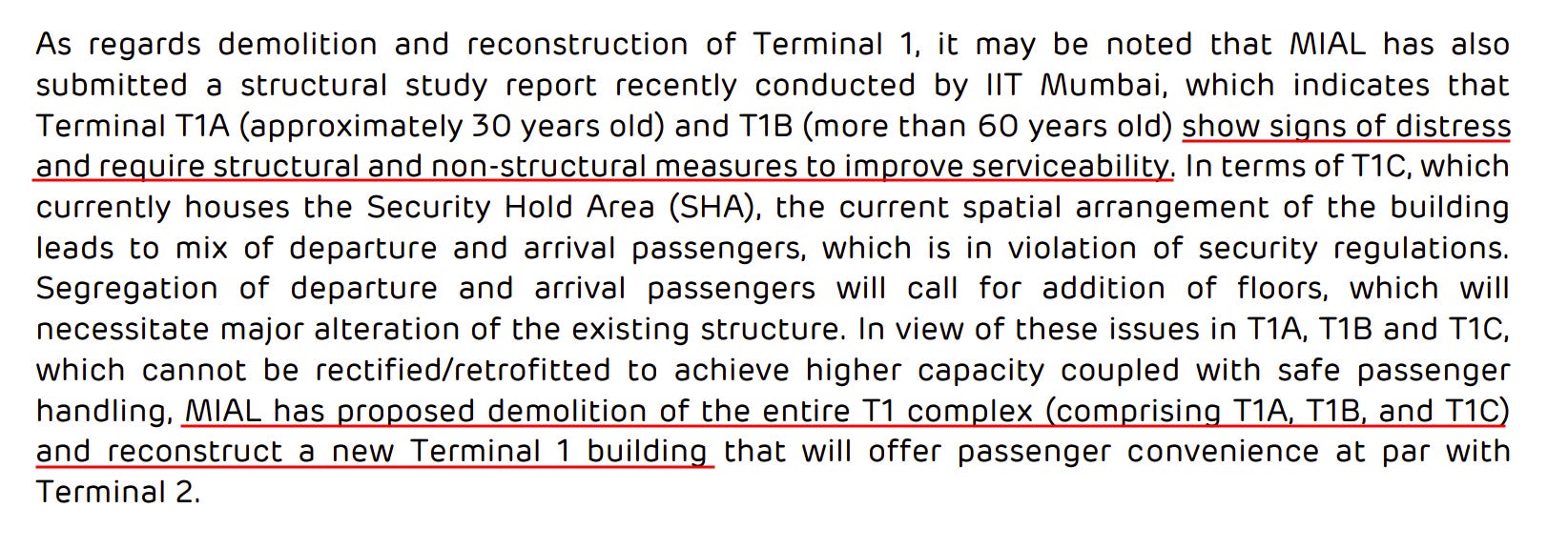
In January 2025, MIAL announced redevelopment starting that November, with T2 and Navi Mumbai absorbing the displaced traffic. That plan slipped because, according to the operator, Navi Mumbai wasn’t ready. By December, redevelopment was reportedly deferred to 2030. The latest timetable brings the first phase forward to January 2027, with commissioning expected in 2029–30.
T1 won’t shut entirely at once. The first phase covers T1B’s north section, accounting for roughly one-third of T1’s capacity. Flights using the other sections can continue operating there for now.
The reported reshuffle would move the displaced domestic flights into T2, which already handles both domestic and international services. To make room, roughly one-third of international operations would move from T2 to Navi Mumbai. International airlines are therefore being asked to change airports because a largely domestic terminal is being rebuilt.
That is where the International Air Transport Association, or IATA, objects. Its complaint concerns the proposed relocation of international passenger and cargo operations to Navi Mumbai. It questions the consultation, whether the new airport is even ready and capable for those operations and what’s the basis of this share of flights to move there.
A flight comes with baggage
To understand those objections, consider what an airline actually has to move.
An international carrier with a modest Mumbai schedule could need separate ground teams, handling contracts, equipment and supervision if it splits operations between two airports. It hasn’t necessarily gained passengers, but it may have almost doubled its set of fixed costs.
Air France-KLM makes this point. It opposes splitting passenger operations, although it would consider moving them entirely if capacity at the existing airport became unworkable.
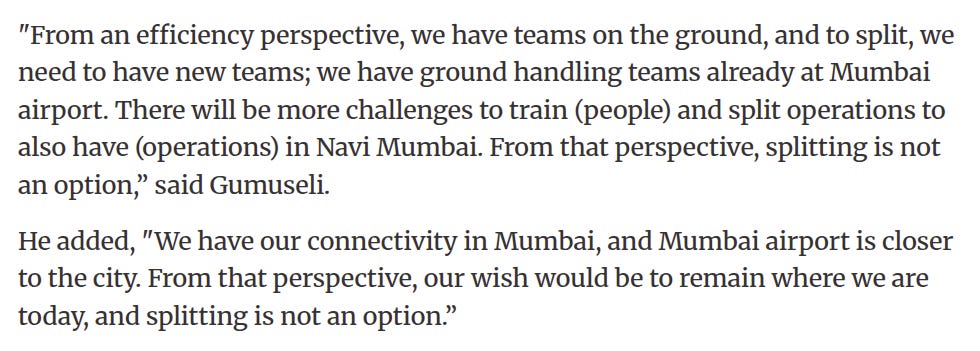
Connections add another complication. If a feeder flight arrives at Mumbai and the onward international service departs from Navi Mumbai, the passenger now needs a transfer. An itinerary that previously worked may become unattractive or impractical.
There is also the aircraft itself. A widebody needs suitable parking, ground equipment and maintenance support authorised for its type. IATA is seeking clarity on those arrangements, alongside catering and crew logistics. These are questions about readiness for particular operations; they do not establish that Navi Mumbai is generally unsafe or incapable.
The impact will consequently vary by airline. A carrier with a large local operation may have more flexibility than one running a handful of tightly timed services. An equal percentage cut does not necessarily mean an equal burden.
Who owns the clock?
These operational concerns explain why airlines care so much about retaining their airport slots.
A slot is permission to use the airport infrastructure needed to arrive or depart at a particular time. Runways, gates, aircraft stands and terminal facilities all determine how many flights an airport can accommodate.
For airlines, the timing matters enormously. A commercially useful slot lets them coordinate connecting flights, aircraft rotations and crew schedules. Losing it can disrupt much more than a single departure.
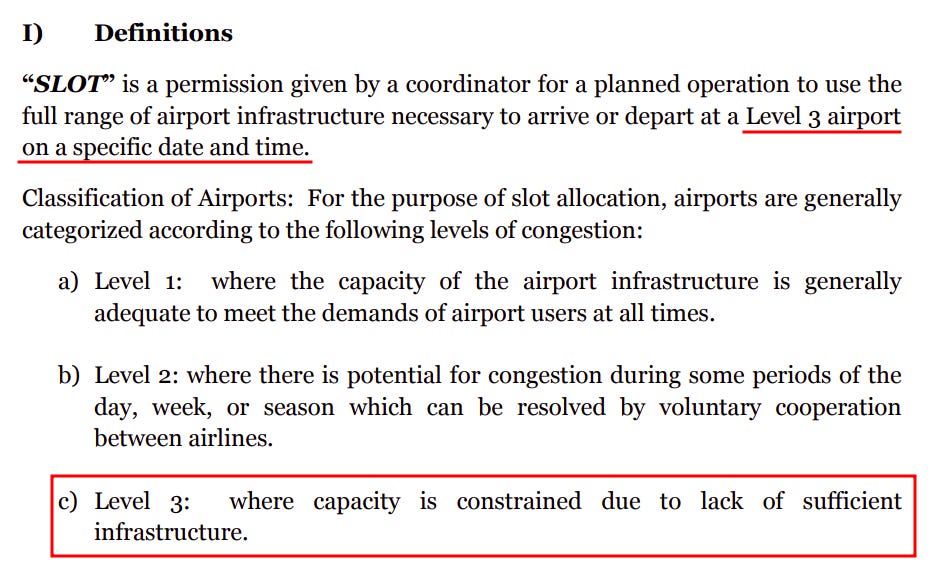
Under the Ministry of Civil Aviation’s slot guidelines, an airport-level committee comprising the operator, an Airports Authority of India air-navigation representative and DGCA assesses capacity. Airlines can comment before the findings and final capacity are published. The airport’s designated coordinator then allocates slots within those limits.
Airlines have conditional priority to retain slots from the previous equivalent season, known as historic precedence. Normally, this requires using a series of slots at least 80% of the time. The guidelines also require early consultation before capacity reductions. Reductions that cannot accommodate established historic slots should be avoided except in the most exceptional circumstances, and allocations must be neutral, transparent and non-discriminatory.
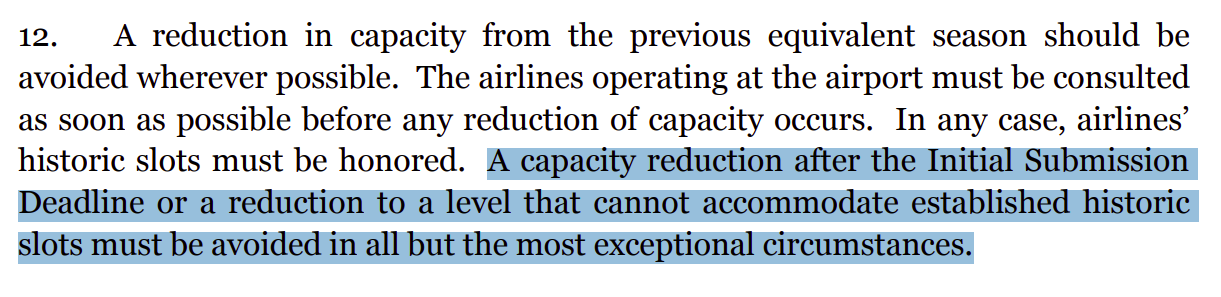
Applied here, the question is how the demonstrated loss of T1 capacity translates into the proposed cuts to international operations.
MIAL says redevelopment is included in AERA’s tariff order. But AERA’s assessment of investment and airport charges does not settle which airline should give up which flight.
The extent of consultation remains disputed too. IATA’s own submission acknowledges attending a March 2024 meeting on MIAL’s capital plans. Discussing a terminal rebuild, however, is different from agreeing on the flights, facilities and timetable for relocation.
MIAL has promised to honour historic slots when T1 returns. That addresses longer-term access. Airlines still need clarity on how the smaller pool of capacity will be shared during construction.
Make room, with a plan
That temporary allocation could also shape how Mumbai’s two airports develop. Both share the same owner, so shifting flights helps build business at Navi Mumbai. Reports suggest a longer-term ambition to develop it as an international connecting hub, though that remains a reported strategy.
The immediate priority is making the transition workable. In our view, the operator needs to show how the proposed reshuffle limits avoidable disruption.
That means publishing the capacity lost at each construction stage and comparing alternatives. Could some airlines move their entire operation voluntarily? Could connected groups of flights move together? Would those options work better than dividing every carrier’s schedule?
Once the allocation is worked out, the move itself needs preparation. Nobody has to reinvent the wheel here. The industry already has a process for such transitions: Operational Readiness and Airport Transfer, or ORAT. It combines planning, staff training and operational trials to establish whether facilities and people can handle the intended services. IATA’s guidance calls for relocation arrangements developed with airlines and grounded in capacity analysis.
None of this guarantees every airline its preferred outcome. Some disruption may be unavoidable, and postponing necessary work carries costs too. There are no easy answers here, only compromises. Who compromises the most remains to be seen.
- This edition of the newsletter was written by Mridula and Kashish.
Our latest episode on Subtext is with serial entrepreneur and RealFast co-founder Sidu Ponnappa. We speak to him about what an AI-native company even means, how to build one, and how rational economic incentives become irrelevant with changes in technology. The link to the episode is in the description below.

Tidbits
1. Government considers withdrawing GST exemption on precious-metal imports by banks
The GST Council is expected to consider withdrawing the IGST exemption available to nominated banks and agencies importing gold, silver and platinum. The move would put these imports on the same tax footing as other channels and comes amid concerns over precious-metal imports and foreign-exchange outflows.
Source: The Economic Times
2. DIAL raises ₹3,500 crore via domestic bonds to refinance $522.6 million debt
Delhi International Airport Limited has raised ₹3,500 crore through 15-year rupee-denominated non-convertible debentures. The proceeds will be used to refinance $522.6 million of dollar bonds maturing this month, reducing the airport operator’s foreign-currency debt exposure.
Source: The Economic Times
3. Indian IT firms turn to GCC acquisitions amid slowing organic growth
Indian IT services companies are increasingly targeting acquisitions of Global Capability Centres and GCC-focused firms to add scale and secure longer-term revenue. The shift comes as weak organic growth, margin pressure and AI-led changes weigh on traditional IT services businesses.
Source: Business Standard
4. CAG audit uncovers ₹1,210-crore mining irregularities in Odisha
An audit report by the Comptroller and Auditor General of India has identified financial and operational irregularities worth ₹1,210 crore in Odisha’s mining sector. The findings highlight instances of excess mineral extraction beyond sanctioned environmental clearances and short-realisation of statutory royalties.
Source: Business Standard
5. RBI grapples with surplus liquidity ahead of policy review
The Reserve Bank of India is dealing with persistent surplus liquidity in the banking system ahead of its latest policy decision. Excess cash can keep short-term market rates below the RBI’s intended policy level, making monetary tightening less effective.
Source: Bloomberg
Want more tidbits? Catch up on last week’s recap!

Beyond Today’s Brief
There’s always more happening at Markets by Zerodha.
The Chatter: What regulatory shifts is the IRDAI Chairman prioritising to deepen insurance penetration and drive industry growth? And how is Bajaj navigating the evolving landscape of credit and financial services?
Points & Figures: What does having a job even mean in today’s economy? And how are the blurring lines between formal employment, gig work, and underemployment complicating India’s labour market data?
Aftermarket Report: How did Nifty recover over 150 points from its intraday lows to close above 22,550 on stable global cues and quarterly updates? And what do 10 of 15 sectors trading below key moving averages, heavy FII shorting, and cheap large-cap valuations reveal about market sentiment, as breadth remains mixed?
Join us on WhatsApp, where we share interesting soundbites from concalls, articles, and everything else we come across throughout the day. You’ll also get notified the moment a new video or article drops so that you can read or watch it right away.
Thank you for reading. Do share this with your friends and make them as smart as you are 😉