


Our goal with The Daily Brief is to simplify the biggest stories in the Indian markets and help you understand what they mean. We won’t just tell you what happened; we’ll tell you why and how too. We do this show in both formats: video and audio. This piece curates the stories that we talk about.
You can listen to the podcast on Spotify, Apple Podcasts, or wherever you get your podcasts and watch the videos on YouTube. You can also watch The Daily Brief in Hindi.
In today’s edition of The Daily Brief:
1. What’s going on in Indian cybersecurity?
Between AI uncovering flaws in web-standard languages and major certificate authorities issuing single-digit security keys, India’s digital infrastructure faces an unprecedented test of credibility. While attackers weaponize newly discovered vulnerabilities in as little as nine hours, enterprise defenders often take months to patch them. Yet, despite surging breach risks and strict regulatory mandates, domestic listed cybersecurity firms struggle to capitalize, as enterprise spending remains heavily dominated by global security platforms and large IT service integrators.
2. What’s a win in India’s quick-commerce race?
India’s quick-commerce battle is shifting from rapid 10-minute grocery runs to full-scale e-commerce, but operating models and balance sheet paths are sharply diverging. While Blinkit turned profitable on an adjusted EBITDA basis and accelerated dark store expansion across non-metro cities, Swiggy’s Instamart stepped up spending on discounts and user acquisition to catch up, relying on a record-monetizing food delivery segment to cushion near-term losses.
What’s going on in Indian cybersecurity?
This month brought a run of alarming technology headlines in India and the world.
First, security researchers revealed that AI found a flaw in the programming language, PHP, responsible for 70% of the world’s websites. Days later, data records linked to SBI were posted on the dark web for sale.
Then, in Bengaluru, eMudhra, an Indian company whose job is to vouch that websites are genuine, admitted that some of its secret security keys were nothing of the sort. They were meant to be random numbers about 116 digits long, but shockingly, they turned out to be single-digit numbers like 4.
If you only looked at those headlines, you would think this is a golden age for companies selling cybersecurity in India. After all, when break-ins go up, the people selling locks should make a fortune. But when we looked at the handful of listed companies in India, the picture was incredibly mixed.
Source: Trust me bro?
Let’s start with the most bizarre story of the company with a single-digit key, and what that key is meant to protect.
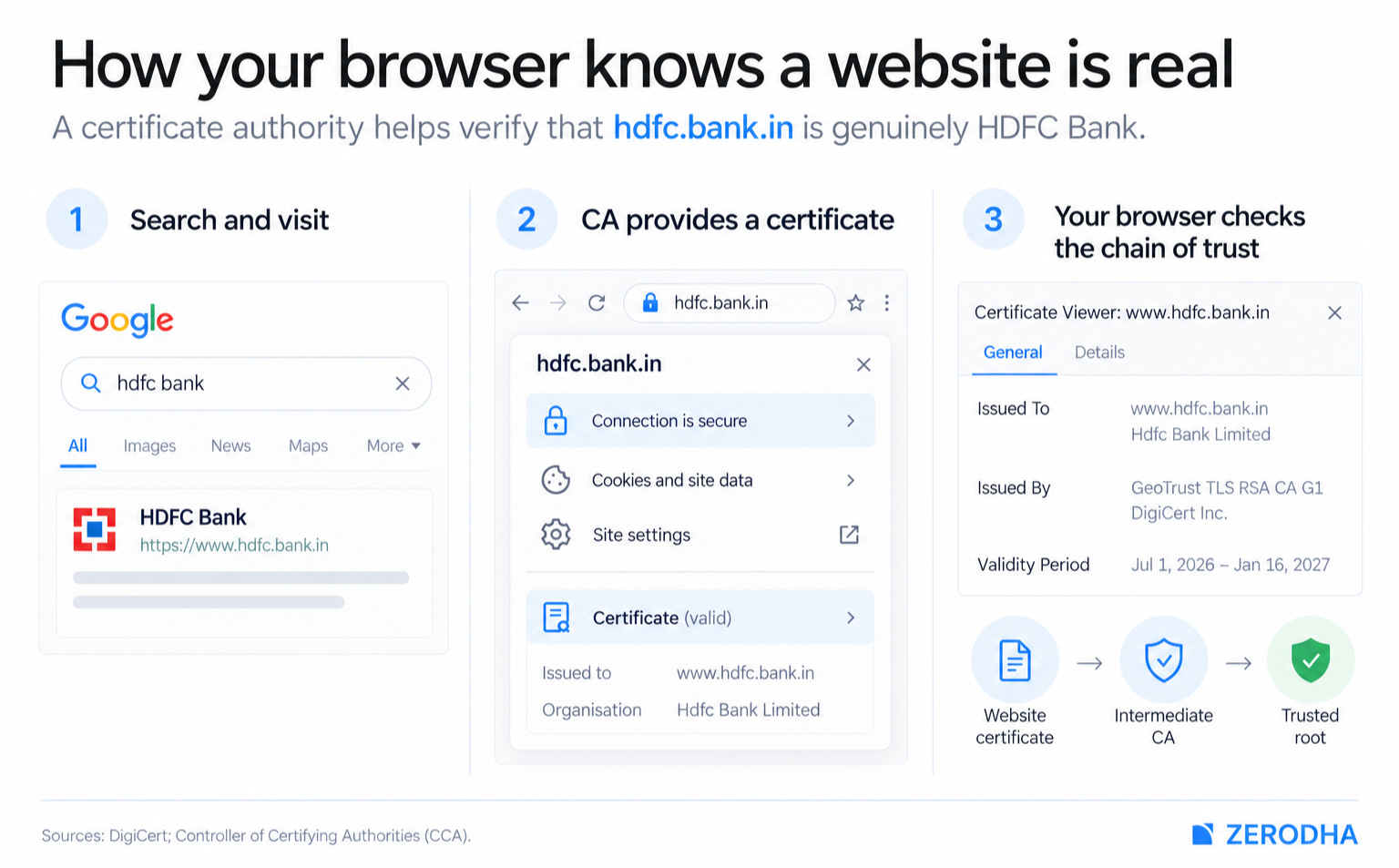
Imagine you search HDFC Bank on Google, and click the first link, hdfcbank.com, into your web browser (like Google Chrome). How do you know the link you clicked was actually HDFC Bank? It’s not like HDFC can simply send back a message saying, “Trust me, I’m HDFC”. Similarly, the browser needs proof that it isn’t a fake connection claiming to be HDFC.
So, the internet relies on an independent referee called a certificate authority (CA), which vouches for the website by digitally signing a certificate called a Transport Layer Security certificate (TLS). The browser checks that digital signature for each website you visit, and if it holds up, your connection goes through.
In India, there is another referee one level up: the Controller of Certifying Authorities, or CCA, an office under MeitY. It licenses 23 Indian CAs. The browser, meanwhile, maintains their own lists of trusted CAs to display.
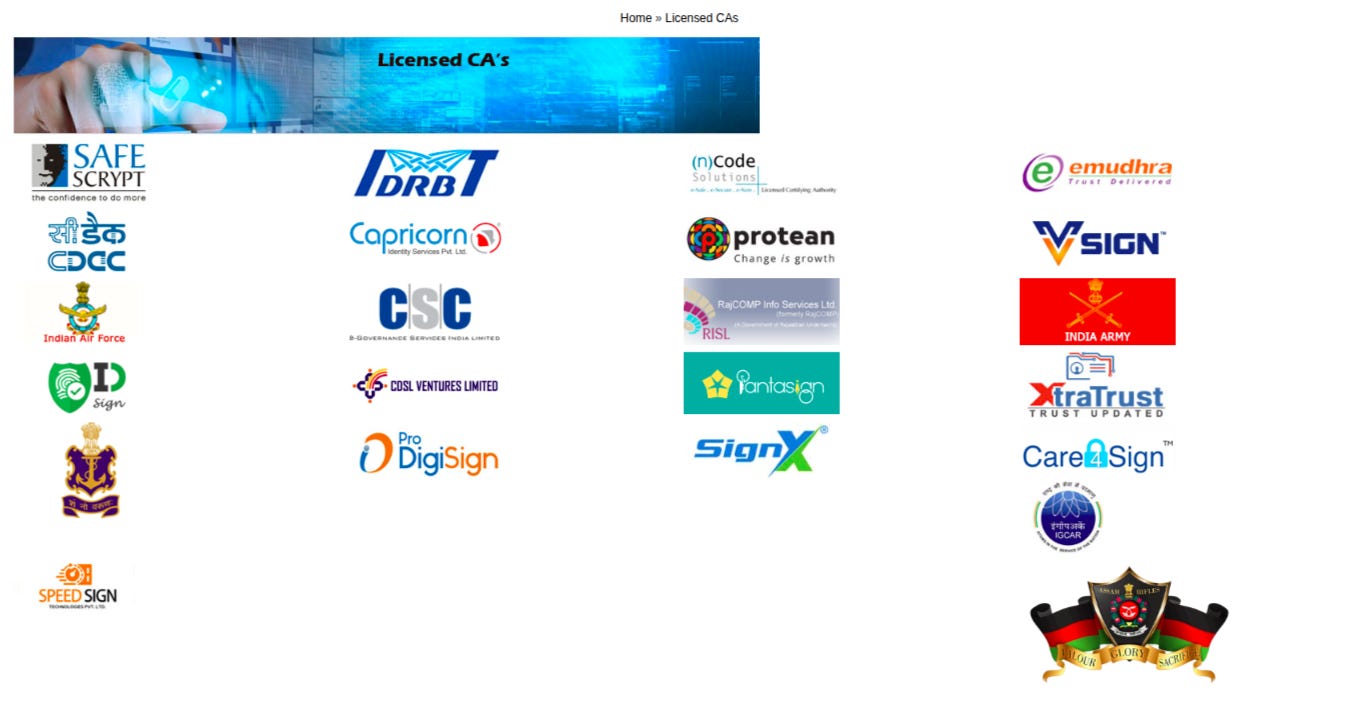
Now, these certificates are in a chain of hierarchy. At the top sits a root certificate, the ultimate source of trust. Below it are intermediate certificates, middlemen that do the day-to-day signing. Your browser only needs to trace the chain back to a root it already trusts.
How do you check this on a website? It’s a little lock icon on the left of the search bar, that you can check for yourself right now.

More interestingly, the cost for this certificate is not expensive for a large bank relative to its IT and security budget, roughly costing $6-50 a year, while basic certificates can be even issued for free. So, what CAs really sell is their reputation as an organisation that browsers are willing to trust.
Every signature a CA makes uses a private key which is about 116 digits long that only the CA should know. Guessing it is practically impossible without tons of computing power.
This is where eMudhra comes in. It holds a 38% market share of the digital signature market. Separately, it is one of very few Indian companies trusted by global browsers to issue website certificates.
A year and a half prior, in April 2025, a software bug in eMudhra’s key-creation process generated eight intermediate private keys that weren’t 116 digits long. Instead, each key was found to be a whole number smaller than three digits, one of them the number 4. Any mildly competent programmer looking at the public files could work out eMudhra’s secret keys almost instantly without lots of computing power.
What’s the worst that could’ve happened? Anyone who recovered one of these private keys could effectively impersonate eMudhra’s certificate-signing machinery. That meant they could potentially mint a certificate for a website they did not own (like HDFC Bank) and make it appear as though eMudhra had vouched for it. However, that certificate alone would not send HDFC customers to a fake website.
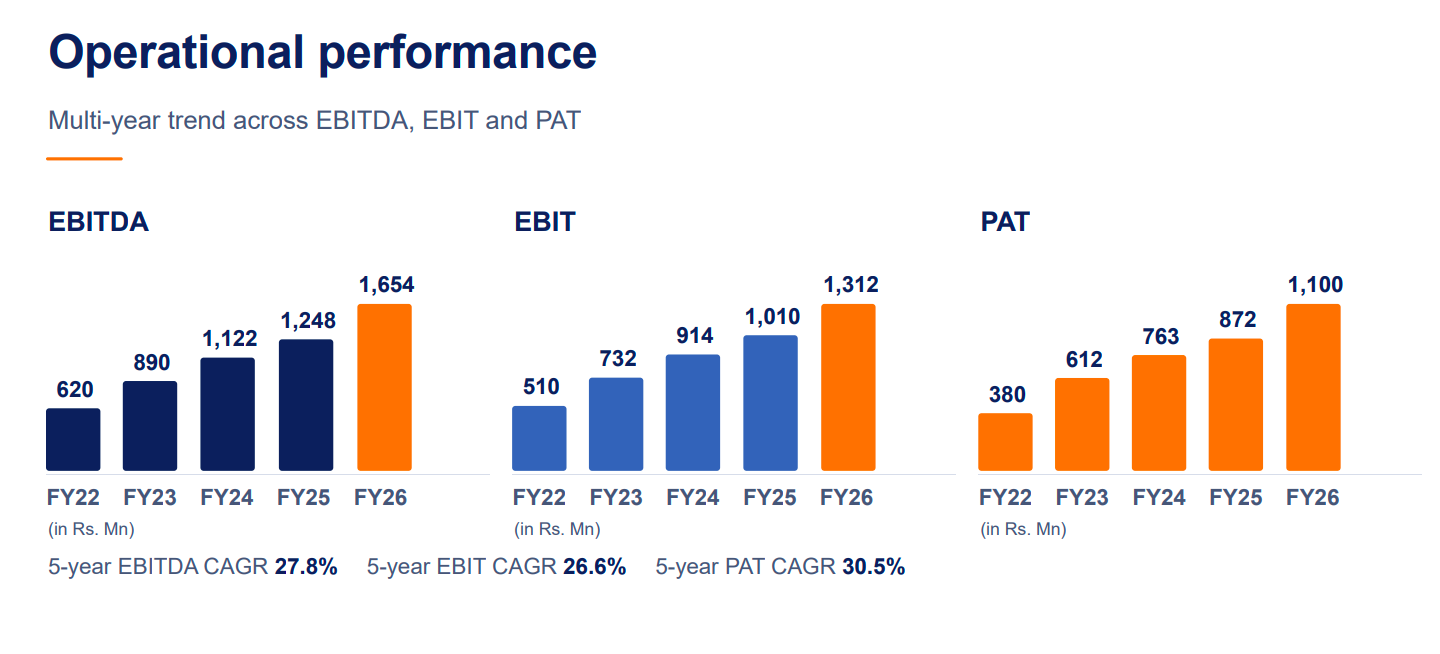
Now, was the impact as dangerous to everyday internet users as it sounded? Probably not, since eMudhra says only one of the eight keys was ever in use, and none issued a single certificate, which matches the public records browsers check. The business involved is about 1% of its revenue by eMudhra’s estimate, and MeitY accused some social media accounts of fear mongering. Prior to the incident, financials for eMudhra increased for the past four years
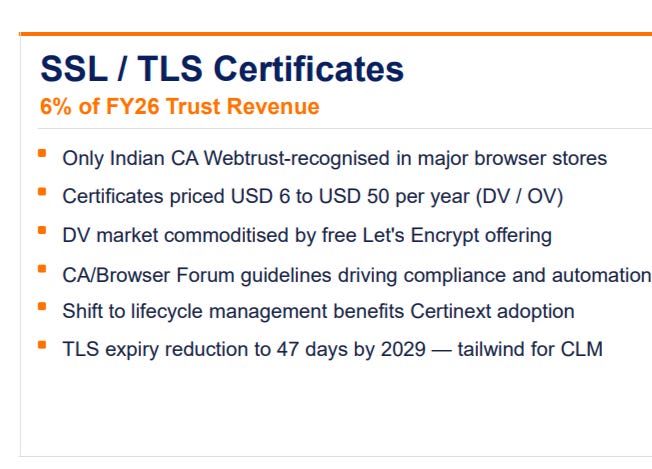
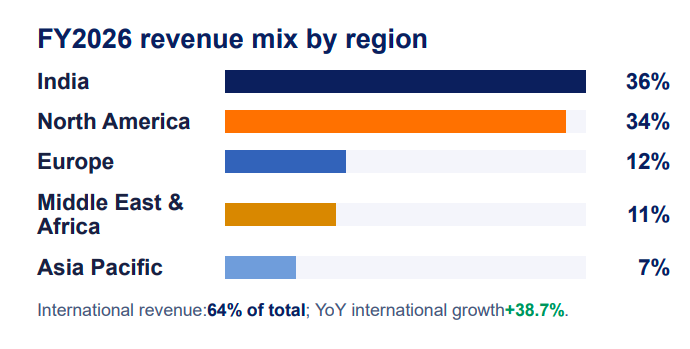
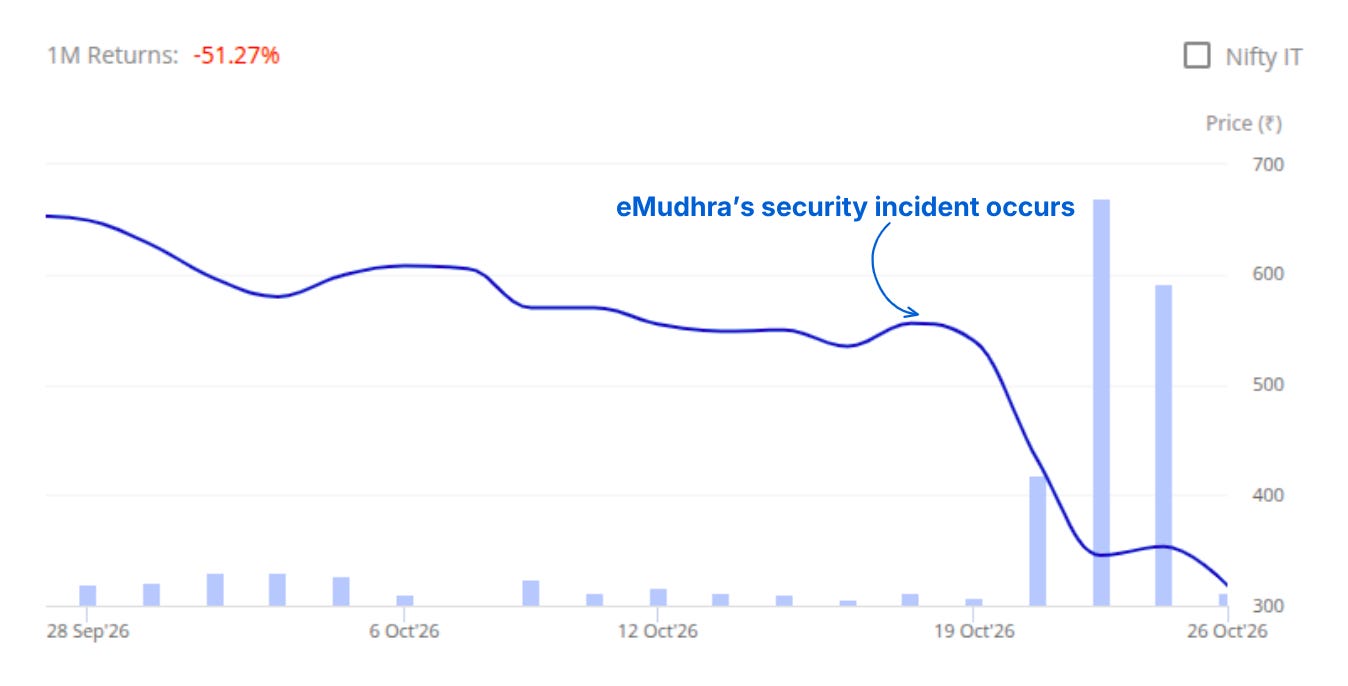
But naturally, no one wants to know that their CA was this lax. Accordingly, global browsers moved to revoke trust in eMudhra’s affected root certificates, knocking eMudhra’s stock down by 40% last week (and -51% over a month), and prompting the company to announce that it will exit the global browser-trusted website certificate business altogether.
What stands out is who policed the error. Google Chrome blocked the weak keys one hour and forty minutes after receiving the researcher’s report. India’s nodal cyber agency, CERT-In, issued its advisory four days later. And the Controller of Certifying Authorities (CCA), the domestic regulator that licenses and oversees eMudhra had made no public statement as of last week.
For website certificates, browser makers are meant to be the primary gatekeepers. This brings us to the question: who is actually guarding India’s digital systems?
Who’s guarding the doors?
On paper, India’s cybersecurity apparatus is split across different agencies under different ministries. But in practice, those lines blur constantly, with responsibilities scattered and overlapping across at least five different ministries and offices.
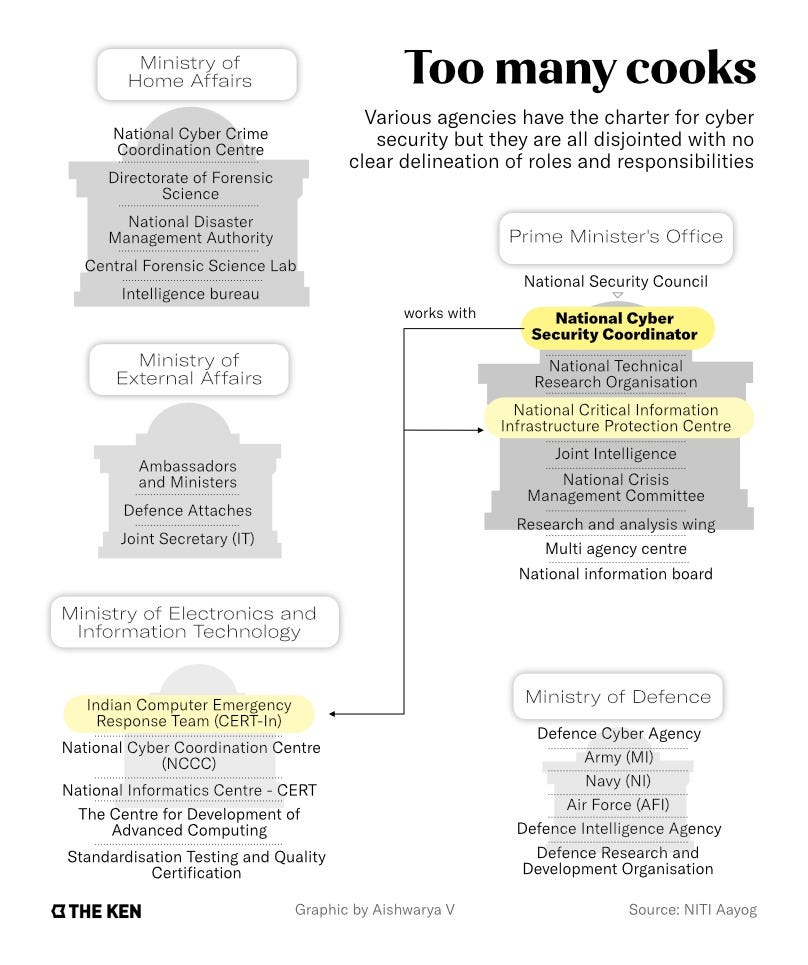
For this story, we’ll focus on CERT-In, which is India’s national agency for cyber incidents under the IT Act and sits under Meity.
CERT-In’s job is to collect reports of incidents, analyse them, send out alerts and advisories, and coordinate the response. But what it doesn’t do is investigate cybercrime or prosecute anyone; that’s the police’s job. Nor does it fix breached systems itself, or compensate the people whose data leaks. In practice, it mostly works as an early-warning system.
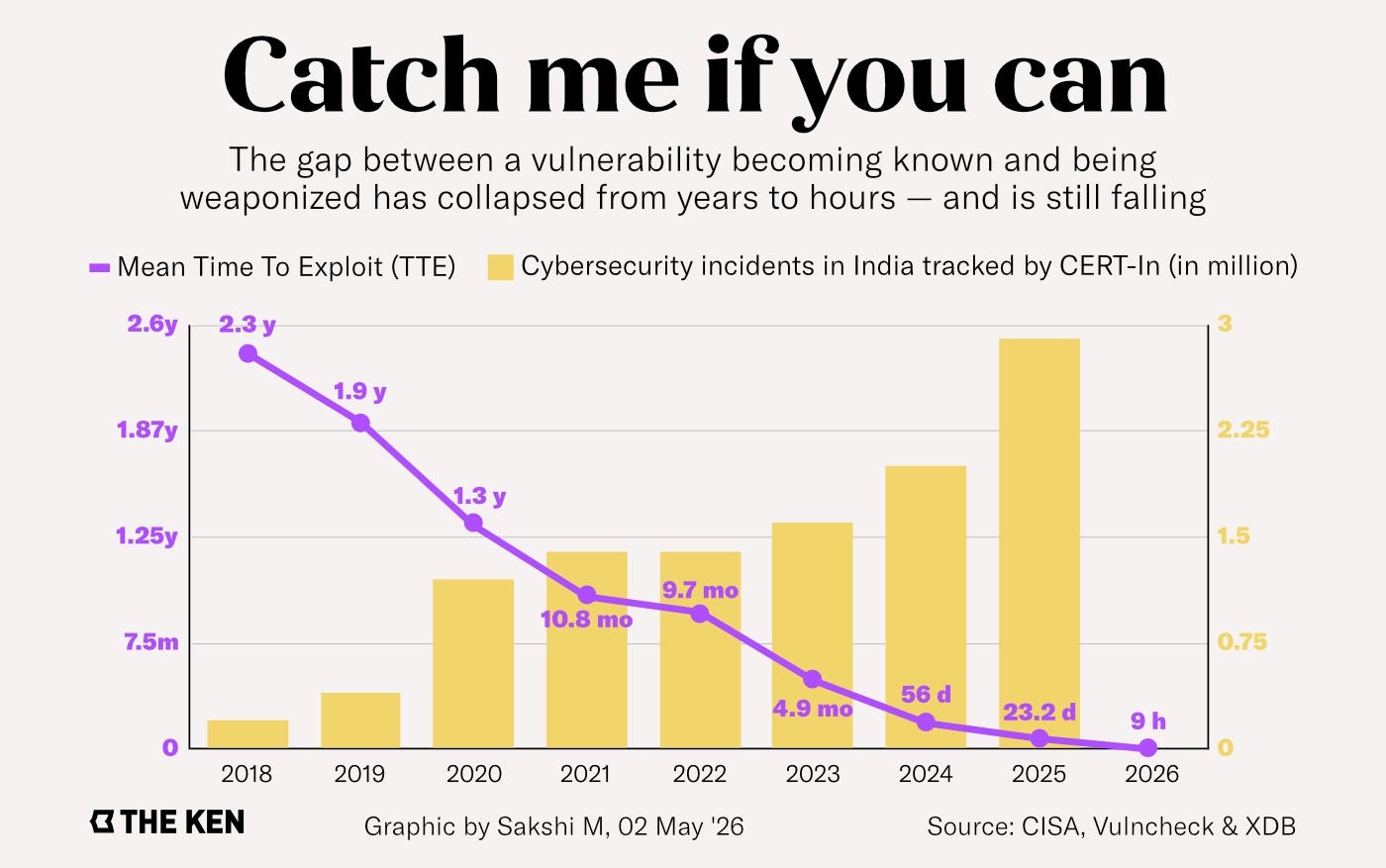
In April 2022, CERT-In tightened its rules. Over the years, India’s official tally of cyber incidents has increased from 53,117 in 2017 to 29.44 lakh in 2025. At the same time, the window before attackers exploit a newly disclosed vulnerability has collapsed, from years to just around nine hours in 2026.
Is it because of AI?
It’s tempting to blame the surge in cyber-security incidents on AI, but the numbers say it’s only part of the story. Incidents rose from ~53,000 in 2017 to 14 lakh in 2021, a 26-fold jump, all before ChatGPT launched in November 2022. Since then, they’ve roughly doubled.
What drove the earlier jump was mostly India moving online. Incidents nearly tripled in 2020, as the pandemic pushed offices, schools and hospitals onto home Wi-Fi and video calls. Digital payments boomed too. UPI went from about 375 crore transactions annually in 2018 to over 24,000 crore by the end of 2025, with dozens of apps plugging into banks’ systems.
Where AI has made a difference is speed. In 2018, attackers took an average of about 2.3 years to exploit a flaw once it became known. By 2026, that had fallen to about nine hours. The PHP flaw is a good example. Weaknesses of that kind had been known for years, but exploiting them took so much tedious trial and error that nobody bothered, until researchers had AI models do that work.
Now that trial and error has become cheaper, AI is changing what attackers go after.
For instance, last week, Railway, a cloud platform that developers use to host their apps, revealed that an intruder may have accessed customers’ stored secrets. These included API keys their apps use to call AI models from companies like OpenAI and Anthropic.
Railway believes it was one of a series of attacks on such platforms aimed at those AI keys. The goal, they said, was to carry out distillation, which involves running huge numbers of queries through a powerful AI model, on someone else’s bill, to train a cheaper copy of it. Railway also discovered that for the hack, the attackers used open-weight AI models with their safety guardrails switched off.
Four days before the onslaught on Railway, a similar attack occurred at Opencode, where attackers launched a large-scale AI distillation attack over a 48-hour window, using stolen bearer credentials to drain other people’s token usage and train smaller models.
Indian organisations haven’t sped up to match. A third of high-severity flaws in India stay unpatched for over 180 days. So the bigger risk AI brings is less time to fix old weaknesses.
What about pureplay cybersecurity companies?
If cyberattacks are rising and regulations are tightening, you’d expect India’s cybersecurity companies to be booming. The picture is more lopsided than that, though it isn’t a like-for-like comparison, since India has only a handful of listed cybersecurity firms.
Take Quick Heal Technologies, India’s first listed cybersecurity company. In FY26, its revenue fell nearly 7% to ₹261 crore, and it swung from a ₹5 crore profit to an ₹11 crore loss. The drag is its legacy consumer business, where gross revenue fell about 25%. The company blamed weak demand and rising hardware prices, but there’s a longer-term problem too: Microsoft Defender now comes built into Windows for free. Its pivot to selling security to businesses is growing, but not fast enough to make up the difference.
Meanwhile, a few tiny newcomers on the SME platforms, including TechD Cybersecurity, Sattrix Information Security and TAC Infosec, are growing fast.
TechD, for instance, runs security operations centres which monitor clients’ systems around the clock, and does audits for companies that must meet security rules from SEBI, the RBI and CERT-In. It doesn’t really focus on selling antivirus to consumers.
Sattrix also gets 58% of its revenue from banks and financial firms, but more than half of it comes from selling and installing other companies’ security software. That makes it as much a reseller as a security-services firm.
TAC is the product company of the three. It sells its own vulnerability-management software, mostly to customers abroad.
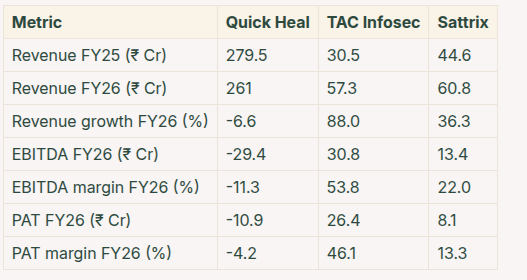
Add up all these companies, and you get only about a few hundred crores of annual revenue, while Indian banks and businesses spend thousands of crores on security. Most of it goes elsewhere, especially big global product companies like Palo Alto Networks and CrowdStrike.
Both these firms are also pushing customers to consolidate. Instead of stitching together dozens of separate tools, large companies want fewer, integrated platforms that cover more of what they need. The people who install and run those Palo Alto firewalls and CrowdStrike tools for big Indian banks are, well, IT services firms like TCS, Infosys, and Wipro.
Conclusion
Taken together, this month’s headlines say less about any single breach and more about how quickly the ground is shifting. For years, finding a flaw and turning it into a working break-in took months of tedious effort. AI has cut that to hours. Earlier this year, Anthropic’s Mythos model found a 27-year-old flaw in OpenBSD, one of the most heavily audited operating systems.. Defenders, especially in India, still largely run on the old clock, where a serious flaw can sit unpatched for six months.
That gap is where cybersecurity spending is likely to move next. So far, much of what Indian organisations spend has gone to global platforms, and India’s listed cybersecurity firms have grown mainly where rules force their customers to act.

What’s a win in India’s quick-commerce race?
Blinkit, which made its name delivering groceries in ten minutes, now wants to sell almost everything a household buys. Amazon and Flipkart, which spent years learning to sell almost everything, are racing to deliver it in minutes.
Flipkart Minutes now operates in more than 150 cities, and Amazon plans to take Amazon Now to 100. Eternal’s group CEO, Albinder Dhindsa, thinks the distinction between quick commerce and ordinary e-commerce will eventually matter less. If customers can get the same product at a similar price, why would they wait?

The economics still leave little room for error. In Q2 FY27, Blinkit earned ₹184 crore in adjusted EBITDA on ₹20,940 crore of net order value. That is roughly 90 paise for every ₹100 of orders. Swiggy’s Instamart lost ₹895 crore on the same earnings measure.
Last quarter, we looked at the different routes these companies were taking towards profitability. The latest results show Blinkit expanding faster while improving its operating earnings. Instamart’s growth has recovered too, but at the cost of a larger loss.
Blinkit is growing profitably. Instamart is spending to catch up.
Last quarter, both were trying to improve their economics. Blinkit was building bigger and busier stores, while Instamart focused on better product margins, advertising and retention. This quarter, Blinkit continued along that path. Swiggy stepped up spending to revive growth, accepting a weaker contribution margin in the process.
First, an accounting caveat. Blinkit already owns much of the stock it sells. Instamart expects to begin moving to the same model in mid-Q3 FY27, with the transition taking another two to three quarters. When a company owns the products it sells, revenue includes their selling value, rather than largely the commission earned from a third-party seller.
So, a fairer way to compare the businesses is Net Order Value (NOV), the value of orders after discounts. Swiggy has traditionally emphasised Gross Order Value (GOV), measured before discounts, but now discloses NOV for Instamart too. On that basis, Blinkit is more than three times Instamart’s ₹6,594 crore in quarterly order value.
Food delivery looks healthier at both companies. Zomato earned ₹627 crore in adjusted EBITDA and Swiggy a record ₹341 crore. Their other businesses were mixed: Hyperpure reported a small adjusted EBITDA profit and District a loss, while Swiggy’s dining-out arm was profitable on the same measure and its supply-chain operations were not.


There were changes outside these core businesses too. Swiggy announced a deal to sell Lynks, its B2B distribution arm, to Udaan’s parent for about ₹500 crore in shares, as it sharpens its focus on consumer businesses. Eternal unveiled dark.ai, a privacy-focused AI assistant it hopes to launch globally by the end of 2026, although its commercial potential remains untested.
For now, though, the clearest difference between the companies lies in quick commerce.
Blinkit’s advantage starts inside its warehouses. A dark store has costs such as rent that don’t rise with every additional purchase. As it gets busier, those costs are spread across more orders.
The latest results show that effect strengthening. According to Eternal, mature cities now earn adjusted EBITDA margins above 5% of NOV, and cities accounting for about 96% of Blinkit’s NOV are contribution-positive. That means they cover the costs included in its contribution measure, though not necessarily all overheads.
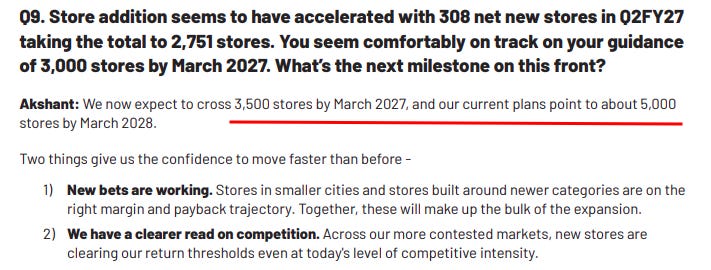
That has encouraged faster expansion. Blinkit added 308 net stores this quarter to reach 2,751, and raised its target to over 3,500 by March 2027 and roughly 5,000 a year later. Management says new stores in more competitive markets meet its return thresholds, although it doesn’t disclose those thresholds. Positive operating earnings also don’t mean the money spent opening stores has been recovered.
What about rivals such as Zepto, Amazon and Flipkart? Eternal’s confidence doesn’t depend on competition disappearing. Management says it now has a clearer understanding of the competitive landscape and is seeing acceptable returns despite it. That gives it more confidence to keep opening stores.
Swiggy has accelerated too. Nandita Sinha took over as Instamart CEO in August, replacing Amitesh Kumar Jha, as the company stepped up its efforts to regain growth.
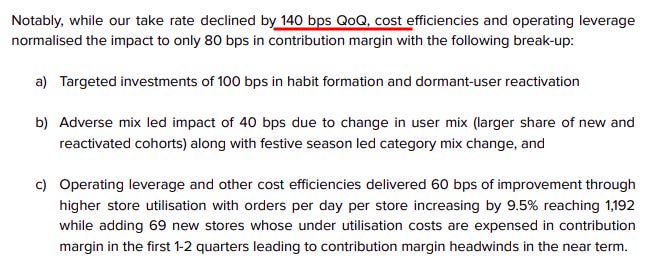
After several quarters of slower expansion, Instamart added 69 stores. This is as many as in the previous three quarters combined. They also increased their average monthly transacting user base by 13 lakh. Better retention, a wider assortment and targeted discounts helped quarterly NOV growth recover from 2.5% to 13.4%. However, Blinkit’s NOV grew 22.2%, so the recovery didn’t really close the gap.
Instamart’s recovery came with a trade-off. Busier stores helped spread costs across more orders, improving contribution margin by about 0.6%. But discounts and changes in what customers bought reduced that margin by about 1.4%, more than wiping out those savings.
Contribution margin consequently fell to minus 1% of GOV. Put simply, for every ₹100 of gross order value, Instamart lost ₹1 even before accounting for costs such as central overheads.
Swiggy had already signalled that it would invest to accelerate growth after reaching contribution breakeven in May. This quarter shows what that choice involved: accepting weaker contribution economics to attract and reactivate users. Its absolute adjusted EBITDA loss widened, although its adjusted EBITDA margin improved slightly as the business grew.
Blinkit continues to argue against relying on deep discounts. Dhindsa says customers who arrive only for offers use the same limited store capacity as regular shoppers, but often leave when the offers end.
It’s easy to criticise Swiggy for spending, but waiting has a cost too. If customers develop a habit of using one app for their weekly shopping, Blinkit’s head start could become harder to overcome. Still, Blinkit growing faster while Instamart increased spending shows how difficult catching up will be.
Swiggy believes Instamart’s losses peaked in Q2, but its breakeven plan is demanding. By management’s estimate, the business needs roughly 2.3 times its current annualised NOV and ₹30 of contribution per order. Much of the improvement must come from better product margins, own brands and advertising, alongside lower costs.
Owning inventory could add about 0.8 percentage points to contribution margin once fully rolled out. But Swiggy also needs to make the products customers buy more profitable to sell.
Both want a bigger share of the shopping list
That brings us to assortment. Both companies want a bigger share of household spending, and Blinkit is betting on choice. Its Delhi NCR catalogue has grown from about 80,000 to 100,000 SKUs, or individual product variants, such as different pack sizes of body wash. The aim is more choice within existing categories, plus entirely new ones.

But a broader catalogue is harder to manage. Milk sells every day. A particular pair of headphones might sit in a warehouse for weeks. More choice can bring bigger baskets, but it can also tie up money and storage space in slow-moving stock. Blinkit has to manage that while keeping products close enough to customers to deliver in minutes.
Swiggy is putting more emphasis on curation and differentiated products. Its Switch range promotes selected alternatives across categories, including products from partner brands and its own labels. Switch products appeared in more than a fifth of Instamart orders in September, suggesting that customers are trying the range.
This doesn’t necessarily mean Instamart will carry fewer products overall. The bet is that selected products can give customers a reason to choose Instamart while improving what it earns from each order.
Its own food brand, No!ce, now appears in more than one in eight Instamart orders, and its buyers show higher retention. That doesn’t prove the brand creates loyalty, but selling its own products could help Swiggy retain more of the margin that would otherwise go to manufacturers. It also takes on the work of developing, marketing and maintaining those products.

Blinkit has chosen a different approach. Dhindsa believes established brands can handle product development, marketing and quality control more efficiently. Rather than compete with them through its own labels, Blinkit prefers to distribute their products and earn advertising revenue when they pay for visibility.
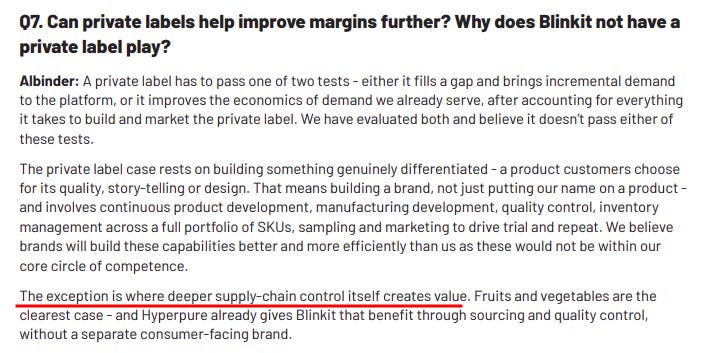
Swiggy wants advertising income too. The disagreement is whether building its own brands adds enough demand and profit to justify the effort.
Amazon and Flipkart approach this market with extensive catalogues and seller relationships, while expanding the neighbourhood fulfilment networks that quick commerce requires. Their operating structures matter too: India’s foreign-investment rules restrict foreign-owned or controlled e-commerce marketplaces from owning the inventory sold on their platforms. An Indian-owned and controlled structure gives operators more flexibility to buy and sell inventory themselves.
Eternal also argues that its physical operations offer some protection if AI shopping agents change how customers discover and buy products. An agent may help someone choose what to order, but the platform still needs warehouses, riders and real-time coordination to deliver it. Eternal sees businesses such as District as more exposed to changes in discovery and booking.
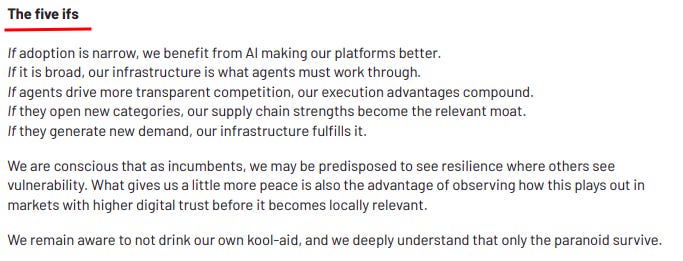
Physical retailers bring a different cost structure. When a DMart customer carries their shopping home, the retailer avoids the last-mile cost of delivering that basket. Selling more of the same products doesn’t mean these businesses will incur the same costs.
Geography changes the proposition too. Blinkit says new stores in smaller cities reach about 1,000 daily orders in a similar time to new metro stores, sometimes faster. In Mumbai, quick commerce may save someone a supermarket trip. In a smaller city, it may offer products local shops never stocked. Availability can matter alongside speed.
As more of that shopping moves onto apps, platforms also gain influence over which brands customers discover. A soap maker that competes for supermarket shelf space may now pay to appear prominently in an app search. The platform can earn from selling the soap and from advertising around it.
These sources of income matter especially to Swiggy. Every improvement in Instamart’s earnings reduces how much its losses weigh on the group, where food delivery currently provides a substantial cushion.
Food delivery cushions the losses. It faces competition too.
Swiggy’s food-delivery adjusted EBITDA this quarter was equivalent to roughly 38% of Instamart’s loss. Across five quarters, food delivery earned ₹1,442 crore while Instamart lost ₹4,288 crore.
These aren’t literal cash transfers, but they show how much the older business softens the losses of the newer one. Eternal is in a stronger position because Blinkit now adds to group adjusted EBITDA alongside Zomato.
Both food businesses are still growing. Zomato’s NOV rose 21.5% year-on-year and Swiggy’s GOV grew 17.7%. Those measures aren’t identical, so they shouldn’t be treated as a precise comparison of growth. But both businesses are expanding while facing new competitive pressure.
Zomato is choosing to put some of its earnings back into growth. Its adjusted operating profit rose from ₹606 crore in Q1 to ₹627 crore in Q2, even as its margin slipped slightly from 5.6% to 5.5%. Eternal wants to keep investing in attracting customers and getting them to order more often, rather than simply pushing margins higher.
And it isn’t just the two players spending to grow. Last quarter, we wrote about Rapido’s Ownly, which charges restaurants no commission, and Flipkart’s plans to enter food delivery with lower fees. What’s interesting is that these companies have reasons to enter the market even if delivering food itself doesn’t make them much money.
Swiggy itself sold its entire Rapido stake for ₹2,399 crore in FY26. The company it once invested in is now challenging its food-delivery business.
Rapido’s existing logistics capabilities could help it build food delivery, although moving passengers and collecting restaurant orders involve different operating requirements. For Flipkart, food could bring customers back more frequently than purchases such as phones and clothes, creating more opportunities to sell them other things.
Those potential benefits may give the entrants reasons to accept thin food-delivery margins. They don’t, however, establish that either can run the service sustainably.
Charging restaurants less doesn’t make delivery cheaper. A ₹150 meal can take almost as much work to deliver as a ₹400 one over the same distance. At a similar commission rate, the smaller bill generates fewer rupees to pay for that work.
Swiggy’s response combines earning more per order with making delivery more efficient. Its food take rate, which includes commissions, fees and advertising, reached a record 26.1% this quarter, helped by advertising.
It is also changing how cheaper meals are served. Bolt focuses on nearby restaurants, helping riders make shorter trips. The 99-Store offers low-priced meals within the main app, while Toing is a separate app for customers who find regular delivery too expensive.
Bolt and 99-Store now account for over a quarter of Swiggy’s food orders. Higher order density, shorter trips and advertising helped lift its food adjusted EBITDA margin to 3.4% of GOV, from 2.8% a year earlier.
Toing is earlier in its development. Two-thirds of its new users were new to Swiggy or long inactive, and management says repeat-user economics have turned positive in its earliest markets. That is encouraging, but it doesn’t establish profitability for the app as a whole.
The Platform Innovations segment, which houses Toing alongside other businesses, lost ₹162 crore this quarter, up from ₹131 crore in Q1. That isn’t Toing’s standalone loss, so we can’t use it to judge the app’s economics separately.
Swiggy is therefore trying to broaden its customer base while protecting food-delivery earnings. If competition forces it to spend more on discounts or accept lower monetisation, that earnings cushion could weaken just when Instamart needs it.
For Q3 FY27, Swiggy expects Instamart’s adjusted EBITDA margin to improve by about one percentage point of GOV, even before the benefits of inventory ownership. Eternal, meanwhile, expects Blinkit’s margins to hold up despite its faster store expansion.
Both expectations rest on something that isn’t guaranteed: that the companies can keep growing without having to spend more to win every additional order. The next quarter should give us a better sense of whether that’s possible.
- This edition of the newsletter was written by Zarieus & Mridula.
Tidbits
1. L&T Technology Services and Nokia sign five-year engineering and R&D deal
L&T Technology Services has secured a five-year contract with Nokia to support its engineering and research and development initiatives in India. LTTS will establish a dedicated offshore development centre focusing on 5G networks, intelligent automation, and AI-driven telecom operations, though financial details were not disclosed.
Source: Business Standard
2. Tata Communications to invest $450 million in India AI fibre network
Tata Communications plans to invest between $400 million and $450 million to build a 10,000-kilometre fibre network connecting major data centres and artificial intelligence hubs across India. The phased project will begin with the Mumbai-Pune-Hyderabad-Chennai corridor, providing high-capacity, low-latency connectivity to support the country’s rapidly expanding AI and cloud infrastructure.
Source: Business Standard
3. MoSPI to shift unincorporated enterprise survey to annual financial-year cycle from April 2027
The Ministry of Statistics and Programme Implementation will conduct the Annual Survey of Unincorporated Sector Enterprises for 2027–28 from April 2027 to March 2028, aligning it with the financial year. The revised survey will add questions on constraints faced by women entrepreneurs, energy use, fixed-asset investment, and handloom and handicraft activity to improve policy and national-accounts data.
Source: The Economic Times
4. Tata Motors’ Iveco takeover bid crosses 80% acceptance threshold
Tata Motors has secured provisional acceptances for 87.81% of Iveco Group’s share capital, clearing the critical 80% threshold required for its €3.91 billion takeover offer. The acquisition, first announced last July, will expand the Indian commercial vehicle manufacturer’s global footprint and product portfolio.
Source: Reuters
5. TRAI recommends authorisation framework for application-based TV distribution
TRAI has recommended a separate authorisation framework for applications and websites that distribute linear television channels over the internet. Application providers would hold primary regulatory responsibility, while broadcaster-owned platforms carrying only their own channels would be excluded.
Source: The Hindu BusinessLine
Want more tidbits? Catch up on last week’s recap!

Beyond Today’s Brief
There’s always more happening at Markets by Zerodha.
The Chatter: What strategic priorities are leaders across internet consumer platforms, hospitality, and banking highlighting for Q2 FY27? How is Eternal re-accelerating Blinkit dark store expansion into tier-two cities, while Swiggy drives toward EBITDA break-even and HDFC Bank navigates net interest margin headwinds?
Points & Figures: Where did India’s international flyers go? From a 9% drop in total international passenger traffic to Indian airlines losing a decade of market share gains to foreign rivals, what does flight data reveal about post-conflict travel demand and carrier resilience?
Aftermarket Report: How did Nifty recover from sharp intraday losses to close near 22,750 despite weakness in IT stocks and lacklustre global cues? And what do improving market breadth, persistent FII shorting, and stronger call writing reveal about sentiment as markets remain in extreme fear?
Join us on WhatsApp, where we share interesting soundbites from concalls, articles, and everything else we come across throughout the day. You’ll also get notified the moment a new video or article drops so that you can read or watch it right away.
Thank you for reading. Do share this with your friends and make them as smart as you are 😉