

Our goal with The Daily Brief is to simplify the biggest stories in the Indian markets and help you understand what they mean. We won’t just tell you what happened; we’ll tell you why and how too. We do this show in both formats: video and audio. This piece curates the stories that we talk about.
You can listen to the podcast on Spotify, Apple Podcasts, or wherever you get your podcasts and watch the videos on YouTube. You can also watch The Daily Brief in Hindi.
In today’s edition of The Daily Brief:
Swiggy and Eternal pick different fights
Quick commerce is getting more competitive, but Swiggy and Eternal are responding differently. Blinkit is betting on larger, denser stores, while Instamart is pushing premium products, advertising and better margins. Both are moving towards profitability, but the bigger question is whether either strategy can hold up as more players enter the market.
The curdles forming in the Indian dairy sector
Hatsun, Dodla and Heritage grew revenues by nearly 20%, but rising milk procurement and packaging costs sharply squeezed margins. With companies investing heavily in value-added products, new capacity and procurement networks, the bigger test is whether these investments can restore profitability while milk supplies remain uncertain.
Gold is India’s favourite asset. But what are you really paying for?
Cash & Copium is our new show where we argue about the things that actually move money in and out of your pocket, and what you should do about them.
In Episode 2, Abid and Bhuvan unpack how gold is priced, whether it really hedges inflation, and why Gold ETFs stand out among the ways to own it.
Watch the full episode: The Real Truth About Buying Gold in India! | Cash & Copium Ep 2
Swiggy and Eternal pick different fights
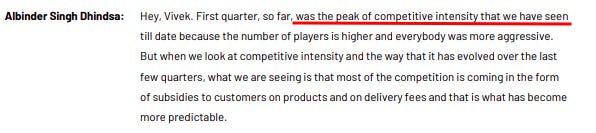
On Eternal’s latest earnings call, Blinkit CEO Albinder Dhindsa was asked about competition and gave an unusually flat answer. This was the hardest quarter Blinkit has faced. There were more players in the market, he said, and every one of them was more aggressive.
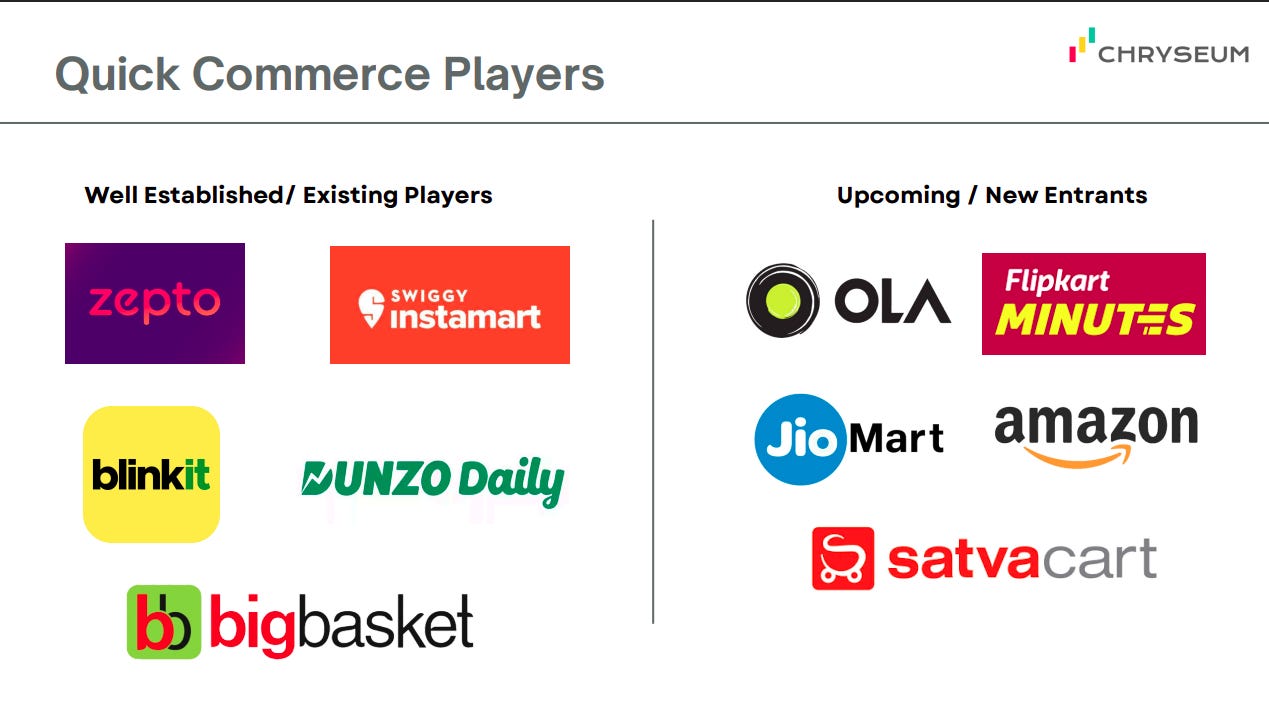
He wasn’t overselling it. BigBasket’s co-founder Hari Menon stepped down as CEO after publicly admitting he had spent too long in denial about 10-minute delivery, a misread that eventually forced the company to pivot its entire model. Flipkart has pushed Flipkart Minutes past 1,000 dark stores. DMart, which built its entire reputation on making customers drive to the store, is now leaning harder on DMart Ready. Reliance is running JioMart deliveries out of its existing store network.
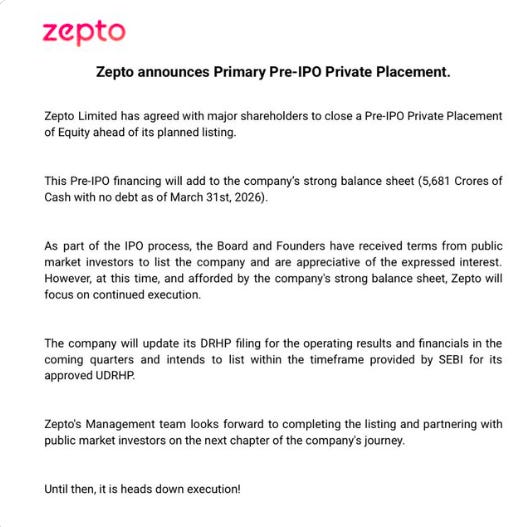
Zepto filed its DRHP and then pulled it back over valuation. And smaller, stranger entrants keep appearing, like FirstClub, a members-only grocery app in Bengaluru selling on the promise of clean labels.
Swiggy’s group CEO Sriharsha Majety counted seven or eight active players. That is the backdrop for everything that follows, because until recently the two listed companies in this fight responded to pressure in somewhat the same way. Reading their June quarter results side by side, that symmetry seems to be gone. They are now answering the same question with two different bets.
Where they stand at
Start with a caveat, because without it the headline numbers are actively misleading.
Eternal reported consolidated adjusted revenue of roughly ₹20,600 crore, up 173% from about ₹7,500 crore a year ago. Almost none of that is real growth. Last year, Blinkit shifted to an inventory-led model, meaning it now buys stock, owns it, and sells it directly to customers rather than taking a cut on someone else’s sale. When you own the goods, you book the entire value of the sale as revenue instead of just your commission.
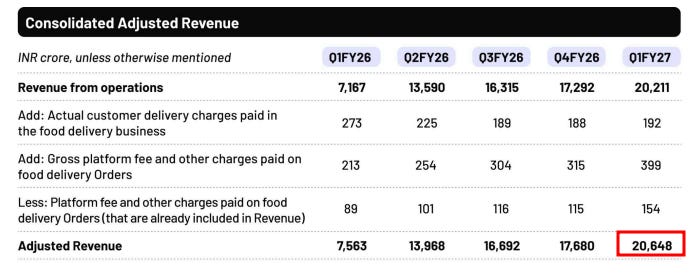
The same volume of business suddenly shows up several times larger. Strip the accounting change out, and Blinkit’s like-for-like quick commerce revenue grew 117%, which is still remarkable, but is a different number entirely.
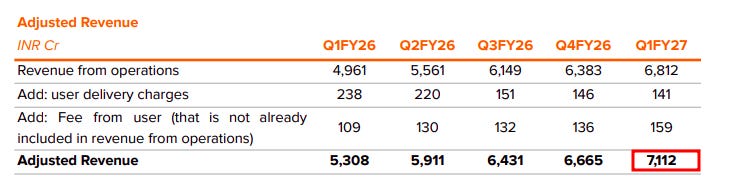
Swiggy, which has not made that shift yet, reported consolidated adjusted revenue of about ₹7,100 crore, up 34% from roughly ₹5,300 crore. Nearly half of that total isn’t consumer business at all, but a low-margin B2B distribution arm that Eternal has no real equivalent of.
So for one more quarter, the top lines of these two companies simply cannot be compared. The same problem runs through the operating metrics. Eternal reports Net Order Value, which strips out delivery charges, platform fees and platform-funded discounts. Swiggy reports Gross Order Value, which includes user delivery charges, platform fees and taxes, and is gross of discounts the platform itself funded.
What does compare cleanly is profit, and cash.
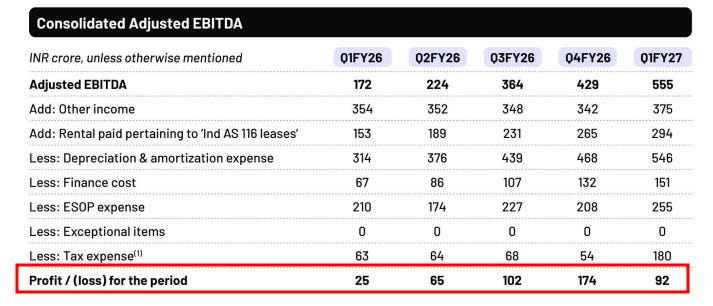
Eternal’s net profit came in at ₹92 crore, nearly three and a half times the ₹25 crore it made a year ago. It ended the quarter sitting on ₹18,300 crore, having added ₹316 crore during the three months.
Swiggy is still loss-making, but the loss is shrinking fast, down to roughly ₹790 crore from about ₹1,200 crore in the same quarter last year. It ended with ₹14,400 crore, having burned ₹686 crore, largely on capital expenditure and working capital.
How’s the food being delivered like
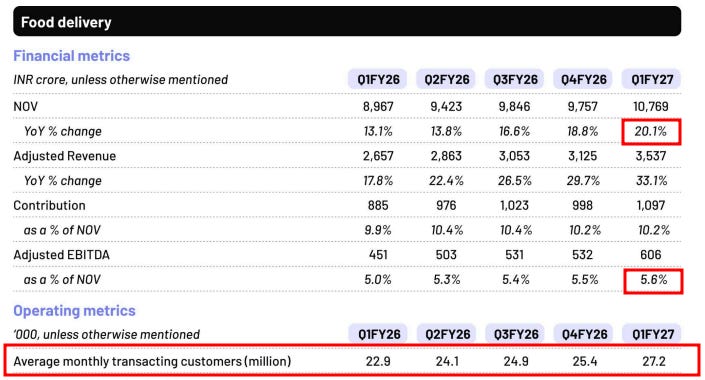
The core business is settled, and boringly so. Zomato’s food delivery NOV grew 20.1%, throwing off about ₹600 crore in segment EBITDA. This EBITDA, as a % of NOV inched up from 5.5% to 5.6%.
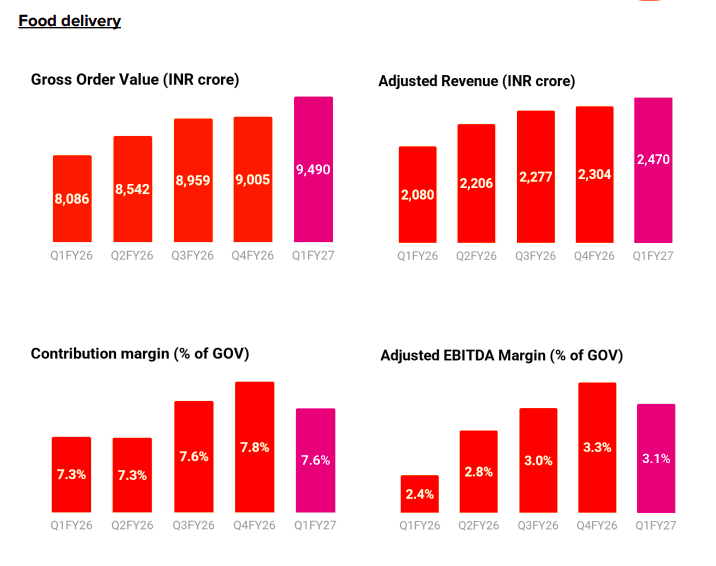
Swiggy’s food delivery GOV grew 17.4%, with segment adjusted EBITDA of about ₹290 crore at 3.1% of GOV, a seasonal dip from 3.3% the previous quarter. Both are profitable, both are compounding, and nobody is seriously arguing about whether restaurant delivery works as a business any more.
What the industry is arguing about, though, is whether the same model works at price points where restaurant delivery might not.
For example, Rapido’s Ownly charges restaurants no commission and no platform fee, making its money instead on a small delivery charge. In four or five months it has taken roughly 7% of the Bengaluru food delivery market, helped along by restaurants that were already unhappy with what the incumbents charge them. Flipkart is joining from around August 15 at a 10% commission, routed largely through ONDC, the government-backed open protocol that lets buyers and sellers on different apps transact with each other.
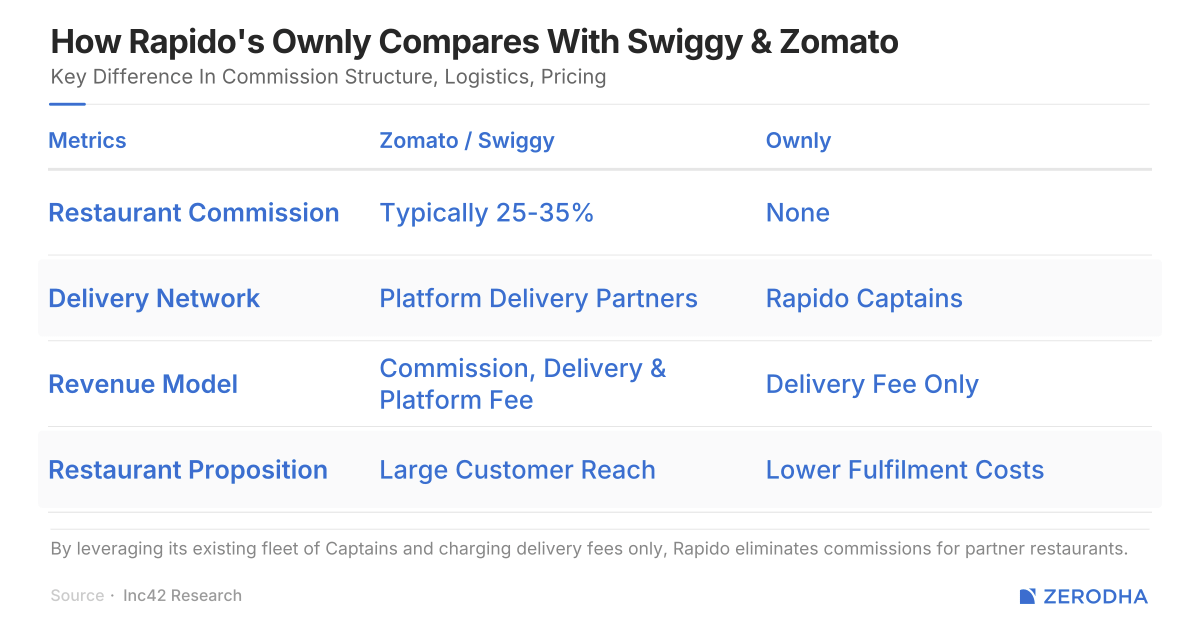
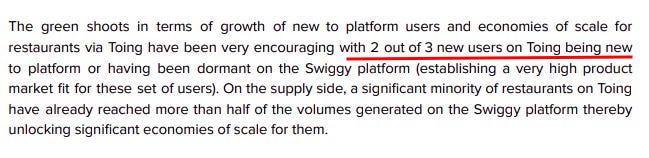
Swiggy’s answer to this is Toing, a separate cheap-meals experiment now live in 50 cities, designed to win budget customers without dragging down the economics of the main app. Its Platform Innovations segment, which houses these experiments, saw losses widen to ₹131 crore from ₹58 crore, most of it the cost of shutting down Snacc, its 15-minute food delivery service built on micro-kitchens. The numbers didn’t work, so it was killed. That is roughly what a competitive response looks like when you run it as a portfolio of bets.
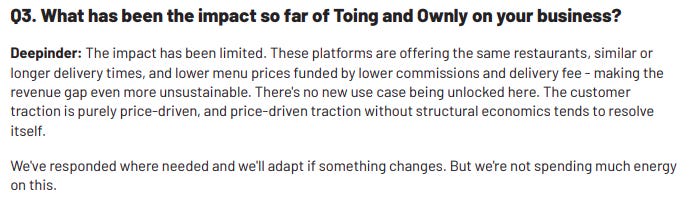
Eternal’s CEO Deepinder Goyal thinks the entire category is a mirage. Toing, Ownly, and everything like them unlock no new use case, in his view, and the traction they show is purely price-driven, the kind that evaporates the moment the price goes back up.
His alternative is Bistro, Eternal’s cloud kitchen arm. If you want food delivery to work at ₹50 to ₹150, he argues, you cannot get there through discounting, only by rebuilding kitchen operations from first principles.

“Quick” Math
India’s quick commerce market grew roughly 24 times between 2022 and FY25, reaching ₹65,645 crore, according to an IBEF analysis. For most of that run, three names carved it up between them. That is no longer true, and the two listed ones are no longer running the same race.
Blinkit’s NOV rose 86% year-on-year to roughly ₹17,100 crore. Instamart’s GOV grew about 40% to ₹7,907 crore, on the more generous of the two measures. The profitability gap is wider still. Blinkit turned in adjusted EBITDA of around ₹100 crore. Instamart, even after cutting operating costs hard, posted an adjusted EBITDA loss of about ₹780 crore.
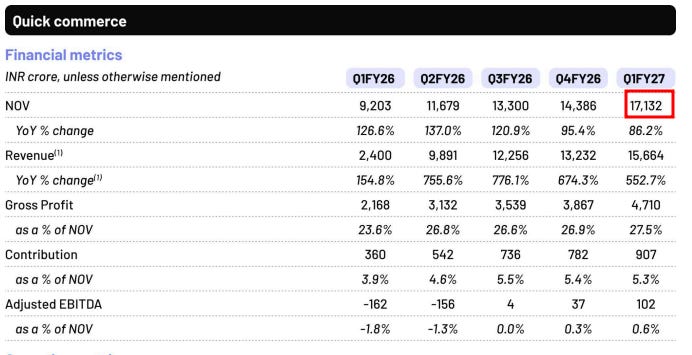
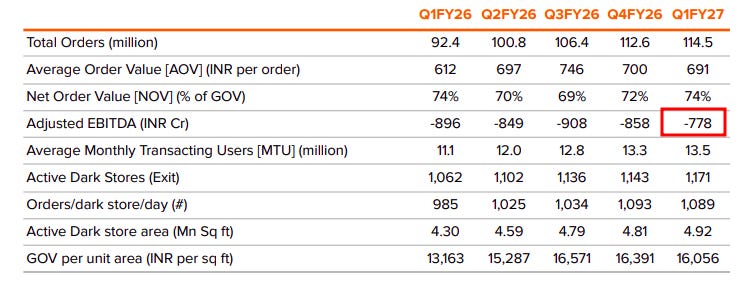
The store counts might explain most of it. Blinkit added 200 net new dark stores in the quarter to reach 2,443. Instamart added 28, taking it to 1,171, deliberately slowing down to fix unit economics first. But the Swiggy management plans to add its highest number of dark stores ever in next quarter.
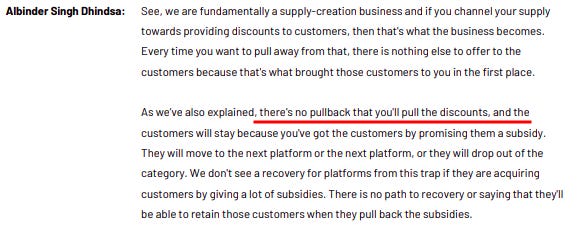
That slowdown reads like a retreat, but it isn’t one. Neither company thinks discounting is the way out. Dhindsa has called discount-led customer acquisition a dead end. Majety made much the same point on Swiggy’s call, arguing that rivals buying customers with discounts will watch their volumes fall the moment the discounts stop, and Swiggy has quietly recast its own aggressive MaxSaver campaigns as a habit of the past. They agree on the diagnosis completely. They disagree on the cure.
It has raised the budget for a single dark store from ₹1 crore to ₹2.5 crore.
Blinkit’s cure is concrete. CFO Akshant Goyal’s logic is that a larger store absorbs far more daily orders, pushing towards ₹11 lakh of sales per store per day at roughly a 6% operating margin. The moat is density and throughput. Build big, pack orders tightly within each area, and let the fixed costs get spread thin enough that nobody can undercut you.
Swiggy’s cure is merchandising. It has pushed 4 million low-value, unprofitable users off the platform over three quarters, and its retention rate has climbed to an all-time high of 61%. When Instamart’s head Amitesh Kumar Jha resigned, Swiggy replaced him with Nandita Sinha, formerly CEO of Myntra, which tells you what kind of business it now thinks it is running. Its ‘Switch to Better’ campaign has brought on more than 400 brand partners, including newer premium labels like Noice, and those premium items now account for 15% of segment sales while driving 30% higher retention among the customers who buy them.
The obvious way to check whether any of this is working is average order value, and this is where it gets genuinely surprising.
Blinkit reports a net average order value of ₹518, down slightly from ₹521 a year ago. Management attributes the flatness to what it calls the bread-and-butter effect: as quick commerce becomes a daily habit, people place small, frequent orders for everyday staples, which naturally holds the average down. Instamart reports a gross average order value of ₹691, up 12.9% from ₹612. Those two numbers are not comparable though.
Convert Instamart to the same net basis, using its ₹5,850 crore of NOV across 11.5 crore orders, and you get roughly ₹511. Against Blinkit’s ₹518. The premiumisation gap essentially disappears.
Which does not mean the strategy isn’t working. It means it is working somewhere else. Instamart’s implied take rate, calculated from its reported revenue against order value, works out to about 21.1% this quarter, up from roughly 18.6% in the March quarter. That jump comes from better terms with brands and from advertising sold inside the app.
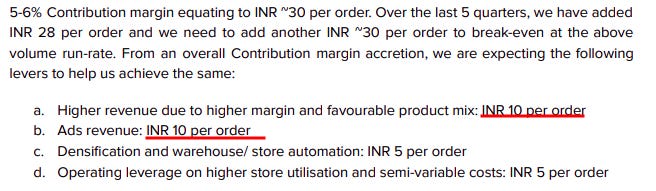
That distinction matters, because it is precisely how Swiggy expects to close the gap to breakeven. Instamart is currently about ₹30 short per order. It expects ₹10 of that to come from better product margins on premium brands, and another ₹10 from native in-app advertising. The take rate expansion is that plan showing up in the numbers a quarter early.
And then there are the competitors who don’t have to show anyone their numbers at all. On Swiggy’s call, an analyst asked CFO Rahul Bothra a pointed question: were unlisted rivals capitalising dark store salaries and server costs, treating them as long-term assets to make their operating losses look smaller than they are? Bothra’s answer was blunt.
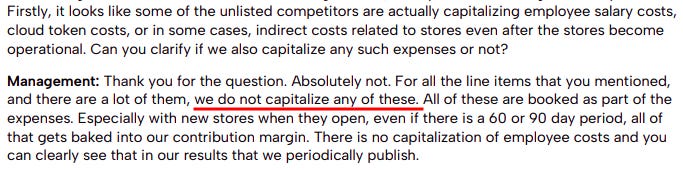
Those are expenses and Swiggy books them as expenses. They are being asked to defend their arithmetic against rivals who publish nothing.
The edges, and what changes next quarter
Around the core, the two are building quite different things. Swiggy’s B2B distribution arm, the one that makes its top line so hard to compare, remains its quiet second business, while Eternal’s version of it, Hyperpure, is a fraction of the size but turned its first profit this quarter. Both are pushing into going-out at almost identical growth rates, though Eternal has attached the bigger ambition to its side, targeting roughly ₹27,000 crore in order value through District by FY30. It also has Nugget, an AI business still in stealth that it says it will talk about in coming quarters.
The change worth watching, though, is regulatory. Swiggy’s domestic shareholding crossed 50% on July 1, and its board has approved capping foreign shareholding at 49.5%, to be voted on at the August 18 AGM. Clearing that threshold removes the FDI restrictions that have kept Instamart out of an inventory-led model, and lets it start buying and owning stock the way Blinkit already does. Swiggy expects that to be worth ₹4 to ₹5 an order in captured wholesale margin, or about 80 basis points. It also explains why it plans to add more dark stores next quarter than it ever has.
Add it up and Swiggy has a fairly precise map to breakeven: ₹10 from brands, ₹10 from advertising, ₹4 to ₹5 from owning inventory, against a ₹30 gap. Roughly ₹5 unaccounted for, on the assumption that nothing else moves. Eternal, meanwhile, is targeting around ₹9,000 crore of consolidated adjusted EBITDA by FY29, with Bistro expanding by ten kitchens a quarter.

The curdles forming in the Indian dairy sector
Over the last couple of quarters, we’ve been looking at what’s happening to India’s largest publicly-listed dairy companies. So far, the story has been one of a milk shortage because of a weaker-than-usual monsoon season, which contributed to rising milk costs. Meanwhile, Indian dairy continues to move away from milk and towards value-added dairy products like ice-cream and paneer.
Now, in this quarter, that picture has only become more prominent, but somehow, the headline results have also improved. Revenues grew almost everywhere, while everyone’s margins have taken large hits. A brutal milk shortage due to climate extremes, the Strait of Hormuz blockade, and the relentless push into higher-value products, all collided in the same quarter.
We’ll be looking at the Q1 FY27 results of three major listed players — Hatsun Agro, Dodla Dairy, and Heritage Foods — to see how the narrative is shaping up. Much of their adaptation lies in restructuring their supply chains and product mixes to weather what is literally an unpredictable climate.
Let’s dive in.
The numbers
In a commodity that seems as simple as milk, such divergence in financial performance should ideally seem uncommon, but it has been happening.
Hatsun Agro, India’s largest listed private dairy, and one of the largest ice-cream players of the country, continued its strong momentum. Its revenue from operations grew by 19% year-on-year to ₹3,093 crore. However, its profit-after-tax (PAT) saw a slight decline of 1.5% to ₹133 crore, impacted primarily by a sizable 37% increase in the cost of materials consumed.
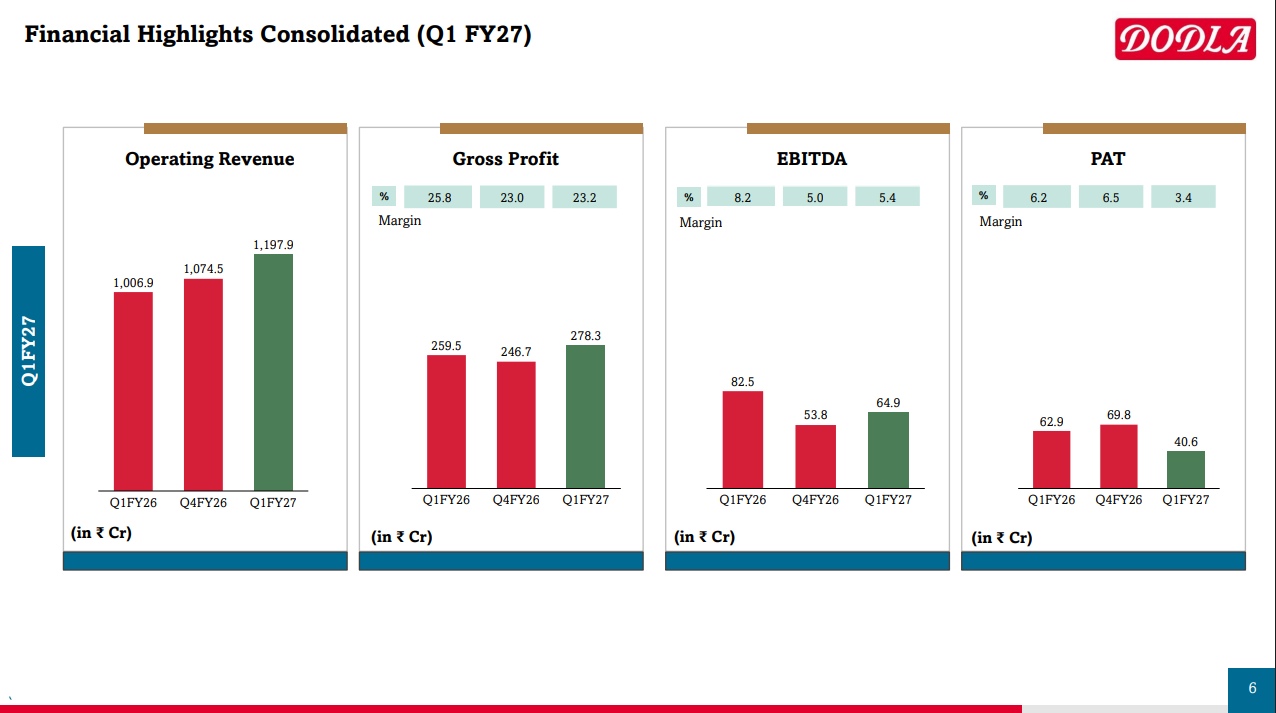
Dodla Dairy, meanwhile, bested its own all-time quarterly revenue high that it achieved just last quarter, reaching ₹1,198 crore this quarter — a robust 19% jump year-on-year. However, much like last quarter, the revenue surge didn’t help margins much, as its EBITDA contracted from 8.2% to 5.4%, and PAT fell from 6.2% last year to a measly 3.4% of revenue at ₹41 crore.
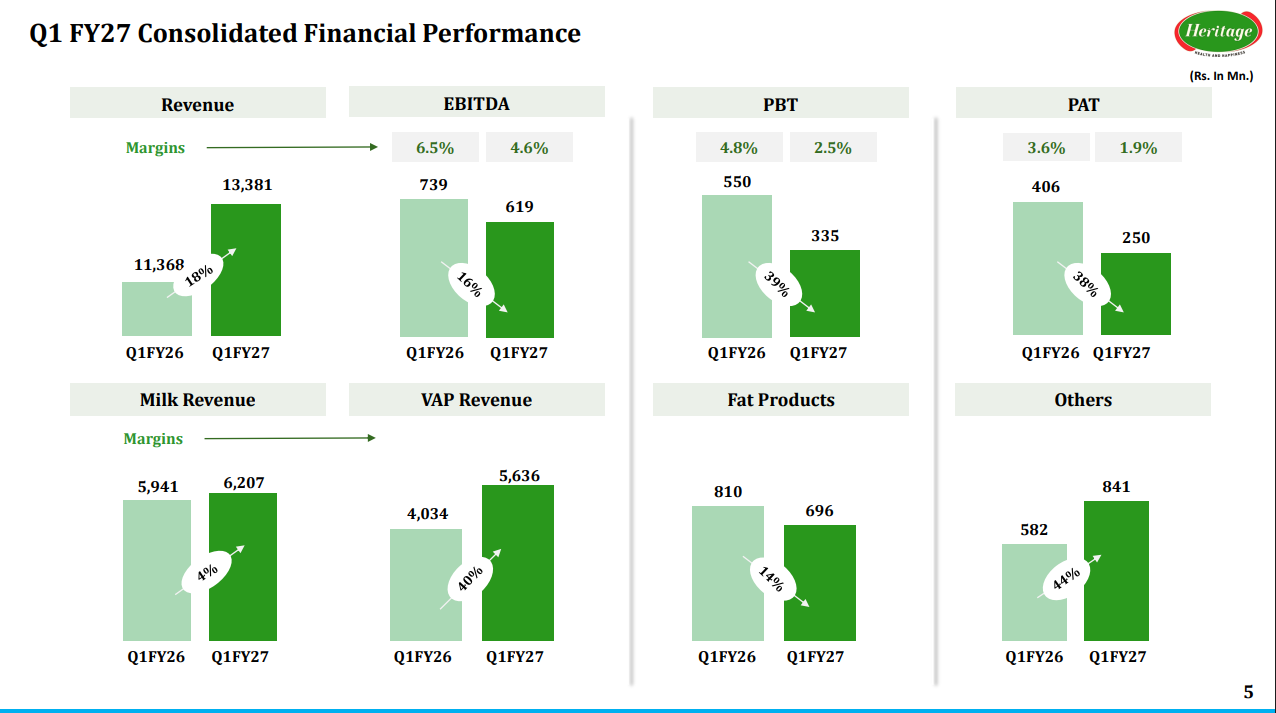
The story of Heritage Foods was not all that different either. Its consolidated revenue increased 18% year-on-year to ₹1,338 crore. But profitability took a hit, with EBITDA margins falling from 6.5% in Q1 FY26 to 4.6% this quarter. Similarly, PAT margins fell drastically from 3.6% to 1.9% in the same time period.
The cost squeeze
There were two main culprits behind why margins were bruised for everyone. The most important one is milk procurement, and the second one is the cost of packaging which has risen because of the Strait of Hormuz blockade.
Milk procurement
Let’s start with the biggest culprit.
India’s dairy industry is supposed to have a natural rhythm. The classic flush season, where cattle milk production rises naturally, takes place between October and February. We now know that flush didn’t really arrive as expected in the past year, simply because of erratic rainfall that often caused bouts of over-flooding.
Now, companies usually expect a ‘mini flush‘ in the months of April and May, particularly in South Indian regions. This is a brief window where milk supply surges before the peak summer heat sets in, which helps bring down procurement prices.
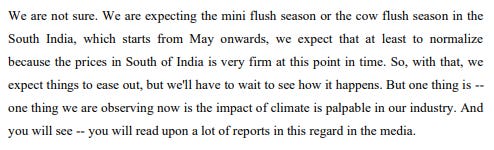
That mini flush didn’t appear, either. The monsoon-dampening effect of this year’s Super El Niño and an unseasonably warm summer disrupted this cycle. The combination of excess rainfall in some regions and severe heat in others caused extreme animal stress, lowering milk yields across cattle.
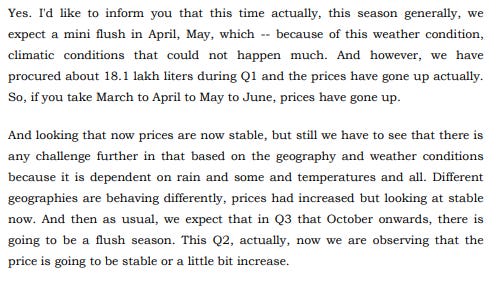
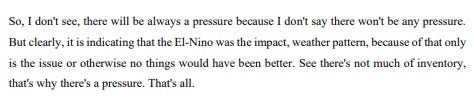
Yet, despite these supply constraints and elevated costs, milk procurement actually remains near record levels highs for these companies. Dodla Dairy, for instance, recorded its highest-ever milk procurement of 21.1 lakh liters per day, while Heritage procured 18.1 lakh liters per day — 2% more than what they did in Q1 FY26. Within the tough conditions they face, this is impressive.
But this was no accident. These dairies intentionally kept buying milk at inflated prices.
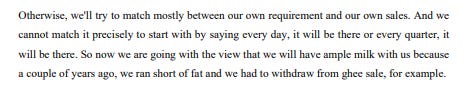
They did this for two strategic reasons. First, they needed to aggressively build up inventory for upcoming quarters in anticipation of further supply tightness. In fact, Dodla has mentioned before that they’ve been scarred by supply deficits before. A few years ago, they had to withdraw high-margin ghee from the consumer market because they ran out of fat. So, they’d rather over-procure milk.
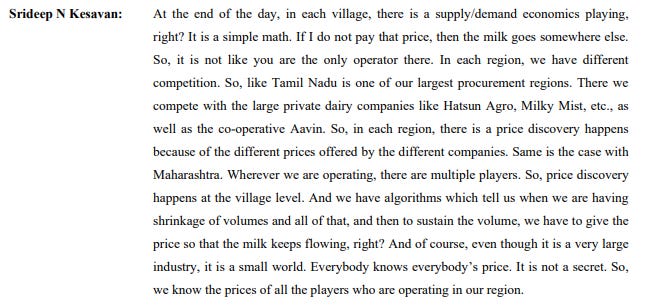
Secondly, maintaining farmer loyalty is critical — if they don’t pay the higher prices during tough times, the milk goes to a competitor or the unorganised market. Heritage had said exactly this in the previous quarter.
Both companies also managed to expand their procurement network. For instance, Dodla’s recent acquisition of Ranchi-based dairy firm OSAM has helped them spread into Eastern India. Heritage also added 5,000 more farmers to their network this quarter. So while the milk-per-cow average may have dipped, they could ensure their supply from more cows.
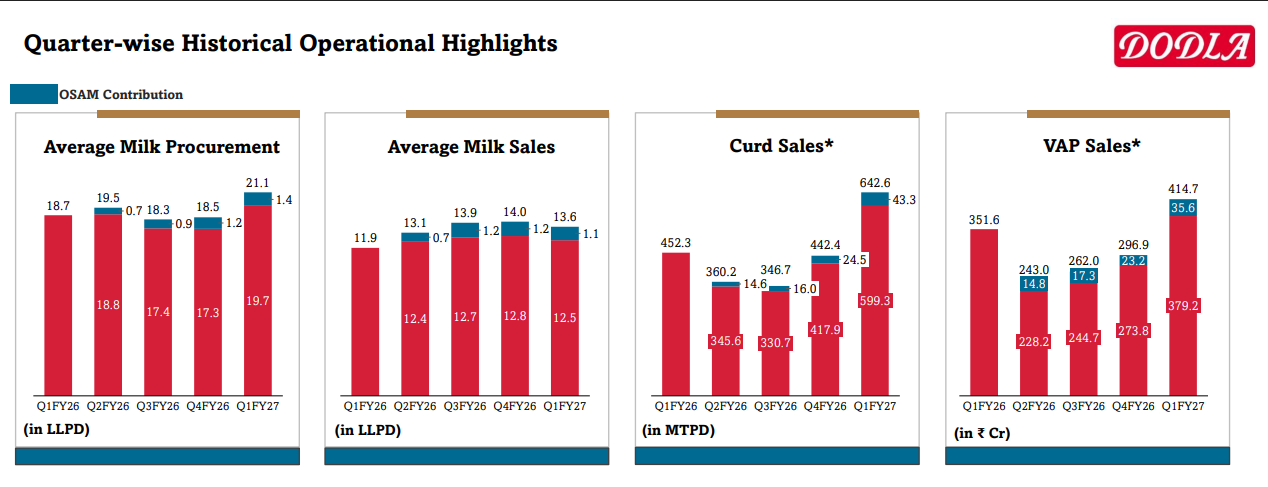
Meanwhile, they absorbed the higher costs of procurement without fully passing them on to consumers, opting to protect their market share instead. That decision is what squeezed their margins so tightly this quarter.
Packaging costs
To add to this, dairy players have been hit by rising packaging costs. For Dodla, packing material costs increased by 48% during the quarter. Packaging depends on the availability of plastics, which is a by-product of crude oil. But the world as a whole fell short of oil as shipments found it difficult to move past the Strait of Hormuz.
Complicating this was a strategic business move: the de-prioritization of B2B sales in favor of entirely retail consumer portfolios.
Historically, dairy companies sold their products to institutional buyers and middlemen, but that was always low-margin work that doesn’t build a brand. This, in fact, is why Hatsun Agro bypasses traditional wholesaling middlemen and low-margin institutional channels entirely, relying instead on direct-to-retailer distribution and their own massive exclusive network of over 4,100 HAP Daily outlets.
But, when a dairy company shifts its product mix from bulk B2B sales to consumer-facing pouches of liquid milk and packets of paneer and ice-cream, the packaging requirement obviously skyrockets. Unlike Hatsun, Dodla and Heritage are still midway in this transition, so they bore the brunt of this transition.
The VAP pivot
For the longest time, all three players have been doubling down on Value-Added Products (VAP). After all, liquid milk is a commodity business with not much margin space left. And the shift to VAP helps offset the pressure on margins from procurement and packaging costs.
This quarter, all sorts of VAP products have recorded double-digit growth for both Dodla and Heritage. Meanwhile, Hatsun remains a market leader in ice-cream, while also growing the rest of its VAP portfolio.
But even within VAP, companies are finding that over-reliance on a single product is a risk.
For instance, curd is the biggest driver of VAP for both Dodla and Heritage, and this quarter, the curd portfolio has grown significantly for both. But the problem is that it’s highly seasonal (as sales in winter fall) and spoils easily.
To de-seasonalize their business, dairy firms have been aggressively pushing products that sell year-round. For instance, paneer is emerging as the dark horse. Heritage’s paneer volumes grew 33% year-on-year, becoming a significant, non-seasonal contributor to its revenue. Dodla also highlighted growth in its paneer business, while not breaking out exact numbers.

At the same time, companies are leaning hard into high-margin drinkables and functional foods. Heritage Foods reported staggering growth in its summer portfolio despite the erratic weather: buttermilk volumes surged 60%, and lassi shot up by 98%.
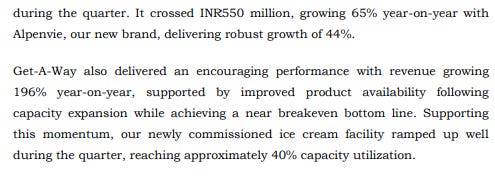
Ice cream, too, is a major battlefield as companies try to chase the high margins that Hatsun Agro enjoys. Heritage Foods saw its ice cream business surge 25% year-on-year in Q1, crossing the ₹55 crore mark in revenue. This was driven by its new brand Alpenvie (growing at 44%) and its recently acquired D2C brand Get-A-Way, which grew an impressive 196%.
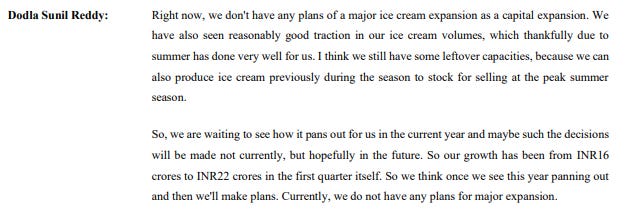
While Dodla explicitly said they don’t have any immediate major capex plans for ice-cream, they have also been aggressively driving ice-cream volumes. In their own words, they also have leftover factory capacity should they need to ramp up production in the short-term.
Large plans
To support this pivot to value-added products, capital expenditure is flowing heavily into scaling processing capabilities.
Hatsun Agro announced a massive planned investment of around ₹1,000 crore in FY27 to expand milk procurement, distribution, and production facilities. The goal is to increase product sales from 1.84 crore packs per day to 2.4 crore packs.
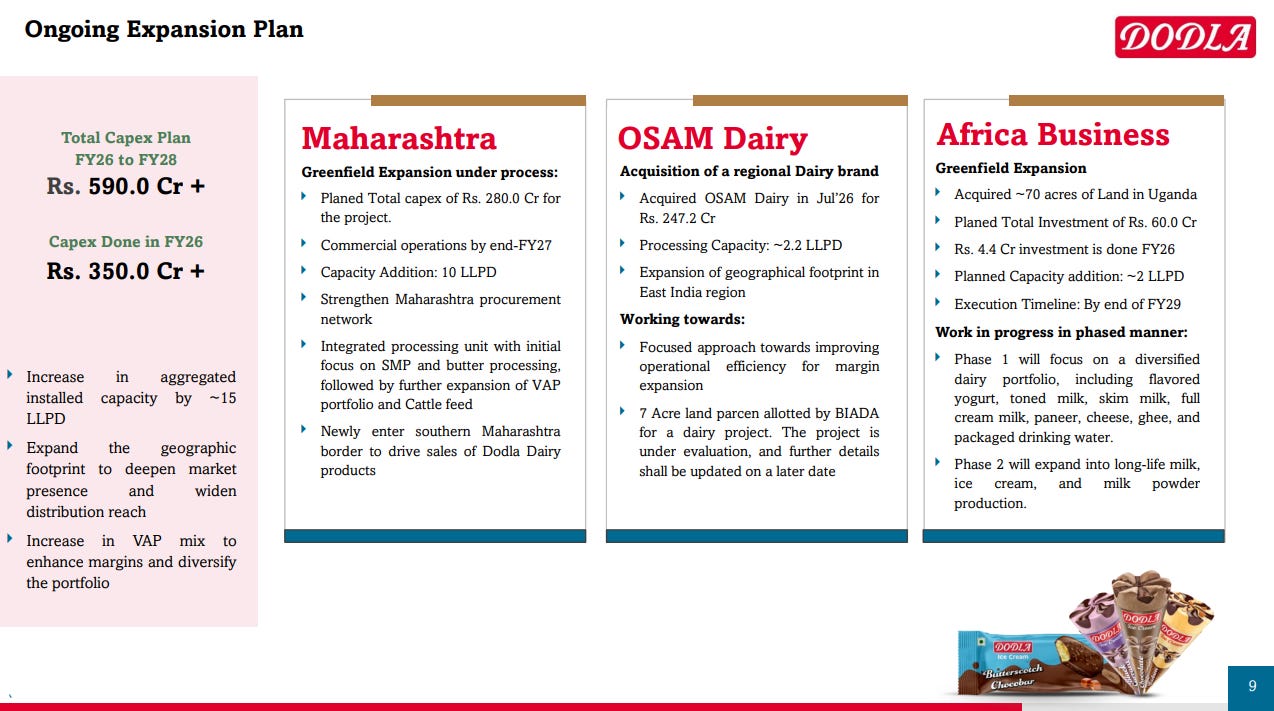
Dodla’s overall dairy business is running at 70% to 75% capacity utilization. But the real bottleneck is in their rapidly growing Africa business. Dodla’s existing yogurt plant in Uganda is operating at full capacity, and their newer Kenya plant is already at 80% utilization. To unblock this, they are planning a greenfield expansion in Uganda.
Back in India, they are deploying ₹280 crore for a greenfield integrated facility in Maharashtra to capture the Solapur market, which could eventually yield ₹500-₹600 crore in revenue.
Heritage Foods has been playing big. This quarter, they revealed that they have two projects, one for paneer and one for ghee, underway. Along with some investments on milk procurement, they expect the total capex for FY27 to reach ₹250 crore.
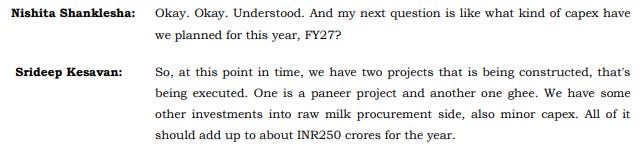
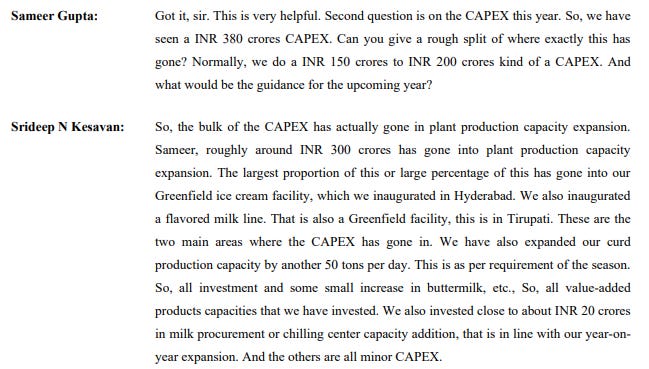
This is on top of the ₹380 crores worth of capex they put last year. Most of it went to a new ice-cream facility in Hyderabad and a milk plant in Tirupati. They expect the Hyderabad plant to eventually deliver ₹500-₹600 crore in revenue over the next 6-7 years, especially as their pre-existing ice-cream were already at full capacity.
Conclusion
For much of last year, every dairy company admitted as much that the industry was going through a very rough phase. That, unfortunately, may not change this year. It might even worsen. Rainfall continues to be spotty and volatile across India, which makes milk procurement uncertain for most of this year. For now, the companies are expanding their procurement network, but what happens when that push begins to lose steam?
At the same time, the aggressive expansion into new geographies and the shift from low-margin B2B to high-value retail products requires significant upfront investments in cold chain logistics, marketing, and distribution. Companies like Dodla and Heritage are sacrificing short-term margins by absorbing part of the raw milk price hikes to maintain their market share against co-operatives and unorganized players.
The true test in the coming quarters will be whether this expanded capacity and deepened retail penetration can deliver enough operating leverage to restore their margins, especially as procurement costs are likely to stay high this year.
We have a new Subtext episode out!
Why are major manufacturing investments (like Foxconn) going to Tamil Nadu, and how do Centre and states shape industrial policy?
We spoke with Mausam Kumar, an industrial policy researcher based out of Princeton, to unpack India’s manufacturing push—covering state bidding wars, development finance, Chinese FDI, and lessons from Japan.
Watch the full podcast episode below, where Mausam breaks down how India’s industrial policy really works:
The State of India’s Industrial Policy ft. Mausam Kumar | Subtext by Zerodha
You can also listen to the full conversation on Spotify and Apple Podcasts, or read the transcript.
Tidbits:
1. OpenAI Developing $300 Doughnut-Shaped Smart Speaker
OpenAI is reportedly building a premium, display-free smart speaker shaped like a doughnut to serve as a physical manifestation of ChatGPT. Expected to cost around $300, the device will feature high-quality metal materials and use the company’s most advanced AI models for natural, human-like voice interactions.
Source: Bloomberg
2. Policy Reforms Fast-Track Coal Mine Operations
Recent government reforms have slashed the operationalisation timeline for fully explored coal blocks by 11 months and partially explored blocks by 14 months. Coal Secretary Vikram Dev Dutt noted that cutting this administrative red tape is significantly accelerating mine development and commercial coal production.
Source: The Economic Times
3. India Approves ₹23,731 Crore Push for Biogas Production
The Union Cabinet has cleared a massive ₹23,731 crore national scheme to increase domestic Compressed Biogas (CBG) production tenfold over the next decade. The initiative aims to convert agricultural and municipal organic waste into clean fuel, boosting rural incomes while reducing reliance on imported fossil fuels.
Source: Financial Express
4. Govt Denies Plans to Blend Raw Ethanol with Aviation Fuel
Civil Aviation Minister K. Rammohan Naidu strongly refuted political claims that the government plans to blend raw ethanol with Aviation Turbine Fuel (ATF), calling the rumours false and a needless cause for passenger anxiety. He clarified that internationally certified Sustainable Aviation Fuel (SAF) is entirely different from raw ethanol and undergoes rigorous global safety testing.
Source: Business Standard
5. Infosys Inks 10-Year AI Deal to Overhaul Crocs’ IT Systems
Infosys has secured a 10-year contract to rebuild and modernise the global IT and business operations for footwear maker Crocs using artificial intelligence. The long-term tech overhaul aims to break down data silos, reduce operational costs, and build a more flexible infrastructure for the global brand.
Source: Financial Express
- This edition of the newsletter was written by Mridula & Manie.
Beyond Today’s Brief
There’s always more happening at Markets by Zerodha.
The Chatter: What is driving Dixon’s shift from assembly to components and exports? Can Motherson’s push into aerospace and new businesses reduce its dependence on autos? And are Biocon, Ather and Deepak Nitrite showing signs of a broader manufacturing recovery?
Points & Figures: What do India’s factories tell us about the trade-off between jobs, capital and value creation? Why are large factories generating most of the value while contract labour takes a growing share of employment? And what does it take to build a deeper industrial base?
Aftermarket Report: What is keeping Nifty stuck in the 24,550–24,600 range? Why are Auto and IT holding up while Financials drag? And what are FII-DII flows, earnings and the options setup telling us about the market ahead?
Join us on WhatsApp, where we share interesting soundbites from concalls, articles, and everything else we come across throughout the day. You’ll also get notified the moment a new video or article drops so that you can read or watch it right away.
Thank you for reading. Do share this with your friends and make them as smart as you are 😉
One dimension I think deserves more attention is the capital intensity of the inventory-led model. The ₹4–5/order wholesale margin Swiggy expects to capture sounds attractive, but inventory ownership also transfers working-capital, shrinkage, expiry and markdown risk onto the platform. So the real test shouldn't just be incremental contribution margin per order, but incremental ROIC and cash conversion.
In quick commerce, a higher margin business isn't necessarily a better business if it requires disproportionately more capital to generate that margin.
Would love to see a deep dive done on state level milk cooperations like Nandini / Aavin etc