

Hi everyone, I’m Mridula, and welcome to the sixth edition of Weekly Tidbits.
We spend a lot of time reading interesting stories that never make it into a full Daily Brief piece. So, once a week, we pick some of the best ones and add a little context.
We sort them into GEIC: Global, Economy, Industry and Company.
Let’s get started!
If you prefer watching the video, here’s the link:
G — Global
[1] Saudi Arabia’s oil backup route is hit
Saudi Arabia’s East-West oil pipeline was shut after drone attacks damaged pumping stations. The country has since signalled that it plans to restart the route. The pipeline gives Saudi Arabia another way to export crude because most of its oil normally leaves through the Persian Gulf and passes through the Strait of Hormuz.
The East-West pipeline avoids Hormuz by carrying crude from Saudi Arabia’s eastern oilfields to the Red Sea port of Yanbu. That makes it an important backup whenever shipping through the Gulf becomes risky. We have written before about why the Strait of Hormuz matters so much to global energy markets.
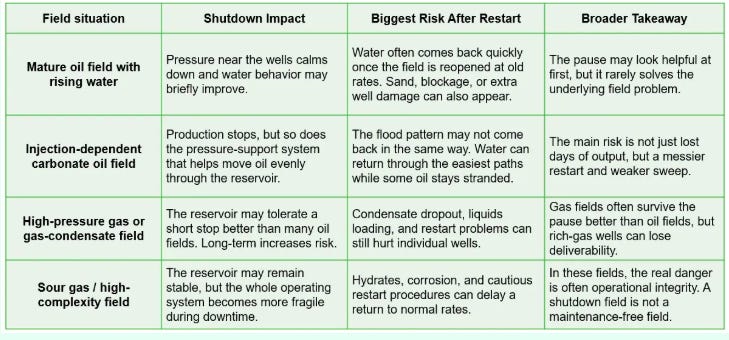
For now, the shutdown has reduced that flexibility, and some European refiners were told that October supplies from Yanbu would not arrive. Saudi Arabia can still export large volumes of crude, but an outage on one of its main alternative routes leaves it with fewer options if shipping through Hormuz also comes under pressure.
[2] US borrowing costs are near 20-year highs
US government borrowing costs have climbed to levels last seen before the 2008 financial crisis. The yield on the 10-year Treasury crossed 5% in mid-September. When investors sell bonds, their prices fall and the return a new buyer earns, called the yield, rises.
Several things are driving the sell-off. Higher energy prices are adding to inflation fears, while investors are also worried about how much debt governments are issuing. The Federal Reserve raised rates on September 16 and has signalled that more increases could follow. Companies are borrowing heavily too, including to fund data centres and other AI infrastructure, which means investors have even more debt to absorb. We wrote earlier this month about how America’s growing debt and borrowing needs are putting more pressure on the bond market.
The pressure has spread beyond America. Germany’s 10-year government bond yield reached its highest level since 2009, while Australia’s touched a 15-year high. Higher government yields can feed into mortgages, company loans and other borrowing, making money more expensive.
[3] China is investigating Meituan and Alibaba
Chinese regulators are investigating Meituan and Alibaba units for suspected violations of unfair competition laws. Meituan is one of China’s largest local-services platforms, spanning food delivery, hotel bookings and other services that connect consumers with businesses.
Platforms like Meituan become stronger as more merchants and users join them. More restaurants attract more customers, while more customers make the platform more important to restaurants. Once that loop becomes large enough, businesses can find it difficult to stay away even if they dislike the terms.
Chinese industry groups have raised concerns around commissions, search rankings and promotional programmes used by online platforms. Regulators are now looking at how companies use the bargaining power that comes with scale, especially when restaurants, hotels and other merchants depend heavily on them for customers.
E — Economy
[4] Bangladesh is buying Indian wheat again
Bangladesh has started buying Indian wheat again after a gap of four years. Traders have already booked more than 200,000 tonnes as disruption around the Black Sea makes supplies from Russia and Ukraine less dependable.
Bangladesh normally imports a large share of its wheat from the Black Sea region. But attacks on ports, ships and grain infrastructure have made that route riskier and more expensive. At the same time, high rice prices at home are pushing more people towards wheat, which is increasing demand just as imported supplies become harder to secure.
India suddenly has an advantage. It lifted the wheat export ban imposed in May 2022 after a strong harvest improved domestic supplies, and its proximity to Bangladesh keeps transport costs much lower than wheat coming from Australia or North America. The Black Sea war is now shaping where Bangladesh buys one of its basic staples, and India is the nearest beneficiary.
[5] GST collections are recovering
India overhauled the Goods and Services Tax last September. Four major slabs were reduced to two main rates of 5% and 18%, while a new 40% rate was introduced for some sin and luxury goods. Taxes were also cut across several categories.
Lower rates make products cheaper, but they also reduce the tax collected on every sale. Net GST collections, which means revenue after refunds, stayed subdued through the end of 2025 before beginning to recover. In August, net collections reached about ₹1.68 lakh crore, 8.3% higher than a year earlier. The comparison needs some care because GST 2.0 also changed the compensation cess on several products.
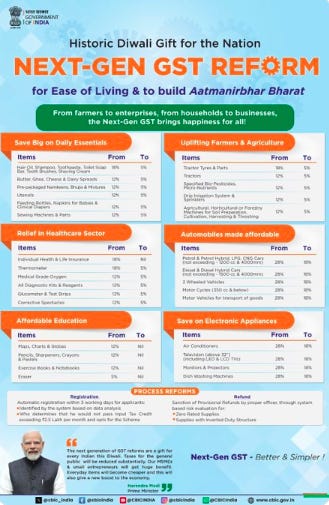
When the reforms were announced, we wrote about this trade-off. Lower prices could support consumption, while simpler slabs could improve compliance and reduce classification disputes. The recent recovery suggests that at least part of the initial revenue hit is narrowing, although one year is still too early to say the tax cuts have paid for themselves.
[6] India may create a ₹20,000 crore AI fund
The government is considering putting ₹15,000–20,000 crore into a proposed National Frontier AI & Compute Fund. The fund is still under discussion, but it could provide long-term capital to Indian AI companies and finance GPU clusters, specialised data centres and other computing infrastructure.
Advanced AI models need large amounts of computing power. That means thousands of specialised chips, along with the electricity, cooling systems and high-speed networks needed to run them. Global technology companies can finance this infrastructure themselves, while an Indian startup may have the talent and the model idea but still lack enough computing power to train it at scale.
India already has the IndiaAI Mission, which is also trying to expand access to computing capacity. The new proposal appears to add a dedicated pool of long-term capital for frontier AI and infrastructure. What is still unclear is how much of it would be new support and how much would overlap with programmes the government is already building.
I — Industry
[7] India may change how DAP subsidies work
The government is considering different subsidy rates for diammonium phosphate, or DAP, depending on how companies produce it. DAP is one of India’s main fertilisers and receives support under the Nutrient Based Subsidy scheme, which helps keep the price paid by farmers under control.
Some companies import finished DAP, while others manufacture it in India using inputs such as rock phosphate and phosphoric acid. Those routes do not face the same costs. Sulphur prices have risen sharply as supply disruptions around Russia and West Asia tightened the market. Sulphur is used to make sulphuric acid, which is needed to produce phosphate fertilisers, so domestic producers feel that increase more directly.
India also wants to reduce its dependence on finished fertiliser imports. If the subsidy does not reflect the higher cost of making DAP locally, importing the finished product can become more attractive than producing it in India. Differential subsidies would try to keep fertiliser affordable without weakening that localisation push.
[8] India’s e-bus boom faces a financing problem
Electric-bus sales in India reached 5,412 units in FY26, around 35% more than the previous year. Much of that growth comes from buses operating under government-backed contracts with state transport undertakings.
Private companies often run these buses under Gross Cost Contracts. They buy and operate the vehicles, while the transport authority pays them a fixed amount for every kilometre travelled. That predictable payment stream makes financing easier. Operators running intercity, staff or other private services have a harder time because they carry the passenger and revenue risk themselves. We wrote about this model earlier, when India’s e-bus push was still largely being driven by government contracts and payment guarantees.
An electric bus can cost around ₹90 lakh to ₹1.2 crore, compared with roughly ₹43–45 lakh for a diesel or CNG bus. Lower fuel and maintenance costs can make up part of that difference over time, but shorter loan tenures leave operators with large repayments before those savings add up. The harder task is making the economics work for operators without a government contract behind them.
[9] Europe may stop sending metal scrap to India
India could lose direct access to some European metal scrap from May 2027. The European Union is changing its rules for shipping waste to countries outside the Organisation for Economic Co-operation and Development, or OECD. India has applied for continued access but is not currently included for some metal-waste categories in the proposed list.
For Indian metal companies, scrap is a raw material. Aluminium scrap can be melted and reused, using far less energy than producing fresh aluminium from ore. India is also a major buyer of European aluminium scrap.
If those shipments are restricted, recyclers will have to source more material from other countries. Higher scrap prices would raise production costs, while using more primary metal would increase energy use. Europe wants to make sure its waste is processed safely after leaving the bloc, but the same environmental rule could change where Indian factories source their raw material and what they pay for it.
C — Company
[10] Nykaa and L’Oréal will invest in beauty startups
Nykaa and L’Oréal’s venture arm BOLD are teaming up to invest in Indian beauty, personal-care and wellness brands. BOLD stands for Business Opportunities for L’Oréal Development. The two companies plan to take minority stakes while founders continue to run their businesses.
Nykaa brings a large Indian retail platform, which gives it a view into what consumers search for, what sells and which young brands are gaining traction. L’Oréal brings capital, product expertise and decades of experience scaling beauty brands.
The partnership also pushes Nykaa further into a dual role. It already sells other companies’ products while owning brands of its own, including Nykaa Cosmetics and Dot & Key. That could make rival brands on its platform wonder how neutral it can remain as it invests in more brands itself. For startups, the attraction is simpler: Nykaa and L’Oréal can provide capital, distribution and expertise when the challenge shifts from launching a good product to building a much larger business.
[11] Apple Pay is preparing to enter India
Apple is preparing to launch Apple Pay in India, beginning with Axis Bank credit cards. It is also talking to other large banks.
The reported launch is about cards, not UPI. Apple Pay stores a tokenised version of a card on an iPhone or Apple Watch. When a user taps the device at a compatible payment terminal, the transaction still runs through the card network behind that card. UPI works differently because it moves money directly between bank accounts.

than the average Indian digital-payments user.
[12] A tax dispute is holding up the JSW–Volkswagen deal
JSW Group wants Volkswagen to remain responsible for a potential tax liability of $1.4 billion, roughly ₹13,160 crore at ₹94 to the dollar, as the two companies negotiate a partnership involving Skoda Auto Apple therefore does not need to build another payment network. It can use existing card rails and compete for the interface customers use to pay. India is overwhelmingly a UPI market and Apple has a much smaller handset share than Android, so the initial audience is likely to be narrower and more affluent Volkswagen India.
The dispute goes back to vehicle parts imported between 2012 and 2024. Indian authorities say Volkswagen brought in what were effectively complete knocked-down vehicle kits but classified the parts separately. Complete kits attract a higher import duty, while individual components can attract lower rates. Volkswagen denies the allegation and is challenging the demand in a Mumbai court.
The old case now affects the valuation of the new deal. JSW does not want the liability to move into the business it is buying if Volkswagen eventually loses the case. The group is already expanding in automobiles through its partnership with MG Motor India, and a Volkswagen deal would take that push further. Before that happens, both sides need to agree on who carries this risk from the past.
That’s it for this week.
A few of these stories are still developing, so we’ll be keeping an eye on them. But if there’s one you’d like us to write about properly, let us know in the comments.
See you next edition :)