


Our goal with The Daily Brief is to simplify the biggest stories in the Indian markets and help you understand what they mean. We won’t just tell you what happened; we’ll tell you why and how too. We do this show in both formats: video and audio. This piece curates the stories that we talk about.
You can listen to the podcast on Spotify, Apple Podcasts, or wherever you get your podcasts and watch the videos on YouTube. You can also watch The Daily Brief in Hindi.
In today’s edition of The Daily Brief:
1. The US is one step away from banning green cards
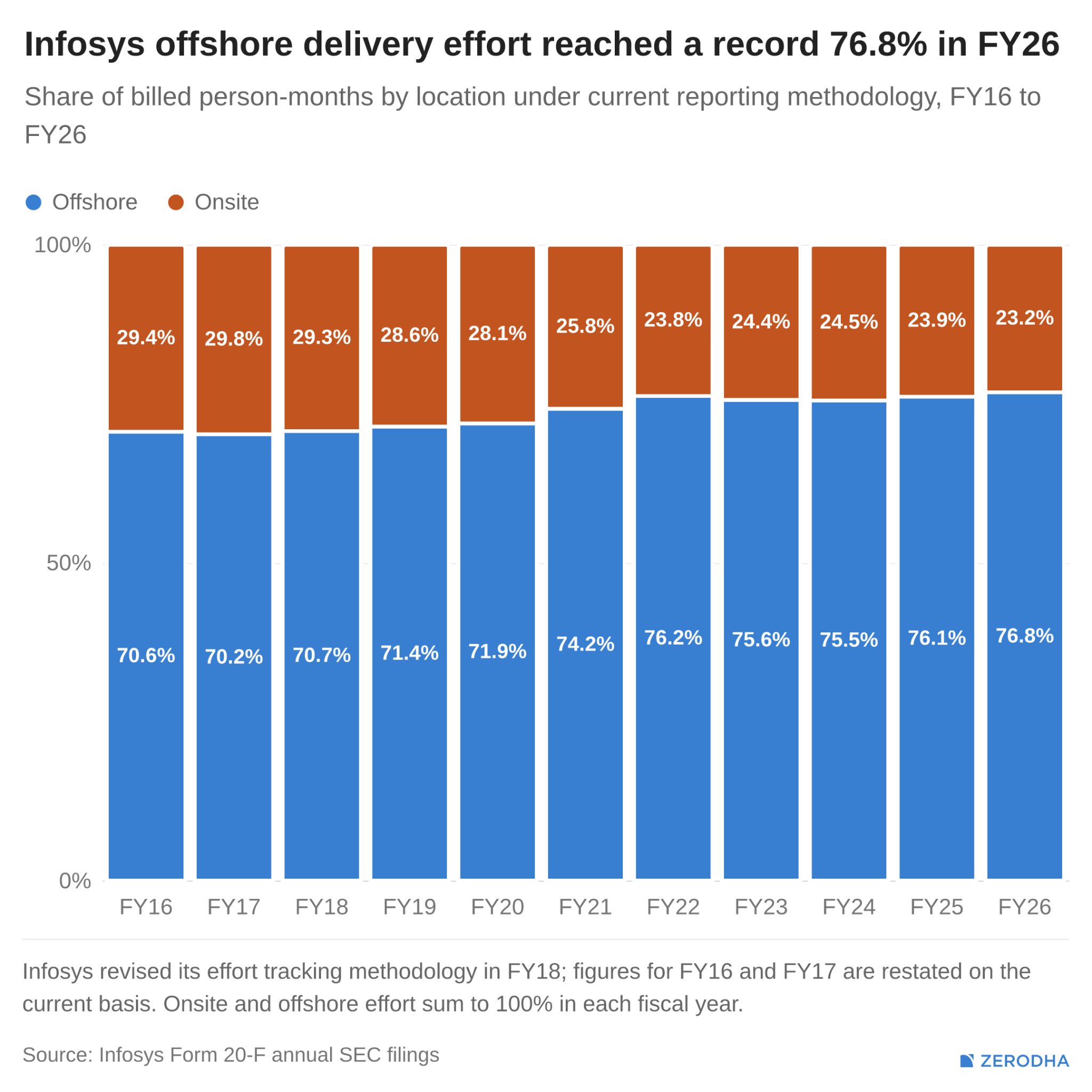
The US Department of Labour indefinitely suspended eight major tech firms—including Microsoft, TCS, Infosys, Wipro, and Cognizant—from the Permanent Labour Certification (PERM) program, freezing the primary pathway to green cards for foreign workers. However, top Indian IT firms have already dramatically reduced their reliance on US work visas and green cards over the past decade, shifting to high offshore delivery ratios (~77%) and local US hiring, while Big Tech firms like Microsoft bear the brunt of the freeze.
2. India’s housing boom has narrowed
Headline data shows major-city housing sales remaining flat at 2.58 lakh units between January and September 2026, but underlying segment trends reveal a stark divide. While the ₹1–5 crore mid-to-premium housing segment surged—now accounting for over half of all sales—the affordable market (<₹50 lakh) fell 12% due to soaring land costs, reduced developer launches, and buyer affordability constraints exacerbated by the RBI’s recent rate hike.
The US is one step away from banning green cards
Just a few days ago, US Vice President JD Vance and Labour Secretary Keith Sonderling held a press conference to announce one of the Trump administration’s most aggressive immigration enforcement actions yet. Eight major technology companies were being indefinitely suspended from the Permanent Labour Certification program, or PERM. No new applications would be accepted, nor would any pending applications be processed.
As per Sonderling, since 2009, these companies alone had received over 2.3 lakh H-1B approvals and obtained over 1 lakh PERM certifications. Vance singled out Microsoft for laying off 6,000 American workers while obtaining over 6,000 H-1B visas and ~3,000 green cards. He called the foreign workers these companies employed “indentured servants”.
However, four of those eight companies are TCS, Infosys, Wipro, and Cognizant, which have already reduced their green card applications significantly to a negligible scale. Their combined filings in FY26 were essentially zero. The company this freeze hits hardest is actually Microsoft, which is the single largest filer of PERM cases.
This is also hardly the administration’s first move against skilled immigration. Just last year, the US had steeply hiked the application fee for the H1B visa. But since then, it’s hardly made a dent to the Indian IT business, which has been preparing for long against this eventuality.
So, what really is the intention behind this PERM move? How does it measure up against the goals it has set out to achieve?
The H1B fee hike
Let’s start with last year’s H1B fee hike.
In September 2025, the Trump administration issued a proclamation slapping a $100,000 fee on new H-1B visa applications on top of the previous cost of just $5,000. Indians account for ~70% of all H-1B beneficiaries, so this was, in effect, an India tax.
However, the fee barely survived contact with the courts. A Massachusetts judge vacated it in June 2026, calling it an unlawful tax. The First Circuit, which hears appeals from federal district cases in some states, declined to reinstate it in July. Between September 2025 and February 2026, the Department of Homeland Security actually collected the fee on just 85 applications. Fee-subject filings collapsed by 87%.
But perhaps, the fee was probably not needed at all. Indian IT firms have been reducing their reliance on H1B registrations for much of the last decade anyway.
As we’ve covered before, Indian IT chooses one of two ways to reduce their reliance on H1B. The primary move is to move as much of their work offshore as possible. When that isn’t possible, they pull the secondary lever: hiring Americans locally.
In fact, between 2015 and 2025, there has been a 70% drop in H1B registrations for initial employment from the top Indian companies. In FY24, these firms only filed nearly 4500 petitions, which represented 0.003% of America’s civilian workforce. The H1B fee only nudged these companies further in a direction they were already headed in.
The bridge between guest and resident
Now, an H-1B visa is a temporary work permit. It lets a skilled professional live and work in the US for up to six years. But it’s tied to a specific employer. If you lose your job, you have 60 days to find another sponsor or leave the country. You can’t freelance, you can’t start a company, and your bargaining power with your employer is limited, because there is no alternative to leaving your employer other than leaving the US altogether.
A green card, though, is permanent residency. It lets you live and work in the US indefinitely, for any employer, on your own terms.
PERM is the bridge between the two. Before an employer can sponsor a worker for a green card, it must first get the Department of Labour to certify that no qualified American worker is available and willing to take the job. The employer posts the position, runs a recruitment campaign, documents that no suitable American applicant turned up, and then files for PERM certification. Only after that can it petition for access to a green card.
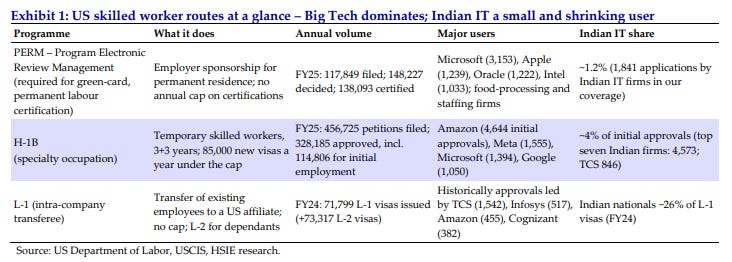
In other words, the PERM process is specifically designed to protect American workers.
So what does freezing PERM do? It doesn’t cancel anyone’s work visa, nor does it immediately deport anyone. What it does is freeze their path to permanence. Workers can keep working, but they can’t move toward a green card through these eight employers. The freezing of PERM, then, locks out many hopefuls from the ability to exit the trap Vance described.
Shooting moving targets
That being said, Indian companies have relied even less on the PERM as they have on the H1B.
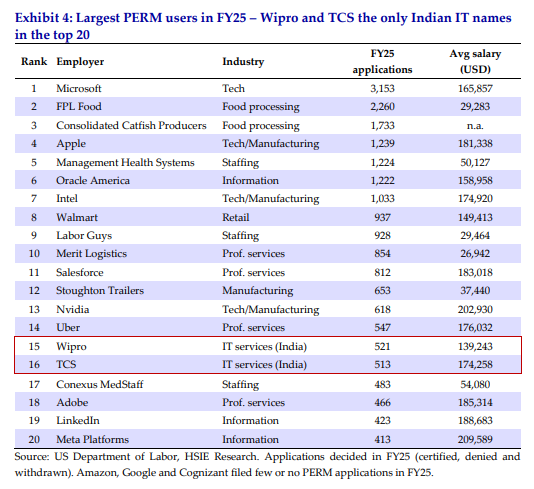
The US Department of Labour publishes PERM disclosure data every year. In FY25, Microsoft had 3,161 PERM cases that were decided. This was more than the Indian outsourcers on the list combined. In FY26, the gap became even starker: Microsoft got 1,683 of those, while each of Infosys, Wipro, TCS and Cognizant had either a negligible number or flat zero.
As per HDFC Securities, only two Indian IT firms feature in the top 20 PERM users of FY25.
That also tracks with the intentions that Indian IT firms have publicly announced. For instance, TCS CEO K Krithivasan said publicly that the company is not looking to hire any new H-1B applicants in the US at all.
TCS told the stock exchange that except for its backlog, its new PERM applications had been in “single digits“ over the last two years. Cognizant went from over 1,200 PERM cases a year to zero. Even when certifications came through, many companies let them expire unused. They weren’t carrying workers with green cards.
Meanwhile, the companies hit hardest are American multinationals like Microsoft and Adobe, who often onboard Indian workers under both H1B visas and the green card.
For many Indian engineers, a job at a Big Tech company has long been the American Dream. But now, Trump’s policies are only making it harder to realise it. In fact, this is exactly what we discussed in a recent Subtext episode with serial entrepreneur Sidu Ponnappa.
Like we mentioned before, Indian IT firms have been pulling two levers to escape America’s anti-immigration measures.
The first is offshoring. It’s well-known that Indian IT has been increasing its offshore mix over the last 10-15 years. The share of work done at the client’s location in the US has been falling across companies, much of it directly in response to the risks posed by American policy measures.
Moreover, a paper in Management Science by economist Britta Glennon found that restricting H-1B supply doesn’t cause companies to hire Americans. It causes them to move work abroad. A one-percentage-point cut in H1B supply led to 12-16% growth in foreign affiliate employment. It just moves the work.
The second lever, though, might contrast with this paper’s findings, because starting around 2016, Indian IT firms actually began hiring locally. By 2017, Infosys had committed to hiring 10,000 Americans and opening innovation hubs across the US. Today, TCS has ~30,000 US employees, of whom a third are on the H1B visa.
Later, Trump instituted a “Buy American, Hire American“ executive order, which only accelerated it. The localisation rate has climbed steadily since. Wipro went from about 50% local workforce in the US in 2017 to over 80% by late 2025. Meanwhile, HCL also has a ~80% localisation rate as of this year.
Now, you might think that both levers might be at odds with each other. But the nuance here is that the localisation rate has been rising, but the onsite footprint share has been shrinking. The US jobs Indian IT adds are dwarfed by the headcount it keeps adding offshore. The net flow of work is still moving to India, not away from it.
Additionally, offshore growth is also taking the form of GCCs in India, where companies like Microsoft, Amazon, and Google are building their own captive operations. These centres bypass both the visa system and the IT services vendor entirely.
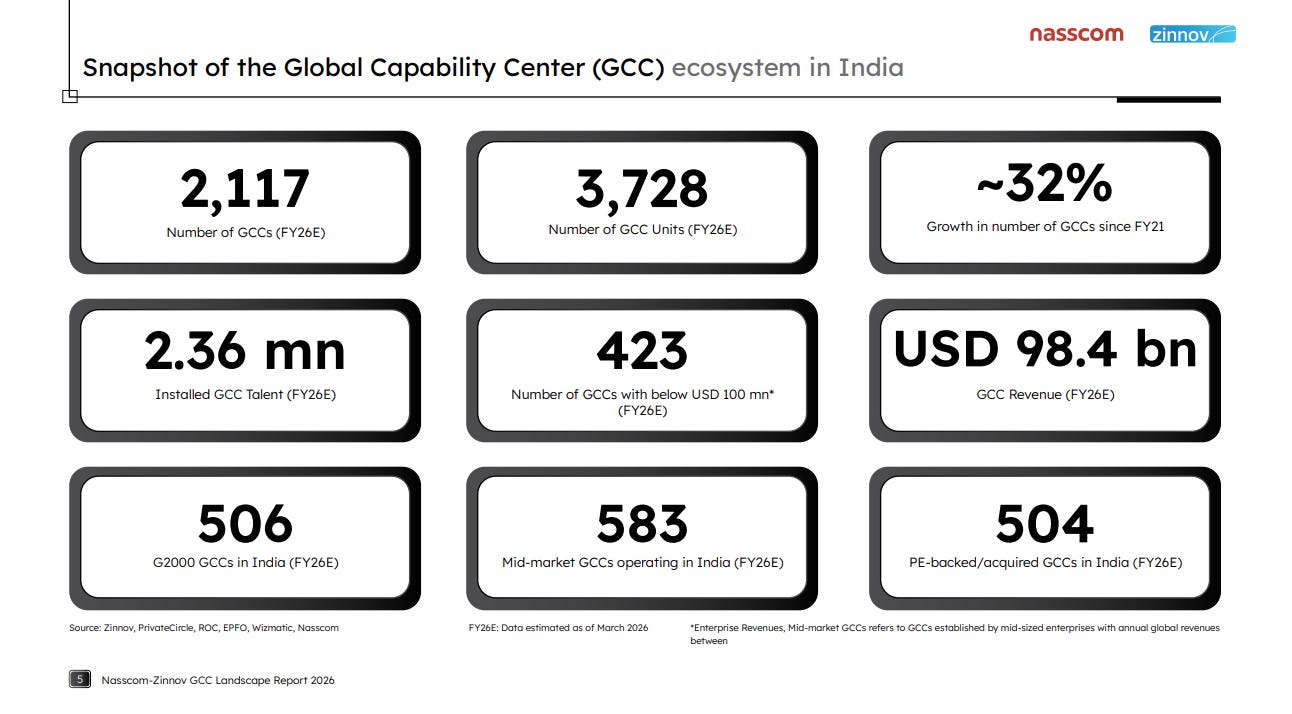
So Indian IT might be doing what Vance says he wants: hiring Americans, building local workforces, reducing visa dependence. But the ban may not be as effective, particularly on Indian IT that have more or less already abandoned the PERM program. And while it potentially hurts Big Tech firms more, their most rational response might be to move more of the work outside.
The AI invariant
However, there’s one variable we’re yet to account for that might intersect with this ban in unseen ways.
AI is, of course, rapidly forcing software product and services firms to upend their organisations and even shrink the base of the pyramid. The routine work that filled the offshore pyramid, like testing, code maintenance, and basic application development, is exactly the kind of work LLMs are getting good at.
In light of that, there could theoretically be a limit to how much offshoring you could do.
Meanwhile, as AI automates the commodity layer, the work that remains valuable is the exact opposite. It’s the work that requires being deeply embedded with the client, understanding their data, their systems, their specific problems. Sometimes, if not always, that might mean actually being physically present at a client site. This, in fact, was also alluded to in the same Subtext episode with Sidu Ponnappa.
This is the Forward Deployed Engineer (FDE) model, where small teams of highly-skilled engineers sit wherever the client’s key workflows live. It is a heavily customer-facing role, much unlike most offshore work Indian IT has done this far. And while it’s hardly a new model, it was made popular by a very specific American company: Palantir.
Interestingly, some months ago, Alex Karp, the CEO of Palantir, said that AI makes large-scale skilled immigration hard to justify “unless you have a very specialised skill“. In a sense, that is also the ideology behind the PERM restriction. Karp also has extremely close ties with the Trump administration.

Indian IT firms are starting to build FDE-style capabilities. TCS, for instance, has already begun hiring FDEs. Plus, as we’ve covered before, some of the fast-growing mid-cap IT firms are following a model somewhat similar to that of Palantir, where teams are arranged in small “pods” of human FDEs and AI agents, dedicated wholly to certain clients. When the business grows, the size of the pods themselves doesn’t; only the number of pods does. But it’s still early days.
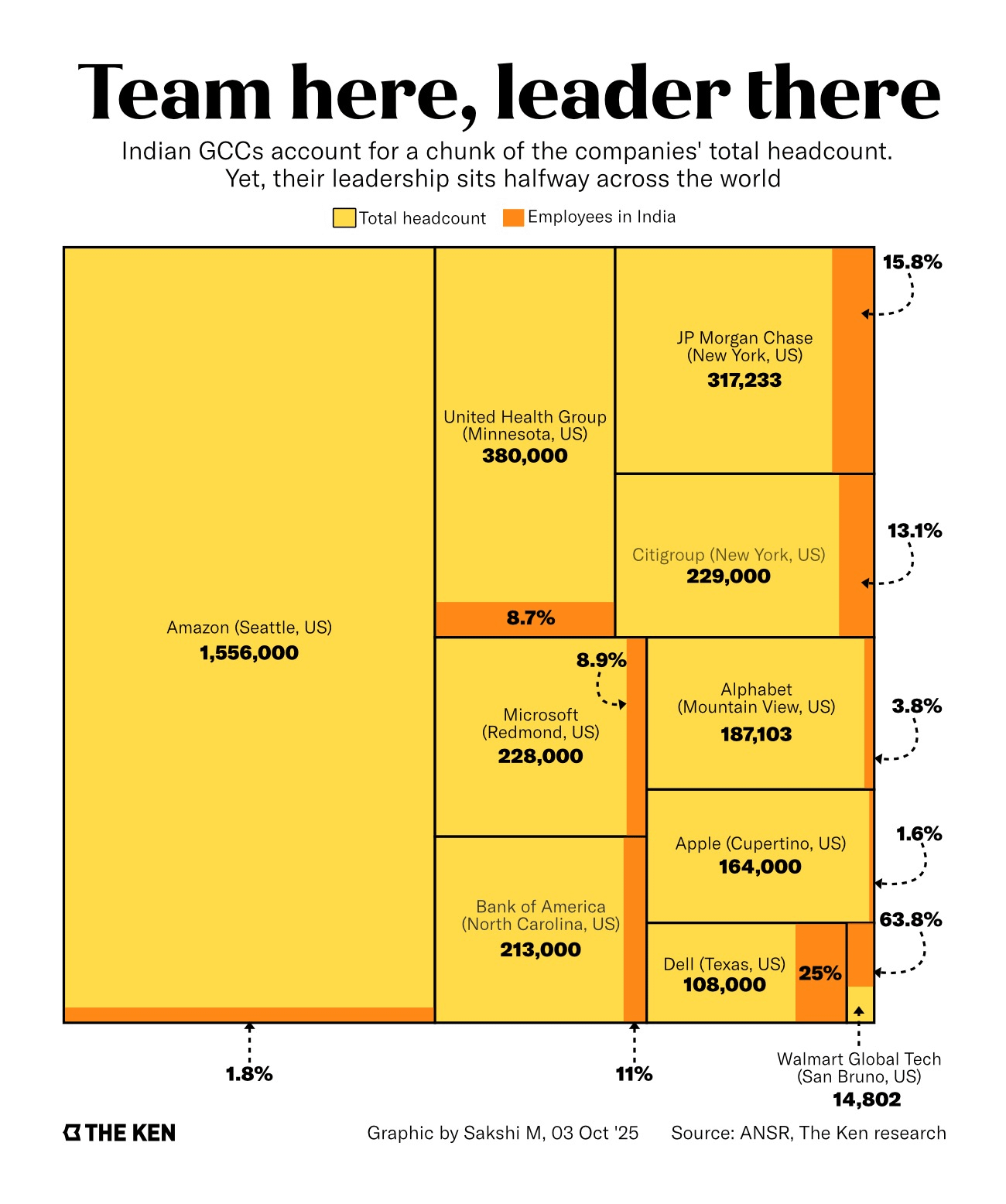
The real volume, meanwhile, is flowing toward India’s GCCs, with firms like Amazon and Microsoft committing billions of dollars to India. That does mean more jobs in India, but does it mean more decision-making power? Well, GCCs expected that Trump’s policies would give them that. But, as The Ken found out, many of the critical decisions continue to remain in American headquarters, while India does the execution.
Fighting the last war
The PERM freeze is indefinite with no end date in sight yet. But, like the H-1B fee before it, is aimed at a model that’s already mostly gone. The Indian IT body-shop has been in retreat for a decade, while also diversifying away from the US. Most of the companies named in the suspension had already stopped using the programme.
The policy assumes a world where blocking a foreign worker creates a job for an American. While there are signs it does, much of the best available evidence says that the relationship is not 1-to-1. It may even be negative.
It also goes without saying that this is yet another measure from the Trump administration to de-globalise and insulate the US from the rest of the world. However, if there’s anything we’ve learned this year, it’s that trade always finds a way to move and skirt past barriers.

India’s housing boom has narrowed
If you only looked at the headline numbers, you’d think India’s big-city housing market has simply stopped moving. Knight Frank counted 2.58 lakh sales across eight major markets between January and September 2026, almost exactly what it sold a year earlier. In July–September alone, sales slipped just 1%. Boring, right?
Not quite. A market can be flat in two ways. Either nothing moves, or some parts surge while others sink and the two cancel out. India’s housing market is the second kind. Cheaper homes are selling less, the ₹2–5 crore bracket is booming, and some corners of the luxury market are slowing hard. To see what’s really going on, you have to look underneath that total

Premium demand is real but uneven
In July–September, sales of homes priced between ₹1 crore and ₹2 crore rose 4% from a year earlier. The ₹2–5 crore segment grew 20%. Put together, these two brackets now make up just over half of all the homes sold across the eight markets.
And these are actual homes changing hands at those prices, not just developers announcing bigger booking numbers. Developers are seeing it too.
In an interview, Prestige Estates chairman said its luxury projects, like Prestige Nautilus and Prestige Ocean Towers in Mumbai, had seen a strong response. He admitted there’s a lot more luxury supply coming up, but his point was simple: get the location, design and price right, and buyers will show up.
Of course, that’s one developer talking about his own projects. Zoom out, and the picture gets messier.
In NCR, sales of ₹5–10 crore homes fell 63% in July–September, while unsold stock in that bracket rose 33%. That’s a staggering fall. Knight Frank’s read is that NCR’s top end had become an investor-heavy market, where prices ran ahead of what people who actually want to live there could pay. That’s the consultancy’s take, though. The sales numbers alone can’t tell us why buyers stayed away.
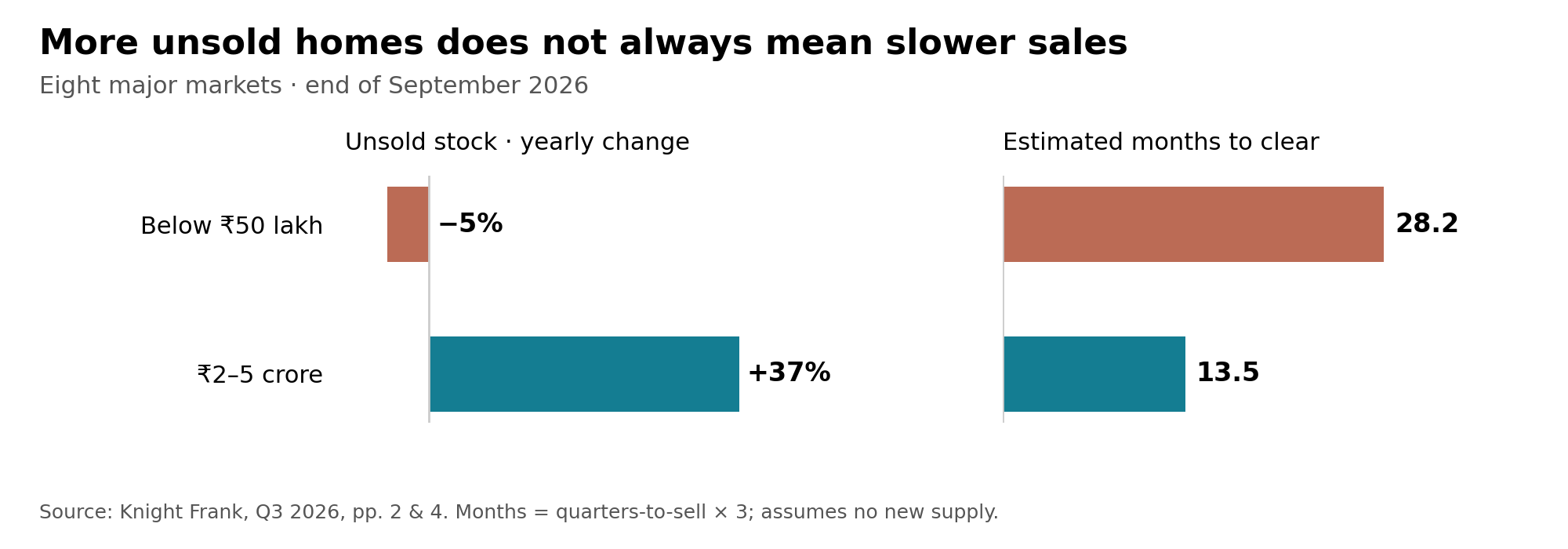
Even the booming ₹2–5 crore segment is piling up homes fast. Across the eight markets, its unsold inventory rose 37% from a year earlier. That sounds alarming, until you notice that it would take about 4.5 quarters to clear, quicker than the market-wide 6.1. So it’s something to keep an eye on, not a sign that demand has fallen off a cliff.
There’s one more catch here. Think of a flat that cost ₹85 lakh a few years ago and now costs ₹1.1 crore. It’s the same flat, but it has quietly moved into a higher price bracket. So part of this shift towards crore-plus homes is buyers genuinely upgrading, and part of it is just homes getting pricier. It doesn’t all mean Indians suddenly got richer.
The affordable end has two problems
Now go to the other end of the market. sales below ₹50 lakh fell 12% in July–September, while the ₹50 lakh–₹1 crore bracket fell 8%.
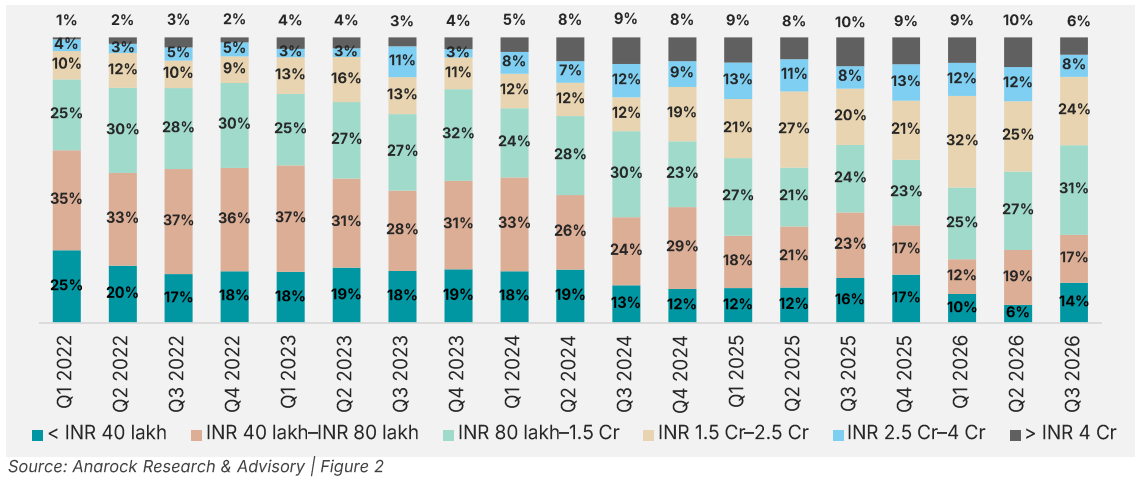
Part of the story is that builders simply aren’t making enough of them. Reporting on the first quarter of 2026, Knight Frank blamed much of the fall in cheaper-home sales on fewer launches.And this isn’t a recent blip. It’s been building for years. In early 2022, about a quarter of all new homes launched across India’s top seven cities were priced under ₹40 lakh, according to Anarock. By April–June 2026, that share had shrunk to just 6%. Homes under ₹80 lakh, which made up 60% of launches back then, had fallen to a quarter.
There was a small bounce in July–September, when sub-₹40 lakh homes rose back to 14% of launches. But one good quarter doesn’t undo four years of drift.
Builders, for their part, say costs, especially land, have made it hard to build homes at those prices and still make money. But that can’t be the whole story. If the only problem were a shortage of new homes, the ones already on the market should be flying off the shelves. Are they?
Here’s where it gets interesting. By September, there were nearly 1.7 lakh unsold homes below ₹50 lakh. That’s actually 5% fewer than a year ago, so cheap homes aren’t exactly piling up.
And yet, the time it would take to sell them all has stretched from roughly 26 months to 28 months. Think about that. The stock is shrinking, but it’s selling even more slowly. That only happens when buyers are pulling back too. In other words, the affordable end has a supply problem and a demand problem at the same time.
Why are buyers holding back?
So what’s keeping buyers away? The industry’s first answer is affordability. In April, Knight Frank’s Shishir Baijal pointed to rising prices alongside weakening sales as a sign of pressure on buyers’ ability to purchase. That makes sense, but it doesn’t explain every unsold home.
That said, it would be wrong to claim homes have become less affordable everywhere. Knight Frank’s separate first-half assessment found affordability broadly stable across most major markets, because earlier interest-rate cuts softened the blow of rising prices. But that cushion is now being taken away. On October 7, the RBI raised the repo rate by 25 basis points to 5.5%, its first hike since February 2023. Higher rates mean higher EMIs, and that bites hardest for buyers already stretching to afford a cheaper home.
And these affordability figures are city-wide averages anyway. They can’t tell us whether the families actually hunting for the cheapest homes can manage the down payment and EMI.
Other things probably matter too. Is the project too far from work? Is it well built? Will it even be finished on time? These are real worries for buyers, but the data doesn’t measure them, so it’s hard to say how much they weigh.
What we can say is that simply building more cheap homes won’t fix this. Builders say they struggle to make them at those prices, and the ones already built are taking longer to sell. The real question is whether anyone can build homes people actually want, at a price they can actually pay.
So that’s what sits beneath the flat headline. Some premium brackets are booming, others are overbuilt, and the cheaper end is squeezed from both sides. Call it a boom or call it a slump, and you’d be missing the real story.
- This edition of the newsletter was written by Manie & Mridula.
Cash & Copium #8
In this episode of Cash & Copium, Abid, Bhuvan, and Aakanksha break down India’s expanding credit ecosystem, the illusion of “no-cost” EMIs, and the psychological traps driving lifestyle borrowing. They explore how household debt hit ~48% of GDP while net savings dropped to 5%, why comparing Indian floating-rate leverage to US fixed-rate mortgages is a dangerous fallacy, and how taking long-term EMIs for speculative suburban flats destroys financial flexibility and long-term wealth creation.
Check out the episode on YouTube.
Tidbits
1. Embraer to acquire 51% stake in Mahindra aerospace joint venture
Embraer will acquire a 51% stake in Mahindra Defence Systems’ newly formed Novavayu Aerospace for about ₹5.1 lakh. The joint venture will support the companies’ bid to manufacture Embraer’s C-390 Millennium in India if it is selected for the Indian Air Force’s medium transport aircraft programme.
Source: The Economic Times
2. RBI raises repo rate by 25 bps in first hike since 2023
The Reserve Bank of India has raised the repo rate by 25 basis points to 5.5%, its first increase since February 2023. The MPC also shifted its policy stance to calibrated tightening as inflation risks rose, including from higher energy costs.
Source: The Wall Street Journal
3. Amazon in talks to acquire AI startup Decart for around $7 billion
Amazon is in discussions to acquire AI startup Decart in a deal that could value the company at around $7 billion, according to The Wall Street Journal. Decart develops AI software including tools for working across different chips and generative models that create simulated environments.
Source: Reuters
4. India releases draft National Steel Policy targeting 604 million tonnes capacity
The government has released the draft National Steel Policy – Vision 2047, which aims to expand India’s steel production capacity to 604 million tonnes over the next two decades. The proposed framework also projects increasing per-capita steel consumption to 302 kg and annual steel exports to 45 million tonnes by 2047.
Source: Business Today
[5] Coal India denies supply shortfall to NTPC despite low plant stocks
Coal India says it supplied 97 million tonnes of coal to NTPC and its joint ventures in the first half of FY27, exceeding its contractual commitments. The statement comes even as NTPC’s coal inventories have fallen sharply, leaving several plants with critically low stocks.
Source: Business Standard
Want more tidbits? Catch up on last week’s recap!

Beyond Today’s Brief
There’s always more happening at Markets by Zerodha.
The Chatter: What strategic trends are leaders at TCS, Maruti Suzuki, and PB Fintech highlighting? How is TCS managing AI contract deflation, while Maruti Suzuki prioritises deep localisation and biogas, and PB Fintech navigates insurance commission rules?
Points & Figures: What brings Indians to court? From 6.5 lakh cheque-bounce cases in Delhi to motor vehicle accidents, excise enforcement, and conjugal rights, what does district court data reveal about the everyday legal disputes clogging India’s judicial backlog?
Aftermarket Report: How did Nifty give up its early 73-point opening gains to slide 230 points off its high and close at 22,363? And what do persistent foreign portfolio outflows of ₹12,943 crore, extreme fear sentiment, and the Nifty 50 consolidated P/E dropping to a multi-year low of 19.1x signal as large caps continue to drag the market lower?
What We’re Reading: From the rise of omnipresent digital gambling and France’s tightrope between public welfare and bond market pressures, to 50-year social transformations in rural Tamil Nadu, Henry George’s land-tax economics, and why AI models adopt Kenyan writing patterns—here are ten curated reads from our fortnightly reading list.
Subtext by Zerodha: What does innovation in India really look like on the ground? Former IIM-A professor Rakesh Basant breaks down knowledge transfer, R&D spend, intellectual property, and how academia connects with industry.
Join us on WhatsApp, where we share interesting soundbites from concalls, articles, and everything else we come across throughout the day. You’ll also get notified the moment a new video or article drops so that you can read or watch it right away.
Thank you for reading. Do share this with your friends and make them as smart as you are 😉