



Our goal with The Daily Brief is to simplify the biggest stories in the Indian markets and help you understand what they mean. We won’t just tell you what happened; we’ll tell you why and how too. We do this show in both formats: video and audio. This piece curates the stories that we talk about.
You can listen to the podcast on Spotify, Apple Podcasts, or wherever you get your podcasts and watch the videos on YouTube. You can also watch The Daily Brief in Hindi.
In today’s edition of The Daily Brief:
1. The uncertain fates of India’s inter-state migration
Widening regional income disparities have accelerated domestic migration from states like Bihar and Odisha toward high-growth hubs such as Karnataka and Gujarat. While remittances fund over 30% of household consumption back home, this income rarely converts into local productive capital, leaving sending regions caught in economic stasis. In destination states, migrant workers provide essential low-cost labour for construction and services, yet face fragile livelihoods tied to informal contractors, precarious housing, and barriers to accessing localised public benefits.
2. Indian IT feels the sting of AI deflation
Despite steady operating margins across TCS, Infosys, and HCLTech, India’s IT majors face severe price compression driven by aggressive vendor competition and client demands to pass on AI-led productivity savings. While premium rates still apply to complex AI implementations, standard billable-hour revenues are deflating rapidly on routine workloads. In response, vendors are shifting toward multi-model LLM management, fixed-fee and outcome-based pricing models, and specialised token architectures to capture broader scope within static IT budgets.
Subtext by Zerodha
Why hasn’t nuclear power become widespread despite providing reliable, low-carbon electricity? In our latest episode, CEEW energy researcher Karthik unpacks the core physics, high construction costs, waste hurdles, and India’s three-stage roadmap with SMRs. We also discuss whether the proposed SHANTI Act can ease liability rules to unlock private capital as clean baseload demand surges.
Watch the conversation on YouTube.
The uncertain fates of India’s inter-state migration
One of our teammates told us an actual story about a young man from Bihar, who works at a coffee shop in Bengaluru near where he stays. When his shift ended, he slept on his scooter.
There’s no way to fully know why he sleeps there, but what we can unfortunately say for sure is that it was certainly not out of choice. And it only made us further wonder what brought him so far from home in the first place.
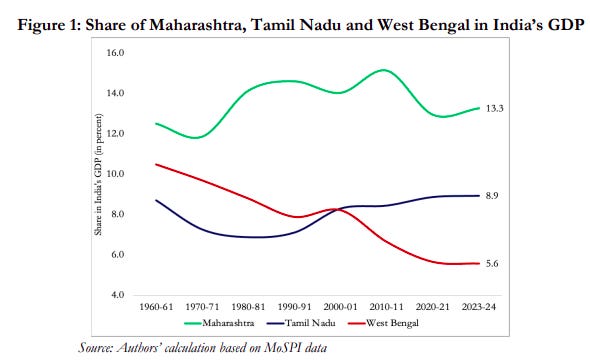
Part of the answer lies in how unevenly India’s regions have developed. Bengaluru became a technology hub, Chennai a manufacturing centre, and Hyderabad a base for software and pharmaceuticals. These industries created work for people who cook, drive taxis, deliver parcels and serve coffee.
In 1990–91, Karnataka’s per capita income was 19% below the national average. By 2023–24, it was 81% above it. Bihar’s stood at just 32.8% of the national average.
Bihar wasn’t always without industry. Before 2000, it had major steel and engineering plants, but they gave rise to few of the smaller suppliers and workshops that would turn a factory into an industrial town. Most of them also became part of Jharkhand when the state was divided. Odisha’s problem is different. Mining produced 10.8% of its economic output in 2021–22 but employed just 0.5% of its workforce in 2020–21. An economy can grow on machines without hiring many people.
Now, workers from Bihar and Odisha travel to Bengaluru, Surat, Delhi, Maharashtra and Gujarat, in search of jobs in factories, on construction sites and in services.
Finding a job, though, is only the start. What happens after they leave? What happens to the farms and families they’ve left behind, to the money they send home, and to their chances of building a life in the city that hired them?
What gets left behind
When a young adult leaves a farming family, the money they send home can help pay the bills. But someone still has to work in the fields they used to tend. A 2025 NBER study found that migrant-sending families tended to cultivate less land and use less agricultural technology, rather than replacing the missing labour with machinery. In the researchers’ estimates, other farmers took up the slack as land and crop prices adjusted, offsetting more than three-quarters of the direct loss in output.
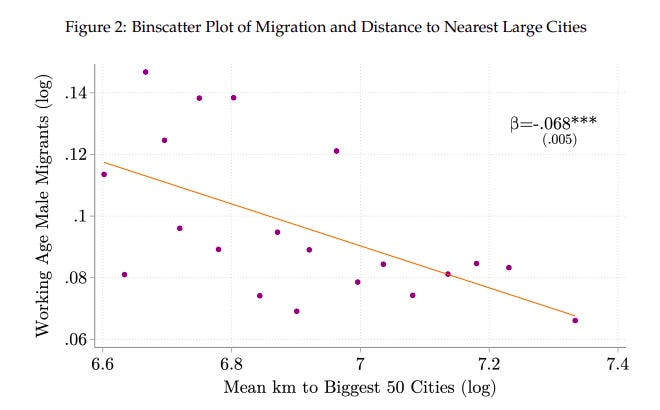
The bigger loss doesn’t show up in harvest figures. In many villages, relatives and neighbours carry families through illness, crop failure and months without income. Economists Kaivan Munshi and Mark Rosenzweig found that in India, rural caste networks work as a kind of informal insurance, and that the households that depended most on this protection were the least likely to migrate.
These networks can entrench caste hierarchies, but the security they provide is hard to replace. A worker in Bengaluru may earn far more than he could in Bihar and still have no one to call when he falls sick. Migrants aren’t entirely without support, though. A 1983 study of migrants in Delhi found that 86% of those arriving from rural areas already had relatives or people from their home villages living there. These connections helped newcomers find their footing, although assistance with settling into a city isn’t necessarily the same as the financial protection they relied on back home.
That’s why higher pay isn’t always enough to make people leave. Economists Clément Imbert and John Papp found that seasonal workers in India often preferred government-provided jobs under the MGNREGA scheme even though city jobs paid 35% more per working day. Higher city living costs explained only part of that gap. Harsh working conditions, uncertainty and time away from family explained much of the rest.
What migrant money can and can’t do
For those who do migrate out, one of the biggest returns on their choice is the money they send home.
Business historian Chinmay Tumbe found that in 2007–08, domestic remittances paid for more than 30% of consumption in the households that received them. A separate study estimated that around 18% of households in Bihar and 15% in Uttar Pradesh received such money. It paid for schooling, healthcare and better homes, and sometimes for a small business. In migrant villages studied in southern Odisha, former workers and their families now run rice mills, shops and transport services.
But money reaching a household is not the same as investment reaching the local economy. According to the RBI, outstanding bank credit relative to deposits was around 51% in Bihar at the end of March 2025, compared with 80% nationally and 115% in Tamil Nadu. This doesn’t tell us where migrant earnings went, but it points to a separate problem: money reaching Bihar’s households doesn’t automatically translate into financing for businesses within the state.
This may tell you that remittances don’t affect an economy much.
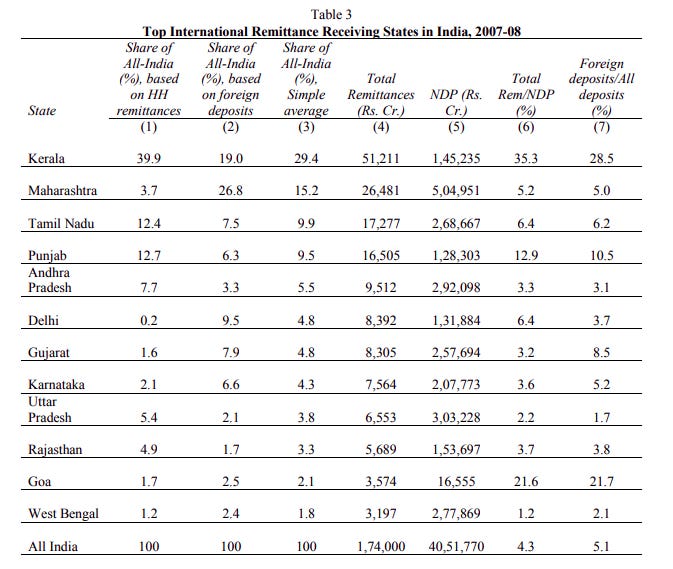
However, there is one state that is a notable exception to this: Kerala. Now, the caveat here is that most of its money comes from workers abroad rather than elsewhere in India. However, the underlying principle of migrating for work and better pay is the same. Moreover, Kerala sending its own workers abroad en masse creates its own domestic problem, which we’ll come to soon.
The Kerala Migration Survey 2023 estimated that the state received nearly ₹2.17 lakh crore in remittances that year, equal to ~23% of its net domestic product. Among reported uses were home and shop renovations at nearly 16%, bank loan repayments at 14%, education at 10% and healthcare at nearly 8%.
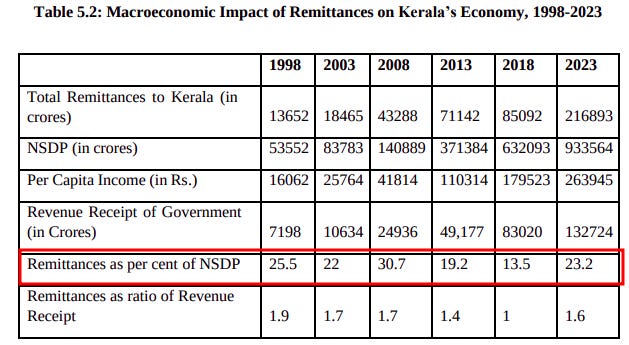
That spending kept whole trades in business. Every house under construction needed masons, electricians and building materials, while shops gained customers with money to spend.
But it also raised costs. Economists K.N. Harilal and K.J. Joseph argued that, in the absence of a strong manufacturing industry, remittance-fuelled consumption spending pushed up wages and local costs, making agriculture and traditional manufacturing only further less competitive. This resembles what economists call Dutch disease, where large inflows of money benefit some industries while putting pressure on others.
Kerala now oddly sits on both sides of the migration economy. It still sends workers overseas, while its factories and construction sites depend on workers from other states. According to research an estimated 25–30 lakh interstate migrant workers work in the state, equivalent to roughly 8–10% of its population. Many work in construction, manufacturing and other labour-intensive industries. The exact number remains uncertain because many workers move back and forth between Kerala and their home states.
Those workers send money home too. A study commissioned by the Kerala State Planning Board found that migrants from Bihar earned around ₹15,865 a month and sent home about ₹30,121 a year, nearly two months’ wages. Across all interstate migrant workers in Kerala, the researchers estimated annual remittances of around ₹7,500 crore. In 2024, Benoy Peter of the Centre for Migration and Inclusive Development told The New Indian Express that migrant workers in Kerala could be sending at least ₹17,000 crore annually to their home states.
Kerala’s employers feel it when those workers leave. In April 2026, when large numbers of migrants went home at the same time, firms reported labour shortages. In May 2026, Business Standard reported that employers across southern India were being asked to pay ₹30,000–33,000 a month for welders, compared with around ₹20,000 previously. Imbert and Papp found a similar pattern elsewhere: when rural public employment kept seasonal workers at home, wages rose in the cities that relied on them.
Free to move, but how free to settle?
Even if a state needs these workers, does it necessarily mean that migrant workers can afford to settle there?
For many seasonal workers, a place to sleep comes with the job. They share rooms near factories or stay in temporary shelters on construction sites, often arranged by a contractor. If they lose the job, they can lose the roof too.
Millions of people move repeatedly for temporary work. In a 2020 report, Delhi-based think tank Institute for Human Development cited an earlier estimate of about 5 crore short-duration seasonal migrants in India. Many travel between their villages and jobs in construction and brick kilns without changing their usual residence, making them difficult for conventional migration surveys to count.
Keeping the family back home saves the cost of moving an entire household and keeps relatives close. But living between two places creates its own problems. Srivastava notes that migrants may hold an AADHAAR card, yet struggle to access benefits tied to a home address or local residence. The “One Nation One Ration Card” scheme has made subsidised food more portable, but an identity card doesn’t establish eligibility for every service in a new city.
How much freedom a migrant has also depends on how they were hired. A formal contract may offer more protection, while someone recruited through a contractor can have fewer options, especially when wages and debt are tied to the employer. In western Odisha, brick-kiln workers sometimes take cash advances before leaving home.
The problem isn’t the advance itself, but what happens when workers cannot leave until they repay it. This creates a situation of bonded labor, which, while obviously illegal as a whole but none of that is settled. A state can send workers for generations and still not build the industry to keep them; it can receive them for generations and never quite let them belong. Which way each state tips is still being decided — which is why, for now, the fates of India’s migrants remain genuinely uncertain., still shockingly occurs in some parts of India.
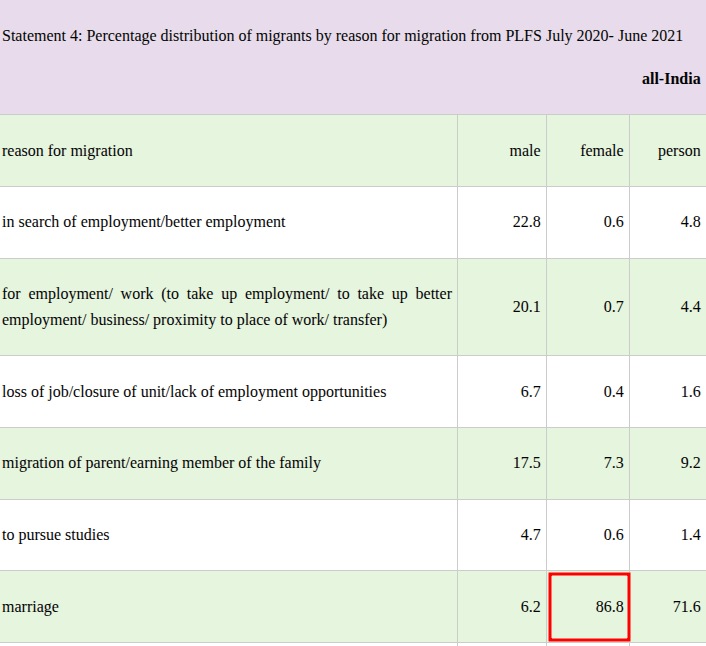
All of this concerns people who move for work, but much of India’s recorded migration happens for other reasons. According to the PLFS of 2020-21, marriage accounted for ~87% of female migration, and of every 1,000 women who migrated, just 7 did so for a job. The survey records why a woman moved, not what she did afterwards. Many go on to work on farms, in factories or in family businesses, where formal and informal employment can mean very different levels of security.
Migration can also change who a family turns to in a crisis, even when nobody has moved for work. In a 1989 study, economists Mark Rosenzweig and Oded Stark found that marriages linking families in distant South Indian villages helped households cope with bad harvests. A family facing a poor harvest could rely on in-laws whose village had escaped it. The study doesn’t establish how much choice women had over where they went, but it shows that movement can build economic ties beyond the job market.
Village networks cut both ways. The ties that protect people can also control them through caste, family expectations and social obligations. A city can offer freedom from some of those pressures, along with an independent income and new relationships. But someone may leave a village hoping for greater independence, only to find that their wages, housing and ability to change jobs depend on the same contractor.
The age gap
What complicates India’s migration story further is that India’s states are aging at different speeds.
In 2023, Bihar’s fertility rate was 2.8 children per woman, against Kerala’s 1.5. By 2036, government projections suggest that nearly 23% of Kerala’s population will be over 60, compared with about 15% nationally. Kerala and Tamil Nadu may increasingly need workers from elsewhere, especially in construction and healthcare.
Demographics won’t decide where people go, though. West Bengal, for instance, has low fertility and still sends large numbers of workers elsewhere.
The balance could change if states that send workers begin creating better jobs themselves. If Bihar or Odisha offers more work closer to home, employers elsewhere may have to raise wages, improve conditions or manage with fewer people. For decades, workers have travelled to places where employers needed them. In the years ahead, employers may have to work harder to persuade them to come.
But none of that is settled. There are many reasons for why poorer states are unable to do so, and that’s beyond the scope of this story.
States that are able to create better jobs can receive workers for generations and never quite let them belong. The digital inclusion of migrant workers, how that’s tied to the benefits they receive, their housing situation, and most of all, a sense of community, all of this is still up in the air.
We may now have some sense of the circumstances that possibly surrounded the migrant worker who we started the story with. But this might have left us even more perplexed, that too in despair.

Indian IT feels the sting of AI deflation
By the usual scorecard, India’s big IT firms had a decent quarter. Operating margins actually went up for HCLTech, Wipro and Tech Mahindra, while TCS and Infosys held steady.
But for a business threatened by AI, margins holding steady is no more the metric by which we judge health. After all, the trajectory with new technologies usually follows the path of “slowly, then all at once.”
Accordingly, the management teams of firms spent the earnings calls sounding anything but relaxed. They were thinking out aloud about margins, how to pass on productivity benefits to customers, and what pricing models now look like.
In fact, this quarter, annual revenue growth has actually been slow for many of them. TCS has only grown 2.8% y-o-y in constant currency terms, while the same figure for Infosys was 1.5%.
The numbers are there for everyone to see. AI revenue, for instance, officially makes up at least 10% of all business at TCS and Infosys. But we’ll take a little detour away from figures.
The bigger shift is what AI, and a brutally competitive market, are doing to the price of the work and the decades-old model used to charge for it. We’ve tracked this for a while now.
This quarter, we can ask three questions: where the price pressure is really coming from, what clients now demand inside an AI deal, and what really is replacing the old way of charging.
Under pressure
The standard explanation for Indian IT’s squeezed pricing has been AI-led deflation: AI makes the work cheaper to deliver, so clients pay less. This is indeed happening at a substantial scale.
But this quarter, management was unusually blunt that AI is only part of it.
Tech Mahindra said plainly that much of the industry’s price compression comes from competitive intensity rather than from clients diverting budgets into AI. Infosys made the same point from the other side: the price increases it had penciled in for the year simply didn’t arrive, because competition had stiffened.

Some of the discounting, in other words, is the oldest force of too many capable firms chasing the same deals.
But AI has now become the new pretext to ask for less.
On genuinely new AI work, firms still charge a premium since it’s scarce and clients don’t fully know yet what it’s worth. HCLTech, for instance, said its AI-enabled IT services work yields 7-10% higher margins than traditional services. This could involve building new agentic workflows, training in-house small-language models, or creating new IP.

However, margin pressure falls on lower-value, more routine work, especially as clients demand productivity benefits from AI be passed on.
On net, margins more or less rose or remained steady for everyone. However, the pain showed up in other ways. Infosys, for example, reduced its forward guidance. The squeeze is real, but for now it’s being absorbed rather than suffered.

New demands
On the other side of this story, the demands of clients also seem to be evolving.
The first demand is simple: share the savings. Where AI cuts the effort, clients expect a lower price, and firms are writing those give-backs straight into renewals. For Infosys — which has also explicitly said before that it’ll reject deals that don’t fulfil its preferred margin profile — clients have stretched their pricing power a bit too much.

However, the expectation is that the vendor uses the same savings for a wider scope on the same budget, and IT firms may be approaching deals with clients the same way. It is the best way to offset per-unit revenue deflation.

This, ideally, would also show up in the total contract value (TCV) metric of companies, which should either be resilient or rise. Infosys, for instance, earned its second-highest quarterly TCV in the last 5 years. TCS, meanwhile, has slightly notched up its TCV from last quarter. Of course, the downside to this, as HCLTech noted two quarters ago, was that it takes more effort to land the same amount of TCV now.

Perhaps, the more interesting client demand now boils down to the choice of LLM.
Now that, within enterprises, AI has moved from pilot stage to deployment stage, token cost has also become a bigger consideration. Clients no longer want to be locked into one pricey frontier model. They want to route each task to whatever’s cheapest for the job. That’s also why, as per management, clients are showing more openness to open-weight models.

TCS calls the layer it builds for this a “harness“. Infosys’s Topaz platform acts similarly as a harness that organizes fifteen different LLMs so a client can pick per task and keep token costs down. Tech Mahindra said clients are already shifting routine workloads onto cheaper open-source models, reserving the frontier ones for the parts a human checks.

What’s striking is how openly firms are now pricing all this. HCLTech said it has started listing its “AI Force” platform as an explicit line item in large contracts, and signing deals that fold token costs directly into the price. Tech Mahindra has built an internal framework to audit its AI revenue against its books, and will start reporting the figure from the second half of the year. The pricing of AI, until recently buried inside vague “enterprise AI” bundles, is now slowly being dragged into the open.
The price experiments
All of this chips away at the oldest thing in IT services: the billable hour. For decades the unit was man-hours, and that’s precisely what AI undoes. We’ve asked before what replaces it, and the answer is that, in the face of AI still being a technology in-development, how it should be priced is still uncertain.
Which is why firms are trying from a slate of different models.
One of them is fixed-price is one, where you commit to a price for an outcome, and whatever effort AI saves is yours to keep. The trap is that it only pays if you’ve judged the effort right; misjudge, and the overrun is yours to eat.
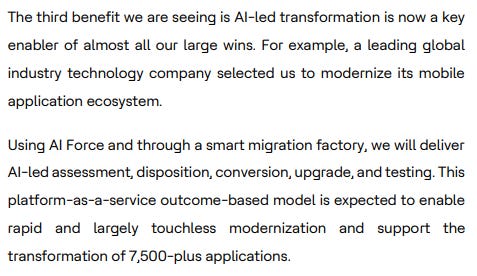
Then there’s outcome-based pricing, which goes further in tying the fee to a business result rather than any measure of effort. Wipro’s AI-Native Unit, for instance, has said that its seeing good traction here. HCLTech, meanwhile, mentioned signing a large outcome-based deal to modernise the mobile app ecosystem of a global company.
The most well-known experiment of all the large firms is still Tech Mahindra’s service-token model: break a contract into sub-processes, specify the human-versus-machine split on each, and let the price move visibly as AI takes over more. It’s an attempt to price the human-plus-machine blend as a single unit. It isn’t necessarily wholly fixed-price or outcome-based; it can very well have a time-and-materials component. But either way, revenue is coming unhooked from headcount.
That being said, this isn’t showing up as layoffs. Hiring actually turned back up this quarter: Infosys added over 4,000 people net, HCLTech a record 6,450, and Wipro will return to campuses in the second half. TCS’s chief executive even points to his growing headcount as proof the jobs apocalypse isn’t arriving.

Conclusion
The bet underneath all this is coherent. You win market share through consolidation, charge for outcomes instead of hours, and let AI-driven efficiency protect margins even while handing savings back. For a while, this has seemed to work.
The question is how long efficiency can keep outrunning deflation. Margin discipline holds only while there’s enough richly-priced new work to walk toward as the old work cheapens, and that balance is getting finer and more blurry.
Wipro offered one possible hopeful note. With contracts running two to two-and-a-half years, and the industry now a couple of years into repricing them, the worst of the deflation may wash through in a few more quarters.

But large-scale enterprise adoption of AI is still far away, and we’re still seeing new model developments at a ferocious pace. We can now say with some certainty that IT services firms will be at the forefront of enterprise adoption of AI. But their pain may be far from over before they get there.
- This edition of the newsletter was written by Mridula & Manie.
Tidbits:
1. Cabinet approves ₹10,000 crore container manufacturing scheme
The Union Cabinet has approved a ₹10,000 crore scheme to expand domestic container manufacturing capacity nearly tenfold to 7.5 lakh TEUs by 2040. The programme will offer operational subsidies, interest support, testing assistance and concessional port land, with incentives linked to rising local-content requirements.
Source: The Economic Times
2. Textiles PLI scheme reopens with lower ₹100 crore turnover threshold
The Ministry of Textiles is reopening the Production Linked Incentive (PLI) Scheme for Textiles for a fourth round, lowering the minimum turnover requirement for applicants from ₹200 crore to ₹100 crore. The move aims to encourage greater participation from MSMEs and mid-sized manufacturing units in the production of man-made fibre apparel, fabrics, and technical textiles.
Source: Business Standard
3. PVR INOX second-quarter profit jumps 149% to ₹263 crore
PVR INOX reported a 149% year-on-year surge in consolidated net profit to ₹263 crore for the September quarter, driven by robust box-office collections. Revenue from operations increased nearly 17% to ₹2,105 crore as standout performances from Hollywood and regional releases lifted both ticket sales and food and beverage revenues.
Source: Reuters
4. Marvell in advanced talks to acquire Lumentum in AI infrastructure push
Marvell Technology is in advanced talks to acquire data-centre optics maker Lumentum, with a deal potentially announced as soon as next week. The acquisition would deepen Marvell’s exposure to optical networking as AI workloads drive demand for faster data movement inside and between data centres.
Source: Livemint
5. Shapoorji Pallonji seeks up to $200 million to repay debt
Shapoorji Pallonji Group is in talks to raise 150million-200 million through additional rupee bonds issued by its Eqyizen Investment unit. About half the proceeds would repay creditors of Porteast Investment, while the remainder would be used for other group debt, with the financing targeted for completion by mid-November.
Source: Bloomberg
Want more tidbits? Catch up on last week’s recap!

Beyond Today’s Brief
There’s always more happening at Markets by Zerodha.
The Chatter: What are regulators and corporate leadership across capital goods, insurance, and pharma signalling for Q2 FY27? How is SEBI planning a domestic market-specific AI model and new investment frameworks, while L&T secures a record ₹1.48 trillion in quarterly order inflows and commits $750 million to AI data centres?
Points & Figures: Where did India’s international flyers go? From a 9% drop in total international passenger traffic to Indian airlines losing a decade of market share gains to foreign rivals, what does flight data reveal about post-conflict travel demand and carrier resilience?
Aftermarket Report: How did Nifty stage a strong rally past 22,900 to settle at 22,937 as a Fed rate pause and retreating crude oil prices brought relief to markets? And what do 14 rising sectors led by Realty, an improving Put-Call Ratio at 1.31, and the Fear & Greed Index climbing out of extreme fear to 28 reveal about broader market participation?
Join us on WhatsApp, where we share interesting soundbites from concalls, articles, and everything else we come across throughout the day. You’ll also get notified the moment a new video or article drops so that you can read or watch it right away.
Thank you for reading. Do share this with your friends and make them as smart as you are 😉
Would be nice to have a view from the performance of midcap ITs now that most results are out, though the stagnancy or slowness is beginning to catch up with them too, except 1 or 2 firms