


Happy Diwali from all of us at The Daily Brief!
Thank you for reading, watching, and thinking alongside us through another year of mayhem in the markets and industry. We’re grateful you let us be a small part of your day.
May your festival be bright, your diyas brighter, and, of course, your portfolios in the green 🙂
Our goal with The Daily Brief is to simplify the biggest stories in the Indian markets and help you understand what they mean. We won’t just tell you what happened; we’ll tell you why and how too. We do this show in both formats: video and audio. This piece curates the stories that we talk about.
You can listen to the podcast on Spotify, Apple Podcasts, or wherever you get your podcasts and watch the videos on YouTube. You can also watch The Daily Brief in Hindi.
In today’s edition of The Daily Brief:
1. The fractures in the streaming business
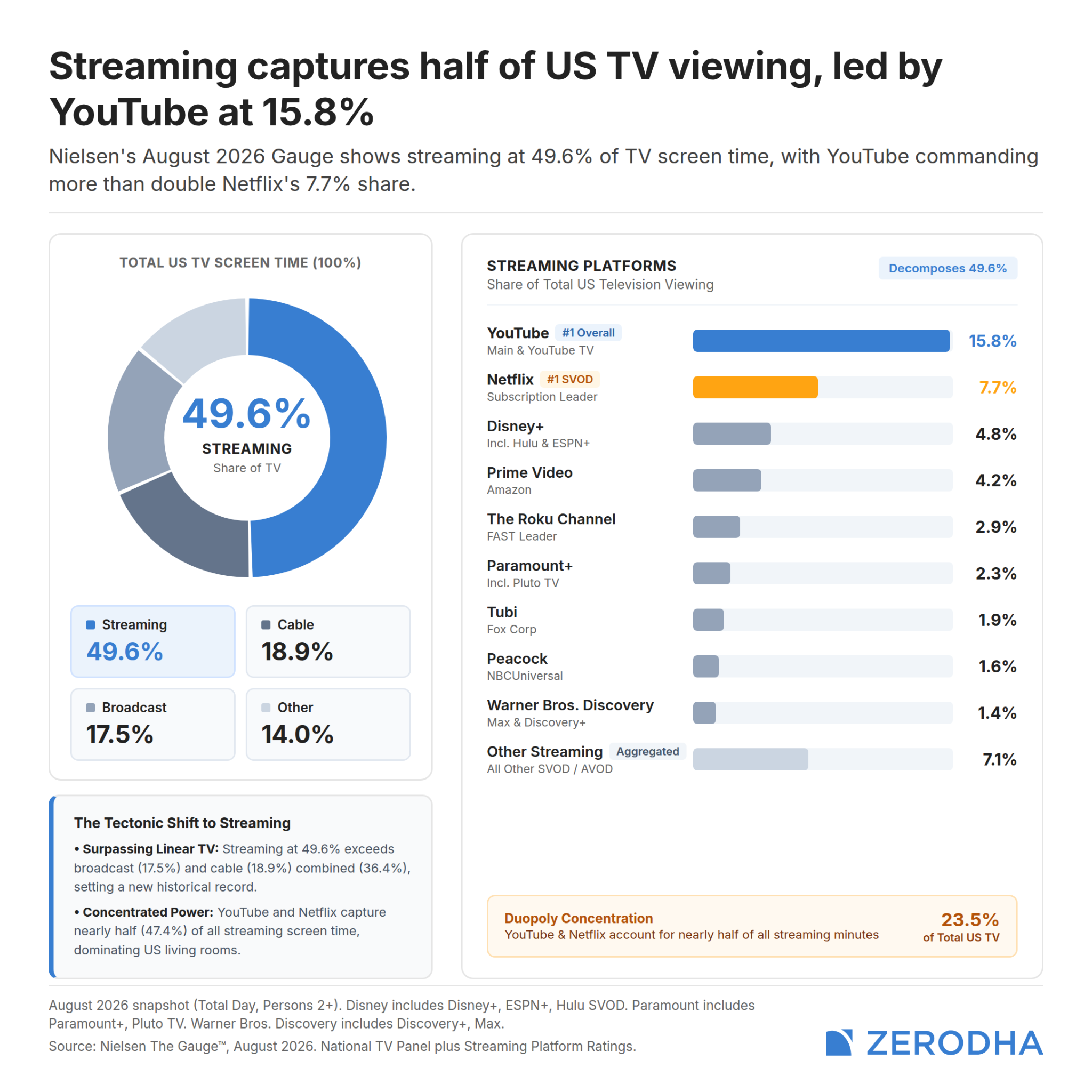
Despite reporting a 12% jump in quarterly revenue to $12.9 billion and an operating margin of 31.5%, Netflix faces structural engagement headwinds as subscribers open the app less often and spend fewer hours watching. While its ad tier has grown over 80% this year, total ad revenue of $2.7 billion remains a fraction of Amazon’s retail-backed ad machine. Furthermore, with legacy back-catalogue titles driving 63% of watch hours, streamers are caught between expensive licensing battles and an ascendant YouTube commanding nearly 16% of total US television viewing.
2. The drift of Indian tyremakers gets a puncture
Indian tyre manufacturers posted record quarterly revenues behind booming automaker demand, but severe cost pressures crushed bottom-line earnings. Natural rubber climbing to a 20-year high of ₹285/kg alongside crude-linked input inflation added nearly 30% to raw material baskets, far outrunning rolling 11–15% replacement price hikes. As working capital needs double net debt burdens across the sector, manufacturers face a looming volume slowdown and mounting top-end competition from BKT’s newly formed passenger-car manufacturing tie-up with Pirelli.
The fractures in the streaming business
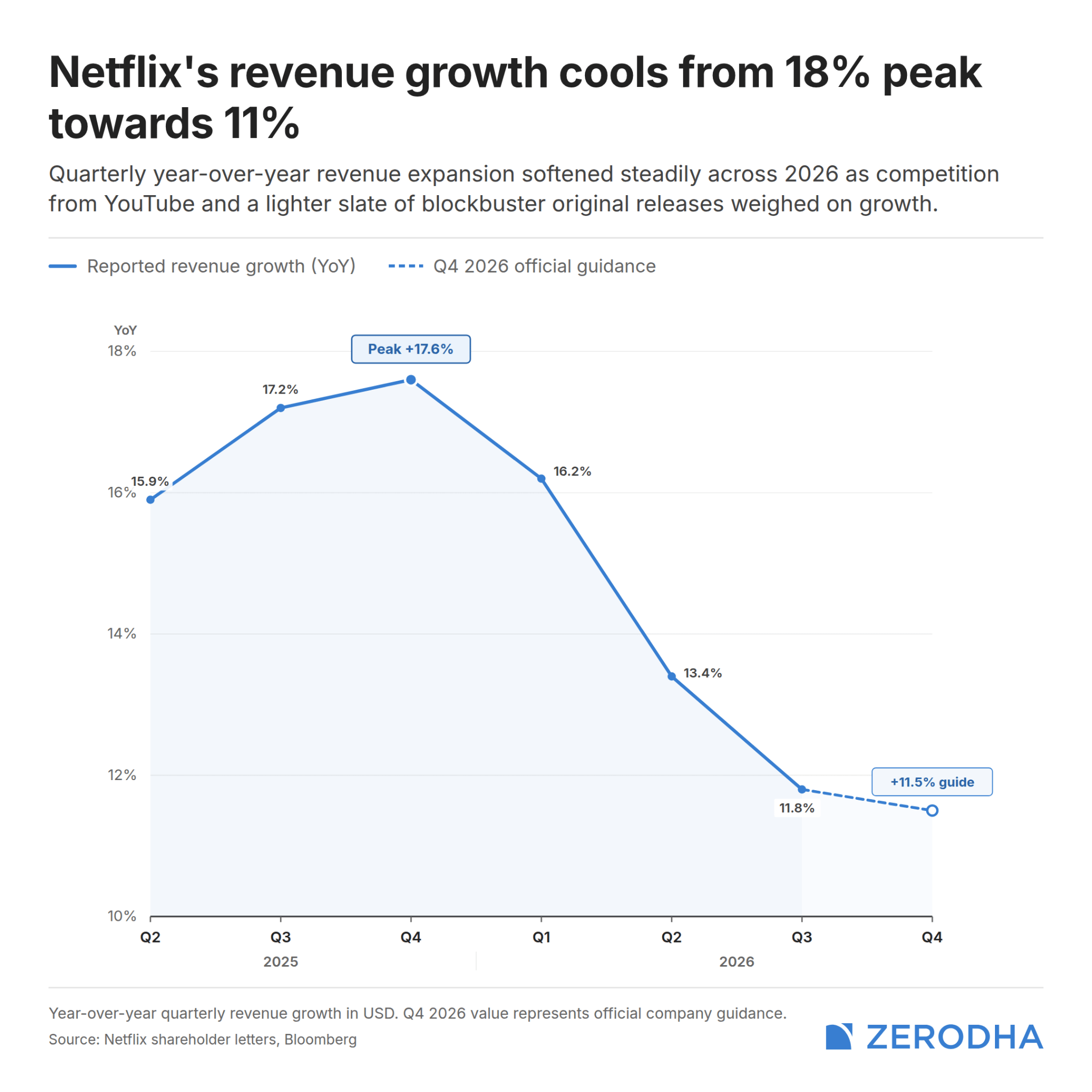
On October 20, Netflix told investors it had a great quarter, which it did. Revenue grew 12% year-on-year to $12.9 billion, and operating profit jumped 37% y-o-y. Fewer people were cancelling than a year earlier.
Five days later, though, Bloomberg reported something odd. According to people familiar with Netflix’s internal data, subscribers were opening the app less often and spending less time watching. Total viewing was still growing, but only because Netflix had more accounts. The average account was watching less.
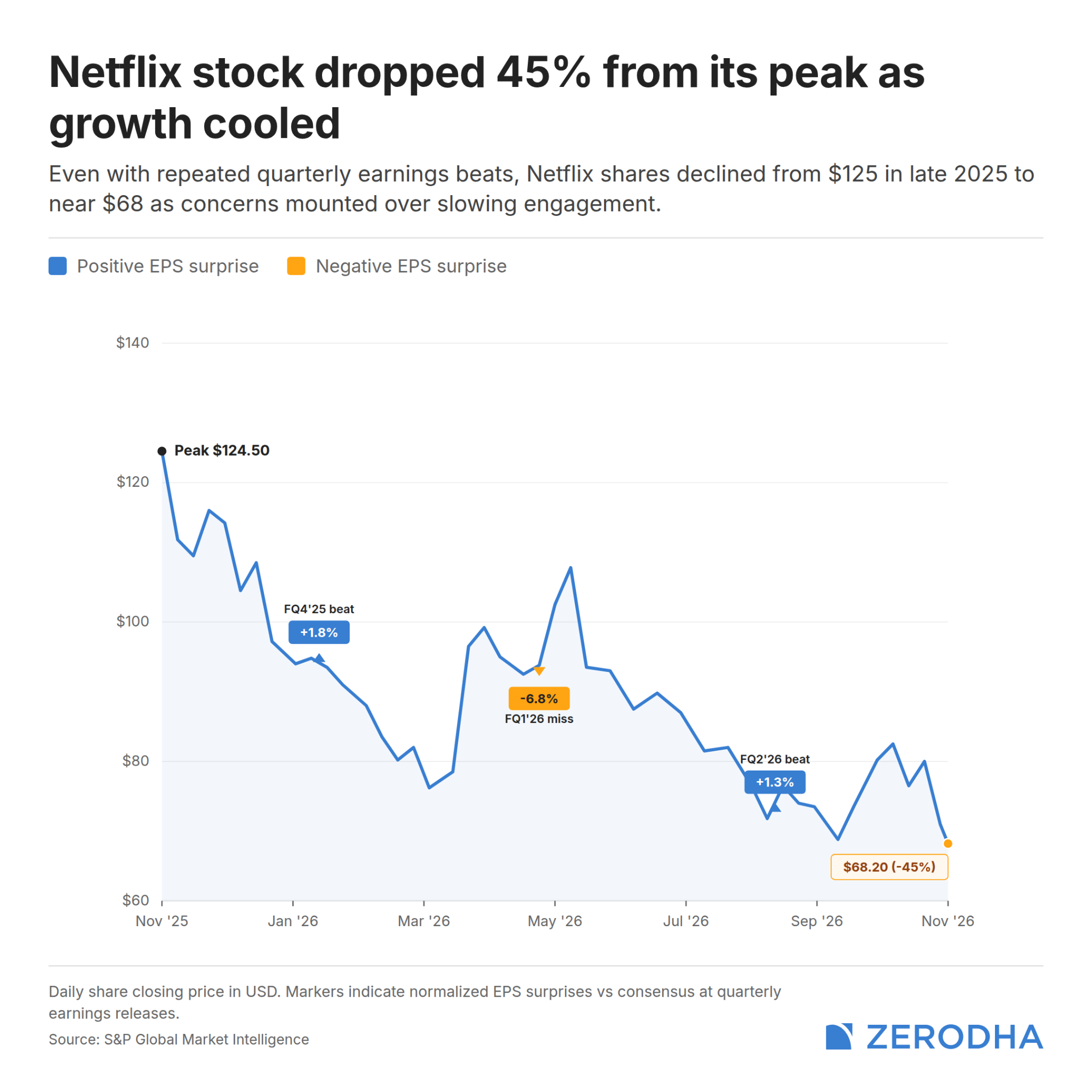
Now, Netflix spent much of last year asking investors not to worry about subscribers leaving, but how much time they’re spending on the app. But this year, that gambit is also losing its power. Part of the bump in revenue and margins this year is owed to a base effect. As far as the share price is concerned, Netflix has been tanking.
The value that we derive from our streaming subscriptions has changed over the last few years. Netflix’s immediate competitors in the same category exist, yes, but in essence, they compete for our time. And we’ve found other things to do that make it worth our time — like playing mobile games — which Netflix knows very well.
At the same time, streaming platforms like Netflix, Disney+ and Prime Video are now selling advertising because subscription revenue is losing steam. However, advertising depends on how much people actually watch.
So just as streaming companies are finding new ways to make money from our attention, they’re having to compete harder for it, which is bearing down on growth. Which raises three questions about how much our viewing time is worth, who is best placed to make money off of it, and what the future of streaming is.
A view to monetize
Let’s start with how Netflix makes money.
For streaming, revenue grows when more people sign up, prices rise, or fewer people leave. How much each person watches doesn’t really show up on the bill. Netflix said last quarter that growth came mainly from more members and higher prices.
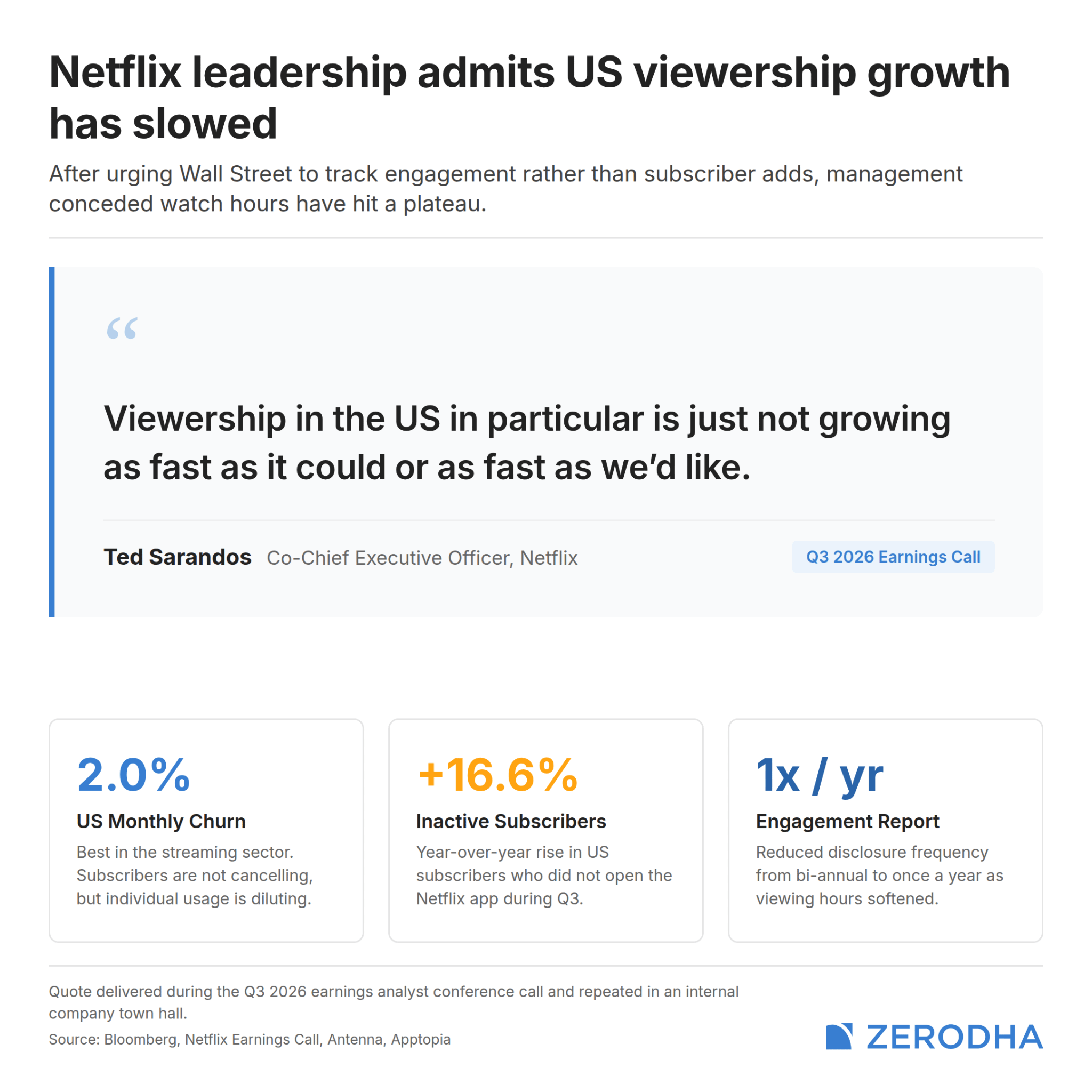
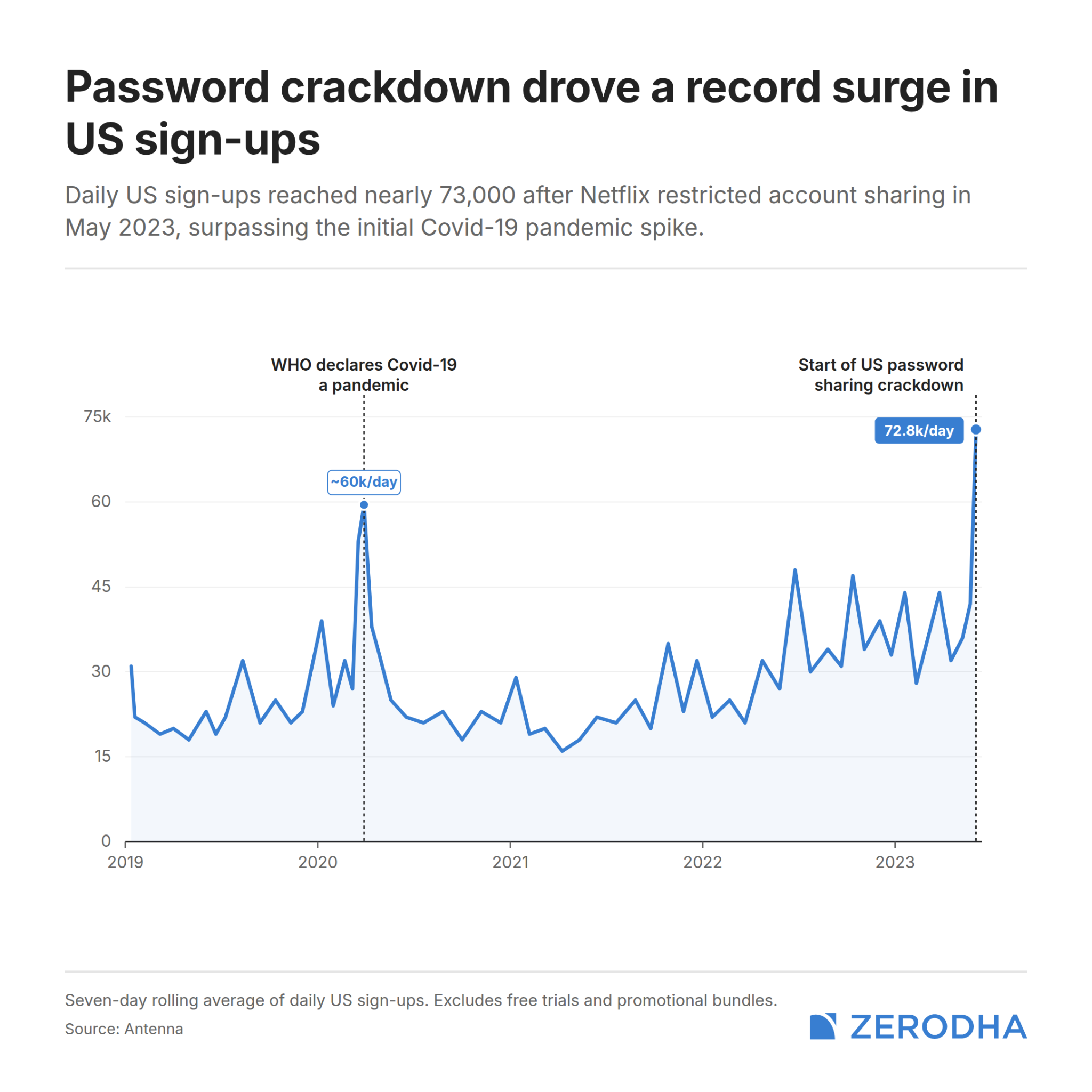
Netflix’s viewing numbers have a quirk, though. Its decline began around its password-sharing crackdown. As people stopped sharing accounts, viewing per account could fall simply because fewer people were using each one. Executives expected the dip to fade, but it hasn’t, which is worrying considering the crackdown started all the way back in 2022-23. This is ironic considering that Netflix’s comeback was partly spurred by the crackdown, as it got them more paid users.
The model works when revenue grows faster than the cost of keeping people entertained. Netflix’s annual content spending has risen from about $17.5 billion in 2021 to an expected $20 billion in 2026, while revenue has grown from roughly $30 billion to an expected $51.1 billion. That’s helped make Netflix profitable, with an expected operating margin of 31.5% this year.
But growth has been slowing, with Netflix reporting its slowest sales jump in three years this quarter as well.
Now, it was in the face of slower subscriber growth that Netflix introduced ads in 2022. With subscriptions, an extra hour of viewing mainly matters if it stops someone from cancelling. With ads, that hour can also earn money.
But if Netflix’s viewing numbers are going down, shouldn’t that mean its ad-revenue also decreases?
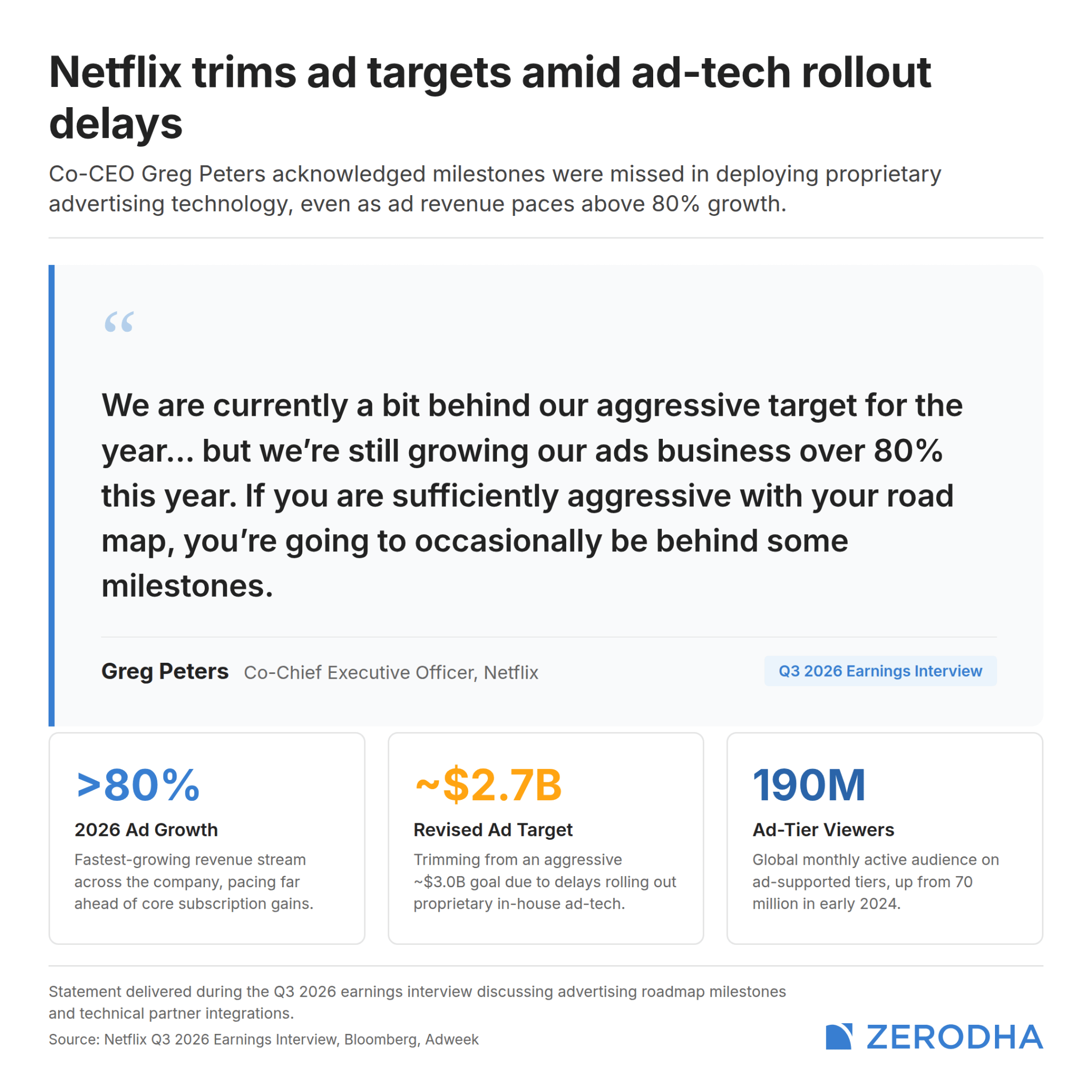
Well, no. Netflix’s ad business is perhaps the brightest spot in the company. By the admission of its management, it has grown 80% this year. Netflix’s ad-tier subscription has also grown much faster. The ad business will only be affected if ad-tier hours are low, and they aren’t yet. Netflix has also admitted that it hasn’t sold all of its ad slots yet, which is also why, despite its impressive growth, it still fell 10% short of its own expectations.
Now, except for Apple, Netflix’s competitors also have ad-tiers which are cheaper than their main subscription plans. However, all of them have advantages that Netflix will probably never have.
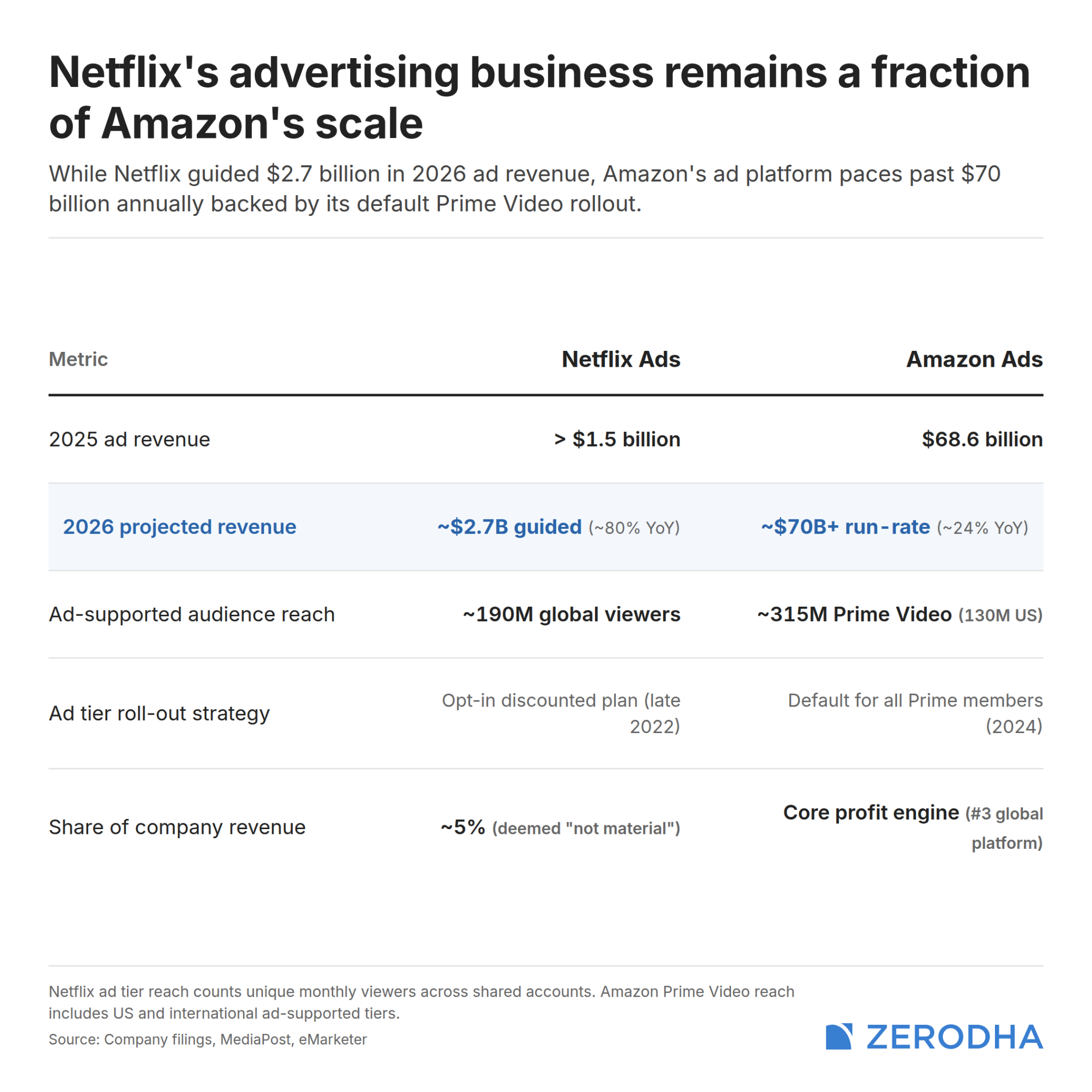
Start with Amazon. Say you’re watching a Bond movie on Prime. In the middle, you get an ad for the iPhone. Your Prime Video account is part of your overall Prime subscription, which includes the Amazon shopping platform. Amazon, which has the world’s third-largest ad stack (behind Google and Meta), can send you targeted ads very easily, which can convert to attributable purchases.
Amazon’s ads business made nearly $69 billion in revenue, of which Prime Video is estimated to make up $6-7 billion. It is still at least twice that of the $2.7 billion Netflix’s ads business generated this year already. In July, Amazon pointed out viewers who watch several sports on Prime Video were spending more and ordering more on its store.
In fact, Netflix now lets advertisers target its viewers using Amazon’s shopping data. Meaning, it also rents shopping data from Amazon.
Disney’s advantage, meanwhile, lies not in ads, but in more physical offerings. On its August earnings call, Disney CEO Josh D’Amaro used the Toy Story franchise as an example. All five Toy Story films have earned over $4 billion at the box office and clocked more than two billion viewing hours on Disney+. Toy Story Merchandise alone sells over $1 billion a year, while the characters appear across four themed lands, 19 attractions and two hotels. Even a disappointing film can help sell toys and bring visitors to the parks.
What’s more, Disney and Amazon also have another way to keep people paying by creating value bundles. On its August earnings call, Disney said customers with a bundle of Disney+, Hulu and ESPN had the lowest cancellation rates. Amazon has a similar advantage with Prime, which people may keep for deliveries even when they aren’t watching much.
Without parks, shopping or phones to fall back on, Netflix has to make entertainment pay for itself.
Hits end, habits don’t
Every streamer is faced with another problem: how do you keep people hooked to the platform after their favourite show ends? This question matters heavily to engagement, which will drive the ads business.
Stranger Things aired its finale last New Year’s Eve. This was Netflix’s darling show for a decade, but how does it keep subscribers interested long after the finale?
Netflix’s accounts reflect how quickly hits fade. Instead of counting an original show’s full cost as an expense when it comes out, Netflix spreads it over the years it expects people to watch. It claims to write-off over 90% of a title’s cost within four years because most viewing happens early. There is some accounting debate around the 4-year figure, but content amortisation as a whole is the biggest individual expense Netflix carries.
That being said, amortisation of outside licensed content, while massive, is much easier. If you license, say, the hit show “Friends” for four years, you know the cost of it has to be spread by that much.
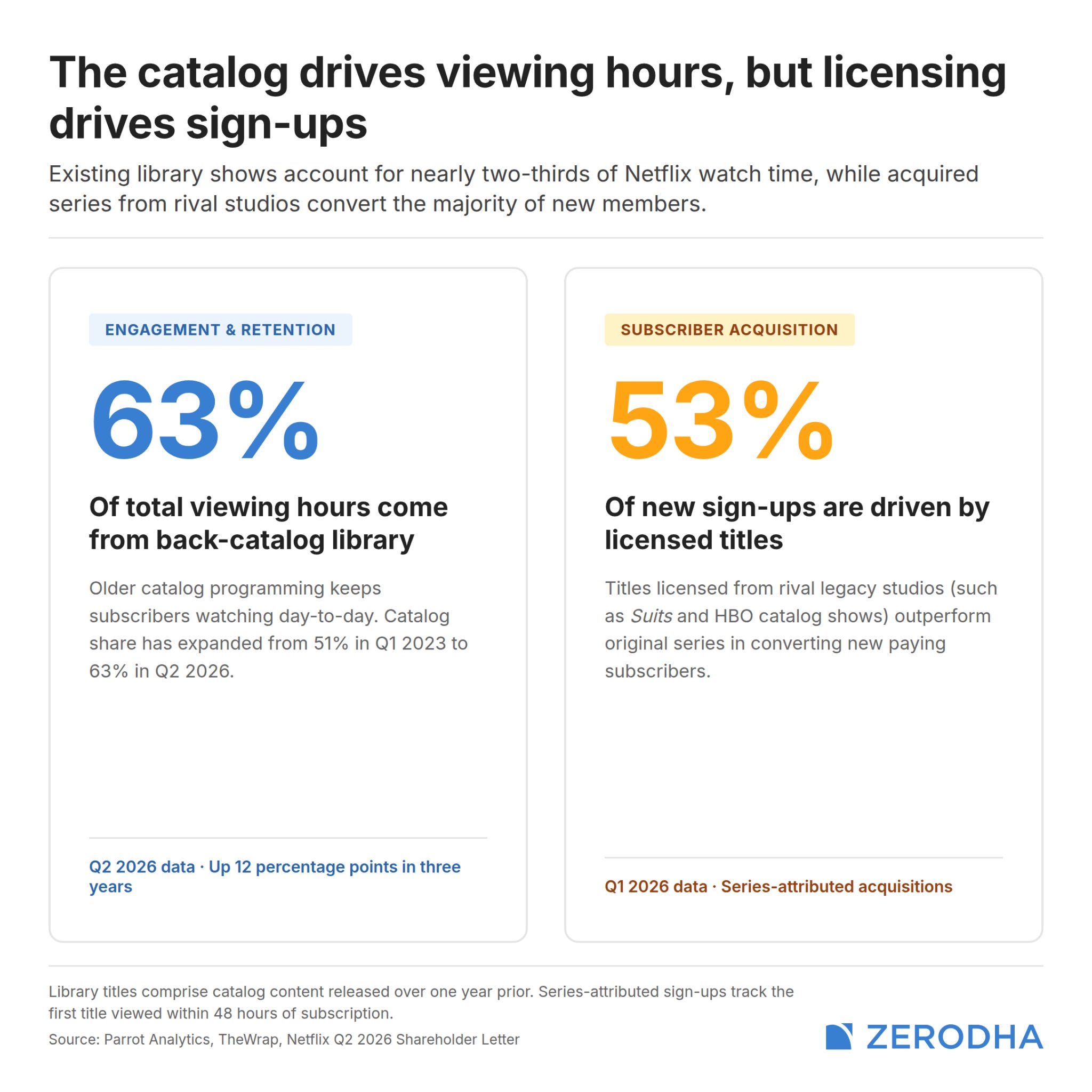
Shows like that also have incredible recall value, especially since Netflix only started making its own content a decade ago. Even Disney owns decades of entertainment. According to Parrot Analytics, library titles (which are all older titles, including Netflix originals) accounted for 63% of Netflix’s viewing in Q2 2026, up from 51% in early 2023. New seasons, meanwhile, fell from 12% to 8%.
Libraries have become so valuable that companies are willing to buy entire studios for them. That’s why, as we covered before, Netflix was in talks to buy Warner Bros before walking away when Paramount Skydance bid much more than it was willing to pay. More than half of Netflix’s content amortisation last year came from licensed titles.
But the threat of not owning legacy titles is very clear. In 2018, Netflix reportedly paid $100 million to keep Friends for just one more year in the US. The show eventually left for its owner’s streaming service anyway. Netflix had paid top dollar to keep a guest who was already packing.
So, how do you build or acquire property with immense recurring value? There is one category of entertainment that offers exactly this.
Be it America or India, streaming platforms bid huge amounts to acquire the rights to broadcast sports leagues, which return every season, whose games happen at fixed times, and which fans want to watch live. Disney has enjoyed the ownership of ESPN, which streams all the major American sports leagues. By August, Disney had sold all its advertising slots for the next Super Bowl.
Netflix has the rights to WWE and NFL games. Netflix’s WWE agreement was reportedly worth over $5 billion for ten years. Similarly, Prime Video has NFL and NBA rights, too.
Now, it might be an expensive bet. Beyond the amount itself, Netflix expects live events to account for just over 5% of content spending but only around 1% of viewing hours. Yet, live events also accounted for six of its ten biggest new-member sign-up days over five years. They attract subscribers and advertisers, even if they don’t generate many viewing hours.
Netflix may not need expensive sports rights to build a viewing habit, either.
In India, viewing hours per member actually rose last quarter because of reality shows. Anyone who grew up with a family glued to Bigg Boss every night knows how such programming works. Netflix’s version of it is Lock Upp. There’s another episode tomorrow, another argument, and therefore another reason to return.
Selling the same hours
While streaming companies are spending billions to keep us watching, YouTube is winning more of our time without producing most of its own content.
In August, YouTube took ~16% of all US television viewing, more than double that of Netflix’s share. YouTube made $11.2 billion from ads last quarter, and Alphabet says over a third came from TV screens. That is more in one quarter than Netflix expects from ads in a whole year. Bloomberg’s figures don’t say where Netflix’s lost hours went, but YouTube is (and has always been) the prime suspect.
YouTube also never bets on a show before anyone has watched it. For ordinary long-form videos, YouTube pays eligible creators 55% of net advertising revenue. So when ad spending slows, YouTube’s payouts shrink with it. YouTube takes far less of the upfront risk of making entertainment compared to any streamer that’s also a studio.
And YouTube isn’t stopping at selling ads around videos. More than 1.3 million channels are enrolled in YouTube Shopping, and creators can now tag Amazon products directly in their videos. Someone watching a product review can go straight from the video to the product. YouTube can earn from the advertisement, while also helping turn the viewer’s interest into a purchase.
That’s the challenge for Netflix and other studios. They spend heavily to produce entertainment, only to compete with a platform where creators supply most of the videos, viewers keep finding something new, and advertisers have several ways to reach them.
And there’s another problem. Every streamer is adding ad slots at the same time. In August, Disney’s finance chief said the growing supply of streaming ad space was creating some pricing pressure for Disney and others, even though Disney’s own slots were fairly well sold. Each company adding ads makes sense on its own. Together, they risk pushing down the price of every ad.
Conclusion
There’s one more change we haven’t talked about: the kind of content people want to watch. Short-form videos and microdramas, which tell entire stories in episodes just a few minutes long, are finding an audience. YouTube already has Shorts, and even Netflix is experimenting with short clips to help people discover shows.
So while streaming companies are figuring out how to make more money from our attention, the way we spend that attention is changing too. Whether microdramas become a lasting part of our viewing habits, or remains something we watch alongside longer shows, is still an open question.
But with or without short-form, video streaming is in the most uncertain flux it has even been.

The drift of Indian tyremakers gets a puncture
If you bought a tyre after last September’s GST cut, it should have cost you roughly 8% less. The tax had fallen from 28% to 18%.
But the same tyre today might cost you more than before the cut. Since April, tyre makers have raised prices by up to 15%.
In February, we wrote about how the tax cut gave tyre makers their best quarter in years. By June, rubber, crude oil and the rupee had turned against them.
This quarter, buyers kept buying despite higher prices, and revenues hit records. But profits still fell, sharply at some companies.
So who paid for the cost shock? We looked at Apollo Tyres, CEAT, JK Tyre and Balkrishna Industries (BKT) to find out.
The scorecard
Let’s look at the headline numbers.
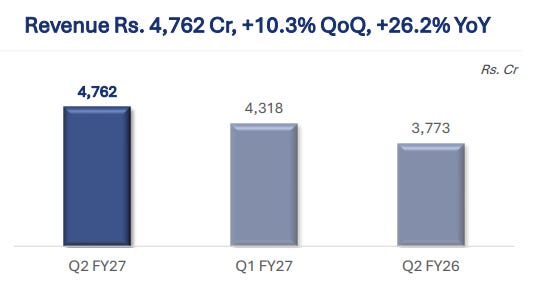
CEAT posted its highest-ever quarterly revenue of ₹4,762 crore, up 26% year-on-year. But its EBITDA margin fell to 9.5%, from 13.5% a year ago, and its consolidated profit fell 40% to ₹112 crore. CEAT says its margins are still well below where it wants them, and more price hikes are coming this quarter.
JK Tyre also had a record quarter on sales, with consolidated revenue up 20% to ₹4,850 crore. Its EBITDA margin, however, nearly halved, and net profit fell 73% to ₹60 crore. Compared to the last quarter, margins did tick up slightly, but that came from its overseas business. In India, JK’s margin slipped.

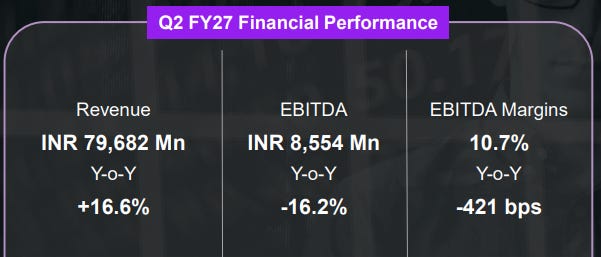
Apollo Tyres grew its consolidated revenue by 16.6% to ₹7,968 crore. Its EBITDA margin fell to 10.7%, from 14.9%. Reported profit rose to ₹292 crore, but only because the same quarter last year carried a one-off charge of about ₹180 crore.
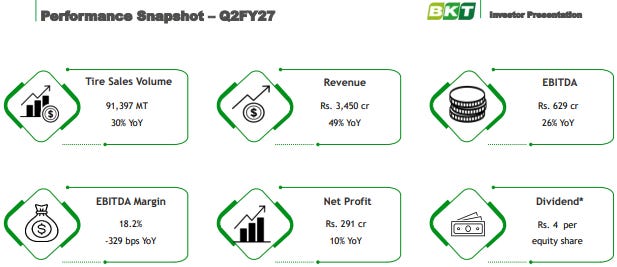
BKT‘s standalone revenue grew 49% to ₹3,450 crore, and profit rose 10% to ₹291 crore. But that growth comes off a weak base, since US tariffs had hit its sales badly a year ago. Its EBITDA margin of 18.2% is still far above its peers’, but down from 21.5%.
Prices went up, and they stuck
Every company sold more than a year ago, yet earned less on each tyre. All of it boils down to a cost shock.
A tyre is a mix of natural rubber, synthetic rubber, carbon black, steel and chemicals. Apart from natural rubber, most of these are made from crude oil. At JK Tyre, for instance, oil-linked materials make up 65-70% of the raw material bill.
When the West Asia conflict pushed up oil prices, almost everything tyre makers buy got costlier. JK’s raw material costs rose 22% between April-June, and another 9% between July-September.
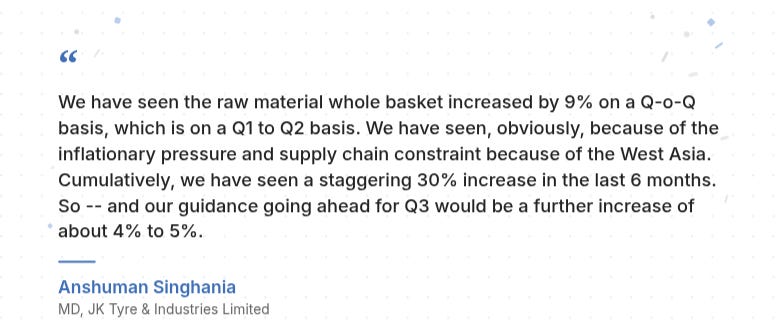
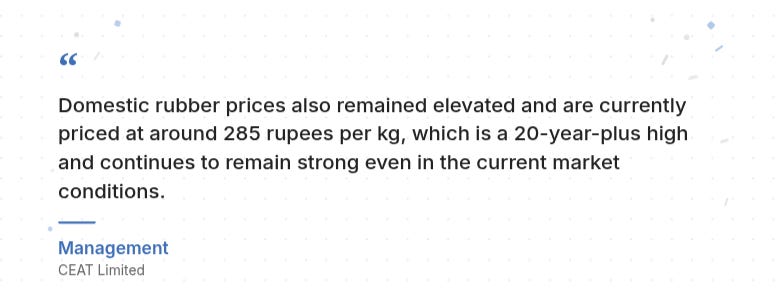
Unfortunately, the one input that doesn’t depend on oil rose, too. CEAT says natural rubber now costs about ₹285 a kilo in India, the highest in over 20 years. Tyre makers responded by raising prices by 11-15% over the last six months.
That still wasn’t enough. Apollo said it would have needed a 16-17% price increase to fully cover its higher costs.
You can see the gap in the numbers. In Apollo’s India business, raw materials now eat up 68% of revenue, up from 62% a year ago. At CEAT, material costs went from 59% to 66% of revenue. Meanwhile, for every tonne of tyres BKT sold, the raw material bill rose about 31% from a year ago while the consolidated revenue it earned rose only ~12%.
Tyre makers can’t raise prices as fast as their costs go up. The units they sell to car manufacturers are priced under contracts that are linked to raw material costs, but these prices are only revised after a lag of three months or so.
In the replacement market, though, where people buy new tyres when their old ones wear out, there is a little more flexibility. But even then, tyre-makers like to nudge prices up only a little at a time.
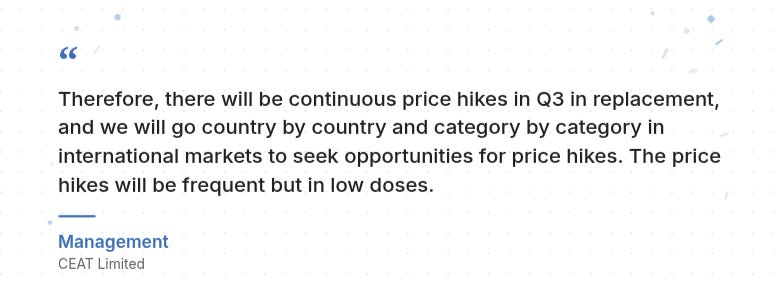
However, every major tyre maker raised prices at roughly the same time, so customers had no cheaper brand to turn to. CEAT said rivals matched its hikes within a week or two. Apollo said “pricing discipline across the industry has been at a very different level of rigor in the first half.” It wants this to become “a permanent feature of the business“.
That kind of discipline is easier to keep at home. As we explained in last year’s primer on the sector, India restricts tyre imports, so Indian tyre makers mostly compete with one another here. But outside India, it’s a different game. Abroad, they’re up against global giants and cheap Chinese brands, and raising prices is much harder. The cost of shipping tyres abroad has also gone up sharply this year, but tyre-makers haven’t been able to charge foreign customers more to cover that.
Inflation is eating the cash
Costlier raw materials have hurt tyre makers in another way too. They’ve left companies with less cash in hand.
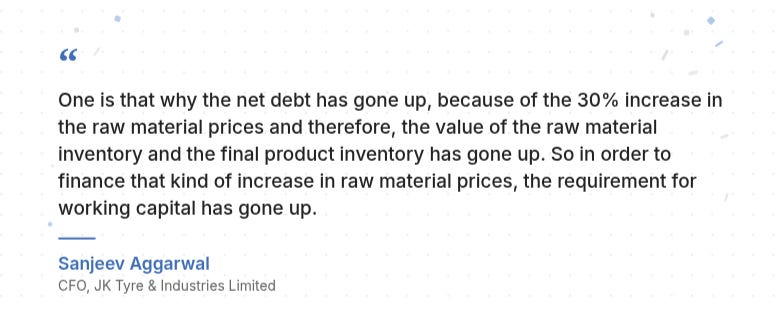
Tyre makers always have money tied up in stock. There’s rubber in warehouses, half-made tyres in factories, and finished tyres waiting to be sold. When raw materials get pricier, that same pile of stock ties up a lot more money.
That’s exactly what happened at JK. Its net debt rose ₹751 crore in just one quarter.
The West Asia conflict has also made shipping slower and less predictable. So companies are keeping extra imported raw material in stock, so their factories don’t run short.
On top of that, the big expansion plans we wrote about in June are now being paid for. Apollo spent ₹1,500 crore on expansion in the first half of this year, more than in all of last year. Its free cash flow went from ₹2,000 crore last year to minus ₹1,400 crore in six months. Its net debt doubled, from ₹1,600 crore to ₹3,300 crore.
Others are borrowing more too. CEAT’s debt rose from ₹2,944 crore a year ago to ₹3,846 crore. BKT’s long-term borrowings have nearly doubled since March.
None of them is in trouble yet. But CEAT has lowered the amount of debt it’s comfortable carrying. This time last year, its stated leverage ceiling was three times its yearly operating profit. Now, CEAT has lowered that to two, and it’s already at 1.93.
Slowing down isn’t really an option, because the factories are almost full. Apollo’s Indian plants are running at 92% of capacity.
Buyers didn’t flinch, at least not yet
On the positive side, though, higher prices didn’t scare Indian buyers. JK sold 22% more tyres in India than a year ago. Apollo’s India revenue grew 25.6%, and about half of that was volume-driven rather than higher realisations per unit. CEAT’s overall volumes grew nearly 10%.
Much of this growth came from carmakers. Vehicle sales are booming, and every new car or truck that rolls out of a factory needs a set of tyres, no matter how much they cost. JK said that in the first half of this financial year, commercial vehicle sales grew 30%, passenger vehicles 26%, and two- and three-wheelers 27%. Apollo and JK each sold ~25% more tyres to OEMs.
On the other hand, the replacement market is more price-sensitive. But a worn-out tyre has to be replaced sooner or later, and people certainly were demanding their old tyres be retired for new ones.
In February, we asked whether the rush after the GST cut was just delayed buying that would fade. More than a year after the cut, demand is still growing. That suggests it was more than a one-time rush.
The coming months will be harder, though. Growth is measured against the same period a year ago. And the October-December period last year was when the GST cut first kicked in and tyre sales jumped. Matching that, let alone beating it, will be tough, and tyre-makers know this too well.
Apollo expects volume growth to be much more muted next quarter. CEAT also expects demand to cool, and points to two additional and interesting reasons. Firstly, this year’s monsoon ended nearly 13% below normal, the weakest since 2015, which could weigh on rural spending. Secondly, in October, the RBI raised its repo rate for the first time in over three years, which makes vehicle loans costlier.
The deal that could shake things up
One company found a way to fill its new factory faster. On October 22, BKT signed a deal with Pirelli, the Italian tyre maker best known as Formula One’s tyre supplier. From 2027, BKT will make Pirelli-branded car tyres at its new plant in Bhuj, Gujarat, scaling up to 8 lakh tyres a year by 2030. After that, the two plan a 50:50 joint venture with a new plant for premium car tyres, sold under both brands.
To see why it matters, look at what Pirelli and BKT each get out of it.
Pirelli sells tyres in India but makes none here. It focuses on premium tyres for SUVs and luxury cars, a market the two companies expect to grow almost fivefold by 2030. BKT gives it an Indian factory without having to build one.
For BKT, it’s a shortcut. BKT built its business on farm and off-road tyres for Europe and the US, and the US tariffs showed how exposed that left it. Now it is betting on India, with truck, two-wheeler and car tyres. Its biggest hurdle is getting dealers to stock a car tyre brand they’ve never sold, which is where the Pirelli name helps.
The catch is that this is contract manufacturing. Pirelli will pay BKT for raw materials at actual cost plus conversion charges. BKT has not disclosed the margin it expects to earn from this arrangement. BKT will use Pirelli’s technology to make Pirelli-branded tyres, while its own tyres will continue to use BKT’s designs and technology.
For everyone else, the fight is at the top end. Premium tyres are where Apollo, CEAT and JK have been chasing better margins, and CEAT’s sales of them grew over 30% this year. A locally made Pirelli will now compete there too. And BKT’s own brand will cover the entire car tyre range.
And while the agreement lasts, it stops both companies from setting up a similar venture with anyone else in India. So no rival can sign up either of them.
What next?
The cost shock was paid for by a bit of everyone. Buyers paid higher prices, shareholders got thinner margins, and lenders are covering the cash gap.
What happens next depends on raw materials. JK and CEAT expect costs to rise a little more this quarter. Apollo expects them to peak around the end of the year.
If costs do start falling, margins could recover quickly. As one analyst on Apollo’s call pointed out, tyre makers usually don’t cut prices for replacement buyers when costs come down. If that holds, this year’s price hikes may be here to stay.
At the same time, competition among the players will only heat up with the BKT-Pirelli partnership. A new player, with a global brand behind it, has every reason to compete hard on price to win dealers and buyers. Whether it does will show how lasting this year’s pricing power really is.
- This edition of the newsletter was written by Mridula & Vignesh.
Tidbits:
1. Mahindra & Mahindra cuts FY27 tractor industry growth forecast to flat
Mahindra & Mahindra has revised its domestic tractor industry growth forecast for the 2026-27 financial year from 5% to flat. The automaker attributed the downgrade to weaker rainfall and drought conditions, lower-than-expected reservoir levels, and pressure on farmers’ incomes from high input inflation, particularly in key markets like Maharashtra and Karnataka.
Source: Business Standard
2. TRAI recommends permitting direct-to-device satellite connectivity
The Telecom Regulatory Authority of India has recommended allowing satellite networks to provide direct-to-device connectivity using conventional mobile frequency bands. Under the proposed framework, satellite companies would need agreements with terrestrial telecom operators to use their spectrum without causing harmful interference to existing mobile networks.
Source: Financial Express
3. Apple seeks about $7 billion through US bond sale
Apple is seeking to raise about $7 billion in the US investment-grade bond market through a multi-part debt offering, according to a Bloomberg report cited by Reuters. The company plans to use the proceeds for general corporate purposes, including share buybacks and debt repayment.
Source: Reuters
4. Hindustan Zinc signs 11 pacts for proposed industrial park in Rajasthan
Hindustan Zinc has signed 11 memorandums of understanding with industry partners to advance its proposed Zinc Industrial Park in Rajasthan’s Bhilwara district. The agreements intend to attract downstream manufacturing, engineering, and service operations to the site, establishing a local ecosystem focused on zinc alloys, galvanising, and advanced applications.
Source: ThePrint
5. RBI proposes ₹100 crore priority-sector loan limit for agriculture infrastructure
The Reserve Bank of India has proposed capping bank loans for agriculture infrastructure at an aggregate sanctioned limit of ₹100 crore per borrower across the banking system under priority sector lending rules. The draft framework, intended to consolidate and revise existing priority-sector lending guidelines, is open for public comment until November 26.
Source: Business Standard
Want more tidbits? Catch up on last week’s recap!

Beyond Today’s Brief
There’s always more happening at Markets by Zerodha.
The Chatter: Why does OpenAI see India as ChatGPT’s largest market globally by active users, and how are Uday Kotak and Ananth Narayan diagnosing India’s $50B foreign outflow problem and the tax gap between debt and equity? Plus, what do management teams at M&M, LIC, Bharat Forge, Mphasis, and BEML signal about production ramp-ups, ATAGS defence clearances, and AI platform contracts?
Aftermarket Report: How did Dalal Street celebrate the festive season as Nifty recorded its strongest week in nearly six years, surging 8.6% past 25,000 to close at 25,030 amid a 15% plunge in crude oil? And what do a 39-point leap in the Fear & Greed index into greed at 63, FIIs pairing bearish bets with a 13.5% jump in index futures long positioning, and Private Banks and Realty leading sector gains indicate ahead of Muhurat Trading?
What We’re Reading: Looking for great long-form ideas to dig into over the festive break? From why Chinese e-commerce giants were built for internal markets rather than geopolitical rivalry and the real quirks of Indian consumer spending, to the fierce debate between Zoltan Pozsar and Perry Mehrling over the future of the dollar and why AI’s biggest fortunes might be captured outside AI itself—we curate ten sharp reads for your long weekend.
Join us on WhatsApp, where we share interesting soundbites from concalls, articles, and everything else we come across throughout the day. You’ll also get notified the moment a new video or article drops so that you can read or watch it right away.
Thank you for reading. Do share this with your friends and make them as smart as you are 😉