


Our goal with The Daily Brief is to simplify the biggest stories in the Indian markets and help you understand what they mean. We won’t just tell you what happened; we’ll tell you why and how too. We do this show in both formats: video and audio. This piece curates the stories that we talk about.
You can listen to the podcast on Spotify, Apple Podcasts, or wherever you get your podcasts and watch the videos on YouTube. You can also watch The Daily Brief in Hindi.
In today’s edition of The Daily Brief:
1. Reliance is reminded that it’s still an oil business
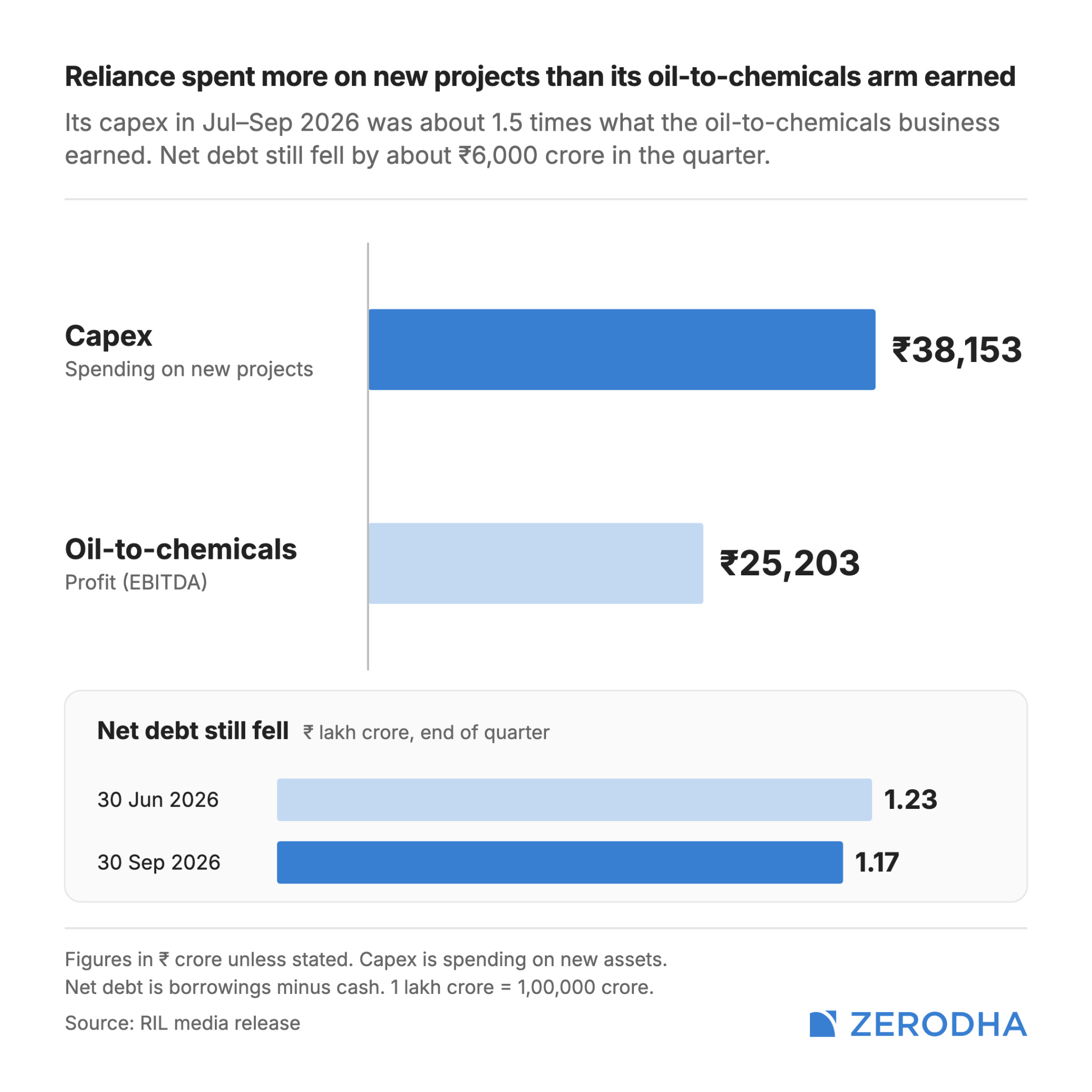
Reliance reported record quarterly EBITDA of ₹62,409 crore, but roughly 80% of its ₹12,744 crore operating profit increase came solely from the oil-to-chemicals (O2C) segment as West Asia turmoil widened refining crack spreads. With its Jamnagar complex flexibly processing heavy sour crude, running near full capacity, and swapping high-cost naphtha for imported ethane, O2C EBITDA surged 68% to ₹25,203 crore. This windfall funded two-thirds of the group’s ₹38,153 crore quarterly capex, cross-subsidising margin pressure in Retail from dark store investments and cushioning project delays across its New Energy battery and solar buildout.
2. Indian mid-cap IT sees the weight of scale
While tier-one tech services firms battle billing-rate deflation, India’s mid-cap IT providers are taking distinct routes to sustain momentum and manage client pricing pressures. Persistent Systems grew 20.8% by taking over mature enterprise software suites and using AI to strip out operating costs, though financing its $1.25 billion Nagarro buyout diluted equity and compressed margins. Coforge integrated its Encora acquisition to upgrade full-year EBIT margin guidance to 16%, while automotive-focused KPIT relied on fixed-price contracts and heavy-machinery engineering to counter budget cuts from European and Japanese carmakers.
Reliance is reminded that it’s still an oil business
Reliance just had its biggest quarter ever, with record revenue, EBITDA and profit (leaving out one-off gains).
Revenue grew 27.8% from a year ago to ₹3.6 lakh crore, and EBITDA grew 23.9% to ₹62,409 crore. Two days before the results, Jio listed on the stock market as India’s second most valuable company.

But this wasn’t a quarter where everything went right, or even needed to be. There was just one.
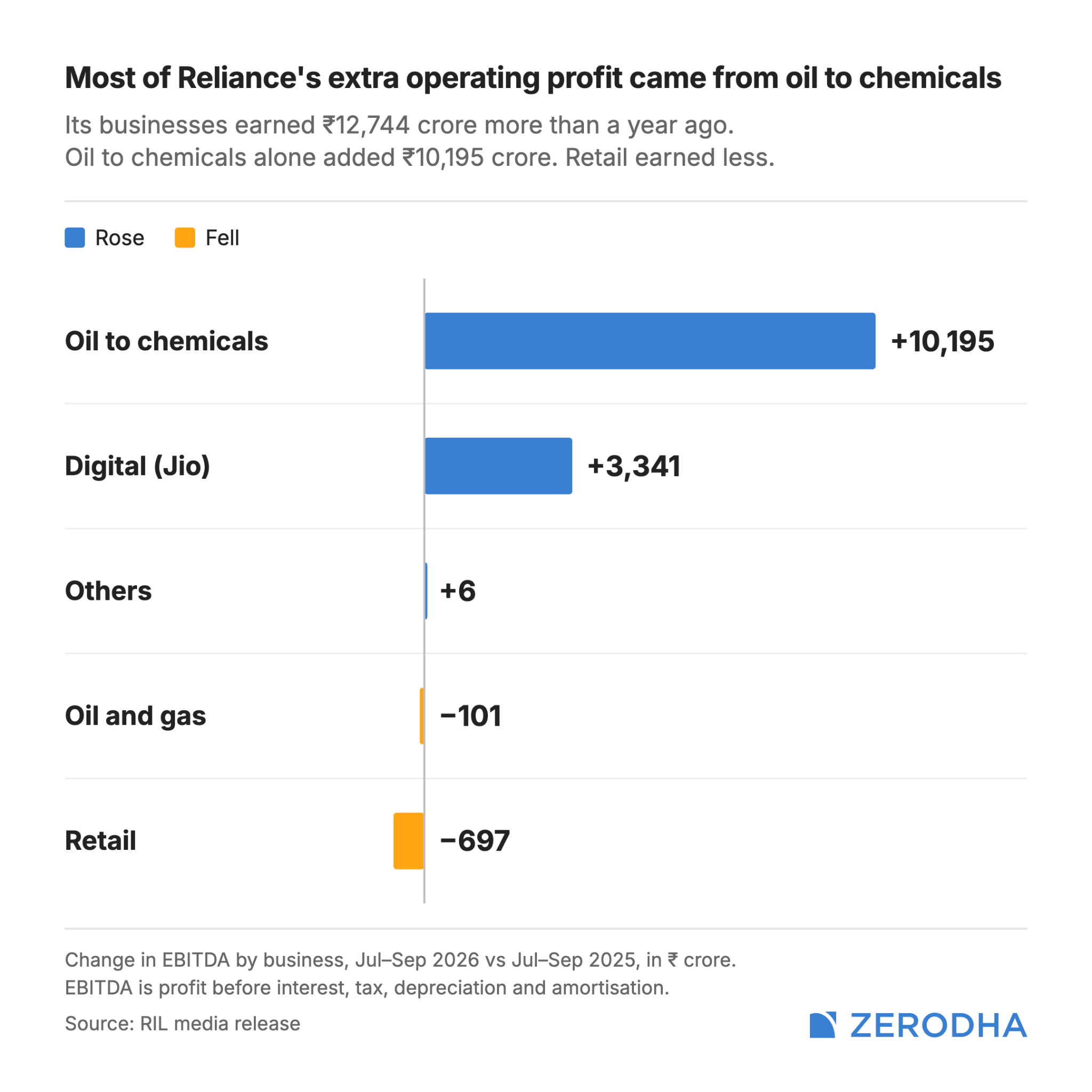
Reliance’s businesses together earned ₹12,744 crore more EBITDA than a year ago. About 80% of that came from just the oil-to-chemicals (O2C) business. Retail and oil and gas exploration actually earned less than last year.
And you may have guessed this by now, but this rise in margins owes to the upheaval in oil markets from the conflict in West Asia.
That’s the obvious story, and we’ll get into the mechanics of this. But what is Reliance doing with all the cash sitting in its kitty?
For years, Reliance has told investors its future lies in Jio, Retail and clean energy. Right now, most of those bets are spending heavily, running late, just about paying for themselves, or all of them. And the bill is being paid by the oldest business in the group.
So, how much of the upheaval in oil did Reliance capture? How much of that will stay once the war ends? And what happens to Reliance’s big bets if it doesn’t?
A quick note before we start: from now on, our coverage of Reliance will not include Jio. Instead, it will now be part of telecom results coverage separately.
Rise and shine (and refine)
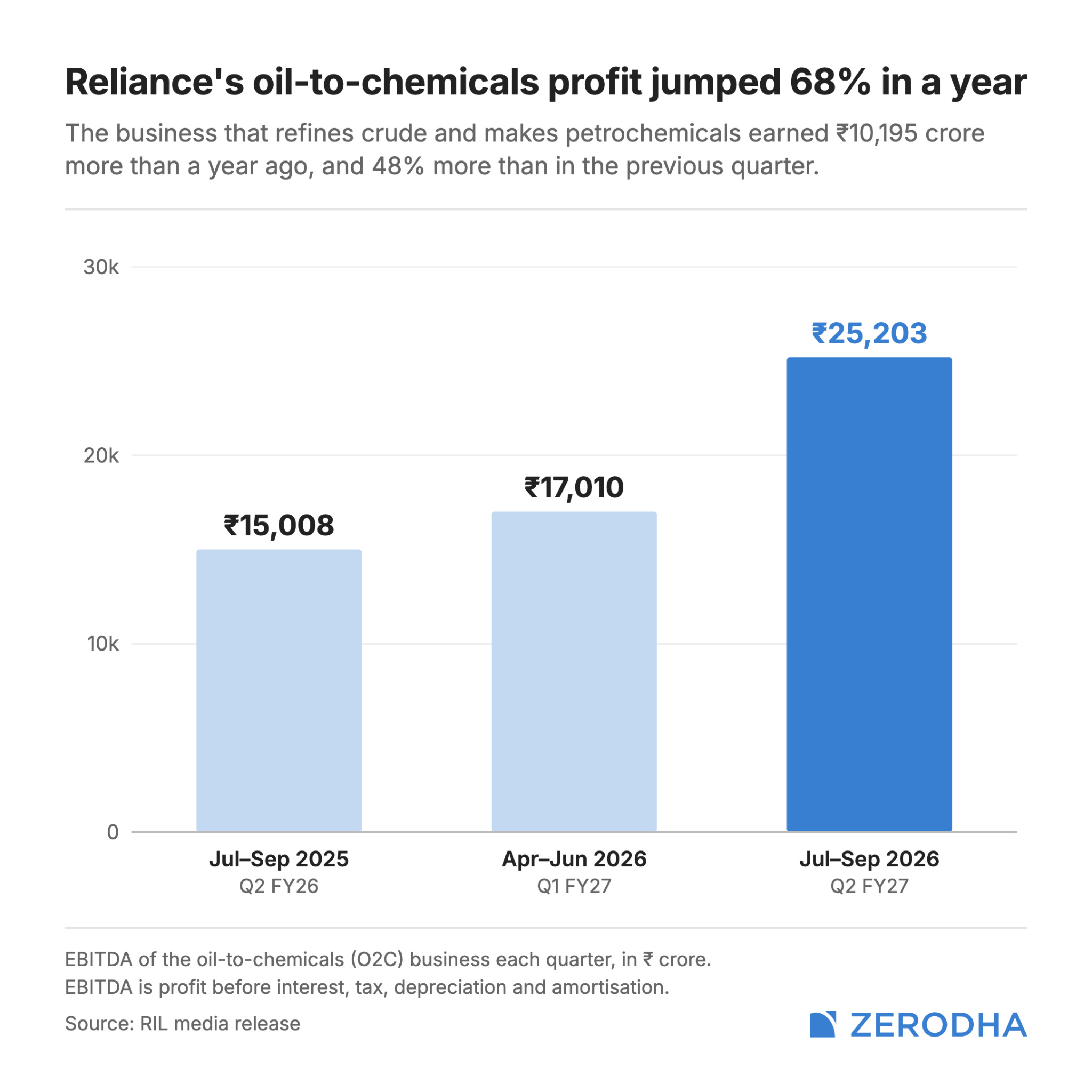
The EBITDA of the O2C business grew ~68% y-o-y to ₹25,203 crore, the best quarter this business has ever had in its entire history.
To understand this statistic, we will need to look at what happened in the oil market. We broke down the oil market’s chaos just a few days ago, so we have a reference point to start with. While we’ll keep things simple here, we recommend going through that story for richer detail.
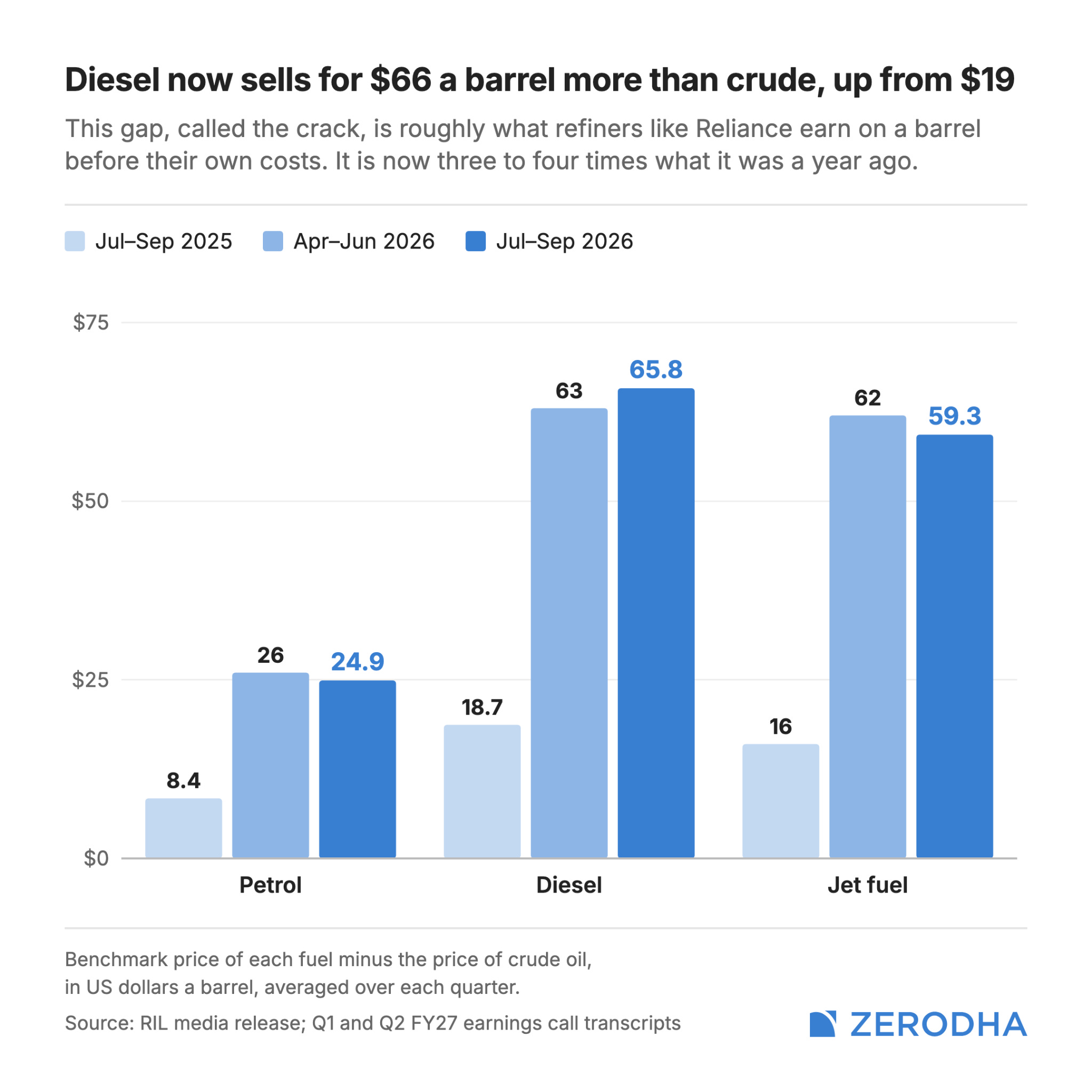
See, a refinery makes money on the gap between what it pays for crude and what it earns selling fuel. That gap is called the crack.
Now, cracks roughly tripled from a year ago. The war in West Asia crippled refineries in the region. Refineries in Russia have taken a hit because of the war with Ukraine. China’s refineries, while still active, are prioritizing their home market more instead of exports. With a shortage of refining capacity, that only created a massive demand opportunity which the largest refinery of the world in Jamnagar was best positioned to make use of.
But this was also the situation last quarter, and cracks have barely moved since then. Yet, EBITDA jumped 48% from last quarter. So, what changed?
A (black) golden opportunity
Reliance just captured more of the opportunity.
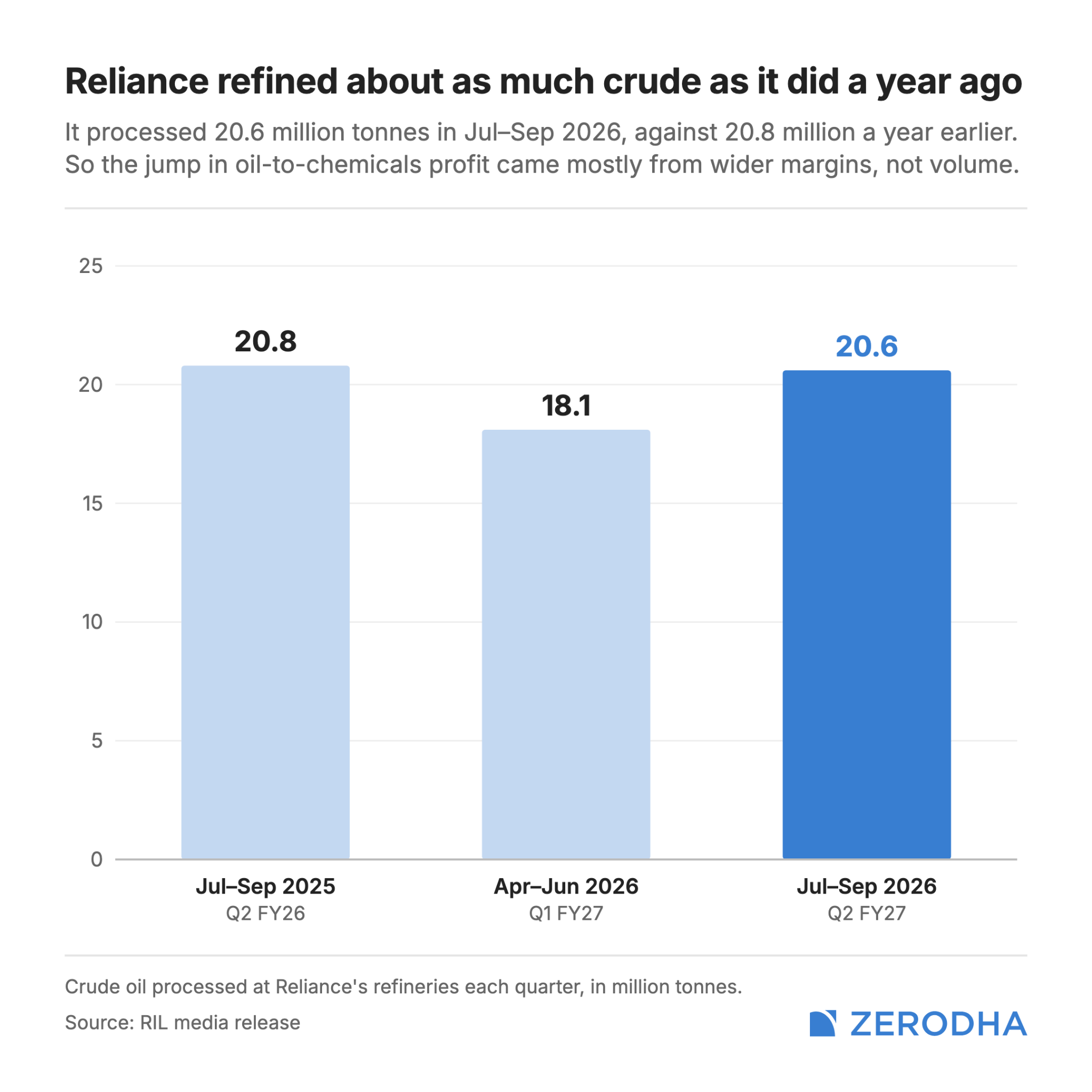
For one, the refinery was running fully again. In contrast, last quarter, part of it was shut for planned maintenance and a government order diverted feedstock into cooking gas. This quarter, throughput rose about 14% and that order was relaxed.
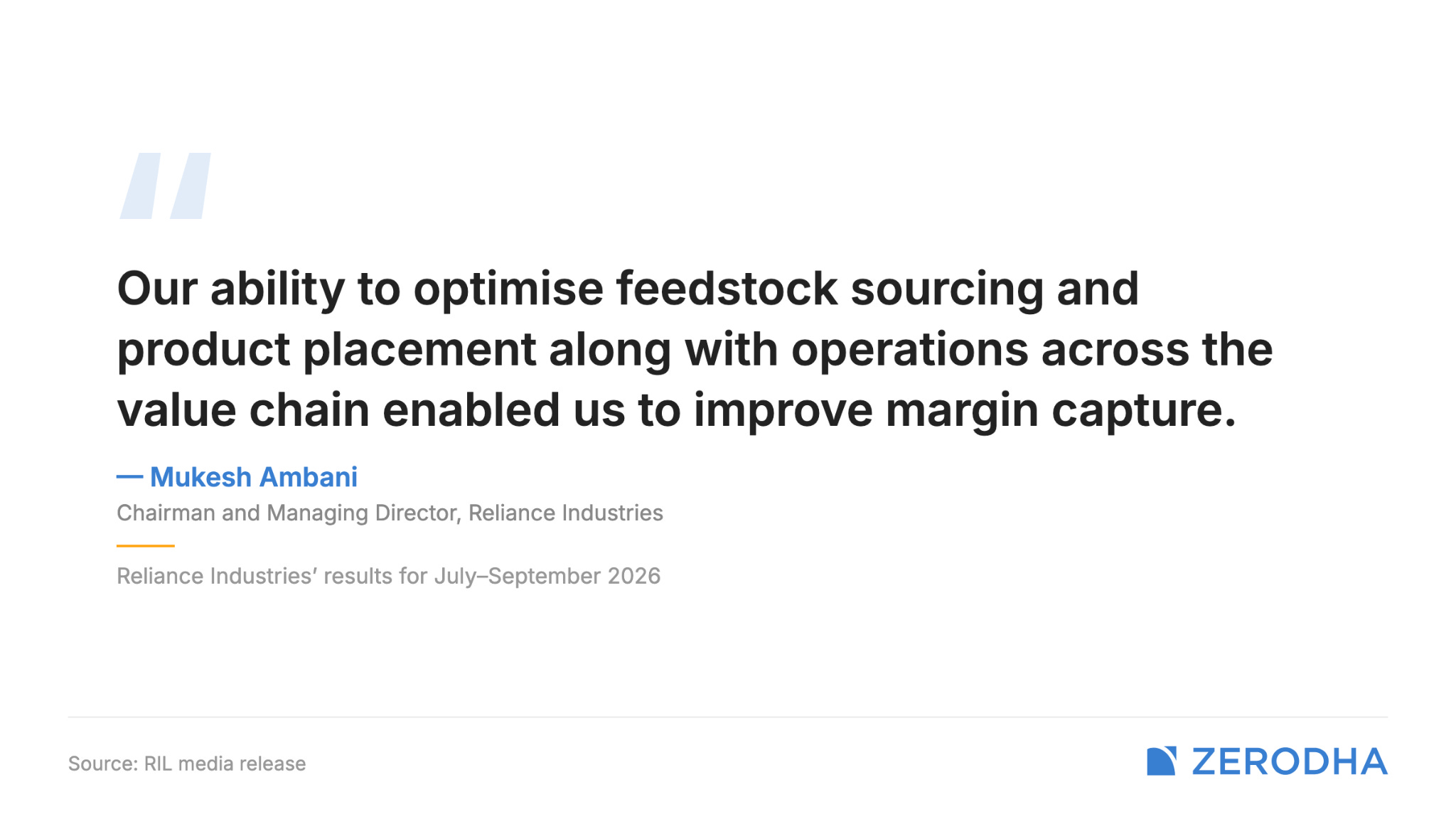
Secondly, Reliance changed where it bought crude almost every month and sent fuel wherever prices were highest.
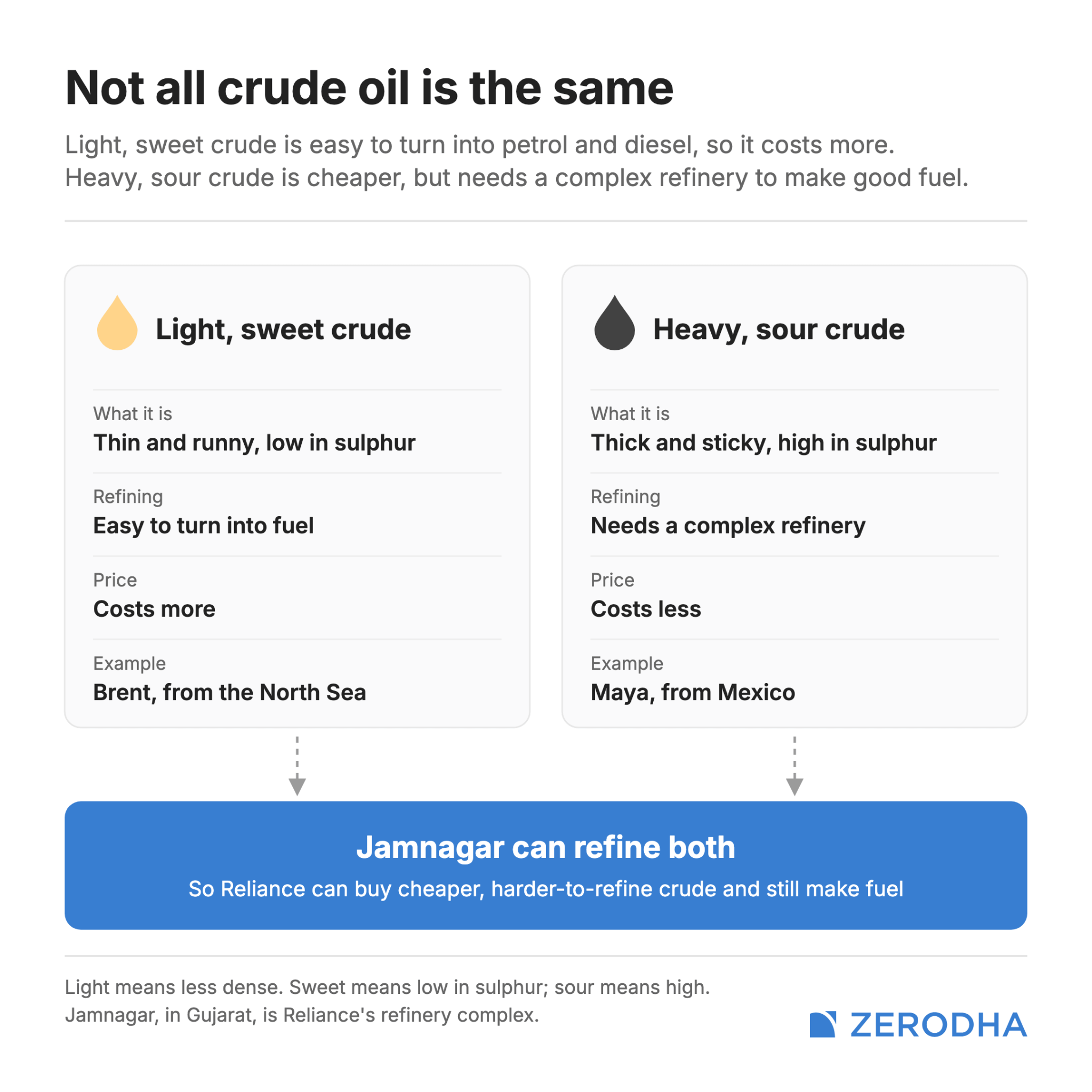
Even within the varieties of crude oil, Reliance maintained flexibility that few refineries in the world have the privilege of doing. Sweet oil, for instance, is easy to refine, and therefore higher in demand and expensive. But sour oil, which is thick and full of sulphur, is hard to refine, so it’s cheap. Most of the world’s sour oil comes from Venezuela. In January, we covered why Venezuelan oil will certainly need Indian refineries — Jamnagar has the highest crude oil complexity score in the world.
So when the Gulf shut, Reliance could switch suppliers every month and keep running. During the worst of the crisis, refineries elsewhere in Asia cut their runs by 15–20%, but Jamnagar kept going.
Additionally, Reliance has its own ships, too. While freight rates jumped 15–20 times, Reliance had 20-25 ships on long-term hire at fixed rates.
The chemicals side
On the other side of the O2C business, Reliance also sold chemicals at a premium.
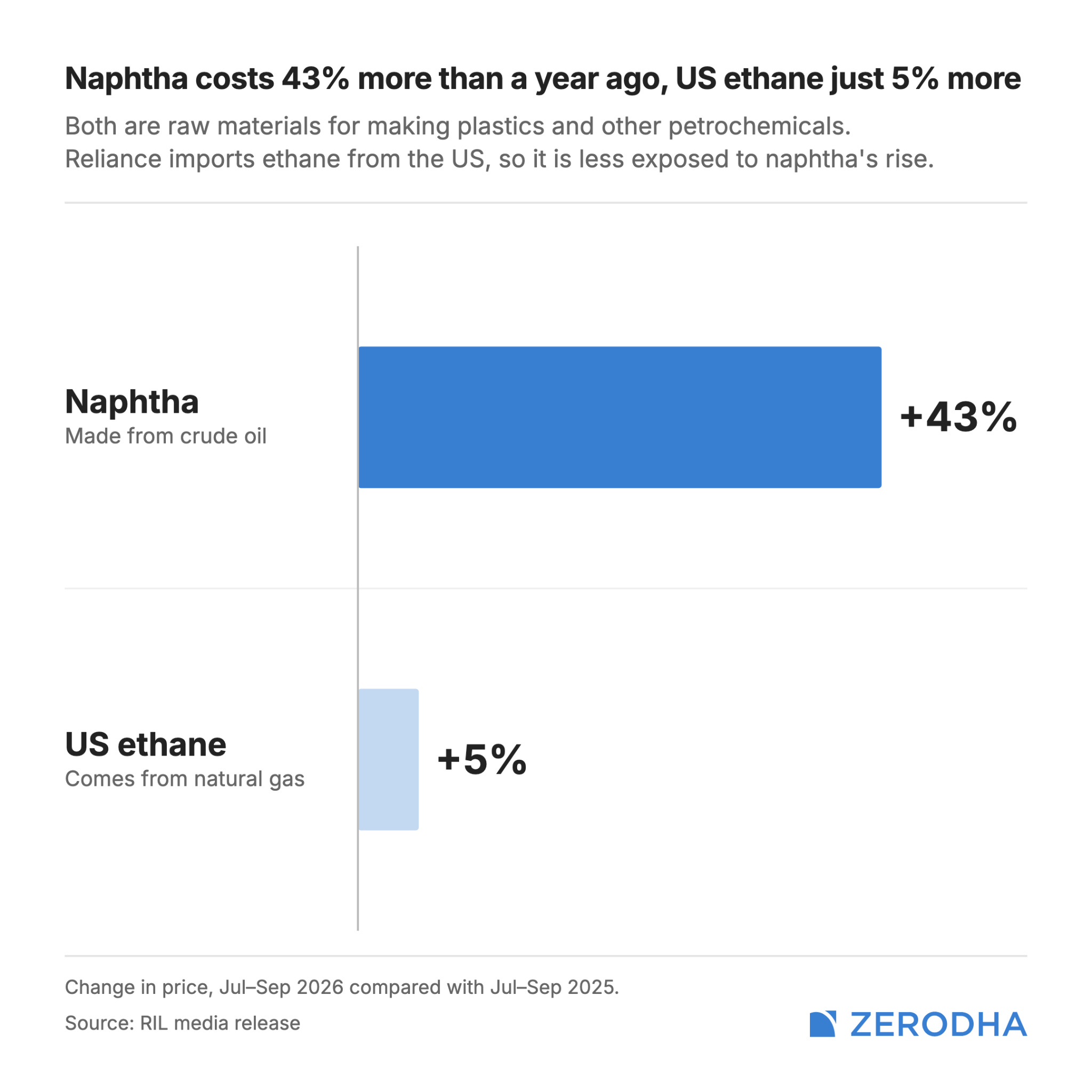
Most Asian plants make plastics from naphtha, which comes from crude oil. This quarter, naphtha became scarce since Middle East supply halved, and prices rose 43%.
However, as we covered last quarter, Reliance was able to switch naphtha with ethane for most of its ethylene production. Today, on a per-tone basis, ethane is cheaper than naphtha by ~$560 — this number itself is 2.3 times the 2025 average, so the gap has only widened due to a shortage of naphtha.
In other words, Reliance sold plastics and polyester at wartime prices while paying far cheaper for its raw material. Polyester margins hit a three-year high.
Chasing the market
However, this multiplication of cracks didn’t translate one-to-one in Reliance’s O2C profit, which only went up 1.7 times. Its O2C margin also only moved from 9.3% to 10.9%. The leak lay in places that Reliance could only do so much to control itself.
First, buying crude itself got expensive. Forget each barrel selling at high premiums, Reliance also paid higher freight and insurance charges alongwith.
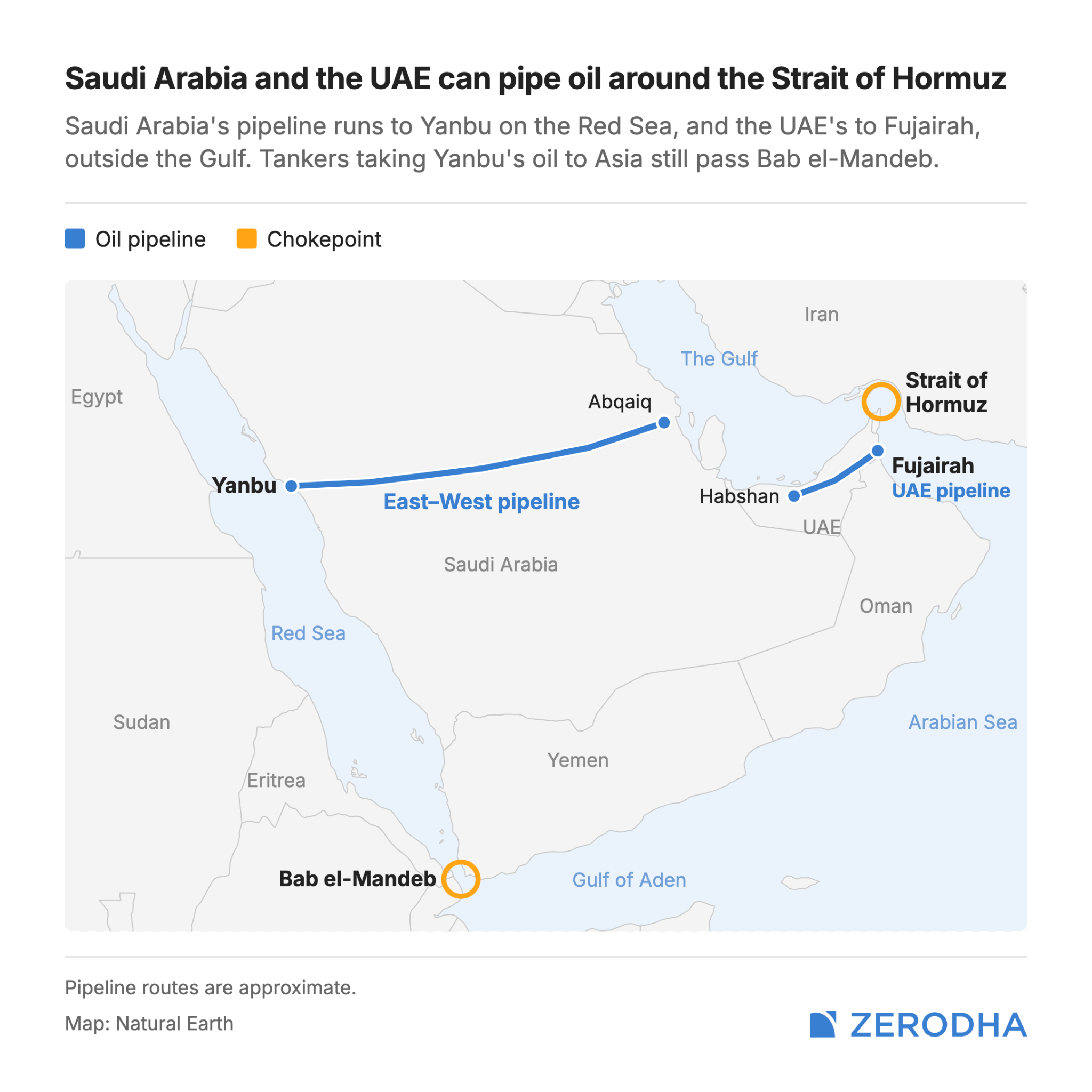
Now, Reliance procured this oil from diversified sources, including the Strait of Hormuz. However, at the Strait of Hormuz, oil is now being transferred from ship to ship, instead of one single tanker carrying everything. Alternative routes and pipelines either don’t carry as much oil, or run longer, more expensive paths.
Second, India didn’t let domestic pump prices rise, so Jio-bp sold fuel at a loss at home. Now, compared to public oil marketing companies like Indian Oil, Jio doesn’t have to strictly adhere to the standard of selling oil to the public at highly subsidised rates. But it can’t do much when a price cap applies to the whole industry.
Third, despite an easing of the government quota this quarter, Reliance made almost twice its normal amount of LPG so Indian homes didn’t run short of cooking gas. That meant making less of its more valuable products.
An abnormal situation?
We don’t see a conflict like this all the time, so it’s worth asking what happens when the war ends.
The cracks will certainly fade away. They’re high because about 4–5 million barrels a day of refining is still shut, and fuel stocks are low. What will also fall are the premiums Reliance has been getting on its cargoes, and much of the extra gap between ethane and naphtha.
But what stays is Jamnagar’s ability to run on almost any crude, the ships, and the ethane setup. In fact, the ethane edge is growing: Reliance has three new very large ethane carriers coming in, and one is already running. None of these need a conflict to make money.
In the same quarter a year ago, O2C earned ₹15,008 crore. That was also an environment that saw dirt-cheap crude oil. This quarter, it earned ~₹10,000 crore more. It’s tempting to think that this is the delta at stake when things “normalize”.
However, Reliance doesn’t think things will go back. In their view, the oil market has “fundamentally structurally changed”. Srinivas Tuttagunta, who runs refining, compared it to the 1973 Arab oil embargo, where the market stayed nervous about the Middle East for decades afterwards.
The analysts asking the management questions weren’t so sure, though. One of them pointed out that, by some estimates, Middle East oil flows have at times come back close to pre-war levels since the quarter ended. Another asked whether demand is shrinking for good, as China moves quickly to EVs and LNG-powered trucks.
We can’t say for sure, but what is true is that until this conflict, oil was in a structural glut which kept prices low. It is part of why the Arab member-nations of OPEC, which caused the 1973 embargo, have already started breaking apart. As long as the war continues — which could be a long time — Reliance may well be right. But the safer assumption is that most of those extra earnings are temporary. The 1973 embargo lost its pricing power eventually, too.
Reliance’s cross-subsidy bill
This quarter, O2C’s EBITDA alone covered about two-thirds of Reliance’s capex. Net debt fell too, to ₹1.17 lakh crore from ₹1.23 lakh crore last quarter. In a large way, the windfall is paying for the build-out while cutting Reliance’s debt at the same time.
Now look at where the build-out money is going.
Retail is choosing to spend
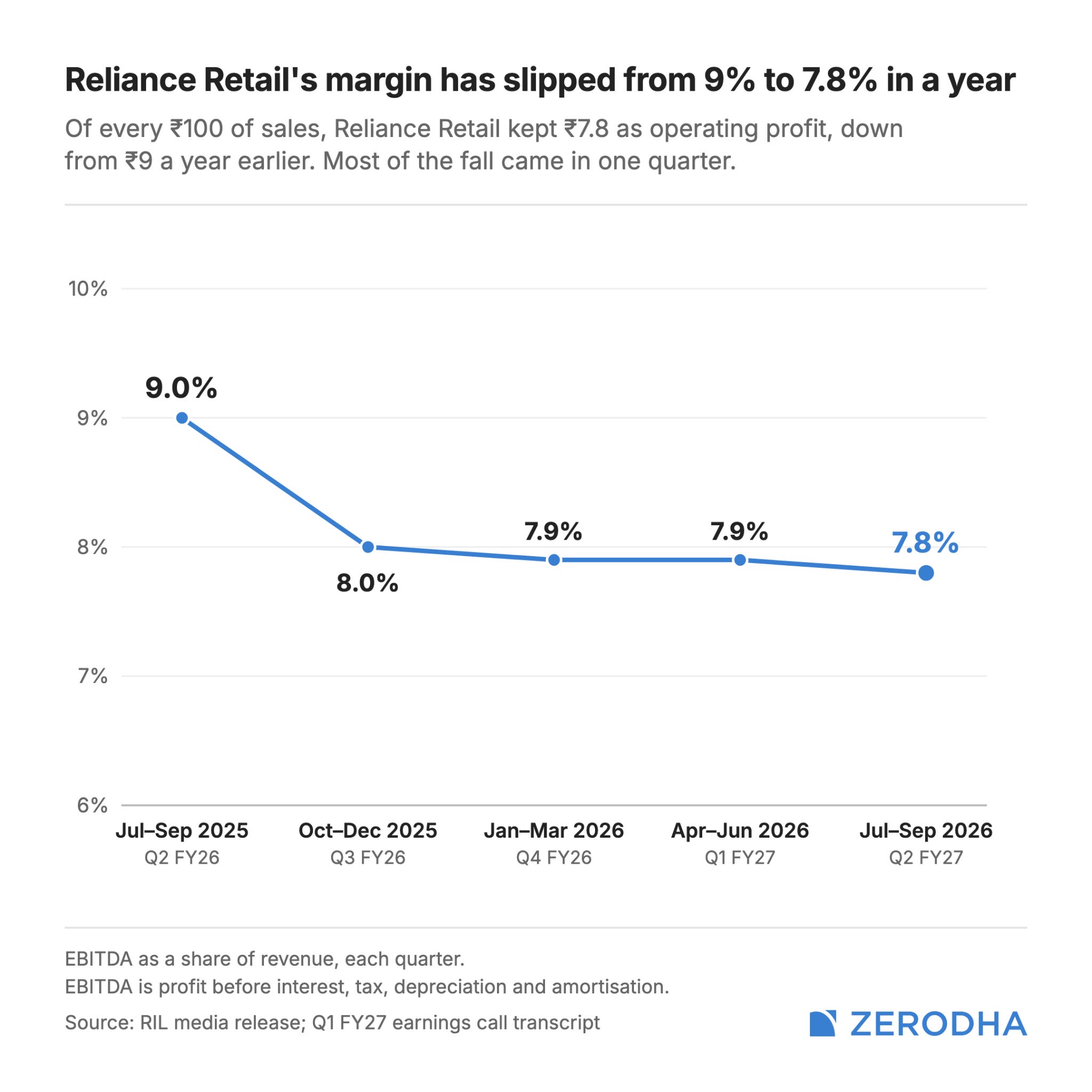
Reliance Retail’s EBITDA margins are down to 7.8% from 9% a year ago. Partly, it’s because Reliance is pouring money into dark stores and matching quick commerce prices in big cities. Revenue grew only 6.4%, though part of that is because festive shopping moved to October this year.
On the call, an analyst called JioMart’s growth “underwhelming” next to quick commerce rivals. Reliance’s answer was that online growth is mostly a question of how much money you’re willing to burn, and it’s choosing to burn less.
That’s a fair answer for a company with a profitable store network behind it. But it’s a lot easier to be patient when O2C is printing money. Reliance still targets roughly doubling Retail’s EBITDA in about two years.
The consumer brands business, led by Campa, brought in ₹8,266 crore revenue this quarter, 1.6 times that of last year. In just six months, it made about 80% of last year’s full-year revenue. But on the previous call, Reliance said it was only breaking even on EBITDA. That’s another growth bet that needs funding for now.
New Energy is running late
Meanwhile, the business that’s meant to one day replace oil is the one slipping.
In July, Reliance said its 40 GWh battery capacity and battery cell factory would be ready this year. Now, battery packs come in the first half of 2027, and cells only ramp up between June and December 2027. Power from its giant Kutch solar project, also due this year, now waits on a transmission link in the first quarter of next year.
Solar manufacturing is on track, at over 6 GW of modules with 20 GW planned early next year. And Reliance still expects New Energy to start earning in FY28. But every quarter of delay is another quarter the old business has to carry it.
Reliance’s data centre bet
Reliance is also building data centres at Jamnagar.
It expects to finish 44 MW of capacity in the next 4-6 months, is planning another 120 MW, and is separately building one for “one of the hyperscalers”, presumably Meta.
In that last one, Reliance is only providing the land, the building, the power and the network. The tech company buys the GPUs, the most expensive and fast-depreciating asset in a data center. It plays to Reliance’s strengths, since power, land, water and connectivity — some of the hardest things to secure at scale — are all elements Reliance already has readymade at Jamnagar.
Conclusion
Reliance wants us to see it as a consumer and technology company that happens to own a refinery. But the truth, by and large, continues to be the exact inverse.
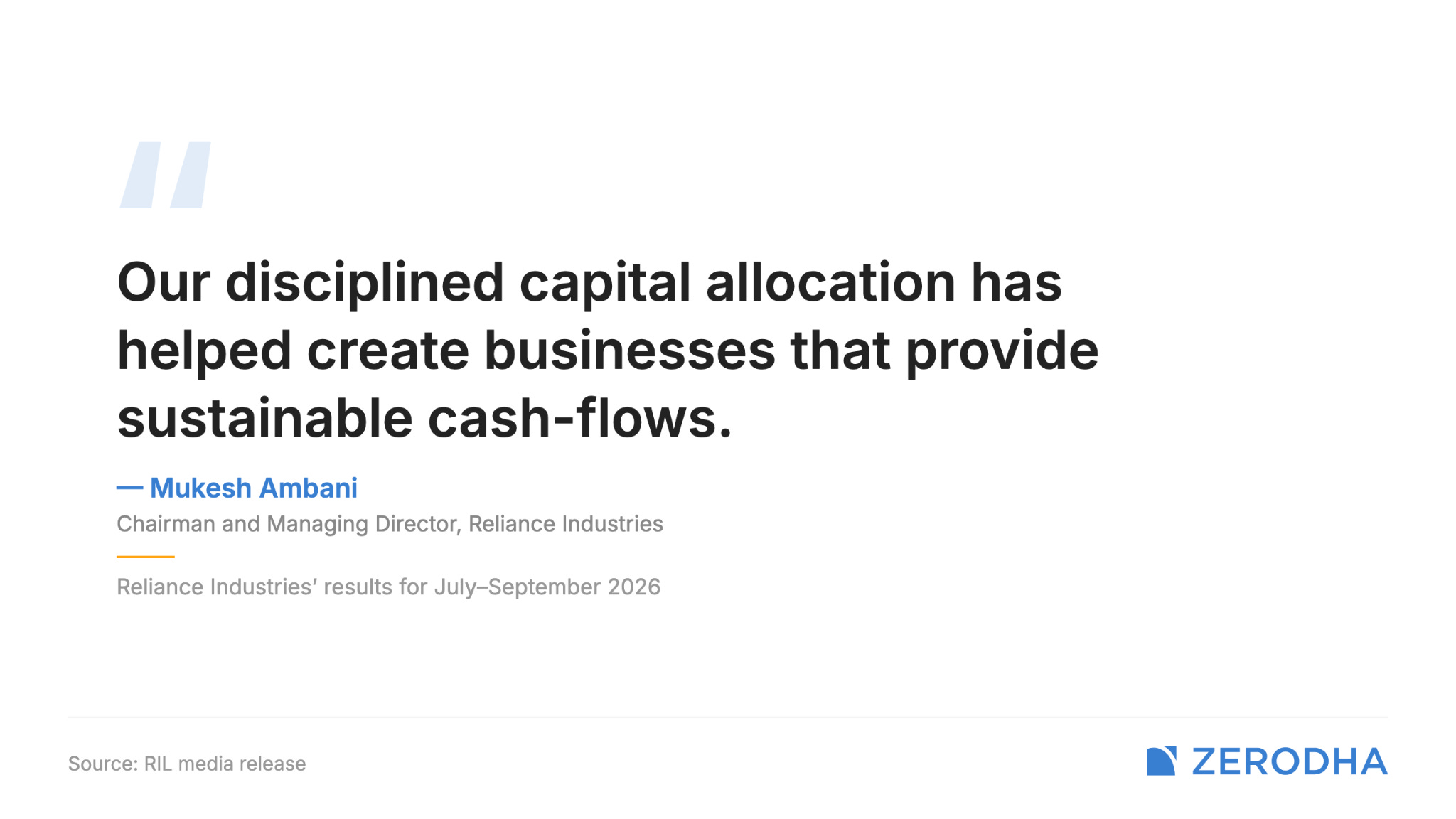
That being said, it works only as long as the windfall lasts long enough for all the other businesses to turn a corner. That would also explain the bets as hedges against oil. But if cracks fall sooner, Reliance will have to choose between slowing down its spending, maybe taking on more debt, especially to fund a mammoth data center expansion.
This year, very few companies in India will have a Diwali season as happening as Reliance. It’s just a different type of gold making its fortunes.

Indian mid-cap IT sees the weight of scale
Indian midcap IT has been no exception to the pressure AI is putting on any kind of software company. Which is odd, considering their solid results continue. But the market is spooked enough by AI’s long-term threat to discount the present value of the business.
The story for the sub-sector hasn’t changed much from last quarter. Companies are trying to build the ultimate knowledge base they can, and that means working hand-in-hand with clients old and new, or buying companies with existing relationships. How new deals are being approached is also changing. Firms are looking beyond hourly billing, though pricing models vary from deal to deal.
But no two companies are making the same decisions even under the pressure of AI. This quarter, some of those decisions only became more pivotal.
Persistent(ly) taking on a client’s products
Let’s start with the results of Persistent Systems.
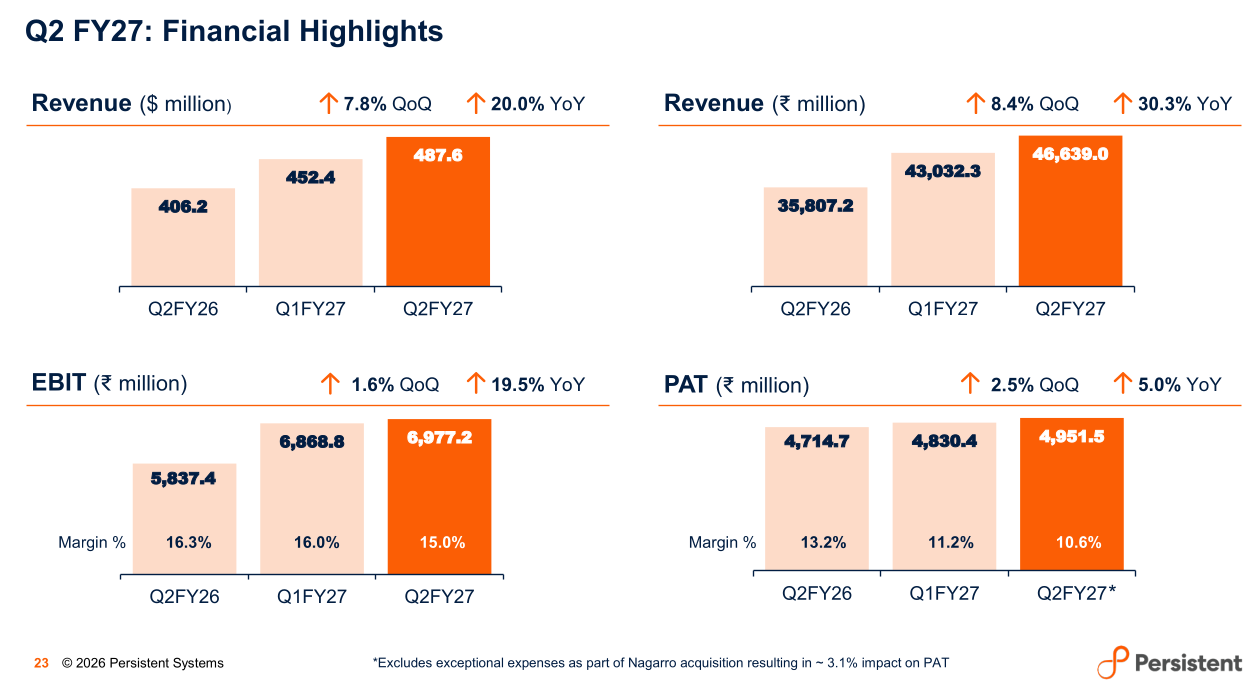
Persistent’s revenue in constant currency terms grew 20.8% year-on-year to nearly $488 million (~₹4,664 crores), its 26th straight quarter of growth. Leading the way was its Software, Hi-Tech and Emerging Industries vertical, the part of the market most exposed to AI, which grew 28.5% year-on-year.
Persistent’s key customers are enterprise software companies like Microsoft and Salesforce. Indeed, those companies are seeing immense growth, having launched their own agentic platforms, LLMs, and in Microsoft’s case, the growth of Azure.
But AI is also squeezing the same customers from two sides. AI-native startups and frontier-model makers are chasing their customers, while their older products are weighed down by rising talent, licence, cloud and AI token costs, just as they need cash to build AI products of their own.
Persistent’s answer to this specific problem is a new offering where they help these firms strip out the cost of running them, and the savings from that can be funnelled into the next generation of AI products. It takes over those older software suites, trims the third-party licence bills, optimises the cloud setups, and frees up cash for the client to fund its next-gen AI bets.
And this is not the first time Persistent has tried taking over the mature products of an older company. They tested similar partnerships before 2019. But back then, it was mostly a brute-force exercise that threw rooms of engineers at legacy code, while taking on the brunt of paying for cloud servers and third-party vendor licences.
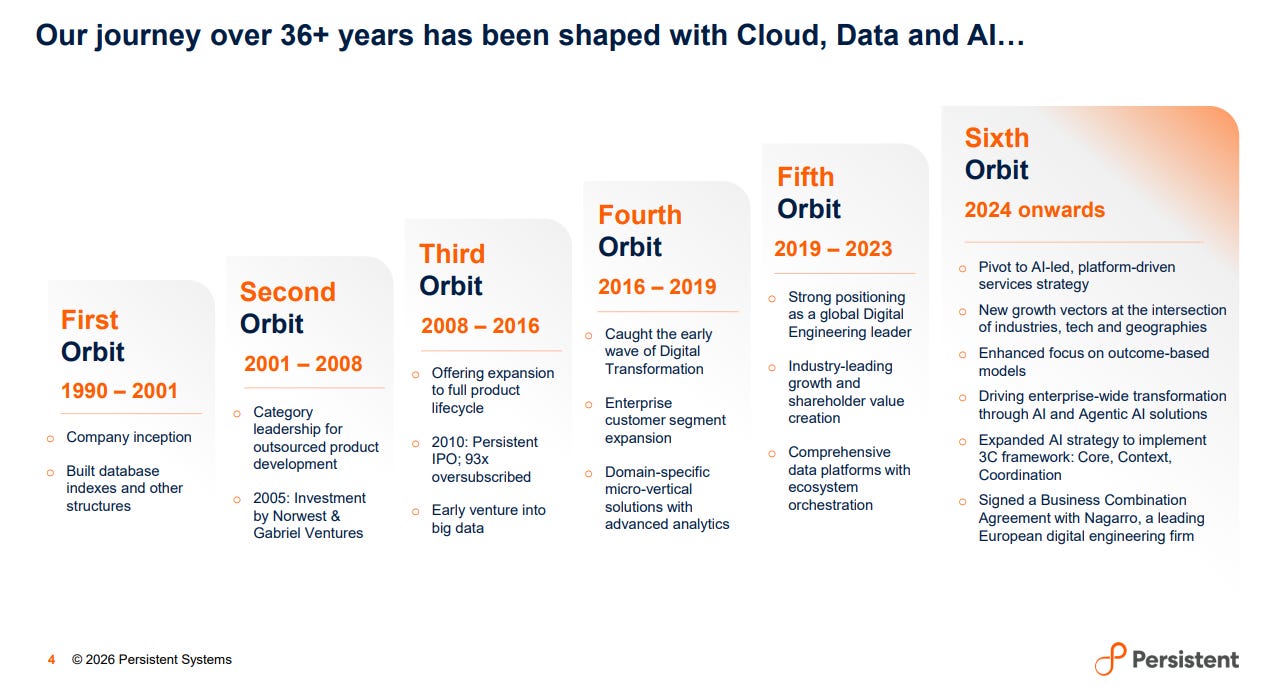
The difference this time boils down to AI, which does away with the need for brute-force. Persistent can now map a product built 5-15 years ago, spot wasted cloud spend, and build custom components to replace the third-party tools embedded in it, wiping out those licence bills. For one large software client, it is cutting running costs by 45%.
This playbook is validated by a multi-year deal worth $650 million that Persistent signed with an unnamed large technology company last quarter. In Q1 FY27, Persistent’s TCV crossed $1.15 billion for the first time ever, and this $650M contract accounted for more than half of it. We can’t confirm if this is the same client whose running costs have been slashed by nearly half.
However, this quarter, the deal reached its steady-state run rate, and its costs showed up. Since Persistent took on the portfolio’s cloud spend and licences, its intangible assets jumped by over ₹900 crore, and amortising them hurt margins by 0.9 percentage points. Together with annual wage hikes and lower utilisation, that pulled Persistent’s EBIT margin from 16% to 15%. Management’s bet is that the drag shrinks as its engineers replace those licences and trim cloud spend.
The second-most consequential cost to Persistent lies in its biggest acquisition ever of Germany-based IT services firm Nagarro, which we covered before. Once the deal closes, likely by early 2027, North America falls to about 62% of revenue and Europe rises to about 22%. Until then, nearly 80% of Persistent’s business came from North America, so this is much needed diversification.
But until then, it has to bear the burden of financing it.
In June, that financing plan was meant to be debt-only. But in October, shareholders approved a $1.25 billion (₹11,809 crore) long-term plan with equity capped at $450 million (₹4,251 crore), and the rest in over ₹6,000 crore of bonds. Persistent has since raised ₹4,264 crore through a QIP, which also diluted shareholders by nearly 5%.
The reason for this change amongst others lies in German law, which states that buying a company doesn’t let you touch its cash or sweep its accounts without signing a formal profit-pooling contract. Persistent has said it won’t sign such a contract for two years after closing. Borrowing the full amount would have left net debt at up to about 2.5 times combined EBITDA, and the equity takes it closer to 1.5 times.
The deal is already weighing on profits: about ₹185 crore of one-time costs pulled net-margin to 7.5%; stripping them out, it would have been 10.6%, with another $25-30 million (₹240–287 crore) to come.
Coforge’s unbeaten streak has a hitch
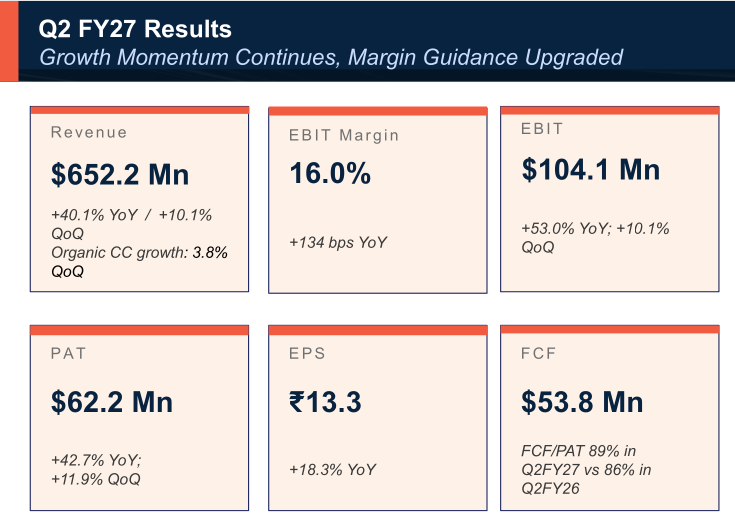
Where Persistent’s margin dipped, Coforge held its EBIT margin at 16%, flat on the quarter, and raised its full-year EBIT margin guidance from 15.5% to 16%. Consolidated constant-currency revenue grew 10.9% sequentially (reaching ~$657 million on a constant-currency basis). Rupee revenue jumped 53.6% year-on-year while general and administrative costs rose just 15.6%.
While Coforge is by far the market leader in travel software services, its travel share of revenue actually slipped to 20.2% from 23.3% a year ago, mostly because it’s expanding. Its acquisition of US-based Encora added large healthcare and hi-tech businesses. Its order intake crossed $1 billion, roughly double a year ago, spread across BFSI, software and hi-tech, and public sector projects.
In contrast to Persistent’s buyout of Nagarro, Encora was mostly paid by issuing new shares. The acquisition brought 11 clients spending over $10 million a year and more than 3,100 nearshore engineers in Latin America. Coforge has cut Encora’s administrative costs by 40%, and while integration cost was slightly over budget, Encora’s margins are improving faster than planned. The biggest deal in Coforge’s pipeline currently is also with an Encora client.
As far as AI is concerned, Coforge has been testing alternatives to hourly billing through “Mod Squads”, teams of engineers and AI agents billed by subscription or outcome, which we covered last quarter. This quarter, it formalised that playbook with Nuuron: its platform that feeds enterprise rules and data to AI agents, and Momentuum Blue: a dedicated team of on-site engineers embedded inside client offices to deploy working AI prototypes fast.
Just as important is how Coforge uses AI internally. The largest IT firms have historically earned the best margins by spreading overhead across huge revenue. Co-forge CEO Sudhir Singh says AI is “breaking the link between scale and margin leadership” by automating routine internal work.

However, these results came alongside some troubling off-field noise.
On September 8, chairman O.P. Bhatt and the head of the board’s nomination and remuneration committee resigned after KPMG, the company’s internal auditor, found that board-evaluation reports, including the chairman’s lowest rating, had been withheld from other directors. Shares fell 9% the next day. A broader governance review remains open, though management says it is unrelated to financial reporting. Separately, Coforge continues to fight a lawsuit filed earlier this year by rival Mphasis in a US court.
KPIT diversifies inside the garage
If Persistent and Coforge show what happens when you widen out across industries, KPIT shows what happens when you stay in one.
KPIT built its business writing software for cars. But when you’re tied to one industry, you catch every cold it does. Its 23-quarter growth streak broke in Q1, and this quarter wasn’t much better: in constant-currency terms, revenue was almost flat year-on-year.
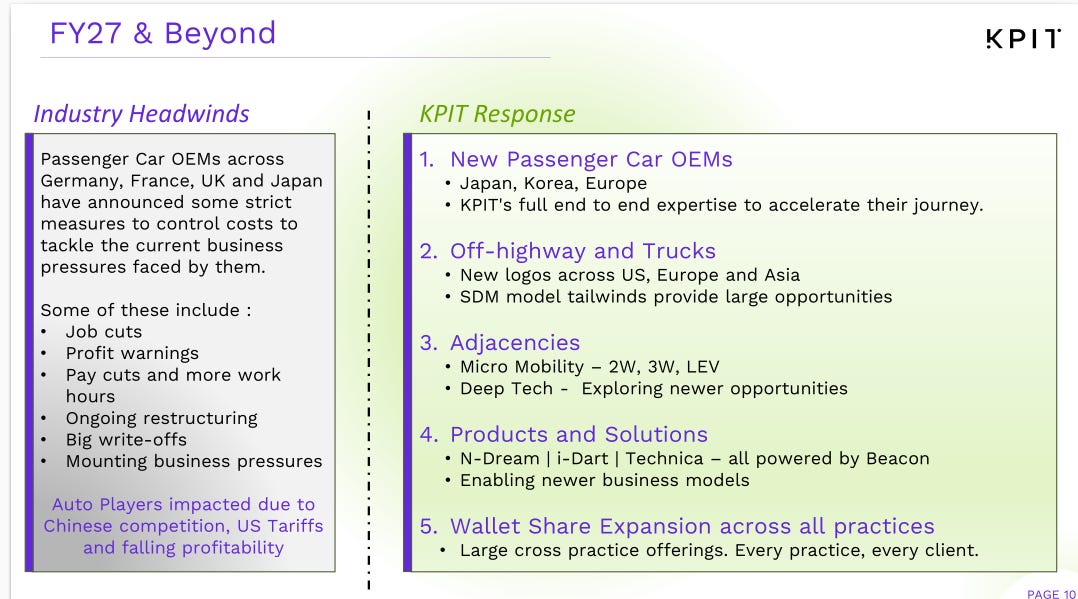
The damage comes from two of its largest clients, one in Japan and one in Europe, which have cancelled programmes or cut spending; revenue from them fell about 13% from a year earlier. Passenger-car revenue fell 4.1% sequentially, and revenue from Europe, which makes up 42% of KPIT’s business, fell 15.2%. European carmakers, management said, are looking to “further cut their costs dramatically” as they lose market share, particularly in China.
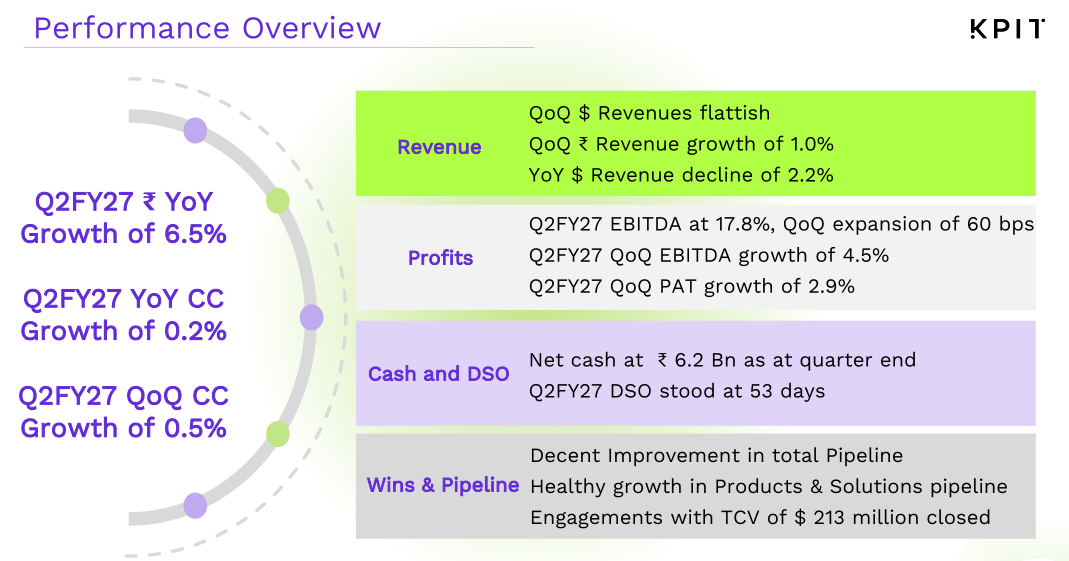
What kept revenue up was everything else. Work for trucks, tractors and off-highway machinery rose 17.6% sequentially and 27% year-on-year. On top of that, revenue from its own software products, making money not just from custom engineering work, but from licensing pre-built platforms and software directly into vehicles, rose 25% year-on-year.
KPIT also has its own answer to the billing question. Fixed-price contracts now make up 70% of revenue. They set a price for an agreed scope of work, so KPIT keeps more of the gains if it works faster. With more product revenue, its EBITDA margin rose sequentially from 17.2% to 17.8%, though still below 21% from a year earlier.
Still, widening out within one industry is slow. Management expects spending from its two troubled clients to take another couple of quarters to bottom out, and carmakers have pushed next-generation programmes toward 2029-30, delaying the opportunity for Qorix, KPIT’s automotive software venture. Even so, management insists the structural pivot to heavy machinery will anchor its next growth phase.

Conclusion
The division between big and small businesses has always fascinated us, and we’ve had an entire Subtext episode on how this is now reflecting in Indian IT.
Larger companies are unable to make use of the same tailwinds as midcap firms because their organisations are bloated with mismatches among a myriad of incentives. But as the smaller firms grow faster at breakneck pace, they run into their own limits.
KPIT has had to lean on trucks, the American market, and fixed-price contracts to steady itself. Persistent and Coforge chose to buy scale. Both concluded that beyond just building an AI tool, decade-long relationships with major clients and the knowledge that comes with them helps you win. So they spent billions acquiring those relationships.
But as we saw, scale has costs, and the payoff is still being proved.
The test now is whether they can carry the size and complexity of a large IT company without losing the edge that got them here. More so, as AI looks to change everything we might know about how software and IT services firms should organise themselves.
- This edition of the newsletter was written by Kulsum & Zarieus
Tidbits
1. Draft aviation fuel policy proposes 5% SAF blending by 2030
The civil aviation ministry has prepared a draft policy for cleaner aviation fuel. It proposes that sustainable aviation fuel make up 5% of fuel used on international flights leaving India by 2030. The target would start at 1% in 2027 and rise over time. Only SAF made in India would count under the proposed framework.
Source: Business Standard
2. SIDBI raises ₹5,607 crore through five-year bonds at 8.17%
SIDBI raised ₹5,607 crore by selling five-year bonds at an interest rate of 8.17%. It had planned to raise up to ₹6,000 crore. Investors placed bids worth more than ₹13,300 crore, showing strong demand for the bonds.
Source: Business Standard
3. Qualcomm sees growth outside smartphones as handset sales weaken
Qualcomm expects first-quarter revenue of $10.4 billion to $11.2 billion, above Wall Street estimates at the midpoint. Growth in areas such as cars, connected devices and data centres is helping offset weaker smartphone demand, after handset chip revenue fell 26% in the latest quarter.
Source: Reuters
4. SEBI makes digital KYC easier for NRIs and overseas investors
SEBI has made KYC rules easier for NRIs, Overseas Citizens of India and some foreign investors. Eligible investors in FATF-compliant countries can now complete more of the process online from abroad. The new rules also make it easier to reuse KYC records across financial firms.
Source: The Indian Express
5. NPCI forms new unit to focus on AI and blockchain
The National Payments Corporation of India has created a new unit to work on technologies such as artificial intelligence and blockchain. The unit will explore how these tools can be used across India’s digital payments network as NPCI looks beyond its core payment systems.
Source: Reuters
Want more tidbits? Catch up on last week’s recap!

Beyond Today’s Brief
There’s always more happening at Markets by Zerodha.
The Chatter: How is Bajaj Finserv navigating distribution fee reforms while deploying ₹4,700 crore in surplus cash into new ventures? Why is Bharat Electronics 99% confident of bagging the massive QRSAM order alongside ₹20,000 crore from Next-Gen Corvettes, and how are Zydus and Marico reshaping their growth models around US speciality launches and rural distribution?
Aftermarket Report: How did Nifty record its best session in six months, surging 2.4% past 24,500 to close at 24,537 as a 9% plunge in crude oil prices and global tailwinds fueled a breakout? And what do 13 gaining sectors led by Auto’s 4.1% rally, FIIs turning their least bearish in a year with ₹7,884 crore in index futures buying, and the Fear & Greed Index crossing firmly into greed at 62 signal as the index reclaims its 200-day moving average?
Join us on WhatsApp, where we share interesting soundbites from concalls, articles, and everything else we come across throughout the day. You’ll also get notified the moment a new video or article drops so that you can read or watch it right away.
Thank you for reading. Do share this with your friends and make them as smart as you are 😉
Thanks for the update of midcap ITs, which are fascinating businesses to follow, particularly their ability to change course effectively in response to ever changing business environment 👍