

Our goal with The Daily Brief is to simplify the biggest stories in the Indian markets and help you understand what they mean. We won’t just tell you what happened; we’ll tell you why and how too. We do this show in both formats: video and audio. This piece curates the stories that we talk about.
You can listen to the podcast on Spotify, Apple Podcasts, or wherever you get your podcasts and watch the videos on YouTube. You can also watch The Daily Brief in Hindi.
Arpit Tandon on the road ahead for Indian IT
In the latest episode of Subtext, we host Arpit Tandon (Director of AI Strategy, CGI) to break down what AI is actually doing to Indian IT. We cover the shift from headcount billing to outcome-based pricing, why “enterprise context” is becoming the ultimate competitive moat, and how AI is reshaping the roles of middle managers and junior talent.
You can watch or listen to the full episode on YouTube, Spotify, or Apple Podcasts.
In today’s edition of The Daily Brief:
1. What is happening with the 86-year-old drug law?
Why is India struggling to overhaul its 1940 Drugs and Cosmetics Act? Following tragic child deaths linked to contaminated cough syrups in Gambia, Uzbekistan, and Madhya Pradesh, the government is making another push to replace the 86-year-old framework. The current system splits power—central regulators approve drugs while 36 state authorities license factories—creating severe blind spots, unauthorized fixed-dose combinations, and massive inspector shortages. The proposed 2026 bill aims to centralize manufacturing licensing, decriminalize minor procedural lapses, and introduce clear rules for e-pharmacies and medical devices. However, reform faces stiff pushback from states unwilling to yield local regulatory power and medical device manufacturers demanding a separate law tailored to engineering rather than pharmaceuticals.
2. Why did tractors not get the monsoon memo?
Why did India's tractor sales hit a record high in Q1 despite an early monsoon deficit of up to 43% and rising El Niño threats? Wholesale volumes jumped 18.6% to 3.39 lakh units as non-climatic tailwinds outweighed early rain deficits. A GST rate cut on tractors from 12% to 5% lowered upfront costs by up to ₹63,000, encouraging farmers to purchase larger 40–50 HP models to offset acute farm labor shortages. Meanwhile, record government wheat procurement of 35.76 million tonnes injected massive cash flows into rural markets, while easy credit—covering up to 90% of purchase costs—fueled buying. However, with profit margins compressing under cost inflation and sales concentrated in well-irrigated regions, a prolonged crop failure could turn this credit-backed surge into rural debt stress next year.
Who let the drugs out?
Medicines are unusual products because the buyer cannot really judge the quality themselves. For every other thing like a shirt or a car you can check the quality before you buy it. But once you buy a tablet, there is no way a layperson can look at it and tell whether it is harmful or not. The stakes are even higher because buying a bad shirt is just inconvenient but a wrong tablet puts your life at risk.
That is why medicines need a much stronger system of regulation than ordinary consumer products.
India has had such a system for over eighty years, built around the Drugs and Cosmetics Act, 1940. And right now, the government is considering replacing it with a new Drugs, Medical Devices and Cosmetics law.
This is hardly the first attempt. Similar drafts have been discussed multiple times over the years. One version even reached Parliament as an amendment bill in 2013, before the Cabinet withdrew it in 2016. Later attempts stalled during stakeholder consultations.
Yet the idea keeps coming back. Usually, it takes a drug safety disaster to put it back on the table.
Remember the Madhya Pradesh incident in 2025, when Indian-made cough syrup was linked to the deaths of dozens of children? Similar tragedies had already played out in Gambia and Uzbekistan in 2022 and 2023.
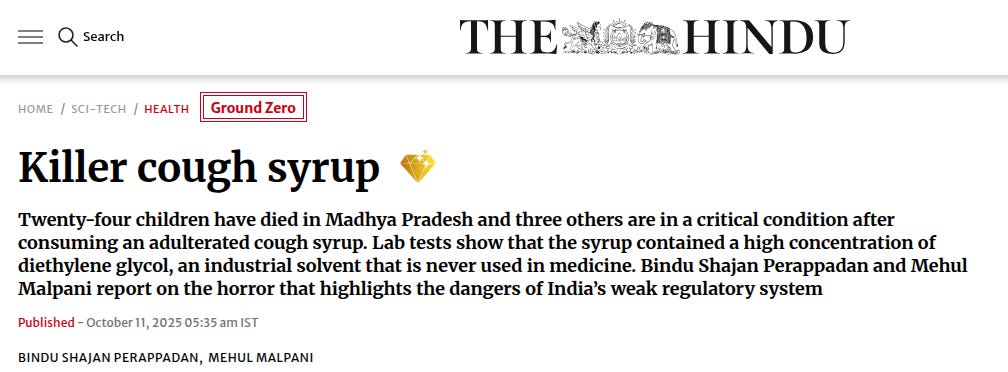
These tragedies damaged India’s reputation as the “pharmacy of the world” — a massive exporter of affordable medicines that other countries rely on.So the bill resurfacing in 2026 is not really the story. The more interesting question is why India keeps needing it.
To answer that, we need to look at how India’s drug regulation system actually works.
How does the whole system work?
The easiest way to understand India’s drug regulation system is to follow what happens when a company wants to sell a new medicine.
The first question is about the medicine itself: can this drug be sold in India?
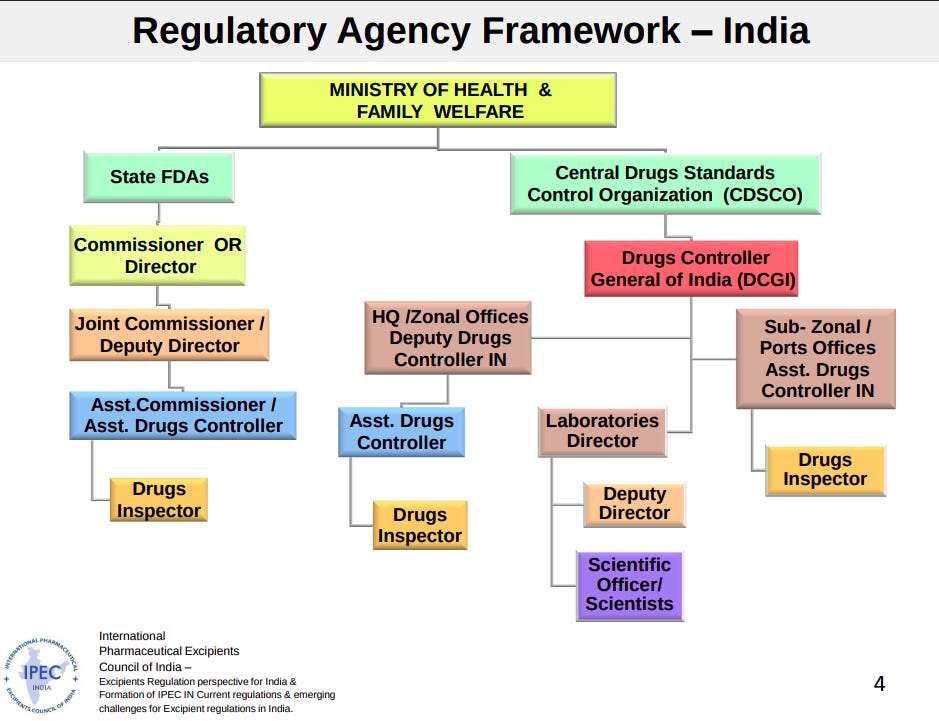
If it is a new drug, the company needs central approval. Today, that comes through the Central Drugs Standard Control Organisation, or CDSCO, headed by the Drugs Controller General of India (DCGI). The regulator reviews clinical-trial and safety data to check whether the drug is safe and effective.
But this modern approval process sits on top of a much older law. India’s basic drug law is still the Drugs and Cosmetics Act, 1940, created to control imports, manufacturing and sales at a time when India had no national drug standards.
The Act was fairly bare-bones, so detailed rules were added as medicine became more complicated. And some things changed completely. In 1940, nobody could have imagined buying pills on a mobile app. Today, online pharmacies are a massive business, but still operate in a regulatory grey area without a clear modern law governing them. New drug approvals, meanwhile, are now governed much more specifically by rules like the New Drugs and Clinical Trials Rules, 2019.
Once a company gets central approval, the drug itself is cleared. But someone still has to manufacture it. That leads to the second question: can this particular factory make the medicine properly?
This is where the Drugs Rules, 1945 come in. Manufacturing licences are largely handled by state regulators, which inspect factories, issue licences and monitor production standards.
So the system splits responsibility between two levels. The Centre asks: should this new drug be allowed? The state asks: can this manufacturer make it properly? One decides whether the medicine itself passes muster. The other makes sure the factory producing it does too.
One category of medicines showed just how badly this chain could break down: fixed-dose combinations, or FDCs. An FDC combines two or more drugs into a single pill.
Legally, a new combination counts as a new drug. After all, nobody has tested what happens when you take those ingredients together in that exact mix. So it still needs central CDSCO approval.
And this is where the cracks appeared.
Over the years, some state regulators independently licensed thousands of FDCs without central approval, treating them as ordinary, already-approved drugs.
This eventually led to the massive FDC crackdown of 2016, when the Centre banned hundreds of combinations. The ban then got tied up in court battles for years. One of the best-known products affected was Vicks Action 500 Extra.

The problem was not necessarily that the individual ingredients were dangerous. Combining multiple drugs can expose patients to medicines they do not need, increase side effects, and make it harder to adjust the dose of each ingredient separately.
But the bigger problem was regulatory. These drugs were supposed to need central approval, yet state licences were enough for thousands of them to reach the market anyway.
The FDC mess was the symptom. The real problem was the system that allowed it to happen.
What is broken in the old system?
India’s drug regulators often do not know what the others are doing.
With 36 independent state and union territory regulators, enforcement can vary sharply across the country. That gives manufacturers an incentive to strategically choose the easiest regulator, shifting production towards states with softer enforcement.
But different standards are only part of the problem. Sometimes, basic information does not travel either.
Take the cough-syrup deaths in Madhya Pradesh in 2025. At least twenty-two children died after taking a contaminated cough syrup called Coldrif.
The factory that made it was thousands of kilometres away in Tamil Nadu. It had been licensed back in 2011 and had kept running for more than a decade. Yet CDSCO did not even have the factory in its database because the state had not reported it upwards and the company hadn’t filed the required information.
When the tragedy struck, Madhya Pradesh could pull Coldriff off its own chemist shelves. But it could not shut the factory that made it. That power sat in Tamil Nadu.
That is the fragmentation problem in one incident: the regulator dealing with the deaths was not the regulator controlling the source.
And even when regulators know where the problem is, there is another constraint. There simply aren’t enough people to police an industry this large.
The Mashelkar Committee in 2003 recommended one drug inspector for every 50 manufacturing units and one for every 200 retail outlets. Against India’s roughly 10,500 factories and 600,000 chemists, that works out to about 3,200 inspectors. In 2015, the country had just 1,467.
The shortage exists at CDSCO too. As of December 2023, it had 504 sanctioned inspector posts but only 201 people actually in them. And the regulators responsible for routine factory inspections have struggled with staffing shortages of their own.
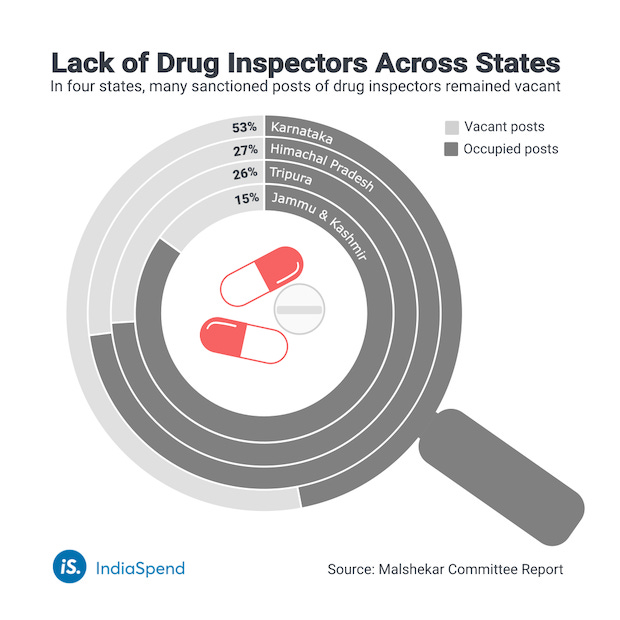
So the old system has two fairly basic weaknesses. Information does not move cleanly across regulators. And there are too few people to enforce the rules that already exist.
What is the new policy trying to change?
Earlier versions of the replacement law went much further than asking regulators to coordinate better.
A revised draft discussed in 2023 proposed shifting the power to issue manufacturing licences for drugs from state regulators to the central licensing authority.
That would be a fundamental change. Today, new drugs are approved centrally, while factories are licensed by states. The proposal would bring the manufacturing licence under central control too.
The logic is straightforward. If different licensing standards across states are part of the problem, one licensing authority should make standards more uniform. NITI Aayog backed the idea on similar grounds.
But that is not coordination. It is centralisation. Instead of getting dozens of regulators to work better together, you take one of their biggest powers away.
And this matters now because the 2026 proposal does not appear to have started from scratch. Industry associations that have seen the latest draft say it is substantially similar to the Bill circulated in 2022 and 2023, with only a few changes.
The full 2026 draft is not public yet, so we do not know which of these provisions survived. But the direction of the earlier reform was clear: if fragmentation is the problem, centralisation might be the answer.
Alongside the bigger question of who gets to regulate drugs, the government has also been changing how violations are punished.
This is part of a much wider push under the Jan Vishwas reforms to remove criminal penalties for smaller regulatory offences across Indian laws. The idea is that not every violation deserves a criminal case. A paperwork lapse is not the same thing as making a contaminated drug that can kill someone.
Drug regulation is getting the same treatment. Certain minor offences under the existing law are being decriminalised, replacing prosecution with financial penalties. But the harshest punishments for dangerous drugs, including life imprisonment in some cases, remain.
The obvious concern is whether large companies simply start treating these fines as another cost of doing business. So the line between a minor lapse and a serious violation matters quite a bit.
But the replacement law is not only trying to fix the problems we have discussed so far. It also has to deal with parts of the drug industry that the 1940 law was never really built for.
Online pharmacies are one example. The Bill would explicitly prohibit selling drugs online except in the prescribed manner. It would also bring clinical trials directly into the law, including compensation for trial-related injury or death, and create dedicated testing centres for medical devices.
These may look like unrelated additions, but they point to the same problem. India is trying to regulate a modern drug and medical-device industry through a law written more than eighty years ago.
The industry pushes back
The draft runs into resistance from two directions. The first fight is with the states.
Drugs sit under Entry 19 of the Concurrent List — “drugs and poisons” — which means both the Centre and states can legislate, with central law prevailing in case of a conflict.
So the states are not arguing that the Centre lacks the power. They are arguing that it lacks the reach. A licence application handled locally can move faster than one cleared in Delhi. And they argue that a central authority overseeing roughly 10,500 factories could be less responsive to problems on the ground, not more. States have resisted handing licensing powers upwards for years on these grounds.
The second fight is about something different: whether drugs and medical devices should be regulated through the same framework in the first place.
In August 2026, 11 medical-device associations demanded a separate law, arguing that the proposed framework remains too pharma-centric.
Their basic point is simple: a pacemaker is not a pill.
A drug is consumed and metabolised. A medical device is engineered. It can fail because of a design defect, faulty software, a dead battery or a broken component. The risks are different, so the industry argues the rules should be different too.
The draft does recognise this to some extent, with a dedicated advisory board for medical devices and risk-based classification. But manufacturers argue that it still carries too much of the old drug-law approach into devices.
Criminal penalties are a good example. The government is already trying to reduce criminal liability for minor drug-law violations. Device makers argue it makes little sense to then expose them to drug-style criminal penalties for what could be technical or documentation failures.
Cosmetics, despite being in the name of the proposed law, have attracted far less attention. And independent analysts describe cosmetics as one of India’s weakest areas of regulatory enforcement.
And that gets to the second big tension in the Bill. Centralising regulation might make standards more consistent. But consistency is not the same thing as treating everything the same. Drugs, devices and cosmetics create very different risks — and the fight is over whether one law can be flexible enough to recognise that.
Conclusion
There is no easy fix here.
India needs more centralisation because standards vary too much across states. But drug regulation is also a local job. Someone still has to inspect the factory, collect samples and catch problems early.
Then there is the question of what we are regulating. Drugs, medical devices and cosmetics are very different products. They probably need different rules. But separating everything can once again create the same silos the new law is trying to fix.
And whatever the law says, India still needs more inspectors, better labs and better coordination to make it work.
So writing a better law is probably the easy part. Getting the Centre, states and three very different industries to agree on who gives up what power — while also building the machinery to enforce it — requires serious political will.
Perhaps that explains why versions of this reform have spent more than a decade appearing, disappearing and coming back again. Whether 2026 finally breaks that cycle is anyone’s guess.
Why did tractors not get the monsoon memo?
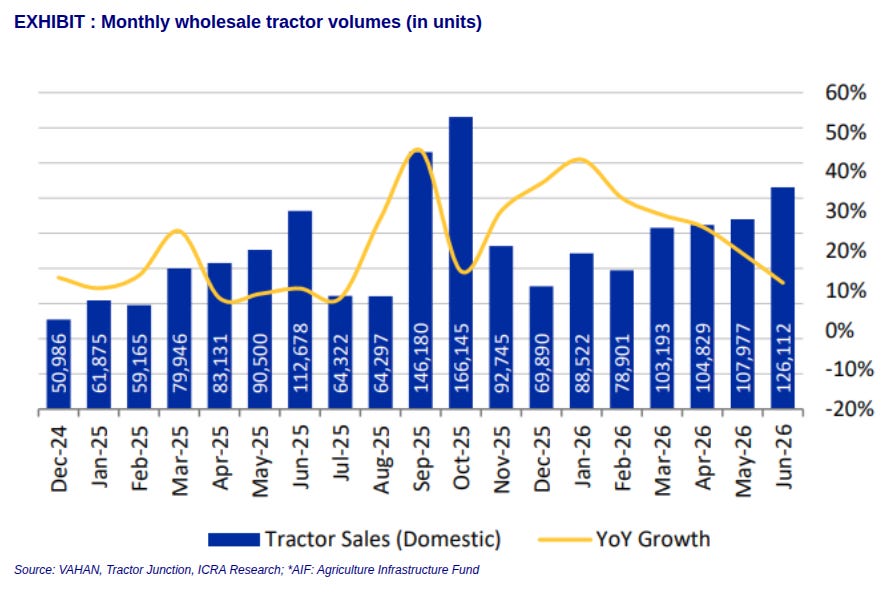
India’s tractor makers had their best Q1 on record this year. Wholesale volumes of tractors to dealers rose 18.6% to roughly 3.39 lakh units. Meanwhile, retail registrations of tractors were up 24.8% to 3.87 lakh units between April and July.
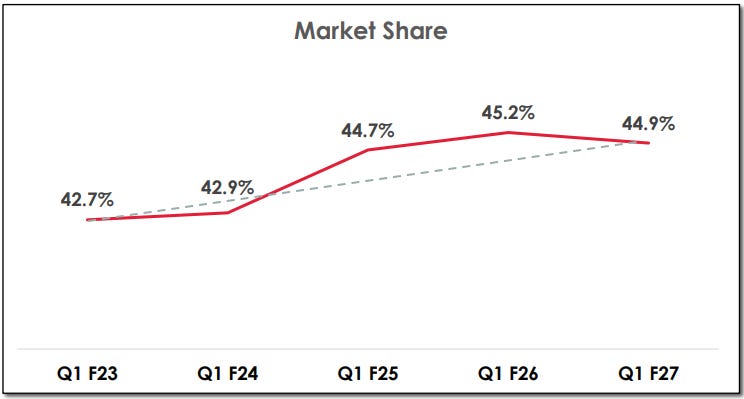
Mahindra, the market leader, said its own farm equipment volumes rose 18% in the quarter, with its market share standing at 44.9%, and normal dealer inventory levels make stocking an unlikely explanation for the surge.
This might sound like business-as-usual. But remember, we’re in a rapidly strengthening El Niño that is forecast to become very strong.
This out-growth happened even as the monsoon ran as much as 43% below normal by late June, before recovering to an 11% national deficit by early August, with eastern and southern India still short even then.
We are already seeing impacts of the Super El Nino, from some of the highest food stockpiles being maintained by the government, to how dairy earnings were already feeling the pinch of heat stress and shaky rainfall. Tractors were expectedly going to be the first casualty of rural India’s rain stress. But the exact opposite was true.
The GST cut
That being said, there were reasons, primarily unrelated to the climate, as to why tractor sales did so well. The first reason is GST.
Back in September, the GST on tractors below 1,800 cc fell from 12% to 5% in an attempt to encourage more farm investment, particularly in mechanisation. The price of a 35 HP tractor fell by about ₹41,000, a 45 HP tractor by about ₹45,000, a 50 HP tractor by about ₹53,000 and a 75 HP tractor by ₹63,000. On an asset bought through EMI, that is a real dent in upfront cost before any manufacturer price change.
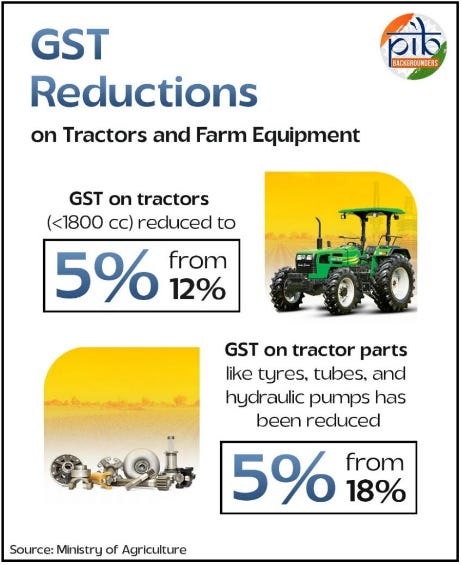
FADA, the dealers’ federation that tracks retail registrations, has called the September rate cut a turning point for the entire auto industry, not tractors alone, saying the resulting strength carried through the festive season and into the January to March quarter. Tractors happened to get an unusually large cut rather than the smaller steps most other vehicle categories received.
Now, let’s look at the farm mechanisation side of things, which, of course, is what the GST cut is partly in service of.
As per Mahindra CEO Rajesh Jejurikar, farm workers are increasingly leaving fields for industrial jobs that pay better, and farmers who can’t find hands are buying machines instead of hiring them. It would make sense to incentivize this shift only further.

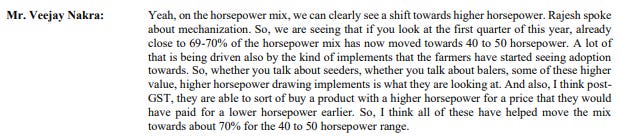
Interestingly, this also shows up in the numbers. For Mahindra, nearly 70% of its tractor sales this quarter were in the 40-50 HP range. This is the bigger end of tractors, and their share has increased over time. As per Mahindra, bigger tractors sold more partly because the GST cut let some buyers afford a size up for the price they used to pay for a smaller one.
The government also runs an ongoing machinery subsidy system called the Sub Mission on Agricultural Mechanisation, which funds Custom Hiring Centres where farmers can rent tractors and implements instead of owning them. That widens the buyer pool beyond individual farmers to entrepreneurs and cooperatives who earn income hiring machinery out.
TAFE, India’s second largest tractor maker by volume, ran factories at full capacity through FY26 and described the year as one where small farmers and first time buyers entered mechanisation alongside steady replacement demand from existing owners. That combination, new buyers and replacement owners together, is harder to derail with a single bad season than demand driven purely by this year’s crop.
Where the money came from
Tax cuts alone do not explain where the money to make tractor investments came from, though. The bigger reason goes back to earlier in the year, before this year’s rains even mattered. Every season, the government buys wheat directly from farmers at a fixed price, so farmers get paid in cash once the crop comes in.
This year that payout was unusually large, 35.76 million tonnes of wheat bought, about 19.4% more than the year before and a five year high, mostly from farmers in Punjab, Madhya Pradesh and Haryana. This provides more liquidity to rural areas, but it may not be a coincidence that this payout coincides with the fact that our foodgrain buffer is unusually large this year in preparation of the El Nino.
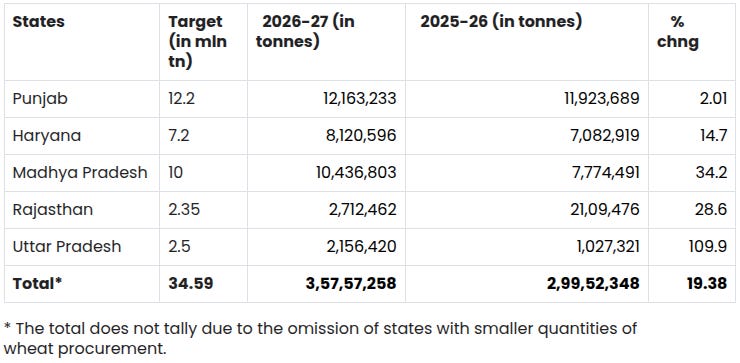
Mahindra said that healthy rabi cash flows from the previous year, and stronger government procurement, were the main reasons why rural demand held up even as this year’s rains disappointed.

Meanwhile, getting a loan was also easier than usual. The RBI cut rates several times through 2025, then held it steady this year. Even so, banks kept lending more to farmers all through the quarter, close to 17% more than last year, and NBFCs, finance companies that lend without being licensed as banks, lent even more.
That meant a farmer without much spare cash could still afford a tractor on credit. Healthy rabi receipts improved farmers’ capacity to make down payments and service loans, while banks, NBFCs and the tractor makers’ own finance arms supplied the rest.
Most tractor loans in India cover up to 90% of the purchase price, and lenders typically let farmers repay monthly, quarterly or twice a year rather than in more regular instalments. This is meant to be timed to when crop money actually arrives. That structure predates this quarter, but it matters more when a farmer has just been paid for a crop and wants to turn that cash into a bigger asset without draining it all upfront.
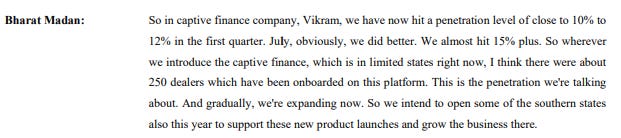
The management of Escorts Kubota, one of the largest publicly-listed tractor players, said its finance subsidiary reached 10-12% penetration in the quarter, rising past 15% by July, with a target of covering 40-50% of its dealer network by the end of FY27. Mahindra’s financial services arm plays a similar role, and the group describes itself as holding a leadership position in financing Mahindra tractors.
The parent company of tractor-maker New Holland, CNH Industrial, runs a similar captive lending business in India, though it does not break out India specific numbers publicly. In-house financing can let a manufacturer approve loans faster and potentially reach buyers a bank might turn down.
Why some states bought more than others
The tractor boom was not spread evenly, though.
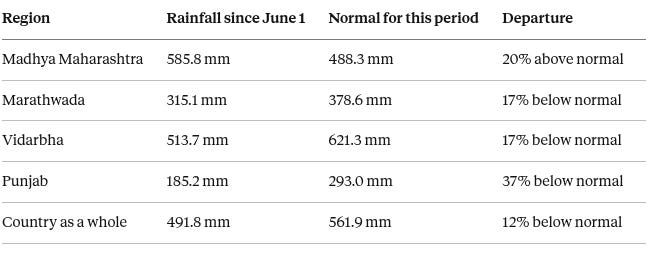
IMD’s cumulative subdivision rainfall data showed that, central Maharashtra was running about 20% above normal, even as Marathwada and Vidarbha both ran about 17% short, and Punjab was down as much as 37%.
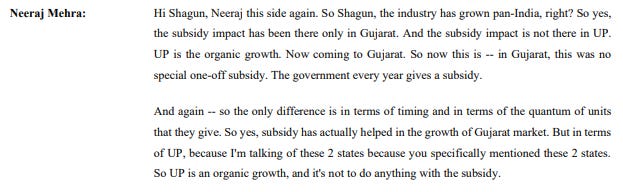
For Escorts Kubota, their strong growth in Gujarat was helped by a state government subsidy that runs every year, while growth in UP was organic with no subsidy involved. The south was the fastest growing region overall, up around 33%. Naturally, places with better irrigation, healthier reservoirs or an active subsidy kept buying even where the monsoon disappointed.
Not every tractor maker rode the same wave, either.
For instance, VST Tillers Tractors, which is weighted towards compact tractors and power tillers, actually sold fewer tractors in July than a year earlier, a decline of about 9%. VST had previously warned that rain fed, single crop regions were more exposed than irrigated ones, a reminder that the quarter’s strength was concentrated in mainstream and better watered markets rather than spread across the whole industry equally.
What this quarter actually measures
None of this means the sector is problem free. The EBIT margins of Mahindra’s Farm Equipment segment fell from 15.0% to 14.2% year on year. Meanwhile, Escorts Kubota’s tractor segment margins fell from 12.6% to 10.8% as commodity cost inflation ate into the benefit of record sales. Escorts Kubota has stopped extrapolating the more than 20% growth rate of Q1, guiding instead to mid-single digit industry growth for FY27 as a whole.
Part of the cushion behind this quarter is structural rather than seasonal. General company commentary points to a meaningful base of replacement demand each year. Many tractors are swapped out at the end of their working life, which is a decision that has little to do with the current monsoon. First time monsoon-sensitive buying is only one part of a much larger, steadier market.
That being said, what happens if this year’s kharif and rabi seasons do not bloom? That could potentially mean sunk costs and liquidity on tractors. That’s a particularly big problem if those tractors have been bought on credit, and a bad crop year could create conditions of rural stress next year.
So in this quarter, prior farm cash flows, a lower tax bill, easier credit and replacement demand look like they outweighed a weak start to the monsoon for now. But we still need water. The bad monsoon’s effect on tractor demand may still show up later, through next year’s crop income and the purchases that depend on it.
- This edition of the newsletter was written by Mridula & Vignesh
Tidbits:
1. Bank of America to Invest $1.9 Billion in Jio Financial Unit
Bank of America is set to acquire a 49.9% stake in Jio Financial Services’ non-banking financial company (NBFC) arm for $1.9 billion. The strategic investment aims to bolster Jio Financial’s capital base as it aggressively expands its lending and consumer credit operations.
Source: Reuters
2. Muthoot Fincorp Files for ₹3,000 Crore IPO
Non-banking financial company Muthoot Fincorp has submitted draft papers to market regulator SEBI to raise ₹30 billion (₹3,000 crore) through an initial public offering. The proceeds will be used to augment its capital base and fund future lending growth in the gold and MSME financing sectors.
Source: ET Now
3. Govt Shifts ₹31,000 Crore Rail Projects to Low-Risk Model
The Ministry of Railways has transitioned infrastructure projects worth ₹31,000 crore to a lower-risk investment framework to attract private sector capital. The move aims to derisk private investments and significantly speed up core rail expansion projects across India.
Source: Business Standard
4. SBI Uses AI to Underwrite ₹1 Lakh Crore in MSME Loans
State Bank of India underwrote nearly ₹1 lakh crore in loans to micro, small, and medium enterprises (MSMEs) using AI-driven risk models in FY26. The shift to automated underwriting has drastically reduced loan approval times while enhancing credit risk precision.
Source: The Economic Times
5. Yulu Raises $93 Million to Expand E-Bike Network
Indian micro-mobility startup Yulu has secured $93 million in new funding to accelerate fleet expansion and scale up its battery-swapping infrastructure. The fresh capital will support the company’s rapid growth in the shared mobility and last-mile delivery segments.
Source: Reuters
6. IEA Foresees Wider Global Oil Supply Deficit
The International Energy Agency reports that global crude markets face a widening supply shortfall despite ongoing conflict weighing on overall demand. Supply cuts and output disruptions continue to outweigh the weakening global consumption growth.
Source: Bloomberg
7. SEBI Plans Major Overhaul for SME Listing Framework
Market regulator SEBI is considering a sweeping revamp of regulations governing Small and Medium Enterprise (SME) listings to enhance transparency and curb price manipulation. The proposed changes aim to tighten eligibility criteria and protect retail investors while boosting participation.
Source: The Hindu BusinessLine
We are hosting a Varsity Live ‘Ask Me Anything’ session with Nithin and Karthik, where you can ask us anything about Zerodha’s journey, trading, investor education, or where the Indian capital markets are headed.
Date: Friday, 14th August 2026 | Time: 6:00 PM – 8:00 PM
Beyond Today’s Brief
There’s always more happening at Markets by Zerodha.
The Chatter: How is Bosch expanding margins while balancing combustion tech with EV joint ventures? What is driving Amara Raja’s ₹1,700 crore push into new energy? And can Zydus, Manappuram, and EPACK Durable sustain growth through market outperformance and product diversification?
Aftermarket Report: Why did Nifty stay range-bound near the 24,400 mark despite a sharp mid-day bounce? How is Jio Financial Services partnering with Bank of America in a $1.9 billion credit joint venture? And why did Solar Industries record a 92% profit surge while Tata Motors saw an 80% hit?
Watch Tharun on YouTube: If you’re interested in what’s actually happening with AI and how you can use it to make better money decisions, check out Tharun’s new YouTube channel.
Join us on WhatsApp, where we share interesting soundbites from concalls, articles, and everything else we come across throughout the day. You’ll also get notified the moment a new video or article drops so that you can read or watch it right away.
Thank you for reading. Do share this with your friends and make them as smart as you are 😉
Small correction in Tidbits. It's 49.9% acquisition and not 4.99% acquisition.
Small correction in Tidbits. It's 49.99 percent stake and not 4.99% of acquisition in jio finance.