


Our goal with The Daily Brief is to simplify the biggest stories in the Indian markets and help you understand what they mean. We won’t just tell you what happened; we’ll tell you why and how too. We do this show in both formats: video and audio. This piece curates the stories that we talk about.
You can listen to the podcast on Spotify, Apple Podcasts, or wherever you get your podcasts and watch the videos on YouTube. You can also watch The Daily Brief in Hindi.
In today’s edition of The Daily Brief:
1. The logic behind ISRO and DRDO’s tech transfers
Why are ISRO and DRDO handing perfected technologies to private firms? Public labs excel at R&D, not factory mass production. To scale up India’s space and defense manufacturing, mature systems like rockets and missiles are being transferred to private partners. This frees scientists for next-gen breakthroughs while building a commercially viable domestic industry.
2. India’s surveillance takes a turn
Why have Chinese CCTV cameras vanished from India’s market? Strict cybersecurity rules now ban camera brains (SoCs) and firmware sourced from land-bordering nations over national security and spying risks. The mandate has cleared out foreign supply chains, creating huge opportunities for domestic chip designers and camera makers.
The logic behind ISRO and DRDO’s tech transfers
Imagine spending a decade solving a problem nobody else in the country has managed to solve, like a brand new missile or rocket. Once it’s proven, the plan is to commercialise it, for which you might need to partner with the private sector.
That is more or less what’s happening inside DRDO right now. The defence ministry has cleared the transfer of technology for all conventional missile systems to Indian companies, so they can manufacture missiles at scale rather than DRDO doing it alone.
ISRO has also been walking the same road for a while now. The Indian Space Policy 2023 explicitly tells ISRO to step back from manufacturing space systems it has already mastered and instead hand them over to industry to build and sell.

Take, for example, the SSLV, ISRO’s compact rocket for small satellites. ISRO designed it, tested it, and got it flying. Then it ran a competition, and Hindustan Aeronautics Limited won the rights to manufacture and sell it commercially.
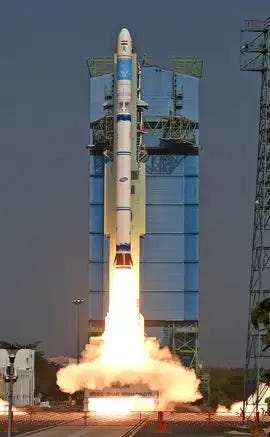
Neither ISRO nor DRDO were particularly designed to make use of a factory floor.
Yet, this doesn’t seem to solve one pressing question. Scientists spend years, even decades, perfecting a technology. But why would they hand it to someone else to manufacture it once its viability is proven? Why would any organisation do that on purpose?
The nature of public R&D
There are multiple reasons, and they all stem from the nature of what a research organisation like DRDO or ISRO is meant to do.
Every new technology starts as an idea. Scientists test individual parts, then prototypes, then full systems, and the conditions get closer to reality with every round. Things break, designs get tweaked, and the cycle repeats until the organisation is confident the technology works and reaches maturity.
Early on, the question is simply “can we make this work at all”. Once something reaches maturity, the question becomes “how do we make thousands of these reliably and cheaply?” India has a legal policy framework to assess this progress, collectively called Technology Readiness Levels (TRLs).
A scientist’s job is to discover the unknown. That means there are endless outcomes, each of which has an unknown probability of being achieved. That is a lot of uncertainty, and one way to reduce it is to use public money to fund R&D efforts that don’t have immediate profit motives attached.
But once that uncertainty disappears, the harder problems become sourcing components, maintaining quality across a production run, and reducing unit cost. That may or may not be within the job description of a pure scientist or research lab. And that is the primary reason behind ISRO’s tech transfers.
You see, to achieve scale and speed in mass-manufacturing together, you may have to partner with other actors, including in the private sector. The government’s own ambition puts India’s space economy at ~$8.4 billion today, on track for $40-45 billion by 2030. That’s a scale ISRO alone was never going to build out on its own payroll. Similarly, a brilliant missile design means very little in an actual conflict if the country can’t produce enough of them fast enough.
But that’s not the only reason for why ISRO or may be asked to transfer technology.
Talent is another. Once ISRO knows how to build a working rocket, the country’s best propulsion scientists may not want to spend their careers supervising a production line when they could be working on the next big breakthrough technology.
A third reason is the need to build an industry that survives beyond government orders. The bigger bet is that Indian companies eventually sell rockets, satellites and imagery commercially, in India and abroad. Defence exports stay far more tightly controlled given the security stakes, but approved Indian systems can still reach foreign militaries under government clearance, and India’s defence exports reached a record ₹38,424 crore in FY2025-26, up nearly 63% year-on-year.
Anyway, inheriting a mature technology doesn’t hand a company a business. It can walk away with world-class know-how and still fail if nobody’s buying their product. Capital-heavy industries like space and defence need steady, predictable demand to justify investments in factories, machinery and a trained workforce. That demand isn’t guaranteed just because the technology works.
The real measure of this experiment, then, was never going to be how many technologies DRDO or ISRO manage to sign away. It’s whether the companies receiving them actually manufacture at scale, win repeat orders, improve the product, and discover new customers.
From 2D to 3D
Now, what happens when DRDO or ISRO transfers a technology?
Depending on the technology, a company can receive step-by-step production instructions, design specifications, material requirements, testing procedures and quality checklists. DRDO bundles all of this into what it calls a Transfer of Technology document. Crucially, its own scientists stay on to guide the manufacturer through the first production runs, rather than handing the file over and walking away.
The space sector runs its own version of this process, split across three separate organisations. One, ISRO develops the technology. Two, IN-SPACe regulates and enables private companies to access it. Lastly, NSIL handles the commercial side, including signing the actual transfer agreements. A company applies through this chain, gets assessed, works out fees and terms, and then ISRO’s own people support the transition of technical knowledge on the ground.
Interestingly, in many of these deals, the company isn’t buying the underlying intellectual property outright. The government typically keeps the underlying IP, retains rights over sensitive uses, and controls where the product can be exported. What a company actually receives is the know-how (and right) to manufacture and sell it, but on terms the government still writes.
The prize
That naturally leads to the next question. If not every company gets these rights, who does, and why? The answers differ slightly for space and defence.
Space
In space, the SSLV rocket is a good example of how the selection process works.
You might think that HAL got the rights to build it simply because it is government-owned, but that wasn’t actually the case. IN-SPACe actually held an open competition where bidders had to show they had the money and technical experience to build the rocket. HAL competed against two other groups and won.
The other bids show how startups can still participate. Alpha Design, an established aerospace company, teamed up with Agnikul, while government-owned Bharat Dynamics partnered with Skyroot. In both cases, a larger company brought the money and manufacturing capacity, while the startup brought its specialised rocket expertise.
A startup doesn’t need to build an entire rocket to have a role here. Some make propulsion systems, some build satellites or sensors, while others use satellite images to help farmers or insurers. Many smaller companies simply specialise in one job.
As we covered in two past stories, this large supplier ecosystem was only enabled with the government opening up space to the private sector. The creation of IN-SPACe and NSIL was specifically intended to govern private sector space activity. India had just one registered space startup in 2014. By August 2026, that number had grown to around 440. However, only a smaller number of them have IN-SPACe approval to build specific space systems.
We recommend going through those stories for a brief history of the private sector’s role in India’s space age.
Defence
Defence is a little different. India already had companies that could make many of the mechanical and electronic parts used in defence systems, so they weren’t always starting from scratch. The sector also had a decades-long head start, with government-owned defence companies and ordnance factories already working with large networks of suppliers.
By December 2025, the government said around 2,000 companies were capable of manufacturing DRDO-developed systems. Some can even get involved before a technology is ready. Under DRDO’s Development-cum-Production Partner programme, a company can help develop a technology and later become one of its manufacturers once it is ready.
So this isn’t really a story of startups competing with companies like Tata. The government is trying to bring both into the same supply chain. Large companies bring money, factories and experience, while smaller ones can focus on solving very specific problems.
What could still derail this
None of these tech transfers are a done deal, though. There are things that could still break agreements.
Former ISRO chairman G. Madhavan Nair has questioned whether companies are ready to take over critical work such as the final assembly, testing and launch of rockets like the PSLV. His concern is that ISRO has spent decades building this expertise, and handing it over isn’t as simple as transferring a design.
There is another problem. The companies that can take on an entire rocket programme are already a small group. In the SSLV transfer, for instance, bidders needed at least seven years in business and annual turnover of ₹400 crore or more just to qualify. Those requirements make sense for something as complicated as a rocket, but they also risk concentrating production among a handful of large companies.
When it comes to defence, a licence to manufacture a missile isn’t the same as an order to build one. In fact, defence projects are very prone to delays. A 2022 CAG audit found that 119 of the 178 projects it reviewed missed their original deadlines, some by more than five times. The reasons included faults unearthed during manufacturing, poor monitoring, and slow approvals.
Delays that long create another problem. A technology can become outdated by the time it finishes testing and reaches the forces. And handing manufacturing to private companies doesn’t fix that on its own. A company could set up a production line for a DRDO missile, only to have it sit idle for years if the military’s order gets delayed.
What’s more, a defence manufacturer can’t easily use exports as a fallback. Exports need government clearance, and the Armed Forces are the only buyer within India. A licensed factory’s fate depends almost entirely on New Delhi’s own procurement calendar staying on schedule, and DRDO has little reason to assume that will be true.
Conclusion
None of this is about either organisation shrinking in their aims, either.
ISRO, for instance, already has a long list of what it wants to work on next. That includes human spaceflight, a space station by 2035, a crewed Moon mission by 2040, reusable rockets and so on. Transferring an existing technology doesn’t mean ISRO stops working on it.
DRDO is trying to do something similar. Its scientists are increasingly focused on newer areas such as hypersonic weapons, directed-energy weapons, quantum technology and artificial intelligence.
Even this new research is no longer happening entirely inside government labs. Startups, universities and established companies are being brought in much earlier, sometimes from the design stage itself, instead of waiting for DRDO or ISRO to finish a technology and hand it over later.
India spent decades building institutions that could invent indigenous technologies. But as with any public research lab, the effectiveness of these institutions is decided by how quickly and efficiently they get monetised. Space and defence are among the most critical industries, and in no way is the job here going to be easy. But this is a start.

India’s surveillance takes a turn
In 2024, the Indian government introduced new security requirements for the CCTV cameras it purchased. Cameras procured by central government departments and other entities covered by the public-procurement order had to meet a set of Essential Requirements for Security.
The government later added these requirements to the certification regime covering all CCTV cameras. This extended the rules beyond government procurement to cameras sold across India. The wider requirement took effect in April 2025.
Companies were given a temporary window to clear old inventory and get new CCTV models certified. That window closed on 1 April 2026.
From then on, CCTV cameras that did not meet the security requirements could not be sold in India. The rule has reshaped India’s ~$2 billion network-camera market. Chinese brands and components once made up a large part of India’s CCTV supply chain. As the new rules took effect, many struggled to qualify, leaving Indian camera makers and chip designers to fill the gap.
What exactly is the government testing?
To understand what changed, we need to look at the government’s Essential Requirements for Security.
The basic idea is simple: CCTV cameras can no longer be treated like ordinary electronic goods. Their hardware, software and supply chains must be tested before they can be certified for sale.
The Bureau of Indian Standards already administers the registration system for CCTV cameras. Under the new framework, the Standardisation Testing and Quality Certification Directorate, or STQC, is responsible for the security testing also now.
Before these rules, CCTV cameras already needed BIS safety certification, but they did not have to undergo a mandatory cybersecurity assessment. Now, every model or eligible product series must clear a set of prescribed security checks.
The STQC guidance focuses on a few critical parts of a CCTV camera. These include the system-on-chip, or SoC, firmware, circuit-board assembly, network card and physical ports such as USB.
However, these components are not all tested in the same way. Labs check the origin of the SoC and firmware, inspect the circuit-board assembly, and test the network card and physical ports for security vulnerabilities.
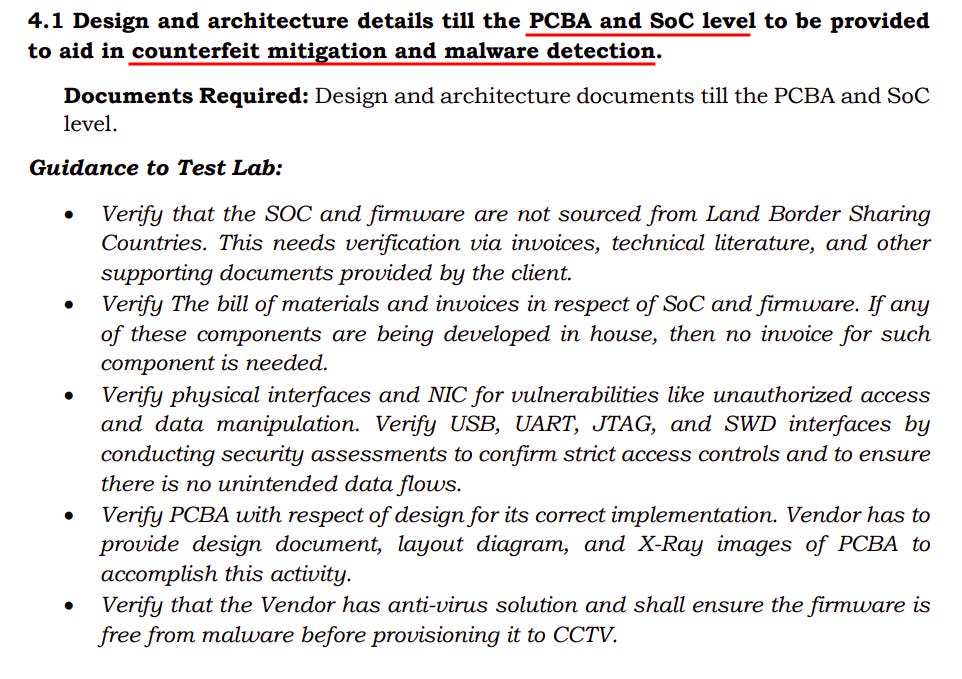
Most importantly, the SoC and firmware cannot be sourced from a country that shares a land border with India.

This means the logo on the camera tells us little about whether it will qualify. A camera made in India can still fail if its technology or supply chain does not comply. The same applies to an American or European model.
The published rule also does not automatically disqualify a model simply because its brand is Chinese. On paper, the restriction concerns the source of its SoC and firmware.
But why focus on these two components?
A modern CCTV camera is essentially a small computer. The lens captures light, the image sensor converts it into an electronic image, and the network connects the camera to other systems. At the centre of it all is the SoC—the camera’s brain.
The SoC processes and compresses footage, runs features such as motion or face detection, manages storage, and helps handle encryption and network communication. It accounts for roughly 25–35% of a camera’s bill of materials. But its strategic importance is far greater than its share of the cost suggests.
If the SoC or firmware is compromised, with or without malicious intent, the entire camera could behave differently from what its owner expects.
That is why it matters where the SoC came from—and who designed, manufactured and supplied it. Under the new rules, manufacturers must provide invoices, technical documents and other records that allow the component to be traced through the supply chain.
But establishing a chip’s origin is not straightforward.
A chip may be designed by a Chinese company, fabricated by TSMC in Taiwan, packaged in Malaysia and finally imported by an Indian camera maker. So what determines its origin: the designer, the foundry, the seller—or all three?
The rules do not offer a neat answer for every mixed supply chain. Instead, they leave STQC to examine the evidence and determine whether a component complies with the requirements.
That is probably why Chinese CCTV models have largely disappeared from the Indian market. STQC is interpreting the rules and checking whether a camera’s SoC or firmware can be traced back to China.
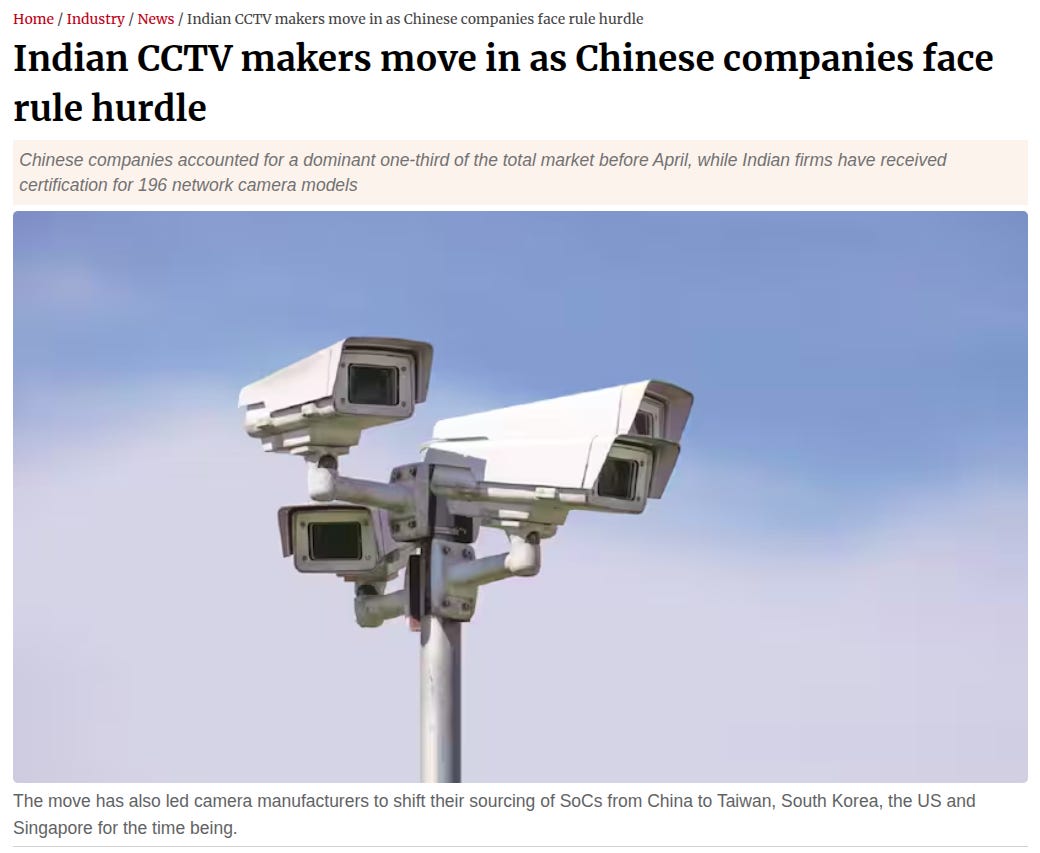
Which brings us to the larger question: why does the government care so much about who controls the chip and code inside a camera in the first place?
Why does the government care so much?
A network camera does more than record video. It can connect to the internet, receive software updates and communicate with other systems. If compromised, an attacker could access its footage, redirect data or use it as a way into a larger network.
The stakes depend on where the camera is installed. Footage from a home is sensitive. Footage from a military base, RBI office or nuclear facility can become a national-security risk. In such places, the government cannot afford to be unsure about who controls the camera or where its data travels.
But does this mean Chinese cameras are spying on India? There are two separate concerns.
The first is product security. In 2021, the Australian Cyber Security Centre warned about a flaw in certain Hikvision cameras that could let an attacker take control of the device and target other systems on the same network. This proves that the cameras had a serious vulnerability. It does not prove that Beijing planted or exploited it.
The second concern is strategic. China’s National Intelligence Law requires organisations to support and cooperate with state intelligence work. A foreign-designed SoC raises questions about what is embedded in the device and how thoroughly it can be inspected. Control over the firmware, remote updates or cloud services creates a more direct concern because the supplier may retain an ongoing route into the system.
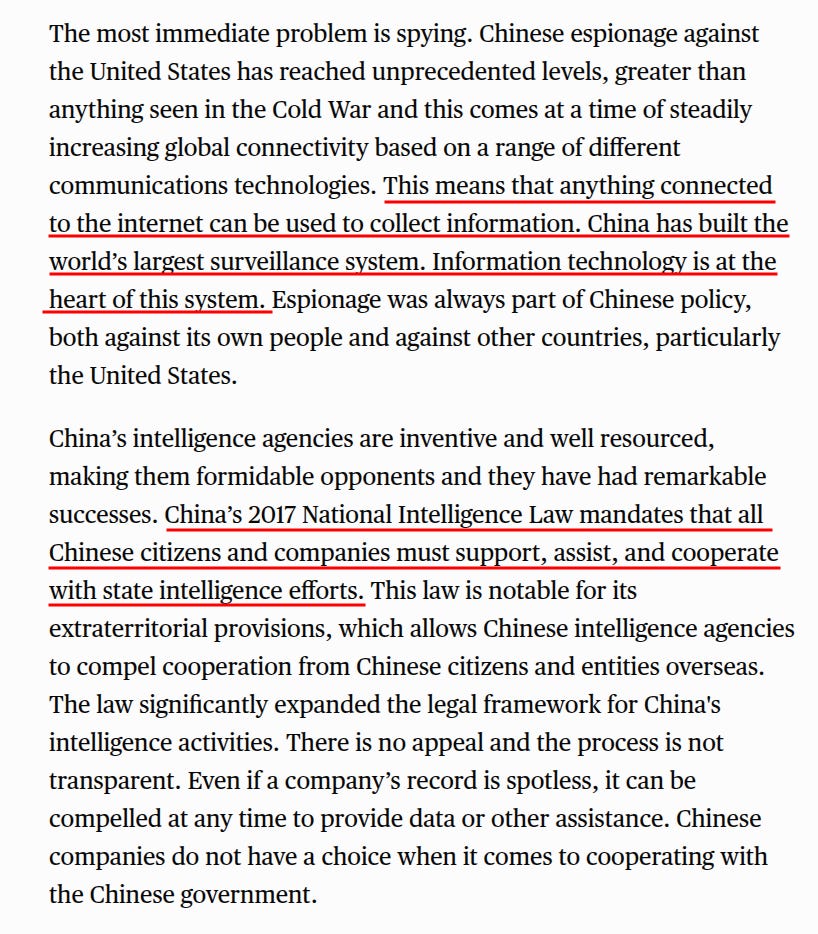
The policy is therefore partly evidence-based and partly precautionary. Governments do not want to discover the risk only after sensitive systems have been compromised.
For Indian camera makers, this creates an opportunity. Companies can replace Chinese components with compliant alternatives from elsewhere, while Indian chip designers such as Mindgrove, Netrasemi and IndieSemiC build their own SoCs.
Cameras may become more expensive because Chinese suppliers were cheaper. And an approved camera will not necessarily be entirely Indian. It may still use a foreign lens, image sensor or foundry. The goal is not complete self-sufficiency. It is to reduce the riskiest dependencies.
India is not alone. The US, UK and Australia have also restricted Chinese surveillance equipment in sensitive settings, each in its own way.
And this concern extends beyond cameras. It applies to drones, routers, cloud infrastructure and chips too: what happens when a critical part of your technology is controlled by someone you cannot fully inspect or trust?
That is the question behind India’s new CCTV rules.
- This edition of the newsletter was written by Vignesh & Kashish.
Subtext by Zerodha
We sat down with Mudit, co-founder of Voltseal, to talk about the duck curve, the many problems batteries can solve, and what happens when the grid finally gets intelligent. With over two decades in the industry, he helped us connect what we had learned through research with how the power system actually works.
Watch the full episode on YouTube.
Tidbits
1. Govt mandates manual verification of imported drugs and medical devices
Customs officers must now manually verify licences, permissions and registrations before clearing imported drugs, medical devices, cosmetics and related inputs. The temporary step has been introduced because CDSCO documents are not yet fully integrated into the SWIFT 2.0 system.
Source: The Economic Times
2. Russia pushes back against pressure over oil sales to India
Russia’s ambassador to India has criticised Western pressure to curb purchases of Russian crude, saying Moscow is ready to supply as much oil as India needs. His comments come as a US sanctions bill proposes steep tariffs on major buyers of Russian energy, including India.
Source: Business Standard
3. Govt considers allowing FDI in more plantation crops
The government is considering expanding foreign direct investment rules to cover more commercial plantation crops. The move is part of a broader push to attract investment into agriculture as India targets $100 billion in agricultural exports by 2030, up from about $53 billion currently.
Source: Financial Express
4. AIFs push to retain existing foreign-control rules
India’s alternative investment funds are urging the government and regulators to retain the current definition of “foreign control” as FEMA rules are reviewed. The industry argues that tighter rules could reduce foreign capital flows into funds that are managed domestically.
Source: The Economic Times
5. India proposes mandatory battery storage for new government solar and wind projects
India has proposed requiring new government solar and onshore wind projects commissioned from July 2027 to include battery storage equal to at least 10% of generation capacity. The draft is aimed at making renewable power more reliable and reducing the need to curtail excess generation.
Source: Reuters

Beyond Today’s Brief
There’s always more happening at Markets by Zerodha.
The Chatter: How is SEBI targeting network-level market risks, and why is Maruti Suzuki betting on biogas alongside EVs? Plus, key updates from United Breweries, Indian Bank, Zen Technologies, and Lumino.
Aftermarket Report: Why did rate hike fears and rising oil prices drag Nifty down to close below 23,800? How are SEBI’s new FPI compliance relaxations and India’s ₹1.1 lakh crore defence clearance shaping sentiment? Plus, key updates on Maruti’s price hikes, JLR job cuts, and surging Brent crude.
Points & Figures: How did India’s mutual fund industry surge to ₹74 lakh crore as SIPs became a monthly habit for millions? What is driving the rise of passive investing, and how far has the boom spread beyond top cities?
Join us on WhatsApp, where we share interesting soundbites from concalls, articles, and everything else we come across throughout the day. You’ll also get notified the moment a new video or article drops so that you can read or watch it right away.
Thank you for reading. Do share this with your friends and make them as smart as you are 😉