


Hi everyone, I’m Mridula, and welcome to the third edition of Weekly Tidbits.
We spend a lot of time reading interesting stories that never make it into a full Daily Brief piece. So once a week, we pick some of the best ones and add a little more context.
We also briefly tried calling this Brief Cases. But my team and I got so used to saying Weekly Tidbits that we decided to keep the name.
We’ll sort everything into EIC: Economy, Industry and Company.
Let’s get into it.
If you prefer watching the video, here is the link:
E — Economy
[1] Private banks saw faster deposit growth than public sector banks
Indian banks have spent the last few years fighting for deposits.
Banks need deposits because they use that money to make loans. When deposits grow slowly but lending keeps rising, banks either have to pay customers more for their money or slow down lending. Private banks seem to be doing better on this front.
Their deposits grew nearly 3.5 percentage points faster than public sector banks by the end of June.
That matters because deposits are becoming one of the biggest constraints on bank growth. A bank may have plenty of people who want loans. But unless it can keep attracting money from savers, it cannot keep expanding its loan book at the same pace. We have written about this problem before. Private banks have been growing their loan books faster than their deposits, forcing them to look for other ways to fund that growth.
It is also about who can convince you to keep your money with them.
[2] Bank lending to industry is rising as companies borrow more
Bank lending to industry picked up sharply in July, with credit growth accelerating to around 20%. That is worth watching because corporate borrowing tells us something about what businesses plan to do next.
Companies usually borrow when they need money for factories, machines, inventories or working capital. Stronger industrial credit can therefore support the broader signs that private investment is starting to recover. But not every type of lending is accelerating.
Gold-loan growth has started moderating after expanding rapidly earlier.So banks are slowly seeing the mix of their loan books change too.
For years, personal loans drove much of bank credit growth while large companies remained cautious about borrowing. We have written about that lending slowdown before, when banks were pulling back on several types of retail credit and overall loan growth was cooling.
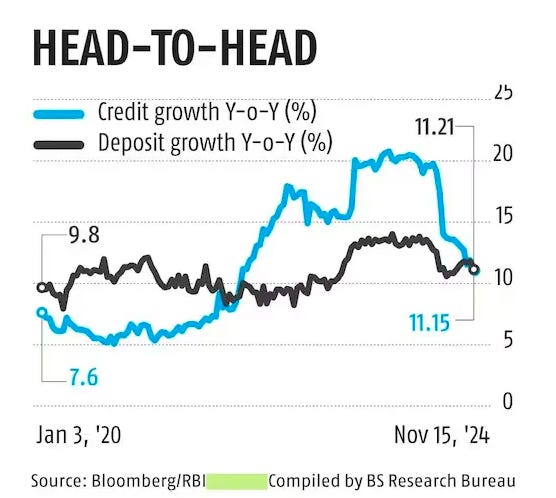
Now industrial credit is picking up again. If that continues, companies could start taking a larger share of bank lending growth.
[3] Foreign investors are buying Indian stocks again
Foreign portfolio investors put ₹30,919 crore into Indian markets in August. That marked their second straight month as net buyers.
But that does not mean foreign investors have suddenly turned consistently bullish on India. Daily flows are still jumping around. In the five trading sessions through September 3, FIIs sold more than they bought overall, even as domestic institutional investors kept buying.
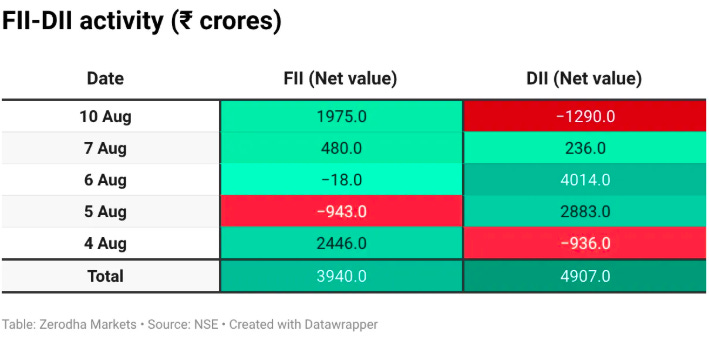
Foreign investors move money between countries based on everything from interest rates and currencies to company earnings and global risk. When they buy Indian assets, they bring dollars into the country. When they leave, they take those dollars back out. That means these flows matter beyond stock prices.
Strong inflows can support the rupee and improve market liquidity. Large outflows can do the opposite.
Two months do not make a long-term trend. But after periods when foreign investors repeatedly pulled money out of India, the direction has at least started to change.
I — Industry
[4] India wants coal plants to respond faster as renewable power grows
India is adding huge amounts of solar and wind power. That creates a strange problem for coal plants. Traditionally, a coal plant tries to run steadily for long periods. But solar power floods the grid during the day and disappears after sunset.
The Central Electricity Authority now wants thermal plants to become much more flexible. It has proposed faster ramping and even two-shift operation for some plants.
In simple terms, coal plants may need to reduce production when renewable power is abundant and increase it quickly when solar generation falls. That changes what India needs from coal.
The grid does not just need coal plants to produce electricity anymore. It increasingly needs them to fill the gaps left by renewable energy. So even as India builds more solar and wind capacity, coal plants may become more important as the system’s backup.
[5] Electric truck makers now have to make more of the vehicle in India
India’s localisation rules for electric commercial vehicles have started taking effect.
That creates a challenge for manufacturers.
An electric truck may carry an Indian brand name and come out of an Indian factory, but companies can still import expensive parts such as motors, electronics and battery components. Localisation rules force manufacturers to source more of that value from within India if they want access to government support.
That sounds straightforward until you look at the supply chain.
India still does not manufacture every EV component at the scale or price that companies need. Forcing localisation too quickly can therefore raise costs even as it encourages suppliers to start producing those parts locally. That is the trade-off.
India does not just want companies assembling electric vehicles here. It wants the factories that make everything going inside them too.
[6] Indian Railways wants private firms to help build new freight lines
Indian Railways plans to build six freight lines with private companies using a funding model that India already uses for highways.
Under the hybrid annuity model, the government pays part of the project cost during construction. The private developer finances the rest and receives payments over time.
That solves one of the biggest problems with private railway projects. Building a freight line requires huge upfront investment, while the developer may have to wait years before traffic generates enough money. That makes companies reluctant to take the entire risk themselves.
The hybrid model splits that risk.
The government still puts money into the project. But private companies bring capital and construction capacity too. If the model works, Railways could build freight infrastructure without putting the entire bill on its own balance sheet. Also, we have written about freight here.
C — Company
[7] Apple wants India to make a much bigger share of the world’s iPhones
Apple could shift 30–35% of global iPhone production to India over the next five years.
That would be a much bigger shift than simply making more phones for Indian customers.
Apple has spent decades building a supply chain around China. Moving production means moving much more than final assembly.
Suppliers need to make enclosures, electronics, camera modules and other components close to the factories putting the phones together. India has already attracted companies like Foxconn and Tata Electronics. The next step is getting more of their suppliers to manufacture here too.
That is where the bigger economic benefit sits.
Every extra iPhone assembled in India creates some jobs. But every component that moves here brings another factory, another supplier and another part of Apple’s manufacturing ecosystem with it.
[8] Yum Brands has sold Pizza Hut. Why?
Yum Brands has completed the sale of Pizza Hut outside mainland China to private equity firm LongRange Capital for about $1.5 billion. Pizza Hut is not a small business. It has more than 15,500 restaurants across over 100 countries and generates roughly $10 billion in annual system-wide sales.
So why would Yum sell it?
Because Pizza Hut has become a different kind of problem from Yum’s other brands. KFC and Taco Bell have generally grown faster and fit more cleanly into Yum’s current strategy. Pizza Hut, meanwhile, has had to deal with changing eating habits, stronger competition from delivery-first pizza chains and the cost of keeping a huge global restaurant network relevant.
Selling the business lets Yum focus more tightly on KFC and Taco Bell.
LongRange gets something very different: a famous global brand that already has scale, franchisees and customers, but still has room to improve how the business runs. It does not need to build Pizza Hut from scratch. It needs to make an old brand work better.
We have written about Pizza Hut and the broader QSR recovery, including how chains like Pizza Hut have been trying to improve sales and store economics after a difficult few years.
[9] Tata Motors is buying Iveco to grow its commercial vehicle business in Europe
Tata Motors has cleared the final regulatory hurdle for its proposed €3.8 billion acquisition of Italian commercial vehicle maker Iveco Group. The European Central Bank gave the last approval needed for the deal to move ahead.
Iveco makes trucks, buses and other commercial vehicles, which makes this a very different business from Tata Motors’ passenger-car operations.
The deal gives Tata a much bigger presence in Europe almost immediately.
Building that kind of business from scratch would take years. Tata would need factories, dealers, customers, service networks and regulatory approvals across multiple countries.
Iveco already has all of that.
The acquisition also gives Tata more scale in commercial vehicles at a time when the industry is changing. Truck makers are spending more on electric drivetrains, alternative fuels and connected-vehicle technology, and larger companies can spread those costs across more vehicles and markets. So Tata is not just buying another vehicle brand.
It is buying distribution, manufacturing capacity and a much faster route into the European commercial-vehicle market.
See you next edition :)
Do you guys not know that Tata Motors builds trucks? And has been building trucks since 1954? The first Tata passenger car, the Indica, came only in 1998.
Happy Teacher’s Day to the amazing team at The Daily Brief. 🎊❤️
Thank you for making learning about markets so simple, insightful, and interesting. 🙏
Please keep educating us like this 😅 📈😂