


Our goal with The Daily Brief is to simplify the biggest stories in the Indian markets and help you understand what they mean. We won’t just tell you what happened; we’ll tell you why and how too. We do this show in both formats: video and audio. This piece curates the stories that we talk about.
You can listen to the podcast on Spotify, Apple Podcasts, or wherever you get your podcasts and watch the videos on YouTube. You can also watch The Daily Brief in Hindi.
In today’s edition of The Daily Brief:
1. How India's elder-care industry works
As shrinking families and migration strain traditional support systems, a new commercial elder-care industry is emerging in India. However, high monthly costs, a shortage of trained caregivers, and the physical limits of local delivery mean organized care remains out of reach for most older Indians.
2. India’s new internet gateway
Tech giants are pouring billions into gigawatt-scale AI hubs and subsea cables along the Andhra Pradesh coast to bypass vulnerable Red Sea routes. But successfully redrawing India’s internet map requires monumental land-based investments in terrestrial fiber, power grids, and water supplies to actually support those coastal landings.
On Subtext, the latest episode of Cash & Copium is out. Bhuvan, Abid and Aakanksha tackle the fears keeping retail investors up at night. Could India stumble into a Japan-style lost decade? Will AI wipe out your job before your SIP matures? Are those juicy high-yield bonds actually a trap?
They dig into the numbers: why India’s 21-22x P/E is nothing like Japan’s insane 60x bubble, how SIPs through even Japan’s 34-year crash still delivered a ~5% XIRR, and why your emergency fund probably needs to be a lot bigger than you think if AI-driven layoffs stretch job hunts well beyond normal timelines.
Watch the full episode here.
How India’s elder-care industry works
For most Indians, the original elder-care institution is the family; children looked after parents, grandchildren were around, and there was a small ecosystem of people willing to look after each other. Living with adult children remains the most common arrangement for older people.
But that arrangement worked when families were large and close-knit, and nobody moved very far. That, as many of you might have experienced yourself, is becoming harder to guarantee.
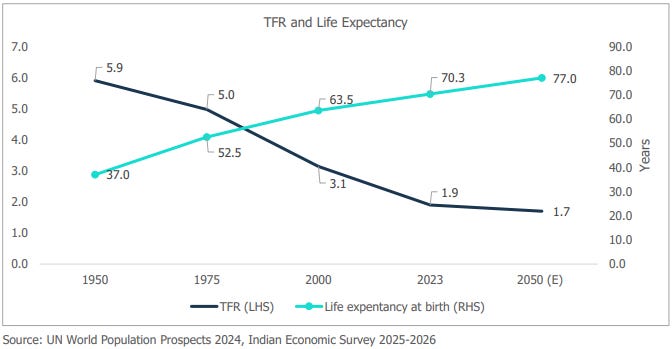
Families are getting smaller. The average fertility rate has fallen from about 5.9 in 1950 to around 2.0 today. A parent who once had four or five children nearby may now have one or two. The children who do exist are moving further away. Migration for work splits families across cities and countries. Urbanisation, migration, changing workforce patterns and the shift from joint to nuclear families are all leaving fewer people at home to look after ageing parents.
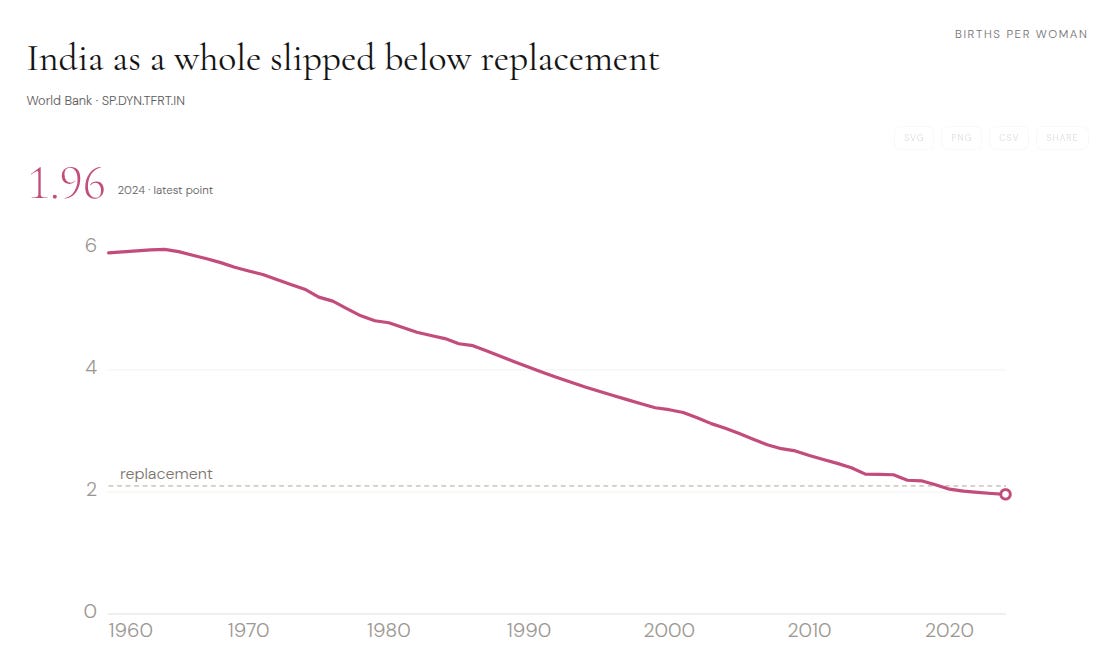
Meanwhile, Indians are living much longer than before. The average lifespan has risen from around 37 years in 1950 to over 70 today, and is projected to reach 77 by 2050. We now have ~167 million people aged 60-plus, and this number is projected to reach ~346 million by 2050.
Fewer people to provide care, more years of care needed.
Meanwhile, 75% of Indians aged over 60 have at least one long-term illness. One in four has difficulty with basic daily activities like bathing, dressing, or eating. They need someone around. Not a doctor or hospital. Just someone who can help them get through the day. What that help looks like, and what it costs, depends entirely on where someone is in their life.
To solve for this, an industry is forming around the care that families can no longer provide. Companies now sell everything from emergency-response subscriptions at ₹1,999 a month to assisted-living facilities at over ₹1 lakh.
It is this elder-care industry that we’ll be tackling on The Daily Brief today.
What elder care actually means
When most people hear “eldercare,” they think of the traditional old-age home, which carries a stigma.
You could probably visualize it. These establishments were often underfunded, understaffed places where dozens of residents were looked after by only a handful of people. Residents had little say over their routines and limited social interaction outside of the home. For many families, sending a parent to one felt like abandonment.
The organized elder-care industry that has emerged over the last decade is built around a different idea.
Instead of taking people out of their lives, it tries to help them stay independent for as long as possible, with support added only when it becomes necessary. A 65-year-old in reasonable health may want nothing more than a safe home, people their own age around them, and somebody to call in an emergency. The pitch has moved from “your family cannot look after you” to “you can keep your independence without managing everything yourself.”
Ten years later, the same person may need help remembering medicines or bathing. They may have dementia, a condition where memory and thinking decline to the point where a person may not recognize family or remember to eat. After a hospitalization, they may need nursing and physiotherapy at home.
This may require specialized supervision that’s different from trying to cure the disease, but instead focused on managing pain and keeping the person comfortable. This is called palliative care, which can run alongside treatment.
Loneliness and social isolation are recognized as serious health risks for older adults. So operators put real effort into social activities, group meals, fitness sessions, cultural events, and outings. These are not extras, but part of what makes the care work.
The most common buyer is often not the elderly person. It is a 35- or 45-year-old in another city whose parents live alone. What they pay for is someone local who is accountable. Someone who knows the medical history, answers the phone at 2 am, arranges the ambulance, and tells the family what happened afterward.
How the money works
The industry runs on several distinct models, each built around a different kind of need.
First, you have the senior housing model, where companies build apartments or gated communities designed for people aged 55 and above.
These houses have features like slip-resistant flooring, emergency alarm systems, grab rails, and wider doorways. But the apartment is only part of the offering: the community is a large upsell. Operators organize daily activities, fitness sessions, group meals, cultural events, and outings to keep residents engaged.
In most of these communities, residents buy their apartment outright rather than renting it, and pay monthly maintenance on top. Real estate players like Ashiana, Columbia Pacific, and Primus are among the larger firms in this space.

This model works because it gives people something they already understand: owning a home. The difference is that the home comes with a built-in support system. If a resident needs more help down the line, some of these communities also have higher-care facilities inside the same campus.
Secondly, you have the home care model, which is designed for families whose parents live alone in another city.
Here, companies like Emoha and Portea assign a care manager who becomes the local point of contact. The care manager knows the parent’s medical history, coordinates doctor visits, arranges emergency transport, tracks medicines, and reports back to the family. The family is paying for someone to be responsible when something goes wrong, and not just passively sit beside the parent.
This is one of the fastest-growing parts of the sector because it solves the most common problem Indian families face: distance. The parent stays in their own home, in their own city. They do not move anywhere. The service simply fills the coordination gap that the family used to handle in person.
Third, you have home nursing. When a parent needs medical care at home, trained nurses or physiotherapists visit for specific appointments or shifts. But a nurse can only be in one home at a time. Every new city requires recruiting, training, and supervising staff on the ground. If there’s a no-show by a nurse at a certain time slot, that isn’t a scheduling problem as much as a safety problem. After all, medical treatment is meant to be administered at specific times, like perhaps one hour before each meal.
Lastly, there’s the assisted living model. This is for people who can no longer safely manage daily life on their own. Residents live in a facility with round-the-clock supervision, help with bathing, eating, and mobility, medication management, and access to nurses and doctors. The monthly cost depends on how much care the person needs, and is typically set after a medical assessment.
A few companies are now trying to connect all of these stages under one umbrella. The idea is that a person who starts with a home-care subscription at 65 can move to assisted living at 80 without changing providers, losing their medical history, or rebuilding trust. Antara, part of the Max Group, and Age Care Labs (which runs both Emoha and Epoch) are among those building across the full range. This makes the industry as much of a relationship business as it is one about who builds the most facilities.
Why elder care stays local
Some of these companies claim coverage across over 135 cities. But “coverage” means different things at different levels of care. A phone-based emergency desk can serve hundreds of cities from one location, but a nurse who must reach someone’s house within 30 minutes cannot. An assisted-living bed in Gurugram does nothing for someone in Chennai.
That creates an interesting discrepancy in the industry. While the communication and coordination layer can scale nationally, the delivery of physical care itself can only scale city by city.
Think about it. As a professional caregiver, you’ll necessarily have to be attuned to the language and culture that the elder is personally most familiar with. That is the only way you get to build trust with them, and broadly, their family. This becomes even more essential with dementia patients, who often have trouble communicating and even stammer. Moreover, in the case of a dire medical emergency, local hospital and ambulance networks are essential.
What’s more, the industry works by word-of mouth. As the child of a parent who you’ve assigned a caregiver to, you’d only recommend someone who did a good job. In fact, referrals accounted for 46% of Ashiana’s senior-living sales in FY26. About 60% of organized senior-living capacity sits in southern India, driven partly by the South’s earlier demographic shift and partly by parents whose children live overseas.
In this kind of care, being deeply rooted in a few cities can matter more than being thinly spread across many, which is why many regional operators exist.
Who can actually afford this
Most of what has been described above is out of reach for the average elderly Indian.
78% of elderly Indians lack pension cover, and 70% depend on their families for everyday expenses. Home care costs ₹15,000 to ₹35,000 a month. Assisted living can go from ₹30,000 to well over ₹1 lakh a month. Only about 1.7 million urban senior households could realistically afford organized senior living, but the industry has built roughly 25,000 units to serve them. That’s a massive demand-supply mismatch.
Moreover, insurance doesn’t bridge this gap. In 2024, the government’s health insurance scheme, PM-JAY, was expanded to cover everyone aged 70 and above, providing up to ₹5 lakh of annual hospitalisation cover on a family basis. But that only covers hospital stays. It does not cover a monthly assisted-living bill, a long-term attendant, or routine home support. Families then face years of care costs without a single hospital visit to claim against.
Guidelines exist for retirement homes, senior citizen homes, and care-home accreditation. But no single national set of rules covers the full range from a home caregiver to an assisted-living facility. The absence of national standards and quality checks was flagged as far back as 2024 and raised again in August 2026. Seven out of ten elderly Indians live in rural areas, where organized care barely exists.
The people doing the work
With how specialized the industry is becoming, it remains scarce of human capital.
An attendant helping someone move around the house is different from a nurse treating a wound, and both are different from someone trained to handle dementia. India has multiple training routes spread across government programs, skill councils, and private courses, with no common framework connecting them. A National Caregiving Qualification Framework and a caregiver registry have been recommended to bring coherence to this.
Trained caregivers from the National Institute of Social Defence’s program start at roughly ₹16,000-30,000 a month, and can reach ₹40,000-50,000 with experience. That is not high pay for work that involves physical strain, round-the-clock shifts and intimate tasks.
The training pipeline is also small. The government’s longest-running geriatric care course has certified about 4,200 people over seven years. A separate initiative trained roughly 37,000 in a single year across multiple categories. The 2026-27 Budget set a target of 1.5 lakh caregivers in the coming year, a significant jump, but that ambition is new. Most recruitment still happens informally, without written agreements, benefits, or training.
What comes next
The organized elder-care industry in India is still in its early stages, but the direction is becoming clearer. Companies that started with one type of service are expanding across the full range, from independent housing to home care to assisted living. The government is beginning to treat caregiving as a profession that needs formal training, common standards, and a national registry. New senior-living projects are increasingly being planned in smaller cities and towns rather than only in the largest metros.
But the harder question is who it will grow for. Right now, organized elder care in India serves a thin, affluent, mostly urban slice of the elderly population. The vast majority of older Indians will age at home, looked after by family, neighbours, or nobody at all. Bridging that gap will take more than companies and investors. It will take public systems, community networks, and trained people in places where none of these currently exist.

India’s new internet gateway
Most of our international internet traffic enters the country through undersea cables that come ashore at Mumbai or Chennai. TRAI counted 17 submarine cable systems landing in the country as of 2023, but those two cities hold the bulk of the concentration.
Now, another state wants a piece of this pie.
Over the past year, Andhra Pradesh has been making plenty of moves here. Google has committed $15 billion to build an AI hub in Visakhapatnam, where it will also be building a new undersea cable gateway. A consortium including Microsoft and Tata Communications is landing another cable further down the Andhra coast. Sify, the Indian firm, broke ground on a 50 megawatt AI edge data centre and open cable landing station in Vizag in October 2025, with an indicated investment of ~₹1,500 crore.
None of this is coincidence. It follows a simple logic that makes the Andhra story genuinely interesting, rather than just another infrastructure announcement.
Cables follow compute
See, a data centre is where the internet thinks. A cable landing station is where the internet enters the country. And every extra kilometre between the two means terrestrial fibre to build, additional cost, and higher latency.
So, it makes far more sense to land cables right next to the servers. This is one reason why Mumbai is both India’s primary hub for both subsea cables and data centres.
Now, in Vizag, Google is building a gigawatt-scale AI hub with AdaniConneX and Nxtra by Airtel. Vizag is a coastal location that also helps with the water and cooling challenge we’ve covered separately. It’s a $15 billion commitment over five years, and routing all that international traffic through Mumbai or Chennai first would mean building hundreds of kilometres of terrestrial fibre just to reach a cable landing, adding latency and cost at every step.
The I-2SEA cable illustrates the same logic from a different angle. It’s a 3,600-kilometre system connecting Singapore and Malaysia to our east coast, built by a consortium of Lightstorm, Microsoft, Singtel, and Tata Communications. Tata Communications has separately disclosed $89 million for the Chennai-Singapore cable project.
Now, the cable will land at the town of Machilipatnam in Andhra Pradesh. It’s not a place that consumes enormous quantities of internet bandwidth. But Lightstorm, the majority owner, calls it the point providing “the shortest subsea access” to Hyderabad, which is one of their largest data centre clusters.
State ambitions
We’ve covered before how Andhra Pradesh has been aggressively courting large industrial projects recently. The subsea story is the latest chapter, but in place of factories, it’s now the ecosystem that supports data centres.
AP has an active industrial policy to attract data centers, which includes a menu of juicy incentives. For instance, there’s 100% state GST reimbursement on capital goods or a 10% capital subsidy on plant and machinery, 100% stamp duty exemption on the first sale, industrial power tariffs, and case-by-case mega-project packages. The policy targets 200 MW of new data centre capacity, with an upper ambition of up to 1 GW.
Companies came calling to answer. Over July-August 2026 alone, the AP government approved four data centre projects worth a combined ₹2.83 lakh crore and nearly 3,500 MW of capacity. By the way, 3,500 MW is nearly a quarter of the entire state’s peak power demand in 2026. Incentives ran into thousands of crores across the policy’s various exemptions and subsidies.
This is the flywheel that creates a hub. State policy and available land attract hyperscale compute, which creates demand for international bandwidth, which in turn makes more data centres attractive. And then carrier networks arrive.
Usually, a cluster only becomes one when the arrival of one big firm brings with itself other smaller supplier firms. We’re seeing early signs of such a cluster forming in AP already. The different players have different reasons for being there. Google’s reason is its own massive Vizag compute, while Lightstorm’s is the shortest route to Hyderabad, and Sify is building a carrier-neutral, open landing facility.
All of this also begs the question: why won’t every coastal state end up with its own cable hub? Technically, any stretch of coast can land a cable. But commercially, a new landing has to justify the cost of manufacturing and laying thousands of kilometres of specialised cable, building shore infrastructure, securing permits, and funding long-term maintenance, and a coastline alone doesn’t generate that demand.
When the Red Sea goes dark
The second reason for the buildout in AP has more to do with geopolitics.
We’ve covered before about what happens when our westward internet corridors get disrupted. In March 2024, multiple Red Sea cables were severed. In September 2025, more outages degraded connectivity across India, Pakistan, and the UAE; Microsoft warned that Azure traffic routed through the Middle East had to be rerouted.
Some of the activity in AP is meant to hedge against the Red Sea risk.
Take Google’s data centre. It is just one element in Google’s large America-India Connect programme, which routes pass through Singapore and Australia in the East, and South Africa in the South-West. Those paths bypass the Red Sea completely while connecting to the American coastline, which is the programme’s aim. Google itself says the Vizag gateway will add “vital diversity” from existing landings in Mumbai and Chennai.
Don’t hold your breath
Subsea cables are not quick projects, though. As per TRAI, the typical time between first planning a new cable and it becoming ready for service is 5-7 years. The deadline for the I-2SEA project is Q4 2029. It’s a plausible target, and the project is already past the conceptual stage.
But even signed-contract timelines can slip. For instance, Reliance Jio’s India-Asia-Xpress cable was announced in May 2021 with a target of mid-2023. But instead, it launched two years behind the original schedule.
The underwater cable is still only half the job. A landing at Machilipatnam needs high-capacity terrestrial fibre into Hyderabad, which someone needs to build. A Vizag gateway needs connectivity between Google’s campus and our metro networks. A new internet hub only exists once you build enough fibre on land to make the subsea cables useful.
For years, our data centres mostly went where connectivity already existed. AP’s experiment is trying to do both at once — build the compute and redraw the network around it. But the task of enabling the power grid, the water supply, and the terrestrial fiber, altogether for a $15 billion AI hub — without any shortage of power or water — is much more than an uphill task.
- This edition of the newsletter was written by Vignesh.
Tidbits
[1] RBI rejects Tata Sons’ bid to escape CIC status
The RBI has rejected Tata Sons’ request to surrender its registration as a Core Investment Company. Tata Sons remains classified as an upper-layer NBFC, which means the requirement to list its shares also remains. The company had already missed its original September 2025 listing deadline.
Source: ET Now
[2] India approves up to 654 MW of power exports to Nepal
India has allowed Nepal to buy up to 654 MW of electricity through Indian power exchanges until December 31. Nepal sought the power earlier than usual after flash floods damaged facilities and cut its domestic generation capacity by around 550 MW.
Source: Power Line
[3] Airtel and Jio accuse Vi of making number porting harder
Airtel and Jio have accused Vodafone Idea of restricting the SMS facility customers need to port their numbers. TRAI had dealt with a similar issue in 2021 and ordered telcos to allow port-out SMS regardless of a customer’s tariff plan. Vi has reportedly denied violating the rules.
Source: Business Standard
[4] Jet Airways fails to recover ₹500 crore from Boeing at NCLT
The NCLT has rejected Jet Airways’ liquidator’s attempt to recover about ₹500 crore in advance payments made to Boeing for aircraft that were never delivered. The tribunal said the disagreement is a contractual dispute requiring a full trial and cannot be decided under its limited insolvency jurisdiction.
Source: The Economic Times
[5] India is making trade approvals faceless and jurisdiction-free
The government is setting up a Central Processing Department within the DGFT to centrally process trade-related applications. The new system, expected to launch nationally in October, aims to make approvals faceless, paperless and independent of an applicant’s location.
Source: The Economic Times
Beyond Today’s Brief
There’s always more happening at Markets by Zerodha.
Aftermarket Report: How did soaring crude oil prices and rising bond yields hammer Nifty to close near the 23,100 level? And how severely did the sell-off crush broader market sentiment?
What We’re Reading: Everything from Palak Shah’s inside story on covering SEBI to structural shifts in global trade networks to the hidden mechanics of institutional financial risk.
Points & Figures: How severe is the backlog facing India’s judicial system, and what do 5.4 crore pending court cases reveal about institutional capacity and economic friction?
Join us on WhatsApp, where we share interesting soundbites from concalls, articles, and everything else we come across throughout the day. You’ll also get notified the moment a new video or article drops so that you can read or watch it right away.
Thank you for reading. Do share this with your friends and make them as smart as you are 😉
The elder care industry was a really interesting article ⚡️loved reading about it.