


Our goal with The Daily Brief is to simplify the biggest stories in the Indian markets and help you understand what they mean. We won’t just tell you what happened; we’ll tell you why and how too. We do this show in both formats: video and audio. This piece curates the stories that we talk about.
You can listen to the podcast on Spotify, Apple Podcasts, or wherever you get your podcasts and watch the videos on YouTube. You can also watch The Daily Brief in Hindi.
In today’s edition of The Daily Brief:
1. What’s up with copper and why is it down?
Despite long-term supply deficits driven by EVs and power grids, global copper prices have tumbled from their September record of $14,875 a tonne to slip below $12,000, prompting Indian cable makers like Finolex to slash product prices. The sharp selloff stems from a stronger US dollar, hawkish Federal Reserve rate expectations, and hedge funds unwinding bullish copper bets tied to AI data centre stocks. Simultaneously, a massive 2-million-tonne stockpile of refined copper accumulated in US warehouses ahead of anticipated tariffs is now reversing back into global markets after midterm election shifts cast doubt on those duties.
2. India rewrites its rural jobs promise
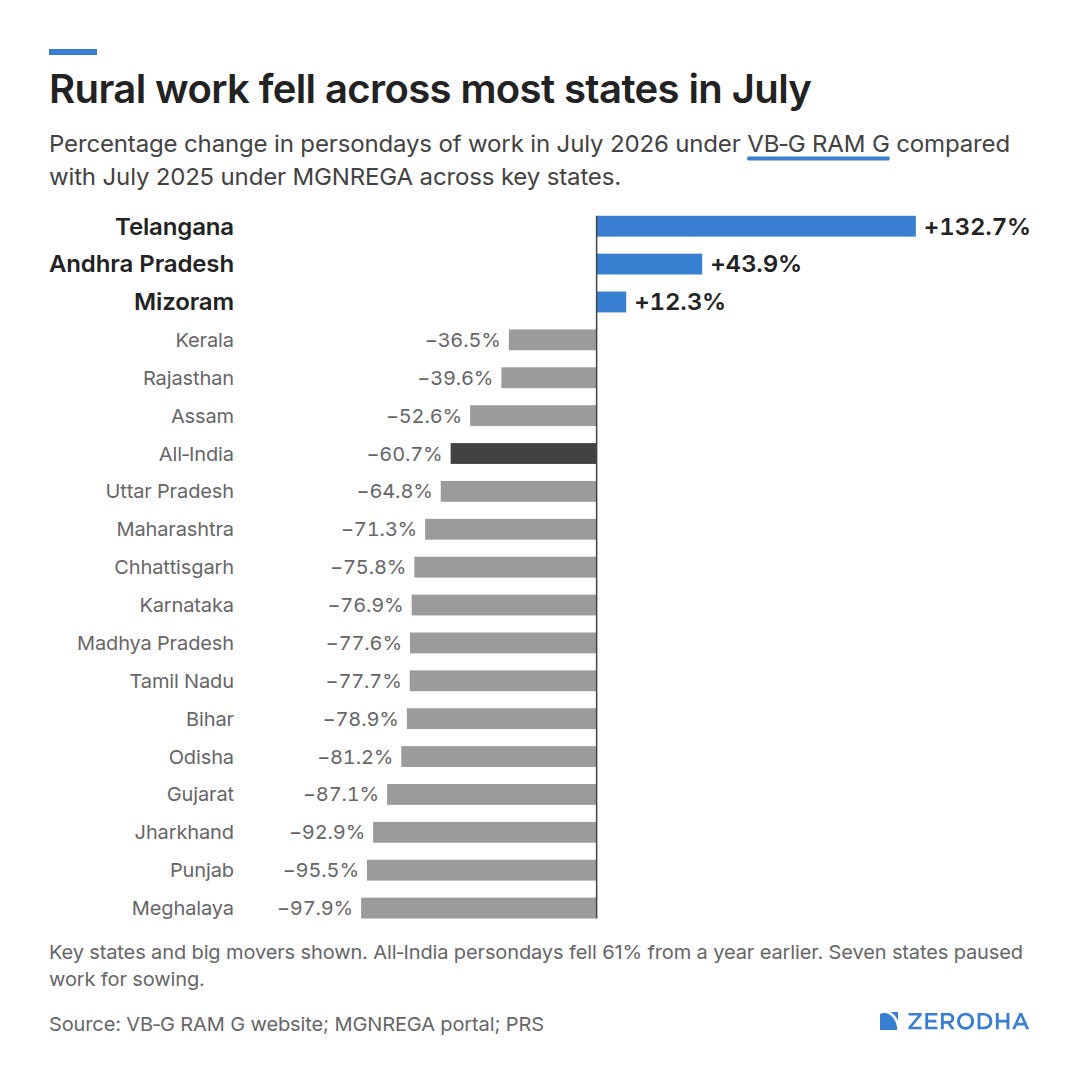
Replacing MGNREGA after two decades, the new Viksit Bharat – Guarantee for Rozgar and Ajeevika Mission (Gramin) Act expands guaranteed rural work from 100 to 125 days and raises minimum notified daily wages to ₹300. However, the overhaul introduces a mandatory 60-day pause during peak sowing and harvest seasons—causing July person-days to drop 61% year-on-year—and shifts the financing burden onto states via a 60:40 cost-sharing split capped by central normative allocations. While digital attendance and stricter grievance timelines aim to curb past administrative delays, states face a roughly sixfold jump in funding obligations to sustain historical employment levels.
Wait, wasn’t the world running out of copper?
If you’ve been reading The Daily Brief over the past year, a fall in copper prices might sound strange. We’ve written extensively about how the world is hunting for copper, and why there simply isn’t enough of it.
Here’s a quick recap of that long-term story. Demand keeps rising: an electric vehicle uses 80-90 kg of copper on average, about four times a conventional car, and power grids, renewables and data centres all need it too. Supply, meanwhile, is slow to grow. The easiest, richest deposits have already been mined, ore grades are falling, and bringing a new copper mine online now takes around 18 years globally. This is part of why hyperscalers like Amazon have explored getting direct exposure to mining assets.
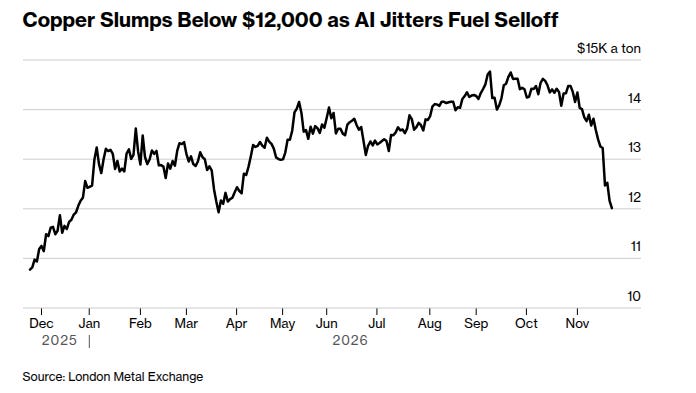
For most of 2026, copper prices kept climbing: Copper on the London Metal Exchange (LME), the global benchmark, hit a record $14,875 a tonne in September.
But since September, it has fallen fast. Last week alone, LME copper dropped about 9%, its steepest weekly fall in more than 19 months. On Monday, 23 November, it briefly slipped below $12,000 a tonne for the first time since March. US copper prices have fallen 15% in November alone. Copper is now roughly back to where it started the year.
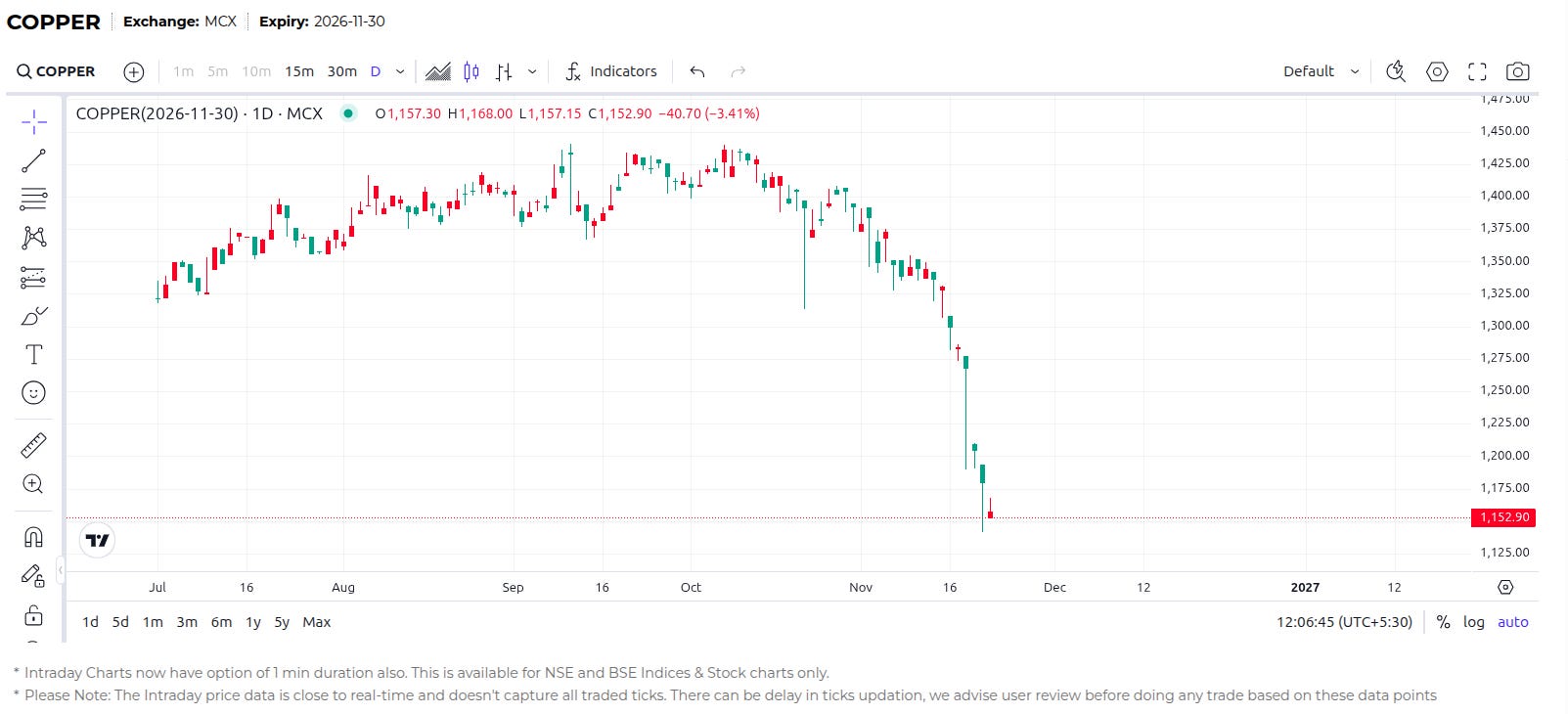
You can see a similar fall in India, on the Multi Commodity Exchange (MCX), where Indian businesses and traders buy and sell copper futures. In early October, MCX copper traded above ₹1,400 a kilo. On 20 November, it closed at ₹1,152.90.
Why are copper prices falling?
So, why did this happen? Did the world suddenly find a lot of new copper? No.
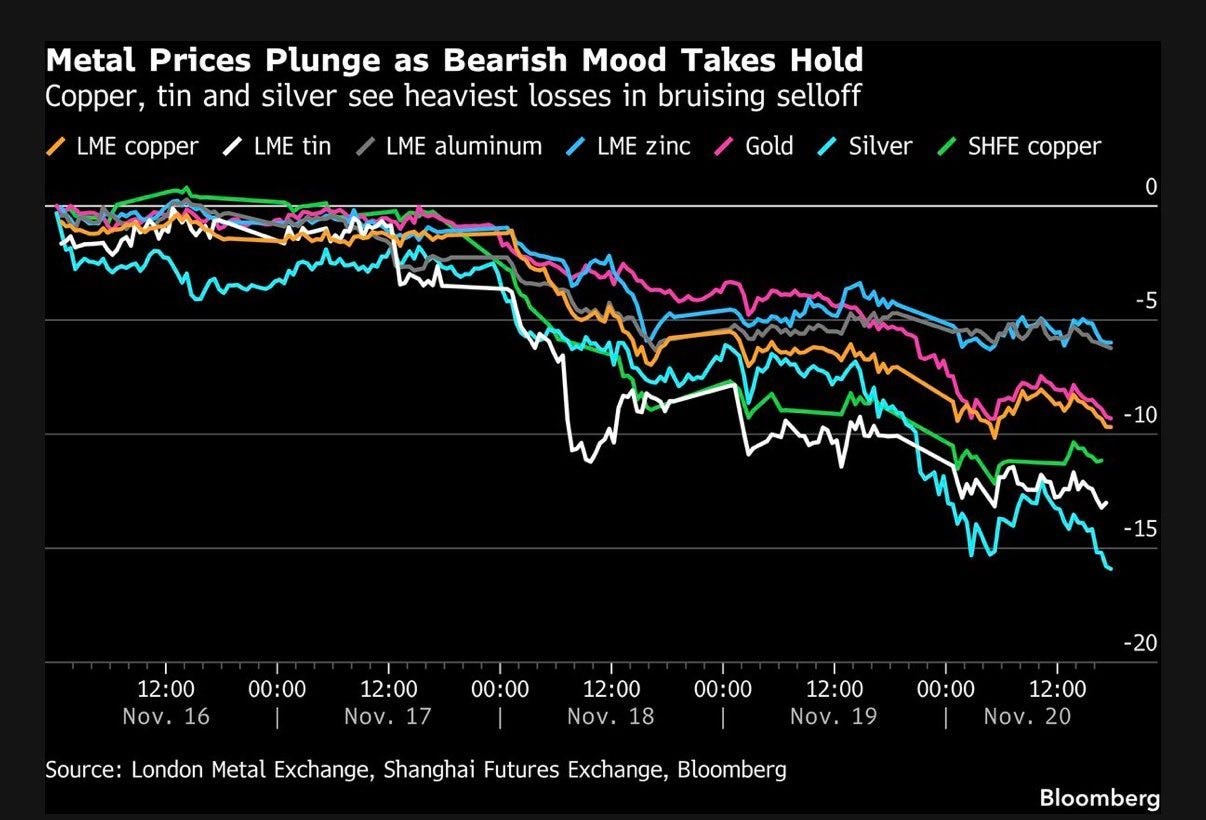
For starters, copper wasn’t falling alone. Last week, almost every major metal fell together. Aluminium dropped almost 6% and gold around 9%.
A few reasons were weighing on most of these metals:
The first is America’s central bank, the Federal Reserve. Inflation in the US is higher than usual, so markets now expect the Fed to raise interest rates again in December. Higher rates hurt metals since borrowing gets more expensive for the factories and builders that actually use metals, which also slows down how much they buy. ING’s analysis points to higher rate expectations as one of the pressures on metals last week, particularly gold.
The second is the US dollar, which is close to its strongest level in 19 months, helped along by those same expectations of higher rates. Metals are bought and sold in dollars around the world, so when the dollar gets stronger, copper or aluminium becomes more expensive for anyone paying in rupees, yuan or euros, and they tend to buy less.
Copper, tin and silver took the heaviest losses of the lot. In this piece, we’ll stick to copper. On top of everything weighing on metals in general, two things stand out for copper.
Copper as an AI bet
Earlier this year, many investors started buying copper as a way to bet on AI. Their reasoning went like this: AI needs huge data centres, data centres need lots of electricity, and electricity runs through copper. So if AI was going to boom, copper would too. As AI excitement grew, investors’ bets on copper rising increased massively.
That changed how copper’s price behaved. Normally, copper’s price follows the factories and builders that use it, and doesn’t pay much attention to the stock market. But ING’s analysis found that from around April 2026, copper was correlated (started rising and falling on the same days) with US stocks far more often than before, both with the broader US market (S&P 500) and with technology and chip companies. In other words, copper began trading a bit like a stock.
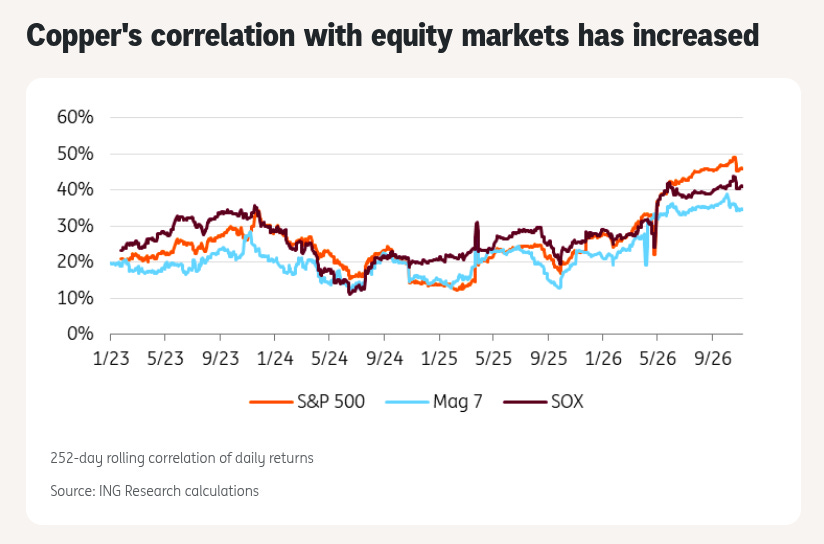
Note: How closely copper’s daily price moves matched each index over the previous year. Each line compares copper with one index. Mag 7: Apple, Microsoft, Alphabet, Amazon, Meta, Nvidia, Tesla. SOX: An index of US chip companies.
Now, that worked well while AI stocks were rising. In November, they fell sharply. Nvidia CEO Jensen Huang’s resignation rattled investors, and after the US midterm elections, investors began doubting how many new data centres would actually get built, since there was growing public pushback against new data centres, and the likelihood of more regulation from a Democratic-controlled Congress.
Funds had actually started pulling back weeks earlier. Between late September and 17 November, the bets that hedge funds and other investors had placed on copper rising shrank by nearly two-thirds. Then, as AI stocks fell in November, ING’s analysts say, copper got caught in the same selling. Billionaire investor Stan Druckenmiller, the most vocal backer of the copper-and-AI idea, said last week that he was now betting copper would fall.
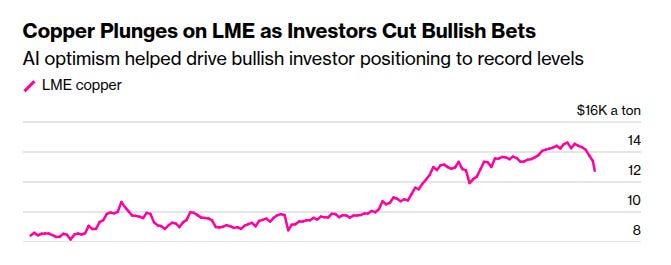
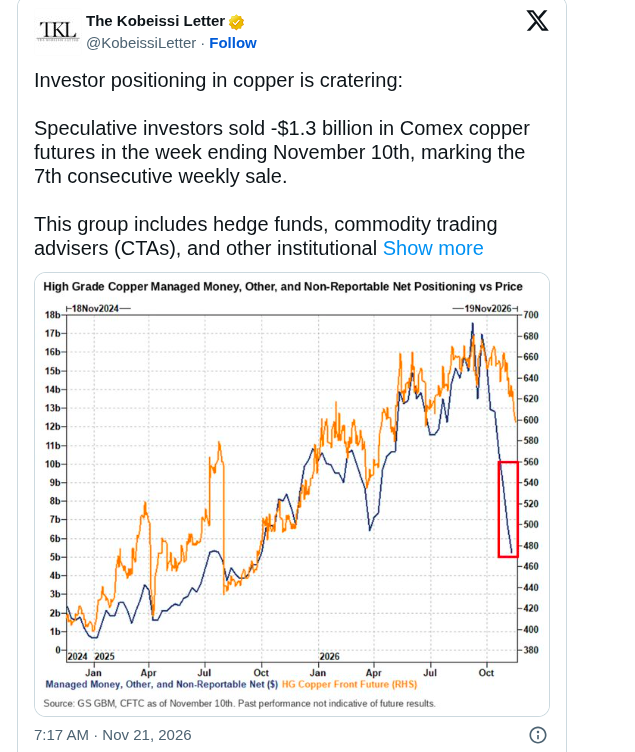
So, was copper’s AI story overdone? Some analysts think so. Benchmark Mineral Intelligence states they had long felt the AI premium in copper (the extra price investors were paying because of AI) “might be a bit over-egged.” BMO Capital Markets says there’s strong evidence that AI is adding to copper demand, but that “volatility is guaranteed.” Copper’s demand doesn’t depend on data centres alone, but by trading like an AI stock, copper got caught in the same selling.
An expected tariff that arrived partly
AI isn’t the only reason copper fell. The second reason goes back almost two years, to a tariff the US has been planning to put on copper.
In February 2025, the US government began planning to put a tariff on copper imports in the USA, which global traders prepared for all of 2025 and 2026, and now think that the tariff might never happen. To follow what happened next, it helps to know two things.
First, the copper that’s traded on exchanges, and stockpiled in their warehouses, is refined copper: almost pure sheets of copper, ready to be made into wires (and the one in our story).
Second, copper doesn’t have just one price. The global benchmark is set on the London Metal Exchange (LME), and that’s the price we’ve been tracking so far. But the US has its own copper exchange, called Comex, with its own price. Normally, the two stay close to each other.
The threat of an important tariff, which the market expected to be around 25%, would make imported copper costlier for American buyers. So, already existing copper (mined in the USA or imported earlier), became more valuable, and the US copper prices rose well above the global benchmark.
For copper traders, to export copper before a tariff hits the USA was an obvious opportunity. They could buy refined copper at the global benchmark price, ship it to the US before any tariff landed, and sell it there for more. So that’s what they did, on a huge scale. US copper imports jumped 80% in 2025, to 1.64 million tonnes.
But the tariff never arrived fully! It only partly happened, when the Trump administration imposed a 50% tariff on semi-finished copper imports, but refined copper, the kind traded on exchanges (and our story is about), was left out. Instead, the US government said they would decide whether to tax refined copper at 15% from 2027, rising to 30% in 2028. The deadline to decide was set to June 2026.
So, traders kept shipping refined copper into the US, before the full tariffs came, which became a huge stockpile. This increased the supply of copper in the USA massively. By this November, the US was sitting on roughly 2 million tonnes of refined copper. And you can see it in the warehouses run by the world’s two biggest copper exchanges, the LME and Comex. These warehouses hold copper that’s ready to be bought and delivered at short notice. Two years ago, about 20% of that copper sat in the US. Now, about 94% does.
With so much copper exported to America, buyers in the rest of the world found it harder to get copper quickly. Bloomberg says that left countries “tight” on supplies, which kept the global benchmark price for refined copper high.
And China felt this the most. It uses roughly half the world’s copper and depends heavily on imports, so it was competing most directly with the US for the same metal. As copper flowed to America, Chinese buyers struggled to restock. Last week, the Shanghai Futures Exchange nearly ran out of copper to deliver, and Chinese importers are now paying a record $360 a tonne above the global benchmark. Yet China’s own appetite for copper is weak. Its October data showed factories producing less, and people spending less, than expected. Estimates for copper demand from China’s domestic economy is to shrink by 11-12% this year. So far, a shortage in China hasn’t stopped the global price from falling.
The US government, meanwhile, has said nothing about taxing refined copper since the middle of the year, when the Commerce Department was due to deliver its report on the matter. Traders kept waiting anyway. The turning point came this month, after the Democrats won the US midterm elections, when traders began to doubt the tariff would ever be imposed.
That undid the whole calculation. Refined copper in the US was worth more only because traders expected a tariff. Without that expectation, there’s no reason to pay extra, and the US price has now slipped slightly below the global benchmark.
So the trade has started to reverse. Traders are shipping copper out of the US, mostly to China so far. Only tens of thousands of tonnes have left, out of roughly 2 million, and each shipment takes weeks to arrive. But the global price is already looking ahead. Bloomberg reports that traders now see a world that would be very comfortably supplied if America’s copper pile flows back out, and the FT says doubts about the tariff added to last week’s selloff.
For India, this is where the story lands. Copper prices here have moved with the global benchmark, as the MCX chart above shows, and Finolex’s price cuts are where that reaches buyers.
So, is the world still running out of copper?
The long-term story we’ve been telling hasn’t changed. New copper mines still take years to build, and grids, EVs and data centres still need copper. What has changed is everything that was stacked on top of that story: Investors who bought copper as an AI bet are pulling back. And the copper America piled up for a tariff that may never come is starting to look for buyers elsewhere.
For Indian buyers, that means cheaper cables for now. Finolex has moved first, and its rivals may follow. How long that lasts may depend less on the world’s copper mines than on the US government tariffs, and on how investors feel about AI.

India rewrites its rural jobs promise
For twenty years, a rural household in India could turn to the government for work. If its adult members were willing to do unskilled manual labour, they could ask for up to 100 days of work in a financial year, shared among them. The Mahatma Gandhi National Rural Employment Guarantee Act, or MGNREGA, made that a legal right.
In December 2025, Parliament passed a law to replace it. The Viksit Bharat – Guarantee for Rozgar and Ajeevika Mission (Gramin) Act, or VB–G RAM G, took effect on 1 July 2026. It raised the guarantee to 125 days. The Centre also raised wages and budgeted nearly ₹96,000 crore for its share of the scheme in 2026–27.
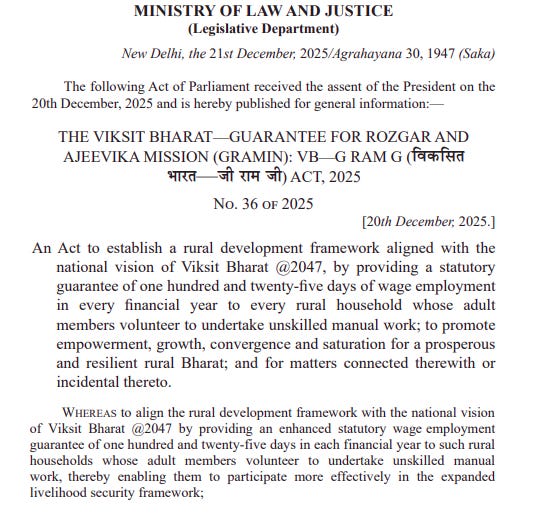
But the new law also changes when families can get that work and who pays for it. States must pause public works during peak farming seasons. They must also pay a larger share of the bill, especially if more people need work than the Centre budgeted for.
So will those extra days reach the families that need them? The answer starts with what it took to get work under MGNREGA.
The promise India struggled to keep
Farm work in India comes in bursts. A landless labourer might find plenty of work during sowing and harvest, and then go weeks without it. If the monsoon fails, even the work the family was counting on can disappear.
MGNREGA was built for those gaps. A rural household registered with its gram panchayat for a job card. When an adult in the family needed work, they could ask the panchayat for it and get a dated receipt. The state ordinarily had 15 days to offer work, such as digging a pond or desilting a canal. If it missed the deadline, the worker could claim an unemployment allowance from the state.
This was a national guarantee, but each state had to make it work village by village. Panchayats had to record requests and plan projects. Block and district officials helped organise the work. Once a project began, officials had to record who turned up and how much work they did so that wages could be paid. A worker could have exactly the same legal rights in two villages and quite different experiences of getting a job.
The Centre picked up about 90% of the overall bill. It paid all unskilled wages and 75% of the cost of materials and skilled labour. States covered the remaining quarter and shared the administrative costs. The Centre also set the wage for each state, revising it every year to reflect changes in the prices agricultural labourers paid. States could top it up from their own budgets.
The annual budget for this was an estimate. So, if more families needed work than the Centre expected, the guarantee still applied and the government was supposed to provide the extra money. That flexibility mattered during COVID, when millions returned to their villages looking for work. MGNREGA spending rose 55% in 2020–21, which couldn’t have been budgeted for.
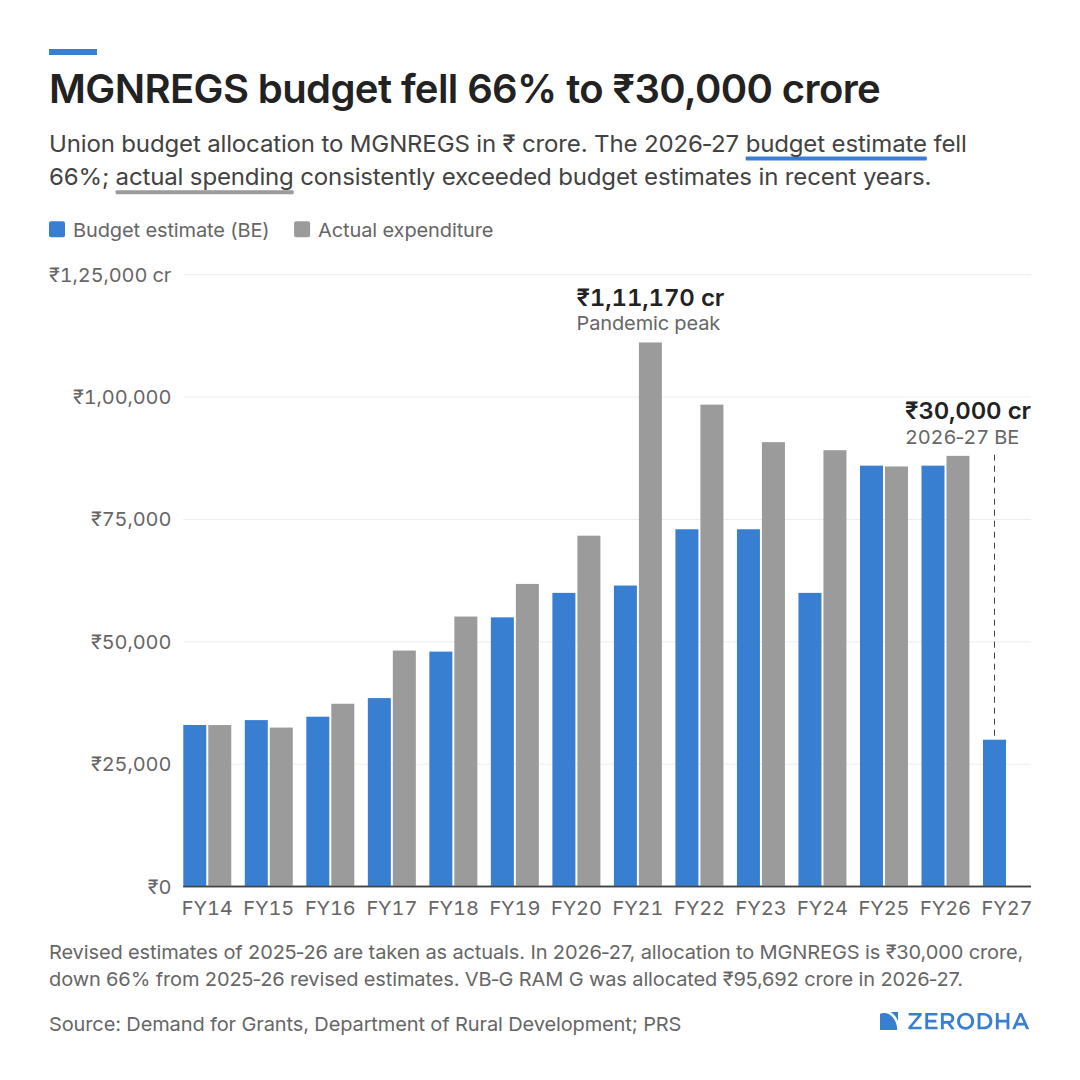
How much work did families actually get? Over the past decade, participating households averaged around 48 days a year. Fewer than 4% completed 100. Those figures alone tell us little about whether the guarantee worked. A family that wanted 30 days and got all 30 looks exactly like one that wanted 60 and got only 30. Low wages or late payments may also have discouraged some families from asking again.

The state audits show why it’s so hard to tell these families apart. In Uttarakhand, the Comptroller and Auditor General (CAG) found that none of the 16 gram panchayats it examined for 2019–24 kept the required registers of work requests or issued dated receipts. Without a date, how could a worker prove that the 15 days were up? Even the auditors couldn’t establish who had waited too long or what the state owed them.
In Karnataka, auditors traced requests that officials had recorded incorrectly, costing some households their allowance. In Maharashtra, even when the system recognised that an allowance was due, the state paid almost none of it. Nationally, states paid about 8% of the unemployment allowance officially recorded as due from 2019–20 to 2024–25. That figure only counts claims that made it into the system.
In Kerala, the difficulty came even after people had worked. Over five years, workers received more than ₹308 crore in wages late. And the official measure of delay sometimes stopped before the money reached their bank accounts. By the government’s clock, a payment could look more timely than it felt to the person waiting for it.
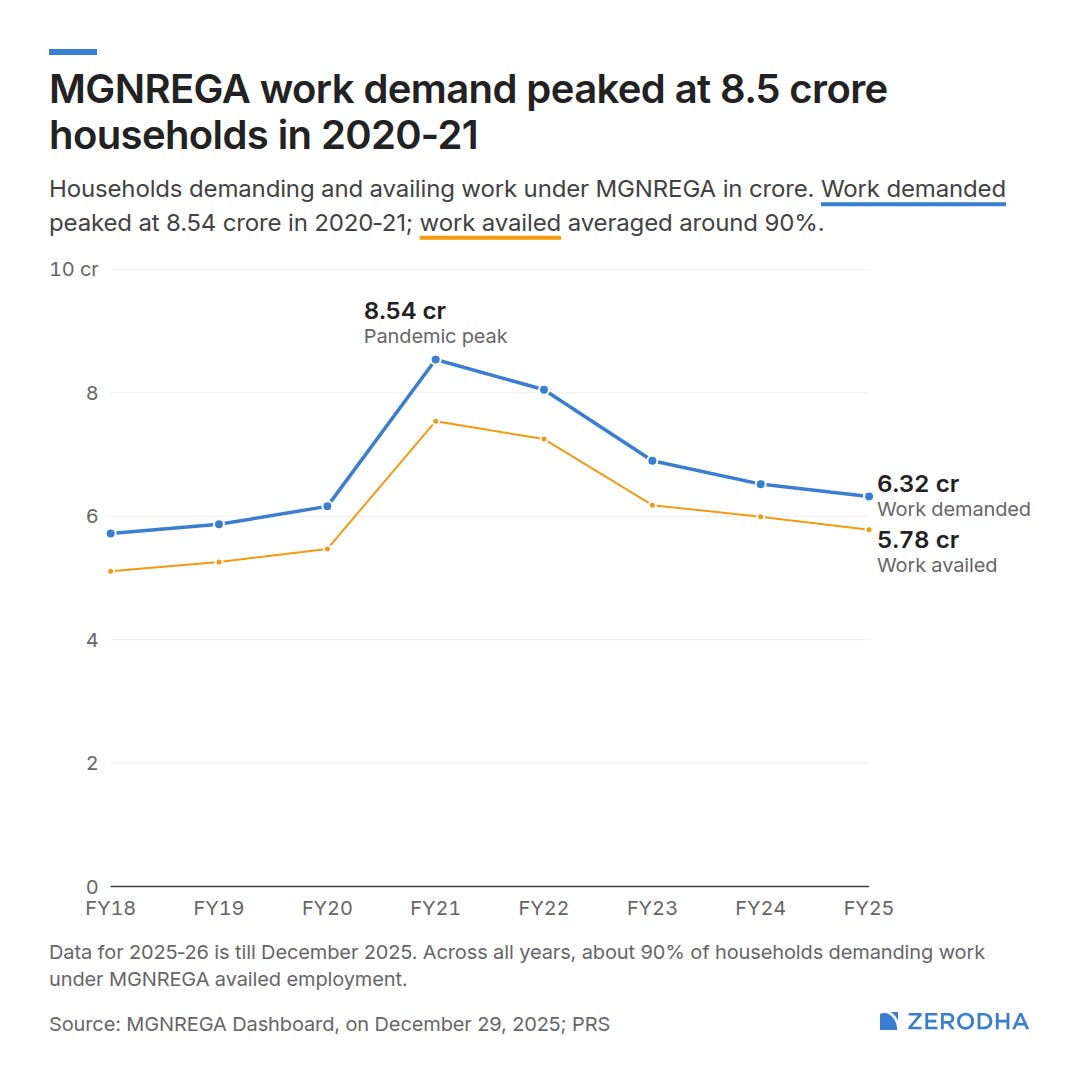
The Economic Survey of 2023–24 found that states with stronger administrations were better at planning projects and providing work. That gives us a way to judge the new law. An extra 25 days clearly helps a family that has used all 100 and needs more. But, what exactly changes for the family whose first request went unrecorded?
What does the new law fix?
When the bill came before Parliament, the opposition protested both the funding changes and the removal of Mahatma Gandhi’s name. The rural development minister defended the legislation on practical grounds. Better planning would produce more useful assets, and stronger accountability would help workers get their due. Which of those improvements needed a new law, and which depended on officials doing things the old law already required?
For a household that gets the work it asks for, the gains are straightforward. It can draw on 25 more days in a bad year. And the July wage notification raised the lowest notified rate to ₹300 a day, so even a family that needs only a few weeks of work can earn more for those weeks.
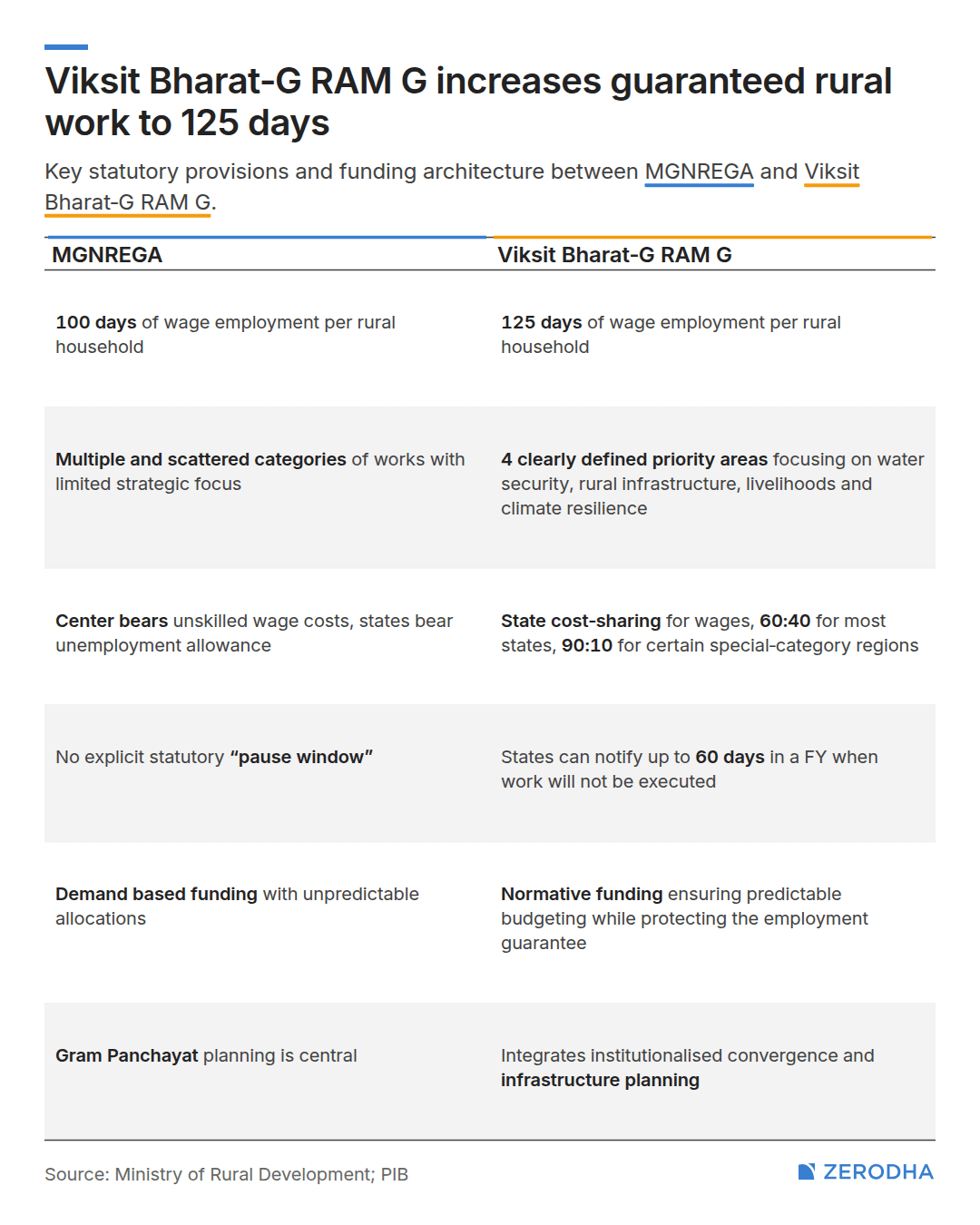
For the worker who couldn’t prove they’d asked, the change is more modest. They can apply in person or through a digital platform. Officials must register the request, issue a dated receipt and enter the date in the system. A recorded application gives the worker something to point to if an offer never comes. But MGNREGA already required receipts. For someone applying in person the improvement depends on whether the official hands one over.
Once work begins, biometric attendance can help establish who worked and on which days. Wages are still due within a fortnight, and workers can claim compensation for delays. The new grievance rules also require officials to acknowledge a complaint in writing, investigate within seven working days and ordinarily resolve it within 15. That gives a worker a deadline to hold officials to. As the Kerala audit illustrates, the thing worth measuring at the end is how long it takes the money to reach their account.

Then there’s what the village gets out of the work. In Uttarakhand, auditors found water tanks built without an inlet channel. Workers could earn wages for building a tank that the village had no way to fill. MGNREGA already required village plans. Under the new law, the gram panchayat draws up a plan, the gram sabha approves it, and those plans are brought together at the state level. The point of coordinating projects is easy to see in this case. Someone planning the tank and the channel together has a chance to spot the missing connection before digging begins.
Another change is the farm-season pause, which serves a different purpose. The government wants farmers to be able to hire enough workers during sowing and harvest. States must choose a total of 60 days each year when public works stop. Dates can vary by district to match local crop calendars.
That means, for a labourer the question now becomes whether there’s a (quality) paid farm job to go to when the public worksite closes.
Who pays when more people need work?
States receive a share of central taxes that they can spend according to their own priorities. The money for MGNREGA came through a separate provision in the Union Budget, earmarked for rural employment. States estimated how much work they would need. As people worked, states sent payment orders and the Centre credited wages directly to workers’ accounts. It released money for materials and administration to states in instalments.
The government argues that states will oversee this spending more closely if they pay more of the bill themselves. Under the new law, for every ₹100 of costs the two governments share, most states pay ₹40 and the Centre pays ₹60. North-eastern and certain Himalayan states get a 90:10 split.
That split only holds up to a point. Each year, the Centre sets an amount for each state. The law calls this its “normative allocation”. Once a state exhausts that allocation, it ordinarily pays the whole cost of any extra work. So the next ₹100 of work can cost the state ₹100 instead of ₹40. The household still has the same right to ask.
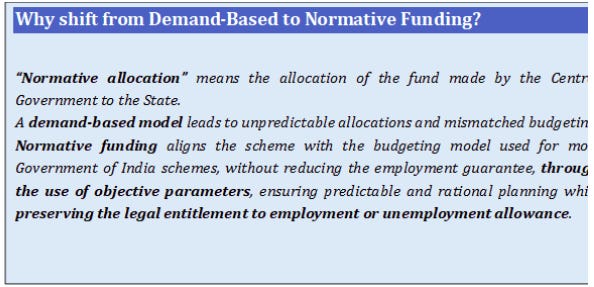
To see its true impact on states, PRS Legislative Research asked a simple question. Suppose states provided exactly as much work as they did in 2025–26, at exactly the same wages. What would they have paid under the new rules and proposed formula? Their combined bill would have risen from ₹5,261 crore to about ₹33,000 crore. That’s roughly six times as much before a single household gets an extra day.
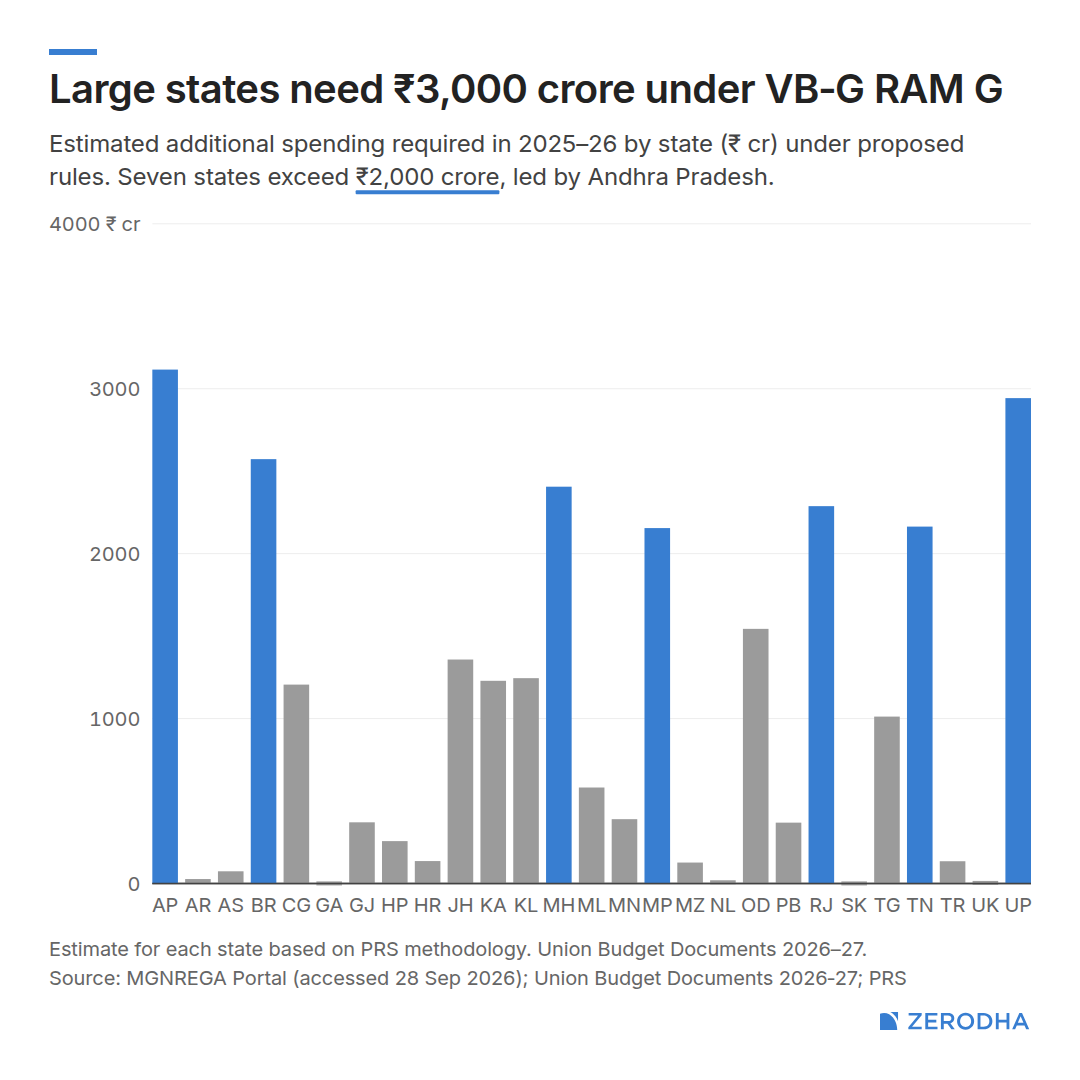
Take Bihar. In the PRS calculation, Bihar would have received enough central funding to cover the Centre’s full share. Yet paying its own 40% would have cost it ₹2,971 crore, up from the ₹398 crore it actually spent. Bihar would have had to find roughly ₹2,600 crore more simply to provide the same work.
Andhra Pradesh shows what happens when a state also runs up against its allocation. A straight 60:40 split would have put the Centre’s share at ₹4,675 crore. The proposed formula gave the state ₹4,038 crore. Andhra Pradesh would have had to cover the missing ₹637 crore on top of its usual 40%. These are estimates, but they show why the same rules can leave two states facing quite different bills.
From the second year, the proposed rules could also link part of a state’s allocation to its performance, including whether it pays wages on time. That gives officials a reason to fix delays. But if a state is already behind because it lacks money or staff, a smaller allocation could make catching up harder.
Now picture a drought halfway through the year. More families need work just as their state runs through its allocation. The Centre can grant relaxations during a natural calamity, including additional employment. Unless it steps in, the state must find the extra money itself.
We can therefore see ourselves how a funding squeeze can reach a worker. Under MGNREGA, delayed or inadequate releases held up wages in Uttarakhand. By March 2024, the state also had ₹122 crore in unpaid bills for materials, skilled wages and taxes. That was under the old funding arrangement. Under the new one, a state facing a shortfall has a further incentive to limit works or discourage requests. Whether states act on that incentive is a question for the evidence.
What the early numbers show
Nearly five months in, what can we see? In August, the government said over 98% of households recorded as seeking work had received an offer. A family that asked for 20 days and was offered five would count among that 98%. A family whose request went unrecorded would be missing altogether.
In September, the number of households asking for work rose 34% from a year earlier, even as the total days of employment generated fell. Both can happen if more families each work fewer days. To know whether families wanted fewer days or states offered too few, we’d need to compare the days requested with the days actually worked, state by state.
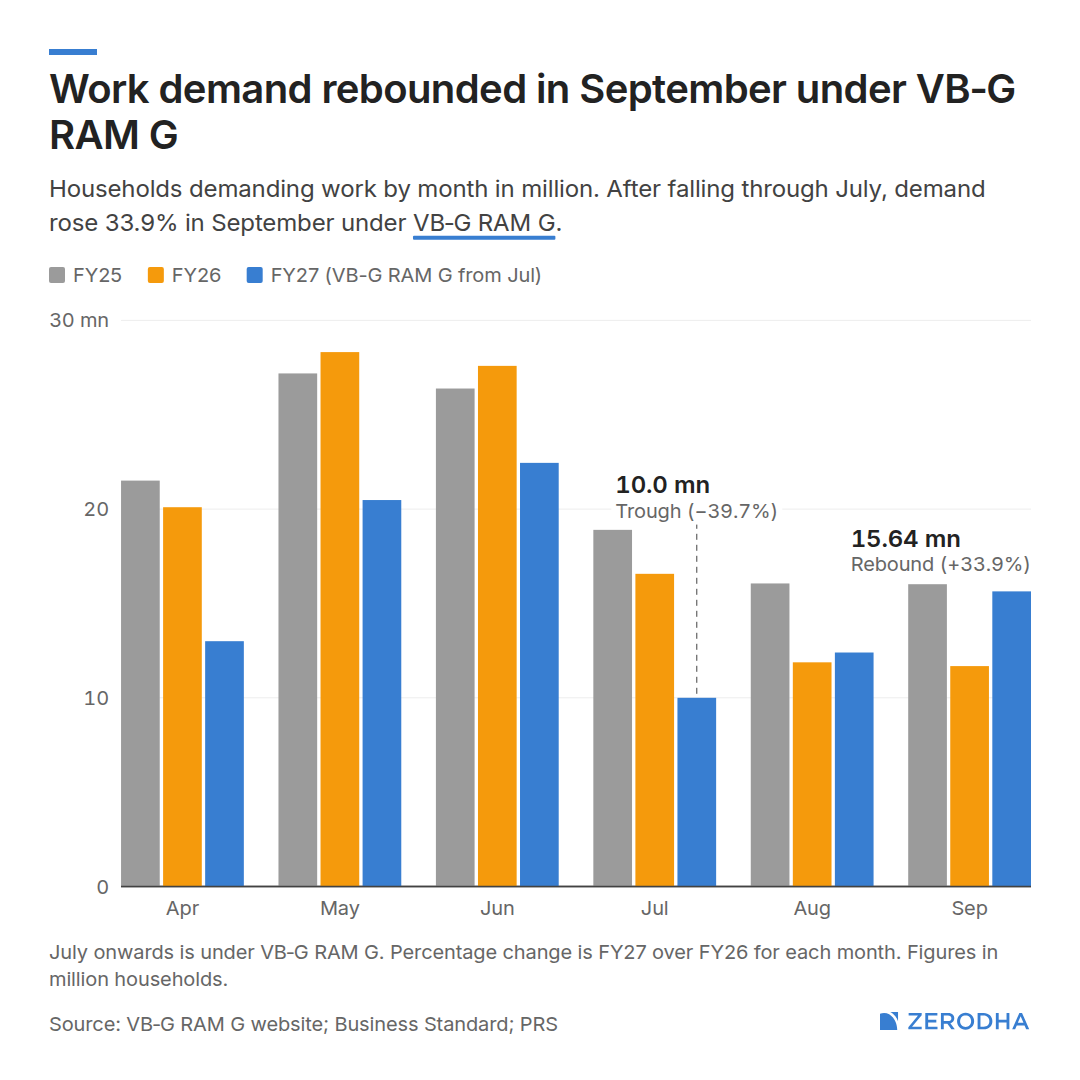
On the farm-season pause, we can already see one consequence. In July, seven states halted public works during sowing, contributing to a fall in days worked. Did those workers find jobs on farms? It’s hard to get data for that.
Research on MGNREGA helps explain why farmers might welcome the pause. The scheme raised rural wages and drew some workers away from private jobs. Yet the study found those effects mainly outside the peak farming seasons. The ministry’s own review found that around 70% of MGNREGA work in 2010–11 already took place in the lean season. That was fifteen years ago. To judge this July’s pause, we’d want to know what happened in those seven states. Did farmers fill jobs they previously struggled to fill? And did labourers get enough paid days on farms to make up for the public work they lost?
Imagine a farm labourer negotiating a day’s wage during harvest. One thing that matters is whether she can afford to say no. If public work is available that week, she has another place to earn. She might take the farm job and never spend a day on a public worksite, yet the guarantee may still have helped her get a better rate.
Now look at the 60-day pause from both sides of that conversation. The farmer hopes it will make hiring easier. The labourer goes into the same conversation with one fewer option. India has spent much of this debate asking whether 125 days are better than 100. For someone deciding whether to accept a wage this morning, the more important question may be whether today is one of them.
- This edition of the newsletter was written by Zarieus & Mridula.
Our latest Subtext episode is on UPI MDR and the various nitty-gritties of India’s digital payment infrastructure. We host Tanya Naik, who heads Pine Labs’ omnichannel business, and Naveen Chaluvandi, Chief Digital Officer of YES Bank. This is a technical conversation full of incredible insights into how UPI work.
Watch the episode on YouTube.
Tidbits:
1. India’s pulses imports surge 59% in first half of FY27
India’s pulses imports rose nearly 59% by volume and 50% by value between April and September 2026. Masoor, chana and yellow peas saw the sharpest increases as traders stocked up amid concerns that weak rainfall and El Niño conditions could hurt domestic pulse production.
Source: The Economic Times
2. FSSAI sanctions prosecution against Bisleri over unsafe water sample
FSSAI has sanctioned prosecution against Bisleri after one packaged-water sample was declared unsafe. An initial test found excess bromate, while a referral laboratory later found bromate within limits but detected PAHs; Bisleri has disputed the findings and says five other samples from the same plant passed.
Source: Reuters
3. Tata Steel strikes broader strategic deal with APL Apollo Tubes
Tata Steel will sell its tubes and colour-coated businesses to APL Apollo for ₹28,000 crore while also buying the promoter group’s 26.6% stake in APL Apollo for about ₹15,510 crore. It will also launch an open offer for another 26%, with the transactions subject to regulatory approvals.
Source: Business Standard
4. VinFast to manufacture electric scooters in Tamil Nadu, eyes early 2027 launch
Vietnamese EV maker VinFast is setting up a dedicated two-wheeler production line at its Tamil Nadu manufacturing facility, with plans to launch two electric scooter models in India in early 2027. The company aims to scale annual capacity up to 1 million electric two-wheelers depending on market demand and has already signed contracts with more than 50 dealers across 34 cities.
Source: Inc42
5. India becomes Suzuki Motor’s biggest growth engine in H1 FY27
India accounted for 62.2% of Suzuki Motor Corporation’s incremental global automobile revenue in the first half of FY27, with revenue from Maruti Suzuki rising 28.9% year-on-year to 1,390.7 billion yen (₹82,000 crore). India’s share of Suzuki’s global automobile revenue climbed to 45% as domestic sales volumes jumped 31.6% to 1.15 million units, supported by strong demand following last year’s GST cut on small cars.
Source: Financial Express
Want more tidbits? Catch up on last week’s recap!

Beyond Today’s Brief
There’s always more happening at Markets by Zerodha.
The Chatter: Why is PM Modi urging corporate India to pivot toward pharma APIs, speciality metals, and Global South machinery, while CEA V. Anantha Nageswaran sees India nearing $1 trillion in exports and acting as a safe haven from global AI volatility? And how are IBM, Tata Technologies, KEI Industries, and Canara Bank navigating autonomous AI agents, 20% margin targets, and ₹30,000 crore data centre cable opportunities?
Aftermarket Report: How did Nifty and Sensex extend their winning streak for a fourth straight week, with Nifty rising 2.6% to 25,801 as Bank Nifty surged nearly 6% and FIIs poured ₹34,686 crore into Indian equities? And what do steep drops in gold and silver, 305 new 52-week lows, and a Fear & Greed reading of 71 signal ahead of monthly expiries?
Join us on WhatsApp, where we share interesting soundbites from concalls, articles, and everything else we come across throughout the day. You’ll also get notified the moment a new video or article drops so that you can read or watch it right away.
Thank you for reading. Do share this with your friends and make them as smart as you are 😉