


Our goal with The Daily Brief is to simplify the biggest stories in the Indian markets and help you understand what they mean. We won’t just tell you what happened; we’ll tell you why and how too. We do this show in both formats: video and audio. This piece curates the stories that we talk about.
You can listen to the podcast on Spotify, Apple Podcasts, or wherever you get your podcasts and watch the videos on YouTube. You can also watch The Daily Brief in Hindi.
In today’s edition of The Daily Brief:
1. Can AI talk the way India does?
Voice AI is rapidly moving beyond text chatbots to automate phone conversations across Indian banks and NBFCs at roughly one-third the cost of human telecallers. While startups like Sarvam and Gnani.ai race to overcome regional accent accuracy and sub-second latency hurdles, commoditized outbound calling has already sparked fierce price wars. Ultimately, major lenders like Bajaj Finance and Axis Bank hold the strongest leverage by owning proprietary customer call recordings, driving billions in bot-originated loan disbursals even as new TRAI spam regulations mandate bot disclosure.
2. Why tile profits rose as factories shut
Disruptions in West Asia doubled gas costs in Morbi—India’s ceramics hub—and choked export freight, forcing nearly 35% of local factories to shut down rather than dump unsold inventory domestically. This supply crunch forced unorganized Morbi manufacturers to hike prices by up to 40%, narrowing the historical price gap with branded giants like Kajaria and Somany. Shielded by contracted fuel supply outside Gujarat, branded tile makers expanded volumes and tripled profits, though Cera Sanitaryware missed the windfall due to surging brass costs in its core bathware segment.
Can AI talk the way India does?
For many Indians, using their voice online is much more than mere convenience.
India has 22 scheduled languages, written in different scripts from Devanagari to Tamil. Typing in them remains a barrier for native speakers and readers, since it means navigating different keyboards. The smartphone is still mostly optimized for QWERTY.
So, you might feel like using the voice note feature on WhatsApp instead. While Meta has never revealed exact numbers on usage, as per some surveys, India uses voice notes more than most countries in Asia.
Now, so far, much of the AI buildout has focused on chatbots and text. But voice AI is catching up fast, already changing some familiar rituals. Have you ever called customer care, which would then ask you to “press 1 for Hindi”, “2 for English”, “3 for a human”, and then have you wait through painfully cheerful elevator music? Voice AI replaces all of that with a phone conversation in, say, Hindi, Tamil or a mix of both.
Voice AI has already begun to make its dent in business outcomes, especially inside some of India’s biggest banks and NBFCs, like Axis Bank and Bajaj Finance. And dozens of Indian startups want a piece of this market.
Today, we look at what it takes for AI to hold a phone call the way Indians actually speak.
A quick note: we’ll mostly be looking at AI that holds live phone conversations, not apps that transcribe meetings or dictation, like Granola or Wispr Flow.
How does AI hear and speak?
In ChatGPT, you type a question, and the LLM generates an answer by predicting the next token.
But voice AI has an extra challenge. It needs to understand what you’re saying and respond fast enough to feel like a human conversation, which standalone LLMs can’t do effectively. For this, the most common approach today is to use three AI models working together in a relay.
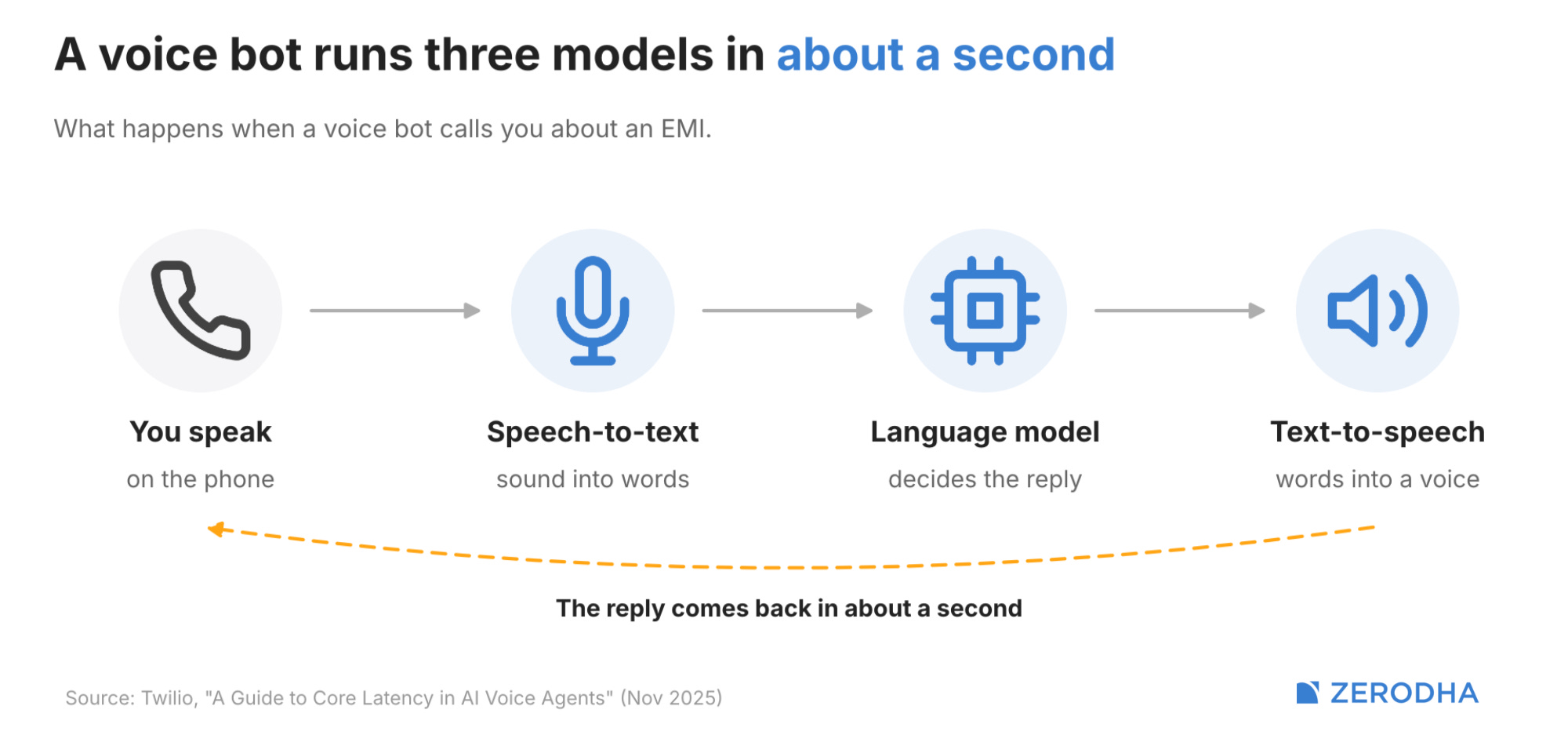
In the first step of the chain, a speech-to-text model (STT) turns someone’s spoken word into written words. Then, those words go to a standard LLM (like Opus 5.5), which works out what the person speaking meant, checks it against the context and rules it has been given, and writes back a reply in text. Lastly, a text-to-speech (TTS) model then turns that reply back into voice.
Simple enough, but the catch with using three AI models in a relay is time. One person talking to another has fairly quick back-and-forth actions and reactions. We barely notice when a chatbot takes time to reply. But three seconds of silence on a phone call with a voice AI bot is awkward. Every turn in this relay adds delay to the phone call, which the industry calls latency.
There’s another approach to voice AI, which isn’t mainstream in India yet due to limited Indian-language support and high costs. Instead of using three models, companies like OpenAI and Google have built just one direct speech-to-speech model to do all the heavy-lifting.
Beyond latency, there’s also the problem of understanding what is being spoken.
You see, traditional telephone audio carries around 8,000 samples of sound every second.
The STT model chops that stream into slices a few milliseconds long and turns each one into a picture of which frequencies are present and how loud they are. The model learns which pattern means which sound.
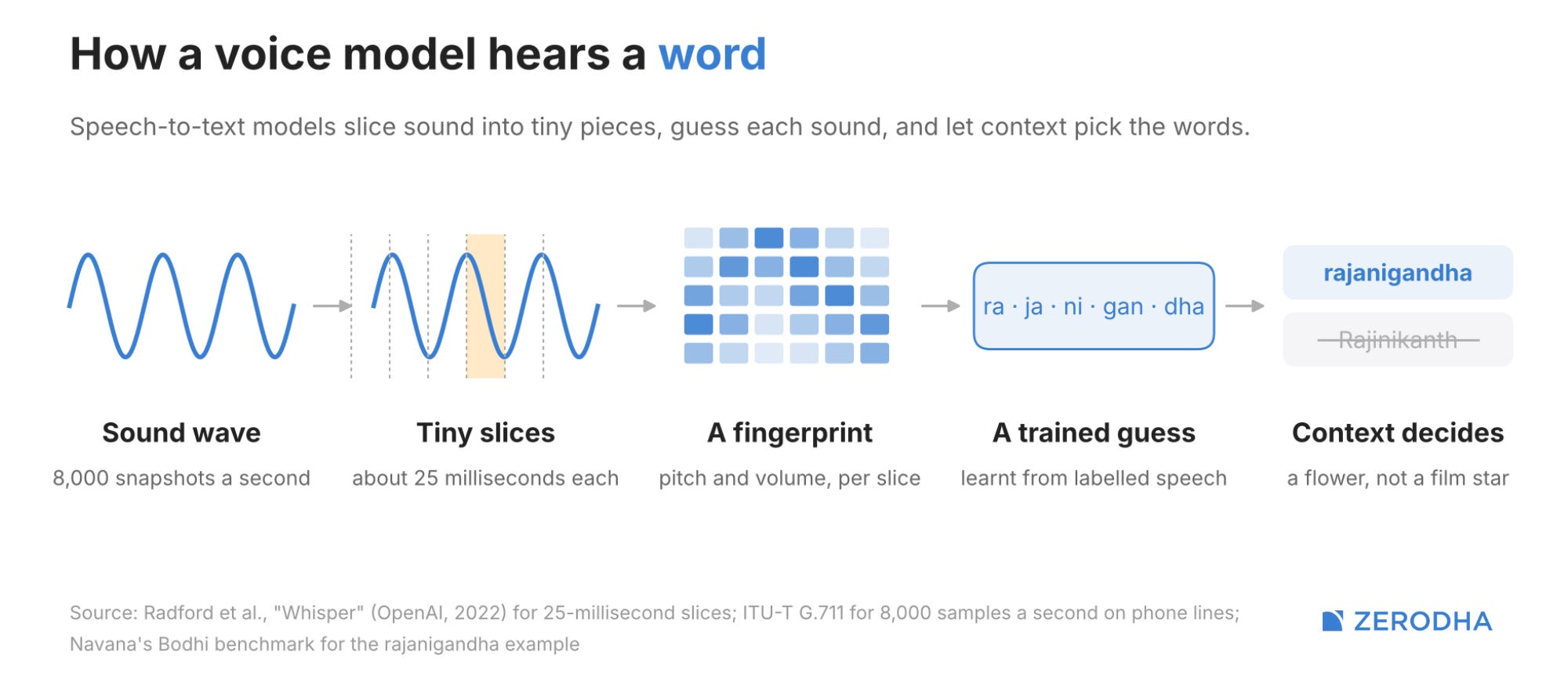
For instance, in one test of Bengali speech published by a voice AI startup called Navana, competitor voice AI agents heard rajanigandha, the word for the tuberose flower, as “Rajinikanth”, the legendary Tamil actor. Imagine if, on a loan collection call, ₹15,000 was confused with ₹50,000.
This is where training data comes in. A speech model learns from recordings of people speaking, paired with accurate transcripts.
Take OpenAI’s Whisper. Its original training dataset contained 6.8 lakh hours of audio, with 4.38 lakh English-speech hours paired with English transcripts, and another 1.26 lakh hours contained translations, Only the remaining 1.17 lakh hours contained non-English speech paired with transcripts in the original language, spread across 98 languages.
That means Indian languages are poorly represented in large datasets like these. And text isn’t enough, either; models need recordings of people actually speaking across different accents, dialects and noisy environments, along with accurate transcripts.
That’s the humongous problem Indian startups have set out to solve.
Who’s building India’s voice bots, and what do they compete on?
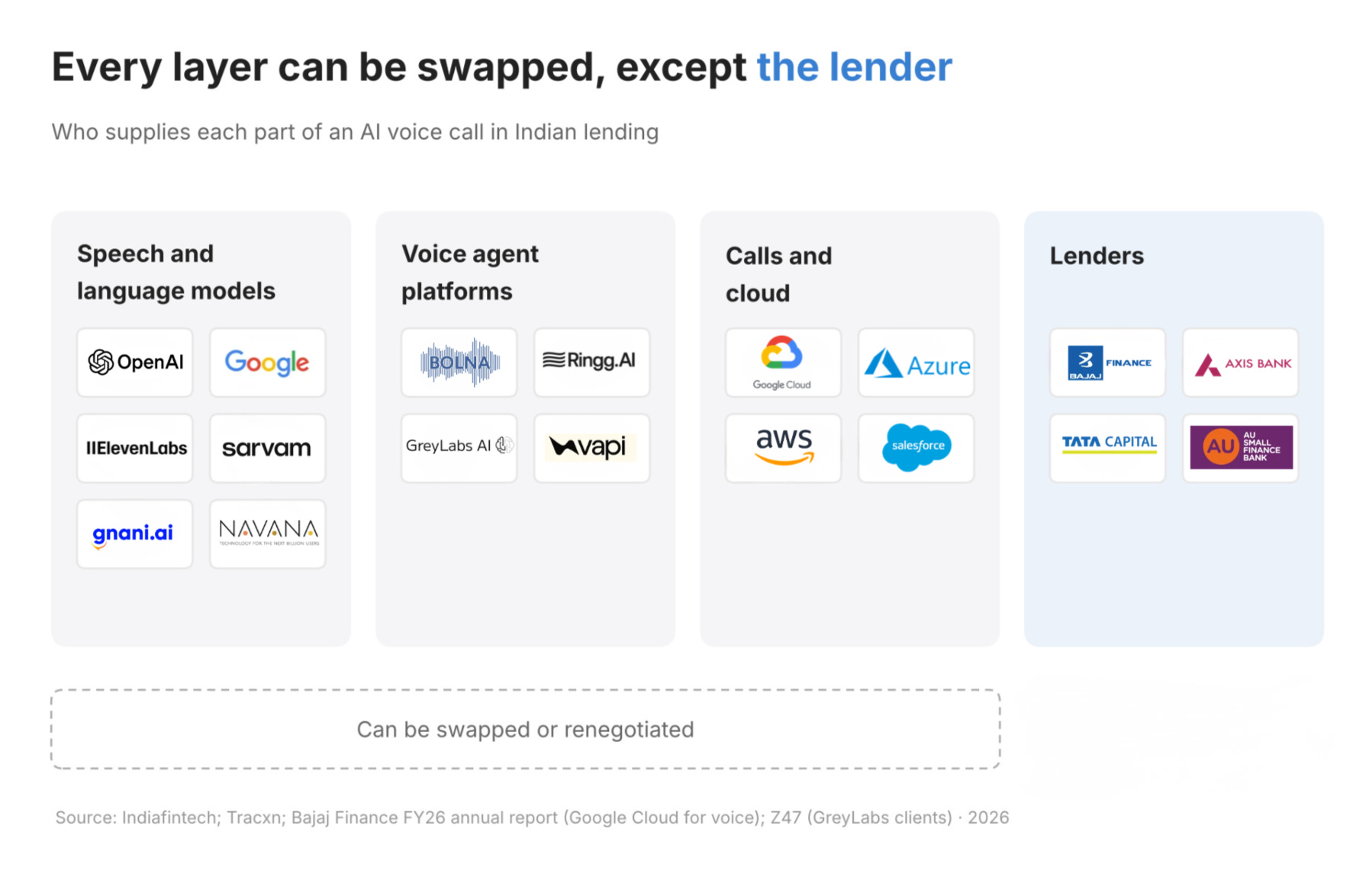
As per data from Tracxn, 34 companies are currently building AI for India’s languages. Among those working on voice, a few, like Sarvam, Gnani.ai, and Navana, build their own speech models. Others like Bolna and Ringg.AI build platforms that stitch other companies’ models together into working voice agents.
Their pitch to companies is simple. A voice AI agent can make routine phone calls to sell loans or chase payments for less than a human. As per Bajaj Finance, a voice AI agent costs about a third of what a human one does.
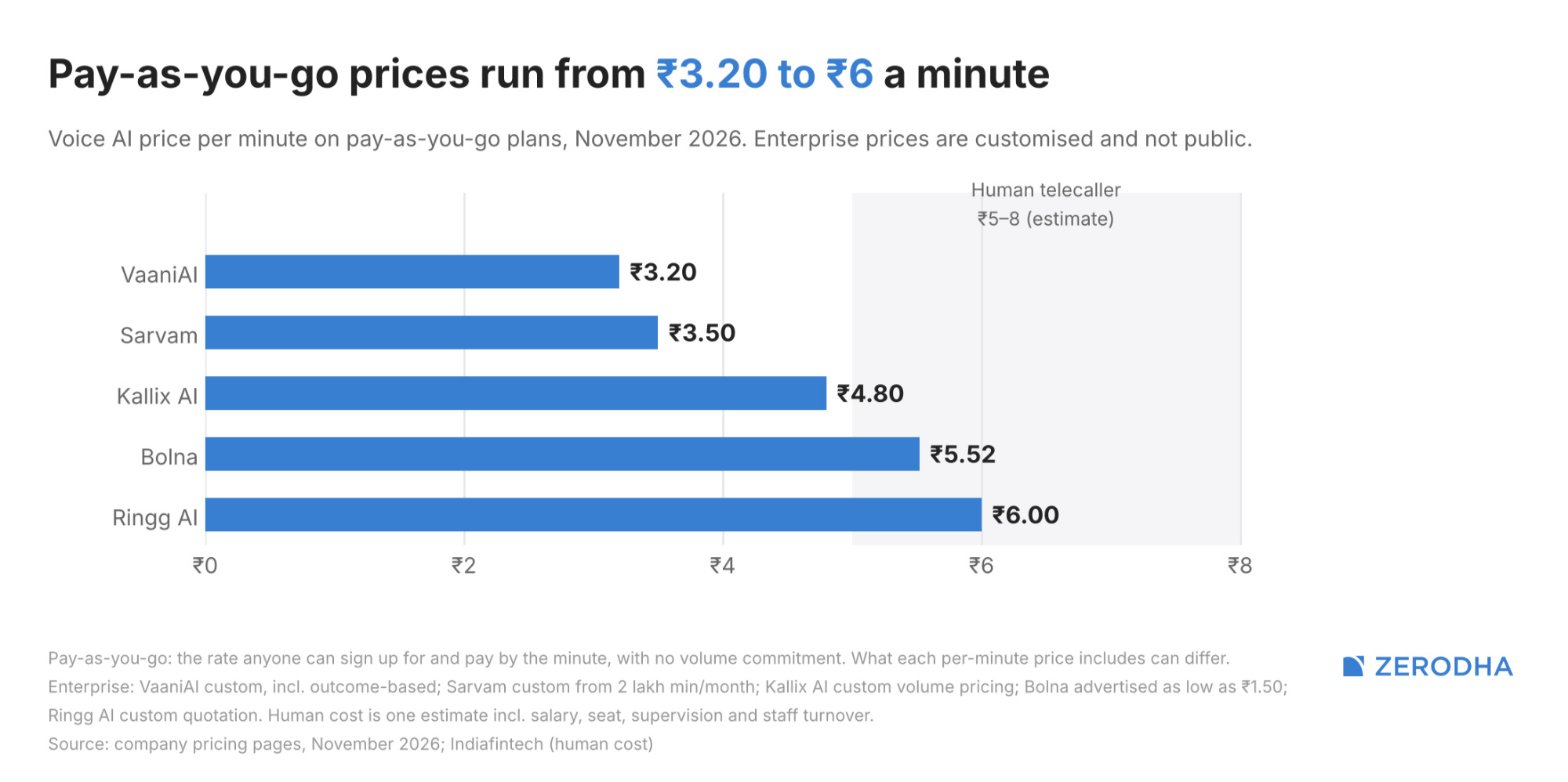
How so? One estimate by voice startup Voxturn puts actual talk time for a human at ~90-120 minutes a day. Add the desk, the supervisors, and the cost of replacing the 30-60% of telecallers who quit every year, and the same estimate puts each minute of human conversation at ₹6-10. By contrast, a large company buying AI calls in bulk from a startup can pay as little as ₹1.75–2 a minute.
Now, you can buy these enterprise plans that are cheaper. Or, you can go for pay-as-you-go plans, where anyone can sign up online and pay by the minute, much like a prepaid phone plan. On these plans, prices run from ~₹3 to ~₹6 per minute.
However, even at a fraction of the cost, the savings in India is smaller than other countries, since labour is already cheaper here. In the US, for comparison, a voice agent can be ten or more times cheaper than a person. Currently, that makes it harder for Indian voice AI providers to cut prices further.
Meanwhile, startups also have high costs. For every minute of a call, they pay for both the phone line and the models underneath. The cost is higher for startups that rent most of their stack. Gnani.ai’s CEO, Ganesh Gopalan, stated that such “aggregators” struggle to make money because every layer carries an outside cost. Building your own isn’t cheap either: Ringg started out as a TTS company, but found training its own speech models too costly.
That leaves just the lever of quality to stand out. One measure of quality in voice AI is latency, which we just mentioned above. Accuracy is another measure; it is tracked using a metric called word error rate (WER), which is the share of words a model gets wrong.
Global leaderboards mostly test WER for English, but for Indian languages, companies largely publish their own tests. Sarvam says its Saaras v3 model beat OpenAI on IndicVoices, a public benchmark of Indian speech, while still getting about one word in five wrong.
This makes it hard for a buyer to tell vendors apart, and it comes back to price. Ring found that basic outbound calling and loan collection weren’t particularly sticky businesses because these are highly-commoditized already. Meanwhile, relationship-heavy work like wealth management still largely stays with humans. The calls startups are trusted with are also the easiest to move to another vendor. That’s why the sector has, by some accounts, already started seeing price wars.


One moat lies in integration. For a bank, a voice agent is only useful if it’s wired into the bank’s systems. It has to see a borrower’s loan details, record a promise to pay, send a UPI payment link during the call, all the while following RBI’s rules. Building all that takes months for each new customer, which is why these startups are selling more like service firms than software companies.
Who’s using Voice AI the most?
This is also where the biggest and first adopters of voice AI in India, banks and NBFCs, come into the picture. After all, they make a huge number of calls, and each has an outcome they count: a loan sold, or an EMI collected.
Bajaj Finance, India’s largest NBFC, has disclosed the most about how’s that going, and its start wasn’t smooth.
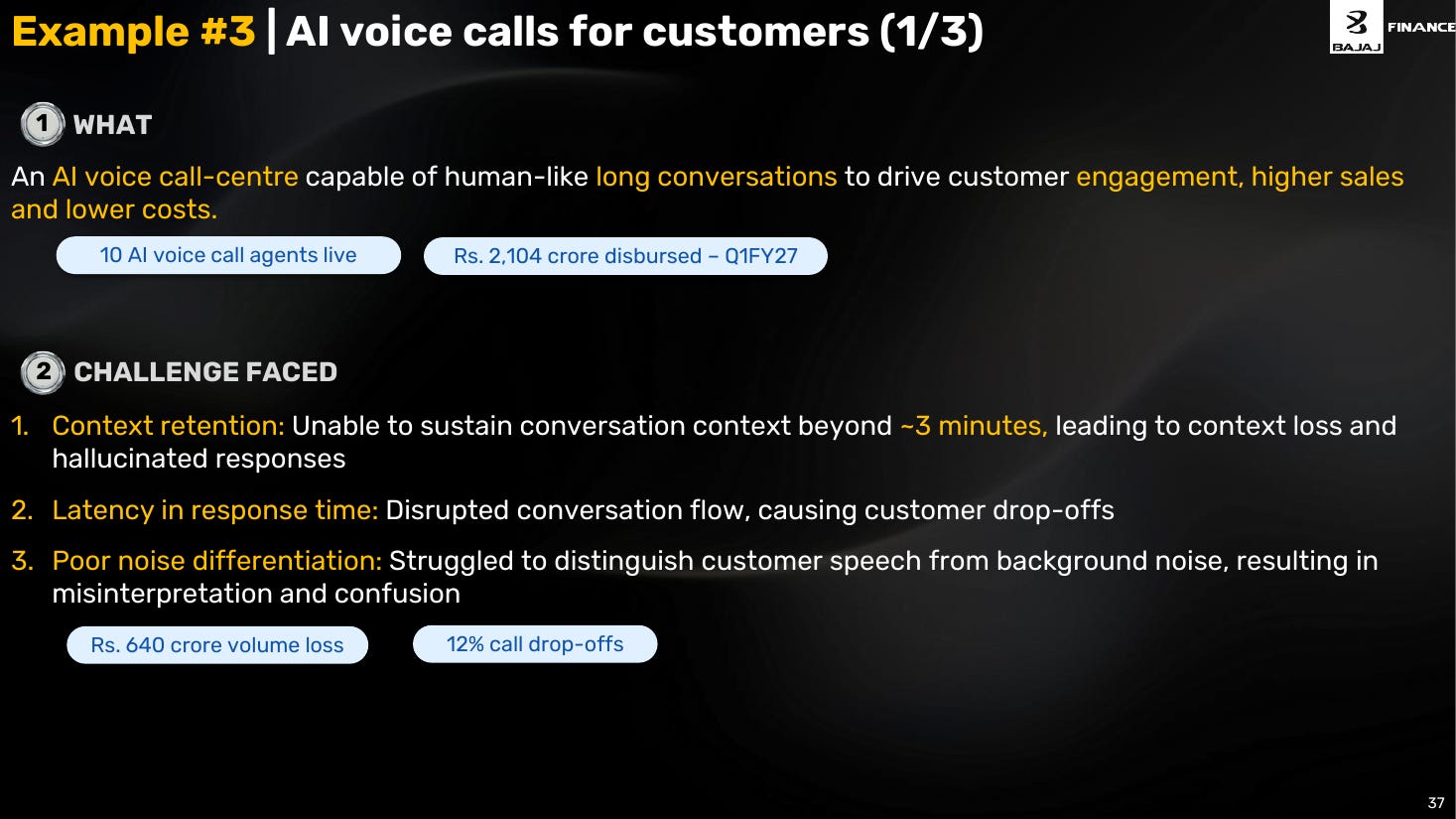
Initially, their voice bots lost track of conversations after about three minutes, paused too long before replying, and struggled with background noise. About 12% of calls dropped, because of which it lost potential business worth ₹640 crores.
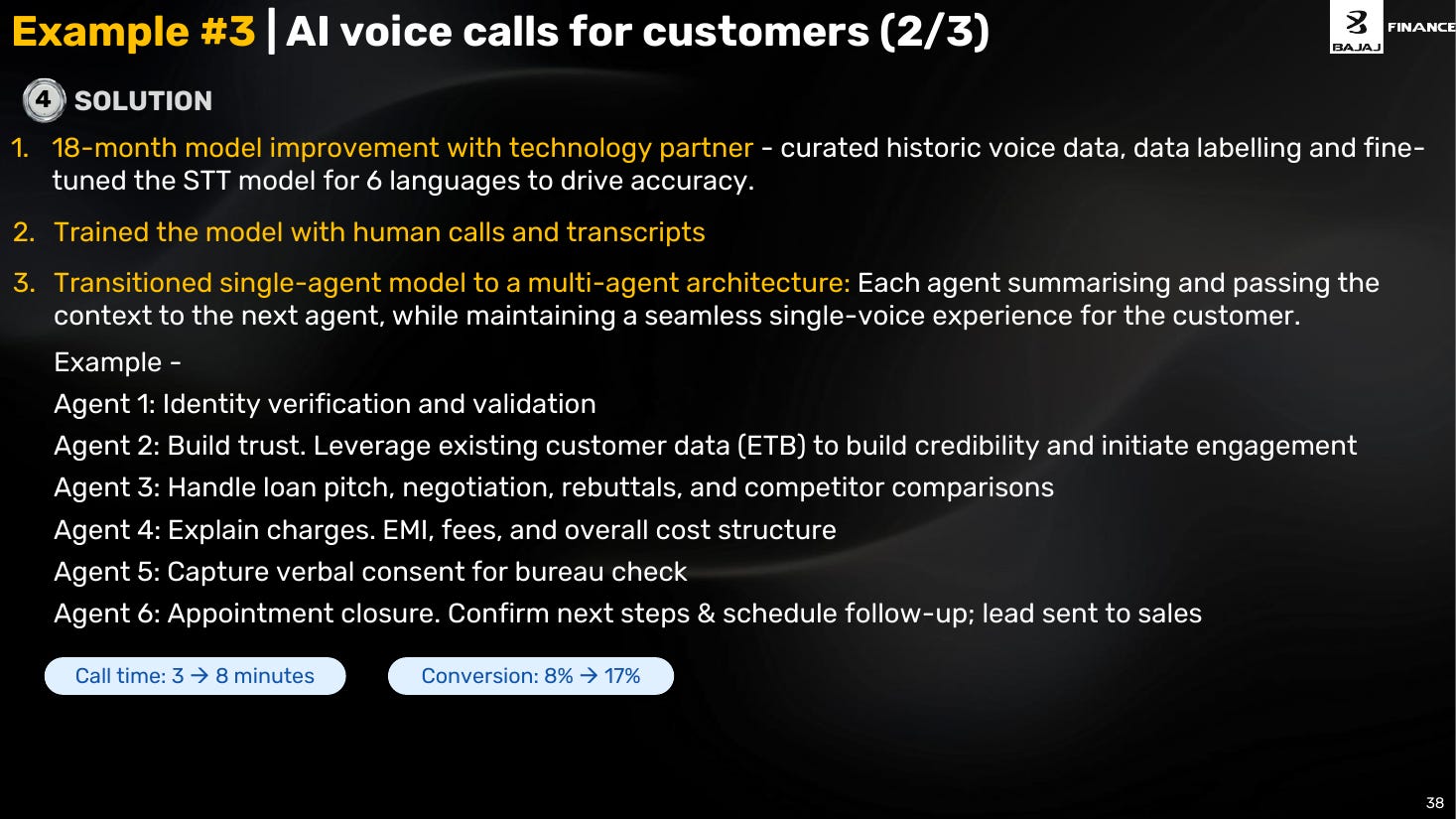
But Bajaj kept at it. Over 18 months, working with an unnamed technology partner, it retrained its STT model in six languages on its own past calls. Its bots’ conversion rate has since roughly doubled, from 8% to 17%.
The AI bots now do most of the work that people used to do. On Bajaj’s April 2026 earnings call, managing director Rajeev Jain said the company once had 5,000 outbound calling (human) agents. Now, 30% of the agents it has left are AI. But we can’t yet fully confirm how many jobs the bots have taken over in Bajaj.
The bots are also being tied to material business outcomes now. Of the ₹2,551 crore of loans that came from leads generated by Bajaj’s voice and text bots in April-June 2026, ₹2,104 crore came through voice bots alone. Bajaj doesn’t say how much the bots add to its earnings, but there is an important metric at the end of it.
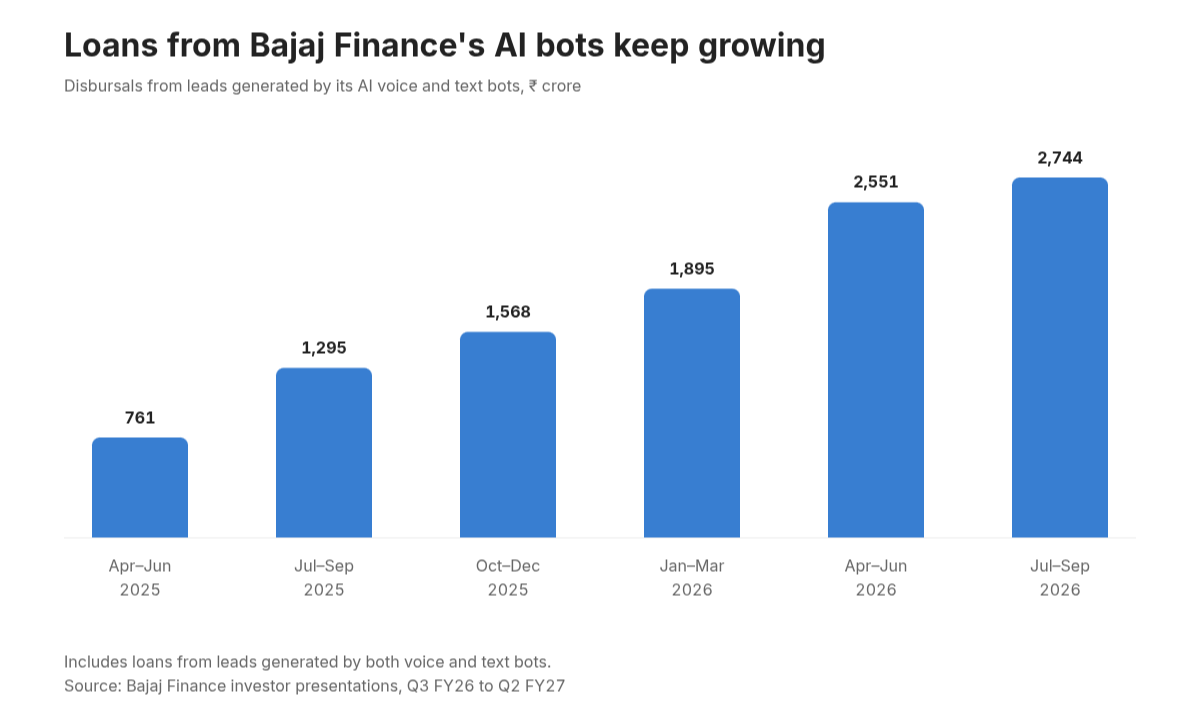
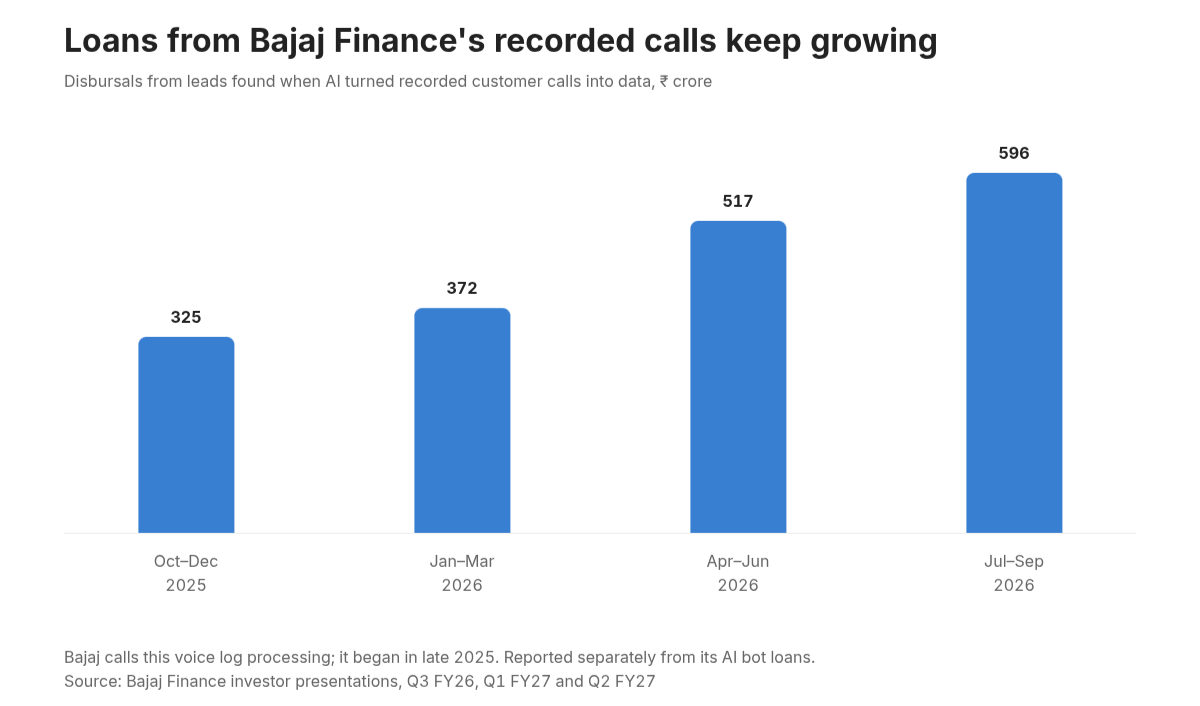
Bajaj also uses AI not merely to talk to customers, but to listen to them. It runs AI over recordings of customer calls and turns them into data that flags who might want a loan. In July-September 2026 alone, it turned 56 million customer voice interactions into data this way, and loans from leads found this way amounted to ₹596 crores.
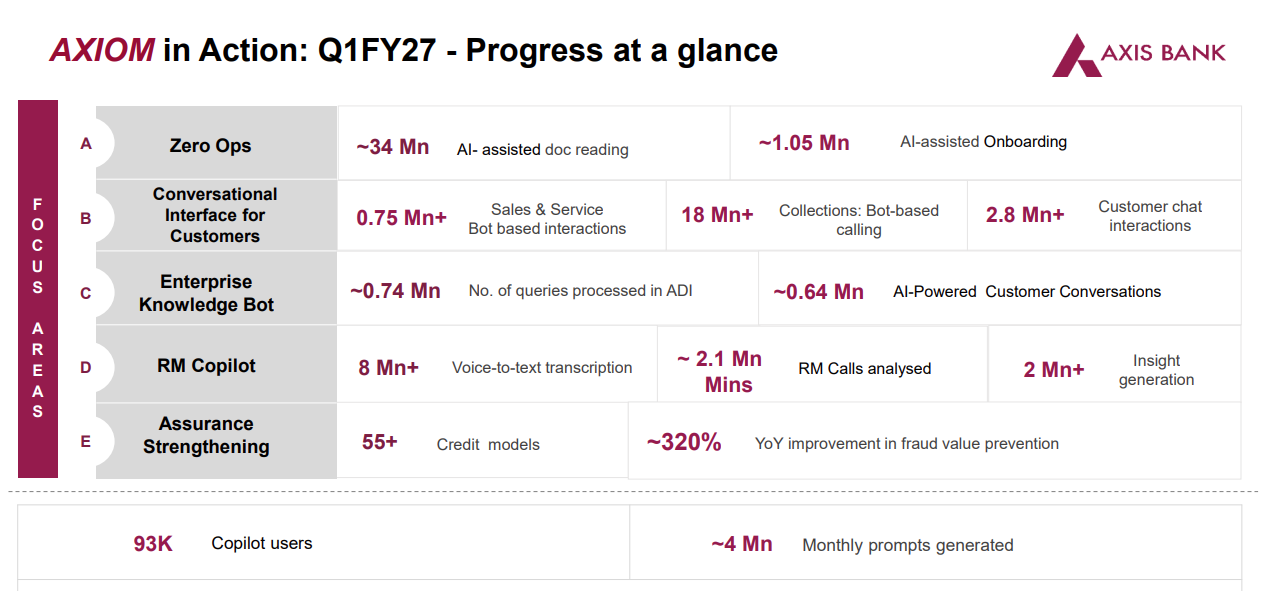
On the bank side, Axis Bank runs its AI work under a bank-wide programme called AXIOM, which covers document reading, voice and more. In Q2 this year, voice bots led 60% of Axis’ collection calls and more than 2.5 million sales calls. In Q1, its bots made more than 18 million collection calls. But it hasn’t said what any of this saves or earns.
In this, what both Bajaj and Axis retain irrespective of whichever vendor powers the voice are the calls themselves. Those recordings, and whatever can be learnt from them, usually sit with them, not the startups.
But what about the voice AI market beyond Indian finance? How big is that, really?
Well, that’s the problem. The work voice AI currently does is the repetitive, low-value kind. And there are only so many customers that are willing to spend money at scale to automate that work. As per two venture investors, only about a hundred companies in India are large enough to sign big voice AI contracts, and that’s mostly banks, insurers and government services. Even those rarely hand all their calls to one vendor to avoid dependence.
Even among potential customers, adoption is very limited. A NASSCOM survey of over 140 organisations found that only 13% had scaled voice AI across multiple customer journeys.
The voice on the line
Voice AI has very measurable business outcomes already. But the story so far has been one of a lot of supply chasing demand that’s relatively much less, even if growing.
Startups have to compete on price, and enterprises haven’t yet handed over complicated tasks. The models can be rented and the vendors swapped, while years of data with a bank’s own customers can’t be bought anywhere else. That’s why, at the top of the market, the stronger hand seems to sit with banks and NBFCs like Bajaj and Axis.
Meanwhile, the rules are catching up, too. In September, TRAI changed its regulations so that businesses must tell their telecom operator in advance about any calls placed by software, including those using artificial voices. Undeclared calls will be treated as spam. The next time your bank calls about an EMI, there’s a fair chance the voice on the line is AI. Soon, the network will at least know which ones are.

Why tile profits rose as factories shut
In March, Morbi ran short of fuel. It’s a city in Gujarat famously called “Ceramics Capital of India”. The war in West Asia choked off the propane and natural gas that fire the kilns there, and by 31 March, only 83 of its roughly 800 ceramic units were still running.
Yet when the July to September quarter ended, India’s big branded tile makers reported sharply higher profits.
These two things are connected. Tiles are pressed from clay and baked in kilns for hours, so energy is one of the biggest costs in the business. Morbi makes nearly 90% of India’s ceramic tiles and sanitaryware. Branded companies like Kajaria and Somany compete with these factories, run their own plants elsewhere, and also buy tiles from Morbi to sell under their own names.
When we last wrote about this sector in September 2025, the problem was too many tiles. Morbi was making more than the market could absorb, which kept prices low and squeezed the big brands. This quarter looks like the reverse. So has the industry turned a corner, or did a war simply hand a few big players an advantage they may not keep?
Same quarter, very different results
Look at the latest results and you can see what we mean. Kajaria Ceramics, India’s largest tile maker, grew revenue by about a quarter and net profit by more than 40%. Somany Ceramics grew revenue just as fast, and its profit more than tripled.
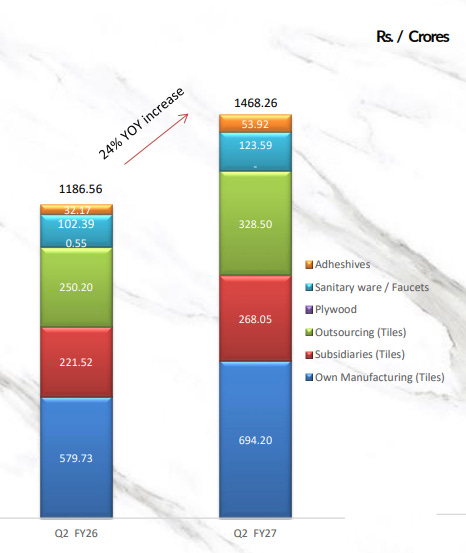
Neither got there by selling many more tiles. Somany sold only about 5% more, partly because some of its plants were down for upgrades in July and August, so most of its growth came from higher prices. Kajaria sold 10% more, so for it the split was roughly half volume, half price.
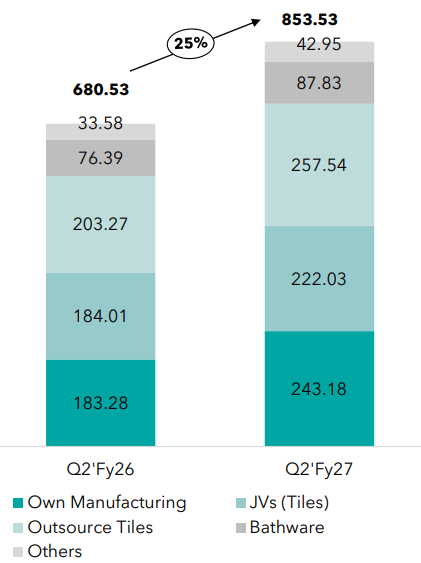
Cera Sanitaryware, which mostly sells toilets, washbasins and taps, is the odd one out. Its revenue grew even faster, by 27%, yet its profit slipped slightly. It was the only one of the three without a blockbuster quarter, because its costs rose on two fronts at once. We’ll get to that later.
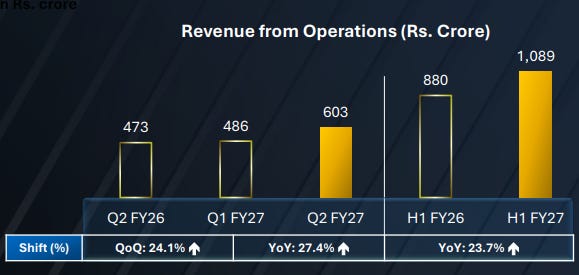
So all three sold more, but not all of them kept more of it. What decided who did was where each company made its products, and what that cost once the war began.
It started with the fuel bill
More than half of Morbi’s factories ran on propane before the war, and from 9 March the government also capped how much piped gas each industrial user could draw. Factories restarted through April on piped gas, and by mid-May more than 670 were running again.
But they were running at a very different cost. Piped gas in Morbi now costs nearly twice what it did before the war. Propane came back from July and many factories switched back to it, but by late October it had become almost as expensive. Coal isn’t an option either, since a 2019 National Green Tribunal order shut the coal gasifiers Morbi once used.
Kajaria largely escaped this squeeze. It does own three plants in Morbi through subsidiaries, and raised prices there by 18–19%. But most of its capacity is in the north and south, where it kept getting gas from GAIL at contract prices well below Morbi’s, and its northern plants run partly on biofuel. Somany sits in between. Its biggest plant is in Haryana, but most of its joint-venture plants are in Morbi.
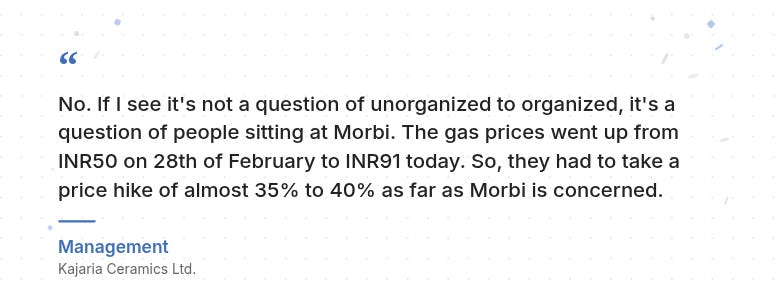
For a sense of what Morbi-style costs did to a profit line, look at Gujarat-based Asian Granito. Its revenue grew 19%, but its power and fuel bill rose 53%, and its profit fell about 75%. Morbi’s smaller makers had even less cushion, and Kajaria described what that did to their prices.
Then exports seized up
The same war hit Morbi’s demand side. Exports make up about a quarter of the industry’s sales. Between April and July, India’s tile exports fell 34% in value and 46% in square metres from a year earlier. April alone was down 72%.
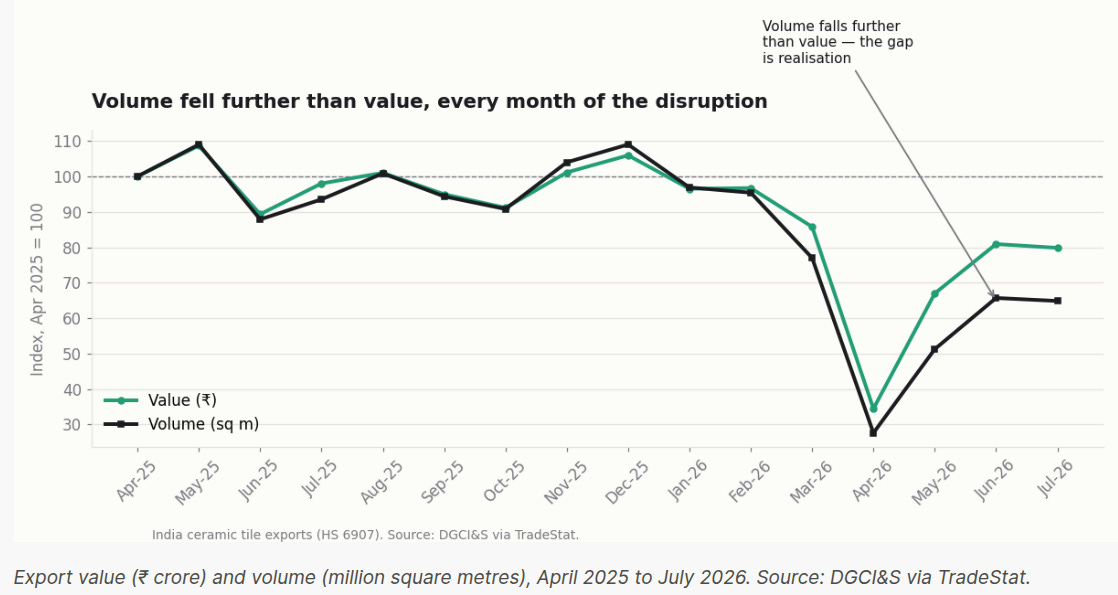
The steepest falls were in the Gulf. Exports to the UAE fell 62%, shipments to Kuwait almost vanished, and Iraq fell 95%. But the Gulf was only a small slice of India’s tile exports, so it can’t explain most of the slump. The war raised freight on most routes out of India. Shipping a container to the Middle East cost about ten times more once the war broke out, and even rates to London rose by well over half. Shipments to the US, down 36%, were also under pressure from an anti-dumping case against Indian tiles. Only Russia grew, slightly, making it India’s largest tile market so far this year.
You might expect all those unsold export tiles to flood India and drag prices down, as they did last year. That hasn’t really happened. With fuel this expensive, Morbi’s export-focused makers couldn’t afford to sell cheaply at home, so many simply shut instead.
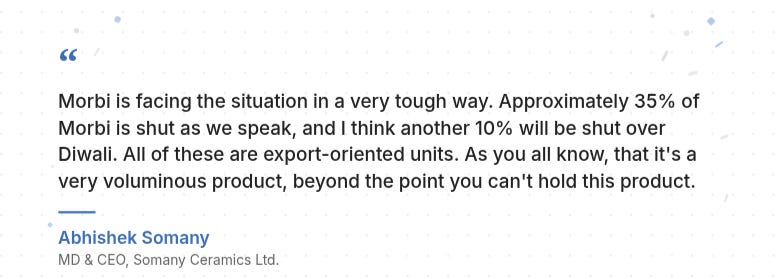
Last year’s problem was too many tiles, and the war fixed it by taking supply away.
That left the big brands with something years of competing with Morbi never got them: a smaller price gap. Morbi had to raise prices far more than the branded makers did, so a Morbi tile is no longer that much cheaper.
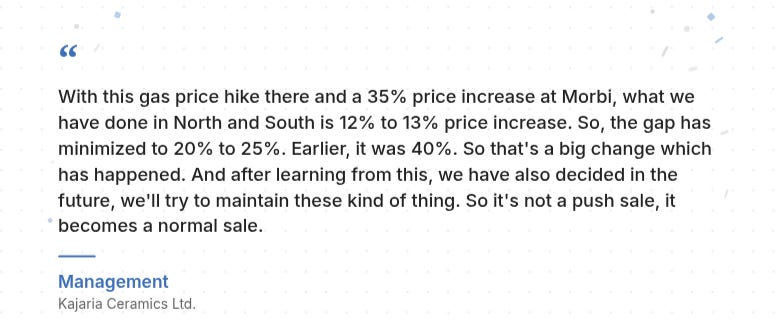
With a branded tile now a much smaller step up, Kajaria sold 10% more tiles in a market that, by its own estimate, grew only 5–6%.
Why Cera missed out
You’d expect Cera, one of the biggest names selling into the same homes and building projects, to have ridden the same wave. It didn’t, because tiles are only a small part of its business. Most of Cera’s sales come from bathroom products, and that’s where costs hit hardest. For Kajaria and Somany, it’s the reverse: bathroom products are only about a tenth of sales.
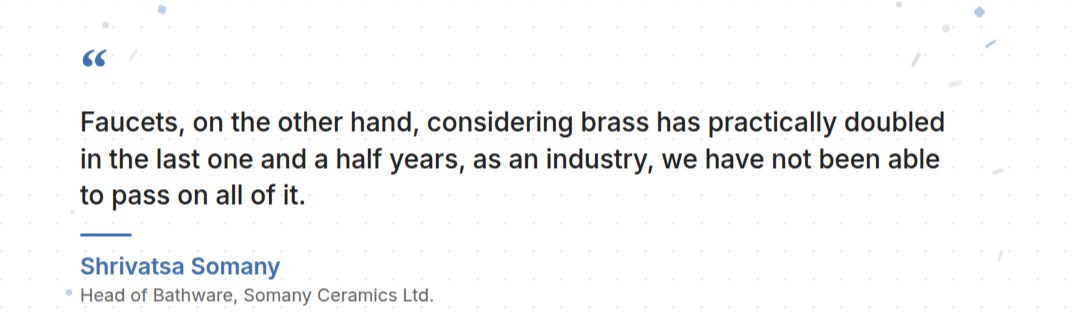
Taps, over 40% of Cera’s sales, are made largely of brass, which cost it 58% more than a year earlier. Its toilets and washbasins are ceramic too, so they felt the fuel squeeze, though less than tiles do. Cera’s own plant in Gujarat paid more for gas, and it buys about 60% of its sanitaryware from outside makers, many of them in Morbi.
Cera raised tap prices by about 8%, but only in September, too late to help this quarter. Its operating margin fell from 14.2% to 12.2%, and it now needs a much stronger second half to hit its target for the year.
Somany, which also sells taps, says the whole industry has struggled to pass on brass costs, and that pricing follows the market leader, Jaquar.
How long can the head start last?
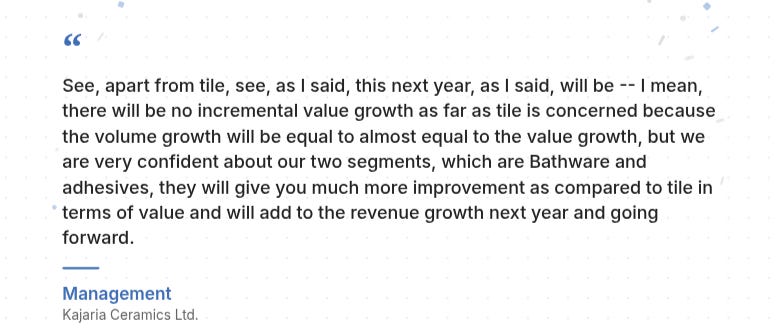
The branded makers are betting it lasts. Kajaria isn’t raising prices further, and is using the narrower gap to win buyers instead. Both are expanding plants they already own. Kajaria’s new lines in Andhra Pradesh and Rajasthan are due by mid-2027, after which it plans to buy fewer tiles from Morbi. That’s a reversal for brands that spent years outsourcing to Morbi because it was cheaper. Somany’s joint venture in the south is doubling its plant.
They also know this year’s price boost won’t repeat, so Kajaria is leaning on tile adhesive, which builders use more as tiles get bigger. It expects adhesive sales to grow from about ₹125 crore last year to roughly ₹400 crore next year.
By the time Somany spoke in early November, Morbi’s gas price had already eased a little. But it doesn’t expect fuel to fall back to pre-war levels even if the war ends.
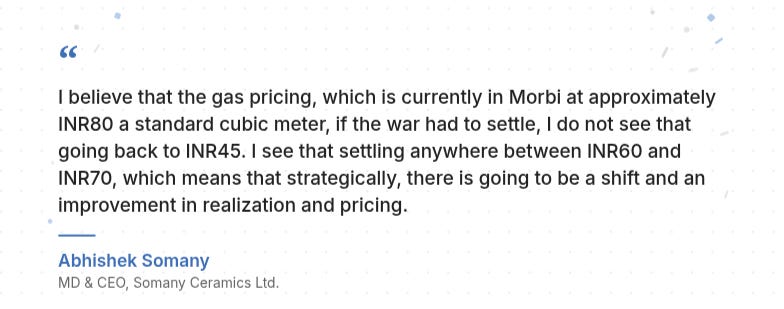
That is a forecast, and the risks run the other way. If fuel gets cheaper, Morbi can quickly roll back its price increases, and the narrower gap goes with them. The shut factories are also export units waiting for orders, and if they restart before exports recover, their tiles will land in India. Freight to the Gulf was still near a five-year high in late October, though Somany said in early November that Morbi’s exports had picked up over the past month as freight eased, with a proper restart expected only in January, after Europe’s December shutdown.
What’s done is done. The real test comes when Morbi’s costs fall, and we see whether buyers who switched to branded tiles stay. If they do, the war will have done for the big brands what years of advertising could not.
- This edition of the newsletter was written by Zarieus & Vignesh.
Tidbits:
1. Hindustan Zinc approves ₹80,000 crore plan to nearly double metal capacity
Hindustan Zinc’s board has approved an investment of about ₹80,000 crore over the next three to five years to increase its metal production capacity from the existing 1.1 million tonnes per annum (MTPA) to 2 MTPA. The company expects to reach 1.4 MTPA of refined metal capacity by FY29, following the commissioning of the integrated zinc smelter at Debari, and will also raise silver refining capacity from 800 to 1,500 tonnes a year.
Source: Business Standard
2. Why rooftop solar needs 44 times more workers than solar parks
A June 2026 CEEW-NRDC study found that a megawatt of rooftop solar puts about 45 person-years of work on the ground, while the same megawatt of a big solar park puts barely one. Much of that gap comes from selling rather than installing, with business development alone at about 17, roughly 39% of the total. Only about 13 lakh of the 44 lakh job-years projected by 2030 are long-lived O&M and manufacturing roles.
3. US moves to restrict remote access to advanced AI chips
The US Commerce Department has issued an interim rule that would require data centre operators in Singapore, Malaysia, Thailand, Indonesia and Brazil to obtain a US government licence before exporting advanced AI chips from Nvidia and other American manufacturers. The rule targets a loophole: Chinese firms are barred from importing top-end chips, but could until now legally access that computing power remotely through data centres in countries such as Singapore, Malaysia and Thailand.
Source: Bloomberg
4. India–Thailand trade rises 12.6%; UPI–PromptPay link discussed
Bilateral trade between India and Thailand grew 12.6% to $21.49 billion in FY26, according to the Ministry of Commerce and Industry, after the 14th India–Thailand Joint Trade Committee meeting. The two countries discussed improving payment connectivity through a proposed link between India’s UPI and Thailand’s PromptPay, along with local currency settlement and fintech cooperation between the RBI and the Bank of Thailand, though the link remains under discussion.
Source: The Hindu BusinessLine
5. India pitches five shipbuilding clusters to global investors
India is seeking nearly $10 billion in investment across five greenfield shipbuilding clusters at Dugarajapatnam (Andhra Pradesh), Kuchhadi (Gujarat), Dighi (Maharashtra), Kendrapada (Odisha) and Thoothukudi (Tamil Nadu), as it aims to rank among the world’s top 10 shipbuilding nations by 2030. The government has identified domestic demand for more than 400 vessels, worth nearly $24 billion, but that pipeline still needs to turn into firm orders and working shipyards.
Source: Mint
Want more tidbits? Catch up on last week’s recap!

Beyond Today’s Brief
There’s always more happening at Markets by Zerodha.
The Chatter: What is Sunil Mittal’s strategic vision for Bharti Airtel amidst the evolving telecom landscape? And how is Hitachi positioning itself to capture demand across India’s infrastructure and technology sectors?
Aftermarket Report: How did Bank Nifty scale fresh record highs above 62,000 while Nifty briefly tested 25,500 before closing near 25,400 at 25,387 amid weak global tech cues? And what do 11 gaining sectors led by PSU Banks rising 1.9%, twelve consecutive sessions of foreign institutional buying, and the Fear & Greed Index climbing to 70 indicate despite slightly negative market breadth?
Join us on WhatsApp, where we share interesting soundbites from concalls, articles, and everything else we come across throughout the day. You’ll also get notified the moment a new video or article drops so that you can read or watch it right away.
Thank you for reading. Do share this with your friends and make them as smart as you are 😉