


Our goal with The Daily Brief is to simplify the biggest stories in the Indian markets and help you understand what they mean. We won’t just tell you what happened; we’ll tell you why and how too. We do this show in both formats: video and audio. This piece curates the stories that we talk about.
You can listen to the podcast on Spotify, Apple Podcasts, or wherever you get your podcasts and watch the videos on YouTube. You can also watch The Daily Brief in Hindi.
In today’s edition of The Daily Brief:
1. The agro-mutual fund that crashed and burned
Agri-tech platform Growpital raised ₹193 crore from 5,200+ investors by promising guaranteed tax-free returns of 10%–15% on farm investments. A SEBI probe revealed the platform ran an unregistered Collective Investment Scheme (CIS) masked as LLPs, fabricating crop revenues—like claiming ₹62 crore from a 75-acre jeera plot worth at most ₹30 lakh and routing funds through shell entities.
2. The Indian Railways tries the High-Way
Indian Railways is adopting the Hybrid Annuity Model (HAM) to build six new freight corridors worth nearly ₹16,000 crore. Under HAM, private developers finance 60% of construction and maintain the lines, while Railways retains freight risk, runs the trains, and repays developers via annuities—allowing it to defer upfront capital costs while sharing construction risks.
The agro-mutual fund that crashed and burned
Another day, another case of fraud under SEBI’s trained, keenly-looking lens.
The subject of this SEBI investigation is Growpital, an agri-tech platform based out of Jaipur. It called itself “a mutual fund but a much better one”. It made grand claims of offering guaranteed tax-free returns of 10-15% per annum, with some plans seemingly going up to 18.5%. These returns were seemingly funded by growing crops.
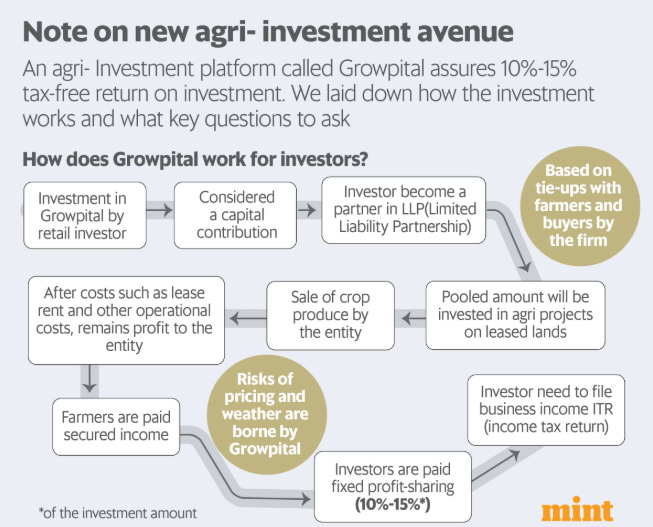
If you know anything about the market, you know that anyone claiming to provide high assured returns out of the blue is likely up to something questionable. In that spirit, an unnamed individual sent SEBI an email to look into Growpital’s mighty claims.
One such key claim was that Growpital earned ₹62 crore in revenue by selling jeera seeds from a single 75-acre plot of land in Barmer, Rajasthan. This, they said, made up 84% of their business.
SEBI executed a simple sanity check to see if this held up. As per government statistics, the average yield of jeera in Barmer is ~124 kg per acre. In 2023, mandi prices for jeera in Barmer hovered around ~₹320 per kg. Put together, the maximum possible revenue from a 75-acre plot comes out to ~₹30 lakh, give or take a few lakhs.
In any case, that’s literally a tiny fraction of the ₹62 crore claim Growpital made.
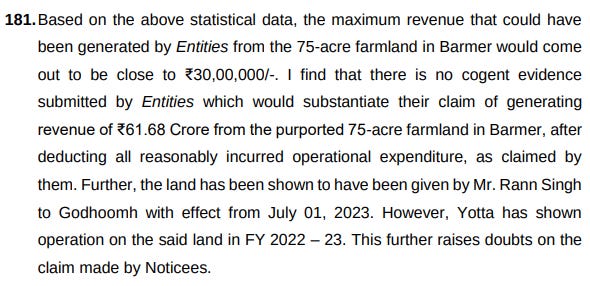
That calculation sits at the heart of SEBI’s massive final order against Growpital, its founders, and a web of 28 other entities and individuals. Between 2020 and early 2024, Growpital raised ₹193 crore from over 5,200 investors by promising them assured, tax-free returns from farming operations. SEBI found that the farms were largely fictitious, the revenue was mostly fairy dust, and the money was being routed through layers of shell entities back into a company the founders controlled.
Let’s dive into how Growpital structured its scam, and the aftermath of what SEBI found.
A not-so-mutual fund
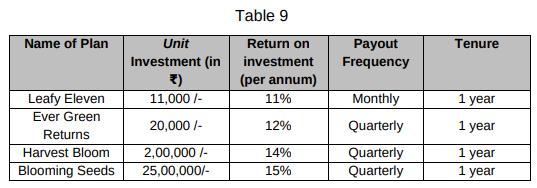
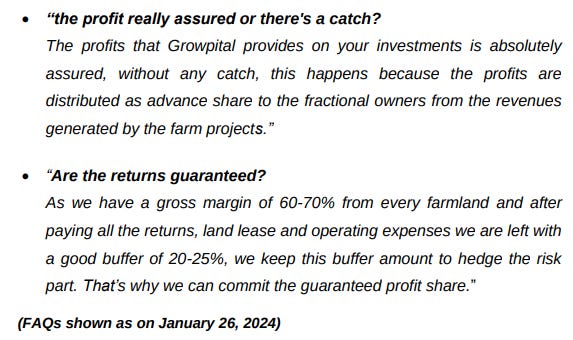
Growpital’s pitch was simple. It offered various investment plans ranging from ₹5,000 to ₹15 lakh per unit through its website and a Telegram group with over 2,700 members. The plans had names like “Leafy Eleven”. and “Blooming Seeds”. The FAQs on the website were remarkably blunt, saying: “The profits that Growpital provides on your investments is absolutely assured, without any catch.”
How could anyone guarantee such returns? Growpital had an answer for that too. The website claimed a gross margin of 60-70% from every farmland. After paying out returns, land lease, and operating expenses, they were still left with a “20-25% buffer“. This was either a secret sauce that no farmer in India had ever heard of before, or it was complete nonsense.
Any investment vehicle that pools in other people’s money is no light, low-risk establishment. You give your hard-earned capital to a manager whose job it is to grow it further. It could be anything from a mutual fund to a teak plantation that is collectively owned. Exceptions to this rule exist (like co-operatives), but only because they’re covered by other laws in India.
It makes sense, then, that SEBI requires all Collective Investment Schemes (CIS) to be registered. And a CIS, legally, has to fulfil four conditions:
Were funds pooled?
Were investors promised profits?
Was the scheme managed on their behalf?
Did investors lack day-to-day control?
By that logic, Growpital was certainly a CIS. But not only was it never registered as a CIS, but its legal structure was also cleverly designed to avoid SEBI’s radar.
In Growpital’s schemes, investors weren’t sold “securities” in the traditional sense. Instead, they were onboarded as “partners” in three Limited Liability Partnerships (LLPs). Each investor signed a consent letter, was added to an LLP agreement, and was told they were co-owners of farming projects. Partnerships are technically governed by the LLP Act, and therefore outside SEBI’s jurisdiction.
Furthermore, the consent letters told a different story. Every investor signed over all their rights and powers to Growpital. They couldn’t attend meetings, couldn’t make decisions, and couldn’t access the bank accounts. All control rested with the Designated Partners, which were two companies: Yotta Agro Ventures (the promoters’ private company) and Farm Silo Tech LLP (the entity behind Growpital). The investors were partners in name, passengers in fact.
Interestingly, Growpital maintained throughout that, unlike a mutual fund that issues “units” to investors that are tradeable, they never did the same. However, the consent letters themselves betrayed their defence, since they contained a field called “Number of Growpital Units Purchased“.
When SEBI pointed this out, the founders argued that “units” was merely an identifier used to map contributions, not a tradeable security. But SEBI, understandably, was not convinced. Under the Securities Contracts Act, units issued by a collective investment scheme to investors are securities. The consent letters proved units were issued.
What that also meant was that the company structure was really a CIS dressed up as an LLP. And this is obviously a no-no.
Record yields, ghost fields?
Now, was there a real business under this structure, no matter what it was?
Growpital’s website claimed to manage over 20,000 acres of farmland across 14 states. When SEBI asked for documentation, the founders submitted records for 13,328 acres across 34 farms in 11 states. That’s already an unexplained gap of 7,000 acres.
But worse yet was that the quality of the claims that looked proven at first sight was really poor.
Take the 75-acre plot in Barmer, from which 84% of all revenue was supposedly generated. The land belonged to a man named Rann Singh. He leased it to a company called Godhoomh Aatamakers, which then subleased it to the promoters’ private firm, Yotta.
But the lease agreement between Godhoomh and Yotta described Godhoomh as the “lawful and absolute owner“ of the land, which it obviously wasn’t. The earlier lease between Rann Singh and Godhoomh hadn’t even been signed by Godhoomh. No proof of any lease payments was provided by either party. And the documents needed to verify the land claims were never submitted.
SEBI also noted that Yotta claimed to have been operating on this land since FY2022-23. But the lease between Rann Singh and Godhoomh only took effect from July 2023. You can’t farm land before you have the right to use it.
The story was similar elsewhere. In Nagaland, the founders produced a Memorandum of Understanding with the district government for 5,000 acres of collaborative agricultural development. But zero revenue was ever generated from it. Then in West Bengal, a tea estate run through a Yotta subsidiary called Winsome Tea Plantations also produced no revenue.
Part of the defence provided by the promoters behind the zero revenue was that agricultural operations are “long-cycle”, and no harvest had matured before SEBI froze the asset. But that doesn’t explain how a 75-acre plot that could only produce ₹30 lakh worth of jeera at best somehow yielded ₹62 crore instead.
Follow the money
What about the investor money? What was it invested in if there was no farm?
SEBI traced a two-layered fund flow. First, investor money collected in the LLPs was transferred to a first layer of companies called “Supplier Entities“. From there, the money moved to a second layer called “Revenue Entities“. Funds were then moved from the second layer to Yotta. Investor money eventually landed in the hands of the promoters through two layers of intermediaries, with fabricated invoices creating a paper trail along the way. Nearly ₹96 crore moved through this pipeline.
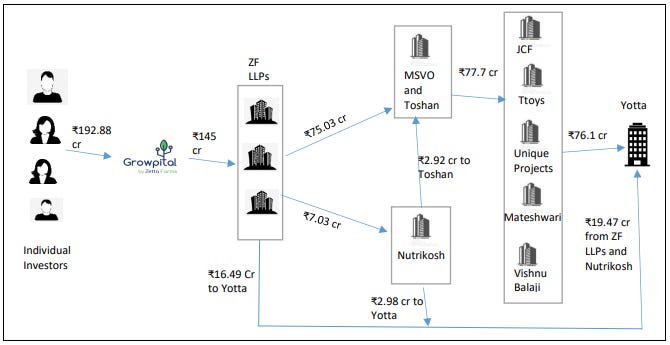
These layers were naturally filled with crap, and we mean that literally. One of the Supplier Entities, MSVO, was supposedly selling organic manure to the LLPs. But its purchases were of jeera seeds bought from the Revenue Entities. How did jeera seeds transform into organic compost? During hearings, SEBI asked about warehouse receipts, transportation documents, and any evidence of this supposed “value-addition”, but got no response.
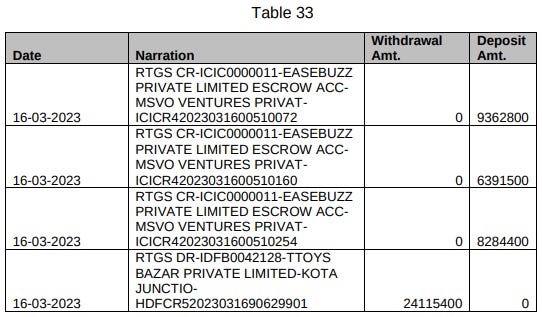
The timing of transfers was equally damning. In one instance on March 16, 2023, around ₹2.40 crore moved from the LLPs to MSVO, which itself transferred ₹2.41 crore to a Revenue Entity, all on the same day. This pattern repeated across dozens of transactions, across months. Money in from investors on one side, money out to Yotta on the other, with barely a day’s gap and no goods ever changing hands.
The promoters had their footprints all over their ecosystem. Gayatri Rinwa, the wife of promoter Rituraj Sharma, was a Designated Partner of the LLPs, so she had oversight of the investor-side bank accounts. She was also a director of one of the Revenue Entities receiving funds on the other end of the pipeline. She sat on both sides of the transaction.
When SEBI pressed the founders on all of this, they submitted expense details totalling ₹73.24 crore but without any supporting documents. The claimed expenses amounted to roughly half the money raised, and no proof was provided to back them up.
Damage control
Of the ₹193 crore raised from investors, SEBI managed to freeze about ₹50 crore in escrow accounts before it was dissipated further. The founders claimed nearly ₹33 crore in receivables. There are some assets in the name of Yotta and Winsome. But even adding all of that up, it falls well short of the original figure.
Accordingly, SEBI brought down its heavy hand on the guilty.
The main entities — the promoters, the wife of one of them, the promoter-group firms and the three LLPs — face a 5-year ban from the securities market, or until full refund is completed, whichever is later. They are jointly and severally liable for refunding the entire amount to investors, with 12% annual interest from the date of the interim order in January 2024. If frozen assets and recoveries aren’t enough, their personal assets will be used to service the same.
All the Supplier and Revenue entities, and their respective directors, weren’t let off the hook either. They face a 3-year market ban.
Monetary penalties total a whopping ₹24 crore across all 28 noticees: ₹2 crore each on the eight main entities, ₹50 lakh each on the conduit layer, and ₹20 lakh each on three individuals who facilitated fund transfers.
SEBI has appointed a Nodal Refund Officer to oversee the process. The investor list will be published, verified against payment aggregator records, and refunds will be made proportionally from whatever is recovered.
The engagement farm
Funnily enough, the CIS Regulations were originally written to anticipate these kinds of schemes before the damage spills over.
In the 1990s, the prominent type of CIS scam revolved around teak plantations. Entities promised extraordinary returns from forestry, only for the investors to find out that their capital was wiped out. Since 1994-95, SEBI has prosecuted over 1,200 unregistered CIS platforms. Perhaps the most high-profile such case was the Sahara Group, although that involved convertible debentures rather than equity units.
But no matter what the instrument of choice, the playbook is the same. You pool money, promise returns, don’t deliver, and hope no one looks underneath the hood. Growpital’s unique contribution to the growing style of CIS scams was using the LLP precedent to masquerade as a CIS.
This episode also shows how much longer we have to go when it comes to investor awareness. The fact that the allure of “guaranteed returns” still has charm means that the many are yet to absorb that, besides life and death itself, few things are as predictable, and markets rank at the bottom of that pile.

The Indian Railways tries the High-Way
Indian Railways wants to build six new freight lines, mostly to move coal, iron ore and bauxite. Together, they will stretch 647 km across Odisha, Telangana and Jharkhand.
Operationally, this is business-as-usual for the Railways. But financially, these projects mark a break from the past. Unlike most railway projects, Railways does not plan to fund the entire construction itself. It wants private companies to put up a large part of the money.
That raises a simple question. Railways can borrow more cheaply than private companies, it already knows how to build railway lines, and ultimately, it will still have to pay the private companies back. And it’s not like they’re suddenly running short of the ability to raise money. So, why bring in private money?
The answer has more to do with how it wants to share the risks of building these lines.
Why did Railways change course?
Traditionally, Railways built the lines and ran the trains themselves, and hence earned the freight revenue itself. But that also meant that if it spent thousands of crores on a new line and the expected freight did not show up, Railways alone took the hit.
Private participation isn’t entirely new to Indian rail. The Railways has formed joint ventures with ports, state governments and companies that needed better rail connectivity. Lines such as Haridaspur-Paradip and Angul-Sukinda in Odisha were built this way. These partners had a reason to put in money because they themselves benefited from the new rail connection.
For the new six freight lines, instead of bringing in companies that needed the railway connection, the Railways wanted a private infrastructure developer to finance and build the line. Initially, the financing model that was meant to be followed was called Design, Build, Finance, Operate and Transfer (or DBFOT).
Under DBFOT, the private company would finance and build the line, maintain it for years and eventually hand it back to Railways. Railways would still run the trains, but the private company’s payments would depend partly on how much freight moved on the line.
But that would imply that the private company would take some of the freight risk, even though it had little control over how much freight actually moved. A company who built the line as promised would still lose out if a mine was delayed, coal demand fell or Railways sent freight elsewhere. That left potential bidders and lenders a bit uncomfortable with the model.
After getting their feedback, Railways ditched DBFOT and turned to a model widely used for India’s highways, called the Hybrid Annuity Model (HAM). Naturally, the biggest change was who took the freight risk; under HAM, it goes back to Railways. PPPAC recommended the six projects to follow HAM on August 1, 2026, while Cabinet approval is still pending.
The HAM model
How does the HAM model work?
Assume a project costs ₹100. Railways pays ₹40 during construction, while the private company arranges the remaining ₹60. Once the line is ready, Railways repays that ₹60 over several years (along with interest) as annuity. The company is also paid separately to maintain the line, while Railways runs the trains and keeps the freight revenue.
That also makes it easier for the company to borrow the ₹60 it needs. Banks don’t have to worry as much about how much freight the line might carry years from now because their borrower is being repaid regularly by Railways.
The final contract is still being worked out, so we don’t yet know what interest rate Railways will pay or what standards the private company will need to meet.
The highway experience
What was the experience of the highway sector with the HAM model?
Before HAM, private companies building highways often had to recover their investment through tolls. That meant they also took the traffic risk. If fewer vehicles used the road than expected, their revenues suffered. After several projects ran into trouble and private interest weakened, NHAI introduced HAM in January 2016, absorbing traffic risk itself.
The model helped attract private companies. HAM accounted for around 55% of highway projects awarded by NHAI between FY21 and FY24. But changing how projects were financed did not solve every problem. By the end of 2024, more than half of the HAM highway projects under construction, worth around ₹1 lakh crore, were delayed by over six months. Problems such as land availability, low bids and construction delays remained. We have covered some of these problems before.
Railways could face an additional challenge because railway lines have to be closely coordinated with train operations. The private company will maintain the tracks, signalling and overhead wires, while Railways will run the trains. If a section needs to be shut for maintenance, for example, both sides will have to coordinate when and for how long. How these responsibilities are divided will depend on the final contract.
So why not just build it directly?
There is still an obvious question. If Railways eventually has to repay the private company with interest, why not just fund the entire project itself? The government can borrow more cheaply than a private company, which also needs to make a profit. So bringing in private money comes at a cost.
The numbers show how large these commitments can become. The six projects have a combined Bid Project Cost of ₹15,976 crore, while PPPAC estimates their total cost over the full contract period at ₹40,866 crore. But the two numbers can’t be directly compared. The larger figure includes costs over many years, such as interest, maintenance, land, taxes and rising construction costs.
In return, the Railways doesn’t have to put up all the money at once. The private company arranges 60% of the construction funding, allowing Railways to spread those payments over several years. The company is also responsible for building the line and maintaining it after construction.
That changes its incentive too. The company cannot simply finish the line and walk away because it will have to maintain what it built for years.
Whether this ultimately gives Railways better value for money is still unclear. The final contracts haven’t been signed, and Railways has never used HAM to build railway lines before. We will only know whether the extra financing cost was worth it once these projects are actually built and operating.
Conclusion
These contracts will run for 17-19 years, including the time spent building the lines. So Railways could still be making payments on them well into the 2040s. Four of the six projects are coal corridors, while one is for bauxite and another for iron ore.
For now, that looks like a reasonable bet. Freight brings in 62% of Railways’ traffic revenue, and coal alone accounts for 48% of freight earnings. India’s coal consumption is also expected to grow.
But these contracts run much longer than that. Coal’s share of India’s electricity generation is projected to fall from around 70% in 2025 to 60% by 2030, while coal demand could peak sometime between 2030 and 2035. Coal isn’t going to disappear, but the amount of freight these lines carry fifteen years from now could look very different from what Railways expects today.
Tidbits
1. 4G phones are making an unexpected comeback
India’s 4G smartphone shipments are expected to grow 3% in 2026, even as the overall smartphone market slows. Rising component costs have made 5G phones more expensive, prompting budget-conscious buyers, particularly those spending under ₹20,000, to choose better-specced 4G models instead.
Source: ETRetail
2. Why some traders want a “No UPI Day”
A federation of consumer-goods distributors has backed a “No UPI Day” protest on October 2, claiming the new 0.4% charge on certain merchant payments above ₹2,000 could cost the FMCG distribution network ₹7,000–9,000 crore annually. It fears the same goods could attract charges twice, when customers pay retailers and when retailers pay distributors.
Source: The Times of India
3. Air India brings duty-free shopping to its app
Air India passengers travelling through select Adani-operated airports can now browse, pay for and pre-order duty-free products through the airline’s website or app, then collect them at the airport. The service makes airport shopping easier while giving Air India another way to earn from passengers beyond ticket sales.
Source: Air India
4. ITC takes full control of Yoga Bar
ITC has acquired the remaining 52.5% stake in Sproutlife Foods, the company behind Yoga Bar, for ₹645 crore, taking its ownership from 47.5% to 100%. The deal gives ITC complete control of a fast-growing, digital-first brand selling protein bars, muesli and other healthy foods, a category it wants to expand beyond its traditional packaged-food business.
Source: The Hindu BusinessLine
5. Andhra Pradesh’s ₹1 lakh crore horticulture bet
Andhra Pradesh plans to develop a ₹1 lakh crore horticulture hub across 201 clusters in Rayalaseema, combining irrigation, rural roads, cold storage and food-processing facilities. The goal is to help farmers move from low-value rainfed crops to fruits and vegetables, reduce post-harvest waste and improve incomes for nearly 9.6 lakh farmers.
Source: Business Standard
Want more tidbits? Catch up on last week’s recap!

Cash & Copium #7
In this episode, Abid, Bhuvan, and Aakanksha explain why banks should strictly be used for banking. They discuss how relationship managers exploit trust to sell low-return ULIPs and endowment plans, and how to counter illegal loan bundling using the RBI Ombudsman.
Check out the episode on YouTube.
Beyond Today’s Brief
There’s always more happening at Markets by Zerodha.
The Chatter: What do top corporate leaders and regulators say about macroeconomic resilience and market shifts? How is NSE navigating derivatives regulation while rebalancing its revenue mix, and how are firms like ONGC, Hero Motors, Bikaji, and Pearl Global managing deepwater gas exploration, raw material inflation, and global supply chain expansion?
Points & Figures: What is driving India’s record vehicle registrations across two-wheelers, cars, and commercial fleets? How are recent tax cuts and surging rural RTO demand reshaping auto sales, and where does EV adoption stand across different vehicle segments?
Aftermarket Report: How did Nifty recover nearly 140 points from intraday lows to close near 22,700 after another volatile session? And what do extreme fear, aggressive FII shorting, and improving options positioning reveal about sentiment as market breadth remains weak?
Join us on WhatsApp, where we share interesting soundbites from concalls, articles, and everything else we come across throughout the day. You’ll also get notified the moment a new video or article drops so that you can read or watch it right away.
Thank you for reading. Do share this with your friends and make them as smart as you are 😉
I liked the first article very much. The scheme and the flow of the entire operation was explained clearly and i especially liked the final tagline " Besides life and death few things are predictable and market sits at the bottom of the pile". This should be the tagline of every financial instrument ads instead of the boring " Investment are subjected to market risks pls read terms carefully"😂