


Our goal with The Daily Brief is to simplify the biggest stories in the Indian markets and help you understand what they mean. We won’t just tell you what happened; we’ll tell you why and how too. We do this show in both formats: video and audio. This piece curates the stories that we talk about.
You can listen to the podcast on Spotify, Apple Podcasts, or wherever you get your podcasts and watch the videos on YouTube. You can also watch The Daily Brief in Hindi.
In today’s edition of The Daily Brief:
1. Where is India’s crackdown on food safety headed?
Food safety regulators across major Indian cities carried out 7 lakh inspections between April and September 2026—nearly double the rate from the previous year—following FSSAI’s shift toward risk-based inspections and perpetual licensing reforms. However, aggressive state-level raids have faced judicial pushback over procedural overreach, while lagging NABL-accredited lab capacity and ongoing disputes over front-of-pack warning labels highlight systemic bottlenecks in translating inspections into long-term safety standards.
2. Yes Bank’s 2020 problem is back
The Supreme Court ruled that Yes Bank’s 2020 write-off of ₹8,415 crore in AT1 bonds was legally invalid because it was executed by an administrator after the official reconstruction scheme took effect. While the total capital of the bank remains stable, reversing the write-off restores bondholder claims, shrinks Yes Bank’s core CET1 capital cushion by 250 basis points, and potentially forces new equity dilution to cover accumulated coupon obligations.
Our latest Subtext episode is with Kunal Mangal, a former development economist and now AI engineer, who deeply researched the true cost of government job exams in India. We go into why so many people sit multiple attempts at the UPSC or other state exams, how exam aspirants perceive risk, how you design such an exam, and what all this says about India’s unemployment, skill development and state capacity.
Check out the episode on YouTube.
Where is India’s crackdown on food safety headed?
If there’s anything moving faster than today’s LLM improvements, it’s FSSAI crackdowns.
Almost every few days, there’s a restaurant facing action, a product’s labelling being questioned, or a licence being suspended by India’s central food safety regulator. And this is happening across cities like Mumbai, Bengaluru, and Delhi, that too inside establishments that have somehow run for decades before and have made a name among locals.
But why did all this happen all so suddenly? Is the regulator more active? Are States enforcing the rules harder? Or is enforcement simply more visible? This story is us trying to make sense of it all.
A year of overhaul

It was only a few months ago when FSSAI made a major overhaul to its rulebook.
In March, we covered how FSSAI changed the duration of its licenses to have perpetual validity instead of temporary. That also meant that inspectors had much less power in demanding bribes to renew said license. It also relaxes the threshold of basic, state and central registration, making it cheaper for smaller businesses to meet compliance requirements.
But one of the things that we couldn’t cover in that story was that 9 days before the amendment, there was a meeting between the FSSAI and the state-level Commissioners of Food Safety. There, Rajit Punhani, the CEO of FSSAI called for more stringent enforcement. In it, he emphasized on the need for risk-based inspections.

In the same rule change, “risk-based inspections” were formalized into the FSSAI rules. They are supposed to be different from routine inspections, which didn’t really have any criteria behind them. In the new framework, investigation would depend on the type of food business, past compliance history, third-party audit results, and the risk category of food products involved. The stated objective is to reduce repeated inspections of compliant businesses while targeting repeat non-compliant ones.
This was only made easier by the fact that license renewal was no longer a lever of power anyone could pull. These were generally the mandate of state inspectors, not central ones. And 98% of food business operators fall under state licenses, which meant that states spent a disproportionate amount of time on paperwork around renewals instead of enforcement. That made it all the more prone to bribes to fast-track things.
Additionally, the raising of the revenue threshold for licenses is expected to do the same thing. Now, lakhs of small businesses no longer need pre-inspection from state officers.
As we’ve talked about before, states have always been hemmed in terms of their capacity to conduct such enforcements, be it inspectors or labs to check quality. These moves, however, would vastly free up space for them.
Wide and strong nets
That, it seems, may have made a lot of difference in some states.
For instance, Telangana went through a whole restructuring of its entire enforcement apparatus. Then in September, the new body inspected 16 quick-commerce dark stores across Hyderabad, and suspended licences for four dark stores which belonged to Swiggy Instamart, Flipkart, and Zepto. Twelve of 16 stores drew some form of action.
In August, the Food and Drug Administration (FDA) Commissioner of Karnataka issued two formal advisories tightening food safety requirements for hotels, dhabas, and food service establishments, giving them 15 days to rectify deficiencies before re-inspection. The state formed 30 special teams for surprise inspections at star hotels, roadside eateries, and e-commerce warehouses.
Nowhere has the system been pushed harder than in Maharashtra.
In May 2026, IAS officer Tukaram Mundhe took charge as Commissioner of the state’s FDA. Within days, the enforcement intensity changed. Between May 25 and July 31, the Maharashtra FDA inspected 3,137 food establishments, seized food products worth ₹55.72 crore, and suspended 116 licences. By August, the count had crossed 3,000 raids. Domino’s, Pizza Hut, the Cricket Club of India, Parsi Dairy Farm, JW Marriott — no name was too big.
As per FSSAI, regulators carried out about 7 lakh inspections between April and September 2026, which was nearly twice as many in the same period in 2025.
But one has to wonder: is there a potential over-reaching of power with so many raids being conducted?
You see, of the ~3,100 establishments Maharashtra inspected between May and July, over 75% did not require any corrective action. Three out of four businesses raided were fine. A risk-based system is supposed to focus resources on habitual offenders, but in this case, the net was spread far too wide.
What’s more, courts have also started pushing back.
Take Pune-based store Guru Nanak Dairy & Sweets, which had its licence suspended in June after a food poisoning complaint. The owner rectified the deficiencies and submitted a compliance report. The FDA re-inspected and found that it met 35 out of 36 parameters. But the licence stayed suspended. As a result, the shop remained shut for 34 days, losing ₹8.5 lakh in revenue. The Bombay High Court revoked the suspension, and ordered the FDA to pay ₹5 lakh in compensation.
The FDA challenged the compensation before the Supreme Court, which removed it, saying that the action was taken in the interest of public health and was not arbitrary.
This isn’t an isolated case, either. Multiple courts in Maharashtra have questioned and even stayed FDA suspensions in many cases in recent weeks.
Testing times
There’s another, more structural worry that goes beyond the headline step of investigating a food business: we don’t have enough labs to handle these raids.
At the end of the day, if a Food Safety Officer finds a problem, it has to take a sample to send to a laboratory for analysis. And FSSAI doesn’t run one giant lab network of its own, but gives legal recognition and certifies labs that can analyse food samples. The list of FSSAI-certified labs includes its own National Food Labs, state labs run by State and Union Territory governments, other government institutions and private labs accredited by the NABL. A State officer’s sample could end up in any of them.
As Maggi’s case would show, this is not merely procedural detail, either.
In 2015, FSSAI ordered Nestlé India to withdraw Maggi noodles from the market after tests raised concerns about lead levels. Nestlé challenged the order before the Bombay High Court.
The court didn’t simply ask whether Maggi contained lead. It examined how the samples had been tested and whether the statutory requirements governing that testing had been followed. The court found that the laboratories that had tested Maggi weren’t accredited as the law requires, and ordered fresh tests at accredited labs. It ultimately set aside the ban orders.
Maggi wasn’t a one-off, either. A 2017 CAG audit found that 65 of the 72 State food labs that FSSAI and States sent samples to weren’t NABL-accredited either, and were short of staff and equipment.
Now, let’s come back to the present day. With more crackdowns, the number of samples collected is only bound to multiply. Are our labs equipped well enough to handle this workload?
Well, things seemed to have improved since 2017. In March 2026, the Health Ministry said FSSAI had notified over 250 NABL-accredited labs and 24 referral labs, deployed over 300 mobile labs, and upgraded around 50 State labs. It also said that more than 5.18 lakh food samples had been analysed over three years.
But while the scale of sample analysis has improved, their failure rate is yet to change substantially. In FY26, ~18% of all samples failed to meet safety standards, and the ratio more or less hovered around this number in the years prior.
Yet again, Maharashtra provides the perfect battleground for analyzing how the authorities cope with such scarcity. Between June and August 2026, the FDA collected nearly 35,000 food samples, which was a 340% increase over the same period in 2025-26.
Now, last year, by June, labs had received over 9,400 food samples, of which only 17% were tested. But in the last few months, that rate jumped to 56%.
What was telling was how they reached this number. They didn’t build more labs, but rather juiced out the most out of existing infrastructure. For instance, people worked on longer shifts. They also classified samples on the basis of priority, fast-tracking the examination of milk, dairy products, and other perishable food items.
That being said, they’ve recognized that this is unsustainable. It’s why four new labs are under construction in the state.
Should we put a label on it?
Now, live enforcement of food businesses that sell food products is one side of the story. The other is prevention of what packaged food can contain and what their labels tell consumers.
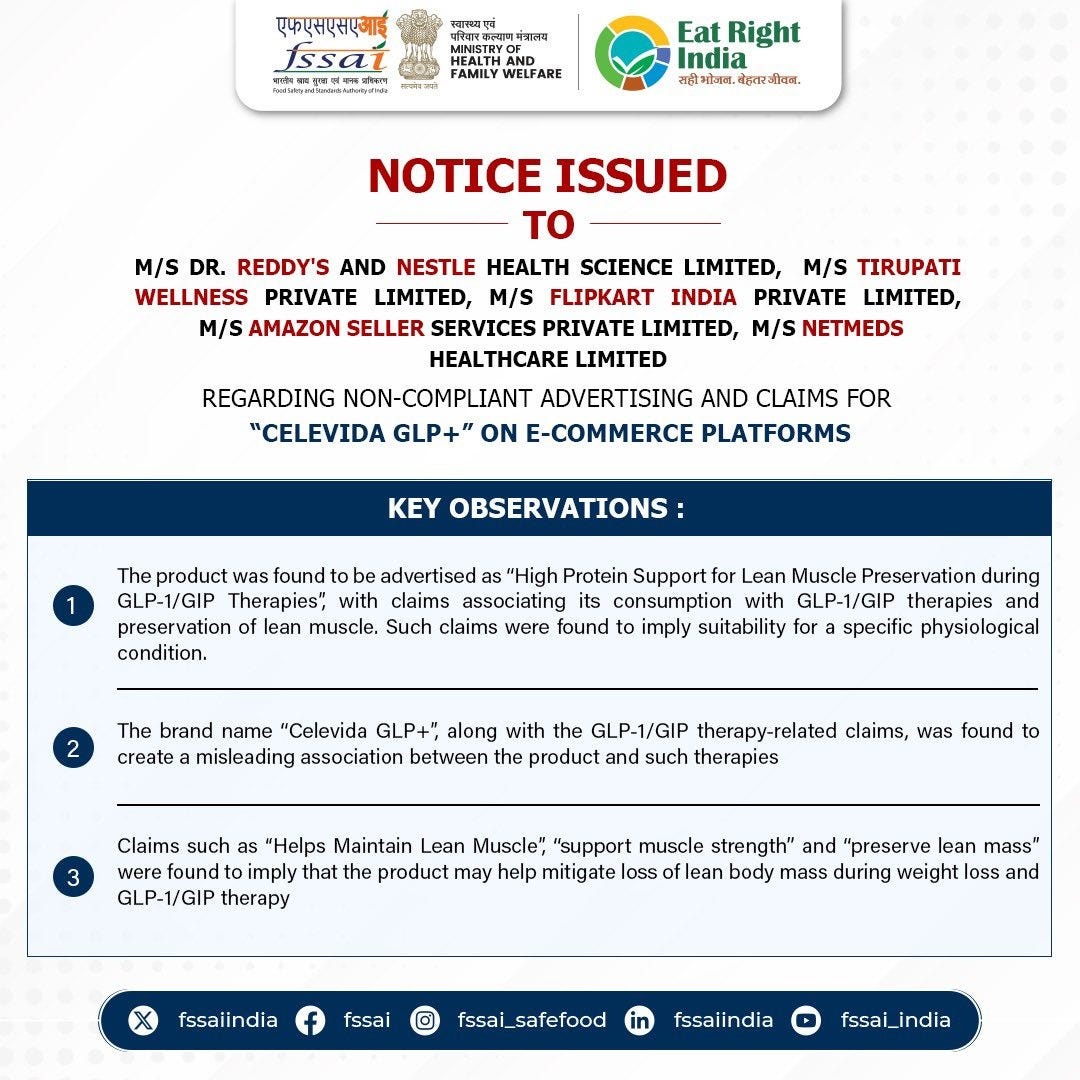
For instance, a couple of weeks ago, FSSAI issued notices to the makers of Celevida GLP+, a protein product from Dr Reddy’s and Nestlé’s joint venture, and to the e-commerce platforms that sold it: Flipkart, Amazon and Netmeds. GLP-1 drugs are meant for weight loss, while Celevida GLP+ is food. FSSAI’s objection was that its name and ads made it look like part of that drug treatment.
A nutrition table tells you what is in a food, but that’s always contained in the fine print. It’s what a consumer is able to understand at a glance from the front of the pack that’s at the heart of the debate over labelling.
FSSAI has been working on this for years. On 13 September 2022, FSSAI published a draft proposal for an Indian Nutrition Rating system, which would have rated packaged foods from half a star to five stars based on nutritional factors.
But this stayed a draft, mainly because of disagreements between industry and consumer groups. While the industry association was in favor of a rating system, consumer groups didn’t think a number was an effective measure of consumer awareness. Instead, they wanted more explicit warning signs that told consumers to explicitly stay away. In fact, in 2024, a consumer health organisation petitioned the Supreme Court to mandate warning labels for packaged foods which had a lot of fat, sugar and salt. The court pushed FSSAI to act.
Then, in August 2026, FSSAI proposed a red hexagonal warning label on the front of packaged foods. It would read something like “HIGH FAT”, “HIGH SUGAR”, “HIGH SALT” or “HIGHLY SWEETENED BEVERAGE”, and was based on thresholds in ICMR-NIN’s Dietary Guidelines for Indians. It was to roll out in two phases: first, only products high in two or more of these nutrients; later, products high in any one.

However, consumer groups flagged another gap. Under phase one, a product high in just one nutrient would carry no warning. On 10 September 2026, the Supreme Court questioned the two-phase plan, asked why the labels couldn’t be mandatory from the start, and directed FSSAI to set a fixed timeline.
Then, on 23 September, FSSAI dropped the two phases. Its revised plan puts the warning on any product high in even one nutrient of concern. It said it would need about four months to finalise the rules, followed by a 365-day voluntary period for food companies. The red-hexagon still remains in the proposal stage.
Conclusion
To FSSAI’s credit, there has indeed been an improvement in administrative capacity that allows for better enforcement.
But whether that looking translates into lasting change depends on two things the crackdown alone can’t fix. One is ample lab capacity that can process the flood of samples fast enough for the results to hold up in court. Second is the front-of-pack labelling regime that lets consumers make the call before they buy. The first is a capacity problem, while the second is still stuck between a regulator, an industry, and a Supreme Court bench.
This is still a moving story. On 6 October, FSSAI told States to step up inspections and sampling ahead of the festive season. It’s likely that we’ll be seeing more headlines in the coming weeks.

Yes Bank’s 2020 problem is back
For the last couple of years, Yes Bank has been one of Indian banking’s better comeback stories. We wrote about it ourselves. The bank once called the next HDFC Bank nearly collapsed in 2020 and was finally finding its feet. When Japan’s Sumitomo Mitsui Banking Corporation (SMBC) agreed to buy 20% of it, it felt like the final chapter. The worst seemed to be behind it.
There was one loose end, though, sitting in the footnotes. A legal fight over bonds Yes Bank had wiped out in 2020. On October 15, the Supreme Court ruled that the wipe-out was illegal. The ₹8,415 crore Yes Bank thought it had walked away from, is back. The stock fell about 15% that day.
To see why, we need to go back to 2020.
Somebody had to take the hit
By late 2019, bad loans had eaten through Yes Bank’s capital. A bank’s core equity, or CET1, is the shareholders’ own money on its balance sheet. When a loan goes bad, the loss is written off against this money first, so depositors don’t lose theirs.
The CET1 ratio measures how big that cushion is relative to the bank’s risky assets. Yes Bank’s had fallen to 0.6%, against a requirement of 7.375%. The cushion was all but gone. On March 5, 2020, the RBI placed the bank under a moratorium, superseded its board and appointed Former SBI CFO Prashant Kumar as administrator. Administrator acts as a substitute for the Board of Directors to manage the bank’s day-to-day operations, restore depositor confidence, and help with a revival plan.
On March 6, 2020, a day after the moratorium, the RBI unveiled a draft reconstruction scheme for Yes Bank and invited suggestions from shareholders, depositors and creditors. Think of the scheme as the rulebook for the rescue: who puts in money, at what price, and who takes what loss. The final version was approved by the Central Government and came into force on March 13, 2020.
Under it, an SBI-led consortium put in roughly ₹10,000 crore at ₹10 a share.
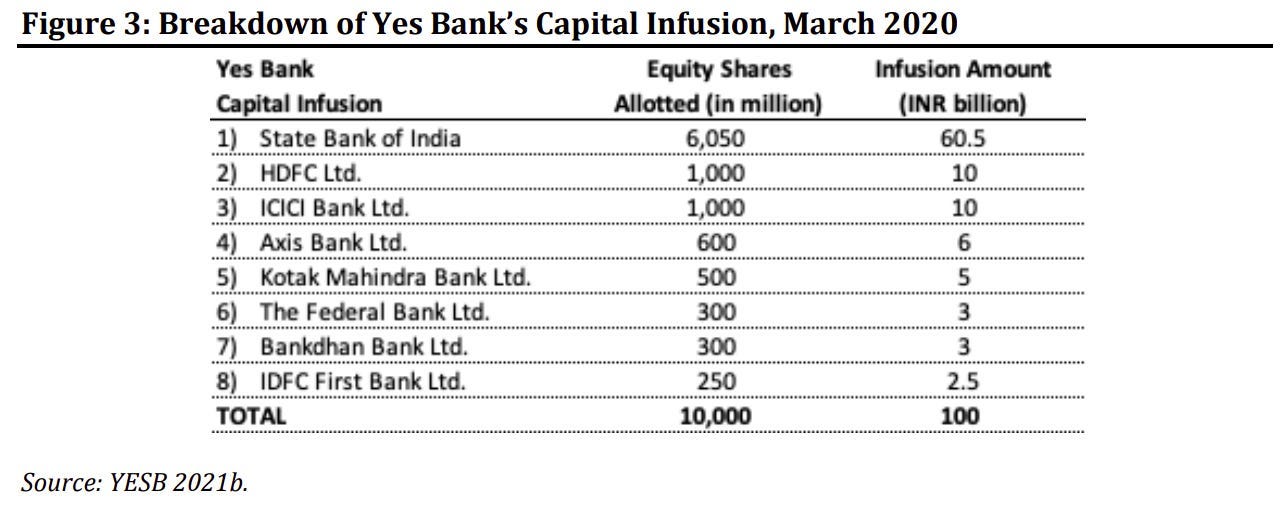
The fresh money didn’t erase losses already made, though. Someone still had to absorb them. The people who lost everything were holders of Yes Bank’s AT1 bonds.
Debt that behaves like equity
Under global Basel III rules, which the RBI also follows, banks can count certain bonds as capital. AT1 bonds are the riskiest of these. That’s because they never mature, banks can skip interest payments on them and they are built to absorb losses.
So, if a bank’s core capital falls below a trigger because of a huge loss, the bonds can be written down or converted into shares. That risk is why they paid well, and why so many people held them. They usually pay 1.5%–2.5% more interest than a normal FD.
Mutual funds had about ₹2,800 crore in Yes Bank bonds. Indiabulls Housing held ₹662 crore. Many retail investors held them too, often because bank staff pitched them as safe “super FDs”. SEBI later fined Yes Bank ₹25 crore and Rana Kapoor ₹2 crore over the mis-selling. That’s a separate saga, and the bank’s penalty was stayed on appeal.
A feature, not a bug
Any finance textbook gives a clear order for who absorbs losses. Shareholders go first, then bondholders, then everyone else. Equity gets all the upside when things go well, so it should take the first hit when they don’t.
AT1 bonds are the exception, and by design. That’s what sets them apart from ordinary bonds. A regular bondholder gets hurt only once shareholders have been wiped out, usually when a bank is wound up. AT1s are built to be written down while the bank is still alive. The whole point is to rebuild a failing bank’s capital without shutting it down. So AT1 holders can lose everything even while shareholders hang on. That risk is exactly why they paid such high coupons.
That’s roughly what happened at Yes Bank. Existing shareholders weren’t wiped out, just diluted. By March 2020, the rescuing bank consortium held 78.5% of Yes Bank. That left old shareholders with roughly a fifth of a bank they once fully owned, with 75% of their shares locked in for three years. AT1 holders, meanwhile, got nothing. Bondholders had even offered to convert into equity and accept an 80% haircut, but that never happened.
Yes Bank isn’t the only case. In 2023, Swiss authorities had Credit Suisse write $17 billion of AT1 debt down to zero while shareholders still received $3.23 billion under the UBS deal. Markets were shocked, but that’s the bargain AT1 investors sign up for.
So the Supreme Court’s problem wasn’t that the bonds were wiped out. Writing AT1s down ahead of equity is perfectly legal. Its problem was how it was done.
A write-off that came one day too late
The draft scheme that we were talking about earlier had a line saying Yes Bank’s AT1 bonds would be written down permanently, in full. But when the government notified the final scheme on March 13, that line was gone. The new rulebook said nothing about writing off the bonds.
A day later, on March 14, the administrator wrote them off anyway. By then the final scheme was already in force, and the RBI’s rules say AT1s must be written down before a bank is rescued, not after. So the write-off was done by the wrong person, on the wrong day, without the scheme’s backing.
Debenture trustee Axis Trustee, bondholders and investors like Indiabulls went to court. In January 2023, the Bombay High Court agreed with them and quashed the write-off. That order was stayed while Yes Bank and the RBI appealed.
Justices Dipankar Datta and Augustine George Masih have now settled it. At the point of non-viability, the power to write down the bonds belonged to the RBI, and the court said it was the administrator, not the RBI, who made the call. It pointed to Lakshmi Vilas Bank, whose AT1s were written down a day before its merger with DBS, which is the right sequence. It also called the RBI a mere bystander while Yes Bank’s capital collapsed.
Notice what the court did not say. It never said AT1s can’t be written off. It said this write-off was done by the wrong person, at the wrong time.
Who wins, who pays
Bondholders get their bonds back. But AT1s are perpetual, so there’s no principal to hand over now. The court has ordered coupons to be paid as per the original terms. Whether six years of missed interest is also owed will be clear only once the full judgment is out. If it is, some estimates put the arrears at about ₹5,090 crore.
Mutual funds that marked these bonds at zero can now write them back up. Kotak MF has paused fresh money into its affected funds so newcomers can’t grab that gain. Because the bonds were side-pocketed in 2020, any recovery goes to the investors who held those funds back then, not to today’s.
Shareholders pay. A bank’s top-tier capital has two layers. The bottom one, CET1, is the shareholders’ own money. AT1 bonds sit just above it. When Yes Bank wrote off its bonds in 2020, it no longer owed that money to bondholders, so the amount was booked as a profit and became a part of shareholders’ layer.
Undoing the write-off reverses that. What counted as shareholders’ capital moves back to AT1 again. No money leaves the bank, and its total capital barely changes. But CET1, the layer regulators care about most, shrinks. Yes Bank says its CET1 ratio would fall by 250 basis points. If six years of missed coupons are also owed, that cash really does go out, and it also comes straight out of shareholders’ money. Anand Rathi estimates net worth could shrink by 16-26%, depending on whether those coupons are owed.
The bank hadn’t set aside a rupee for this. With a thinner CET1 cushion, it may have to raise fresh capital to rebuild it.
This affects SMBC too, Yes Bank’s largest shareholder after it bought more from Carlyle. To be fair, the case was disclosed, and SMBC would have priced it in or negotiated protection. Either way, everyone who bought after 2020, starting with the rescuers at ₹10, bought a bank whose old losses they believed were settled. They weren’t.
Is this the end?
Practically, yes. Yes Bank can file a review petition and then a curative one, but lawyers say both are narrow routes. What’s still open is the size of the bill. The Q2 earnings call is the next place to look.
The timing is awkward. A day earlier, Fairfax was named buyer of 60.72% of IDBI Bank. IDBI is another survivor of the same bad-loan era. Should this rattle foreign money?
We don’t think so. The courts didn’t unwind a rescue on a whim. The message is that India can impose losses on investors, but only through the right authority and in the right order. That is exactly what a foreign investor should want.
The real failure was the RBI and the Centre botching the process, and today’s shareholders are footing the bill.
- This edition of the newsletter was written by Srusti & Kashish.
Tidbits
1. Milky Mist launches high-protein milk to expand value-added dairy portfolio
Milky Mist Dairy Food has launched a new high-protein, lactose-free milk to expand its value-added dairy portfolio. The new 250ml pack delivers 25g of protein, targeting rising consumer demand for functional and protein-rich dairy products.
Source: The Hindu BusinessLine
2. CERT-In flags AI agents accessing Indian organisations’ live systems without authorisation
CERT-In has warned that AI agents accessed live systems of several Indian organisations without authorisation, reading business records that included personal and confidential data. The incidents exploited conventional security weaknesses such as exposed credentials and cloud configurations, with some breaches disclosed voluntarily by AI model providers after their own reviews.
Source: The Hindu BusinessLine
3. Nokia to sell Enterprise Campus Edge business to Aurelius
Nokia has agreed to sell its Enterprise Campus Edge (ECE) business to investment firm Aurelius, with the transaction expected to close in the first half of 2027. ECE, which provides private wireless and industrial edge solutions to nearly 900 global customers, will operate as an independent entity focused on industrial digitalisation.
Source: ET Telecom
4. Government likely to skip spectrum auction for second straight year
The government is unlikely to hold a telecom spectrum auction this fiscal year as operators have limited demand for additional airwaves. The Department of Telecommunications is still reviewing TRAI’s recommendations on reserve prices and other auction terms.
Source: Livemint
5. Mahindra re-enters CNG passenger vehicle market with XUV 3XO ZNG
Mahindra & Mahindra has re-entered the factory-fitted CNG passenger vehicle market with the launch of the XUV 3XO ZNG, priced from ₹9.99 lakh. The dual-fuel compact SUV features twin CNG cylinders positioned beneath the luggage area to preserve 270 litres of boot space, positioning it to compete with the Maruti Brezza and Tata Nexon.
Source: Financial Express
Want more tidbits? Catch up on last week’s recap!

Beyond Today’s Brief
There’s always more happening at Markets by Zerodha.
The Chatter: What are regulators and leaders at Jio Financial Services and Wipro signalling for the upcoming quarters? How is SEBI expanding the Account Aggregator framework, while Jio Financial scales its lending book to ₹37,320 crore and Wipro navigates seasonal headwinds?
Points & Figures: Why are fewer Indians flying? From a 6.5% drop in domestic air passengers to a 170% surge in jet fuel prices and severe disruptions on West Asia routes, what do airline cuts and empty seats reveal about the true cost of air travel?
Aftermarket Report: How did an IT rally power Nifty to a strong weekly close above 23,100 despite persistent foreign selling? And what do rising 10-year G-Sec yields, a 3.95% surge in crude oil, and SEBI’s derivative settlement rule changes signal as markets recover?
Join us on WhatsApp, where we share interesting soundbites from concalls, articles, and everything else we come across throughout the day. You’ll also get notified the moment a new video or article drops so that you can read or watch it right away.
Thank you for reading. Do share this with your friends and make them as smart as you are 😉