


Our goal with The Daily Brief is to simplify the biggest stories in the Indian markets and help you understand what they mean. We won’t just tell you what happened, we’ll tell you why and how too. We do this show in both formats: video and audio. This piece curates the stories that we talk about.
You can listen to the podcast on Spotify, Apple Podcasts, or wherever you get your podcasts and watch the videos on YouTube. You can also watch The Daily Brief in Hindi.
In today’s edition of The Daily Brief:
Will India grow old before it grows rich?
An armor for the Indian Railways
Will India grow old before it grows rich?
In India, the unemployment rate for illiterates is 3%. For graduates aged 15 to 24, it’s 40%.
It seems that the more educated you are in this country, the more likely you are to be jobless. That doesn’t mean education is worthless. But, perhaps, education creates aspirations that the economy struggles to absorb, while someone more illiterate takes whatever survival work is available. A graduate holds out for something better. And that “something better,” for millions, may never arrive.
This isn’t a new problem. The State of Working India 2026 report traces four decades of labour data to show that graduate unemployment for the youngest cohort has been stuck between 35-40% since 1983. Through liberalisation, through the IT boom, through Make in India, through a startup revolution, nothing moved it.
The report follows the lifecycle of a young Indian from classroom to job search, eventually to the labour market, and asks a set of simple questions. The observations, across all three stages, are sobering.
Of course, employment outcomes are a function of many things from nutrition, upbringing, geography, social networks to household wealth and much more. But the report zeroes in on education and skilling — after all, that is the lever the state and market have most directly tried to pull over the last four decades. And the central finding is that the lever might not be working as effectively.
What does that mean for India’s much-celebrated demographic dividend? India has 36.7 crore people between the ages of 15 and 29. This is the largest youth population on the planet, accounting for a third of the country’s working-age population. But the ratio of working-age people to dependents is expected to peak by 2030 and then begin a permanent decline, as the youth share falls and the elderly population grows.
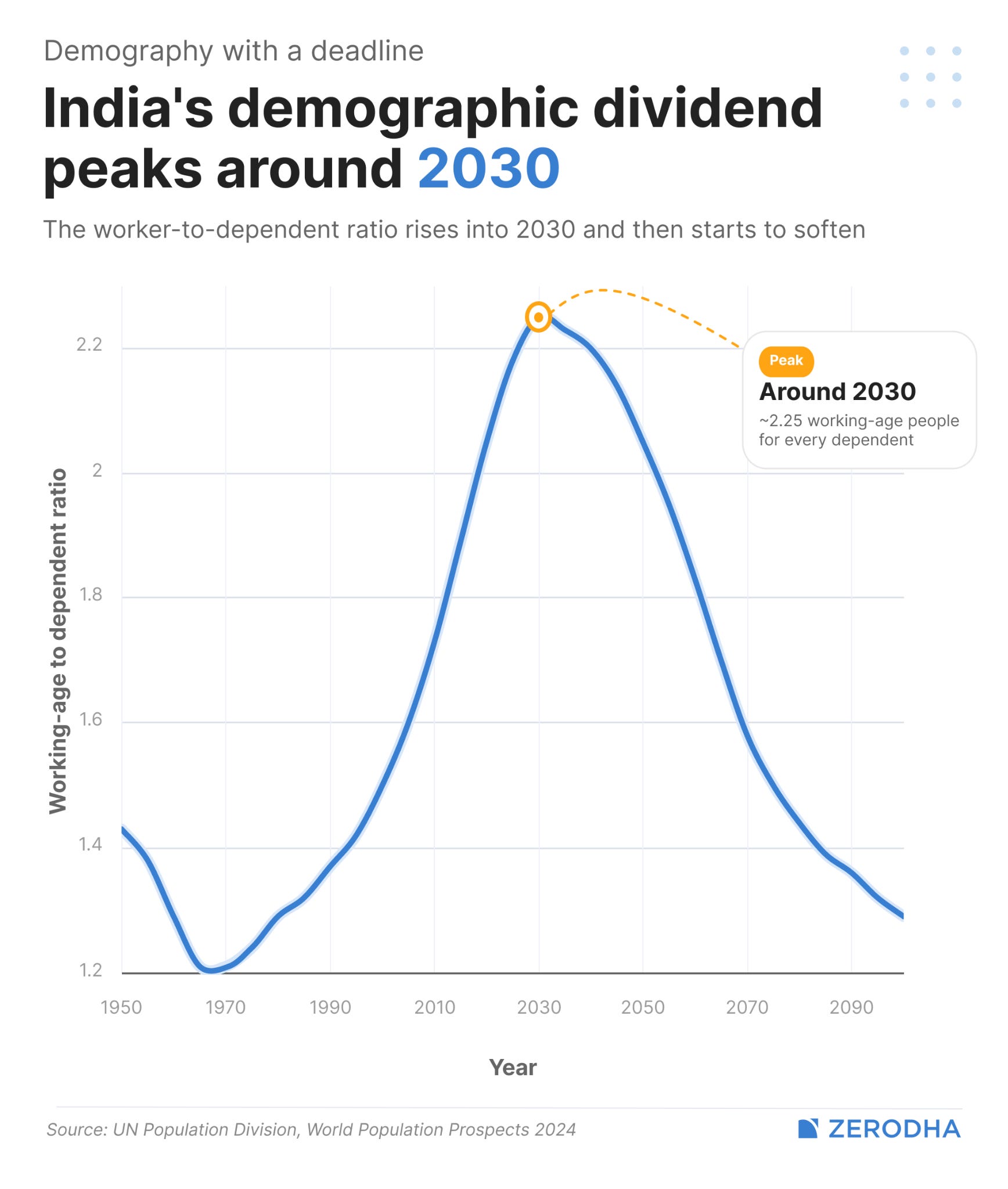
If we exclude those currently in education, we have roughly 26.3 crore young Indians who need to be productively absorbed into the economy. The clock is ticking. And at every stage of the pipeline — education, job search, and employment — something is breaking down.
The ₹1.2 lakh gamble
Since liberalisation, India has built one of the largest higher education systems in the world. The number of institutions exploded 42 times, with 80% of that expansion driven by private providers. College density improved from 29 per lakh youth in 2010 to 45 per lakh by 2021. Enrollment also surged among 15-19 year old men from 49% in 1983 to 73% in 2023. For women, the jump was even sharper from 38% to 68%. India’s tertiary enrollment rate of 28% is now on par with countries at similar income levels.
This is, by any measure, an extraordinary expansion. But the report reveals that quantity came at the expense of quality, and quality came at the expense of equity.
Start with quality. The All India Council for Technical Education (AICTE) recommends 15 to 20 students per teacher. But private colleges currently average 28, while public institutions average 47. This is clearly a system operating at 2-3 times beyond its designed capacity. The link between sitting in a classroom and actually learning something has weakened to the point where, as per the India Skills Report 2026, only ~43% of graduates are considered job-ready by employers.
Then, there’s equity. Between 2007-2017, enrollment from the poorest quartile of households doubled — from 8% to about 15%. That sounds like progress, but look at what those families are enrolling in. Youth from richer households are far more likely to be in the professional degrees like engineering and medicine, that lead to stable salaried careers. Poorer households are overwhelmingly funnelled into low-cost humanities and commerce programmes with far weaker employment outcomes. And the gap has only widened over time.
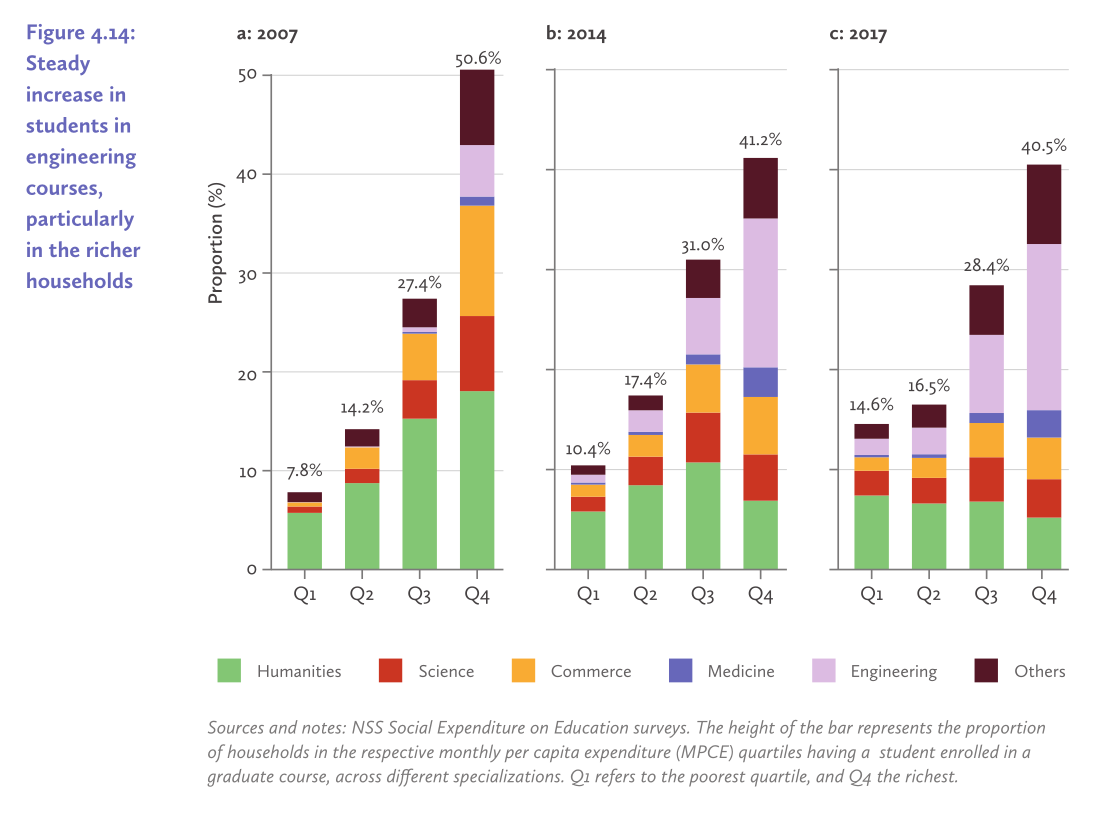
After all, the median cost of an engineering degree — ₹1.23 lakh a year — exceeds the entire annual per-capita expenditure of India’s poorest households. For them, a professional degree is an impossibility. It could be flattering to see more poor families entering higher education. But they’re being sorted into degree tracks that offer the least return.
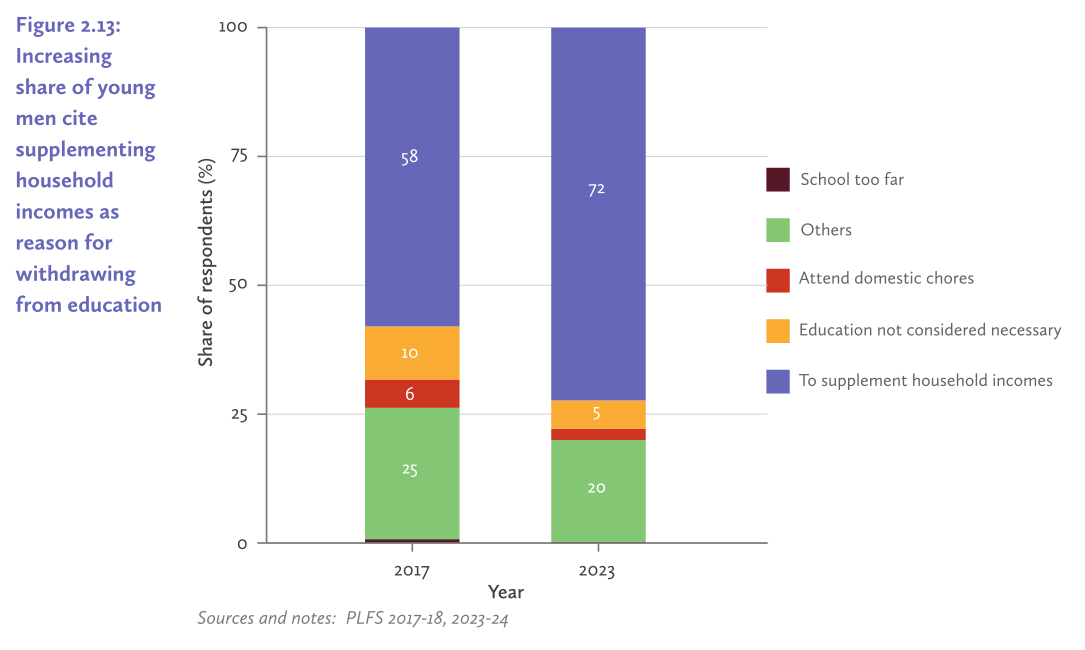
And increasingly, young men are noticing this and choosing to drop out from their degree. Between 2017 and late 2024, male tertiary enrollment actually fell from 38% to 34%. When asked why, 72% cited the need to support household income. In 2017, that ratio was 58%. This is a reversal of a decades-long trend. The economics of a Tier-3 private degree simply no longer makes mathematical sense for them.
The queue
So what happens after education?
Between 2004-05 and 2023, ~50 lakh graduates were added to the labour market each year. Of those, about 28 lakh found employment of any kind, and a fraction of that number entered salaried work. Track a cohort of young male graduates from when they first report being unemployed: half find some form of work within a year but only about 7% secure permanent salaried employment, and a mere 3.7% land white-collar roles. The rest settle for informal, temporary, or gig-based work.
Earlier, we covered how India’s job market operates as two parallel worlds. One world is a tiny formal sector that employs less than 7% of workers, and the other is vast informal economy where the rest cycle between self-employment, daily wages, and joblessness. Very little connects the two paradigms. The SWI report adds a critical youth-specific dimension to that picture, identifying two strategies young people adopt to try and cross the bridge over to the formal sector.
The first is “queuing“ — which refers to sitting out of the labour force entirely to prepare for government exams. It’s no secret that a government posting, with its job stability, benefits, and social prestige that no private sector job can match, is one of the highest aspirations in India. But it’s also a lottery. Government hiring has been declining for decades, and the success rate for most competitive exams is miniscule. Yet millions of young Indians, mostly from wealthier households, park themselves in this queue for years, accumulating no work experience or earnings.
The second strategy is the “fallback“ — taking whatever informal work is available immediately. This is the reality for those who can’t afford to wait. However, fallback work unfortunately tends to become permanent. There’s a “scarring effect“ at work here — years spent in low-productivity informal work erode skills and connections, making it harder to transition into formal employment later.
Migration offers a partial release valve, and it’s becoming a defining feature of how India’s youth labour market actually functions. Younger, poorer states like Bihar and UP have the youth bulge but not enough jobs, while older, richer states like Maharashtra, Delhi and Haryana have the jobs but an ageing workforce. So young people move.
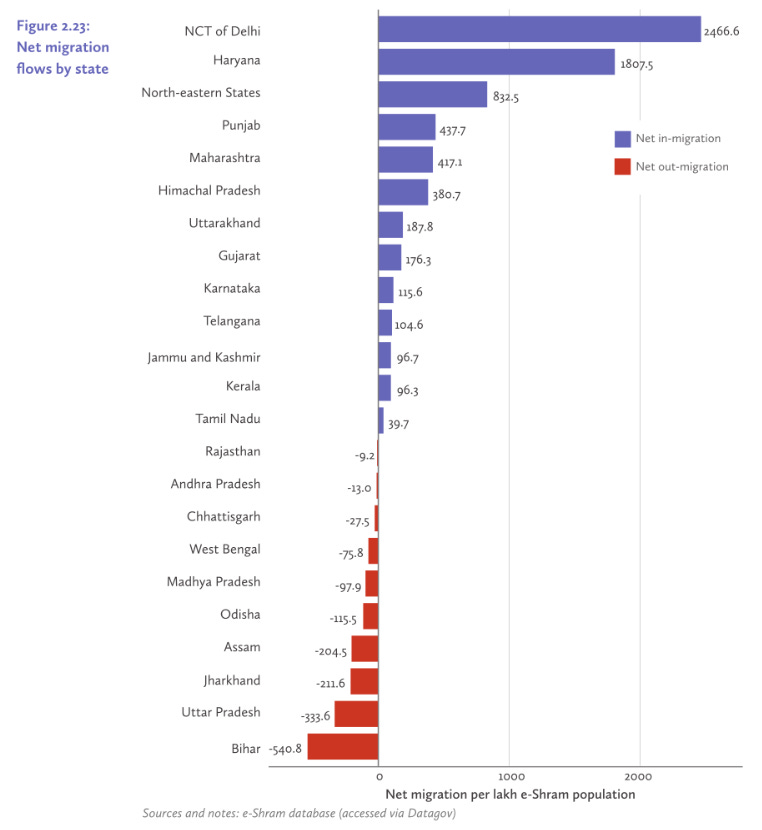
The question, then, that becomes difficult to answer is whether this is solving the regional mismatch or deepening it. If Bihar’s most educated young people leave for Bangalore and Delhi, they may find better individual outcomes. But Bihar itself is drained of exactly the human capital it would need to build its own economy. The sending state stays trapped in a low-skill, low-investment equilibrium, perpetually exporting its young rather than employing them.
The missing middle
Finally, what happens to the young people who do enter the labour market?
The headline trend is that India’s youth are leaving agriculture at a pace far faster than older generations. Among young men, the share in agriculture halved between 1983-2023 — from ~57% to 27%. Among young women, it fell from 75% to 49%. This is, in principle, exactly what structural transformation should look like.
The problem is where they’re going. The textbook model that worked in China, South Korea, and much of East Asia says that manufacturing should absorb workers leaving the farm. In India, that hasn’t happened at the scale needed. Young men exiting agriculture are landing in construction, retail trade, and transport — the same low-productivity sectors that employ older, less-educated workers. The report calls this the “missing middle“.
For women, though, the story is very different. Education does sort young women into higher-productivity work. Graduate women are breaking into IT, business support services, healthcare, and advanced textile manufacturing at rates that far outpace older female cohorts. The gender gap in graduate earnings has also narrowed significantly — young graduate women now earn nearly as much as their male counterparts. This is one of the genuinely positive shifts the report documents.
But even this comes with caveats. The overall female labour force participation rate remains stuck at ~35%, and the report notes a nearly four-fold increase in women entering “own-account” self-employment since 2017 — a category that, as we’ve covered before, often reflects distress rather than entrepreneurship.
A few other shifts are worth noting. Caste-based occupational segregation is weakening: the share of SC/ST workers in the leather and footwear industry — a traditionally caste-linked occupation — fell from 40% in 1983 to 24% in 2023. Younger cohorts are choosing their futures based on aspiration rather than inherited identity. Whether the sectors they’re moving into offer meaningfully better wages and conditions is a different question, one the report acknowledges but doesn’t fully resolve.
What’s the verdict?
The report’s subtitle — “Pathways from Learning to Earning“ — captures the Indian aspiration. But, much like Indian roads, those pathways have plenty of large, glaring potholes, and more often than not, they won’t get you to your destination. The education system produces credentials without capabilities. The job search process is a choice between waiting or compromising. And the labour market absorbs young people without advancing them.
India has four years until the demographic window begins to close. What happens between now and 2030 will determine whether 36.7 crore young people become the engine of the world’s next great economic transformation or whether we grow old before we grow rich.
An armor for the Indian Railways
The Indian Railways runs thousands of passenger, freight, and express trains — most of which operate a shared, tightly coordinated network. For most of this network’s history, what kept those trains apart was signals along the track and the locomotive pilot’s instinct.
This meant that, to a large degree, rail safety was left to manual judgement. The single biggest safety risk on this network has been something called SPAD: Signal Passed At Danger. That’s when a driver misses or misjudges a red signal, and the train enters a section it shouldn’t be in.
Training helps, but it can’t eliminate the problem. As speeds on key corridors have risen toward 130–160 km/h and more trains have been packed onto the same routes, there’s less room for a driver to recover from a mistake. By the 2010s, Europe, Japan, and China had all moved to automated train protection — systems built on a simple idea: if the driver fails, the machine steps in.
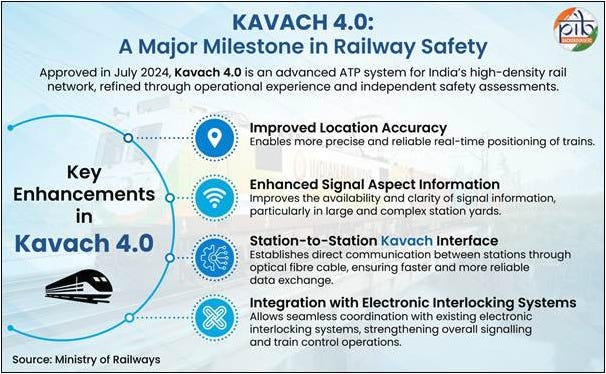
Indian Railways decided to build its machine layer, called Kavach (Hindi for “protection”). Officially, Kavach is an aid to the driver, not a replacement. In practice, it continuously monitors the train’s speed and position, and if the driver doesn’t respond to a danger in time, it applies the brakes. It’s now been commissioned on more than 2,200 route kilometres.
Today, we’ll be diving into what it does, how it works, what it means for the safety of the Indian railways, and why it’s difficult to scale. Let’s dive in.
How Kavach is put together
Every train on a Kavach-fitted route runs inside a safety boundary. The system knows where the train is, what signal is ahead, what the speed limit should be, how fast the train is going, and how long it would take to stop. From those inputs, it builds what engineers call a “brake curve“, which maps the speed at which the train needs to be at every point ahead. If the driver goes above that curve, Kavach applies the brakes automatically.
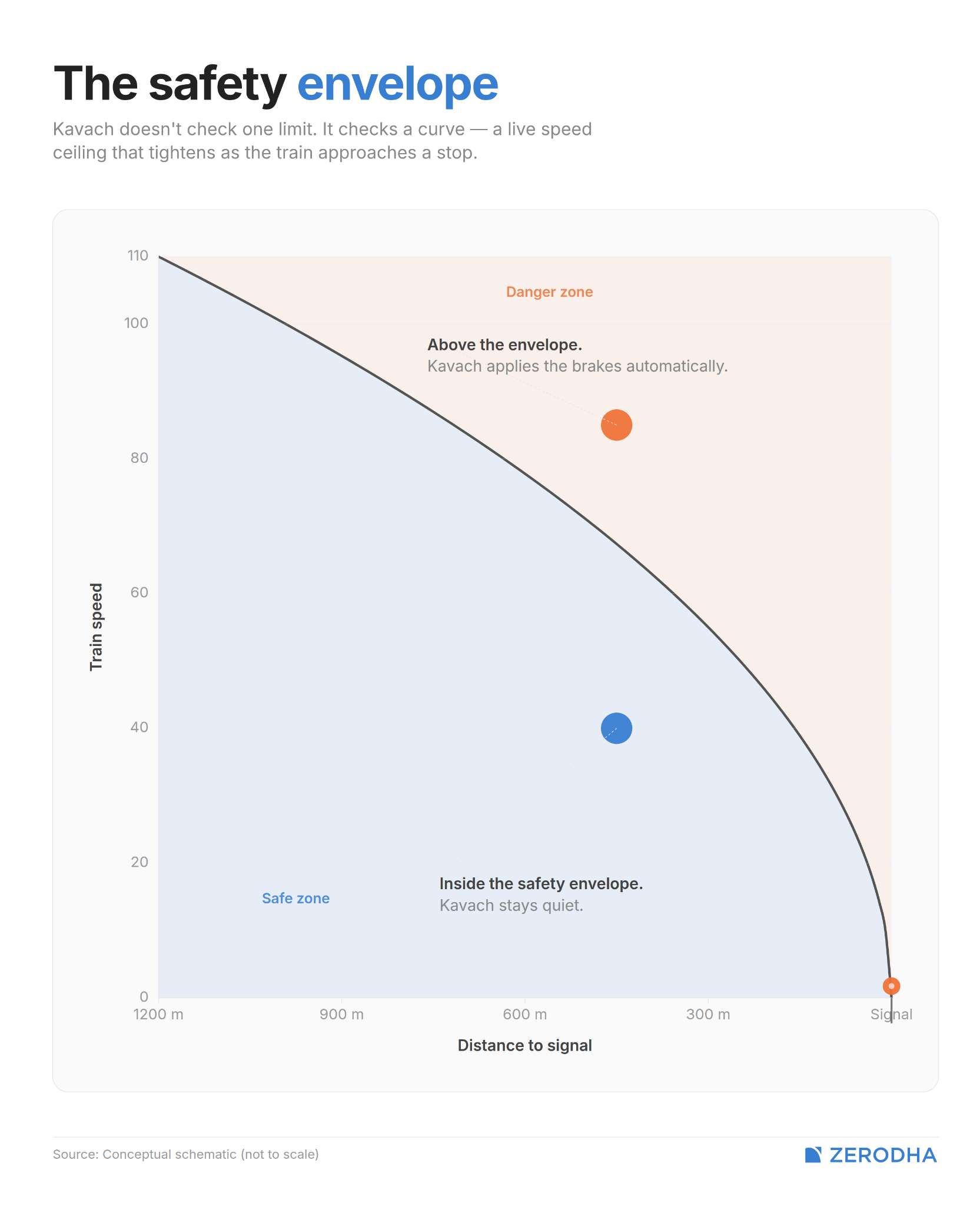
The railways describe this as Safety Integrity Level 4, or SIL-4. It is the highest functional-safety rating used internationally for this class of system. It means the protective function has been designed and tested to fail at an extraordinarily low rate — the kind regulators usually express in scientific notation. Accidents don’t become impossible; the system built to prevent them has been designed to the strictest reliability standard available.
This system operates through four layers of hardware and software, most of which you can’t see.
The tags
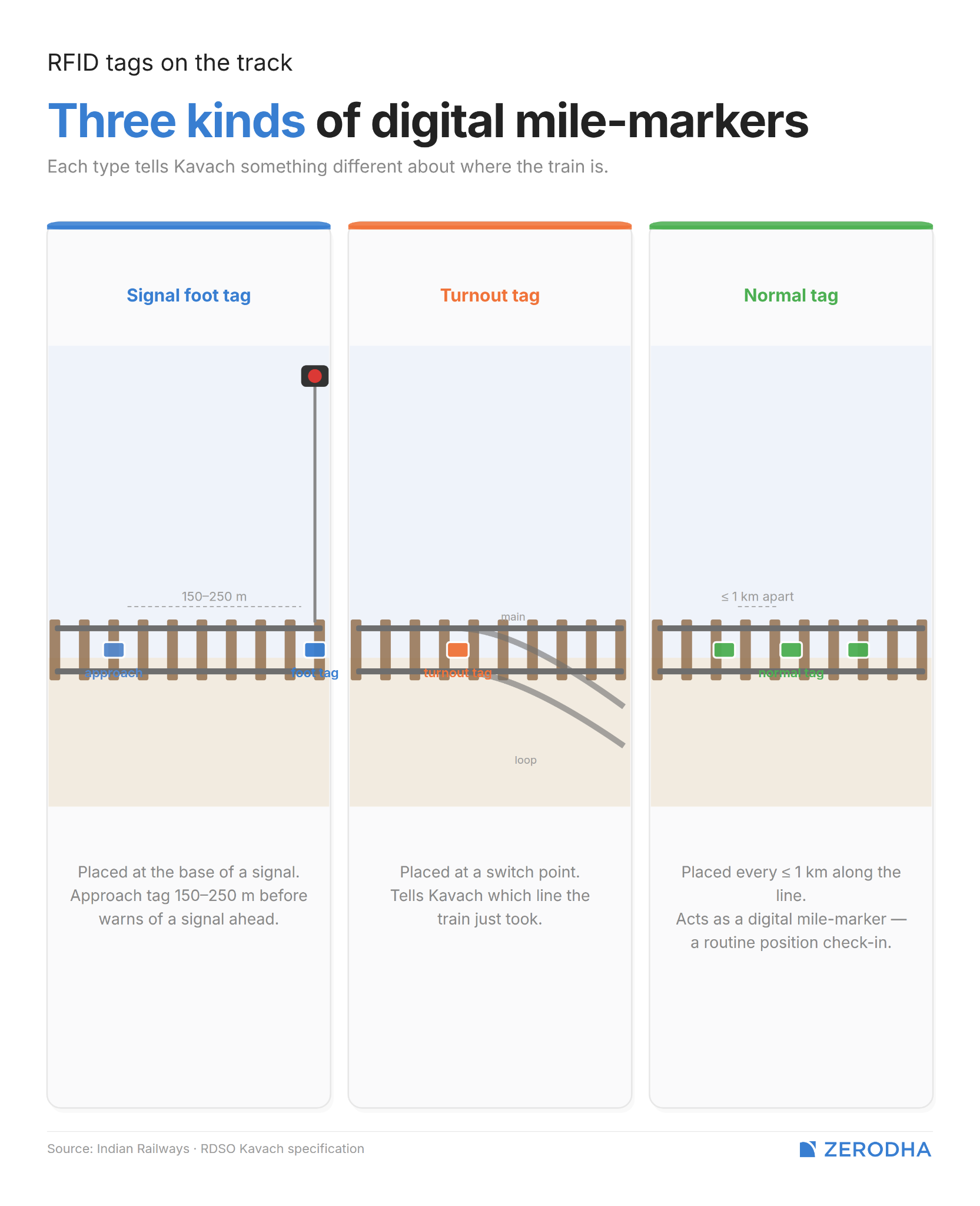
The simplest layer is a set of radio-frequency identification (or RFID) tags fixed to the sleepers between the rails. These have no power of their own — they only wake up when a reader on the underside of a locomotive passes over them. Each tag tells the train exactly where it is and what kind of track feature it has reached. They’re spaced no more than a kilometre apart and installed in pairs for redundancy.
There are three kinds of tags. A “signal foot tag“ sits at the base of a signal, so Kavach knows the moment a train reaches it. A “turnout tag“ sits where tracks branch — at this point, a switch sends a train either onto the main line or off onto a loop. The tag tells Kavach which of the two the train has actually entered. If it’s the main line, speed is capped at 60 km/h, while the loop line is capped at 30.
Between two tags, the onboard computer estimates the train’s position from how far its wheels have rotated. At each tag, it corrects any drift.
The radio
The second layer is a radio network. The locomotive carries two radio modems — if one fails, the other takes over immediately. Information flows continuously between the train, the nearest station, and any other trains on the same stretch. A typical 40-metre tower covers ~4.5 kilometres on each side, and extra towers go up where stations are farther apart, or terrain gets in the way.
If the radio connection drops past the allowed timeout, Kavach blanks its display, asks the driver to acknowledge, and applies the brakes if no response comes.
The computers
The third layer is the computing logic.
One computer is set on the trackside, and one is on the train. The stationary computer reads the existing signalling system — what colour the signal is showing, which way the points are set, what route the interlocking has cleared. (Interlocking is the station’s route-locking logic: it prevents two conflicting routes being set at the same time.) Kavach doesn’t decide what’s safe; the signalling system does. Kavach turns that decision into a constantly updated safety envelope inside the cab.
Onboard, the train’s computer combines inputs from RFID readers, radio modems, speed sensors, and a satellite-timed clock. That’s what lets it know, at any moment, where the train is, how fast it’s going, and how much safe track it has left.
The brakes
The fourth layer is the brake unit. Kavach can apply a normal brake, a full-service brake, or an emergency brake. If the driver goes past the safe limit and doesn’t correct, the system takes over the brakes.
What Kavach looks like in operation
The first clear public demonstration of Kavach was in March 2022, between the Gullaguda and Chitgidda stations in Telangana. Two locomotives were deliberately driven towards each other on the same track. Kavach applied the brakes on both, and the locomotives stopped 380 metres apart. The same trial also prevented a locomotive from crossing a red signal, and cut a train’s speed automatically from 60 to 30 km/h as it entered a loop line.
In normal running, Kavach operates in a few modes. Full supervision is the default when all data is available — Kavach manages how far and how fast the train can go. Limited supervision kicks in when some data is missing; it imposes tighter speed limits. Shunting mode is for low-speed yard movements, where Kavach defines the area the train can move in, and brakes if it goes beyond it.
And if things go further wrong, like the radio is down for too long, or multiple tags are missed, Kavach enters Staff Responsible mode, where it steps back and the driver takes full responsibility under tighter operating rules.
There’s also a distress system. If a train starts sliding backwards on a slope by more than five metres, Kavach detects the movement and applies the brakes. The driver can broadcast a distress alert by pressing an SOS button in the cab; the station master can do the same from his panel.
The system also generates alerts on its own. For example, if a train stops unexpectedly on the open line between two stations when it has been cleared to proceed, Kavach asks the driver to respond within 15 seconds. No response means it broadcasts an SOS and applies the brakes.
Why Kavach looks the way it does
Kavach isn’t the first train-protection system in the world. Europe has their Train Control System, which aims to replace trackside signals and automate things entirely. The US has Positive Train Control. Indian Railways looked at both and built its own, partly because of cost, and partly because neither was designed for a network running this many different kinds of trains on the same track.
Three design decisions follow from that.
The first is cost. The railways’ current planning benchmark is about ₹50 lakh per route kilometre for trackside and station equipment, and about ₹80 lakh per locomotive for onboard fitment. The Railway Minister cited roughly ₹2 crore per km for the European Train Control System during the 2022 trial. Kavach’s cost structure is designed to make it affordable for a 68,000-km network, not just a few showcase corridors.
The second decision is that Kavach sits on top of the existing signalling rather than replacing it. The manual trackside signals still operate. If Kavach fails on a section, trains continue to run under the existing rules — without the extra machine layer, but operationally intact. On a network as dense as India’s, a system that doesn’t take down the route when it misbehaves is a more practical choice than one that does.
The third is interoperability. A train fitted with one company’s hardware has to work with another company’s trackside equipment. Version 4.0 of Kavach includes what RDSO calls a standard braking algorithm — a shared formula for how any Kavach-fitted train calculates its braking. Three Indian companies — Medha, Kernex, and HBL — are the approved manufacturers.
The scaling problem
Kavach works. The harder question is how fast it can spread across a 68,000 km network.
The system can’t just be bolted onto a track. Every kilometre needs fibre-optic cables for communication between stations, radio towers for train-to-ground contact, RFID tags on the sleepers, station equipment, signalling upgrades, and trained loco pilots who know how to operate with it. That’s why the recent approvals in March and April went mostly into the backbone — cables, towers, station upgrades — rather than Kavach hardware itself. The system can’t run faster than the infrastructure underneath it.
That bottleneck is partly what made the response to rail accidents so slow. In June 2023, a signalling error in Odisha sent the Coromandel Express onto the wrong track. It hit a stationary freight train, and 296 people died. Kavach was not on the route. At the time, the system had only been deployed on a tiny fraction of the network. Six months later, that number had gone up by just 10 km.
After the accident, the railways had to move faster. The Delhi–Mumbai and Delhi–Howrah corridors were made the priority, and by July 2024, an updated version — Kavach 4.0 — had been approved for deployment. Prayagraj–Kanpur (190 km) and Vadodara–Nagda (224.51 km) were added in the last month alone. More than 55,000 railway personnel have been trained, including around 47,500 loco pilots.
The vendor pipeline is moving too. Kernex Microsystems disclosed a ₹91 crore order for 112 locomotive sets from Banaras Locomotive Works. HBL Engineering got an ₹84 crore order from Patiala Locomotive Works. Quadrant Future Tek got a ₹20 crore order from Patiala as well.
But partial coverage creates its own risk. A train protection system works best when it covers a route end to end. Right now, a train can move from a Kavach section into one where Kavach doesn’t exist, but the locomotive pilot also has to switch between two ways of operating on the same trip. That increases the potential for error.
What comes next
A few things are already in the pipeline.
The ministry has talked about a centralised AI-based monitoring platform for real-time monitoring of Kavach installations. Kavach 5.0, a next-generation version designed for suburban sections where the priority is not just collision avoidance but running more trains safely at closer intervals, has been announced but not fully specified. And RDSO has a provisional draft specification for an elephant intrusion detection system using optical-fibre sensing to pick up animal movement near tracks.
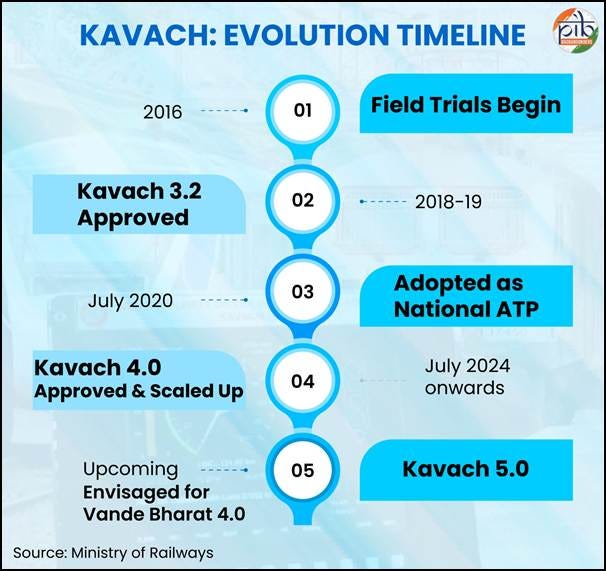
None of that changes the core fact that the program still falls painfully short. The basic Kavach system is still not as omnipresent as it should be. For India, which has had its fair share of rail accidents, getting this done is of paramount importance.
Tidbits
1. TSMC posted a 58% jump in net profit for the January–March quarter, powered by relentless AI-driven demand for its most advanced chips. TSMC flagged the ongoing US-Iran conflict as a potential risk to operations, given Taiwan’s dependence on Middle Eastern energy imports.
Source: Business Standard
2. Bharat PetroResources, BPCL’s upstream subsidiary, will invest $2.8 billion in an oil and gas exploration project in Brazil, marking one of India’s larger overseas upstream bets in recent years. The move is part of BPCL’s broader push to diversify its acreage internationally as domestic E&P opportunities remain limited.
Source: Business Standard
3. India’s CAFE 3 norms — which set stricter fleet-wide fuel efficiency targets for automakers — has reached a final draft after industry and government agreed on the framework. CAFE 3 is expected to push carmakers to accelerate the shift toward hybrids and EVs to meet tighter efficiency requirements across their model lineups.
Do check our recent story on the CAFE 3 norms.
Source: The Hindu BusinessLine
- This edition of the newsletter was written by Kashish and Vignesh.
What we’re reading
Our team at Markets is always reading, often much more than what might be considered healthy. So, we thought it would be nice to have an outlet to put out what we’re reading that isn’t part of our normal cycle of content.
So we’re kickstarting “What We’re Reading”, where every weekend, our team outlines the interesting things we’ve read in the past week. This will include articles and even books that really gave us food for thought.

Has the microfinance credit cycle turned?
Has the microfinance credit cycle turned? That’s the question we set out to answer by digging through 144 concalls across 18 companies over eight quarters. Instead of looking at management commentary in isolation, we track how the narrative evolved over time—from peak optimism to a full-blown credit shock, and now signs of recovery. The idea is to connect the dots and understand what really drove the cycle, and more importantly, what the industry looks like on the other side.
Thank you for reading. Do share this with your friends and make them as smart as you are 😉
We’re set to become the world’s first 'Old & Broke' superpower. After ten years of "masterstroke", India is looking less like a rising tiger and more like a billionaire’s private estate where the citizens are just there to be adjudicated by the landlord.
Corrupt country
Corrupt people
Corrupt industries
Corrupt banks
Corrupt stock market
Sab madarchod hai