


Our goal with The Daily Brief is to simplify the biggest stories in the Indian markets and help you understand what they mean. We won’t just tell you what happened, we’ll tell you why and how too. We do this show in both formats: video and audio. This piece curates the stories that we talk about.
You can listen to the podcast on Spotify, Apple Podcasts, or wherever you get your podcasts and watch the videos on YouTube. You can also watch The Daily Brief in Hindi.
In today’s edition of The Daily Brief:
Behind the Great Nicobar megaproject
The chip on the new world order’s shoulder
Behind the Great Nicobar megaproject
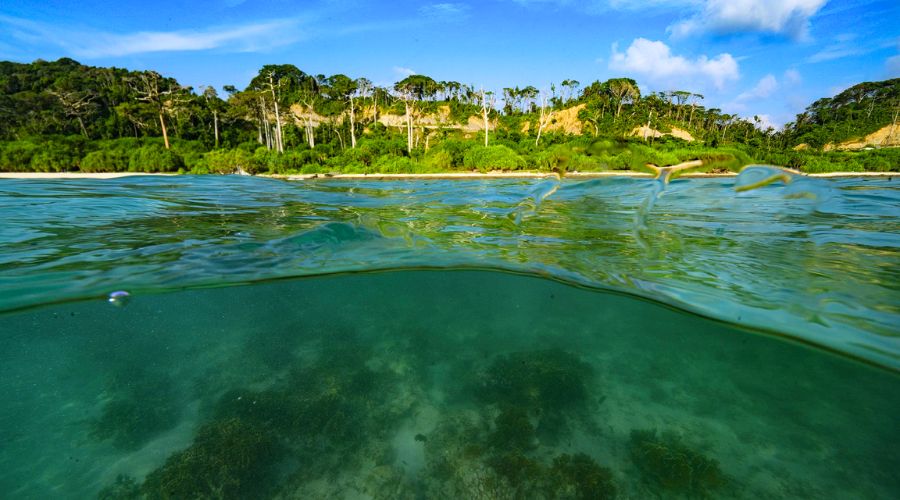
The southernmost point of India — lower, even, than Kanyakumari — is a tiny sliver of land at the very end of the Andaman and Nicobar archipelago. This is Great Nicobar, a pristine island fringed by coral reefs and blanketed in ancient tropical forest, closer to Indonesia than to mainland India. It is one of the most remote and undeveloped places in the country; home to 8,000 people in the middle of nowhere.
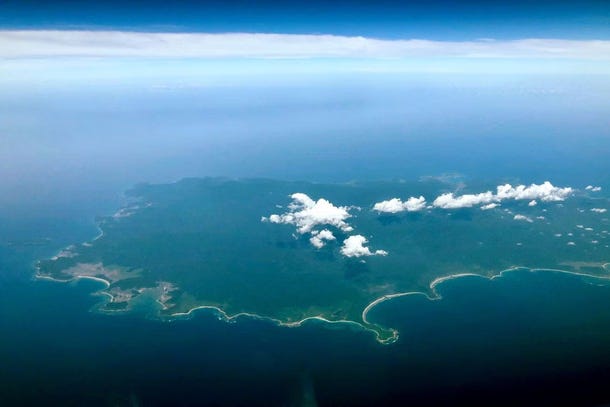
The Indian government wants to change that, dramatically. It’s putting together a giant megaproject, called the “Holistic Development of Great Nicobar Island,” which could turn the island’s southern tip into a massive infrastructure hub. In all, the project will be spread across 166 square kilometres — just under one-fifth of the island’s total area — and will cost upwards of ₹81,000 crore.
Last week, the government got through one of the biggest hurdles in the project’s path. A six-member bench of the National Green Tribunal gave the project its blessing, citing its “strategic and national importance.” If its laundry list of conditions is met, construction can now begin.
This legal approval, however, doesn’t mean the project is uncontroversial. Many researchers consider it an environmental catastrophe in the making.
Are they right? We are genuinely not sure. This is a story with major differences of opinion. Both sides have some basis in the truth. We don’t know enough to tell you who is right. But we want to lay the facts as objectively as we can, so that you know what the fuss is about.
The plan
At the southern tip of Great Nicobar Island, India wants to construct four separate pieces of infrastructure (a) an integrated infrastructure hub featuring a deep-water transshipment port, (b) a dual-use international airport, (c) a gas-and-solar power plant, and (d) a township scaled for 650,000 people.
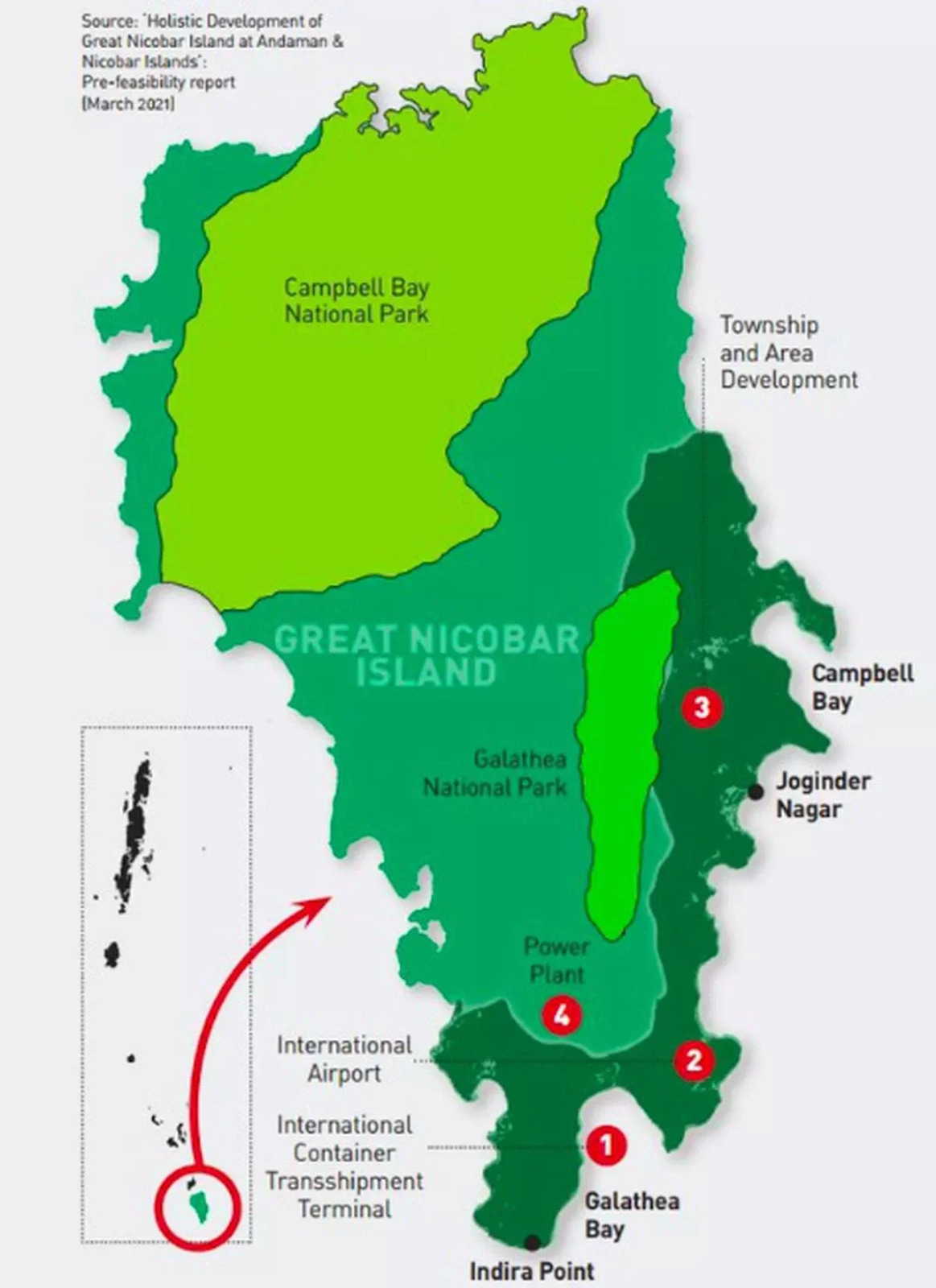
The plan’s flagship is a deep-water container trans-shipment port at Galathea Bay, on the island’s southern coast. This will come together over the next thirty years, in four phases. Even in its very first phase, it’s planned to be a relatively large port — with enough capacity to handle 4 million “twenty-foot equivalent units,” or TEUs. For a sense of how much that is: if all those containers were placed end-to-end, they would stretch halfway around the circumference of the earth. Over time, this will be scaled to somewhere between 14 and 16 million TEUs — nearly twice the size of JNPT, India’s largest port today, and in line with some of the biggest ports on the planet. The private sector will be brought in to build and manage the mammoth facility.
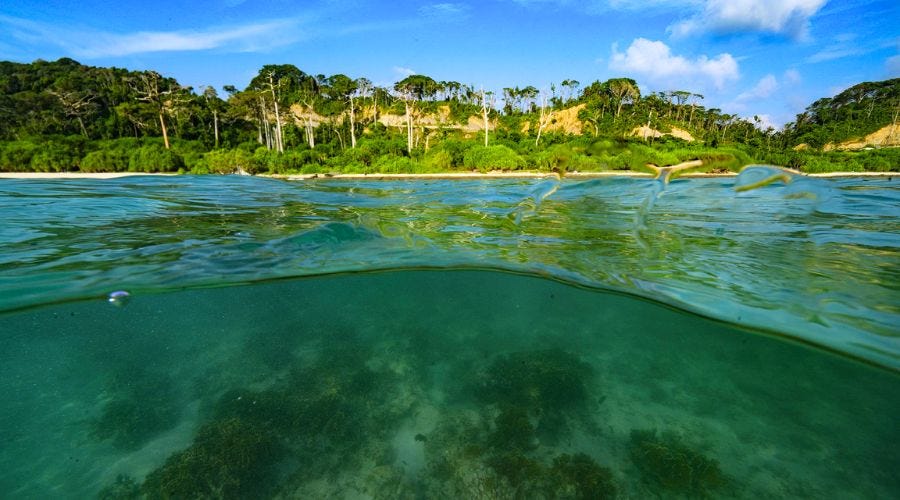
Alongside the port, the government shall add an international airport with a 3,300-metre runway — long enough to handle major commercial aircraft like the Airbus A380. At peak capacity, this will process 3,000 to 4,000 passengers every hour. The airport shall be “dual-use”: apart from the regular flow of tourists and travellers, it will also run military operations. Because the runway is so long, it will essentially jut out into the sea at both ends, requiring land reclamation on either side.
Then there’s the supporting infrastructure. A 450 MVA gas-and-solar hybrid power plant will keep the whole project running. And a pair of townships — spread across nearly 15,000 hectares — will house the people needed to operate all of this. This is the most land-intensive part of the project. The island’s population, currently around 8,000, would swell to over 650,000.
Why here?
What’s the point, though? Why sacrifice a pristine island for just another port?
Well, it won’t be just another port.
There is a structural gap in India’s maritime logistics. Most major Indian ports require continuous, capital-intensive dredging to accommodate “ultra-large container vessels” — the workhorses of modern global trade. Because Indian ports often can’t handle these ships directly, goods moving in and out of the country frequently require trans-shipment: they travel first to a smaller Indian port, then get transferred to a larger hub — often abroad, in places like Colombo, Singapore, or Port Klang in Malaysia. That creates an automatic disadvantage for Indian products. Every container of Indian products costs an extra $80 to $300 in handling, and spends an extra three days or so in transit. We also lose thousands of crores in port revenue to foreign competitors.
Galathea Bay does away with that problem. It has a natural draft depth exceeding 20 metres — deep enough for the largest vessels afloat, without any dredging at all.
But India already has a brand-new deep-water port that can handle the same traffic. Just last year, India inaugurated a new port facility at Vizhinjam in Kerala. That’s a deep water port as well, and sits just 10 miles away from the “international East-West shipping lane”. The Vizhinjam port, too, was built with the same promise — of relieving India’s dependence on foreign ports.
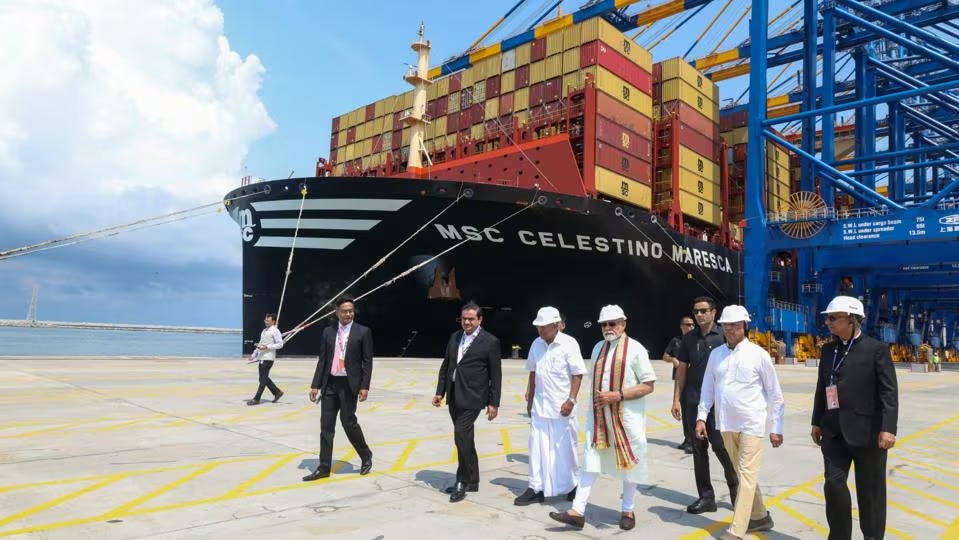
Then why build another, 1,600 kilometres away, on a remote island?
Well, because geographically, there are few points on the Indian ocean with more strategic value.
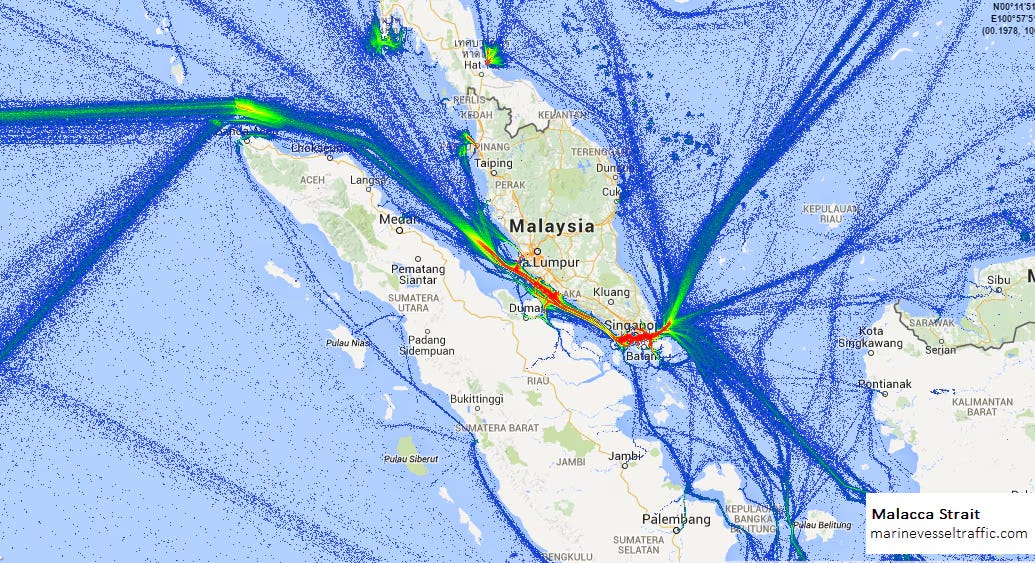
Great Nicobar sits right by the Malacca Strait, one of the world’s busiest shipping lanes, and the heart of the East-West international shipping route. This single, narrow chokepoint handles roughly 30% of all internationally traded cargo — nearly one lakh ships every year. It links the world’s biggest manufacturers — Japan, China, South Korea, Taiwan — to much of the rest of the world. A major port, here, wouldn’t just attract transshipment traffic; it would sit at the doorstep of one of the most important trade corridors on earth.
In times of peace, this is an incredible location to have a logistics hub. But if there’s ever a military confrontation, a large, well-equipped island right in the middle of one of the world’s most strategic shipping lanes effectively lets you project power across the area. The world’s great powers — China, the United States, and others — have all tried to establish a presence in the region. China, for instance, has a massive presence on the Coco Islands, just 55 km to the south.
The new port and airport give India a major foothold of its own.
What it costs
This is a costly project. The government plans to spend ₹81,000 crore over the next 30 years to bring it to life. Chances are, we’ll spend at least a few billion dollars more to bring the project alive. But the real cost, arguably, is environmental.
Critics, broadly, have three complaints against the project: that it irreversibly destroys the island’s natural habitat; that it ignores the human cost that will be borne by the island’s tribes, and that it doesn’t consider the risks of building in the area.
The ecological price
The project takes land that is effectively carpeted with ancient, pristine forest, and clears roughly one-sixth of it. Around 130 square kilometres of forest land will go into this project — at least a million trees.
This forest is unlike any other on earth. It is part of one of the world’s most important biodiversity hotspots, home to species found nowhere else: 11 types of mammals, 32 types of birds, 7 types of reptiles, and 4 kinds of amphibians that only exist here. And that is only what we know; new species are still being discovered. No matter what one thinks about the trade-offs, the damage done to these species cannot be reversed.

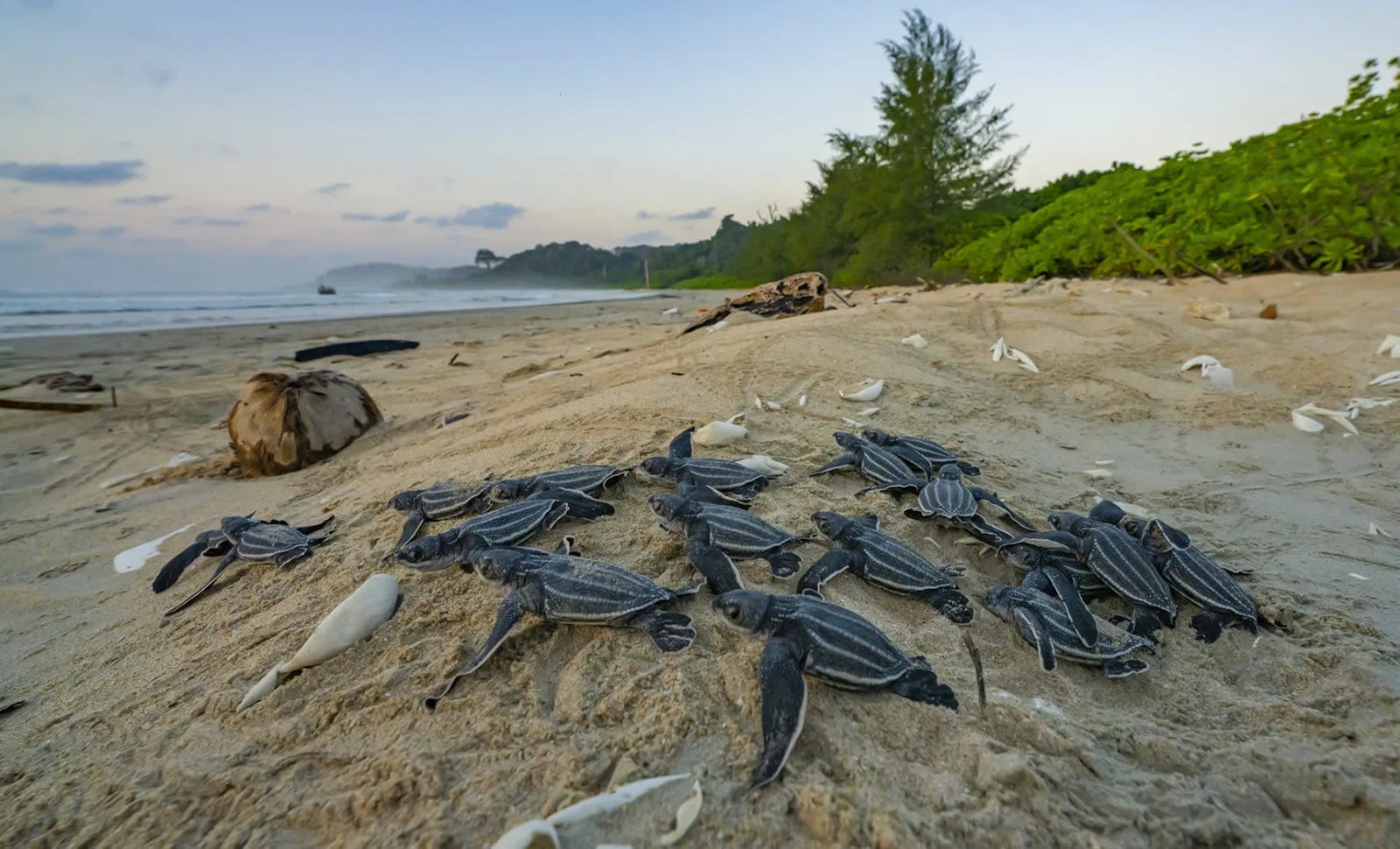
The region is also woven into the lifecycles of animals that range far beyond the island. The leatherback turtle, for instance, depends on Galathea Bay as one of its most important nesting sites in the Indian Ocean. Until 2021, in fact, the bay was a designated wildlife sanctuary for this very reason. Then, in 2021, just as the port was coming up, it was denotified.
It isn’t clear how deeply these costs have been considered. Researchers argue that there have been serious lapses in how the project’s environmental footprint was assessed. The primary biodiversity survey, for instance, was conducted over just 14 field days, by a team with just one ecological expert.
The tribal question
The forests of Great Nicobar are also home to some of India’s smallest and most vulnerable communities — including the Shompen, a tribe of fewer than 300 people, which are among the most isolated people on earth. Under the law, tribes like the Shompen have rights over the forest land they inhabit. Such projects can only proceed with their consent.

The government claims to have done everything by the book, and that the project will have no bad impact on the lives of these tribes. Tribal leaders, however, allege that their consent was obtained under duress, with little understanding of what they were giving away. The Calcutta High Court will see whether the legal process was properly followed next month.
Legalities aside, however, it’s hard to see how their lives will not be changed by a project of this scale. With over half a million people descending upon the island, these tiny communities will probably see their habitats altered and their culture placed under severe pressure. As these groups come into contact with outsiders, they could also be exposed to diseases against which they have no defence.
Seismic risk
Great Nicobar sits on one of India’s most seismically active zones. The earthquake that triggered the devastating 2004 Indian Ocean tsunami — which measured over 9 on the Richter scale — began just 130 kilometres from the island. What if we’re ever to see a repeat?
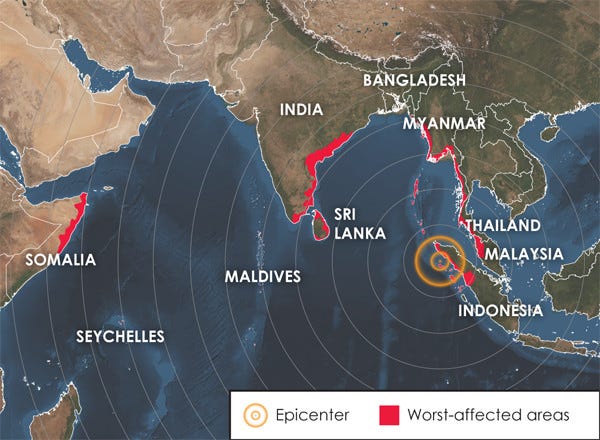
To be fair, according to an IIT-Kanpur study, events of this magnitude only occur once or twice a millennium. But any project built there remains exposed to earthquakes and tsunamis of a lesser but still damaging scale. This is not a problem shared by any of the established megaports the project hopes to compete with.
What is lost, and what can be saved
All these costs are real, and hard to deny.
A megaproject of this scale, on a virgin island, will leave scars. It will change the ecology of the area and put many species with no other home in danger. It will also change the lives of the people who called the island home for hundreds of generations. Even with best practices followed throughout, this is a foregone conclusion.
Some of it can be ameliorated. The environmental clearance granted to the project in 2022 stipulates various safeguards: from relocating corals away from the project site, to measures for protecting specific animals, to preserving mangroves and other vegetation. None of this will keep the island pristine. But if the conditions are followed — along with best practices that minimise habitat destruction — an ecological disaster can, perhaps, be averted.
As things stand, though, these are promises, not outcomes.
This isn’t to take away from the fact that there’s a real case for both a logistics hub and a military installation in the region. There are few better locations for one. But it’s worth asking: can we actually bring the project to life?
If the government’s vision actually bears fruit — if Galathea Bay becomes an essential stop for international liner networks, and a key gateway through which India trades with the world — perhaps these costs are justified.
But there’s a worst-of-all-worlds possibility: one where forests are cleared and habitats destroyed, without creating any value. Megaprojects, after all, fail most of the time. Even if the promised facilities do come up — itself a big if — there are no guarantees that the island actually draws commercial traffic. Shipping alliances might stick to the ports of Colombo and Singapore, while Vizhinjam absorbs the bulk of domestic transshipment demand. In that case, Great Nicobar could become a white elephant — a tremendously expensive, heavily state-subsidised project, with nothing to show for the price that was paid.
Sadly, we won’t know how it goes until the damage is already done.
The chip on the new world order’s shoulder
They say that the devil works hard. But modern geopolitics works even harder.
On February 6, India and the US announced an interim trade deal. Washington would lower its punishing reciprocal tariffs on Indian goods from 50% to 18%. In return, India was required to slash duties on American industrial products and cut Russian oil imports. A few days later, the White House released a revised fact sheet, quietly walking back certain commitments.
Then, in the last 4 days alone, the new world order hit the throttle aggressively.
India formally became a signatory to Pax Silica, a US-led coalition to secure the global supply chain for semiconductors and AI. Soon after, in a surprising turn of events, the US Supreme Court struck down President Trump’s sweeping reciprocal tariffs. In response, Trump signed a proclamation imposing a flat 10% temporary import surcharge on US imports for 150 days — replacing the elaborate tariff regime that had been the basis for India’s trade deal.

Perhaps now, India may have to re-evaluate the entire pact. That’s why, by the next day, India had postponed planned trade talks with Washington.
At The Daily Brief, we’ve mentally prepared ourselves to lose sleep over how world trade can change in a moment’s notice. Arguably, its speed is giving the advancements in LLMs a run for their money.
On that note, we’re yet to cover Pax Silica until now. It’s a monumental attempt to rewire the world’s semiconductor supply chain. It doesn’t exactly entail a set of steps to follow, nor is it binding. But it does tell us about how various countries, particularly the US, are thinking.
Let’s dive in.
Lines in the sand
The name is deliberate. “Pax“ is Latin for peace, stability, and long-term prosperity. The Roman Empire’s golden age, for instance, was called Pax Romana.
Perhaps the most famous such period of stability is Pax Americana. It refers to the period after World War II, where the global order was firmly led by the US. The pillars of Pax Americana included economic openness and adherence to democratic values. This period was underwritten by military power and the status of the US dollar as the world’s reserve currency.
In the same vein, Pax Silica is a bet on the next era of global power will be determined by who controls silicon, and therefore, semiconductors. After all, those who control the chips control AI.
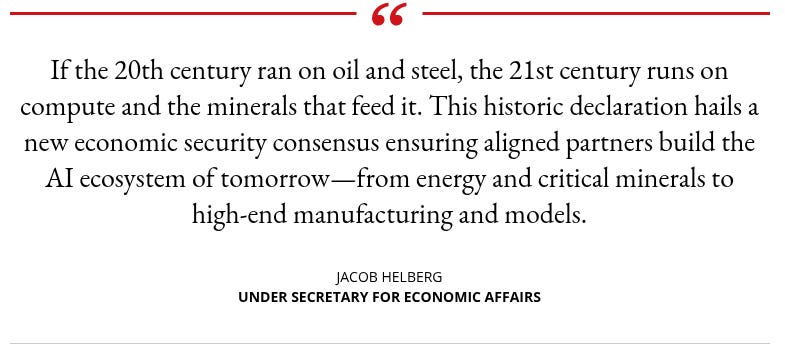
The initiative was launched at a summit in Washington in December 2025. Seven countries — the US, Japan, South Korea, the UK, Australia, Israel, and Singapore — signed the founding declaration. The UAE and Qatar joined shortly after. And now, India became the tenth signatory.
Its stated aims are sweeping. Pax Silica wants to coordinate across the full stack of the AI supply chain: critical minerals, energy inputs, semiconductor design and fabrication, advanced packaging, data centres, and so on. It seeks to reduce “coercive dependencies“ on adversaries. like China — which controls most of global rare earth refining and has a strong presence in legacy chips. Pax Silica wants to protect the technological frontier, ensuring that aligned nations stay ahead of others.
Pax Silica isn’t entirely like Pax Americana, though. This isn’t a coalition built on the principles of economic openness or efficiency. Rather, it’s built on the explicit premise that, in case of a clash, national security takes over economic efficiency.
In other words, with Pax Silica, the role of markets in allocating resources to semiconductor supply chains looks diminished, if not eliminated. Geopolitical necessity now trumps economic efficiency.
This also ties in with the rest of America’s current, hostile approach to globalization. It is Trump’s belief that economic openness is what hollowed out America’s industry. So now, going forward, openness will be a lot more restrictive.
One way to understand why Pax Silica exists is to look at who signed it. Each member controls a critical chokepoint in the semiconductor value chain.
Starting from raw materials, you have Australia, which has vast reserves of lithium and rare earths, and is home to some of the world’s largest mining companies. Japan, while being famous for its electronics manufacturing, also has capacity in key chemicals.
Then, further down, you have most of the world’s innovative companies. South Korea, for instance, is home to the world’s biggest memory chipmakers. Israel brings venture capital and innovation in software and cybersecurity. Singapore, meanwhile, is a vital semiconductor packaging node and logistics hub.
On the energy side, which AI needs a lot of, you have the oil-rich nations of Qatar and the UAE. On the financing side, not only are there the sovereign wealth funds of Singapore, the UAE, Qatar, but there’s also the venture capital ecosystems of Israel and the UK.
And lastly, you have the US, the linchpin of innovation, IP and financing. Together, they represent an attempt to stitch together a coordinated, self-sustaining supply chain that doesn’t depend on China for any critical input.

The notable absences
But what’s just as revealing as the list of signatories is who’s excluded from it.
See, the first Pax Silica summit in December had a wider guest list than its signatory list. Several important players attended the discussions but did not sign the declaration. The most striking absence, perhaps, is Taiwan.
By any measure, Taiwan is the most important node in the global semiconductor supply chain. After all, TSMC fabricates most of the world’s most advanced chips. Foxconn, headquartered in Taiwan, is the world’s largest electronics contract manufacturer — and now the biggest maker of AI servers. Without Taiwanese manufacturing, the entire AI revolution grinds to a halt.
And yet Taiwan was designated only as a guest contributor at the Pax Silica summit, not a signatory.
The reason is straightforwardly political. Most countries — including the US — do not officially recognize Taiwan as a sovereign nation-state. Granting Taiwan full membership in a US-led strategic alliance would provoke a diplomatic crisis with China.
Instead, the US has opted to integrate Taiwanese technology into the allied supply chain while carefully avoiding any formal acknowledgment of Taiwan as a country. It’s a deliberate ambiguity: Taiwan’s chips are essential to Pax Silica, but Taiwan itself cannot be a member.
The other striking absence is the European Union.
As per some analysts, there may be a divide-and-conquer strategy at play here. The idea is that Washington prefers to deal with European countries bilaterally rather than with the EU as a unified entity. A fragmented Europe, from the US perspective, offers more room to manoeuvre. It also doesn’t help that increasingly, the EU finds the US to be more unreliable.
Only individual European nations with specific chokepoints were brought into the fold. The Netherlands, for instance, is home to ASML, whose EUV machines are arguably the single most critical piece of equipment in advanced chipmaking. But while the Dutch attended the summit, they didn’t sign the declaration.
Where India fits in
Meanwhile, India’s path to Pax Silica wasn’t straightforward at all. In fact, we weren’t even invited to the founding summit in December 2025.
The initial exclusion might have two possible explanations. First, Pax Silica membership was structured around existing chokepoints — countries that currently control a critical piece of the supply chain — rather than future potential. India is pursuing its semiconductor ambitions by building new fabs and testing plants. But that’s still mostly aspirational.
Second, unresolved tariff disputes with the Trump administration may have made India’s inclusion diplomatically awkward at the time. Perhaps, India chose to sit out the Pax Silica agreement until it got a better bargaining chip through a trade deal.
So, what changed? Besides the attractive size of India’s AI market, we can’t say for sure. But a few things may still stand out.
The first could be enterprise AI. An interesting trend unfolding now is that to deploy AI at commercial scale, you might need systems integrators — or services companies that can help with deployment. That, perhaps, is why OpenAI has formed partnerships with Accenture and McKinsey — or why Anthropic signed a deal with Infosys.
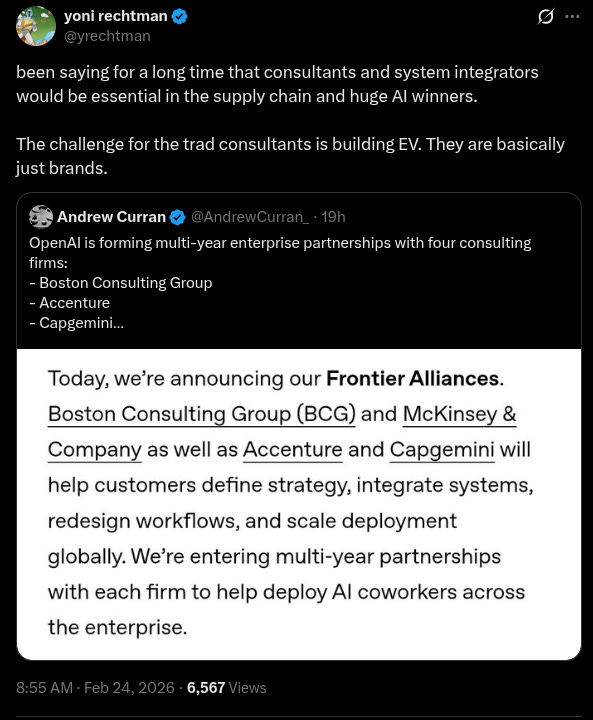
There has been a lot of chatter around how the very existence of Indian IT is threatened. However, the story so far has not been as neat. There’s a possibility that, with the bottlenecks that AI deployment will run into, IT services of some kind may be necessary.
The second, more viable reason is India’s depth in semiconductor design. India is home to a sizable chunk of the world’s chip design engineers. Most of the top fabless semiconductor companies operate a major design centre in India. We house Intel’s largest design hub outside the US. Between 10-30% of NVIDIA’s workforce resides in India.
To a small degree, the chips powering the Pax Silica coalition are, in many cases, already being designed in Bengaluru and Hyderabad. And that can’t be done away with.
The third is India’s push to build physical chokepoints elsewhere in the value chain. Now, this has less to do with India’s current advantages, and more to do with building future leverage. India is building capacity in chip assembly and testing, advanced packaging, and even fabs. It’s an attempt to move up the semiconductor value chain, which could build more bargaining power.
Whither success?
Will Pax Silica succeed? That’s not an easy question to answer, but let’s look at where coordination could go wrong.
In a sense, one can view Pax Silica as an international-scale industrial policy whose execution is underpinned by the US. There aren’t direct subsidies involved, but there’s an attempt to secure a supply chain and house it within certain borders only. And Pax Silica doesn’t fully eliminate markets either — it just limits where they work.
So, the question can somewhat be boiled down to “where does industrial policy work?” It works in curbing national security vulnerabilities — like sanctions, blockades, or even war — that can threaten industrial success. It works if you want to control export access.
But where it doesn’t work is cost. For instance, the IMF has found that friend-shoring can lead to losses in GDP. By imposing geopolitical constraints and prioritizing trade only with “trusted” countries, supply chains become inherently less efficient. They impose trade costs and reduce the possibility of exploiting comparative advantages elsewhere.
In fact, the US’ own efforts to build semiconductor supply chains within borders have run into financial excess. The Peterson Institute estimated that under the CHIPS Act, each job created cost twice the average salary of an American semiconductor worker. Plentiful was devoted to the program without considering cheaper, more efficient alternatives. Instead, the Peterson Institute argues, the money could have been spent on stockpiling chips.


Conclusion
If you’ve been reading The Daily Brief, you’ll know that the Pax Silica story sounds familiar.
In certain cases, attempts to reverse globalization and pursue industrial policy doesn’t always lead to reindustrialization. If anything, it often imposes costs on the host country and siloes them from more efficient global supply chains. The US — or at least its consumers — is already bearing the costs of its own tariffs.
Now frame these issues on a global scale. Pax Silica treats efficiency almost as a vulnerability. But the alternative of building a bloc that shuts out many other countries doesn’t sound foolproof, either. More importantly, Pax Silica doesn’t have everyone — most notably Taiwan — on its side.
There is a logic to Pax Silica, and it could succeed in its intended aims. However, there are allies of Pax Silica, and then there are those that aren’t part of it. Inevitably, this will only fragment the world further.
And as we’ve covered before, innovation in the world today is too globalized for a painless decoupling of supply chains. It’s much easier to fail at a strategy like Pax Silica than not.
Tidbits
Govt waives fresh clearance for mine tailing recycling
The government has exempted recycling of mine tailings within existing leases from needing fresh environmental clearance. The move removes a key regulatory hurdle and allows companies to recover minerals and water from waste more easily. It comes as India ramps up mining to support its energy transition goals.
Source: The Hindu BusinessLineCanada PM Mark Carney to visit India
Canadian Prime Minister Mark Carney will visit India from February 26 as part of his Indo-Pacific tour. Talks will focus on trade, AI, energy, defence and investment, with both sides targeting $50 billion in bilateral trade by 2030. Business partnerships and technology cooperation are expected to be key themes.
Source: ET NowBharti Airtel to invest ₹20,000 crore in NBFC arm
Bharti Airtel will invest ₹20,000 crore over the next few years into its newly formed NBFC, Airtel Money. The unit will focus on digital lending and credit distribution, building on Airtel’s existing ₹9,000 crore loan disbursal engine. The move marks Airtel’s big push into financial services beyond telecom.
Source: The Economic Times
- This edition of the newsletter was written by Pranav and Manie.
We’re now on WhatsApp!
We’ve started a WhatsApp channel for The Daily Brief where we’ll share interesting soundbites from concalls, articles, and everything else we come across throughout the day. You’ll also get notified the moment a new video or article drops, so you can read or watch it right away. Here’s the link.
See you there!
Thank you for reading. Do share this with your friends and make them as smart as you are 😉
While the project is projected as vital for national security and regional connectivity in the Bay of Bengal, it has attracted serious criticism from environmental scientists, disaster-risk experts, and indigenous rights advocates. The concerns outlined below highlight the ecological, social, and governance challenges that question the long-term sustainability and ethical foundations of the project.
Large-scale deforestation of pristine rainforests on Great Nicobar Island
Irreversible loss of biodiversity and endemic species
Destruction of habitats of endangered wildlife (e.g., leatherback turtles, Nicobar megapode)
Damage to coral reefs, mangroves, and marine ecosystems in the Bay of Bengal
Displacement and cultural erosion of indigenous Shompen and Nicobarese tribes
Lack of genuine free, prior, and informed consent from tribal communities
High seismic, earthquake, and tsunami risk (2004 tsunami precedent)
Increased vulnerability to sea-level rise, cyclones, and climate change impacts
Questionable economic viability given ecological and disaster risks
Weak environmental impact assessment and clearance process
Militarisation and strategic development overriding ecological safeguards
Long-term loss of ecosystem services (carbon sinks, coastal protection, fisheries)
The final question we must ask is “development at what cost?”