


Our goal with The Daily Brief is to simplify the biggest stories in the Indian markets and help you understand what they mean. We won’t just tell you what happened; we’ll tell you why and how too. We do this show in both formats: video and audio. This piece curates the stories that we talk about.
You can listen to the podcast on Spotify, Apple Podcasts, or wherever you get your podcasts and watch the videos on YouTube. You can also watch The Daily Brief in Hindi.
In today’s edition of The Daily Brief:
1. The not-so-fine legal print of Indian real estate
Under new rules from the IBBI, every project of an insolvent developer must now maintain a segregated bank account and can be carved out of company-wide bankruptcy if creditors agree. Real estate accounts for 22% of all corporate insolvency cases in India, yet the original IBC framework only recognised whole corporate entities, allowing a single stalled project to freeze solvent sites and strand homebuyers. While formalising project-wise “reverse CIRP” prioritises flat delivery over liquidation haircuts, it risks shifting losses onto secured bank lenders and assumes developer funds were never diverted across projects.
2. Indian cement Q2 results
Despite robust monsoon-quarter demand rising nearly 10%, major Indian cement makers faced sharply divergent fortunes as surging petcoke and fuel costs squeezed profitability per tonne. While UltraTech expanded domestic volumes by 14% and leveraged high operating rates to absorb fixed costs and lift realisations, Ambuja saw operating profit fall 28% after deliberately turning away loss-making institutional orders to focus on retail buyers. With manufacturers adding over 115 million tonnes of capacity through FY28, the industry faces an oversupply risk that could trigger fierce price wars to keep kilns running.
The not-so-fine legal print of Indian real estate
On October 30, the Insolvency and Bankruptcy Board of India (IBBI) made a small-looking, but highly consequential change to how a real estate company goes bust.
Under the new rules, every project of a developer going legally bankrupt must now have its own bank account. Its receipts and payments must be reported separately to creditors. If creditors agree, a project that’s financially healthy may be fully pulled out of the insolvency process of an otherwise-unsound company.
This may seem like fine print, but the law has taken 6 years of hot debate to arrive here.
The rules arrive barely two months after the Supreme Court told the Noida Authority that homebuyers can’t be made to pay for the penalties their bankrupt developer racked up — a ruling we covered extensively. And they trace back to a September 2025 Supreme Court direction asking the IBBI to write insolvency rules specifically for real estate.
None of these are isolated incidents. In May, the IBC was amended to give these new rules a statutory basis, among many other needed changes in Indian bankruptcy as a whole. But they do represent a massive push to clean up the messiest balance sheets of any sector in India. The brunt of that mess has primarily tended to hurt the buyer of the home the most.
The idea that you can put a single project through insolvency rather than an entire developer isn’t new. But why it took so long to formalise comes down to how India’s bankruptcy law was originally written.
A broken bankruptcy code?
Let’s start with the very basics of what it takes to push a company into insolvency in India.
The Insolvency and Bankruptcy Code (IBC) doesn’t ask anyone to prove a company is broke from the get go. It starts with a disgruntled creditor, who only has to prove that the company owed it money, and that it didn’t pay. But note that it isn’t yet accusing the company of insolvency. Today, the missed amount has to be at least ₹1 crore.
Once a tribunal is satisfied there’s a debt and a default, it must admit the case under IBC. Nobody looks under the hood just yet. Whether the company is truly finished is something the process is meant to discover once admitted.
And that process is drastic.
Once a case is admitted, the company’s board loses its powers, and an insolvency professional takes charge of the business. No new lawsuits can be entertained, no selling off assets can take place. The business keeps running, but its fate now belongs to a committee of creditors (CoC). The CoC, dominated by whoever is owed the most, decides whether the company goes to a new owner, or gets broken up and sold for parts.
This design may be reasonable for, say, a steel company. It is one business with a set of assets and factories which a rival steelmaker is only too happy to buy.
But a real estate developer is different. It’s typically a single company running several projects at once, each with its own land, its own approvals, its own buyers and its own timeline. The IBC, though, only recognises the company. The law didn’t recognize “projects” as the unit of bankruptcy analysis.
In effect, one failing tower can drag every other project down with it.
That might make sense if the complaint came from a bank or a supplier owed money across the whole business. But real estate has a creditor no other sector has: the homebuyer. Until 2018, homebuyers weren’t even treated as financial creditors under the IBC, despite the fact that money paid for an under-construction flat is effectively an advance loan to the developer.
More importantly, a homebuyer’s complaint is usually very simple, and may have nothing to do with the company’s solvency at all. It’s that they still don’t have a finished home.
How two homebuyers froze an entire developer
There is one case that highlights the pitfalls of this law the best.
In Gurgaon, a developer called Umang Realtech was building a residential project called Winter Hills-77. Buyers signed up around 2012, and the developer promised to finish construction and apply for a completion certificate by December 2015. But by late 2017, local newspapers were reporting that work had stopped. Buyers visiting the site in early 2018 found no labourers and no machinery.
These buyers weren’t financial analysts. Umang was a private company, so they had no easy way of telling whether it was insolvent, struggling or simply slow. What they knew was that they’d paid most of the price of their flats years ago, and were now paying EMIs and rent at the same time.
So in 2018, many of them went to the Real Estate Regulatory Authority (RERA) of Haryana. Most won their cases on paper, but few got what they’d asked for.
For instance, some wanted a full refund with interest. But RERA refused, and instead ordered Umang to pay them interest for every month of delay until it handed over the flat. Another buyer was also told that a refund couldn’t be allowed because the developer had committed to finishing the project by the end of 2019. By then, Umang was telling RERA it had raised a ₹75 crore loan and had 850 labourers on site.
RERA’s reasoning was that refunding one buyer from a stalled project uses up money needed to finish it for everyone else. There was indeed a case where RERA ordered full refunds for one of Umang’s projects that completely collapsed. But for a project that looked somewhat salvageable (despite being very late), buyers who wanted out were kept in.
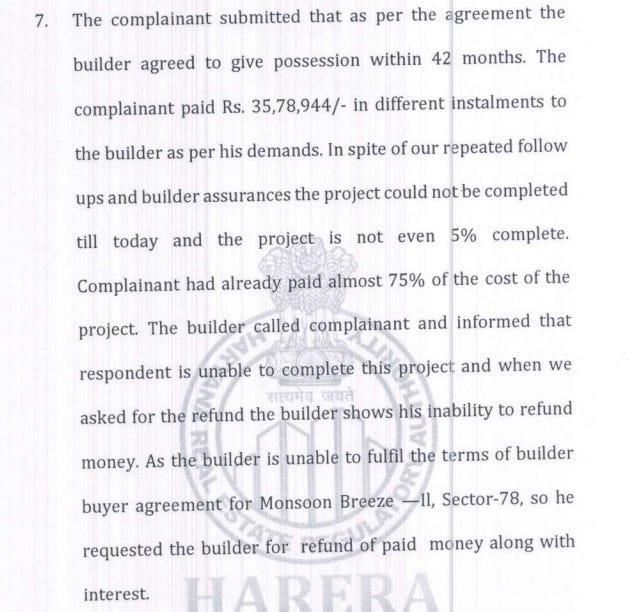
Either way, a RERA order is only an order. If a developer doesn’t pay, enforcement runs through a slow recovery process handled by the district administration.
Two buyers, Rachna and Ajay Singh, who had paid ₹1.01 crore for their flat, took a more drastic route. In 2018, they filed an insolvency case against Umang not under RERA, but under the IBC. They couldn’t have done so before that year because the law didn’t see home-buyers as creditors.

Umang objected. The IBC, it argued, isn’t a tool for individuals to recover their money, which is what it said the home-buyers were really after. Freezing an entire company over such a complaint wasn’t what the law was meant for.
The tribunal, however, disagreed. The Singhs, it said, were asking for a process in which all creditors could come forward, not for their money back. On 20 August 2019, it admitted the case. All of Umang Realtech went into insolvency, including projects whose buyers had no complaint at all.
The resolution came from the appeals tribunal, the NCLAT. By January 2020, the Singhs had received their flat and a sale deed. But the other buyers didn’t want a new owner brought in, or the company broken up. They wanted the building finished.
So in February 2020, the NCLAT did something new. It confined the insolvency to Winter Hills-77 alone, and let the existing promoter keep the project going by funding its completion as an outside lender, all under the insolvency professional’s supervision. It called this a “reverse CIRP”. By mid-2021, over 530 buyers had possession of their flats.
It was, in effect, the first project-specific insolvency in India. And even here, the line wasn’t clean. Years later, a buyer in a different property of the same developer had to go back to the NCLAT to argue that his project had nothing to do with Winter Hills. And as recently as 2024, Umang was arguing in the Delhi High Court that the insolvency freeze still applied to the whole company, not just the one project.
Home is where the heart is
For six years, the reverse CIRP had no clear basis in the law.
The IBC only knew how to put a company through insolvency. Despite the precedent of a reverse CIRP now existing, some lower benches refused to follow it, pointing out that the IBC only recognised the insolvency of a company.
And yet, tribunals kept reaching for it. The NCLAT applied it again within months, ordering another promoter to fund a stalled project as a lender. It confined the insolvency of the developer Supertech to a single project in 2022, and the Supreme Court itself leaned towards project-wise insolvency there, while leaving the bigger legal question open. The IBBI allowed project-wise resolution plans in 2024. As recently as January 2026, the NCLAT was still confining real estate insolvencies to the project the complaining buyers were in.
The reverse CIRP kept spreading because, for homebuyers, the alternative was so much worse.
A standard insolvency process leaves buyers waiting for years. Usually, the home doesn’t get built until a court reaches a resolution. Worse yet, the resolution could just be the company’s assets getting liquidated to pay off creditors. A half-built tower sold for scrap value pays everyone very little, while leaving home-owners without a home.
That points to an even deeper mismatch. In an IBC process, creditors are expected to take a haircut. A bank that recovers 30% of what it lent has taken a bad but survivable hit. A home doesn’t work like that, though. A flat that’s 70% built is worth nothing to a family. For a homebuyer, it’s all or nothing. Reverse CIRP was the first mechanism that treated the delivery of the asset (the flat itself) as the goal, rather than the recovery of money.
Another benefit of the reverse CIRP is that it protects healthy projects. Confining insolvency to the sick project lets everything else keep running. Moreover, if it’s decided to continue construction of the sick project, it gets more legal oversight. As per the new rules, the money for the sick project sits in its own bank account, and the flow of every rupee is reported to creditors.
Whither Chinese walls?
However, there are some valid reasons for why project-specific insolvency was debated for so long.
To start with, it rests on the big assumption that each project’s money actually stayed inside that project. Ring-fence the sick one, and the healthy ones are safe.
But a developer’s balance sheet doesn’t naturally separate its projects. It’s one company, with one pool of cash, one set of lenders and often one set of promoters deciding where the money goes. On paper, RERA already requires developers to park 70% of each project’s collections in a dedicated account.
But in practice, the lines blurred all the time, especially in some of the largest real estate defaults (and frauds) India has ever seen.
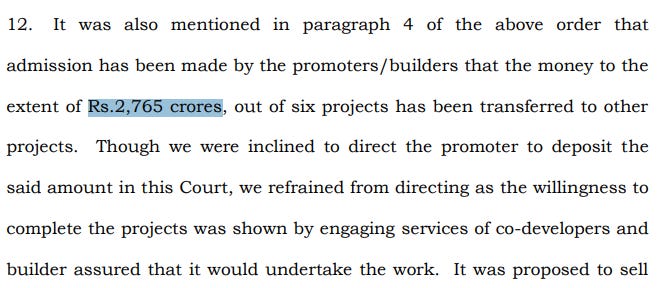
Take the now-defunct Amrapali group, which admitted in court to diverting over ₹2,700 crore of homebuyers’ money across projects. No ring-fence could have worked there. A wall around one project means little if the cash leaked out years before anyone filed a case.
Then there’s the infamous Jaypee Group. The ED alleged that the money homebuyers paid for its Noida projects was diverted to group trusts and sister companies, even as the homebuilder’s land was mortgaged to secure its parent company’s loans.
The second criticism comes from the banks.
Banks lend to real estate projects often on a specific condition: they get first claim on the project’s land and assets in the event of a default. That security is a large part of why they lend at all. They may even lower the interest rates in return.
Project-specific insolvency changes that bargain. If the project is carved out and the goal becomes handing finished flats to buyers, the assets backing the bank’s loan shrink.
That creates an awkward asymmetry. Homebuyers get their homes with no haircut. Banks, holding what was supposed to be the safest claim in the room, absorb the loss. That may be fair from the perspective of home-buyers simply because they have far more at stake. But banks will only see real estate projects as riskier than ever, and hence will either lend less to real estate or charge much more for it.
Moreover, the cost of that might even fall on the next set of homebuyers.
Conclusion
Real estate accounts for 22% of all insolvency cases admitted in India, second only to manufacturing. Yet, it’s a sector the law was never designed for.

India didn’t have a modern bankruptcy law until 2016. Real estate has been catching up ever since, one patch at a time. Each patch fixes a problem created by how the law was originally written, while also revealing the next problem.
The new rules are a real step forward. As one lawyer puts it, insolvency risk has to finally be treated less as a contingency and more as a systemic outcome. After all, bankruptcy is part and parcel of capitalism. But we’re still far away from understanding how the costs of it must be distributed.

Indian cement Q2 results
India’s cement makers just had a strange quarter. Demand was strong, and most of the big players sold more cement than they did a year ago. Yet, several of them earned less on every tonne they sold.
UltraTech stood out. Its domestic volumes grew nearly 14%, and its operating profit per tonne rose from ₹914 to ₹974. Shree Cement and JK Cement grew even faster, but each earned less per tonne. Ambuja, the Adani group’s cement arm, had the oddest quarter of all. Its volumes were flat at 16.5 million tonnes, its operating profit fell 28%, and its profit per tonne slid from ₹1,061 to ₹770.
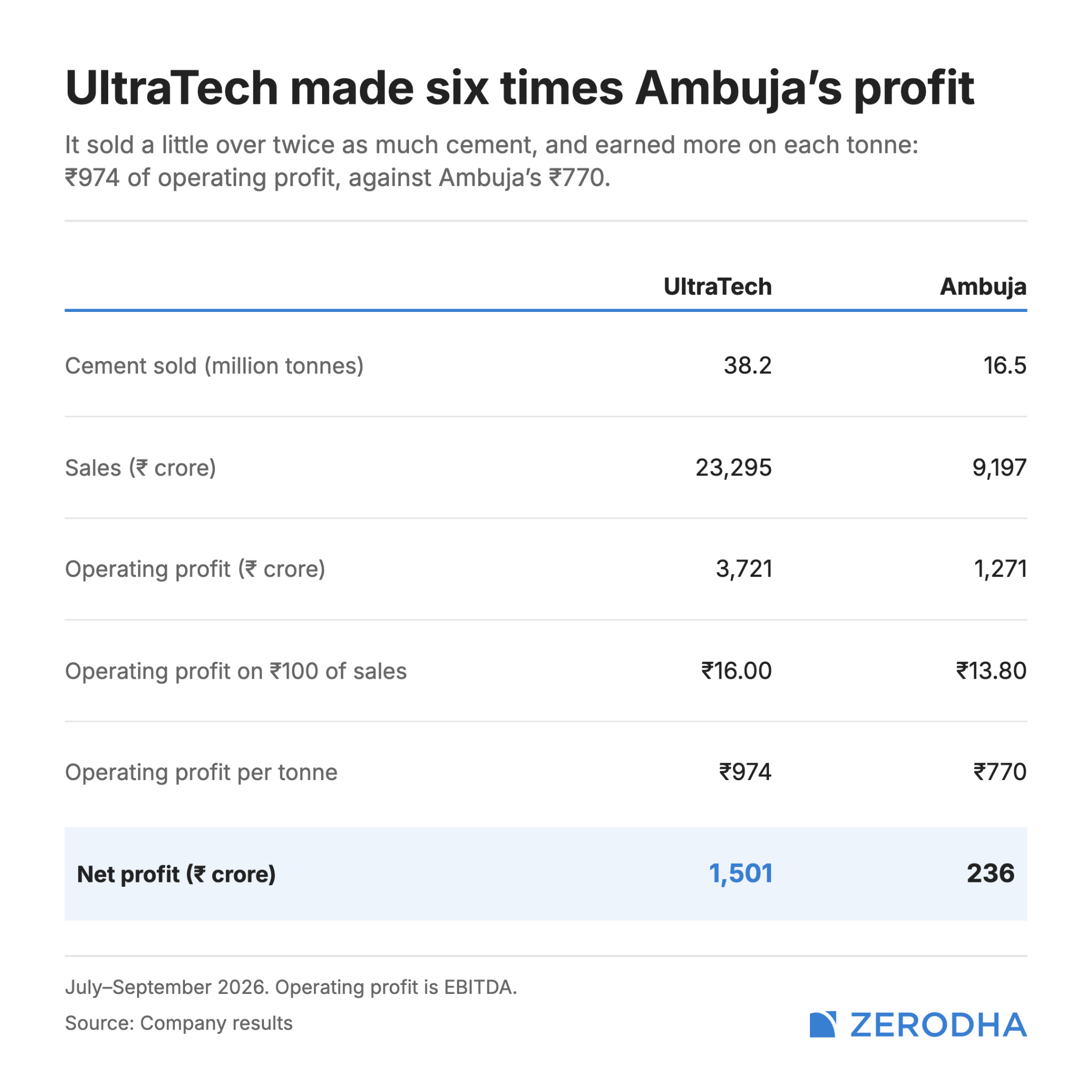
But here’s what caught our eye. Ambuja wasn’t struggling to find customers. It was turning some of them away.
That tells you something about this industry. Cement companies need to keep their expensive plants busy, but not every order is worth taking. Now, rising fuel costs are making that choice harder. And with companies building even more factories, the competition for customers could get tougher.
More tonnes, or better tonnes?
July to September is usually cement’s worst quarter, because the monsoon shuts building sites. This year, weaker rainfall across much of India meant fewer days lost to construction. UltraTech estimated industry demand grew nearly 10%, unusually strong for the monsoon quarter. The East, however, suffered heavy rains and flooding.
The two biggest companies did very different things with that demand.
UltraTech made the most of the stronger demand. To see why that paid off, look at how a cement plant works. It has large fixed costs, such as employee expenses and maintenance. When a company sells more cement, those expenses get spread across more tonnes, bringing down the cost of each one. UltraTech’s volumes rose nearly 14% while its fixed costs rose just 4%, bringing down its fixed cost per tonne by about 6%. This helped UltraTech improve its profit per tonne despite rising fuel costs.
Ambuja went the other way. Its management said some bulk orders from contractors and property developers barely made money, and some lost it. So it walked away from them and leaned towards retail buyers, such as families building homes and small contractors buying through dealers, where cement can fetch better prices. Retail now makes up 74% of its sales.

This logic makes sense. Selling cement at a loss to defend market share is how industries wreck themselves. But walking away from bad orders hasn’t spared Ambuja from a difficult quarter. Its profit per tonne still fell by more than a quarter. And with its plants running at only about 61–62% of capacity, it had fewer tonnes to spread its fixed costs across, which is the very lever UltraTech pulled.
But selling more cement profitably was becoming harder for everyone. Even as demand grew, the cost of making cement was climbing.
Why expensive fuel doesn’t guarantee expensive cement
Last year, cheap fuel was fattening margins. But today, the story couldn’t be more opposed.
The West Asia conflict sent petcoke, the refinery by-product that kilns burn, to around $180 a tonne (~₹16,900 today). UltraTech’s fuel cost rose from ₹45 to ₹51.50 per bag in a year, and Ambuja estimates geopolitics added ₹228 to every tonne it made. Even the cheaper escape route of domestic coal is narrowing, as Coal India prioritises power plants.
And the pressure didn’t stop at the kiln. UltraTech’s packaging costs rose around 30%, while Ambuja faced higher diesel and packaging expenses.
The obvious answer is to charge more, but that’s easier said than done.
According to Emkay Global, companies raised prices by ₹10-15 a bag in April and May, then rolled some of that back during the monsoon due to weaker demand. In August, companies in parts of North and Central India were offering discounts of ₹2–3 a bag to hit their sales targets. Prices recovered in September, but Emkay reckons costs have risen by ₹300-400 a tonne. It estimates the industry still needs another sustained increase of about ₹10 a bag.
A price increase is much easier to sustain when rivals follow, and a rival sitting on idle plants has every reason not to. However, despite operating only at 71% capacity, UltraTech believes it can pass those costs on.

Why so? Because in its key markets, it has little capacity left to fill. Cement is a regional business, and UltraTech’s factories were much busier in the North and South. It needs capacity to be available in the right markets. Cement is expensive to transport, so unused capacity in a state in the North doesn’t necessarily help a company serve customers in the East.
Ambuja, with much more spare capacity, is relying more on cost cuts. Its heavier use of domestic coal gives it an advantage: it paid ₹1.87 per 1,000 kcal of kiln heat this quarter, compared with UltraTech’s ₹2.09. But having cheaper fuel doesn’t automatically make a company more profitable. It also matters how much cement it can sell, and at what price.
Both companies raised prices again in October. UltraTech is counting on tight supply to support higher prices. But what happens to that confidence when everyone starts adding capacity?
The problem with everyone building more factories
UltraTech already has around 205 million tonnes of domestic capacity, and is working towards more than 240 million. Its reasoning follows from the earlier argument of demand stretching supply in some regions. Management confirmed that North India will be a focus of the next round. Days after reporting its results, Ambuja unveiled a ₹14,500 crore plan to add about 30 million tonnes, starting from a very different place.
Analysts weren’t entirely convinced. On Ambuja’s earnings call, one questioned whether the company was putting market share ahead of profitability when some of its acquired plants were running at barely half capacity. Management argued that demand would catch up and that some contractor problems delaying its earlier projects had been fixed. But that’s a lot riding on future demand.

Ambuja wants new grinding plants in Bihar, Jharkhand and Assam, along with substantial expansion in western India. Those areas are also where its customers lie, and are different compared to UltraTech. It is also adding clinker capacity to supply these plants, with projects scheduled through FY30. Building closer to demand can save on freight, even when existing factories elsewhere aren’t full.
Not all of this new capacity is equal, either. Making cement involves heating limestone in giant kilns to produce clinker, then grinding that clinker into cement. Grinding units are much cheaper and quicker to build, and much of the new capacity is grinding. That’s why Emkay expects clinker utilisation to reach around 79% by FY28, even while overall cement utilisation stays near 66%. That makes the oversupply risk more complicated than the headline capacity numbers suggest.
Both UltraTech and Ambuja are expanding closer to the markets they want to serve. But their starting points are different. UltraTech says it could have sold more cement this quarter if it had enough capacity in the right places. Ambuja, despite having more spare capacity, wants to strengthen its market share and reduce transport costs by building closer to customers. Both arguments make sense. But they aren’t the only ones building. CRISIL expects the industry to add 115–125 million tonnes over FY27 and FY28, potentially faster than demand grows.
India will need plenty more cement as it builds houses, roads and factories. But if several manufacturers build new plants to serve the same customers, they may have to compete harder on prices to keep those plants busy.
UltraTech and Ambuja may both be right to expand, but can they do so without competing away their profits?
- This edition of the newsletter was written by Manie & Mridula.
Tidbits:
1. Government reviews customs duty relief on 118 products ahead of Budget 2027
The government has begun reviewing customs duty concessions and exemptions on 118 products that are due to expire in 2027. Line ministries have asked industry to justify whether the relief should continue, using data on domestic production, imports, capacity and planned investment as the government weighs tariff rationalisation and local manufacturing.
Source: The Economic Times
2. Large factories generate nearly 72% of India’s manufacturing GVA
A recent study based on Annual Survey of Industries data reveals that factories employing more than 200 workers account for 10.4% of operational units but nearly 72% of India’s manufacturing gross value added (GVA). Conversely, micro units with up to 10 workers make up 36.3% of factories but generate just 2% of GVA, while carrying a significantly higher formal loan-to-GVA ratio.
Source: The Economic Times
3. SEBI permits REITs and InvITs to issue depository receipts
The Securities and Exchange Board of India has allowed Real Estate Investment Trusts and Infrastructure Investment Trusts to issue Depository Receipts to attract more foreign investment. Under the new framework, the trusts can issue fresh units or transfer existing ones to domestic custodians, with the resulting foreign currency-denominated instruments set to be listed on international exchanges in India’s GIFT City.
Source: The Hindu BusinessLine
4. Supreme Court refuses urgent hearing for plea alleging 700% airfare hike
The Supreme Court has declined to grant an urgent listing for a petition alleging that domestic airfares have surged by nearly 700%. When the petitioner’s advocate pushed for an expedited hearing, the Bench simply responded, “Don’t travel by air,” though a separate petition regarding the regulation of airfare fluctuations remains pending before the court.
Source: The Hindu
5. TRAI tightens complaint redressal rules for telecom operators
TRAI has tightened consumer grievance rules, allowing penalties of up to ₹20 lakh per quarter per service area for improper complaint handling. The amended rules also strengthen reporting and audits, require complaint centres to operate round the clock, and mandate at least 16 hours of human support each day.
Source: Business Standard
Want more tidbits? Catch up on last week’s recap!

Cash & Copium
Are credit cards a free lunch or a debt trap? On Cash & Copium, Pranay Kapoor reveals hidden forex markups, minimum-due interest traps, chargebacks vs UPI, and smart CIBIL building.
Watch the full episode here.
Beyond Today’s Brief
There’s always more happening at Markets by Zerodha.
The Chatter: What is SEBI focusing on in its latest regulatory moves? How is Asian Paints navigating competitive pressures and shifting market demand? And what are the key takeaways from Motilal Oswal and Gulf Oil’s latest business updates?
Aftermarket Report: How did Reliance Industries’ record quarterly earnings and an 11.6% stock surge propel Nifty past 23,400 to close at 23,441 as cooling oil prices lifted market sentiment? And what do 11 gaining sectors led by Oil & Gas, broad market breadth favouring advancers 2.6 to 1, and the Fear & Greed Index advancing to 32 signal as markets head into the November 3 expiry?
Join us on WhatsApp, where we share interesting soundbites from concalls, articles, and everything else we come across throughout the day. You’ll also get notified the moment a new video or article drops so that you can read or watch it right away.
Thank you for reading. Do share this with your friends and make them as smart as you are 😉