


Our goal with The Daily Brief is to simplify the biggest stories in the Indian markets and help you understand what they mean. We won’t just tell you what happened; we’ll tell you why and how too. We do this show in both formats: video and audio. This piece curates the stories that we talk about.
You can listen to the podcast on Spotify, Apple Podcasts, or wherever you get your podcasts and watch the videos on YouTube. You can also watch The Daily Brief in Hindi.
In today’s edition of The Daily Brief:
1. The business behind Zetwerk’s ₹5,000 crore IPO
B2B manufacturing platform Zetwerk is launching its ₹5,012 crore IPO, raising ₹2,830 crore in fresh equity to repay heavy operating loans. While its technology-led universal factory model has scaled total revenue to ₹15,913 crore—driven by custom energy equipment manufacturing and raw-material trading—its low 2.65% adjusted EBITDA margin and persistent working capital cash outflows mean the company must convert order growth into cash to break its debt cycle.
2. Who pays when it becomes too hot to work?
Extreme heatwaves across India are severely impacting the 76% of the population living in high-risk heat districts, with outdoor informal workers facing up to 40% lower earnings on extreme heat days due to reduced productivity and medical costs. Severe gaps in basic workplace amenities—such as shade, drinking water, and sanitation—force street and home-based workers to trade health for daily income, highlighting the urgent need for funded Heat Action Plans and functional parametric climate insurance.
The business behind Zetwerk’s ₹5,000 crore IPO
Imagine you run a business that makes power transmission equipment. You’ve just won a big order, and you need hundreds of parts, each made to precise specifications. Someone has to manufacture them.
Your first option is to hire a contract manufacturer. You agree on the specifications, the price and the delivery schedule, and it handles production from there. It could even deliver a complete product, sourcing components from other suppliers where needed. Think of companies like Dixon and Amber Enterprises in electronics and appliances. The catch is whether their manufacturing capabilities actually fit what you need.
Or you could look for suppliers on a business-to-business marketplace like IndiaMART. It will help you find businesses that make or sell what you need, but it typically won’t take responsibility for executing your order. Checking quality, managing suppliers and chasing deliveries could still be your headache.
Now imagine a third option: a company whose entire business is organising production across a network of factories. You hand it the order, and it takes contractual responsibility for delivering the finished goods to your specifications. It can use its own plants or split the work across outside manufacturers, while it arranges materials, monitors production, checks quality and manages delivery. Several factories may do the work, but you only ever deal with one company.
That, in a nutshell, is Zetwerk’s manufacturing business. What it can make isn’t limited to the factories it owns; it extends to the whole supplier network it manages. On top of that, Zetwerk runs a sizeable business buying and reselling industrial raw materials such as steel, aluminium and chemicals.
And now, Zetwerk is going public. Its IPO runs from October 15 to 19, with shares priced at ₹143–151. At the upper end of that band, the offer is worth about ₹5,012 crore. Of that, ₹2,830 crore goes to Zetwerk itself, and the rest goes to shareholders selling their stakes.
So let’s dig into how this business makes money, how much of that it gets to keep, and what the IPO money will pay for.
What does Zetwerk actually do?
Let’s go back to that transformer order, and say it lands with Zetwerk. Its engineers study the requirements, estimate the cost and quote a price. Once the customer agrees, Zetwerk uses its own software, Zetwerk OS, to assign the work to a suitable factory.
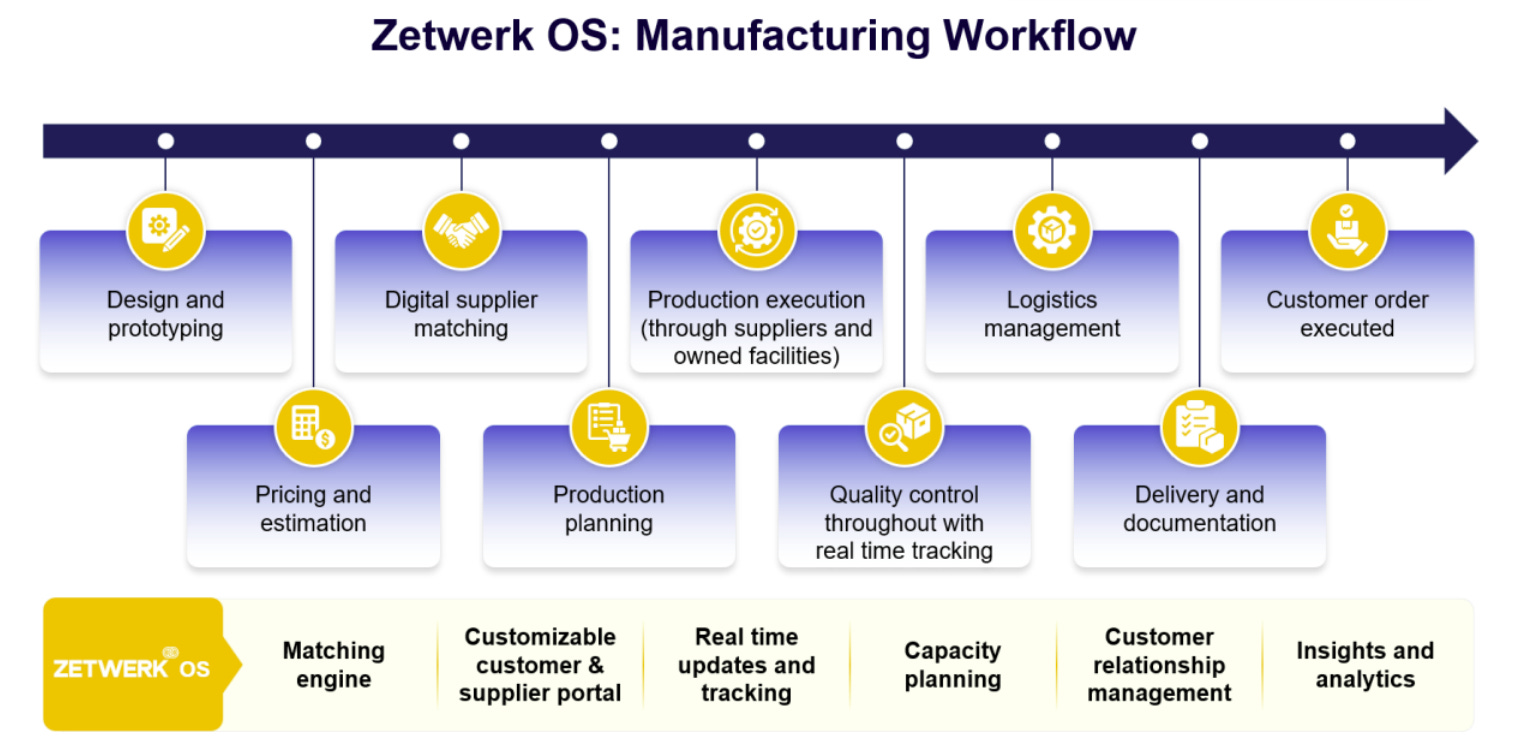
That factory could be one of Zetwerk’s 26 factories across India, the US, Germany and Spain, or one of its 6,979 outside suppliers. Zetwerk started out relying on other manufacturers, but has since acquired 15 factories and built 11 of its own. As of March 2026, three more were under construction.
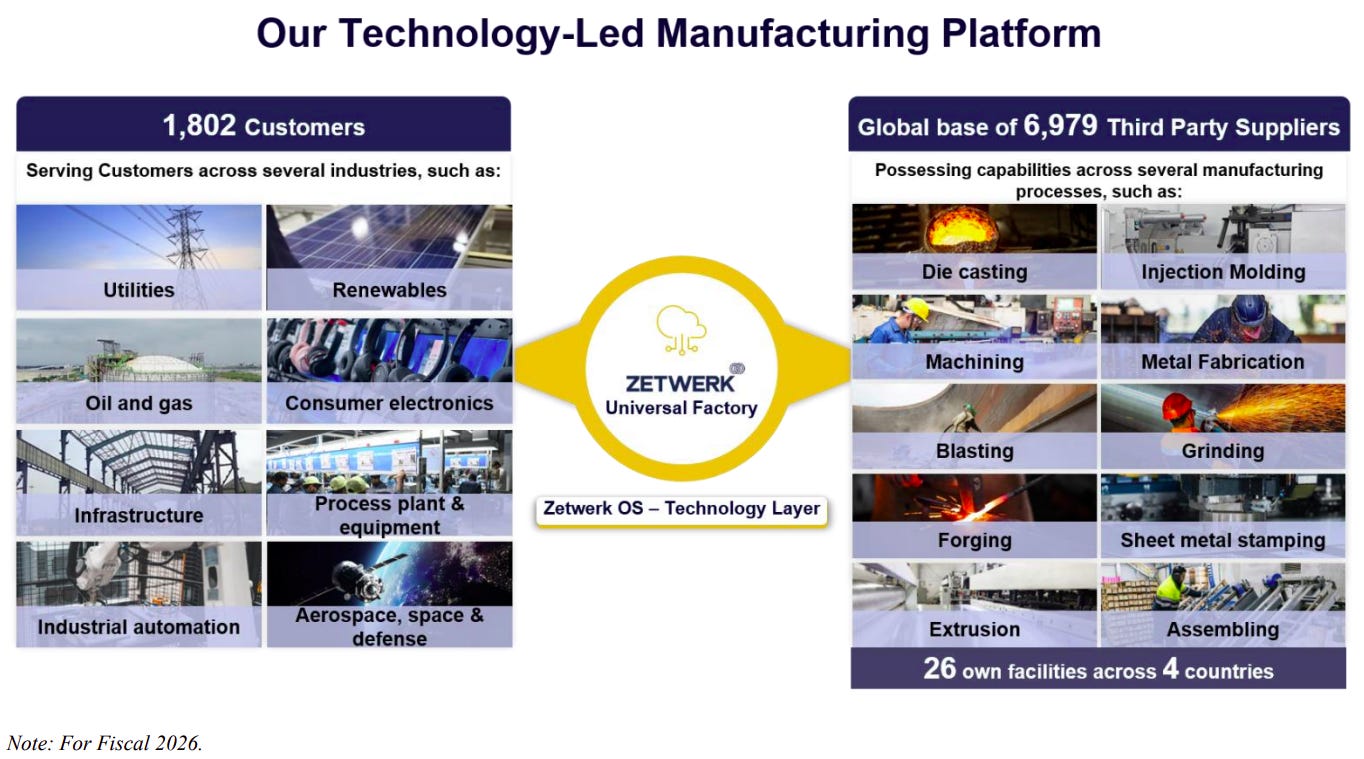
Either way, Zetwerk arranges the materials, monitors production, checks quality and manages delivery. The customer pays Zetwerk, and Zetwerk, in turn, pays the suppliers and everyone else involved.
This manufacturing business spans three areas. The biggest is energy, which covers transformers, solar equipment and wind turbine parts, and brought in 41% of Zetwerk’s total operating income in FY26. Then there’s precision manufacturing, which makes specialised parts for electronics, aerospace and defence, at about 9%. The third is capital goods, meaning the machinery and equipment other industries use, which makes up another 9%.
Its customers include Siemens Gamesa, Acer India, CG Power, NTPC Renewable Energy, L&T MHI Power Boiler, DRDO and the Indian Air Force. But why would these companies pay Zetwerk, instead of just dealing directly with factories?
Because finding a supplier is only one part of the job. Factories are extremely fragmented, and individual ones can differ in quality, capacity and how reliably they deliver. Managing those differences takes people and time, and that adds to the customer’s costs. Zetwerk becomes the orchestration layer that absorbs all that complexity and guarantees the outcome. And when an order can be split across several factories working at the same time, Zetwerk can even shorten delivery times, something a standalone factory can’t do.
That said, how much work Zetwerk does varies from order to order. In a “build-to-print” order, the customer supplies the design and specifications, and Zetwerk simply gets the product made. In an original design manufacturing, or ODM, order, Zetwerk takes on the design work too. That gives it room to earn more for its contribution, though the extra work also brings extra costs and responsibilities.
What the customer is buying matters too. Equipment bought to build a new plant counts as capital expenditure: a big purchase that may not come around again for years. To keep that business going, Zetwerk has to keep finding new projects or new customers. Parts a customer needs regularly, for production or maintenance, are different, because they can bring in repeat orders.
Contract terms can add some predictability as well. Multi-year agreements can support a longer relationship, though they’re only as valuable as what customers actually commit to buying. Take-or-pay agreements go a step further: the customer commits to buying a minimum volume, or pays a shortfall fee if it doesn’t.
So how stable Zetwerk’s revenue is depends partly on its mix of one-off projects, repeat purchases and committed orders.
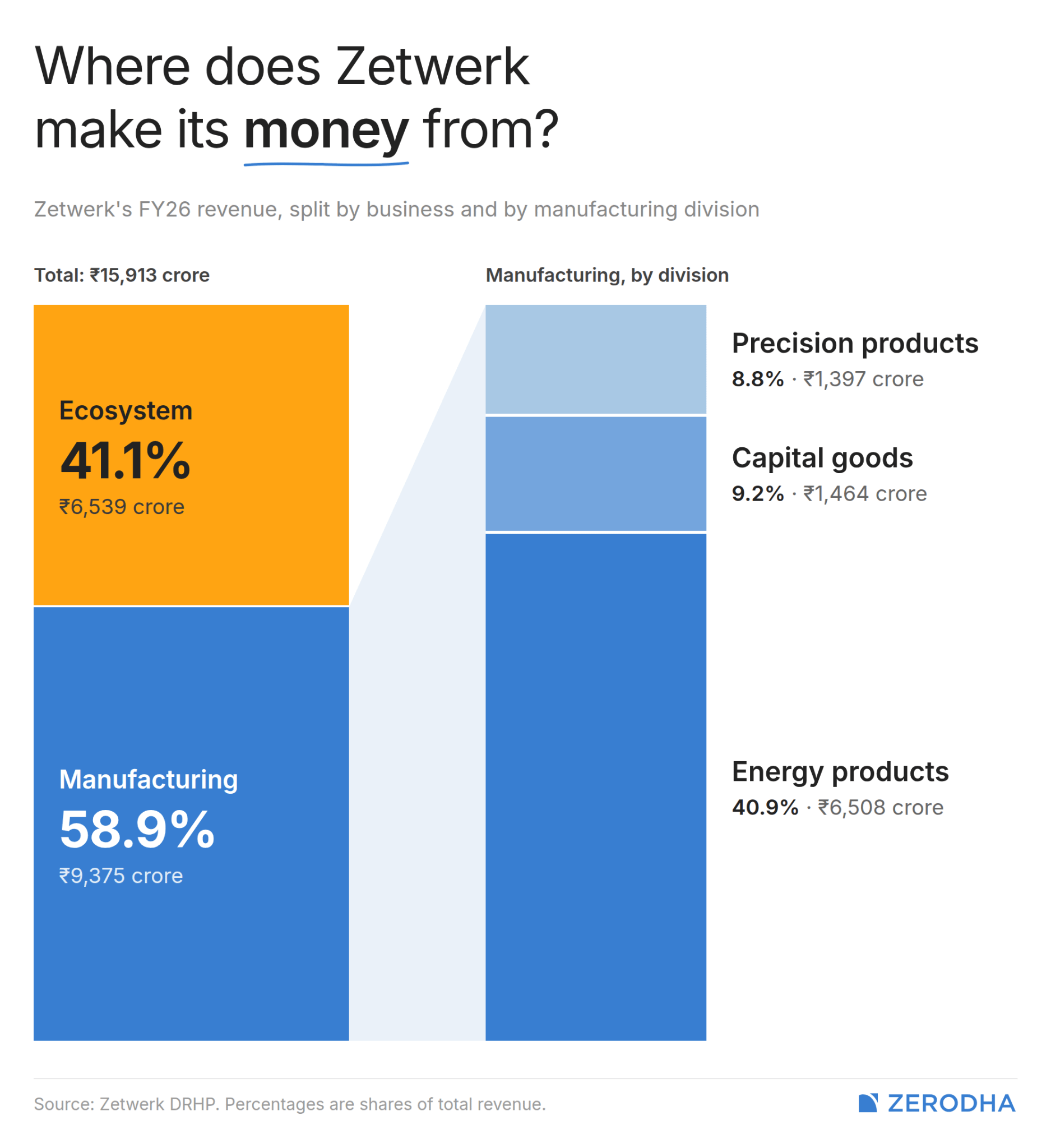
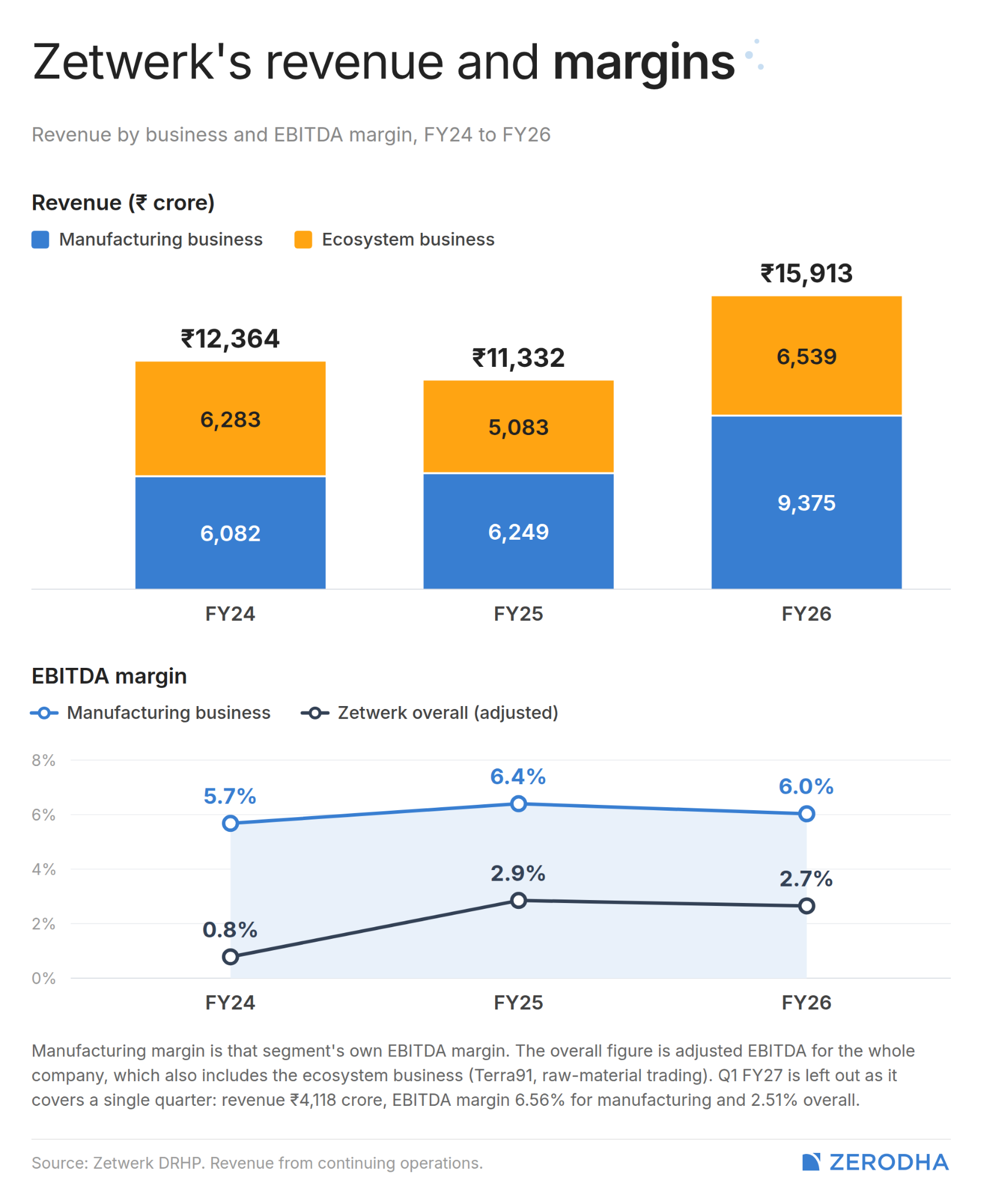
Manufacturing, though, made up only 59% of Zetwerk’s FY26 revenue, or ₹9,375 crore. The remaining 41%, or ₹6,539 crore, came from Terra91, its arm that buys and resells industrial raw materials such as steel, aluminium and chemicals.
In this business, the full sale value counts as revenue. If Terra91 buys metal for ₹100 and sells it for ₹102, it books ₹102 as revenue, but keeps only ₹2 of it before other expenses. That’s why a big revenue number doesn’t necessarily mean big earnings.
Manufacturing generally earns better margins, because here Zetwerk is also providing engineering and production services. Its manufacturing segment’s EBITDA margin was around 6% in FY26, while the company’s overall adjusted EBITDA margin was 2.65%. The two measures aren’t directly comparable, but the gap is hard to miss.
Terra91 may help Zetwerk buy materials at better prices in bulk, and supply its manufacturing partners. But its thinner margins mean we need to look at the mix of businesses behind Zetwerk’s revenue, not just the headline total.
The numbers underneath
Zetwerk’s revenue fell about 8% in FY25, before bouncing back 40% to ₹15,913 crore in FY26. But look closer, and you’ll see its two businesses behaved quite differently.
Most of the FY25 decline came from Terra91, whose revenue fell 19%. Manufacturing held up, growing about 3%, before jumping 50% in FY26. Both businesses kept growing in the June 2026 quarter, pushing overall revenue up 55% from a year earlier. In short, manufacturing has grown more steadily, while raw material trading has driven more of the swings.
Zetwerk is also keeping more of each sale after paying the direct costs of fulfilling orders. Its gross margin rose from 7.7% in FY24 to 12.1% in FY26, though most of that jump came in FY25.
The shifting manufacturing mix helps explain this. ODM orders, where Zetwerk also takes on design work, grew from 8% to 14% of manufacturing order value between FY24 and FY26. Business from North America and Europe can also command better pricing. And doing more work in its own factories lets Zetwerk keep income it would otherwise pay out to outside manufacturers. Of course, those factories cost money to run too.
Once you account for other operating expenses, though, Zetwerk’s overall adjusted EBITDA margin was 2.65% in FY26. That’s better than 0.78% in FY24, but slightly below the 2.85% it managed in FY25. CRISIL also estimated its FY26 operating margin at around 2.6%. Any way you cut it, this is still a thin-margin business.
At the bottom line, Zetwerk reported a ₹1,606 crore net loss in FY26. That includes two large one-time charges: roughly ₹800 crore for additional shares issued to its founders, and ₹450 crore written off against the civil infrastructure business it has decided to exit. Neither required Zetwerk to pay out cash right away. Strip out certain exceptional expenses, and adjusted profit before tax improved from a ₹249 crore loss in FY24 to a ₹46 crore profit in FY26.
So profitability is improving. But it’s the cash position that caught our eye, because it tells a much harder story.
In FY26, Zetwerk reported ₹421 crore in adjusted EBITDA. Yet its operations consumed ₹682 crore in cash. That annual cash outflow has grown three years in a row. And in just the first quarter of FY27, operations swallowed another ₹506 crore.
The reason lies in what Zetwerk takes responsibility for. It has to pay for materials and production before it collects the full payment from customers. Until then, materials and unfinished goods sit in inventory. And once the goods are delivered, the sale can count as revenue even if the customer hasn’t paid yet. That unpaid amount sits in trade receivables.
Suppliers help finance part of this cycle by letting Zetwerk pay them later. But when inventory and customer dues eat up more cash than that supplier credit covers, Zetwerk has to fund the gap itself. And suppliers giving it less time to pay only adds to the pressure.
Inventory and trade receivables together add up to roughly ₹3,500 crore, against a net worth of about ₹4,800 crore. That doesn’t mean shareholders’ money directly funded all of those balances, but it gives you a sense of how big they are next to the company’s equity.
In theory, these assets should turn into cash as goods get sold and customers pay up. And persistent cash outflows don’t necessarily mean the same invoices are going unpaid for years. Collections can simply keep getting absorbed by the next, bigger round of orders. Individual balances keep turning over, but the funding requirement stays put.
To fund working capital and other business needs, Zetwerk borrows both at the parent company and through its subsidiaries. That borrowing comes at a cost. Interest expense in FY26 was around ₹366 crore, a heavy burden next to ₹421 crore in adjusted EBITDA. Much of the operating gain gets eaten up before it can reach net profit.
CRISIL rates Zetwerk’s debt A-/Negative. The “Negative” part is the outlook, a signal that the rating could come under pressure. One of CRISIL’s concerns is that exiting the civil infrastructure business could end up costing more than expected.
There is some breathing room, though. According to CRISIL, Zetwerk ended FY26 with around ₹1,900 crore in cash that wasn’t pledged against loans, and management has committed to keeping at least ₹800 crore as a cushion.
But that cushion won’t refill itself. If operations keep burning cash, Zetwerk will either need fresh funding or have to dip into what it has. And growth can actually make that requirement bigger, when supplier payments run ahead of customer collections. The business is winning more orders. What it still needs to do is turn those orders into cash it gets to keep.
What does the IPO change?
Which brings us to the IPO. Of the ₹5,012 crore offer, ₹2,830 crore will come to Zetwerk through new shares. The remaining ₹2,182 crore will go to existing shareholders selling their stakes.
The offer has also grown since August. The fresh issue went up from ₹2,600 crore to ₹2,830 crore, while the portion being sold by existing shareholders expanded by around 49%.
Of the money coming to Zetwerk, ₹2,160 crore—roughly three-quarters—will repay loans: ₹1,300 crore at the parent level and ₹860 crore across nine subsidiaries. What’s left, before issue expenses, is earmarked for acquisitions and other business needs.
Remember, Zetwerk borrows to fund orders while it waits for customers to pay. Normally, you’d expect that customer payment to free up the money, so the loan can be repaid. But Zetwerk keeps needing more cash to run its operations. So now, it’s raising money from shareholders to pay back its lenders.
This is the interesting part. What looks like a temporary need, money to complete an order, has turned into a permanent funding requirement. One customer pays, but the next order needs financing. Using long-term equity to meet a permanent requirement like that can make sense. The real concern is whether that requirement keeps growing faster than the cash the business earns.
If it does, the IPO will only buy temporary relief. More orders could mean more cash tied up, followed by more borrowing, or yet another equity raise. Paying off today’s loans doesn’t fix the cycle that creates the need for them.
To be fair, Zetwerk has built something customers keep coming back to. Repeat customers contribute around 80% of manufacturing revenue, which suggests it’s solving a real problem. Exiting the loss-making civil infrastructure business could also help, as long as the exit doesn’t bring substantial additional costs.
So after it lists, revenue growth is only one part of what we should be watching. Does Zetwerk start collecting payments faster? Does less money get stuck in inventory? And do its operations start generating cash?
Repaying debt should cut interest costs and lift profitability. But eventually, the business needs to fund more of its growth from the cash it earns. Otherwise, shareholders may find themselves funding the same problem all over again, just at a bigger scale.

Who pays when it becomes too hot to work?
A large chunk of India’s income earners, like construction workers, vegetable sellers, or delivery workers, depend on being outside. With how much hotter each day gets, and how much more rain becomes volatile, these livelihoods are squeezed between a rock and a hard place. After all, if you choose to go home to get respite from the heat, you lose the day’s earnings.
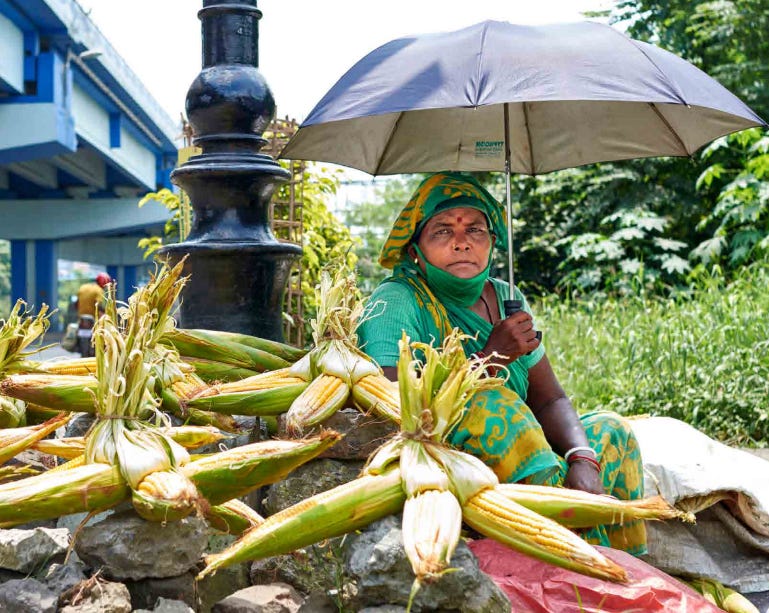
Two Delhi-based economists studied how 396 informal workers in north-west Delhi reacted in the face of such a trade-off when two heatwaves hit the city between May and June 2019. They estimated that earnings after work-related expenses were about 40% lower on heatwave days than on other days in the study.
Workers were also less likely to go to work and more likely to report illness in themselves or their families. Additionally, hotter days were associated with greater medical spending.
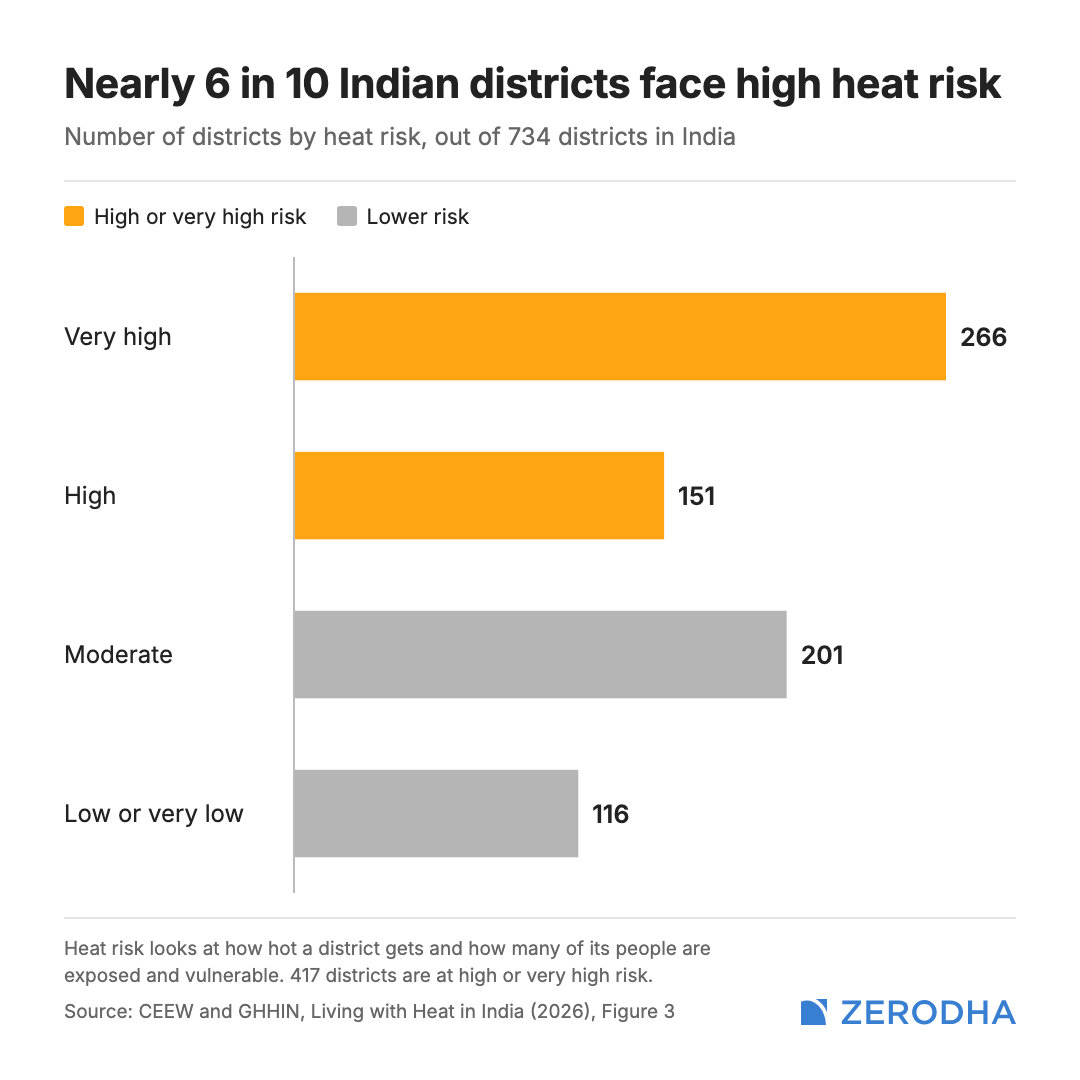
This was a small, local study, so we cannot apply that 40% figure to every worker in India. But the problem it captures is easy to understand, and it’s very likely that it applies to many other parts of India. As per CEEW’s district-level heat risk assessment, 417 of India’s 734 districts are in the high-heat or very high risk categories. These districts are home to roughly 76% of the population.
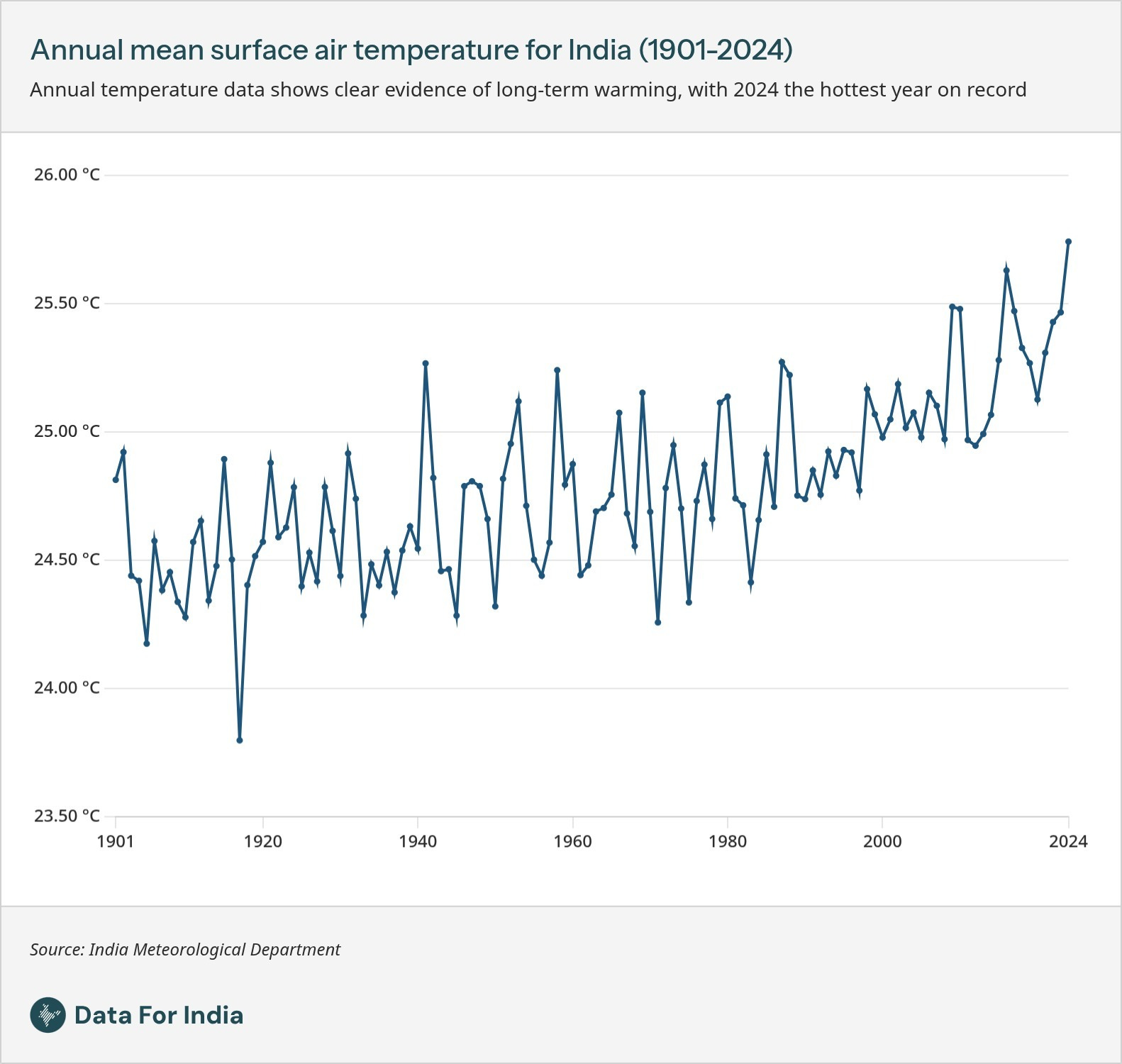
We look at the findings of a few reports to paint a picture of how heat hurts productivity of workers across India. These findings go beyond merely the Celsius temperature, which has certainly risen over time. But they also look at how heat intersects with whether someone has a decent roof above them, how they’re paid, whether there’s a toilet nearby, and so on. The same hot afternoon, then, varies in how much difficulty it creates for different types of workers.
Beyond the temperature
Let’s start with how heat affects different jobs.
Carrying bricks, for instance, generates heat inside the body. Standing near a furnace adds heat from outside. Clothing, humidity and the movement of air affect how easily the body can cool itself. In humid conditions, sweating becomes less effective.
In essence, you don’t need a record-breaking high temperature to know that this is already a problem. Heat intersects differently with the intensity of different kinds of jobs that are done outside. It is why workplace heat assessments often look beyond air temperature.
The financial damage also looks different depending on the job. A daily-wage worker might lose a shift. Someone paid for every piece they make might work for hours but finish fewer pieces. A street vendor can lose money even if they stay at their stall all day.
WIEGO, a research agency focused on informal female workers, conducted a survey of 494 Delhi street vendors last year. They found that 96% reported fewer customers because of heat. Another 90% reported reduced working hours, perhaps because they chose to close early. Meanwhile, 72% reported damage to goods.
There’s another problem: even staying at work safely may require facilities that aren’t available. In the same survey, 79% reported no access to toilets at work, 84% no shelter and 89% no access to free clean drinking water.
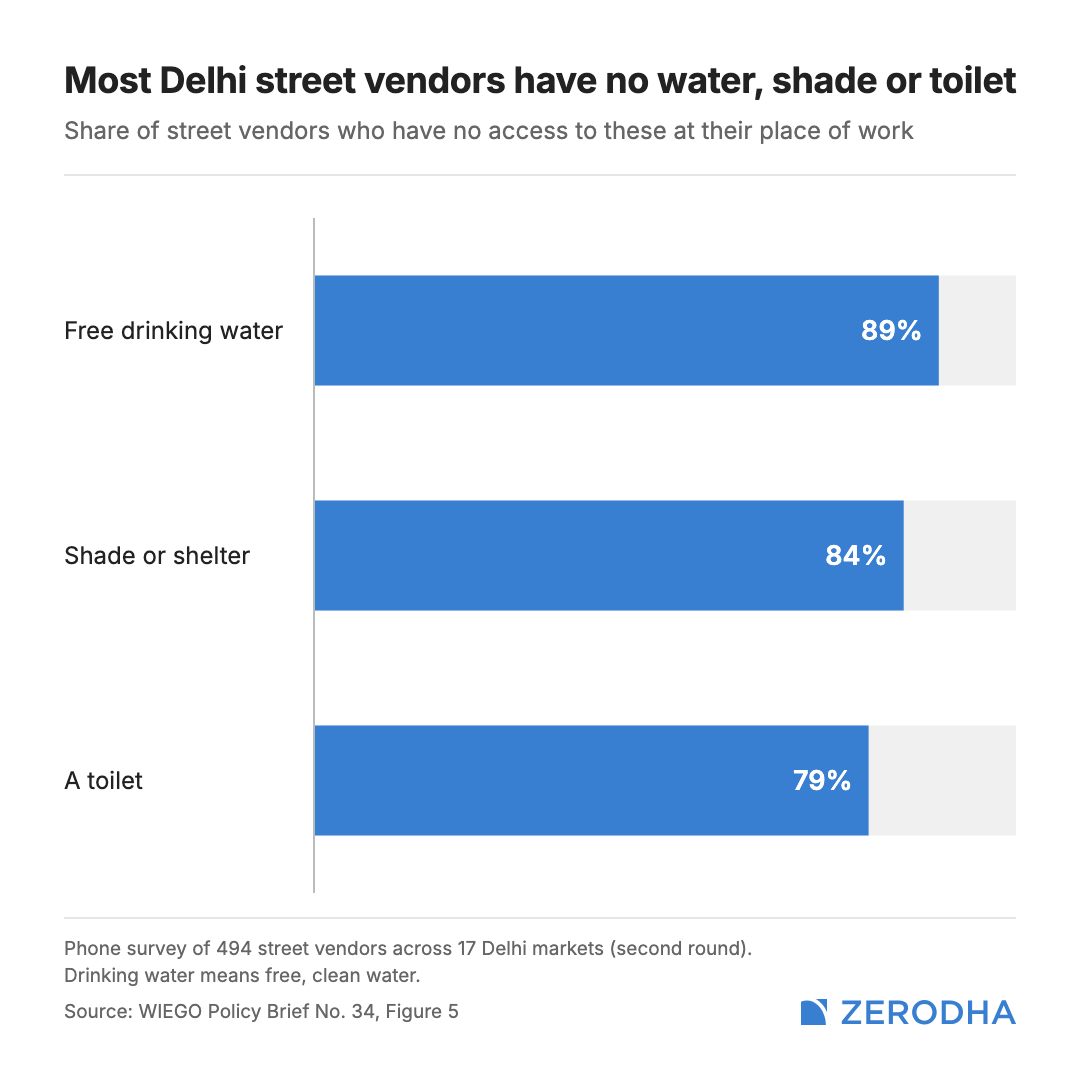
In fact, one of the most alarming effects of the combination of heatwaves and poor sanitation facilities is that workers end up drinking less water because it is the best way to manage the absence of a toilet, even though it makes coping with heat much harder. Research among women working in agriculture, brickmaking and steel documented restricted fluid intake alongside inadequate sanitation access.
Amenities might still be available, but availing them could mean loss of income. A survey with 40 street vendors in Mumbai’s M-East Ward from May this year found that some vendors didn’t drink water to avoid going to the toilet, but additionally leaving the stall to go to a farther toiler could also mean leaving their goods unattended. If you’re someone who gets paid according to how much you produce, finishing less can mean earning less, so taking a break for even going to a clinic would get punished.
Trapped inside
One could be forgiven for thinking that working indoors or at cooler times of the day might make things a lot easier. But reality is hardly such a simple calculation.
WIEGO’s research on home-based workers in Delhi describes women working in cramped homes with unreliable electricity and uneven access to basic services. In its 2025 survey of 328 women, most of whom did sewing-related work, 84% reported reducing their working hours because of heat and 88% reported lower productivity.
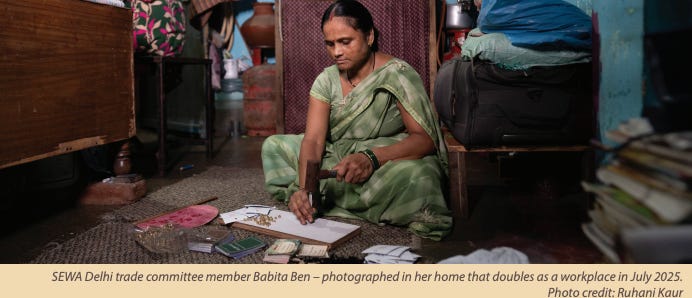
For these workers, the home is the workplace. There isn’t necessarily another room to move into. A fan needs electricity. A cooler needs money, space and even water. A tenant may not have permission to change the roof or improve ventilation. “Stay indoors” doesn’t offer much relief when indoors is where the heat is trapped.
What’s more, a 2021 study of 123 Kolkata slum dwellings and 101 rural houses in West Bengal found that indoor heat stress was actually greater and lasted longer in the urban homes under similar outdoor conditions. The difference boiled down to crowding and construction materials used to build those homes. A recent CEEW report also finds similar results for migrant workers at brick kilns, whose temporary accommodation may offer little cooling. Clearly, leaving the worksite doesn’t end heat exposure.
Even moving work to cooler hours needs some thought. An earlier or later shift has to fit around childcare and transport. For women in particular, lighting and safety are paramount to be solved for before anything.
Who pays for a safer working day?
Say people are allowed to take more breaks to gain respite from the heat, or if the cooling in their workplace improves. What happens to economic output?
When it comes to breaks, it doesn’t have to be an either/or answer where one happens at the expense of the other.
For instance, research among piece-paid sugarcane workers in Nicaragua found that productivity increased while a programme providing rest, shade and hydration was expanded. It doesn’t tell us what would happen in an Indian workplace. But what it does show is that more rest and higher output is possible.
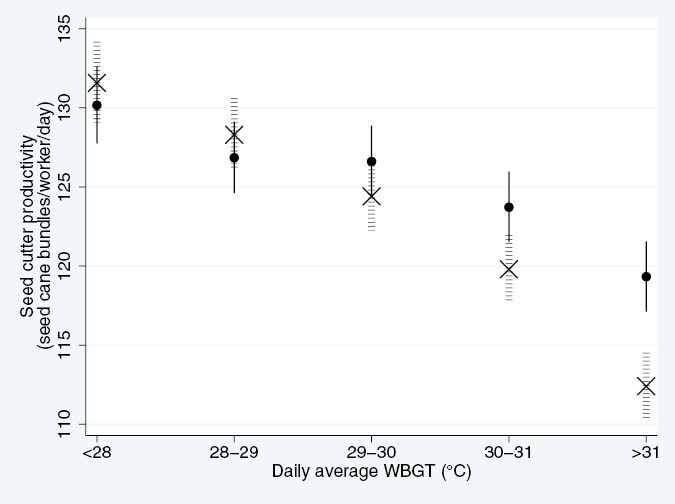
But improving cooling inside a building has a much more unambiguous effect on output. An NBER study of garment factories around Bengaluru found that switching to LED lighting reduced the heat generated inside factories and improved productivity, especially on hot days. Spending on a cooler workplace can bring returns through the work itself.
The next question is how workers (or even which ones) get access to that improvement. Who pays for the roof treatment? What happens if the person living there is a tenant? If another cooling option needs electricity, can the household afford to run it?
For these questions, India does seem to have a policy response, which has developed over time.
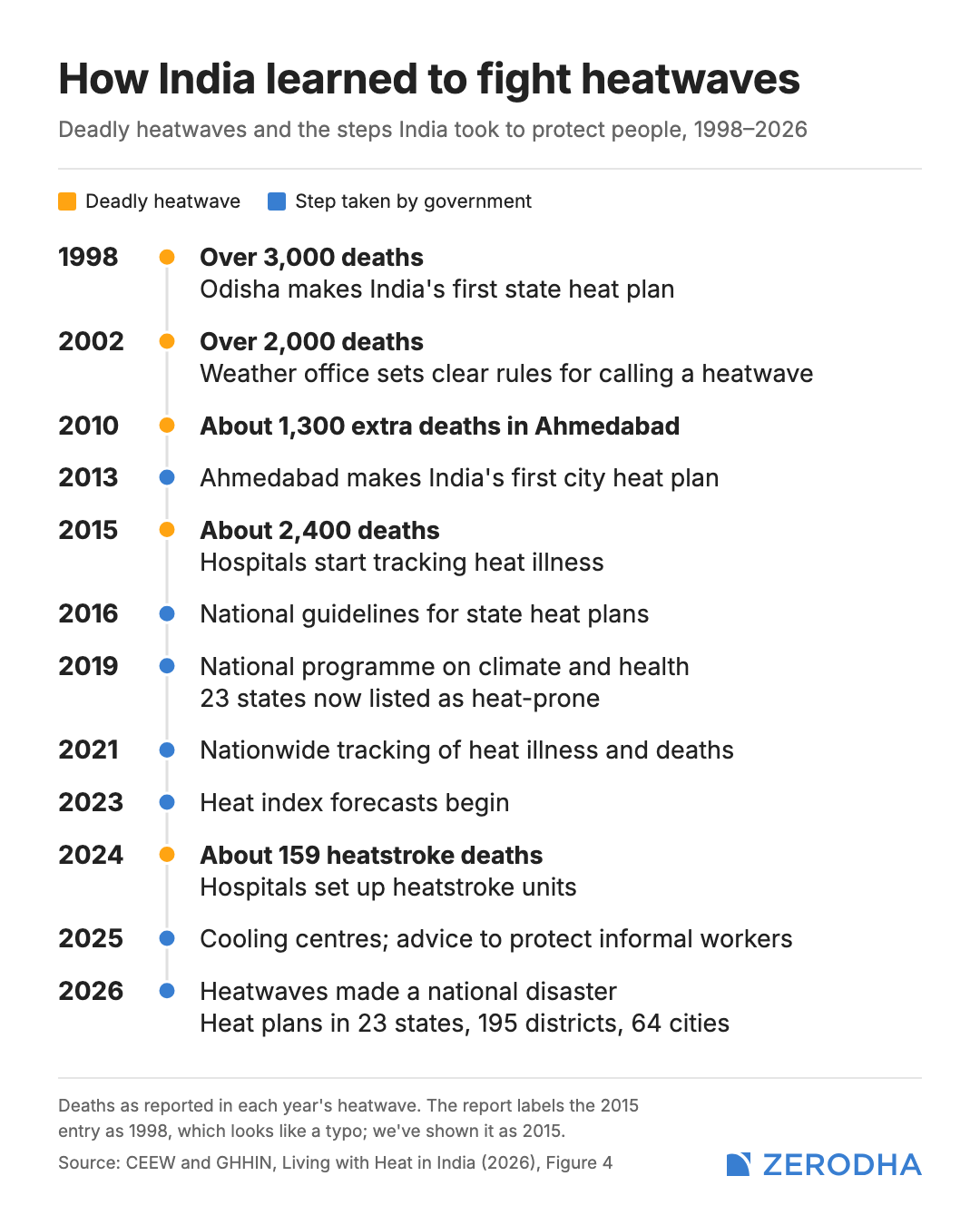
In July 2026, the government reported that 23 states, 195 districts and 64 cities had prepared heat action plans. An April labour ministry advisory called for measures including changes in working hours, drinking water, rest areas and workplace cooling. By August 2026, the Union government had confirmed the inclusion of heatwaves and lightning under the State and National Disaster Response Fund guidelines for 2026-31.
These tell us what governments are asking for, but not how many workers receive those protections. Nor is it complete proof of whether funding is automatically flowing to workers.
For instance, a 2023 review of 37 heat action plans, conducted by Delhi-based think-tank CPR, found that 26 did not mention financing. That’s an older assessment, not a verdict on all current plans. But what it sheds light on is the gap between state capacity and execution, or between words and action.
There is evidence that these plans can help when executed. A study of Ahmedabad’s heat action plan, which was implemented after a devastating heatwave in 2010, projected that nearly 1,200 annual deaths were avoided in the two post-implementation years studied.
Financial support is another part of the response. Parametric insurance, for instance, pays when a predefined weather condition is met. Workers don’t have to prove their individual loss each time. But while that makes payment simpler, it also means someone can lose income and still receive nothing if the exact heat trigger isn’t reached, while workers continue to suffer losses.
The experience of SEWA, India’s primary association for female informal workers, exemplifies this difficulty. A 2023 pilot program covered about 21,000 SEWA women but made no insurance payouts, simply because temperature triggers, which were very high at around 45°C, weren’t met. Yet, members reported losses associated with unseasonal rain.
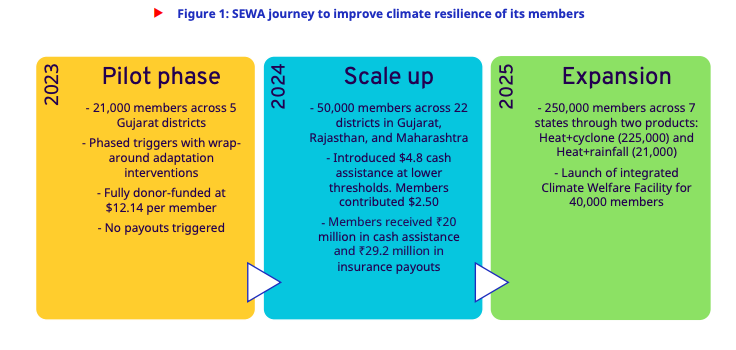
In 2024, a redesigned arrangement combined insurance with separate cash support, and over 92% of the women enrolled received insurance payments. All of them also received ₹400 in donor-funded cash assistance. However, the program also suffered from bank-account and documentation problems that complicated delivery.
Conclusion
India’s heat problem has only become more complicated as it amplifies our other sore spots where we severely lack infrastructure for workers. Someone’s earnings potential is simply not separate from access to water, sanitation, health infrastructure, or even insurance against future climate shocks.
Different solutions address different problems, sometimes at different times of a worker’s day, and certainly not uniformly across industries. Each fix addresses one slice of the problem, but there aren’t many cohesive action plans that integrate all of them together.
People already know that getting out of the heat would help. What they need is a way to do it without creating another problem at home.
- This edition of the newsletter was written by Vignesh & Kulsum.
Tidbits
1. IMF raises India’s growth forecast for FY27 and FY28
The International Monetary Fund has raised India’s economic growth forecast for the current and next fiscal years, citing resilient domestic demand. The agency also noted that artificial intelligence adoption is helping to support broader global economic growth.
Source: Livemint
2. EPFO 3.0 rollout may take another year, delaying gig-worker benefits
The rollout of EPFO 3.0 could take another year after its technology-partner tender is completed, potentially delaying proposed social-security benefits for gig, platform and other workers. The overhaul is meant to modernise EPFO’s IT infrastructure and improve account and claims management.
Source: Business Standard
3. Getty Images to go private through prepackaged bankruptcy restructuring
Getty Images plans to file for Chapter 11 bankruptcy as part of a restructuring deal that will take the company private. The Getty family and Koch Equity Development will invest up to $533 million, while creditors have agreed to reduce debt and extend maturities.
Source: Reuters
4. India’s wheat acreage could fall 5–10% as water shortages push farmers to other crops
India’s wheat acreage could shrink by 5–10% this winter as water scarcity and relatively weak wheat prices encourage farmers to switch to crops such as pulses and oilseeds. Rajasthan, Gujarat and parts of Madhya Pradesh and Maharashtra are expected to see some of the biggest shifts.
Source: The Economic Times
5. Global smartphone shipments fall to lowest third-quarter level in 14 years
Global smartphone shipments fell 20% year-on-year in the third quarter to their lowest level since 2012, according to Counterpoint Research. Soaring memory-chip costs and shortages pushed manufacturers to raise prices, cut shipments and focus more on higher-margin devices.
Source: Reuters
Want more tidbits? Catch up on last week’s recap!

Cash & Copium #8
In Episode 8 of Cash & Copium, Abid, Bhuvan, and Aakanksha break down India’s credit boom, the “no-cost” EMI myth, and the risks of floating-rate debt for lifestyle spending or speculative suburban real estate.
Check out the episode on YouTube.
Beyond Today’s Brief
There’s always more happening at Markets by Zerodha.
The Chatter: What strategic trends are leaders at TCS, Maruti Suzuki, and PB Fintech highlighting? How is TCS managing AI contract deflation, while Maruti Suzuki prioritises deep localisation and biogas, and PB Fintech navigates insurance commission rules?
Points & Figures: What brings Indians to court? From 6.5 lakh cheque-bounce cases in Delhi to motor vehicle accidents, excise enforcement, and conjugal rights, what does district court data reveal about the everyday legal disputes clogging India’s judicial backlog?
Aftermarket Report: nd reclaim 22,700? And what do a 5.22% jump in IT stocks and a return to net institutional buying signal as market sentiment recovers following the Finance Minister’s openness to reviewing LTCG and STT?
Join us on WhatsApp, where we share interesting soundbites from concalls, articles, and everything else we come across throughout the day. You’ll also get notified the moment a new video or article drops so that you can read or watch it right away.
Thank you for reading. Do share this with your friends and make them as smart as you are 😉