


Hi, Kashish here. I’m part of the Markets by Zerodha team that runs this newsletter. In whatever little free time I get, I end up thinking about what exactly we’re trying to do with this initiative.
I’ve been part of quite a few “content strategy groups” and “YouTube communities” over the years, so I thought I’d finally pen down how I understand the space today.
What follows is basically a vomit of thoughts, cleaned up slightly by my editor and personal assistant: AI.
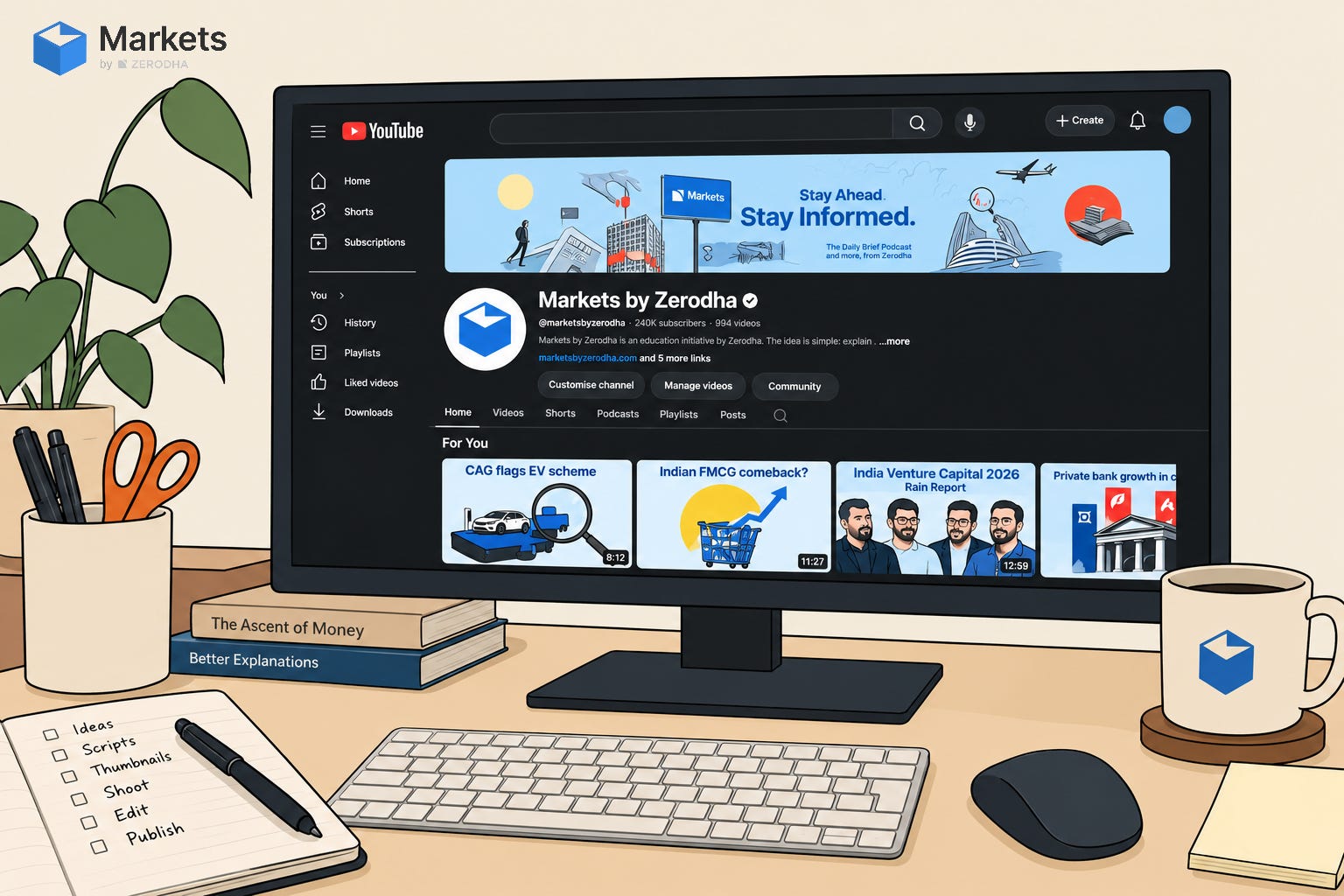
So I’ve been working on YouTube channels for a good part of my career, and I now spend a lot of time thinking about YouTube strategy. Because there is no point making videos, putting in all that effort, without first asking a basic question: what are we actually trying to achieve?
For a brand, the larger goal is fairly simple. You want to reach more people, get in front of them repeatedly, earn some mindshare and, over time, build trust. Maybe some of those people eventually give you business. But that last link is incredibly flimsy. It is very hard to say that X number of views led to Y amount of business. Yet I’ve seen plenty of organisations try to make exactly that correlation, which I think is a pretty stupid way to measure content.
That led me to a more fundamental question: what exactly should we measure on YouTube? How do we know what is working, what isn’t, and whether we are moving in the right direction?
The North Star, at least for us at Markets by Zerodha, remains fairly straightforward. We want to make content that we ourselves would want to consume. We want to make things that genuinely help us become smarter about business and markets. That takes care of the input. We try to do the best work we can, and the response to that work has also been very encouraging.
But we still need to measure something.
I’m not entirely sure what that one thing is. But I do know why we are measuring it. We want to know whether we are reaching people in a meaningful way, whether they are spending time with us, and whether we are slowly building some sort of trust and rapport with them.
The obvious metric is views. But views only answer one part of that question: did you get in front of someone? They tell you very little about what happened after that. The internet is full of subpar, stupid and, more importantly, completely unintentional content that reaches millions of people. That does not necessarily create recall, let alone trust. You can make a reel that goes viral for three days and still achieve almost nothing for the brand.
And at Zerodha, at least I’d like to believe, that isn’t what we are trying to do.
So if views are not enough, what should we look at?
One metric I really like is comments. A comment usually comes very late in the content-consumption journey. Someone chose to watch your content, spent time with it, thought about it, and then cared enough to actually write something. That is a fairly high-signal action.
The best comments go even further. They challenge something you said, ask a difficult question, add context or start a conversation. That tells you the person wasn’t merely exposed to your content. They were actually thinking about it. “Engagement” has become such a vague internet word that it can mean almost anything, but this is the kind of engagement I care about. Comments also give you direct feedback on what people understood, what they disagreed with and what they want more of.
The other metric I keep coming back to is ‘watch time’.
We largely make long-form videos today, though I also want us to get much better at short-form. For long-form especially, average view duration and total watch hours tell me something views cannot: the quality of the view.
If somebody clicks on a 30-minute video and leaves after a minute, that view and a view from someone who watches for 20 minutes are technically counted in the same bucket. But for what we are trying to achieve, they are obviously not the same. The latter tells me that someone intentionally chose to spend a meaningful amount of time with us. And that is probably much closer to the kind of relationship we actually want to build.
So maybe that is the distinction I’m trying to get at. I care less about how many people briefly encountered our content and more about how many people intentionally consumed it. Comments, watch time and average view duration all get us a little closer to measuring that.
None of this, of course, proves that the content eventually drives business for a brand. That link will probably always remain messy. Fortunately, that is also not how I understand content at Zerodha. We do not need to reverse-engineer every video into some dubious revenue attribution model.
That gives us the freedom to focus on the thing that actually matters: making genuinely good content.
Hello Kashish, I (almost) regularly read the daily brief. I like reading it over YouTube watching. There are days when I'm travelling that I listen to it. But absolutely love the depth and simplicity with which the team publishes the content.
I like daily brief very much, I try to listen to it daily and I have gained lot of knowledge from it.
It would be lovely to see the working that goes behind making the video, like the research done, sources used and how you connect the dots, what all aspects to touch upon etc. it will help us develop our own research acumen.