


Our goal with The Daily Brief is to simplify the biggest stories in the Indian markets and help you understand what they mean. We won’t just tell you what happened; we’ll tell you why and how too. We do this show in both formats: video and audio. This piece curates the stories that we talk about.
You can listen to the podcast on Spotify, Apple Podcasts, or wherever you get your podcasts and watch the videos on YouTube. You can also watch The Daily Brief in Hindi.
In today’s edition of The Daily Brief:
1. The Indian states that solar is forgetting
As India’s renewable transition accelerates, solar growth remains concentrated in six affluent states, leaving coal-rich regions like Jharkhand and Chhattisgarh behind. Heavy fiscal reliance on coal royalties, high industrial power tariffs, and weak infrastructure hinder these states from diversifying. Moreover, green energy produces only a fraction of the long-term, low-skilled jobs that coal mining currently sustains.
2. Why power plants run short on coal, sometimes
Despite strong domestic coal production, Indian thermal power plants frequently face fuel shortages during demand surges due to critical logistics bottlenecks. Uncoordinated infrastructure planning, congested rail routes, and slow wagon turnaround times regularly delay coal dispatches from eastern mines to distant generators, showing why expanding mining capacity alone cannot prevent power crunches.
Cash & Copium #7
In this episode, Abid, Bhuvan, and Aakanksha explain why banks should strictly be used for banking. They discuss how relationship managers exploit trust to sell low-return ULIPs and endowment plans, and how to counter illegal loan bundling using the RBI Ombudsman.
Check out the episode on YouTube.
The Indian states that solar is forgetting
At Markets by Zerodha, we’ve been hosting an expert each week on our podcast series, Subtext. One such guest was Dr. Rohit Chandra, an authority on India’s energy sector based out of IIT-Delhi. It was a fantastic episode that we still can’t stop thinking about. One such quote from him that is still stuck in our heads was this:
“You go to one of these power plants in Barh and Korba, and you tell me what’s going on there. It’s not like there’s some massive consumption. There’s nothing there. No one’s opening a Tanishq near those power plants, right?”
“Six states are responsible for 97% of India’s grid connected renewable energy, right? That’s just reproducing previous economic geography, right?”
Similarly, in our most recent episode, we had Trishant Dev and Avantika Goswami from the climate think-tank CSE, who were also concerned about Korba, which is Chhattisgarh’s largest coal-producing districts:
“What does a place like Korba do for a living in 2045?”
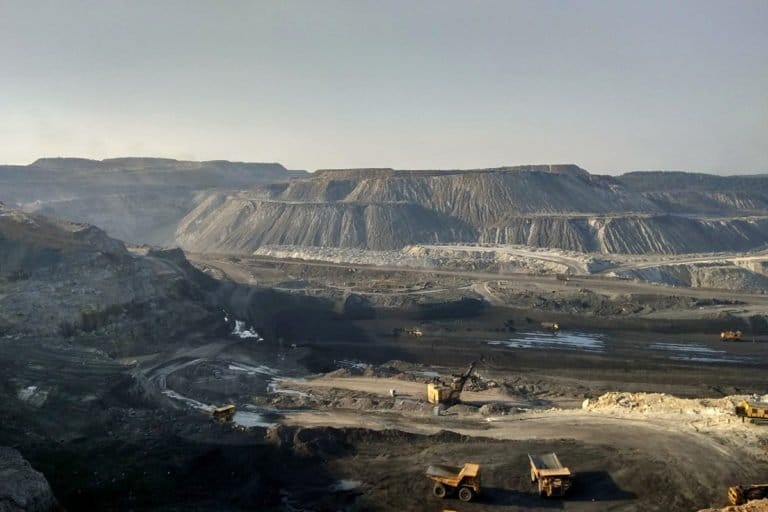
Jharkhand, Chhattisgarh, and Odisha sit on the bulk of India’s coal. Coal royalties, cesses, GST, and other contributions add up to 7-12% of Jharkhand’s and Chhattisgarh’s own revenue. Nearly a third of Jharkhand’s state-own revenue is directly linked to fossil fuels, especially coal. But these are also among India’s poorest states. They also bear all the environmental costs associated with coal mining.
Meanwhile, the six states where solar is concentrated — Rajasthan, Gujarat, Maharashtra, Karnataka, Tamil Nadu, and Andhra Pradesh — are already among India’s richest. They attract the bulk of our FDI, capture most of the renewable investment, and now stand to gain the jobs that come with it.
Which had us asking: what happens to these coal-belt states if renewables like solar and wind become India’s primary source of energy?
To be clear, India’s coal production is still rising, and coal still generates over two-thirds of our electricity. This is not a decline that’s already underway. But solar’s share in our energy mix has also never been higher. The trajectory is visible, and with each passing day, coal-belt states find themselves between a rock and a hard place.
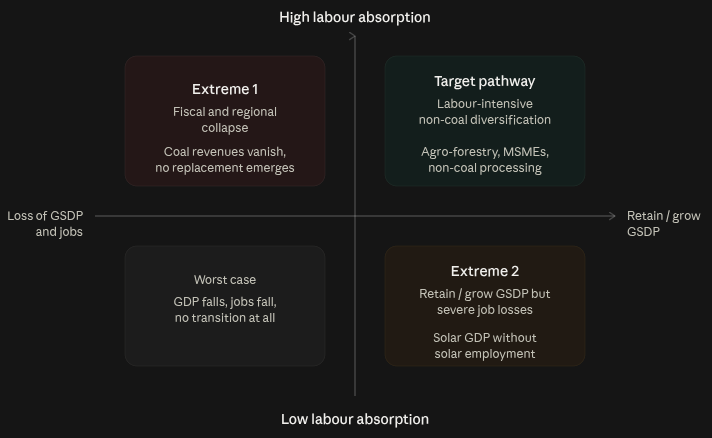
As coal’s dominance diminishes, the coal belt faces three scenarios.
The first is a loss of GDP: state revenues collapse, regional inequality widens, jobs are lost, and the states that fueled India’s industrialisation get left behind the most.
The second scenario is subtler. Assume these states maintain their economic output by diversifying away from coal successfully. But it’s possible that jobs will vanish anyway if the coal industry becomes a fraction of what it is today.
There’s a third scenario: both jobs and GDP rise. But, as we shall show in detail eventually, that is perhaps extremely unlikely because the diversification wasn’t enough to replace the employment scale of coal.
Reality will land somewhere between these scenarios. But addressing them requires planning that, as of today, barely exists.
Limited diversification
Let’s start with the possibility that economic growth (or GDP) itself is at stake for these states.
Everyone agrees that coal states need to diversify. And it’s not as if the raw material isn’t there. Jharkhand hosts Jamshedpur, India’s original steel city. The state sits on 40% of India’s mineral wealth: iron ore, copper, bauxite, uranium, graphite. Odisha has a genuine non-coal mineral base including iron ore, bauxite, chromite, manganese. Chhattisgarh has limestone and iron ore.
But potential and realisation are separated by decades of structural neglect, and the barriers run deeper than a lack of political will.
In 2022, Jharkhand became the first Indian state to constitute a Just Transition Task Force. It was ambitious on paper. But in practice, IndiaSpend reported that the task force had remained largely inert while the state continued opening new coal mines.
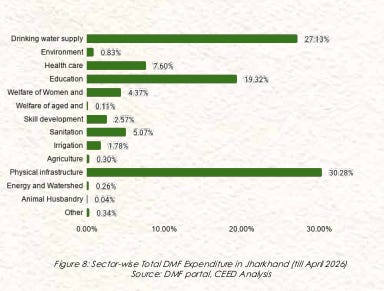
Part of the problem is fiscal. The District Mineral Foundation (DMF) Trust of each state has collected significant sums; Odisha alone has accumulated over ₹25,800 crore, the largest of any Indian state. But state revenues from coal are simply not large enough to fund the scale of transformation these regions need. These are among India’s poorest states, and DMF spending itself has largely gone towards basics like roads and drinking water.
But the larger issue at hand is historical. You see, the infrastructure in coal-rich districts — like rail links, roads, power substations — was built to move coal out, but not necessarily to attract other industries in.
Many of the local economies in coal-belt states still exist just to service the main mine. There is no ecosystem for manufacturing, no supply chain density, and no deep skilled labour pool outside of commodities, which don’t help boost productivity much. Attracting manufacturing and high-value services requires reliable industrial power tariffs, logistics infrastructure, and a state capacity that coal districts could never fully develop.
What also underlies this is the dynamic between the Centre and the states in India that has always given much more leverage to the former.
Central PSUs like Coal India and NTPC are the primary operators in these states. They set production targets, decide where investment goes, and determine how revenues are shared. The states host the mines and bear the costs, but have very little control of the enterprises. While these PSUs built large developed townships in these states, their economic benefits were limited mostly to within the townships and didn’t spread to the wider area.
While states collect royalties from mining minerals, ultimately, the Centre sets the royalty rates, which have rarely been revised. States also have limited power over mineral taxation — it is why last year, Jharkhand tried to sue the Centre over unpaid land dues from central PSUs like Coal India.
Perhaps the most fundamental barrier of all in the inability of coal-belt states to diversify is the high prices of power tariffs. When industrial power is structurally more expensive than in other states, attracting manufacturing would be that much harder. And this is a problem that particularly hurts Jharkhand far more than the other two.
A coal state with no power
Jharkhand sits on roughly a quarter of the country’s coal reserves and hosts massive mining operations. Yet, its power sector is among the weakest in the country. The state’s distribution utility, JBVNL, is in severe financial distress. You might wonder that, given how most state DISCOMs in India are in dire straits money-wise, Jharkhand may not be unique. But in fact, it is in a markedly worse position.
You see, power in many of Jharkhand’s coal belts falls under the jurisdiction of the Damodar Valley Corporation (DVC), a Central PSU which manages dams around the Damodar Valley. It services the highest-paying industrial customers of the state. But, as per another paper by Dr. Chandra, the DVC also offloads the servicing of rural, low-paying customers to the Jharkhand DISCOM. JBVNL has had many a fight with DVC on this sore point of contention.
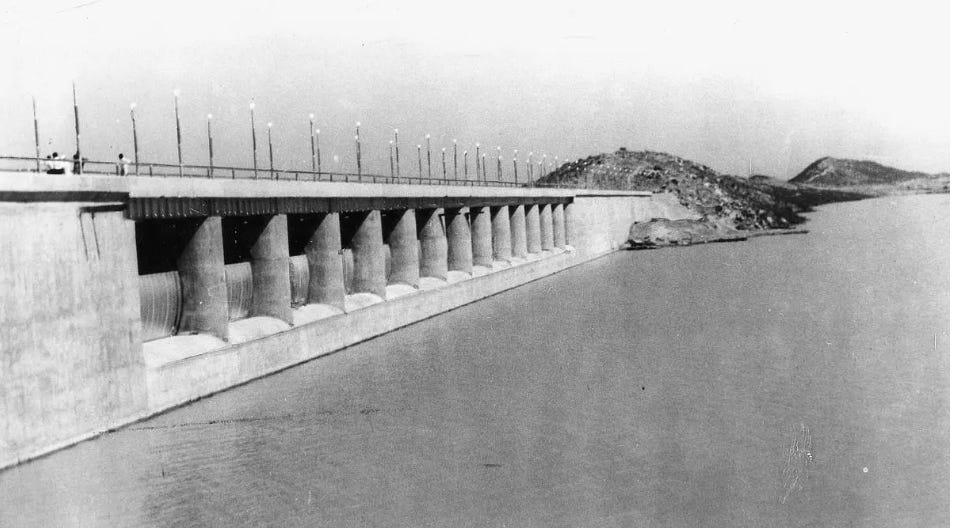
Now, to ensure that farmers and last-mile consumers continue to get subsidised power, JBVNL had no choice but to overcharge the few industrial customers it had. And now, it’s losing even that. Tata received a private DISCOM license in Jamshedpur, and industrial consumers are migrating to it, further hollowing out the state DISCOM.
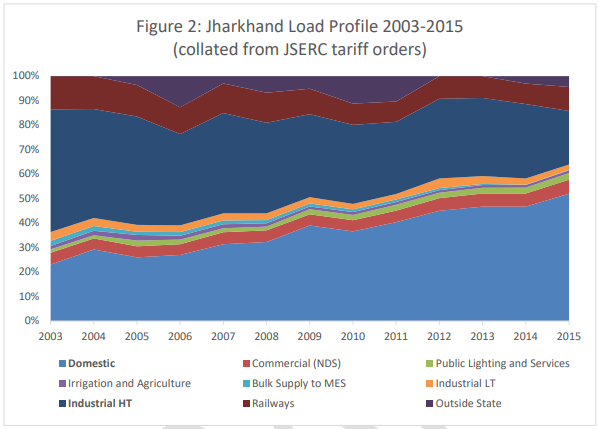
The poor financial health of Jharkhand’s DISCOM is a major bottleneck disincentivising private renewable developers from entering the state. There is also hesitation from DISCOMs themselves — signing a Power Purchase Agreement for solar, when they have to pay a fixed amount regardless of how much solar power is used, will only harm their finances further.
Additionally, geography doesn’t help, either. Solar farms need lots of free, unencumbered land, which coal-belt states don’t have much of. Over 45% of Chhattisgarh’s land area is under forest cover. In Jharkhand, much of the area is rough, hilly, and under forest cover.
What about the land that could potentially open up from the closing of mines, then? To a degree, this is already being repurposed for solar. For instance, in Piparwar, Jharkhand, the closure of an open-cast mine gave way to a 20-hectare solar power plant.
But this is local grid support, not a replacement for national-scale coal generation. Eastern solar insolation simply doesn’t compare to Rajasthan or Gujarat’s large empty tracts of land. Weirdly enough, Chhattisgarh is also seeing interest in using solar plants to power the operations of coal mines themselves!
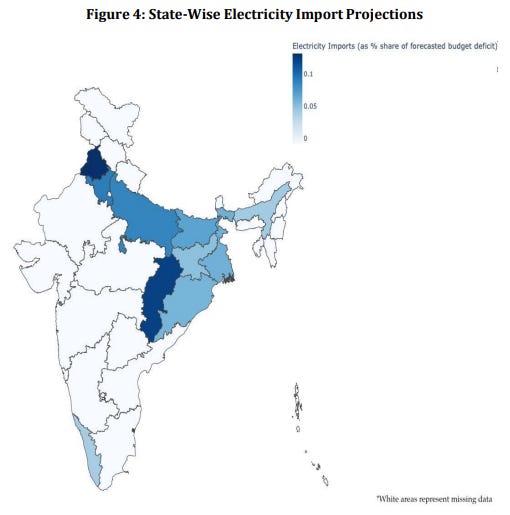
It is very likely that these states will end up importing solar power from states that are already richer and already capture all the investment. In an NIPFP paper, Dr. Chandra and Sanjay Mitra project that solar power imports will add roughly 9% to Jharkhand’s budget deficit and over 17% to Chhattisgarh’s by 2030. Odisha also imports over half of its solar power requirements through out-of-state contracts, although it is now scaling up its own solar capacity.
The green jobs myth
Even if you solve the economic growth problem by diversifying successfully and attracting enough investment, the employment problem for coal-belt states will likely remain. As of now, nothing in the energy sector replaces coal’s sheer density of jobs and livelihoods.
Solar generates a burst of employment during construction, but then that fades away once finished. It requires very little for actual maintenance and operations. A 500 MW solar park needs a fraction of the workforce that a coal mine and its associated thermal plant sustain. The maintenance crew for a utility-scale solar installation is basically a handful of technicians.
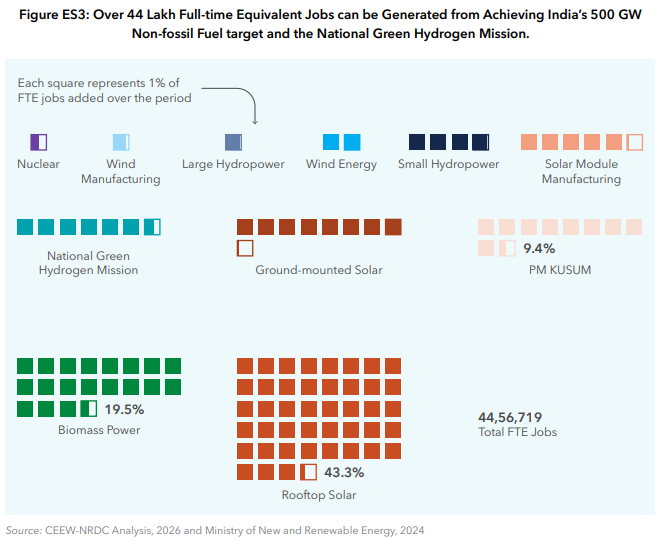
So, the jobs that do exist are overwhelmingly temporary and concentrated in a narrow skill band. In fact, as per CEEW, 1 MW of ground-mounted solar generates just 1 year of full-time employment. A full career is far from the question.
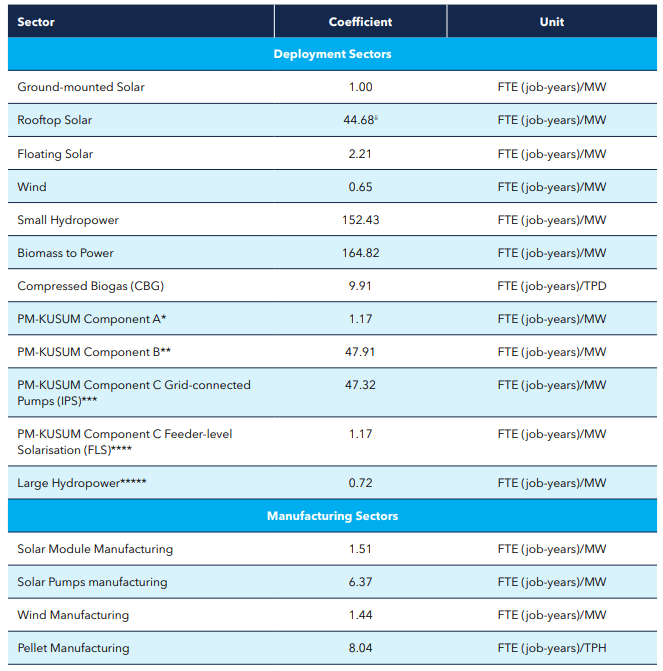
CEEW assumes that in total, green jobs (and not just solar) can generate 44 lakh full-time jobs’ worth of employment. But in another report on coal jobs, CEEW pegs that coal mining alone employs over 40 lakh people today, 70% of which are subcontracted. This number doesn’t fully include other informal workers whose livelihoods also crucially depend on coal. Together, the number could get pushed up above a crore.
Even beyond them lies the entire bazaar economy that a coal town sustains: truck drivers, mechanics, kirana shop owners, tea stall vendors, all of whom depend on the mine’s cash flow circulating through the local economy. When the mine stops needing people, the entire ecosystem contracts.
Even if the green jobs existed, how do you retrain a large section of coal workers for the same?
The Jharkhand Task Force, for instance, has plans to overhaul the curriculum of our Industrial Training Institutes (or ITIs) by including subjects like solar maintenance, battery storage, and EV infrastructure. These programmes target younger, secondary-educated workers aged 18 to 35.
That might get the job done, but most of these programs assume that workers have at least gone through secondary schooling. But most coal workers are unorganized, and therefore, most likely to have very elementary levels of schooling, if any at all. As per an EY survey, 35% of them have zero formal education. In Bokaro alone, that figure is 60%. CEEW states that more than 60% of green jobs require one to be skilled or semi-skilled.
The ITIs themselves aren’t ready, either. Curricula haven’t been updated at scale, certified trainers are scarce, and funding depends on DMFT allocations that have historically gone to roads, not vocational infrastructure. As of 2025, only 30 ITIs had at least one course related to green industrial jobs. That’s 30 out of nearly 15,000 ITIs in India.
The same EY report highlighted that workers are keenly aware of their own skill constraints. When surveyed, they overwhelmingly favour sectors with lower educational barriers, like agriculture, manufacturing, non-coal mining, and construction.
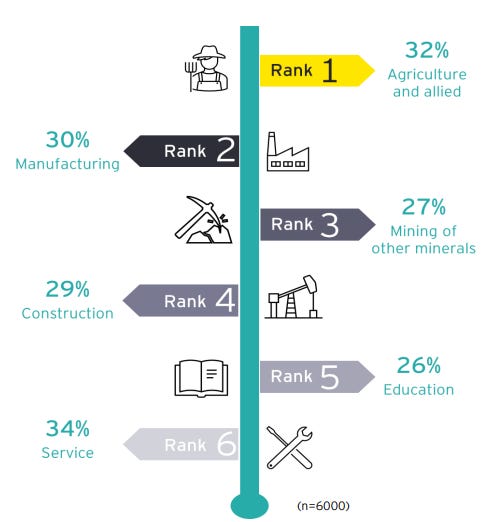
Perhaps the most brutal finding of the EY report was that 35% of the coal workers they surveyed had zero savings buffer. They cannot survive even a month without income. Retraining, if it happens at all, has to begin before mine closures and not after.
So forget green jobs not being enough. Even if we assume optimistically that green jobs do arise in place of coal ones, the people who lose coal jobs are largely not the people who get the new ones.
Conclusion
There are other consequences this piece hasn’t fully explored.
For instance, Indian Railways earns roughly 44% of its freight revenue from coal, which it uses to cross-subsidise its passenger fares. Then, coal gasification could also extend coal’s useful life as an industrial feedstock.
It’s also possible that the local political networks and union structures that underlie the coal economy actively resist the green transition. But even if coal districts cling to the status quo, solar-rich industrialized states like Tamil Nadu, Gujarat and Karnataka will only widen the gap.
The green transition will bring economic growth to India, but it won’t come without winners and losers. And how we compensate the losers will matter much to the nature of that growth.

Why power plants run short on coal, sometimes
Some of India’s power plants are running low on coal again. Electricity demand was unusually high this September. Meanwhile, hydropower generation fell 12% from a year earlier in the first three weeks of the month, following weak monsoon rainfall. Coal plants had to fill more of the gap. They’ve burned through their stocks faster than fresh supplies have arrived.
This happens from time to time, but it doesn’t necessarily mean we aren’t mining enough coal. Rain can disrupt mining, and demand can rise faster than expected. Even when coal is available, though, parts of the delivery network struggle to keep up.
Coal India reported around 76 million tonnes of coal at its mines at the start of September. But having coal at a mine doesn’t guarantee timely supplies to a power plant. The harder task is getting that coal to the plants that need it, on time.
The coal has a commute
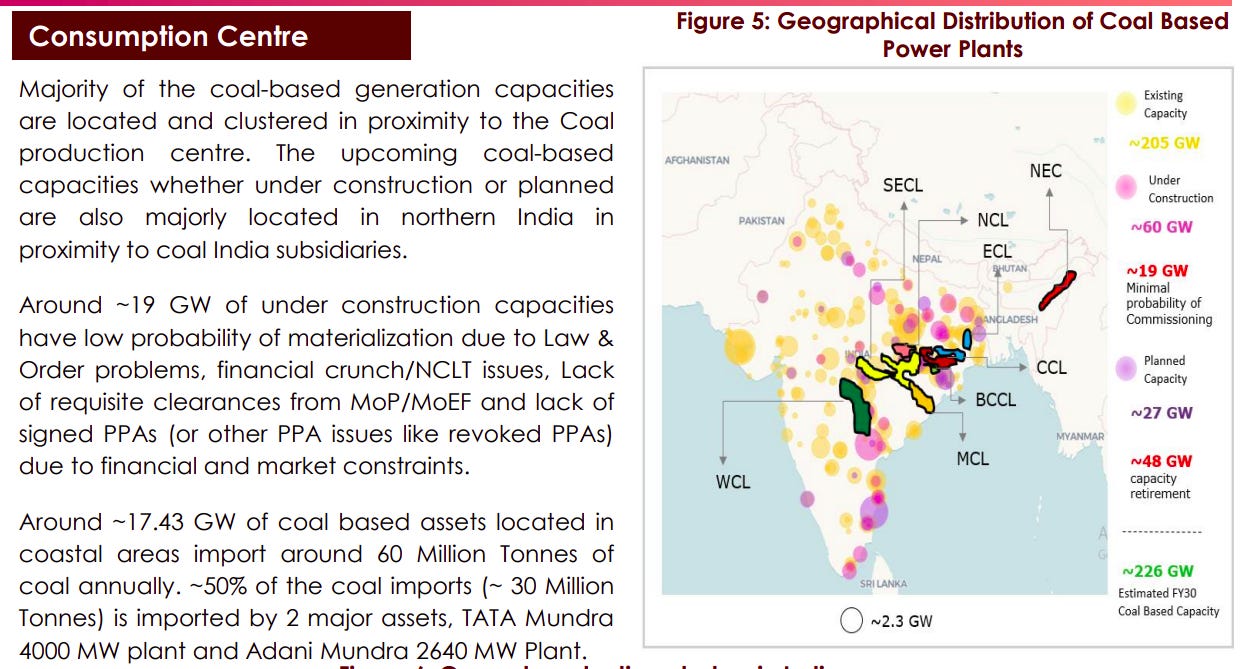
Coal has to be mined where it’s found. In India, deposits are concentrated in Jharkhand, Odisha and Chhattisgarh, with substantial deposits in other states too.
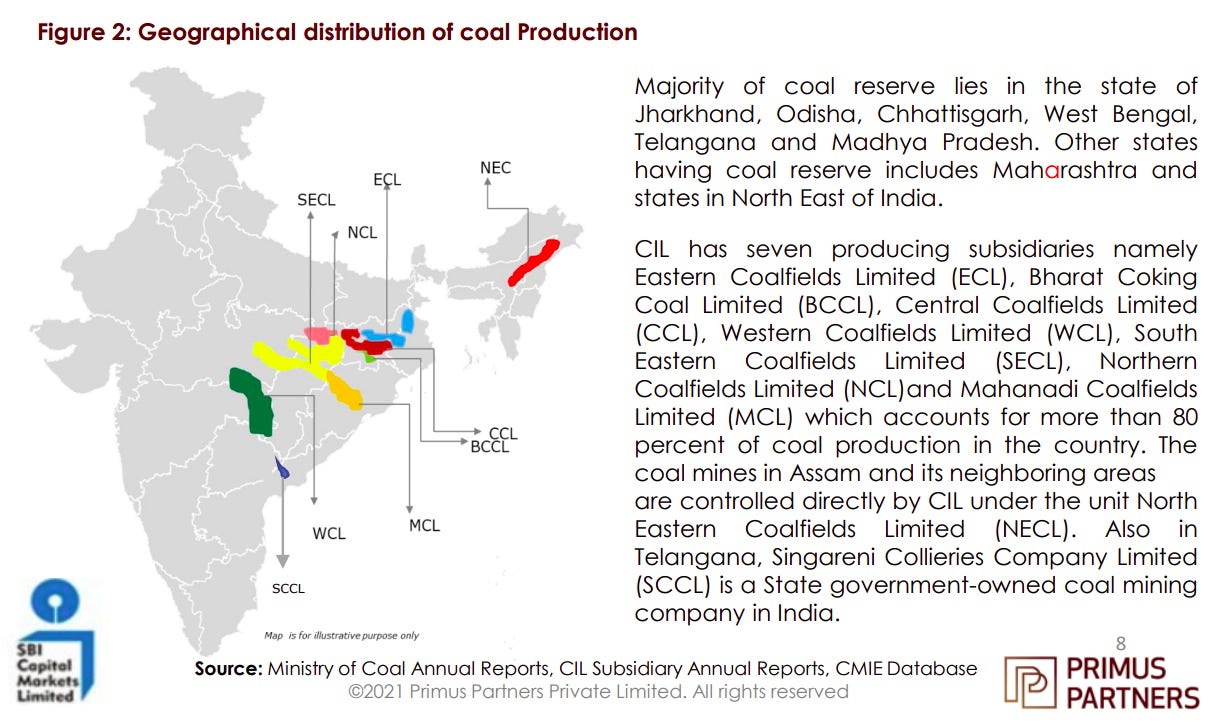
A power plant, though, can be hundreds of kilometres from the mine supplying it.
After mining and crushing comes first-mile connectivity: trucks or conveyors move the coal from the mine to a dispatch point. For coal travelling by rail, that usually means a railway siding, which is a short stretch of track connected to the wider network, where trains can be loaded. Workers load the coal into a rake, the railway term for a set of wagons travelling together. The train takes it to the power plant, which unloads and stores it. The empty wagons can then make another trip.
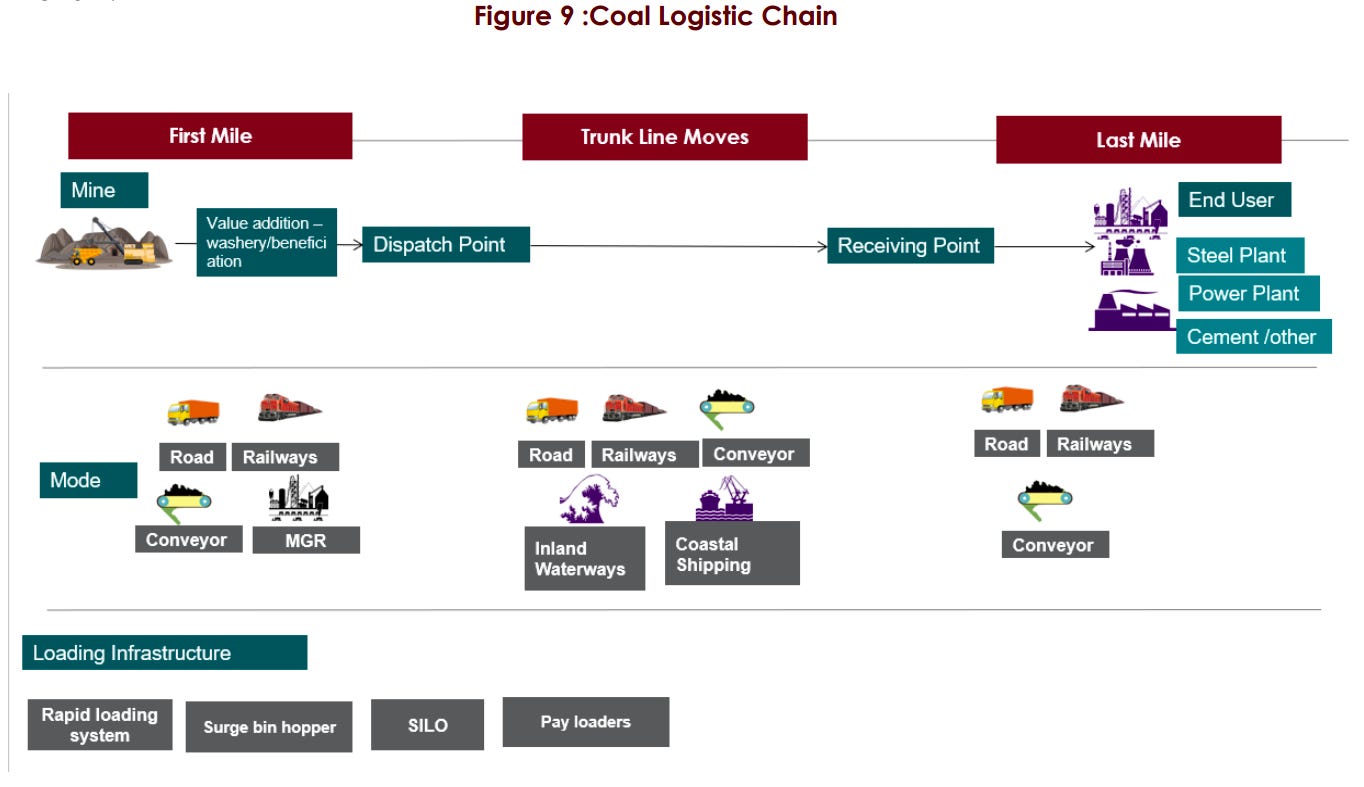
Plants close to mines have an advantage. These “pithead” plants can use conveyors or dedicated shuttle trains called merry-go-round systems. Their coal may avoid a long journey through the shared railway network.
Elsewhere, responsibility changes hands along the route. Coal companies mine and dispatch the coal. The railways run the trains. Power generators buy the coal, maintain stocks and unload deliveries.
The trouble is that the infrastructure for these steps hasn’t always been planned together. A 2022 government study found that sidings were being planned separately from main railway lines, causing delays. More broadly, the coal, railways and ports ministries had planned transport infrastructure separately for years. A national coal logistics policy arrived only in 2023.
So a coal supply agreement is only part of the job. The mine needs a working loading point, the train needs a clear route, and the plant needs to unload it promptly. A hold-up at any step can delay the delivery.
Seven days of breathing room
When deliveries fall behind, plants draw on the coal they’ve stored.
According to Business Standard, stocks fell from 29 million tonnes on August 31 to 22 million tonnes on September 26. Of the 190 plants monitored, 77 had critically low stocks. Across all plants, the coal on hand amounted to about seven days of fuel.
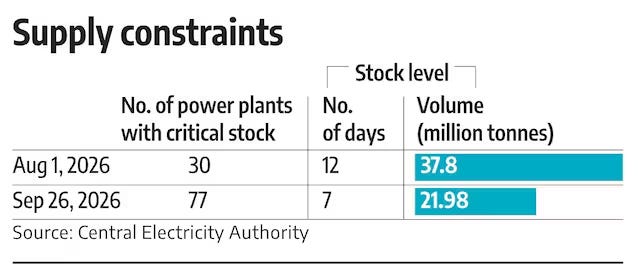
That doesn’t mean every plant would shut down after a week. Trains keep arriving, plants burn coal at different rates, and some have much larger stocks than others. But it does show how little room they have if deliveries fall further behind.
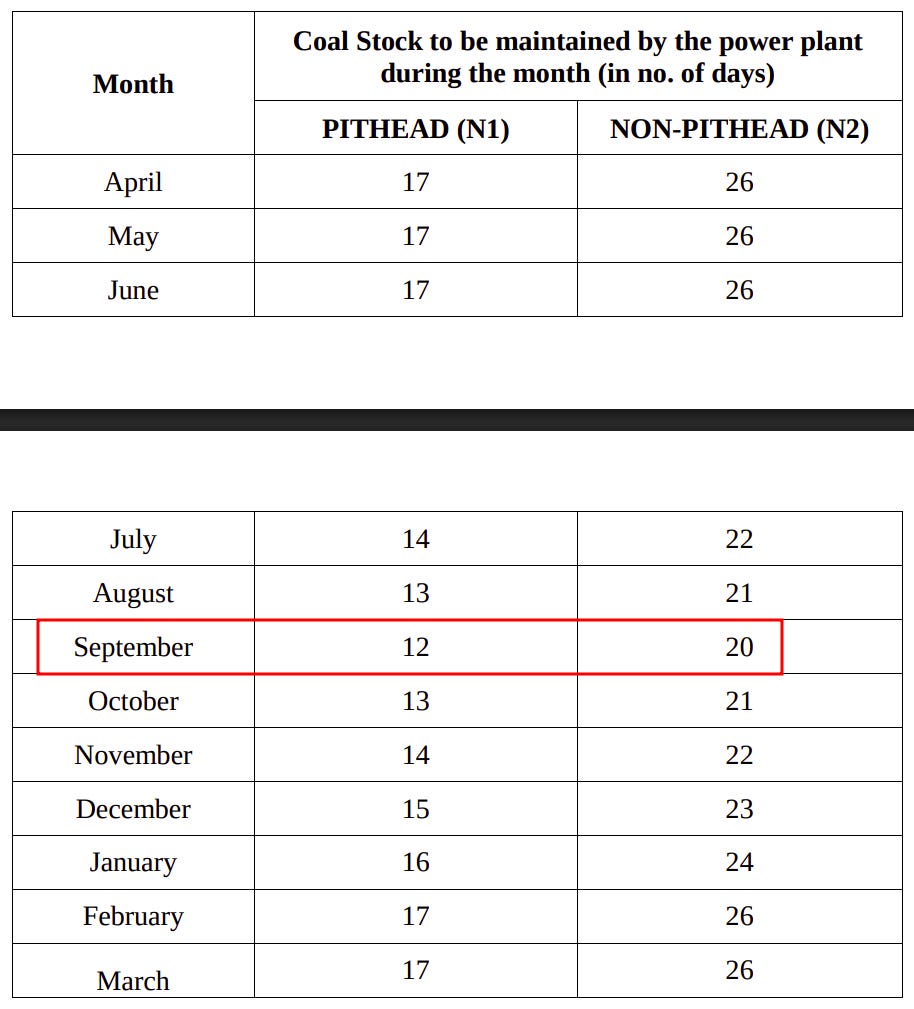
The Central Electricity Authority sets stock requirements based on a plant’s distance from the mines and its capacity, with even penalties for falling short. In September, pithead plants are meant to hold 12 days of coal; other plants, 20 days, assuming operations at 85% capacity.
Where things get stuck
So where, exactly, does the coal get held up?
The first question is whether a plant arranged enough coal early enough. Buying ahead ties up money and takes storage space. A generator might keep stocks low to save on those costs, or struggle to pay for more. Either way, it becomes more exposed when demand rises or deliveries slow.
That’s why it matters whether a plant delayed its order or ordered on time and still didn’t get its coal. Plant-level stock figures are public. But they don’t, by themselves, tell us whether a plant ordered late or whether its delivery was delayed.
Even after an order is placed, coal can get stuck before it reaches a train. Trucks face congested roads. Conveyors and loading equipment may not have enough capacity, while manual loading takes time because of lack of adequate mechanization. A remote mine may be far from the main railway line. Building a siding to connect it can run into land acquisition, clearance and right-of-way delays, especially when sidings and main lines are planned separately.
Then there’s the railway journey. A shortage of wagons and a shortage of space on the tracks are different problems, and both can slow coal deliveries. Buying more wagons won’t help much if trains are already queuing at a busy junction. Some coal routes, including East Coast Railway lines linking the eastern coalfields to ports and the wider network, operated above their assessed capacity. The Coal Ministry’s July assessment flagged congested routes as well as problems with rake availability and turnaround.
Turnaround is the time it takes to load a train, deliver the coal, unload it and return the wagons for another trip. A delay at any step means the same wagons make fewer trips and carry less coal. Freight trains also share the main lines with passenger trains, which often get priority. A coal train may have to wait even when its wagons are ready.
The delay could lie with the coal seller, the supplier of wagons, the railways or even the power plant taking too long to unload. To understand a hold-up, we need to know where it happened and who can fix it.
Rain adds a seasonal strain. It can disrupt mining, damage access roads and slow dispatch, making coal harder to get. Plants are meant to prepare for this as the norms require them to build larger stocks before the monsoon and draw them down when deliveries become difficult. But a surge in consumption can use up that cushion faster than expected.
That also explains why the immediate shortage can ease without much infrastructure changing. When demand eases or deliveries improve, plants rebuild their stocks. The same congested junction may cause trouble again when traffic picks up.
The financial effects depend on where the coal gets stuck. Coal India may be unable to dispatch and sell coal despite strong demand. A generator may have to produce less electricity. At regulated stations, lower output also means lower fuel costs, so revenue and profit don’t fall in the same proportion. But if a coal shortage reduces the plant’s availability below the required level, it can lose part of the payment meant to cover its fixed costs. Meanwhile, distribution companies may have to buy more expensive replacement power, a problem the electricity regulator has flagged.
Getting ahead of the next shortage
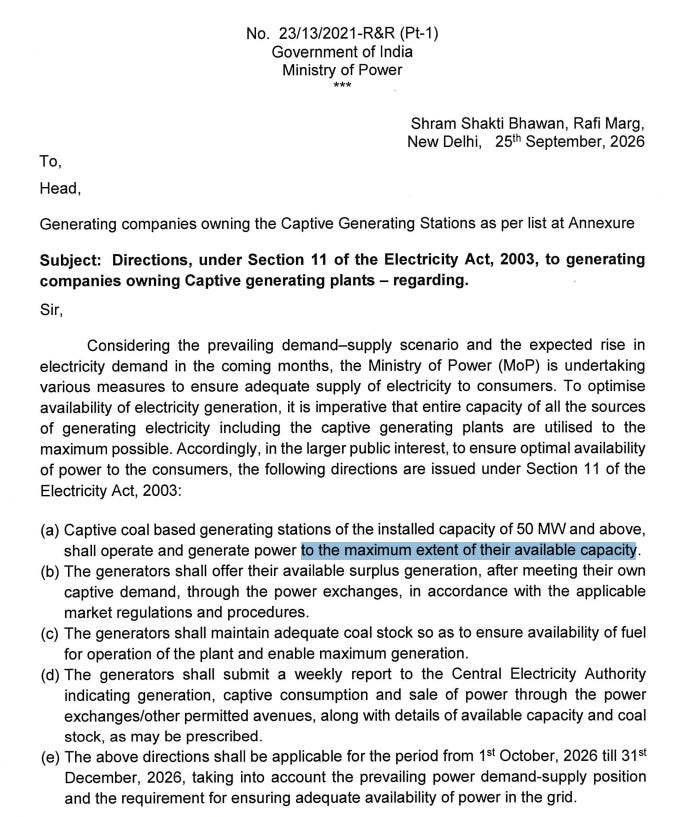
For now, the government is asking plants with spare capacity to generate more electricity. Its September 25 order requires coal-based captive plants of 50 MW and above to maximise available generation from October to December. These plants mainly power their owners’ factories. After meeting those needs, they must offer any surplus through power exchanges. “Captive” doesn’t mean they have a guaranteed coal supply. But if they have enough fuel to run harder, they can take some pressure off the plants running low.
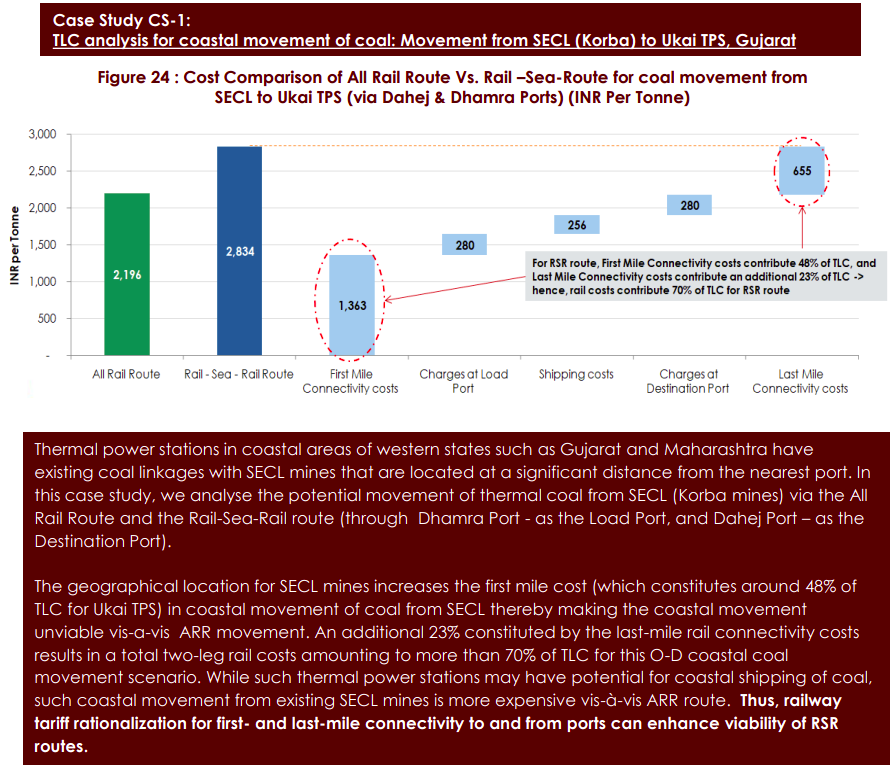
Imports offer another option. A coastal plant may find it easier to receive coal through a port than along a congested inland railway. An inland plant still needs to move that coal from the port, though. The coal must also suit its equipment and make sense at the price it costs to deliver.
Domestic coal can travel by sea too: by rail to a port, by ship along the coast, and then onward to the plant. This rail-sea-rail route gives plants another way to receive coal, provided the ports and rail connections can handle it.
The lasting fixes follow the journey we started with. Plan road and rail access alongside new mines. When allocating a coal block, map out and reserve the land needed for tracks, roads and conveyors, so those connections don’t get held up later.
Share railway sidings where it makes sense. Building a siding for just one coal block may not be viable, while several nearby blocks could use the same one. Improve loading and unloading. Add track capacity on routes that are actually congested. And, where possible, arrange for plants to receive coal from closer mines. These measures are part of the Coal Logistics Policy.
Some work is already done. By July, 72 of 139 first-mile projects had been commissioned; others still faced land, clearance and construction delays. These projects replace truck trips from the mine with conveyors that carry coal to silos for loading. As a train moves slowly beneath a silo, chutes can fill its wagons in under an hour, cutting road traffic and loading time.
Generators also need to build stocks before the difficult months. Those reserves buy time while deliveries catch up. Without them, even a temporary delay can leave a plant scrambling for coal that’s sitting a few hundred kilometres away.
- This edition of the newsletter was written by Manie & Kashish.
Tidbits
1. Vedanta revives Niyamgiri mining push, tribal groups oppose it
Vedanta has renewed its push to mine bauxite in Odisha’s Niyamgiri hills, but local tribal communities say they remain opposed. The project was stalled in 2013 after all 12 gram sabhas voted against mining in the hills. Vedanta argues that tapping the estimated 80 million tonnes of bauxite could support its nearby refinery and create local jobs.
Source: Business Standard
2. IEX subsidiary applies to launch a coal trading exchange
IEX’s subsidiary Indian Coal Exchange has applied for a licence to set up a physical coal trading exchange. The platform would bring buyers and sellers together, enable price discovery and expand IEX beyond electricity and gas trading into coal. The exchange will operate under the new Coal Exchange Rules, 2026, with trades settled through designated delivery points.
Source: Business Standard
3. CDSCO steps up scrutiny of pharma drugs containing narcotic substances
India’s drug regulator is reviewing rules around medicines containing narcotic and psychotropic substances to prevent their illegal diversion. A regulatory committee will identify gaps and recommend tighter controls, with CDSCO tasked with addressing them by March 2027. The review is part of a broader government effort to tackle changing drug-trafficking methods and misuse of pharmaceutical products.
Source: The Economic Times
4. India flags off its first diesel-LNG powered train
India has launched its first train running on a diesel-LNG dual-fuel system in Gujarat. Two 1,400 HP power cars have been converted for the project, with LNG expected to replace nearly 40% of diesel consumption while reducing fuel costs and emissions. Importantly, the train is not fully LNG-powered — it can run on both LNG and diesel.
Source: The Economic Times
5. Centre plans aviation infrastructure push in West Bengal
The Airports Authority of India plans to develop civil aviation infrastructure at Hasimara, Kalaikunda, Malda and Balurghat in West Bengal. AAI and the state government are expected to sign an MoU next month to coordinate the four projects. Hasimara and Kalaikunda are expected to get civil enclaves that would allow passenger operations from existing Air Force stations.
Source: The Hindu BusinessLine
Want more tidbits? Catch up on last week’s recap!

Beyond Today’s Brief
There’s always more happening at Markets by Zerodha.
The Chatter: What do top corporate leaders and regulators say about macroeconomic resilience and market shifts? How is NSE navigating derivatives regulation while rebalancing its revenue mix, and how are firms like ONGC, Hero Motors, Bikaji, and Pearl Global managing deepwater gas exploration, raw material inflation, and global supply chain expansion?
Points & Figures: What is driving India’s record vehicle registrations across two-wheelers, cars, and commercial fleets? How are recent tax cuts and surging rural RTO demand reshaping auto sales, and where does EV adoption stand across different vehicle segments?
Aftermarket Report: How did Nifty plunge below 22,800 as rising oil prices, geopolitical tensions, and broad-based selling intensified? And what do extreme fear, heavy FII shorting, and bearish options positioning signal as market sentiment deteriorates further?
Join us on WhatsApp, where we share interesting soundbites from concalls, articles, and everything else we come across throughout the day. You’ll also get notified the moment a new video or article drops so that you can read or watch it right away.
Thank you for reading. Do share this with your friends and make them as smart as you are 😉