

Our goal with The Daily Brief is to simplify the biggest stories in the Indian markets and help you understand what they mean. We won’t just tell you what happened; we’ll tell you why and how too. We do this show in both formats: video and audio. This piece curates the stories that we talk about.
You can listen to the podcast on Spotify, Apple Podcasts, or wherever you get your podcasts and watch the videos on YouTube. You can also watch The Daily Brief in Hindi.
In today’s edition of The Daily Brief:
1. SEBI finds fraud in the cloud
Why did SEBI just slap a seven-year ban and massive penalties on Varanium Cloud and its promoter? Riding the data center hype, the startup raised public funds by touting edge data centers and cloud services that barely existed in reality. Instead, regulators uncovered ghost facilities, completely fabricated financials, and an elaborate scheme that siphoned over ₹129 crore into the promoter's pockets. The saga reached a comical low when the promoter's 235-page legal defense was exposed for using AI-hallucinated laws and non-existent case citations—proving that in the frenzy of a tech bubble, some businesses are nothing but smoke and mirrors.
2. An unseen fallout of insurance commission caps
Why did SEBI drop a ₹3,900 crore case against Max Financial and Axis Bank? To bypass strict commission caps, the companies used discounted unlisted share deals to route extra payouts as capital gains. While fined by the insurance regulator, SEBI ruled that exploiting sectoral loopholes isn't securities fraud—showing how rigid caps trigger complex legal workarounds.
SEBI finds fraud in the cloud
Every industrial revolution, from the first car to the first robot, may be different in product characteristics, but has some uncanny similarities.
When a new technology shows commercial potential, entrepreneurs rush in and fuel tons of money in the hope that one day, they will reap outsized returns. But this creates a frenzy where too much money ends up chasing far fewer returns.
Eventually, this bubble bursts and causes a recession. But, with the right policies, such a recession gives way to a golden age of productivity.
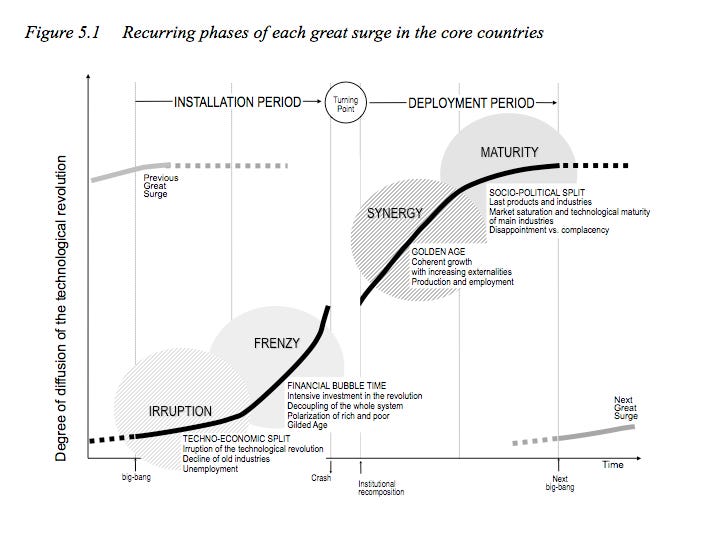
Now, in the chaos of a bubble which is fueled by easily-accessible capital, there will almost certainly be bad actors. They may rely on the shine of this new technology to manipulate markets without actually advancing it. They may even resort to blatant fraud.
In the age of a massive data center buildout, we are already seeing signs of this in India.
In 2022-2023, a company called Varanium Cloud, led by promoter Harshwardhan Sabale, raised money from the public markets. It made many promises on the back of data centers and cloud services. But on Monday, SEBI published a 155-page final order which found nothing but smoke and mirrors instead, and accused it of outright fraud.
It’s only words
The story starts from Varanium’s listing.
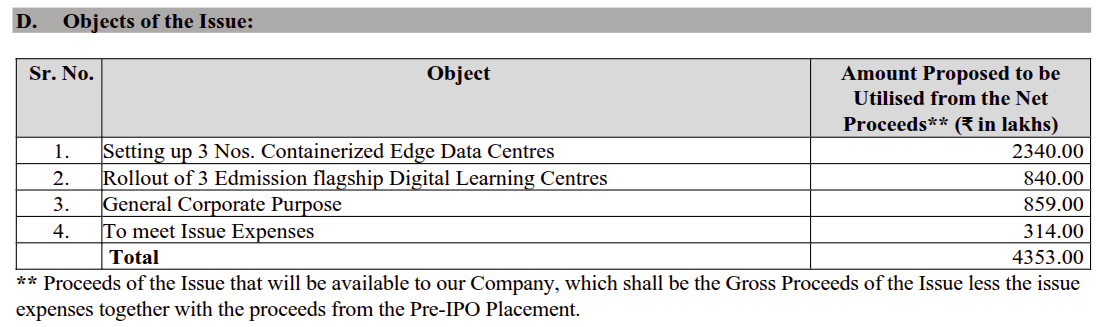
In its prospectus, Varanium said to investors that it would use the proceeds of its ₹40 crore IPO in three things. First, it would build three edge data centers, which are small data center units that are meant to serve only the devices close to it. Second, Varanium would set up three digital learning centers. Third, it would run a BPO operation out of these locations.
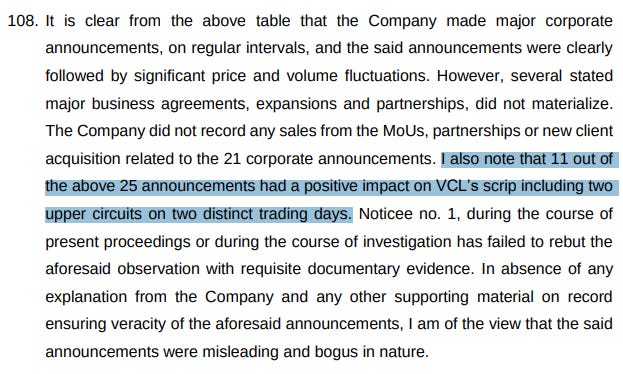
Between listing and the interim order in May 2024, Varanium made 25 corporate announcements. Here’s some of the big ones:
Varanium was meant to inaugurate an edge data center in Goa
It announced a partnership with Secur Credentials for BPO operations
It also launched a cloud-based medical wearable device
It disclosed plans to acquire a cable company for ₹2,683 crore, to be paid wholly in cash.
It told the stock exchanges it was setting up a data center in Malta, and separately, that it was planning to list a subsidiary on the NASDAQ.
None of these announcements materialised. Yet, SEBI found that 11 of the 25 announcements moved the stock price upward, including two that triggered upper circuits.
So, how do we know what was real, and what was up in the clouds? Well, in January 2025, SEBI and NSE conducted site visits at every location Varanium claimed to operate from. And it found many damning facts.
To start with, at the given Goa address, there was no edge data center building, which Varanium told investors it had commissioned in December 2022. Instead, a Varanium admin office was found, whose staff had no idea of any edge data center plans. The lease for the premises was dated April 2023, four months after the supposed commissioning.
Then, there was the electricity bill. Even the most unknowing person is aware that data centers are among the most power-hungry facilities in existence. But a single monthly billing cycle towards the end of 2023 showed just 6 units consumed. That’s what a light bulb uses in a few days. That is weird for a “data center” that’s been in commission for a whole year.
What’s more, in the immediate next month, the electricity bill jumped to a whopping 2,450 units. Possibly, someone had switched things when the law’s long hand reached them.
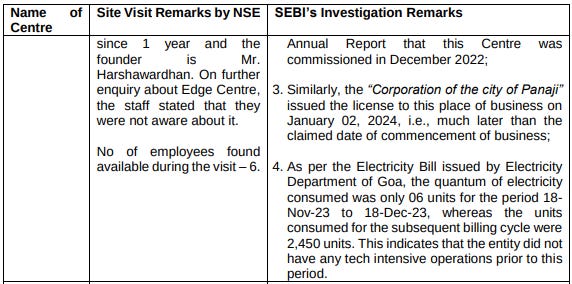
At another location, Sawantwadi, Varanium had publicly announced it employed over 125 young people” in its BPO. But SEBI only found eight people, who said that they were only involved in ”documentation work”. They were doing very little of what a BPO does.
The vendor who was meant to build all of this was Avance Technologies, which is also a publicly-listed company. Somehow, it had zero fixed assets on its balance sheet. Avance later confirmed to SEBI that it didn’t execute any work because Varanium chose to handle the projects directly. The quotation Varanium obtained from Avance for the IPO prospectus exceeded Avance’s own annual revenue.
Cooked books
If the operations were fiction, the financial statements were a masterpiece of the form. Over FY23 and the first half of FY24, SEBI found that most of Varanium’s reported sales and purchases were fictitious.
The centerpiece was Amtelfone, an entity Varanium claimed to sell services to. Over two years, Varanium booked ₹594 crore in sales to Amtelfone. A public domain search yielded only basic information about the company. Neither Varanium nor its suppliers could furnish any invoices or contracts in support of the transactions.
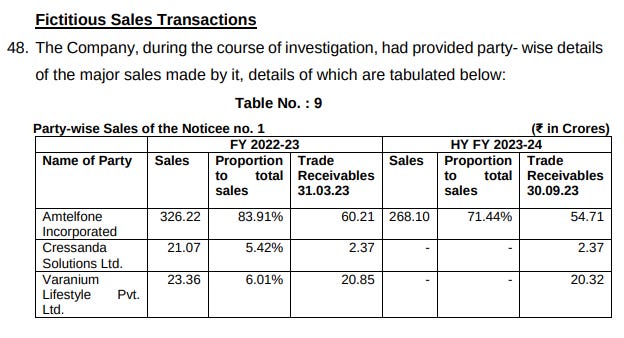
When SEBI examined Varanium’s tally ledger, the entries for Amtelfone were monthly lump sums recorded at the end of each month, but without corresponding bank receipts. Instead, Varanium’s journal entries offset Amtelfone’s receivables against payables to Amazon Web Services.
Now, Varanium claimed to have purchased ₹444 crore in cloud services from AWS. But when SEBI asked, AWS sent back invoices that merely amounted to ₹20,000 to ₹23,000. Varanium’s books also contained a single journal entry of ₹107 crore worth of sales to a US-based clothing company called Courage Clothing. For one, this company had nothing to do with cloud services. But secondly, no receipts existed as evidence of this transaction. All of this should tell you enough about the quality of Varanium’s accounting.
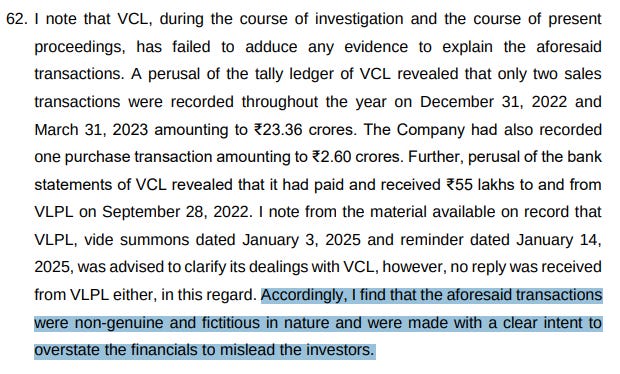
Then, there were sales to entities owned by the same promoter, all of which followed the same pattern. Three such promoter-group entities each had two sales entries booked at quarter-end, with token amounts of ₹5 lakh moving through the bank account to create the appearance of a transaction. Few of these transactions were also not disclosed as related-party transactions.
Where the money went
While the books showed hundreds of crores in fictitious transactions, the actual money raised from investors took a much simpler path.
Of the ₹40 crore raised through the IPO, ₹19 crore was transferred to BM Traders and three promoter-owned entities: Turmeric Lifestyle, and Varanium Earth, and Varanium Lifestyle. Beyond having a common promoter, Varanium had no disclosed business relationship with any of these entities. The IPO prospectus certainly didn’t envision transferring money to them.
Post-IPO, Varanium raised ₹48 crore more through a rights issue. Shockingly, 90% of it went to Harshwardhan Sabale’s personal bank account and promoter-group entities.
Meanwhile, Sabale was selling his shares. The stock had opened at ₹131 on listing day and, aided by the stream of corporate announcements, rose to over ₹1,500 by January 2023. Between November 2022 and March 2024, promoter entities sold shares worth ₹149 crore. After accounting for acquisition costs, SEBI calculated the unlawful gains at ₹129 crore. By May 2024, when SEBI issued its interim order, the stock had collapsed to under ₹18.
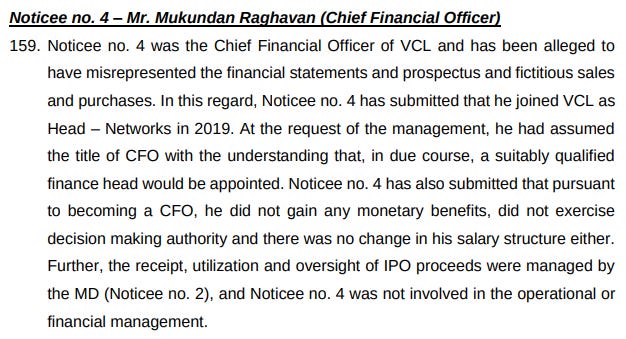
A board that existed only on paper rounded out the picture. The compliance officer told SEBI that Sabale would withhold her salary if she didn’t follow his orders. The CFO, didn’t even have experience in finance and was a network engineer by profession. As CFO, he didn’t work on anything finance-related, and only stuck to the technical stuff he knew.
All these Board members testified to the same fact: Harshwardhan Sabale had immense amounts of control on the money lever.
Ghosts in the machine
Now, based on these findings, SEBI gave the promoter and some of the other accused folks a show cause notice. In response, Sabale came up with a 235-page defence, but SEBI found it very easy to dismiss all of it.
The reason for that is the most entertaining part of the whole ordeal. After all, it was found to have been full of AI hallucinations! The evidence used to back up the defence either didn’t exist, or was used completely out of context.

For instance, Sabale said that, as per the judgement of the now-infamous Ketan Parekh case, proving fraud requires showing the existence of five specific elements. But the judgment itself was untraceable at the given citation. He also cited another case for the principle that corporate governance lapses cannot constitute personal fraud liability. While that case exists, it had nothing to do with directors’ liability; instead, it was related to some other act. Six other cited judgments were simply non-existent.
The reply also argued that the SEBI Act distinguishes between “Category A” (fraudulent) and “Category B” (administrative) violations. Sabale said that since these were “corporate governance lapses”, these offenses should be category B rather than A. But no such distinction exists in Indian capital markets law! SEBI observed that the AI tool appeared to have confused the current SEBI Act with the proposed Securities Markets Code Bill.
Some jokes write themselves: here’s a company involved in data centers that used AI to build up its case and hilariously failed at it.
Meanwhile, the non-AI defences were also dispatched quickly.
Sabale argued the proceedings violated his right to a hearing. But he was given a hearing, which his representative attended. The representative told the panel he was “very tired” and declined to make oral arguments because he’d been drafting Sabale’s reply late into the previous night. That being said, none of this is the same as the government denying you your right to be heard.
Now, Sabale personally was undergoing bankruptcy proceedings as per the IBC — he owed a lot of money. As per the Section 96 of the IBC, he argued, there should be a moratorium on all proceedings. But that section only applies to debt recovery, not regulatory penalties. SEBI’s actions fall outside that.
As for the Goa data center’s electricity consumption, Sabale argued that going from 6 units to 2,450 units is business-as-usual for a data center trying to scale up. But then, if the data center was commissioned in December 2022, why was it not operational for a whole year? Why did this bump only occur when regulators started looking in? Additionally, Sabale also tried to pass off the office space in Goa as proof the data center exists, which SEBI didn’t buy.
Where this fits
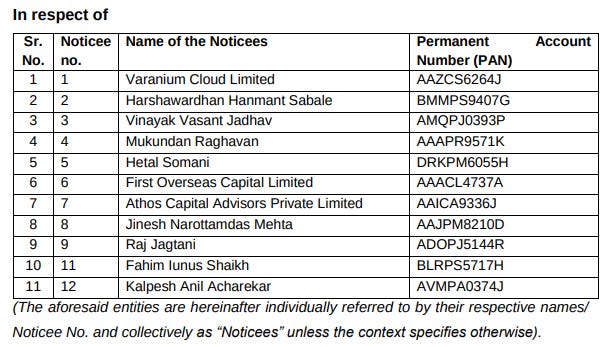
Sabale has been barred from the securities market for seven years and ordered to disgorge the ₹129 crore. Varanium has been directed to return ₹62.5 crore in diverted proceeds with 12% interest. On top of this, the total penalties across all 11 noticees come to about ₹33 crore.
The Varanium order doesn’t exist in isolation. First Overseas Capital, the merchant banker that managed Varanium’s IPO, was supposed to be the gatekeeper that verifies the issuer’s claims before public money comes in. Clearly, their due diligence was not enough. In fact, this isn’t the first fiasco they’ve been a part of. In January, SEBI found that FOCL had facilitated the siphoning of 54% of another SME company’s IPO proceeds. In sum, SEBI gave FOCL a two-year market ban.
BM Traders, the conduit through which IPO money and ₹119 crore from Sabale’s personal account flowed, got a four-year ban and a ₹10 crore penalty. Athos Capital, the advisory firm that helped prepare Varanium’s IPO documents, got a two-year ban. Some of the directors were also slapped with bans and penalties.
SEBI has been tightening the SME IPO framework since late 2024 by raising minimum application sizes, requiring operating profit track records, and so on. Lately, it has been considering overhauling it, and the Varanium order is a case study in why.
But this is also a story of the fraud that entails any technology that might show signs of a bubble. The dot-com bubble, the crypto boom, even the first buildout of the railways in the US, all of these famous bubbles have been replete with fraud. There will always be bad actors that try to cash in, and data centers may not be immune to this. The answer to that has always lay in how swiftly the crackdown on them is.

An unseen fallout of insurance commission caps
India’s insurance regulator caps how much an insurer can pay a bank for selling its policies. There is a good reason for the cap: without it, insurers would bid up commissions and policyholders would end up funding the bidding war.
The Max Life-Axis Bank arrangement is a case study in what happens when a bank wants more than the cap allows.
How the money moved
In 2010, Max New York Life — later Max Life Insurance — signed a ten-year agreement making Axis Bank its distributor. Axis was then India’s third-largest bank and good at selling insurance. Before this, Max Life was doing only about 4% of its new business through banks.
Alongside that distribution deal, a second set of transactions began.
In December 2011, Max Life issued 7.66 crore shares to Axis Bank at ₹10 each. This may not have reflected its actual worth. This included an option agreement, which let either side force a buyback later at a price linked to the fair market value. Through 2016, Max bought the shares back in four tranches: at ₹54, ₹54.1, ₹71.9 and ₹111.
On the other side, Axis earned several hundred crore rupees along the way. This is a textbook capital gain that, seemingly, Axis took in lieu of capped insurance commissions.
Again, in 2016, Max Financial and its Japanese partner Mitsui Sumitomo transferred 9.57 crore shares to Axis at ₹10 each, and repurchased most of them in multiple tranches between 2018 and 2021.
Then in 2020, the relationship was formalised. Max Financial’s board approved selling 29% of Max Life to Axis, but that flouted RBI’s investment limits. So, in early 2021, only ~12% of Max’s stake changed hands, and it was split between Axis Bank, Axis Capital and Axis Securities so that, in accordance to RBI’s rules, no single entity crossed 10%.
What’s in dispute
Now, selling shares for cheap and buying them back expensive as a way of paying a distributor more than commission rules allow is not merely theory. This was IRDAI’s conclusion.
The commission cap is IRDAI’s rule to enforce. It found that Max Life and Axis Bank had used the share deals to get around the limits on what an insurer may pay a corporate agent, and fined Axis Bank ₹2 crore and Max Life ₹3 crore. SEBI itself concluded that this was a regulatory workaround for the insurance commission limits. That was never in question.
What SEBI brought was a different question. IRDAI regulates insurers, but has nothing to say about the rules a publicly-listed company has to follow, which is wholly SEBI’s territory.
See, Max Financial, Max Life’s listed parent, is writing the cheques to buy shares back at ₹166, so its public shareholders ultimately fund the arrangement. But were they told what was happening? And does dressing up compensation as an investment equal defrauding them?
In October 2024, SEBI issued a show cause notice to 25 entities, alleging a ~₹3,900 crore loss to Max Financial and a matching gain for the Axis group.
But this Monday, all charges were dropped on Max Financial, Max Life (now Axis Max Life), and all the three Axis companies.
Why the case failed
So, why did that happen? There are two reasons, both of which are about SEBI’s case rather than the conduct.
The first is related to disclosure. Now, SEBI does believe that the disclosures from all parties have been inadequate, and sent them multiple notices across the years about this. But the problem is when they said this.
Most of it predated the LODR Regulations of December 2015. Before that, the rulebook was the Listing Agreement, which required disclosure of material and price-sensitive information, but didn’t define the material and price thresholds. SEBI’s own later papers acknowledged the ambiguity. Under a rule that vague, a regulator has to argue why a specific item was material at the specific time. But the notices didn’t do much beyond pointing at the size of the numbers.
The second is related to whether this is fraud or not. Under Indian securities law, fraud requires either that someone was induced into a trade and injured by it, or conduct blatant enough that wrongful intent is evident on its face.
But SEBI couldn’t prove fraud on any of those terms. There was no manipulation of price or volume and no artificial market. They couldn’t truly prove that the parties were secretly colluding. In fact, the SEBI order also noted that the pricing structure had been filed with and approved by the sectoral regulator.
But clearly, ₹10 a share was too cheap. So why isn’t that the end of the fraud argument?
Well, that’s because the shares priced at ₹10 are the shares of Max Life, which is unlisted, while the listed company is the parent. SEBI’s fraud rules are aimed at manipulation in the public markets, but there is no market in Max Life shares to distort.
The nuances
As a result, all the main allegations fell away. That being said, the order does not say that the pricing was fair. It finds that injury to shareholders was not demonstrated and intent was not evident, but that is not commentary on the valuation.
Meanwhile, Max’s defence was that, if the numbers are to be believed, the partnership worked. Axis came to generate about 45% of Max Life’s premiums, while Max Life’s embedded value rose from roughly ₹3,200 crore to over ₹24,000 crore. Max Financial’s shares went from about ₹175 to a peak of ₹1,311, and shareholders approved the 2020 sale wholeheartedly.
But SEBI refused to treat any of that as a defence. In its own words: “a scheme or an arrangement can be highly profitable yet inherently fraudulent.”
A couple of loose threads survive in the order without much examination. One such thread was around the 2020 sale, where the valuation report was never circulated to shareholders. It was made available for inspection at the registered office during the COVID lockdown, which proxy advisors said left shareholders unable to decide properly. The order records the complaint, but does not squarely rule on it.
What’s still open
Thirteen of the original 25 noticees, who are Max Financial’s independent and non-executive directors, filed settlement applications which are still being processed. Their orders are held in abeyance.
SEBI also added the customary note that nothing prevents it from acting if the transactions are later found to violate securities laws. So far, the commission cap remains in place, but so does the incentive to work around it.
- This edition of the newsletter was written by Manie & Kashish.
Tidbits:
[1] The government has approved a ₹5,070 crore support scheme targeting 5 GW of floating solar capacity with energy storage across reservoirs and other water bodies. While the model avoids land constraints, developers face higher costs, technical risks and concerns around aquatic ecosystems.
Source: Business Standard
[2] The United States has sanctioned four Indian firms as part of Operation Economic Outcast to curb illicit petroleum trade linked to Iran. The move highlights increasing geopolitical scrutiny and regulatory pressure on Indian entities navigating trade with heavily sanctioned regimes.
Source: The Hindu BusinessLine
[3] PepsiCo bottler Varun Beverages is setting up a wholly owned subsidiary focused on ready-to-drink alcoholic beverages, appointing former Diageo executive Prathmesh Mishra to lead it. The move marks a major strategic expansion beyond its core soft drinks and packaged water operations.
Source: The Economic Times
[4] Tamil Nadu has dropped plans for a second Chennai airport at Parandur following strong opposition from farmers over the impact on agricultural land. Authorities are now evaluating alternative locations while simultaneously working to expand Chennai’s existing airport.
Source: Reuters
[5] Indian Railways is preparing new public-private partnership frameworks, including a Development Partner Model and Hybrid Annuity Model, to attract private capital. The broader ₹2.62 trillion pipeline spans new rail lines, station redevelopment, freight infrastructure and other railway assets.
Source: Livemint
[6] Fashion retailers including H&M and Mango are scaling back larger size assortments as consumer demand patterns shift alongside the rise of GLP-1 weight loss drugs. While brands are adjusting inventory, analysts continue to debate the exact causal impact of the medications on retail sizing choices.
Source: Bloomberg
Beyond Today’s Brief
There’s always more happening at Markets by Zerodha.
The Chatter: What is driving Borosil’s volume growth across consumer and scientific glassware despite supply disruptions? How is Orchid Pharma leveraging novel drug partnerships and API expansion to scale margins? And what does Welspun’s order book reveal about export demand across textiles and pipes?
Aftermarket Report: How did Nifty remain locked in a choppy, back-and-forth trading session as consolidation continued? And which sectors managed to hold the fort amid intraday swings?
Subtext: Banking analyst Tamal Bandyopadhyay breaks down a landmark milestone for Indian banking—why no listed bank currently has a net NPA above 1%, and what this historic asset quality cleanup means for future credit growth.
Join us on WhatsApp, where we share interesting soundbites from concalls, articles, and everything else we come across throughout the day. You’ll also get notified the moment a new video or article drops so that you can read or watch it right away.
Thank you for reading. Do share this with your friends and make them as smart as you are 😉
This is the same pattern I see when clients chase hot sectors—data centers, AI, whatever's shiny. Hype makes due diligence feel optional.
A diversified portfolio with basic checks would've caught the red flags: no assets, no revenue, no receipts. But greed overrides process.
The lesson isn't just about Varanium. It's about staying boring when everyone else is getting rich.
This is the reason why SME IPOs are risky..not enough due diligence is required to list — hopefully like you mentioned the SME listing requirements should get stricter safeguarding shareholders