


Our goal with The Daily Brief is to simplify the biggest stories in the Indian markets and help you understand what they mean. We won’t just tell you what happened; we’ll tell you why and how too. We do this show in both formats: video and audio. This piece curates the stories that we talk about.
You can listen to the podcast on Spotify, Apple Podcasts, or wherever you get your podcasts and watch the videos on YouTube. You can also watch The Daily Brief in Hindi.
In today’s edition of The Daily Brief:
1. Sagar Defence wants to take its unmanned machines public
Sagar Defence Engineering, which builds unmanned aerial, ground, surface, and underwater systems powered by a unified software stack, is filing for an IPO of up to ₹3,412 crore—including ₹1,200 crore in fresh capital largely earmarked for a new autonomous shipyard in Andhra Pradesh. Riding defence procurement orders, revenue surged sixfold over two years to ₹255 crore in FY26 with an industry-leading 47.5% EBITDA margin. However, with nearly 97% of revenue tied to the Indian government, trade receivables have ballooned to ₹438 crore over an average 277-day collection cycle, turning operating cash flows deeply negative alongside fixed-price contract and component-import risks.
2. How Tata Steel plans to buy APL Apollo with APL Apollo’s money
In a circular, multi-leg transaction that sent both stocks tumbling on announcement day, APL Apollo Tubes will borrow ₹28,000 crore to buy Tata Steel’s tubes and colour-coated steel businesses, while Tata Steel uses those proceeds—plus a net outlay of roughly ₹4,300 crore—to acquire the Gupta family’s stake and launch an open offer for a 52% controlling interest. While Tata gains an immediate pan-India downstream distribution network and APL secures raw material backing, the deal leaves APL saddled with heavy debt pending an unpriced ₹18,000 crore equity infusion and has drawn fierce pushback from minority shareholders and scrutiny from SEBI over its sequencing and governance.
Sagar Defence wants to take its unmanned machines public
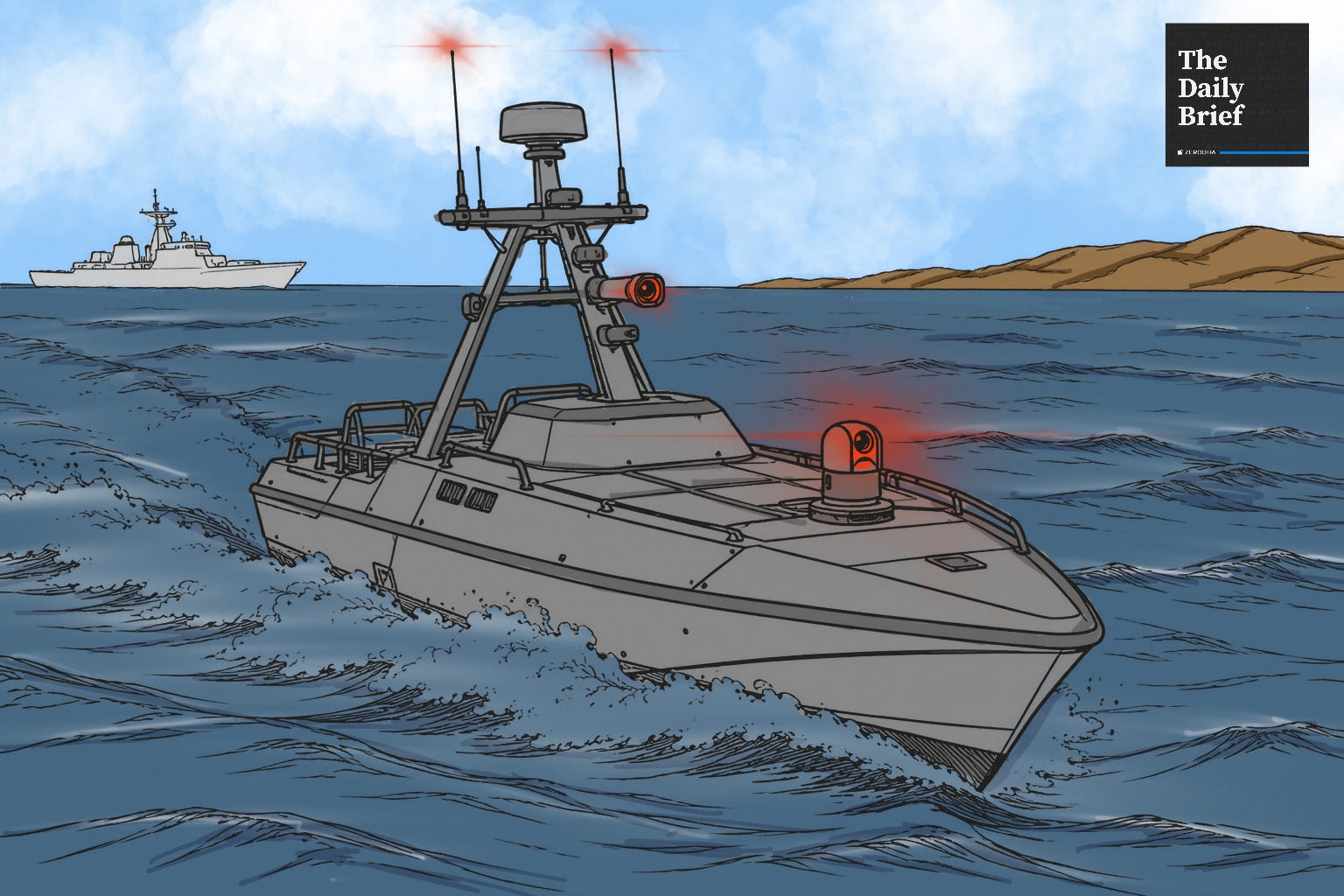
Across wars in the world, drones with guns have become ubiquitous in modern military operations. Often, they’re no bigger than a toy, flying over battlefields with no pilots on board. Drones are one kind of what militaries call unmanned systems, which also include boats, underwater vehicles, and ground robots that work with no humans inside.
Sagar Defence Engineering, a decade-old Indian company founded by a former merchant navy officer that claims to make all four kinds, is filing for an IPO of up to ₹3,412 crore. From a 150 sq ft workspace in Mumbai, it manages two factories in Pune, while planning one in Andhra Pradesh.
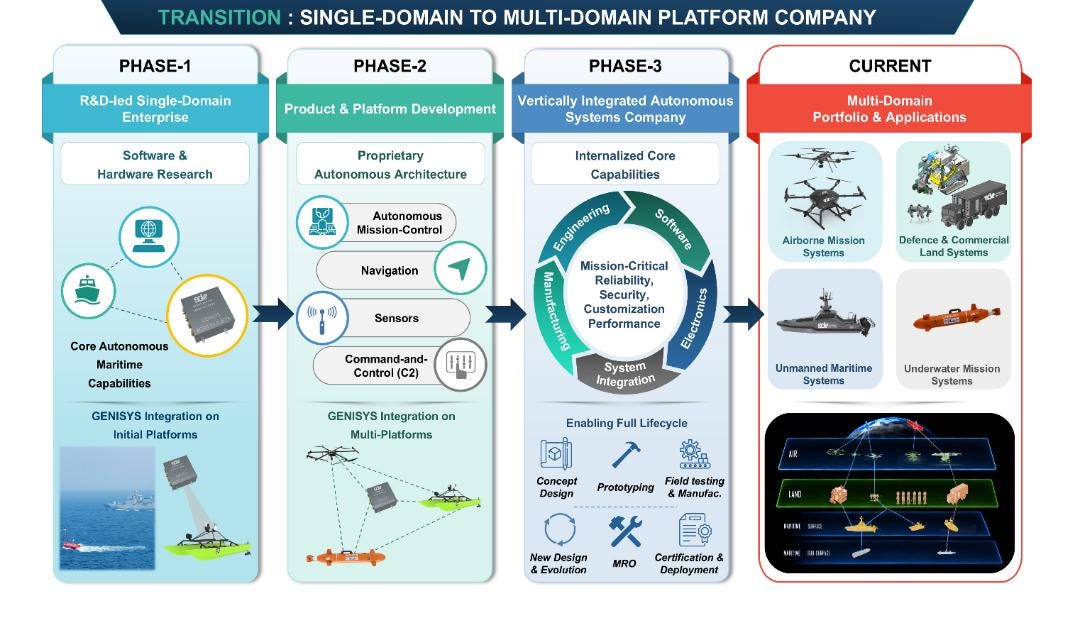
Initially, the company focused on maritime software, and later built the vehicles around it. It also expanded its range to not just unmanned systems that run on the sea surface, but also underwater, in the air and on land.
Of the ₹3,412 crore on offer, ₹1,200 crore is new shares, while the rest is an offer-for-sale. Most of the new money, ₹725 crore, goes to a manufacturing campus in Andhra Pradesh’s Nellore district, which Sagar pitches as India’s first autonomous shipyard. Another ₹83 crore will buy machinery for its Pune plants, and ₹170 crore goes to research and development.
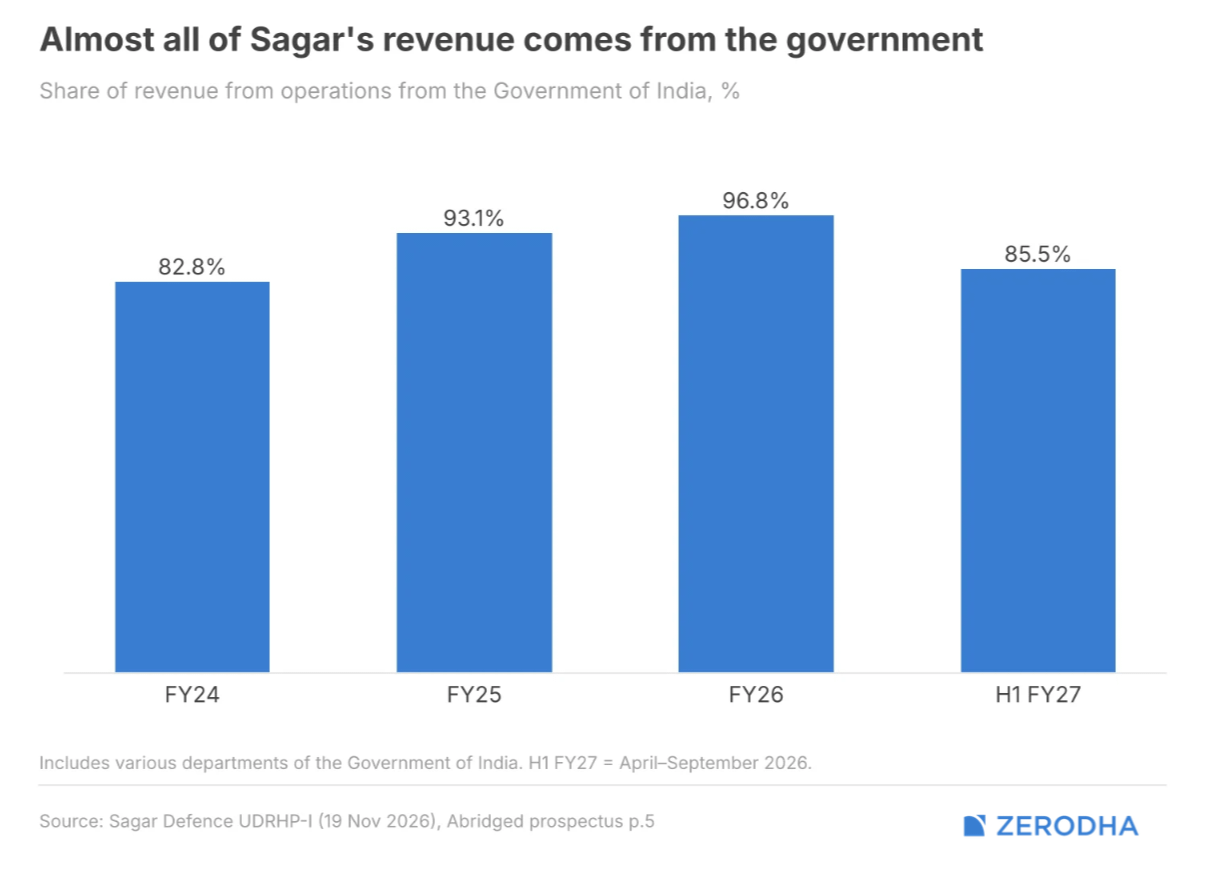
Before we get into the IPO, though, there’s one detail worth highlighting. Almost every rupee Sagar earns comes from a single customer in FY26: the Government of India. This is hardly strange for a defence company, but it shapes nearly everything in Sagar’s numbers, from the margins to the cash it is due but hasn’t yet received.
What are unmanned systems?
Let’s start with what an unmanned system is.
It doesn’t necessarily mean that there’s no human behind it. The sufficient condition for being an unmanned system is that the human is not on board, and can operate the vehicle remotely. If something happens to the vehicle, the human is not at immediate physical risk.
Other unmanned systems are truly autonomous. They’re given a mission and make their own decisions to carry it out, even when the radio link to their human operator is jammed.
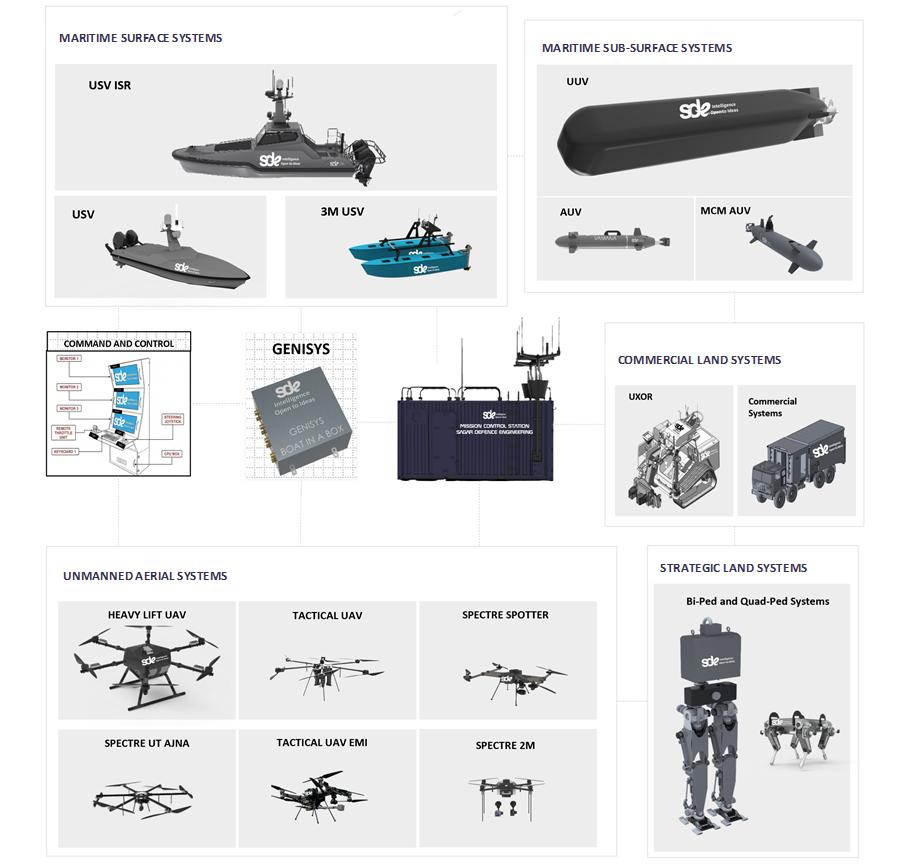
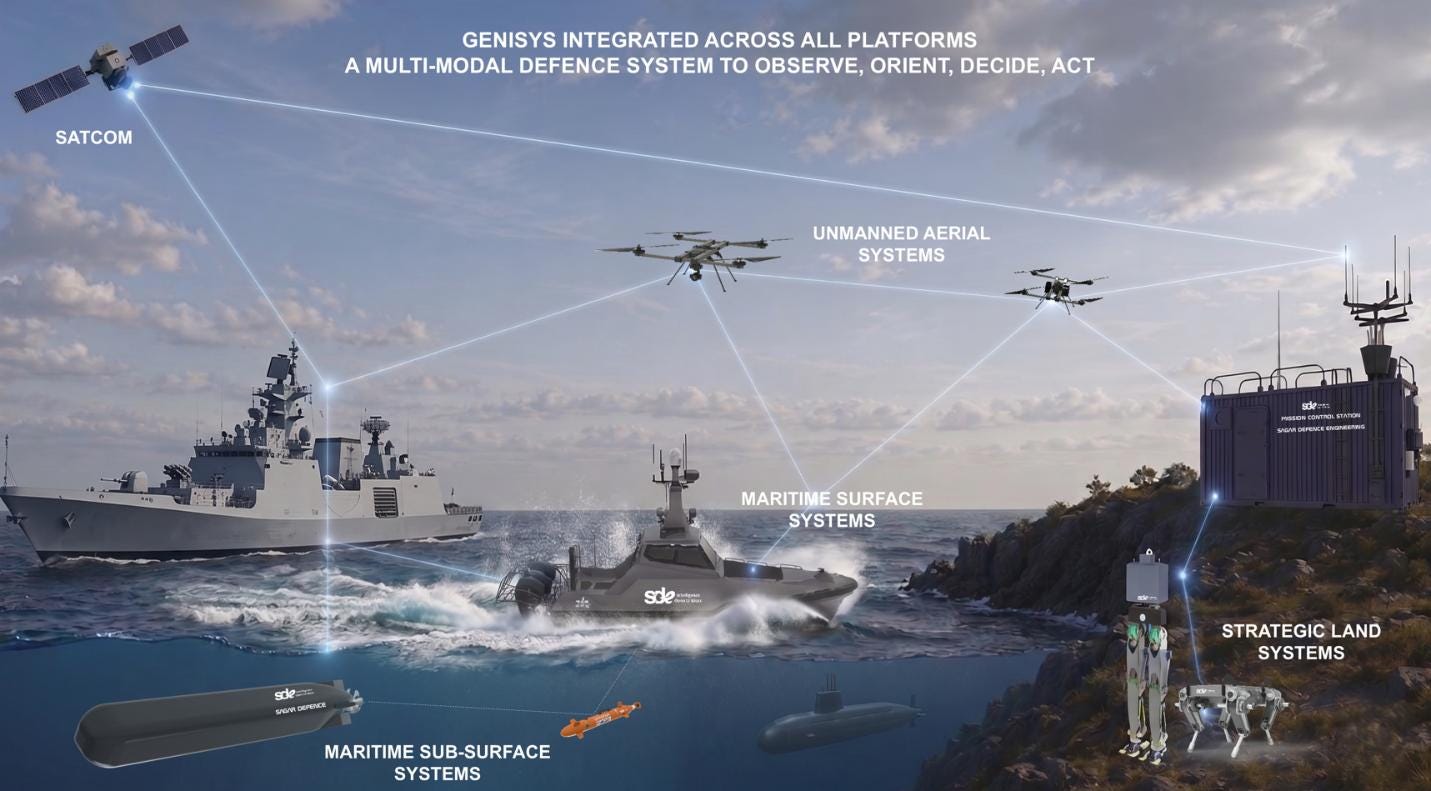
Unmanned systems come in four kinds, depending on where they work: drones in the air (UAV), ground vehicles on land (UGV), unmanned surface vessels on water (USV), and unmanned underwater vehicles (UUV) below it. Militaries increasingly use them for jobs once done by crewed platforms, like human patrol boats.
Sagar says it is the only Indian company that specialises in all four, run on one connected software stack. Sagar’s catalogue also includes electronic command-and-control systems, which help military personnel monitor and coordinate these machines from a distance.
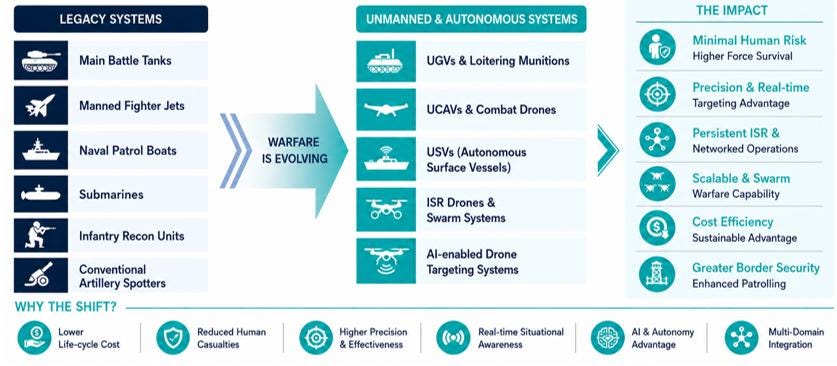
Yet, unmanned systems are still a small slice of what India’s armed forces buy, with estimates for the Indian market for unmanned defence systems was about $1.1 billion in FY26. That’s roughly 5% of the $22.7 billion market for defence systems as a whole.
What ties these products together is Sagar’s proprietary software brain, GENISYS, which reads the vehicle’s sensors and plans its route.
The numbers
Sagar earns almost all of its revenue from sales of these machines, with its software built in. As of yet, it doesn’t earn anything from licensing GENISYS alone. Other services like maintenance and training brought in 0.9% in FY26.
Which of these products is Sagar’s biggest earner? The DRHP does not give a split, but we can get a sense by counting the confirmed orders. The Navy has ordered 12 autonomous interceptor boats, and its underwater vehicle for clearing mines has also received a procurement order.
As its unmanned machines moved from trials to sales, revenue rose from ₹39.5 crore in FY24 to ₹255 crore in FY26. Net profit went from a loss of ₹6.3 crore in FY24 to a surplus of ₹102 crore in the first half of the current fiscal year. Exports make up a very small chunk, which is standard for an Indian defense company building primarily for the Indian government.
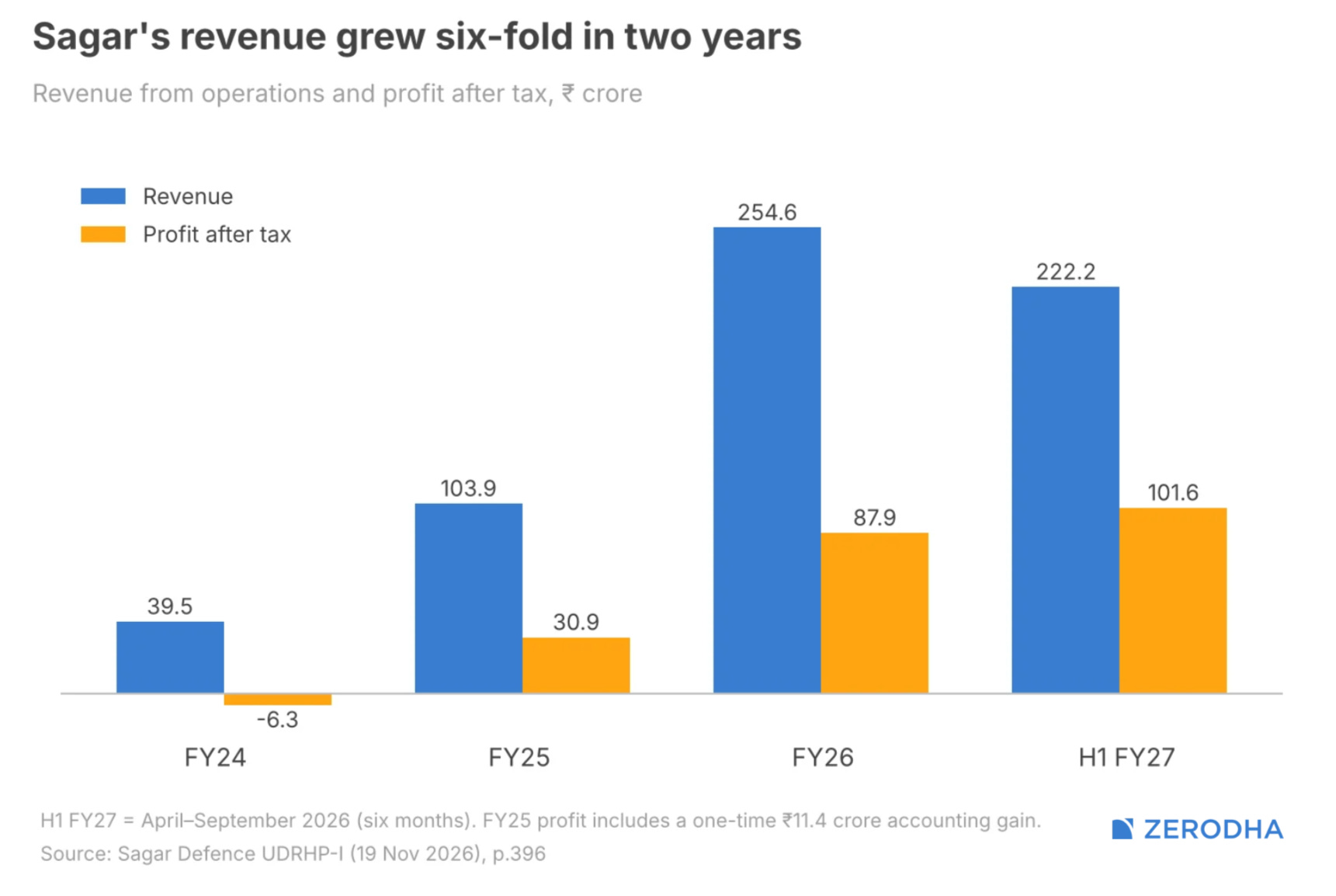
However, there are two important considerations regarding Sagar’s profit. First, about a quarter of Sagar’s FY25 pre-tax profit had little to do with its defence business. Sagar had previously raised money from investors through preference shares and debentures. When it bought some of these back or converted them into regular shares, their settlement value was lower than what Sagar had originally recorded on its books. The difference was counted as a one-time profit.
Secondly, in the first half of FY27, Sagar added about ₹13 crore worth of unsold products to its inventory. Under accounting rules, the cost of making these products is counted as an expense only when they are sold. So, while Sagar has already incurred these costs, they haven’t been deducted from its profits yet. This is normal accounting, but worth keeping in mind.
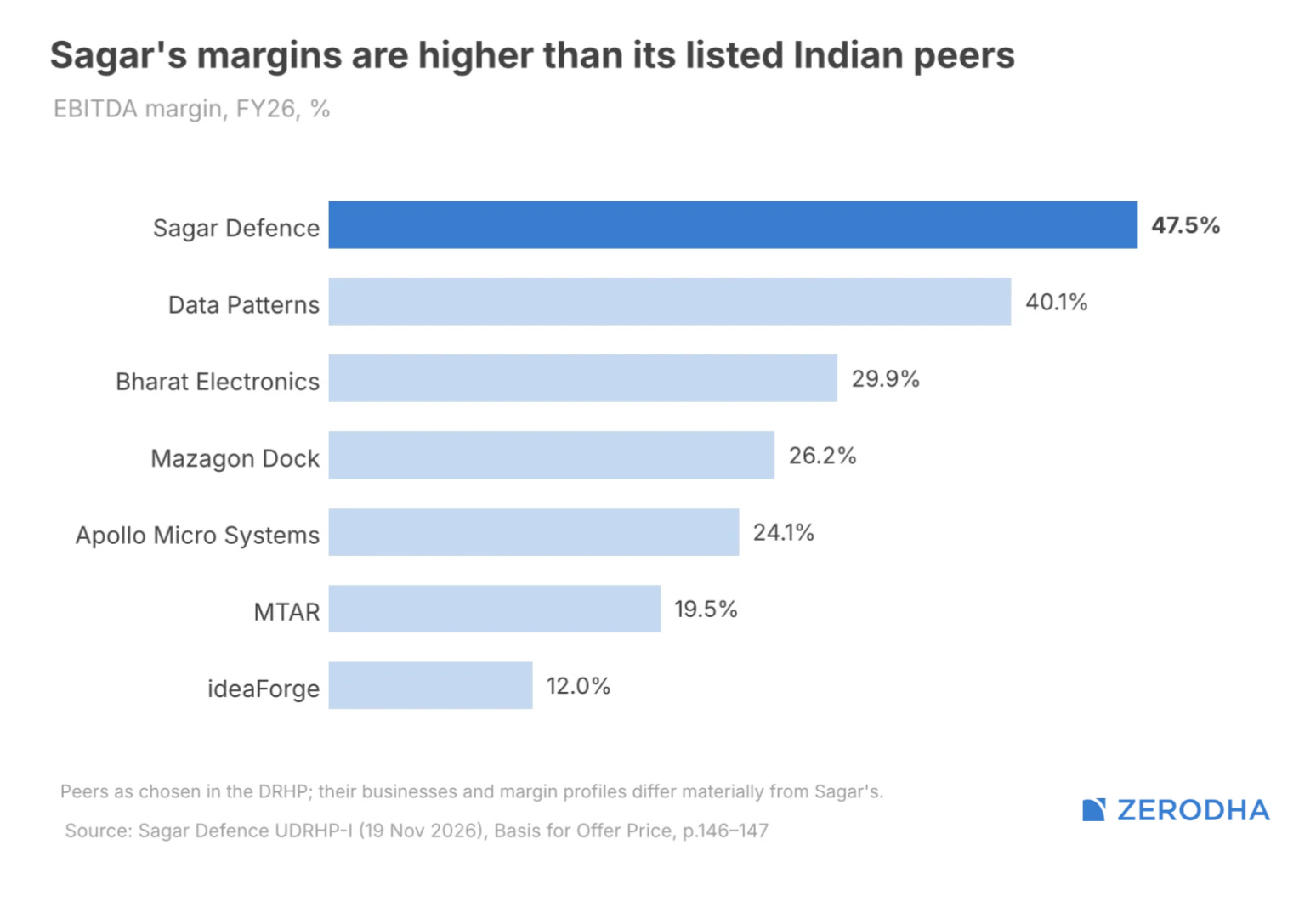
Even so, what stands out is its EBITDA margin compared to its peers. Sagar’s EBITDA margin was 47.5% in FY26, while Data Patterns was at 40%, Bharat Electronics at 30%, and ideaForge at 12%. These aren’t perfectly comparable, since they build different things, from warships to circuit boards, but are the six listed companies that Sagar itself identifies as peers in its DRHP.
There’s a flip side to these margins. Most of Sagar’s contracts are fixed-price, meaning the price is locked in when an order is signed, often years before delivery. If parts, labour or financing get costlier along the way, Sagar absorbs the difference.
Part of that EBITDA margin is attributed to two things. The first is GENISYS, the software, because the same software runs across its boats, drones and robots, Sagar says it hasn’t had to build the core technology from scratch for each new product. The second is scale: as revenue grew more than six-fold between FY24 and FY26, costs like salaries and overheads were spread over far more sales.
Materials are Sagar’s biggest cost, though, and how much they eat into revenue depends largely on what it delivers. Material costs fell from 58% of revenue in FY24 to 32% in FY25. Sagar says this was mainly because the platforms it shipped that year needed fewer materials, and counts GENISYS as a further contributor. In FY26, the ratio rose back to 38% as deliveries shifted towards more material-heavy platforms. Sagar itself cautions that this ratio will keep moving with the mix of what it delivers
The government as customer
Selling a full-stack defence platform is not easy, though. Before the armed forces of a country decide to purchase a new platform in large numbers, it has to go through several stages, from prototypes to trials at sea, which takes years, all of which is highly regulated and mediated.
Sagar’s entry into this ecosystem came through iDEX, a defence ministry programme where start-ups are invited to solve defence problems. One such problem the Navy put forward was Autonomous Boat Swarms, which Sagar won. Some of Sagar’s other products are still going through this process.
This also means that Sagar’s biggest customer, one way or another, is the government. And while that ensures steady demand for Sagar, it also impacts its selling operations in a way like no other feature of the business does.
You see, it’s only natural for the defence industry to be characterised by a long gap between delivering a product and receiving payment for it. So, while a company may have already recorded revenue and earned a profit on paper, it waits for cash to come in.
That has much to do with the fact that government units are the primary buyers. We also saw this in our story on India’s capital goods sector, where the biggest customers are government enterprises and state-owned thermal power plants.
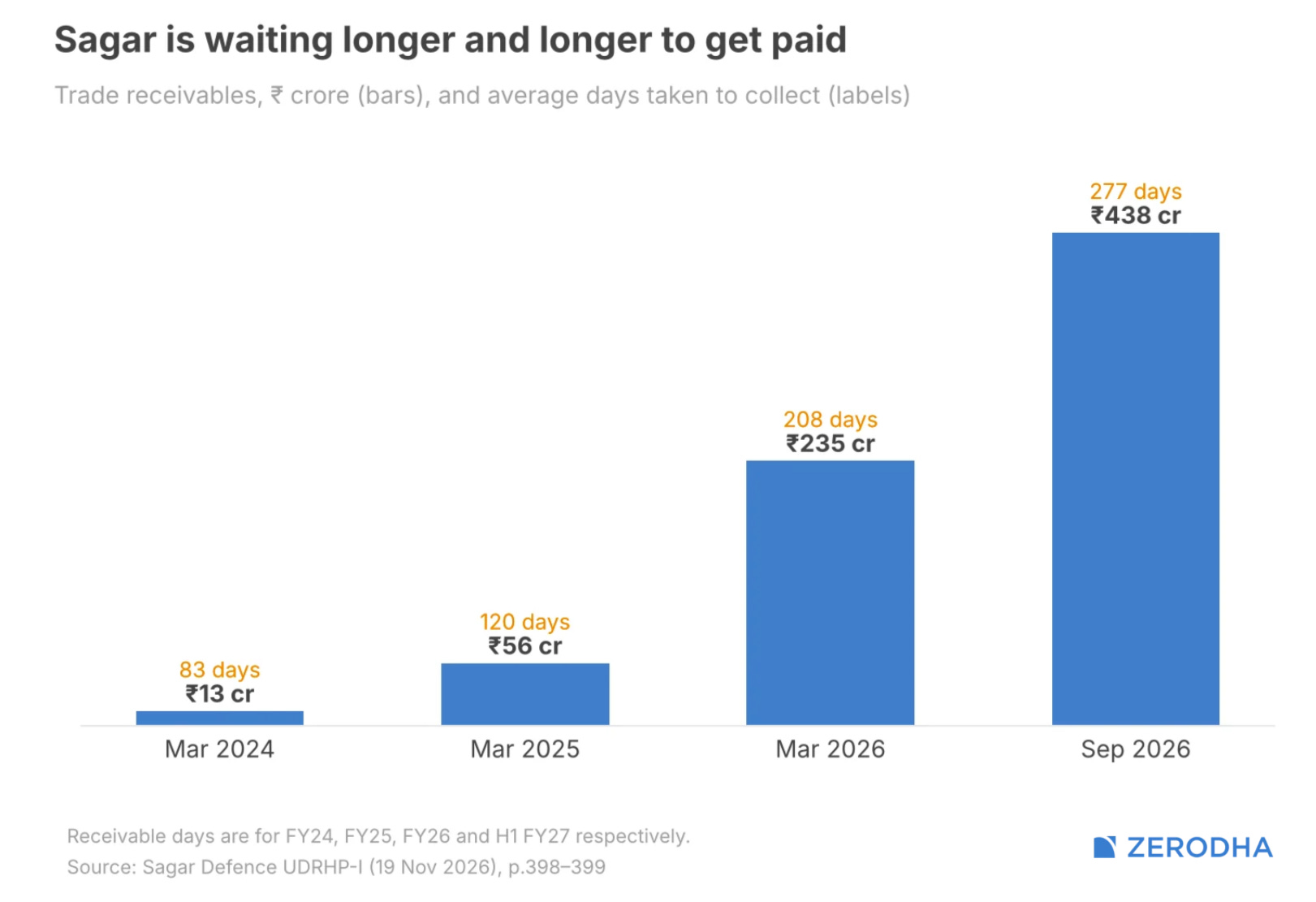
Sagar typically builds first, then goes through the arduous government testing process before it receives payment. Meanwhile, the money it is owed piles up. Sagar’s receivables went from ₹13 crore in March 2024 to ₹235 crore in March 2026, and ₹438 crore by September 2026. On average, it now waits 277 days to be paid, up from 83 days in FY24.
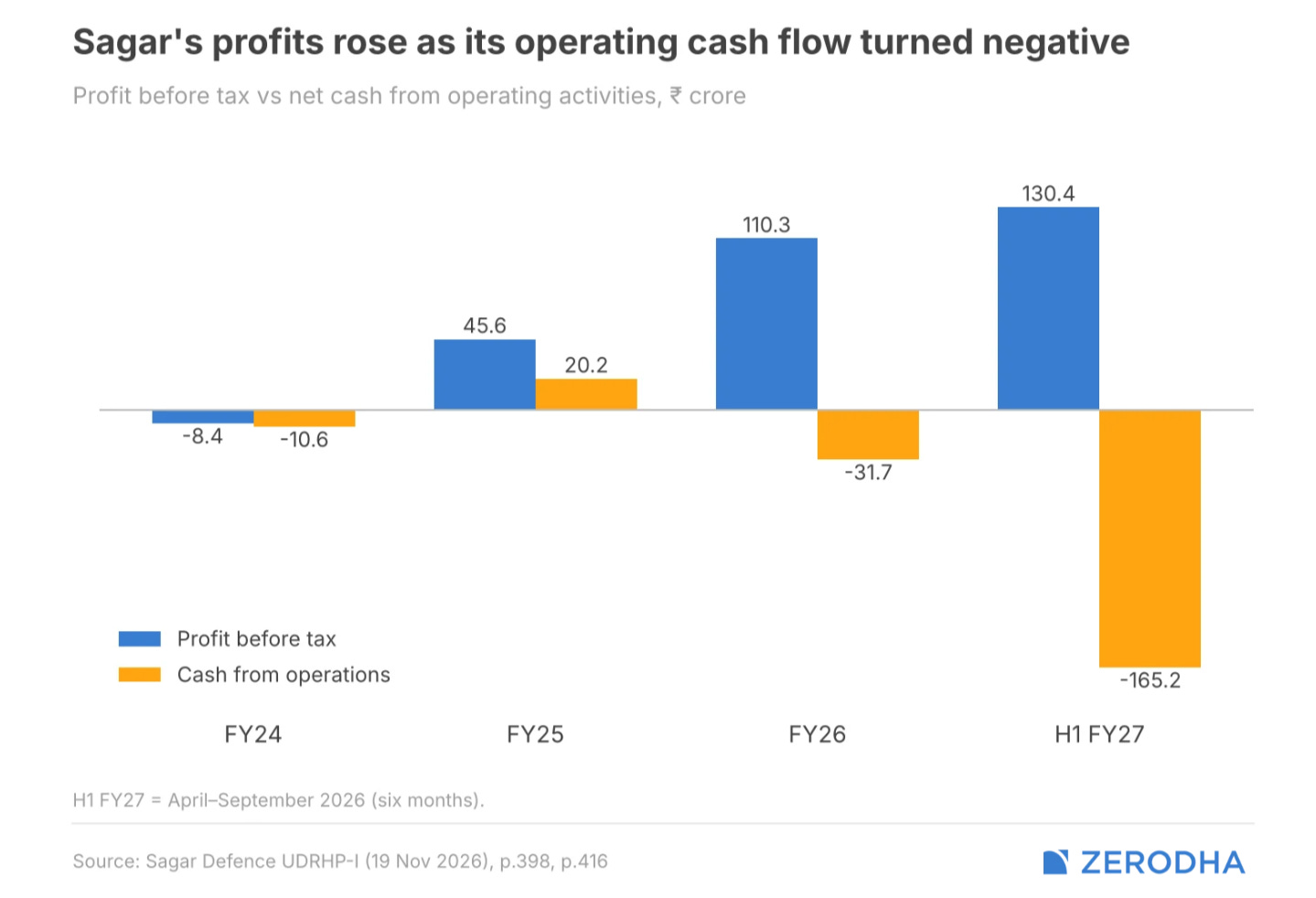
That also means that Sagar’s cash position has run in a direction opposite to its profits. Low liquidity especially as its operating cash flow turned negative again in FY26, and fell to –₹165 crore in the first half of FY27. While Sagar managed a cash conversion cycle of 96 days in FY26, the gap between paying suppliers and collecting cash blew out to 201 days in the first half of FY27 as unpaid government invoices mounted.
To fill its liquidity needs, Sagar naturally borrowed. Its short-term borrowings rose from ₹35 crore in March to ₹163 crore in September, and it drew down ₹94 crore of cash it already had.
Who else builds these?
Now, what about Sagar’s competitors?
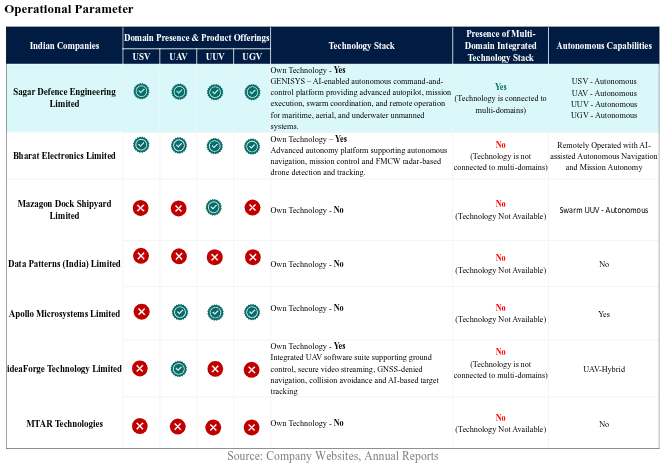
In each domain Sagar claims to build products in, it has company. In the air, there’s ideaForge and private makers like Garuda Aerospace and NewSpace. Underwater, Mazagon Dock builds autonomous vehicles, and Apollo Micro Systems won a Navy order in July 2026 to build an anti-submarine platform. The DRHP lists only one player that, like Sagar, makes all of these: Bharat Electronics, though mostly as a provider of radars and electronics rather than building autonomous vehicles in-house.
The size of each domain matters too. By CareEdge’s estimates, unmanned boats made up only 2-4% of India’s unmanned systems market in FY26. Of the ~$18 billion opportunity CareEdge maps over the next five years, ~$15 billion is in drones and over $1 billion in surface vessels. So, the product Sagar is best known for sits in the smallest slice, while the biggest slice is the most crowded.
Moreover, since government procurement takes so long, and depends crucially on public budgets, Indian defence buying comes in cycles even when demand exists. For instance, in emergency procurement, ideaForge’s CEO told investors there’s a ₹300 crore ceiling on what the forces can spend, the defence ministry took six months to place orders in the previous cycle, and then suppliers get 12 months to deliver.
Look at ideaForge itself to see how quickly this business swings between such cycles. In FY25, ideaForge’s revenue fell 48.6% and its EBITDA margin dropped from 27.4% to -19.6%, which its CEO partly blamed on the general elections and slow progress on government procurement.
Sagar flags a similar exposure: it says its results depend on the timing of approvals, tenders, trials, budget releases and contract awards. Which brings us to, what else could go wrong?
What could go wrong?
The DRHP lists several risks. The first is the one we started with, the concentration risk - The government made up 96.8% of FY26 revenue, and the top five customers 99.9%. Its order book fell from ₹1,108 crore in March to ₹890 crore in September.
The second is the Andhra campus we mentioned at the start, which is yet to start construction, and Sagar has never run a coastal facility. Of the ₹1,200 crore Sagar is raising for itself, the majority ₹725 crore will fund a manufacturing campus in the state. Sagar hasn’t signed definitive agreements for the equipment, though. Until the campus is ready, all its manufacturing stays in just two plants in Pune.
The third involves factories. Right now, Sagar doesn’t actually hold the leases to its two factories in Pune. The land is leased from the Maharashtra state industrial board by the founder’s father, who sublets it back to the company, and formal, registered sub-leases haven’t been signed yet. This isn’t unusual for family-owned business, but is a point to note.
Lastly, Sagar’s “fully indigenous“ pitch doesn’t wholly stand up to scrutiny. Its design and software are built in India, but many of the parts that go into its machines are imported, mainly from the US, UK, Japan, Germany and France. These include specialised electronics, sensors, batteries and propulsion components. And since all of Sagar’s contracts are fixed-price, any jump in the cost of those parts, or a weaker rupee, is Sagar’s to absorb.
Conclusion
That leaves anyone looking at this IPO with a few trade-offs: Sagar has done what the DRHP says takes years, moving the armed forces from trials to orders, and at high margins. But much of that profit is still on paper, sitting in receivables. And most of the new money goes to a shipyard to be constructed in Andhra Pradesh.
For the defence industry, and particularly Sagar, we’ll have to keep an eye out on how steadily the government orders keep coming in and how fast they turn into cash.

How Tata Steel plans to buy APL Apollo with APL Apollo’s money
Tata Steel plans to buy a big stake in one of its biggest customers, APL Apollo Tubes. But before it does that, Tata Steel will first sell two of its own businesses to APL Apollo.
Money moves in both directions, APL takes on a pile of debt, shares change hands, and APL’s founders exit. The pieces look unrelated, but net net, the whole thing is fairly simple.
So first, let’s work out what’s happening: who pays, who gets paid, and who ends up with what. Then we’ll try to read why both stocks fell so sharply on announcement day, APL Apollo by about 21% and Tata Steel by about 8%. Nobody can fully explain a stock’s move, but the market was clearly sending a signal.
Who pays, and who gets paid
There are four players: Tata Steel, the steelmaker; APL Apollo, the listed tube company; the Gupta family, APL’s founders; and SG Spectra, the Guptas’ private company. The deal has three legs, plus a side agreement.
First, APL Apollo buys two of Tata Steel‘s businesses: steel tubes, and Tata Steel Colors, which makes colour-coated steel, the painted sheets you see on factory roofs. APL already makes both, mostly tubes, so Tata was its competitor here. For Tata, these are downstream businesses. Upstream turns iron ore into steel while downstream turns that steel into finished products like pipes and roofing sheets.
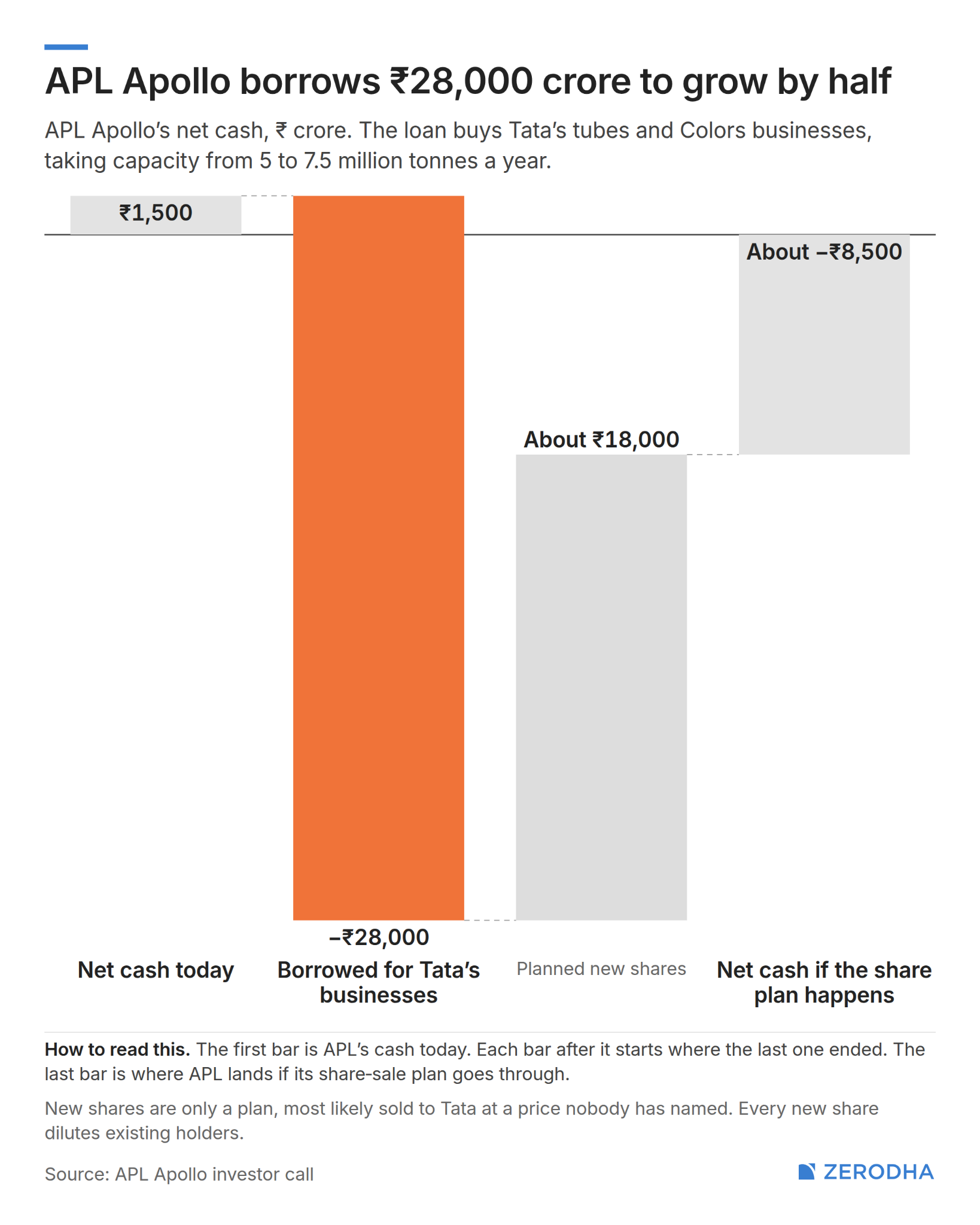
The deal is ₹28,000 crore, all of it borrowed. APL’s capacity will rise by 50%. But a company with roughly ₹1,500 crore of net cash will now carry about ₹28,000 crore of debt. About ₹18,000 crore of that is meant to be swapped for fresh equity within a year, most likely from Tata. But nobody knows at what price this fresh equity will be issued. If Tata buys those shares cheaply, its stake rises and everyone else’s shrinks.
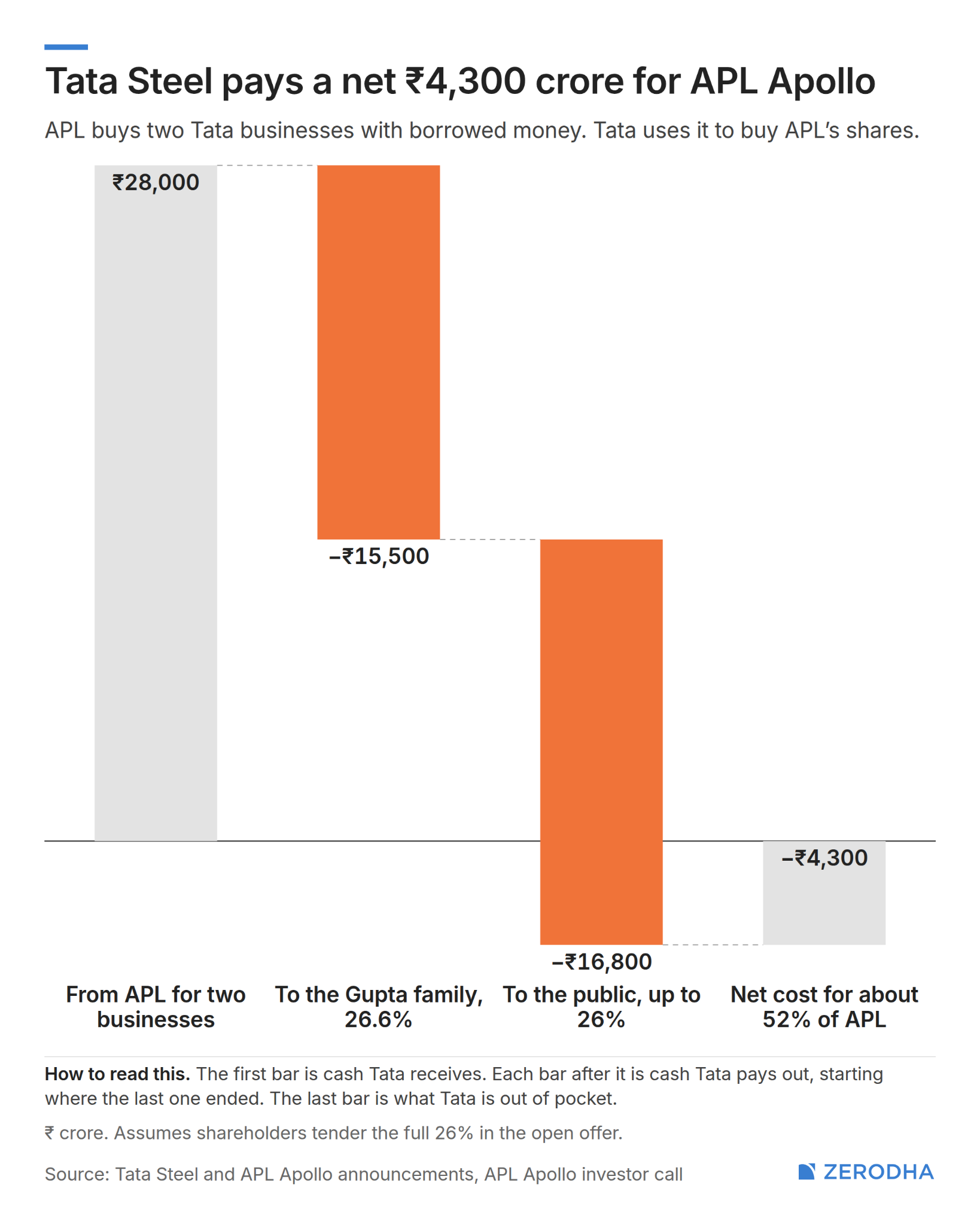
Second, Tata Steel buys the Gupta family’s entire stake at ₹2,100 a share valued at about ₹15,500 crore.
That’s not it though for the Gupta family. Their private company, SG Spectra, becomes Tata’s exclusive contract manufacturer for colour-coated steel, meaning it makes the product to order for Tata to sell. It plans 5 million tonnes of yearly capacity and Sanjay Gupta says he’ll put all his post-tax proceeds from the Tata-APL deal into it.
Third, Tata’s stake would cross 25%, and under SEBI’s takeover rules, that triggers an open offer. This is an offer to buy shares from the public at a set price, so small shareholders have the option to exit when ownership changes. Tata will offer ₹2,301 a share, about 10% more than the Guptas get, for another 26% of APL. But the public owns about 72%, so if everyone tenders, only about 1 in 3 shares gets bought. The rest stay in a far more indebted company.
Net it out, and Tata pays about ₹32,300 crore (₹15,500 crore to the Guptas, up to ₹16,800 crore to the public) but gets ₹28,000 crore back from APL. So for about ₹4,300 crore of its own money, it could own about 52% of a 7.5-million-tonne company. In return, it gives up full ownership of two businesses, and APL’s new debt lands on Tata’s books too.
Now that we have some clarity on what’s happening, we can ask why both companies want this, and who might lose out.
Why Tata Steel wants this, and why it might not
Tata’s core argument is simple. Upstream steel grows by building plants; downstream grows by building brands and distribution, which takes years. As CEO T V Narendran put it, “anyone can build a pipe plant.” APL comes with the market ready-made.
Tata also needs the margin. Its Indian business has earned about ₹14,000–15,000 of operating profit per tonne of steel over the past decade, but that’s under threat. After 2030 its captive iron ore mines come up for auction and ore costs would rise. If downstream business is done well, it adds a steadier layer of margin on top. Here, honestly, Tata is late. JSW’s coated steel arm already has about 2.8 million tonnes of colour-coated capacity, more than three times what Tata currently had, and Jindal Steel has just launched its own coated brand.
There’s also an arbitrage. Tata is selling its businesses at about 25 times their expected yearly operating profit, or EBITDA, while Tata Steel itself trades at 6–7 times. Its presentation calls this “unlocking value.” But APL’s other shareholders fund part of that price through APL’s new debt, and Tata funds part of it through its planned equity infusion. On top of that, Tata pays a similar multiple to buy its stake in APL. So selling its businesses at a high valuation doesn’t help much when it buys back in at a similar one.
The case against? Tata had planned to grow these businesses itself, including more than doubling its tubes capacity. Now they’d sit in a company it owns only about half of. That makes everyone think, is Tata giving up profitable downstream businesses for cash today?
Then there’s the obvious debt. Tata’s consolidated net debt would rise from about ₹91,000 crore in September to roughly ₹1.2 lakh crore, and Tata itself says the deal won’t add to its earnings per share for about three years. One analyst on its call showed why: Tata takes on about ₹27,000 crore of extra debt for only about ₹1,000 crore of extra yearly operating profit, and the interest alone would eat more than that. Management called the maths simplistic, arguing APL’s profits will grow fast. For now, that’s a promise.
Why APL wants this, and why it might not
For a tube maker, the biggest headache is steel: it eats about 80% of APL’s revenue, and its price swings constantly. Management argues steadier supply from Tata would lift APL’s plants from about 70–75% of capacity. That’s not obvious, since APL already buys from several mills and Tata says it will keep buying elsewhere when that’s cheaper.
Competition is heating up too, including from Tata itself. As Gupta put it on the call, “I cannot fight this battle alone.” With Tata behind it, APL has a better shot at its goal of ₹10,000 crore in yearly operating profit, over five times what it made last year.
But look at the price. APL is paying about 25 times EBITDA for Tata’s businesses, roughly what APL itself traded at before the deal. In other words, it’s paying its own premium valuation for someone else’s assets. The market has since cut APL’s valuation to about 18 times.
And then there’s the interest bill. Assuming 10% interest on ₹28,000 crore of borrowing, it would cost about ₹2,800 crore a year, according to estimates. This is honestly more than the operating profit APL made last year. So everything hinges on the ₹18,000 crore equity infusion, whose terms are unknown.
So, who got the raw deal?
Start with APL’s minority shareholders, because they’re the ones with the most questions.
Can a promoter commit his company to a ₹28,000 crore acquisition while selling every share he owns? One fund manager asked exactly that. An exiting promoter has no stake in what comes next, so the deal he signs doesn’t have to work for those who stay. And the legs aren’t linked. APL’s management confirmed that even if minority shareholders vote down the purchase of Tata’s businesses, the promoter sale and the open offer still go ahead.
Then there’s the timing. APL agreed to buy Tata’s businesses on a Sunday, when Tata was still an outsider. Tata agreed to buy the Gupta stake the next morning. Why does the order matter? If Tata had become APL’s owner first, this would have been a deal with APL’s own promoter, and SEBI’s rules would let only independent shareholders vote on it. As it stands, the Guptas, who still hold about 17%, can vote too, which makes approval more likely. J N Gupta, a former SEBI executive director, says APL’s independent directors approved the purchase without knowing the owner was about to change. Proxy adviser InGovern wants SEBI to judge the whole thing as one deal.
For APL’s minority shareholders, then, the complaint is fairness. One global fund manager called the deal’s “circular financing” “highly abusive of minorities.” Tata Steel‘s shareholders worry about something else. If Tata’s net outlay is so small, why did its stock fall about 10% in two sessions? Because to them, Tata is taking on a lot of debt for very little extra profit. As The Ken noted, that revives memories of Corus, the expensive European acquisition that weighed on Tata Steel for years.
Was there a better way for Tata to expand? Maybe grow these businesses organically as Tata had planned, list them separately, or swap them for APL shares with no new debt. Tata’s answer seems like speed. Building a market and a brand takes years; buying into APL gets it there on day one. Whether that speed is worth the debt is exactly what its shareholders are asking.
Tata Steel now says it is open to reworking the structure, and SEBI is reportedly taking a closer look. Until then, the answer to “who got the raw deal” depends on how the slum sale vote goes.
- This edition of the newsletter was written by Zarieus & Kashish.
Tidbits:
1. India’s electronics exports expected to cross $60 billion in FY27
India’s electronics exports are expected to cross $60 billion in FY27, up from $48 billion last year, according to a senior government official. Exports reached $38.4 billion in the first seven months, including $20 billion from mobile phones and about $18 billion from other electronics.
Source: Business Standard
2. PhonePe restarts IPO plans, eyes up to $15 billion valuation
Walmart-backed PhonePe has resumed plans for its stock market listing, targeting a valuation of $12 billion to $15 billion in early 2027. The company aims to raise $1.2 billion to $1.5 billion through the sale of existing investors’ shares and is expected to file updated papers with SEBI within 30 to 45 days, according to Reuters.
Source: Reuters
3. Jindal Steel plans ₹15,000 crore investment by 2035
Jindal Steel plans to invest ₹15,000 crore in its plants in Odisha and Chhattisgarh by 2035. The company aims to increase its annual steelmaking capacity from 15.5 million tonnes to 20 million tonnes, using its own earnings rather than new bank loans. It has also launched a range of coated steel products for construction and warehouses.
Source: Business Standard
4. Government extends duty-free raw sugar imports until March 2027
The government has extended the deadline to import up to 10 lakh tonnes of raw sugar without paying import duty from December 31, 2026, to March 31, 2027. Sugar mills now have until September 30, 2027, to process the imported sugar and sell it in India. The move aims to keep sugar supplies steady and control prices.
Source: DGFT Notification
5. Cabinet approves around ₹4,300 crore container terminal at Kamarajar Port
The Union Cabinet has approved around ₹4,300 crore second container terminal at Kamarajar Port in Tamil Nadu. The project will be built in two phases and add capacity to handle 2 million containers a year, measured in standard 20-foot units. It will also allow the port to handle larger ships and support growing trade from southern India.
Source: PIB
Want more tidbits? Catch up on last week’s recap!

Beyond Today’s Brief
There’s always more happening at Markets by Zerodha.
The Chatter: Why is the RBI urging Primary Dealers to boost liquidity across off-the-run bonds as insurers shift toward equities, while SEBI pilots tokenised corporate bonds under Demat 2.0? And what do both sides of the ₹28,000 crore Tata Steel–APL Apollo Tubes deal, Siemens’ industrial AI rollout, Jupiter Wagons’ high-speed rail JV, PGInvIT’s ₹16,000 crore debt headroom, and Dhoot Transmission’s EV ramp-up tell us about corporate India’s next capex cycle?
Aftermarket Report: How did Nifty edge higher to close at 25,884 as Asian markets rebounded on hopes that US tariffs may prove milder than feared? And what does the divergence between gains in IT and realty versus weakness in consumer stocks and banks signal for the market's near-term direction?
Join us on WhatsApp, where we share interesting soundbites from concalls, articles, and everything else we come across throughout the day. You’ll also get notified the moment a new video or article drops so that you can read or watch it right away.
Thank you for reading. Do share this with your friends and make them as smart as you are 😉


