

Our goal with The Daily Brief is to simplify the biggest stories in the Indian markets and help you understand what they mean. We won’t just tell you what happened; we’ll tell you why and how too. We do this show in both formats: video and audio. This piece curates the stories that we talk about.
You can listen to the podcast on Spotify, Apple Podcasts, or wherever you get your podcasts and watch the videos on YouTube. You can also watch The Daily Brief in Hindi.
In today’s edition of The Daily Brief:
The split personalities of Indian FMCG
Why are India’s consumer goods giants caught between shrinkflation and premiumization? After years of flat volumes masked by subtle packet-size reductions, FMCG majors like HUL, Marico, and Britannia are finally seeing a volume-led recovery. However, this growth is split down the middle: rural demand is being propped up by higher government MSPs and disinflation rather than real wage growth, while urban growth is powered by affluent consumers splurging on premium products via quick commerce. With raw material and packaging costs rising again due to oil volatility, companies are walking a tightrope to maintain margins ahead of the festive season.
How are NPAs in India so low?
How did Indian commercial banks drive net bad loans down from a peak of 6.0% in 2018 to a two-decade low of 0.4% today? While a doubling loan book helped the ratio, the decline was primarily powered by aggressive provisioning, with banks raising their coverage ratio from 48% to over 76%. At the same time, fresh bad loan additions halved, and banks cleared ₹27.8 lakh crore in old NPAs through recoveries, upgrades, and write-offs. While the massive corporate debt cleanup of the last decade is now complete, early stress in retail and microfinance serves as a reminder that low NPAs reflect a completed credit cycle rather than its end.
In the latest episode of Subtext, we host Dr Rohit Chandra (Assistant Professor at IIT-Delhi’s School of Public Policy) to give us a history of India’s power sector and the role of coal in it. The podcast uses coal (and broadly energy) as the centrepiece to talk about various episodes in the history of the Indian economy: the 2010s NPA crisis, how India’s biggest PSUs work, our Cold War strategy, ministerial turf wars within the Indian government, and vertical integration.

You can watch the full episode on YouTube, or listen to it on Spotify and Apple Podcasts.
The split personalities of Indian FMCG
For quite some time, the big consumer goods giants of India have been navigating a tricky landscape.
For one, that pack of biscuits or chips, or even the bottle of skincare lotion you buy, might have been feeling a little lighter by weight while being the same price. It’s also possible that prices of these items have increased slightly. They’ve been playing a game of see-saw of value and volume to protect profits.
At the same time, the companies making these daily essentials are now promoting a lot of high-end products, like protein snacks, face serums, and so on. That’s in line with the trend of premiumization that we’ve been talking about on The Daily Brief for so long, and much of it has been driven by urban consumers rather than rural ones.
Meanwhile, raw material costs have spiked due to a historic oil crisis, creating an urgency for the industry to find new growth drivers as soon as possible.
These sound like disparate images, but they’re really part of one cohesive story, for which we’ll be looking at the latest quarterly earnings calls of 4 FMCG companies: HUL, Marico, Britannia and Nestle India.
The volume-value see-saw
For a long time, FMCG earnings reports looked great on paper, but that wasn’t necessarily because they sold more. The sales of soap bars, packets of tea, or bags of chips have been fairly flat, and in some cases, even falling.
Which only means one thing: revenues went up because of a price effect. That could mean a price hike, but mostly, FMCG firms pursued another strategy: shrinkflation. Instead of raising prices outright, companies quietly trimmed a few grams off a package while keeping the price at a familiar ₹10 or ₹20. Companies do this knowing that it might hurt volumes.
Obviously, there is a limit to how small a biscuit packet can get before consumers notice and start looking for alternatives. This is where companies diverged this quarter.
Marico, for instance, chose not to implement any additional grammage reductions on its flagship Parachute Coconut Oil. Instead, management attributed the brand’s resurgence to adjusting prices downward on its larger family “loyalty packs”. Marico saw some of their fastest quarterly growth in a while, and also why it recorded its highest profit growth in the past 7 years.

But Marico was an outlier. Many companies committed to more shrinkflation or even price increases. Britannia, for instance, openly admitted to still trimming packet sizes. HUL, meanwhile, actively implemented price hikes this quarter, while also signalling future hikes are possible. This was primarily done to offset cumulative palm oil and packaging inflation, which we’ll eventually talk about.
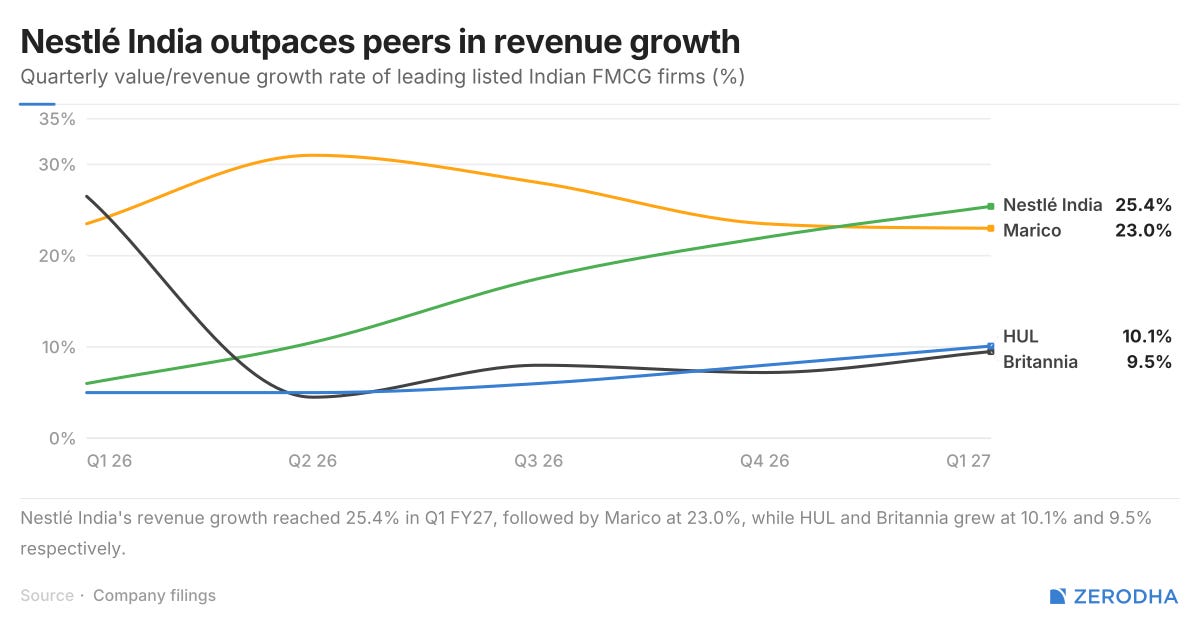
Yet, despite that, these companies also benefited from very strong volume growth. Britannia saw sales volumes recover, while HUL enjoyed price and volume growth equally, contributing to what is their best growth period in 13 quarters. There are clear signs that volume growth seems to have returned across the board.

With the festive season approaching, FMCG firms expect to drive even higher volumes. Which is why they have stepped up their ad spending at a blistering pace. Nestlé India, for instance, hiked its ad spend by over 40%, while HUL spent over ₹1,657 crore on brand building in a single quarter.
A comeback for rural growth?
To see where this actual volume growth is coming from, you have to look at two very different parts of the Indian economy: small rural kirana stores and 10-minute delivery apps in cities.
Let’s start with the former.
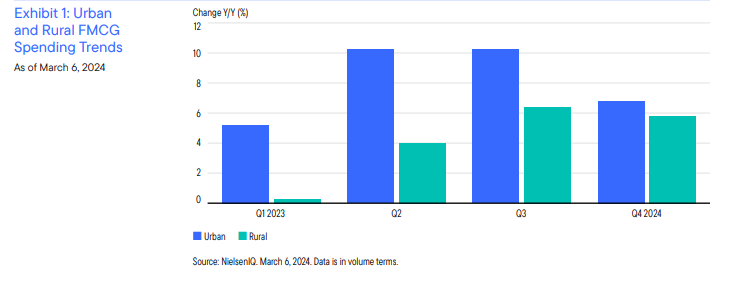
Between 2021 and 2023, rural sales were sluggish as village households dealt with high food inflation and unpredictable monsoon seasons. But recently, rural India seems to have staged a comeback, as FMCG rural volumes seem to be outpacing, or at least matching, that of urban areas.
So, what made rural demand come back?
The well-known explanation is disinflation. A drop in general food inflation means rural families, who spend a massive chunk of their budgets on daily food, should have more disposable cash left over.
However, beyond this disinflation, real rural wages have not meaningfully increased over the past 2 years, and FMCG firms themselves are among the first to admit that.
What that means is farmers didn’t earn more from what they produced. Either crop output remained muted, or even if it rose, farmers couldn’t earn more from it. In essence, farm productivity hasn’t improved, and agriculture hasn’t moved the needle much. So if inflation trends, which can be fickle, reverse, rural growth goes back to square one again. We covered this trend last year.
So if wages were flat and the harvest itself only grew modestly, what actually put more money in rural pockets this cycle? Well, that answer came from HUL itself: the government raised the Minimum Support Price on crops by around 5-6% this cycle.
Yet again, though, that’s a temporary price effect meant to support farmers through a rough El Nino season. It is not a structural volume effect. If MSP increases tone down in the future, or don’t keep pace with any renewed inflation, the rural income cushion that’s currently propping up FMCG volumes could disappear.
As a result, the network of kirana stores that forms the backbone of rural retail (also known as Traditional General Trade) is bustling again. HUL’s traditional trade channels are back in positive territory, while Nestlé India confirmed that its volume growth was led primarily by rural markets. Marico saw double-digit volume growth in general trade thanks to its rural expansion push.
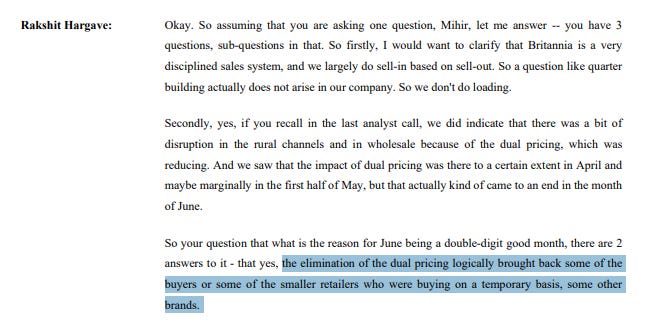
Part of this rural growth came from companies fixing their own internal glitches. Britannia’s General Trade grew 1.5 times faster than its rate for the entire previous year. But that was largely unlocked after the company completely eliminated something called dual-pricing. This “dual pricing” here isn’t about charging the consumer two different MRPs, but is rather a glitch on the B2B side of things.

Sometimes, companies offer steeper discounts or older inventory to massive, unorganized wholesale markets. This creates a “dual pricing” effect, meaning a box of biscuits is suddenly cheaper in the wholesale market than it is coming directly from the company’s official rural distributor.
Since rural kirana owners operate on razor-thin margins, they’d rather buy that box for ₹92 at the wholesale market than from the official distributor trying to sell it for ₹95. But that, in turn, fills up the distributors’ warehouses with unsold stock. As a result, they stop placing new orders with the FMCG firm whose official “rural volume growth” then plummets.
This dual-pricing issue had previously disrupted wholesale channels in April and May, but its elimination brought unorganized retailers back in droves in June, allowing Britannia to exit the quarter with mid-teen sales growth.
A K-shaped hole
Meanwhile, urban cities are seeing a massive shift toward quick commerce and premium products.
India has been seeing what is often described as a K-shaped consumption boom. Here, the upper-income bracket (the top arm of the ‘K’) sees surging wealth and spends aggressively on premium goods and lifestyle upgrades. Meanwhile, the lower- and middle-income segments face stagnant incomes, forcing them to tighten their belts.
This divergence is visible across sectors. For instance, as per Franklin Templeton, sales of premium TVs and high-value autos have surged by 18% and 28% respectively, while mass-market appliances and lower-value autos have seen volume declines.
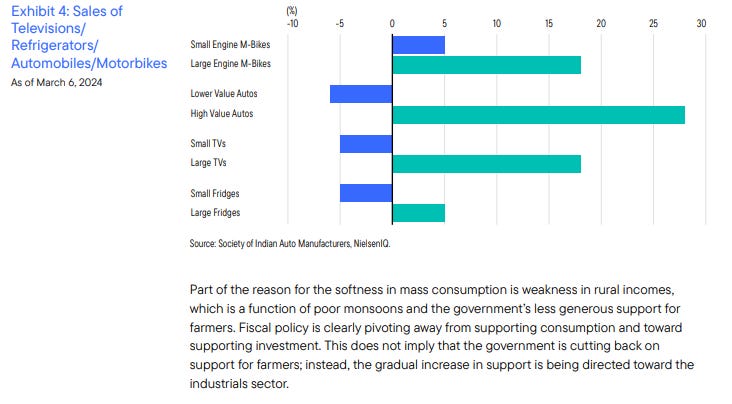
Consumer companies are leaning heavily into the top-half of the K by expanding their premium and health-focused lineups. For example, HUL saw rapid double-digit growth in premium body washes and skincare brands like Simple, Pond’s, and Vaseline Gluta-Hya. Britannia’s premium croissant business grew over 30%, doubling its run-rate to roughly ₹200 crore with profit margins that match its core business. Meanwhile, Nestlé India reported that its premium NESCAFÉ coffee variants recorded double-digit, volume-led growth.
Much of this urban growth is now being driven by quick commerce. HUL’s sales on quick commerce apps are growing between 40% and 50% year-on-year, while Marico saw a 50% jump in e-commerce revenue primarily due to q-com.
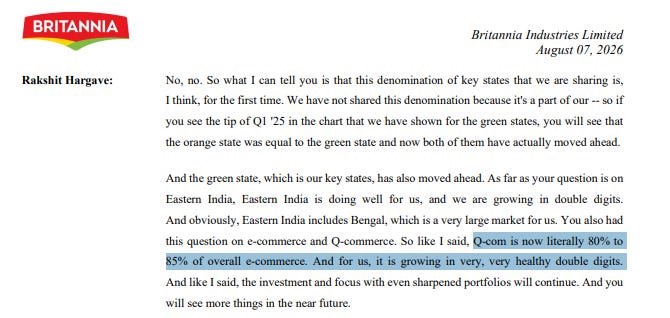
Britannia revealed an even more striking stat: quick commerce now makes up an overwhelming 80% to 85% of its total e-commerce sales. This shift has forced companies to overhaul their supply chains.
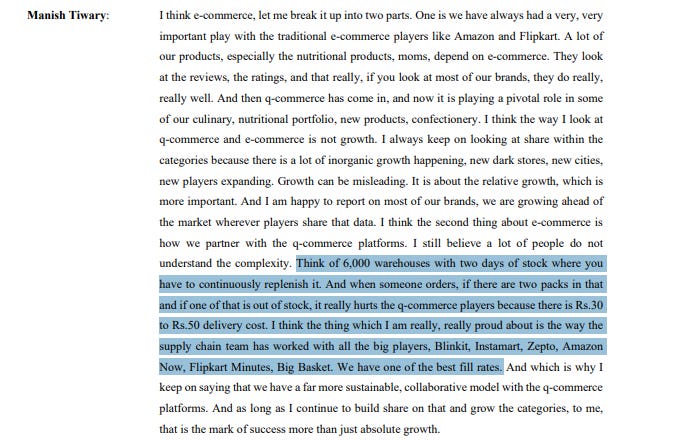
Meanwhile, Nestlé India pointed out that because quick commerce dark stores operate with just two days of physical inventory, suppliers have to deliver with near-perfect reliability to keep products on those digital shelves.
While q-com is exploding, it still only accounts for a small fraction of total revenue. Legacy premium upgrades like Pond’s or Vaseline are growing across all traditional and modern retail channels. However, Quick Commerce punches way above its weight in the premium category. With their short inventory model, dark stores have extremely limited shelf space, so they’d much rather prioritize stocking high-margin, premium items (like a ₹400 face serum) over giant, low-margin sacks of basic staples.
As a result, while legacy brands sell everywhere, “digital-first“ premium brands rely heavily on these apps to reach affluent urban millennials. And many of the acquisitions made by legacy FMCG players are geared toward this strategy.
HUL in particular has been quite aggressive with its M&A strategy. Last year, it acquired digital-first skincare brand Minimalist. Then, earlier this year, it executed a complete buyout of plant-based nutrition brand OZiva. Similarly, Marico’s digital-first wellness portfolio, comprising brands like Plix, Beardo, and Cosmix, crossed a combined run-rate of ₹1,100+ crore, with Beardo notably delivering double-digit profitability through online channels.
Input Costs
FMCG companies are simultaneously dealing with a fresh wave of raw material inflation. Much of it is driven by the Strait of Hormuz disruption, which increased the price of crude oil and gas, which are key inputs in the manufacturing process. Plastics are also a by-product of crude oil, which means that packaging costs for these firms also spiked.
That being said, depending on the core products, the impact of raw material inflation differed across companies.
For Marico, global prices of copra — the kernel of a coconut that’s used to extract coconut oil — were discounted by 30-35%. Meanwhile, global energy and hydrocarbon cycles drove crude oil-linked polymers (HDPE) and Liquid Paraffin packaging inputs rising significantly. Ultimately, due to softer copra prices and a favourable portfolio mix, Marico saw a 30 basis point expansion in gross margins.
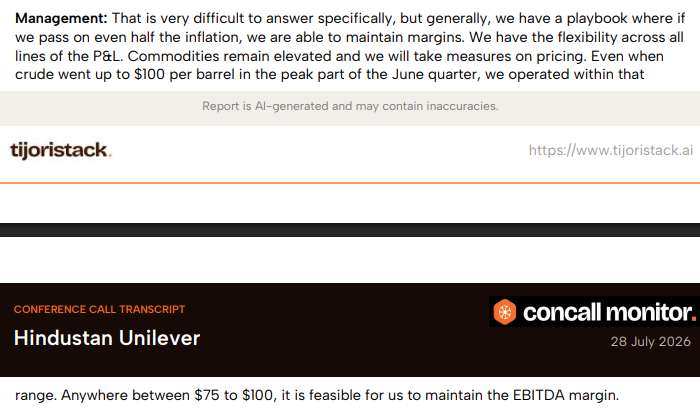
Britannia, conversely, faced severe margin pressure from refined palm oil rising and packaging laminates inflating. Crucially, a large part of its baking uses LPG and CNG, both of which “shot through the roof” in April and May. As a strategic hedge against gas volatility, Britannia leaned more on biomass. HUL followed a strategy of only passing on half of its cost increases in Q1 FY27, but didn’t rule out future measured pricing steps.
The Bottom Line
At the end of the day, the Indian consumer goods market is no longer a simple game of flooding kirana shelves with basic staples or relying on price-tag tricks. The rules of the game have fundamentally changed. To win today, FMCG giants must run a delicate, high-speed balancing act, capturing mass-volume demand from a recovering rural core, while simultaneously racing to deliver 10-minute convenience to urban consumers eager to splurge on everyday luxuries.
With this urgency to adapt to a new consumer landscape has come a massive wave of leadership reshuffling across HUL, Britannia, Dabur, Colgate, and so on. Companies are actively bringing in new executives and CEOs that may be best suited to navigating such a medley.
As the festive season approaches, the industry is hoping for a stronger period of demand. However, with input cost volatility persisting and US-Iran tensions only escalating, while an El Nino continues to threaten the year’s crop season, it will be difficult to say how bright the festivities might be.

India’s net NPAs are at a historic low, but why?
A chart by Zerodha Capital on Indian banks went viral recently.
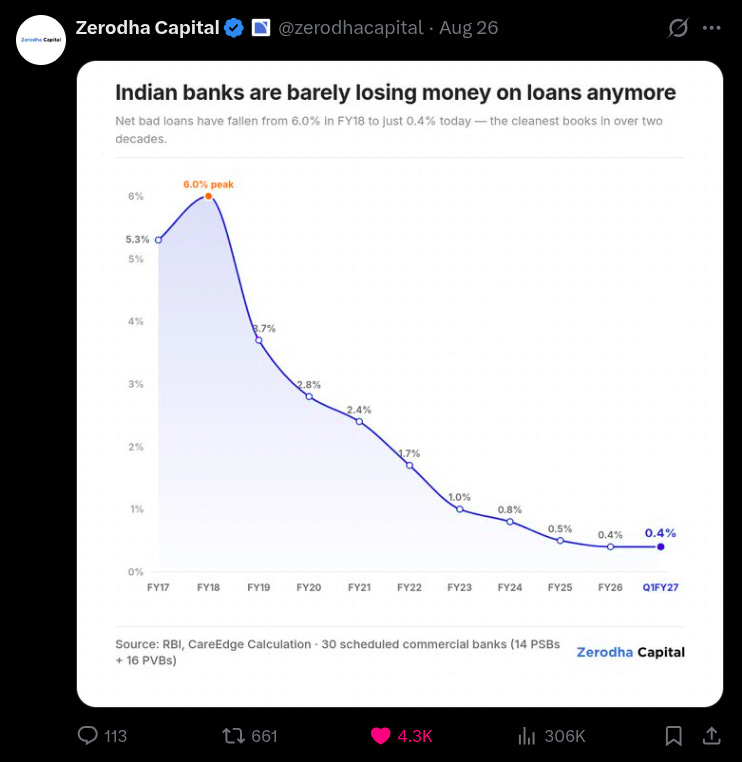
It showed the net NPA ratio falling from 6% in March 2018 to 0.4% in June 2026. CareEdge, whose calculations underlie the chart, says asset quality has now improved for 20 consecutive quarters.
This chart gives us a pretty good 30,000-foot view of what has happened to Indian banks over the last few years, but the line by itself does not tell us why this happened. And that matters, because FY18 was also an unusually bad starting point, coming after the RBI’s Asset Quality Review forced banks to recognise a lot of stress that had built up over the previous credit cycle.
So to understand how net NPAs went from 6% to 0.4%, we need to look at what changed underneath that line.
Start with the word “net”
The first clue sits in the metric itself. This chart is not showing gross NPAs. It is showing net NPAs — bad loans left on the books after banks have already set aside provisions against expected losses.
That distinction matters a lot here.
Gross NPAs tell us the total stock of loans classified as bad. Net NPAs tell us how much of that stock is still effectively uncovered after provisions and other permitted deductions.
And Indian banks have become much more aggressive about provisioning.
In March 2018, Indian banks’ provision coverage ratio was only 48.3%. In other words, they had provided for less than half of their gross bad loans. By March 2025, provision coverage had risen to 76.3%.
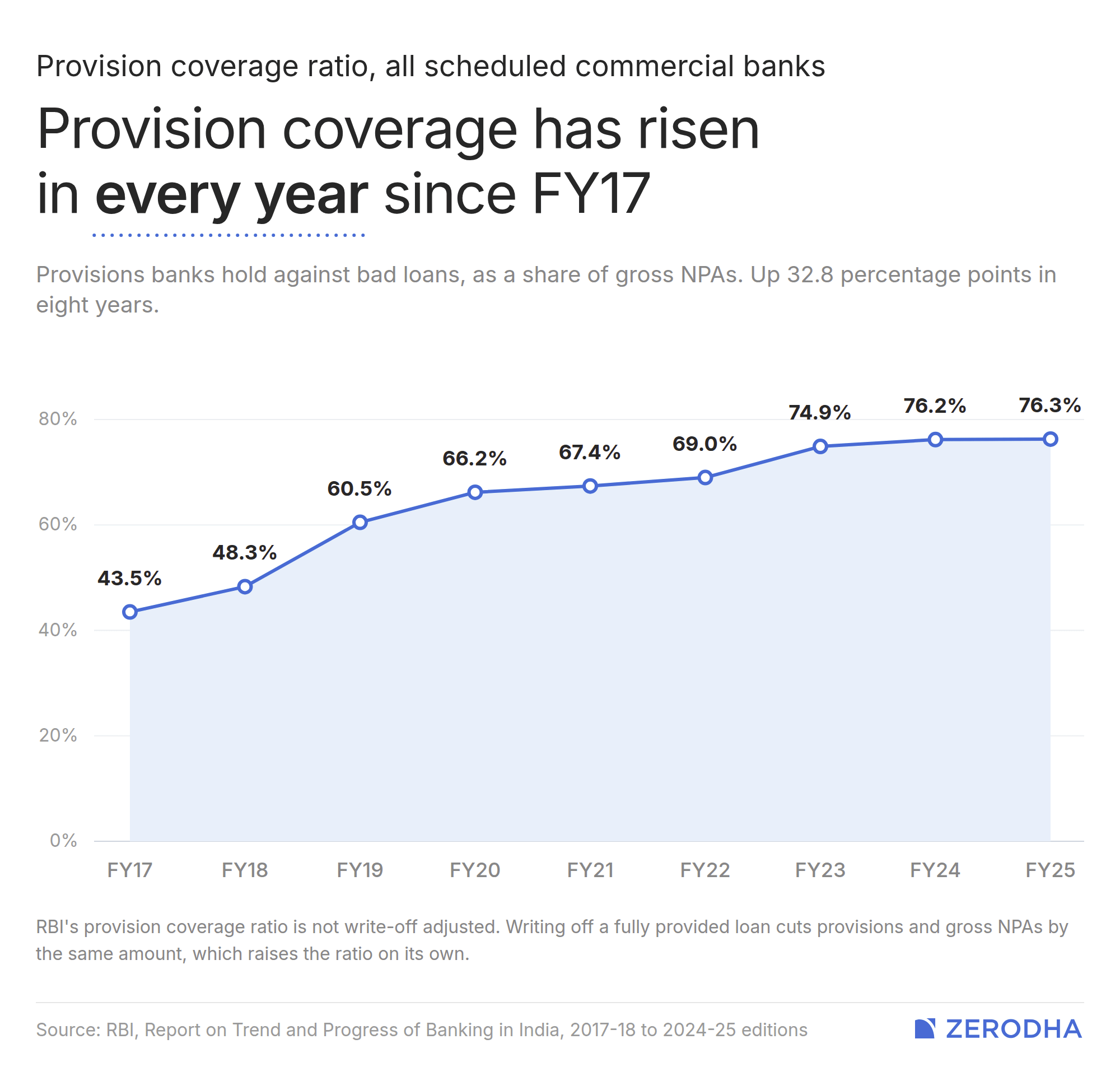
So even if the underlying bad loan did not disappear, a larger part of the expected loss had already been recognised and absorbed through the bank’s profits.
That alone pushes the net NPA ratio down. It is one big reason the chart looks as dramatic as it does.
But the improvement is not merely accounting
Higher provisioning explains part of the fall in net NPAs. But the underlying stock of bad loans also shrank sharply.
Scheduled commercial banks had ₹10.40 lakh crore of gross NPAs in March 2018. By March 2025, that had fallen to ₹4.32 lakh crore.
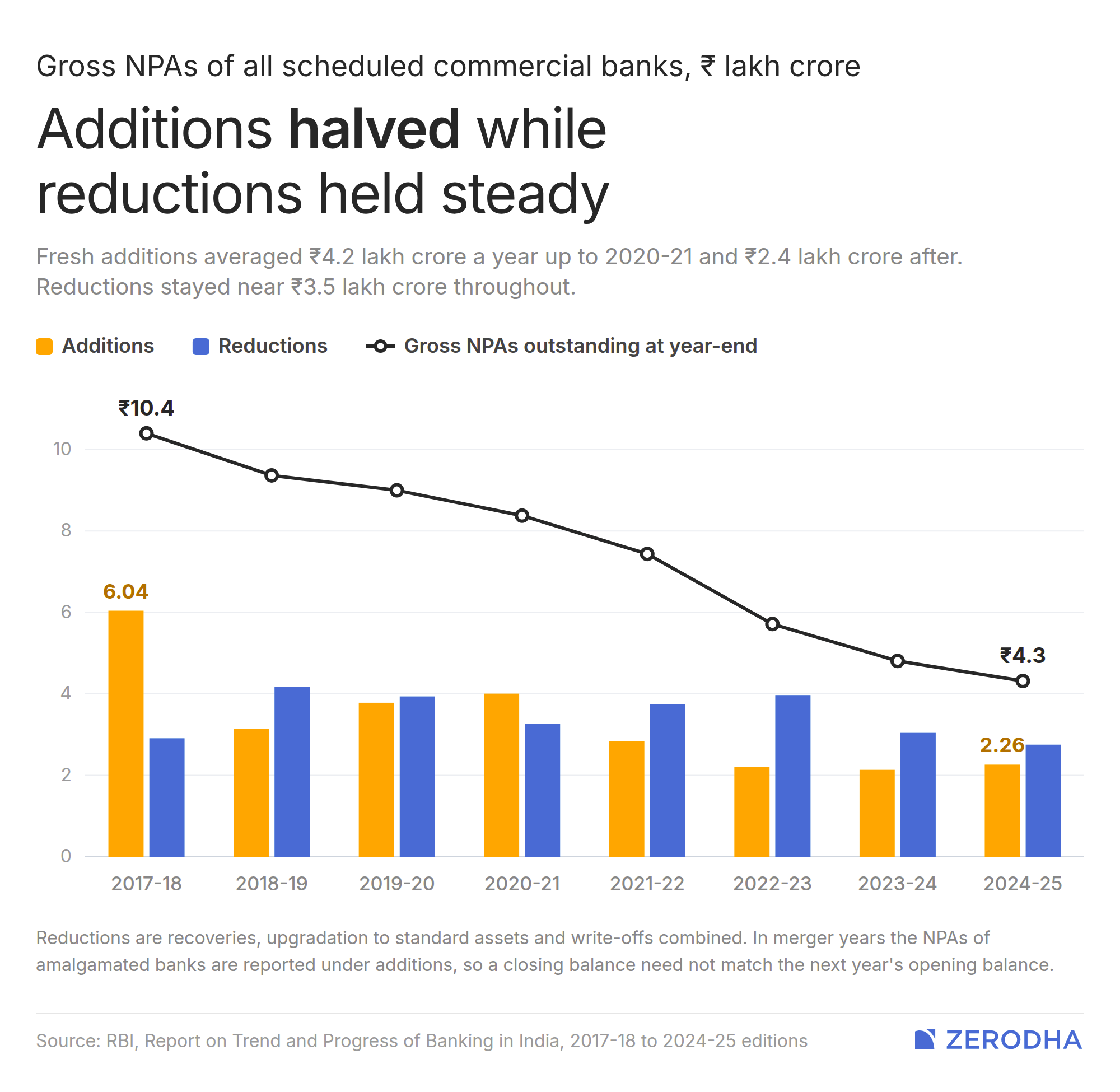
That can happen in two ways: fewer fresh loans turn bad, and old NPAs leave the pool through recoveries, upgrades or write-offs.
The first is probably the more important part of the story.
Banks added ₹6.04 lakh crore of fresh NPAs in FY18. By FY25, annual additions had fallen to ₹2.26 lakh crore, even though the overall loan book had become much larger.
A cleaner way to see this is through the It shows fresh NPAs added during the year as a share of the standard loan book at the start of the year. That ratio fell from 7.6% in FY18 to 1.4% in FY25, and further to 1.2% in FY26.
So this is not just old bad loans being provisioned away. Far fewer performing loans are turning bad in the first place.
The other side of the equation is how old NPAs leave the system.
In FY25, banks removed ₹2.75 lakh crore from the gross NPA pool. Of this, recoveries and upgrades accounted for 42.8% of the reduction. Write-offs made up the remaining 57.2%.
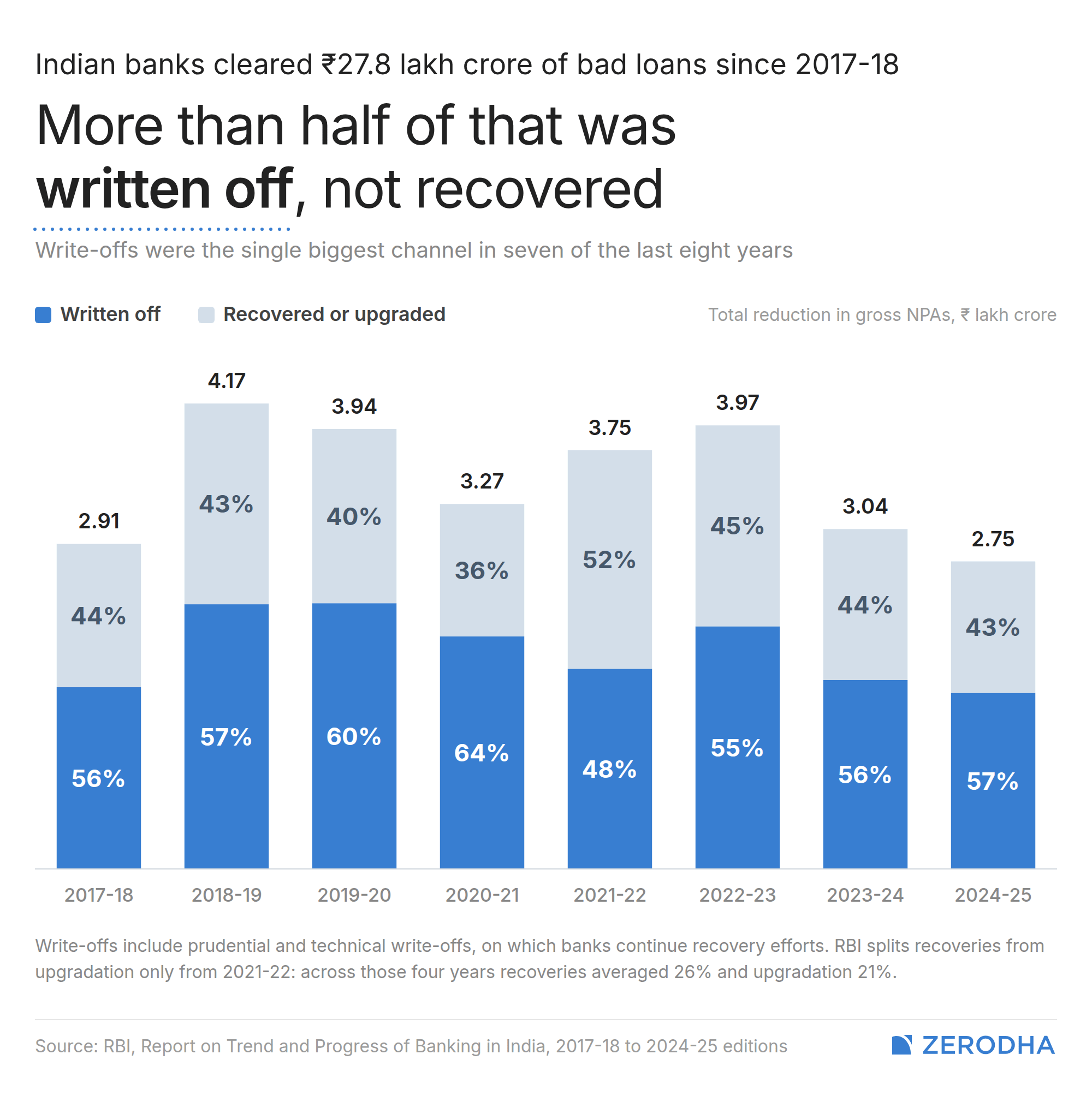
Recoveries are straightforward: the bank gets some money back, whether through direct collection, settlements, IBC, SARFAESI or other recovery routes. Upgrades are loans that stop being NPAs because the borrower clears the required dues and the account returns to standard.
Write-offs are different. The bank removes the loan from its reported balance sheet, but that does not necessarily mean the borrower is forgiven. The bank can still continue recovery efforts.
This matters because write-offs have been the single biggest route through which old NPAs have left banks’ books.
But they are not a separate explanation for the fall in net NPAs. By the time a loan is fully provided and then written off, most of the reduction in its net value has already happened through provisioning.
Put simply: provisioning brings down net NPAs. The eventual write-off cleans up gross NPAs.
The loan book also became twice as large
There is one more reason the ratio fell: the denominator got much bigger.
Gross advances of scheduled commercial banks rose from ₹92.66 lakh crore in March 2018 to ₹194.49 lakh crore in March 2025. So the loan book more than doubled in seven years.
That matters because even if net bad loans had stayed flat, spreading them over a much larger loan book would have pulled the ratio down.
But this was not just a denominator effect. Net NPAs themselves also fell sharply, from ₹5.21 lakh crore to less than ₹1 lakh crore.
So both things happened at once: banks had fewer net bad loans, and a much larger loan book.
What does the 0.4% figure really tell us?
The 0.4% net NPA ratio is a useful snapshot, but it is also the end result of a very specific credit cycle.
Banks recognised a large pile of old stress, provisioned heavily against it, recovered or wrote off bad loans, and then grew the loan book on top of that. At the same time, fresh slippages fell sharply.
A lot of that clean-up was concentrated in the corporate loan book, where the last cycle did the most damage. That problem is now much smaller.
But credit cycles do not disappear. When stress falls for long enough, lending standards can loosen, risk can build in new pockets, and eventually some of it shows up again.
Today, some of those pockets are visible in parts of retail lending and microfinance, even if they are nowhere close to the scale of the old corporate NPA problem.
That does not tell us where NPAs go next. It is just worth remembering that a historic low is not the same thing as the end of the cycle.
- This edition of the newsletter was written by Srusti & Kashish.
Tidbits:
1. Data centres hire acoustic experts as noise complaints grow
As AI drives a boom in data-centre construction, operators are increasingly hiring acoustics consultants to address noise from cooling systems, generators, and other equipment. Specialists are helping developers design mitigation measures, comply with local regulations, and reduce community opposition.
Source: Bloomberg
2. FSSAI issues notices to JW Marriott and Juniper Hotels over safety lapses
The Food Safety and Standards Authority of India has issued show-cause notices to luxury hospitality operators, including JW Marriott and Juniper Hotels, citing violations of hygiene, labelling, and storage protocols. The regulatory action follows inspections that uncovered deficiencies in sanitation and food management.
Source: Business Standard
3. Flipkart Minutes overtakes Swiggy Instamart in dark store network across top cities
Flipkart’s quick-commerce service, Flipkart Minutes, has surpassed Swiggy Instamart in the number of dark stores across India’s top 10 cities. According to a CLSA report, Flipkart now operates 627 micro-warehouses compared to Swiggy’s 615 in these key markets, reflecting intense competition as companies rapidly expand physical infrastructure to dominate the 10-minute delivery sector.
Source: The Economic Times
4. BPCL plans e-commerce and payment gateway entry with grocery deliveries
Bharat Petroleum is leveraging its large LPG distribution network to deliver groceries alongside cooking gas cylinders. To support this non-fuel expansion, the state-owned oil marketing company is developing its own e-commerce platform and digital payment gateway, with pilot projects already underway.
Source: The Economic Times
5. JSW Group puts Odisha battery plant on hold over LFP technology access
JSW Group has paused its proposed battery-cell manufacturing project in Odisha after failing to secure a technology partner for lithium iron phosphate (LFP) cells. The company noted that access to LFP know-how remains heavily concentrated in China, delaying its plans to manufacture cells domestically.
Source: The Hindu
Beyond Today’s Brief
There’s always more happening at Markets by Zerodha.
The Chatter: What is driving Borosil’s volume growth across consumer and scientific glassware despite supply disruptions? How is Orchid Pharma leveraging novel drug partnerships and API expansion to scale margins? And what does Welspun’s order book reveal about export demand across textiles and pipes?
Aftermarket Report: What dragged Nifty below 24,100 to mark its second consecutive close at the day's low despite an initial gap-up opening? Why did HDFC Bank slide to a fresh 52-week low following a US securities lawsuit? And what are the key details behind the NCLT approving Subhash Chandra's personal insolvency plan with a 99.97% haircut?
Join us on WhatsApp, where we share interesting soundbites from concalls, articles, and everything else we come across throughout the day. You’ll also get notified the moment a new video or article drops so that you can read or watch it right away.
Thank you for reading. Do share this with your friends and make them as smart as you are 😉
Quite a detailed explanation....
😛🤩🏆