


Our goal with The Daily Brief is to simplify the biggest stories in the Indian markets and help you understand what they mean. We won’t just tell you what happened; we’ll tell you why and how too. We do this show in both formats: video and audio. This piece curates the stories that we talk about.
You can listen to the podcast on Spotify, Apple Podcasts, or wherever you get your podcasts and watch the videos on YouTube. You can also watch The Daily Brief in Hindi.
In today’s edition of The Daily Brief:
1. India’s textile waste problem
India generates over 7,000 kilotonnes of textile waste annually, but unlike plastic or e-waste, it operates without dedicated recycling regulations or Extended Producer Responsibility (EPR) mandates. While pre-consumer factory waste sees high recovery rates, lack of source segregation causes over 45% of post-consumer household waste to end up in landfills or incinerators.
2. India’s telecom hardware problem
With electronics imports catching up to crude oil as a major contributor to India’s trade deficit, telecom equipment sits at the centre of the gap. Despite Production Linked Incentive (PLI) schemes, domestic value addition remains below 20%, leaving the country heavily reliant on imported active hardware and critical 5G components.
India’s textile waste problem
India makes a lot of cloth. Textiles and apparel are the country’s second-largest employer after agriculture, supporting around 4.5 crore people directly. It’s the world’s second-largest vertically integrated producer after China, with the second-largest spinning capacity anywhere, contributing roughly 2% of GDP and 7% of industrial output.
All that activity leaves scrap behind. The Ministry of Textiles, in a mapping exercise published in February, put the figure at 7,073 kilotonnes a year.
And almost nobody talks about it. Plastic waste has dedicated rules and a decade of headlines. So does e-waste. Construction debris, biomedical and hazardous waste each have their own framework. Textile waste has none of that, despite being one of the largest streams the country produces.
That might shift this year. Between the Ministry’s report, a Fashion for Good study, a CEEW analysis and an industry coalition report, there’s finally a proper picture of an ecosystem that’s been running quietly for forty years. And the first thing you learn is that it organises itself around a single split.
Clean waste and dirty waste
Pre-consumer waste is everything shed while making the product, before it reaches a shopper. Post-consumer waste is what gets thrown out after someone’s used it. In India the split runs 42% to 58%.
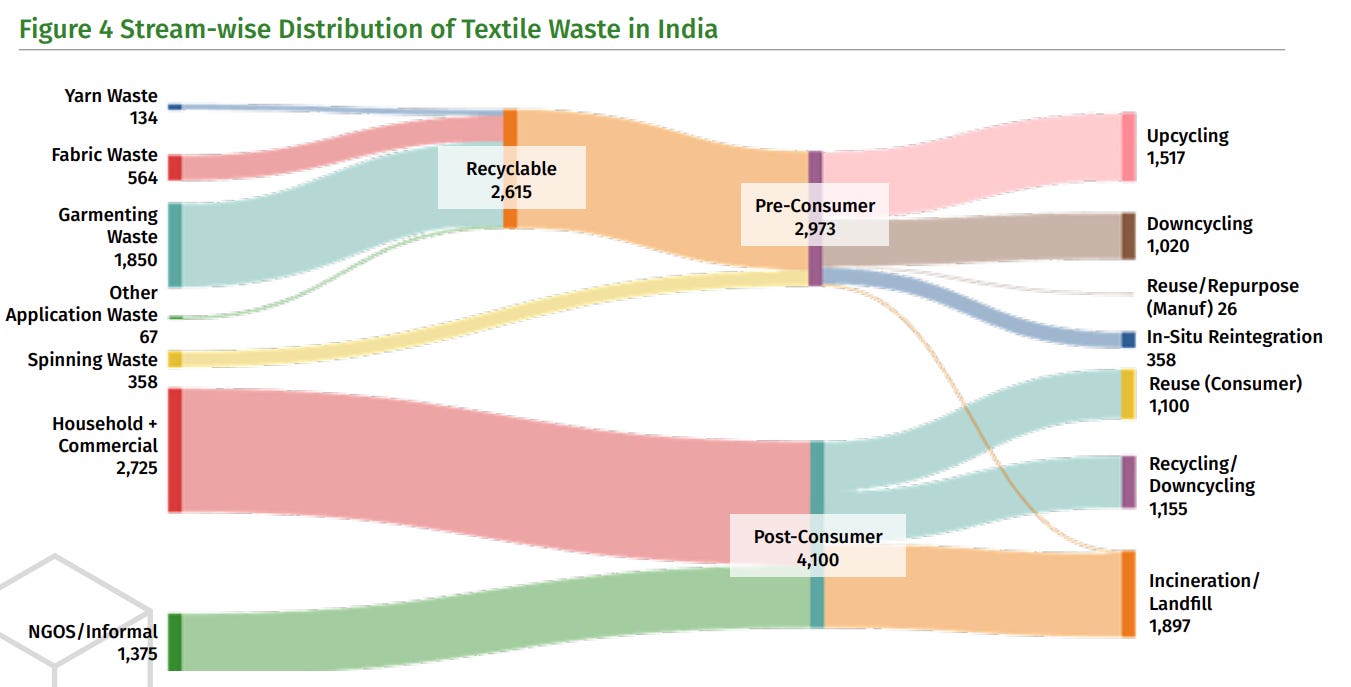
Pre-consumer waste piles up at every stage of making a shirt. Spinning mills shed short fibre and dust, though nearly all of that goes straight back into the same mill. Looms leave offcuts and defective rolls. Dyeing throws off rejects. But the stage that dominates is garmenting, where fabric is cut to pattern. That one step accounts for roughly 70% of all pre-consumer waste, and it comes from an industry doing nothing wrong. You cannot cut curved pattern pieces from rectangular fabric without leaving scraps.
Post-consumer waste needs less explaining. It’s the shirt three years later, worn thin, stained, out of fashion or just replaced. About 4,100 kilotonnes a year, and the larger of the two streams.
The labels sound like bookkeeping. What they describe is condition, and condition is everything here. Factory scrap has never been worn or washed. It arrives in tonne-lots from a known address, one fabric, often one colour, no zips or buttons. Household clothing has been through a hundred washes, has elastic and a metal zip, is usually a blend. That difference decides everything that follows.
Three things you can do with a scrap of cloth
Cut it and sew it into something else. This is upcycling, and it needs no technology at all, just scissors, a sewing machine and a market. Large leftover panels from garment factories get stitched into kidswear and undergarments for local markets. Long cutting strips get woven on handlooms into rugs, cushion covers and tote bags. Unsold factory inventory goes straight to secondary retail. Technically it isn’t recycling at all. The cloth never stops being cloth.
Shred it and spin it again. This is mechanical recycling. You feed fabric into a machine that tears it back into loose fibre, then re-spin that fibre into yarn. Around 900 units in India run on it, mostly in Panipat and Tirupur. If you’ve heard of Panipat as India’s blanket city, this is why — the blankets and cheap bedsheets it’s known for are made largely from shredded waste.
It has two hard limits. Every pass shortens the fibre, so virgin polyester has to be mixed back in to hold the yarn together. And it can’t separate a blend. Anything too weak or too mixed comes out as shoddy, cheap fibre that gets spun into coarse blankets at best, and at worst never gets spun at all, ending up as mattress filling and wipes. That last bit is downcycling, and it’s a one-way door.
Dissolve it and rebuild it. This is chemical recycling. Instead of tearing the fabric apart physically, you break it down to its raw molecular ingredients and build fresh fibre from those. Because the material is taken back to the start, it doesn’t matter that it was a blend, or dirty, or worn. The output is near-virgin quality.
That makes it the only route that can genuinely handle what India actually throws away. India’s commercial chemical recycling capacity is zero. Not small. There’s no operating plant. Filatex has announced a ₹300 crore facility slated for this year, not producing yet. Birla Cellulose’s Liva Reviva comes closest, pulping cotton scrap into viscose, but it’s capped at 20–30% recycled content and takes only clean white cotton from factories.
The reason is arithmetic, not science. Chemical recycling costs roughly two and a half times what virgin fibre costs in Asia, and it’s energy-hungry on top of that. India isn’t uniquely behind either. The Swedish firm that built the world’s first industrial textile-to-textile plant went bankrupt in 2024 because brands had signed letters of intent rather than purchase orders.
Factory waste: everything gets used, most of it badly
Start with the government’s headline number. Of the 2,615 kilotonnes of pre-consumer waste that isn’t spinning soft waste, 97% gets recovered. Only 2% is landfilled or burned. Against a global picture where only 12–15% of textile waste reaches a recycling facility at all, that is genuinely a good number.
The trouble is that “recovered” only means it didn’t get thrown away. It says nothing about what it became. Of that 97%, about ~1,500 kilotonnes stays in the textile world. Some gets resewn into new products, some gets shredded and spun into fresh yarn. The other ~1,000 kilotonnes becomes stuffing and wipes, and never comes back. That’s nearly two-fifths of everything Indian factories throw out, gone from the textile economy for good.
What decides which pile a scrap lands in is how uniform it is. One fibre, one colour, and it can be sewn into something new or spun into usable yarn. A blend can’t be pulled apart by any machine in the country, so it goes to stuffing. That part is a genuine technical limit.
But here’s the thing. A lot of that 1,020 kilotonnes is not a blend. It’s plain cotton, clean and perfectly good, and it’s still being sold as filler.
That’s because factories sell their waste mixed, so once cotton and blends share a bale, the whole bale gets priced and processed as blend. Nobody decides to downcycle good cotton. It happens by default. And nobody in the chain has a reason to change that, because whoever would pay for sorting isn’t whoever would earn from it.
Household waste: half of it never gets used at all
Now run the same three options against a worn shirt.
Of the 4,100 kilotonnes generated each year, roughly 1,100 is reused directly, as hand-me-downs or through the second-hand trade. About 1,150 gets shredded, almost entirely into shoddy. And 1,897 kilotonnes, roughly 45%, is burned or buried. The share that makes it back into the supply chain as fibre fit for new cloth is under 1%.
Three things are going wrong at once.
The first is contamination, and the Ministry is direct about it: there is almost no segregation at source. Household textiles go into the same bin as everything else and reach recovery facilities already mixed with food waste. Once a garment is soiled, nobody will buy it to wear and the fibre is too far gone to shred into anything useful. Bengaluru’s Hasiru Dala, which runs one of India’s few dedicated textile sorting facilities, has measured this. Of what reaches them through mixed collection, only 25–30% can be used for anything at all, whether resale, repair or shredding. Handed over clean and dry, that rises to about 85%. Same city, same clothes, same workers. The difference is whether it touched a banana peel. Everything that fails is either landfilled or burned as fuel in a cement kiln.
The second is the garment itself. Zips, buttons, beads and elastic all have to come off by hand before anything can be shredded, and the fibre underneath has been weakened by years of wearing and washing. Put that through a shredder and you get dust rather than spinnable fibre.
The third is blends. A cotton-polyester-spandex T-shirt cannot be mechanically separated, full stop. Chemical recycling could take it. India has none.
And the reuse bit, the only part that works, is run almost entirely by people nobody counts. Municipal collectors pull textiles out of bins, NGOs like Goonj run donation drives, and underneath both sits the Waghri community, who go door to door swapping utensils for old clothes and resell them at markets like Delhi’s Raghubir Nagar, which alone has two to three thousand sellers. Shirts at ₹30–50, a Banarasi sari at ₹200–400. Thirty years of it, no recognition.
This chain supports ~45 lakh livelihoods, mostly women from marginalised communities, and recovers 55% of post-consumer waste. The part of the system that works best is the part nobody designed.
The rule that doesn’t exist
Compare this with plastic. Rigid plastic packaging sold in India must now contain 40% recycled material, up from 30% last year and headed for 60% by 2028-29. E-waste carries recycling targets pegged to what a producer sold. Both run on Extended Producer Responsibility, which keeps the brand on the hook after the sale.
That’s the only reason anyone bothers. A company separates its waste when someone downstream has a target to meet and will pay for clean material. For textiles, nothing obliges a brand to put a single gram of recycled fibre into a shirt. So nothing obliges anyone upstream to keep good cotton out of the stuffing pile.
Which is why almost everyone in this industry assumes textile EPR is coming next.
It isn’t. No notified textile EPR, no draft in the gazette, no pollution control board consultation paper. Every major report over the past year is asking for one. Which also means nobody is required to collect household textiles separately in the first place, so they keep arriving in the same bin as the food waste.
The gaps run further. There’s no HSN code distinguishing recycled textile fibre from virgin, which the Ministry flags directly: without one, recycled yarn has no formal identity in trade, so manufacturers can’t claim incentives for using it and the government can’t mandate it in procurement. The tax system cannot see the difference. There’s no national grading standard either, so not a single bale of sorted textile waste in India carries verified documentation of what’s inside it. Which is precisely why no bank will finance a sorting facility.
Meanwhile, the one rule that did change points the wrong way. The Solid Waste Management Rules, 2026, effective from 1 April, mandate four-way segregation at source: wet, dry, sanitary and special care. Textiles stay inside “dry waste.” Where they are named specifically is in the definition of refuse-derived fuel (RDF)— and the rules raise mandatory RDF substitution for cement kilns and waste-to-energy plants from 5% to 15% over six years.
Read plainly: India’s newest waste law creates growing, legally mandated demand for textiles as fuel, and no pathway at all for textiles as material.
So where does this land
Plenty is being built, to be fair. Usha Yarns in Ludhiana recycles 12,000 tonnes a year for Adidas, Nike and Puma. Arvind runs closed-loop denim. Hasiru Dala, Saahas Zero Waste, Green Worms and ReCircle are putting together the collection and sorting layer that barely existed five years ago, and IKEA has built a working chain in India with Saahas supplying feedstock and Usha Yarns spinning it.
None of it scales, though. The processes that come closest to turning cloth back into cloth lose the most material on the way, running at conversion efficiencies below 60%, so the more circular you get the less you have left to sell. And almost all of these businesses sit in the missing middle, too big for microfinance and too risky for banks, drawing on the same schemes as any ordinary textile manufacturer.
The instinct is to demand EPR immediately, but India has run EPR for plastic since 2022 and regulators auditing it found roughly 700,000 fake recycling certificates in circulation, co-processing units claiming 335 million tonnes against a real capacity of 11.4 million, and ₹355 crore in penalties to levy. Informal collectors were left outside the framework entirely. Bolt a textile EPR onto that same machinery, and it fails faster, because you can weigh a bale of plastic but you cannot see what’s inside a bale of cloth.
Which leaves the harder question of who moves first. Nothing here is technically difficult. Every fix costs money at one end of the chain and pays off at the other, and nobody has ever been told to connect the two.

India’s telecom hardware problem
Last week, HSBC put out a report calling electronics “India’s new oil.” The comparison isn’t about energy. It’s about dependence. In just the first five months of this financial year, India’s electronics trade deficit hit nearly $40 billion, putting it almost on par with the crude oil import bill. Electronics is catching up to oil as the import category that keeps policymakers up at night.
Telecom equipment sits right at the centre of this. India imports $4-5 billion worth of telecom and network equipment every year. We’ve managed the passive side reasonably well, things like optical fibre cables, towers, and enclosures.
But over 80% of active hardware, which are the components that actually process and route data through our networks, comes from China. This includes particularly critical parts like 4G/5G antennas and signal processors.
The implications of this extend beyond the trade deficit.
The hardware inside India’s 5G towers, internet backbones, and data centres also determines how secure those networks are. A compromised chip or an undocumented backdoor in a core router is enough to expose power grids, financial systems, or defence communications. The government recognised this and tightened procurement through the National Security Directive on Telecommunications and the Telecom Cyber Security Rules 2024, which mandate security testing and origin certifications.
But procurement rules can only filter what comes in. They don’t create a domestic alternative.
India does have a PLI scheme for telecom equipment. Seemingly, PLI-backed telecom firms have generated over ₹85,000 crore in net sales so far, which sounds impressive until you look under the hood. The bulk of domestic production under PLI is limited to basic assembly. Imported chips get soldered onto printed circuit boards, fitted into enclosures, and shipped as finished products. Domestic value addition still sits below 20%.
To attempt to repair this deficit, Communications Minister Jyotiraditya Scindia is leading the buildout of a Telecom Manufacturing Zone (TMZ) in Gwalior, Madhya Pradesh.
As of last week, 24 companies have formally initiated applications to set up units in what the government is calling Asia’s first dedicated telecom manufacturing cluster, with proposed investments of ₹5,500 crore. The list includes Tata-backed Tejas Networks, HFCL, Dixon, and VVDN Technologies.
How the zone works
The Gwalior TMZ is a 350-acre “plug-and-play” cluster where manufacturers, component makers, and testing facilities all sit next to each other on shared infrastructure. The zone itself is structured as a joint venture between the Madhya Pradesh government at 51% and the DoT at 49%. Investor demand has already exceeded the available land.
It’s not unlike the Sriperumbudur auto cluster, where a car plant is surrounded by glass makers, powertrain suppliers, and other component manufacturers within a few kilometres. A complete car rolls out without parts crossing state lines.
The TMZ clusters PCB fabricators, moulding units, and optical component makers around anchor OEMs. It also includes a proposed ₹500 crore shared testing lab funded by the Department of Telecommunications. Telecom hardware needs rigorous certification before it can be deployed, and the labs that do this testing cost crores to build. Most smaller manufacturers cannot afford their own, which keeps them locked out of the supply chain. A government-funded shared lab changes that equation.
The anchor commitments reflect this logic. HFCL has committed ₹700 crore for an optical connectivity plant with 80% of output aimed at exports. VVDN Technologies is investing ₹500 crore in a 5G and satellite communications R&D facility. Dixon Technologies, through a joint venture with Taiwan’s Gemtek Technology, plans to manufacture optical transceivers in India. These are the small but critical components that route data inside 5G towers and cloud data centres, and until now, we’ve imported nearly all of them.
None of this works without heavy state intervention. Manufacturing telecom equipment in India costs 12 to 18% more than in China or Vietnam, according to estimates from TRAI. The gap comes from higher borrowing costs, elevated tariffs on intermediate components, and the absence of a deep local supplier base. Countries like Vietnam widen this further by offering zero-tariff regimes on goods imported for re-export.
Add the central PLI scheme’s 4 to 7% production-linked payouts on top of all this, and Indian manufacturers inside the zone can, on paper, reach unit-cost parity with East Asian competitors for the first time. Whether they actually do depends on every one of these incentives being disbursed on time and without interruption. Given the PLI’s history of late disbursement, this is a much bigger question mark than usual.
Why Gwalior?
But before any of those issues arise, you might be wondering, why Gwalior of all places?
It’s not like Gwalior is known as a manufacturing hub. Even Madhya Pradesh itself does not feature in the top 10 states by manufacturing value-added.
However, there are many components in telecom that are common in electronics clusters. Those clusters today exist in states like Tamil Nadu and Andhra Pradesh, which are more qualified to make them today. They are also states that not only have logistics connections by road, but they also house two of India’s biggest ports: Chennai and Visakhapatnam.
Publicly, the choice of Gwalior seems to rest on two things. The upcoming 88-km Agra-Gwalior expressway will link the zone to NCR freight and logistics networks. The city’s universities produce ~25,000 engineering graduates each year, giving manufacturers a large technical workforce at Tier-2 salary levels instead of the premiums of Bengaluru or Pune.
But to make many of the complex telecom components, you’ll need workers who understand SMT operations, RF testing, optical fibre handling, PCB work, and so on. Tamil Nadu and Karnataka already have all of those at scale. The most reliable advantage, then, that Madhya Pradesh offers is cheap (though relatively less-skilled) labour, but that alone does not build a cluster.
In that case, what else does Gwalior offer?
Well, there’s certainly cheap land. The market rates at MP are now certainly cheaper than in TN or AP. Moreover, MP has allocated the initial 170 acres entirely free of cost, offered future expansion land on 30-year leases at ₹1 per square metre, and announced a 50% capital subsidy for anchor tenants capped at ₹200 crore.
The centre has also committed ₹493 crore towards infrastructure covering power, water, and roads, while manufacturers get power tariff rebates, subsidised water, and wage subsidies. While TN or AP also started their way with these hefty rebates and land subsidies, they can’t offer them endlessly forever.
Interestingly, the TMZ is being built on land in the Shrimant Madhavrao Scindia Counter Magnet City, an industrial zone the Centre established in the early 1990s as one of five counter-magnet cities meant to draw industry away from Delhi. After lots of investment, though, the project never attracted the industries it was designed for, even being deemed a “ghost town“ a few years ago. This unused land has found renewed purpose.
The execution test
Remember, these are still proposed investments from companies that have initiated applications, not binding commitments backed by deployed capital. The real metric for the TMZ will be how many of these 24 applicants break ground, hire workers, and ship products.
The infrastructure the zone depends on is also not ready yet. The Agra-Gwalior expressway is already running roughly eight months behind schedule because of land acquisition disputes across three districts. The ₹500 crore shared testing lab has been announced but is not operational. Delays on either front directly eat into the cost advantage the subsidies are meant to create.
If the TMZ does work as designed, though, the payoff goes well beyond one manufacturing zone in central India. India currently has no credible domestic alternative to Chinese-made 5G radios, optical transceivers, or core network routers. A functioning cluster in Gwalior, with companies like Dixon-Gemtek manufacturing optical components and VVDN building 5G R&D capacity, would begin to change that.
- This edition of the newsletter was written by Kashish & Vignesh.
Tidbits
1. Domestic Airfares Rise While Business Class Rates Soften
Average domestic airfares in India jumped sharply in the first half of the year, driven by high demand and limited airline capacity. However, business-class ticket prices dropped slightly as airlines adjusted their strategy to attract corporate travellers.
Source: Business Standard
2. Indian Exports to China Grow, But Trade Deficit Expands
China became a major buyer of Indian raw materials and industrial supplies recently, leading to an increase in Indian exports. However, India’s trade deficit with China widened further due to large imports of Chinese electronics and machinery.
Source: Business Standard
3. Apple Eyes India Payments Market with Axis Bank Partnership
Apple is preparing to roll out Apple Pay in India in partnership with Axis Bank to enter the country’s growing digital payments market. The service will integrate directly with India’s Unified Payments Interface (UPI) network.
Source: Reuters
4. Saudi Oil Pipeline Disruption Triggers Global Market Concerns
Saudi Arabia shut down its main East-West oil pipeline after a drone attack damaged pumping stations. The disruption forced Saudi Aramco to cancel October crude shipments to European refiners, causing fresh concerns in global oil markets.
Source: Bloomberg
5. Café Chains Launch Protein Drinks Amid Rising Ingredient Costs
Major beverage chains like Starbucks, Tim Hortons, and Chaayos are launching high-protein drinks to capture growing health-conscious demand in India. Brands are pushing these products despite a recent surge in global whey protein prices.
Source: The Economic Times
Want more tidbits? Catch up on last week’s recap!

Cash & Copium #6
In this episode of Cash & Copium, Abid, Bhuvan, and Aakanksha break down the unspoken habits of financial stagnation and the subtle traps that keep people poor. They discuss why over-managing a small portfolio yields negligible returns compared to career growth, how committing to a home EMI in your 20s destroys your career optionality, and why shallow side hustles, high-interest debt, and neglecting your health silently derail long-term wealth creation.
Check out the episode on YouTube.
Beyond Today’s Brief
There’s always more happening at Markets by Zerodha.
The Chatter: What new regulatory measures is SEBI introducing to deepen India’s corporate bond and AIF markets? How is Mazagon Dock navigating its ₹15,000 crore expansion alongside high-value naval bids? And how are firms like Mphasis, Redington, and TVS Supply Chain adapting to IT, AI, and global supply chain shifts?
Points & Figures: How severe is the synchronised global supply shock across energy, metals, and freight? What does India’s 510-basis-point WPI-CPI gap reveal about margin compression, and how are rising sovereign yields reshaping global rates?
Aftermarket Report: How did the Nifty hold above 23,400 as cooling crude oil prices provided relief to the market? What do the latest trends in foreign institutional buying, delivery spikes, and options positioning reveal about market breadth?
Subtext: How do developing nations navigate the impossible balance between industrialisation and decarbonisation? In our conversation with Avantika Goswami and Trishant Dev from CSE, we explore the power dynamics behind Western climate mandates and what a truly just green transition looks like. Watch the full episode here.
Join us on WhatsApp, where we share interesting soundbites from concalls, articles, and everything else we come across throughout the day. You’ll also get notified the moment a new video or article drops so that you can read or watch it right away.
Thank you for reading. Do share this with your friends and make them as smart as you are 😉