


Our goal with The Daily Brief is to simplify the biggest stories in the Indian markets and help you understand what they mean. We won’t just tell you what happened; we’ll tell you why and how too. We do this show in both formats: video and audio. This piece curates the stories that we talk about.
You can listen to the podcast on Spotify, Apple Podcasts, or wherever you get your podcasts and watch the videos on YouTube. You can also watch The Daily Brief in Hindi.
In today’s edition of The Daily Brief:
1. India can’t find a sweet spot for its sugar policy
Just months after approving 20 lakh tonnes in sugar exports to clear a perceived surplus, India executed a complete policy reversal as domestic spot prices jumped to record highs. The government banned exports, imposed strict stock limits, and opened duty-free imports after crop estimates dropped 11% due to adverse weather, crop disease, and cane diversion to khandsari units. While ethanol blending was not the primary cause of the miscalculation, the sudden crunch exposes how fragile policy buffers become when fragmented data and thin reserves leave no room for forecasting errors.
2. Can hydrogen actually power Indian trains?
India is currently testing two hydrogen-rail pilots—a passenger train in Haryana and an industrial freight locomotive for NTPC—to explore where fuel-cell technology fits into its rail network. With almost the entire broad-gauge network already electrified, hydrogen is unlikely to replace traditional electric trains, but it could offer a clean alternative for unwired industrial routes, power plants, and heritage lines. However, high fuel costs (₹279–₹350/kg), competition from advancing battery technology, and global reliability issues pose major hurdles before widespread adoption.
India can’t find a sweet spot for its sugar policy
In February, India had a sugar problem: we had too much of it.
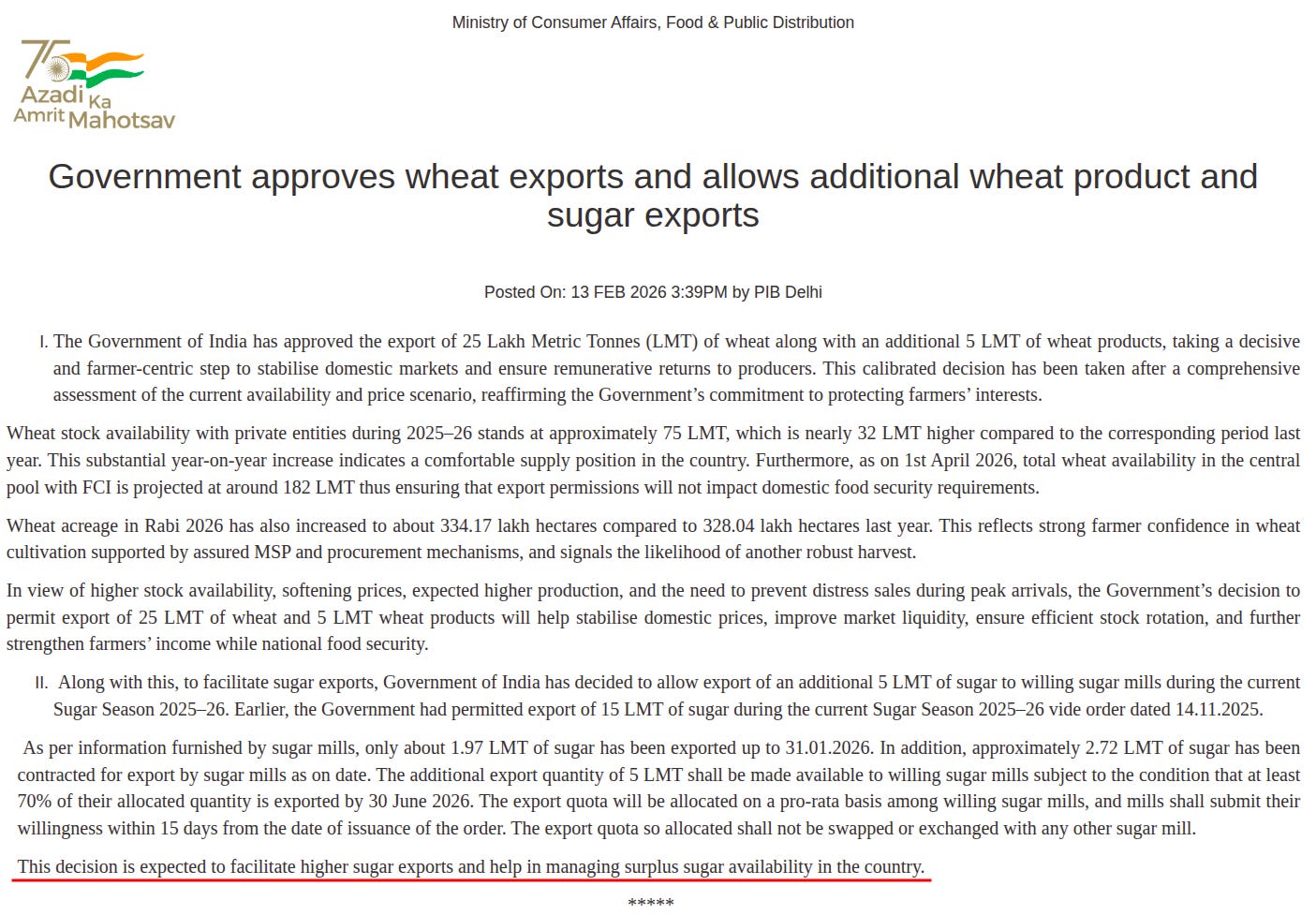
The government had already allowed mills to export 15 lakh tonnes of sugar during the 2025–26 season. In February 2026, it added another 5 lakh tonnes, taking the total export quota to 20 lakh tonnes. The official reason was to manage India’s “surplus sugar availability”. Mills eventually exported only around 8 lakh tonnes against that quota.
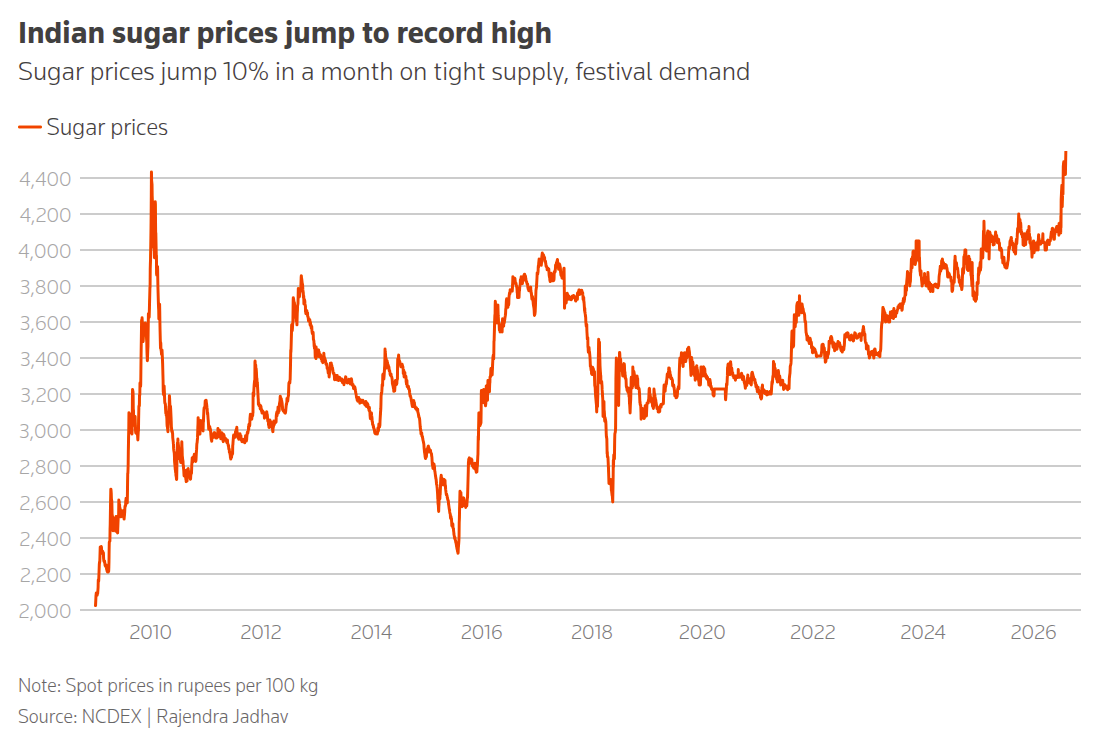
By August, though, the problem had done a complete 180-degree flip. Domestic spot sugar prices had jumped roughly 10% in a month and climbed to a record high.
The government’s response was almost the opposite of what it had been doing a few months earlier. It prohibited further exports, began physically verifying mill inventories, restricted how much traders and large consumers could hold, and opened a duty-free window for 10 lakh tonnes of raw-sugar imports until 31 October.
What went wrong?
The reversal makes sense once you look at what happened to the production estimates.
Sugarcane-growing states had initially projected production of around 343 lakh tonnes. The government now expects roughly 306 lakh tonnes, about 11% lower than the original estimate. The government was not alone in getting it wrong — the US Department of Agriculture (USDA) also cut its India estimate by 53 lakh tonnes. The exact numbers vary depending on who you ask. But directionally, all estimates were lower than initial expectations.
But what’s worth asking is why did it take so long for this mismatch in expectations to become so obvious?
You see, the season had started strongly. Production was running well ahead of the previous year, especially in Maharashtra and Karnataka. But early production can be deceptive. Sugar output depends on both how much cane reaches mills, as well as how much sugar mills recover from every tonne of that cane. A mill can crush a lot of cane early without the total crop for the year being any larger. It may simply be processing the available crop faster.
That is broadly what happened. By 15 April 2026, India had produced 275 lakh tonnes of sugar, just around 8% more than a year earlier. But only 19 mills were still operating, against 38 at the same point the previous year. Then by 30 April, output was still 7% ahead of the previous year. Yet only 5 mills remained operational, against 19 a year earlier.
So the strong first half did not necessarily mean the crop was much larger, but just that a greater share of it had arrived early.
At the same time, the quality of the crop itself had weakened for several reasons. Excess rain hurt parts of Maharashtra. Crop disease damaged cane in UP and Maharashtra. Weaker cane quality also lowered recovery, which meant the same tonne of cane produced less sugar. The USDA, too, cited excessive rainfall when it cut its India estimate.
In UP specifically, even the cane that was available did not necessarily reach sugar mills. The state’s cane availability for crushing was estimated to be 2–3% lower. Some mills closed around 15 days earlier than scheduled while others reportedly received around 25 lakh quintals less cane.
Industry representatives said some farmers had sent cane to khandsari (raw sugar) units, which could offer better prices and immediate payment. This connects to a problem we explored the last time we covered sugar, which is that sugar mills must pay farmers a government-regulated price for cane, while the price they get for sugar keeps changing. When sugar and ethanol sales do not cover costs, mills can run short of cash and delay payments to farmers. That can make khandsari units, which often pay immediately, more attractive.
This alone wouldn’t explain all of the shortfall, but it is another reason why estimating cane output alone is not enough.
Now, beyond this, the data around sugar production itself is too fragmented to get a fully accurate picture. Mills report production, sales and stocks to the government. Traders now update inventories through the Department of Food and Public Distribution’s online portal. But there is still no single public, live balance that tells you how much sugar was produced, sold, exported, dispatched or remains in stock.
India had sugar, but the buffer was thin
Even now, nobody quite agrees on whether India has a genuine sugar shortage.
The government initially argued that the price rise was not justified by demand and supply. It blamed hoarding, speculative transactions and paper trades in which sugar was sold without physically leaving the mill.
The industry has pushed back too. The National Federation of Cooperative Sugar Factories estimates net production at 279 lakh tonnes, after around 24 lakh tonnes of sugar-equivalent was diverted to ethanol. It expects the next season to begin with around 35 lakh tonnes of stock. Against monthly demand of roughly 22 lakh tonnes, that should ideally bridge the market until fresh sugar arrives.
Technically, both sides can be right. India could have enough sugar in the national balance while the market for sugar that was unsold and ready to move was still tight. Once the buffer became thin, hoarding or delayed selling could make that tightness much worse.
That is why the government’s response focused first on finding and moving the sugar that was already inside the country.
On 24 July, officials were asked to physically verify mill inventories and reconcile declared stocks with sales, dispatches, mill returns and GST-linked information. A discrepancy could even affect a mill’s future domestic sale quota.
Then came stock limits. From 1 August to 30 November 2026, sugar dealers were required to report inventories every week and stay within prescribed holding limits. From 1 September to 30 November, businesses consuming more than 10 tonnes of sugar a month were also barred from holding more than 15 days of their normal requirement.
These measures can stop people from sitting on inventory. But they cannot create more sugar out of thin air.
That’s where wheat imports come in. The government opened a duty-free window for 10 lakh tonnes of raw sugar until 31 October. Unlike stock limits, imports actually add to supply.
But not immediately. Sugar from Brazil can take around 40–45 days to reach Indian ports, before unloading, refining and inland transport. Industry representatives expect only some consignments to arrive before 15 October. Raw sugar sitting at a western port is not the same as white sugar reaching a bakery in northern India.
The industry has also suggested starting the next crushing season earlier. That can bring fresh sugar into the market sooner, but less mature cane generally gives lower recovery. In other words, early crushing can move sugar from a later month into an earlier one without necessarily increasing total production.
Did ethanol drink India’s sugar?
The most obvious suspect in this imbalance is a commodity that we only see ourselves covering more as its mentions grow in government announcements: ethanol.
Sugar mills do not only make sugar. They can also divert cane juice and molasses towards ethanol, which oil companies buy for blending into petrol. Every tonne of sugar-equivalent that goes towards ethanol is, by definition, sugar that does not enter the food market.
So when sugar prices rise after a production shortfall, it is tempting to say: perhaps India simply turned too much of its sugar into fuel. That argument sounds plausible because ethanol policy was designed primarily to absorb India’s excess sugar. For years, India struggled with too much sugar, weak mill finances and delayed payments to farmers. Ethanol gave mills another buyer for the sucrose inside cane and a more predictable revenue stream.
But this year, ethanol does not really explain the hole.
The government says the share of sugar diverted towards ethanol fell from around 12% in 2022–23 to 9% in 2025–26. It also says nearly three-fourths of India’s ethanol now comes from foodgrains. It seems that no matter what the estimate, ethanol did not create that forecasting miss. It did, however, reduce the cushion once the crop turned out smaller.
Cutting cane-based ethanol would release more sugar into the food market, but it would not explain why the crop estimate was wrong in the first place. It would also weaken a revenue stream that helps mills generate cash and pay farmers.
So the real policy problem is not sugar versus ethanol. It is how much cane India can safely commit to ethanol before it knows how large the crop will actually be.
That question is still unresolved. The government’s draft Sugarcane (Control) Order, 2026 tried to bring ethanol and khandsari more formally into cane economics, but was withdrawn in May after opposition from states and other stakeholders. Its withdrawal did not cause the current price spike. But the tension remains: when sugar is abundant, India wants more cane to become fuel, and when the crop disappoints, it needs more of that cane back in the food market.
Who wins and who pays?
The price spike does not hit everyone in the sugar chain the same way. Mills, farmers, food companies and consumers, all feel it differently.
For mills sitting on cheap inventory, higher sugar prices are obviously helpful. Balrampur Chini, for instance, held 45.67 lakh quintals of sugar on 30 June 2026, valued in its books at ~₹37 per kg. Its average June-quarter realisation was nearly ₹42 per kg. That is why sugar stocks rallied as prices rose as investors were betting on the margin sitting inside those inventories.
But the upside is not unlimited. Some stock may already be contracted and domestic sales are regulated. Additionally, higher cane costs, weaker recovery, interest expenses and lower volumes can eat into the benefit. That became obvious when Balrampur Chini, Dhampur Sugar and Bajaj Hindusthan fell around 5% each after duty-free imports were announced. More supply threatened the same price advantage investors had been betting on.
Farmers benefit less directly. Cane prices are set through the central Fair and Remunerative Price, or a higher state-advised price in some states. So a spike in sugar prices does not automatically mean farmers get paid more.
What higher sugar prices can do is improve mill cash flow, making it easier to clear cane dues and compete for the next crop.
For food companies, the effect runs the other way. Sugar is a major input in biscuits, drinks, ice cream, confectionery and bakery products. Large companies have more protection through contracts and pricing power. Smaller bakeries, sweet shops and regional manufacturers are more exposed to spot prices and frequent purchases, especially under the 15-day stock limit.
Consumers eventually feel some of this too, either through higher retail sugar prices or through pricier sweets, biscuits, drinks and desserts. The pass-through will not be immediate or uniform, but festival-season inflation is exactly why sugar gets politically sensitive so quickly.
The missing safety margin
The cautionary tale doesn’t lie in the fact that India got its sugar forecast wrong. It is in the nature of forecasts to not be accurate.
The problem is that policy left very little room for that error.
India manages almost every part of the sugar market: cane prices, ethanol prices, domestic sales, exports, imports and stock limits. That means the government is constantly balancing three interests that rarely line up neatly — farmers want higher cane prices, mills want better realisations, and consumers want cheap sugar. In a surplus year, the system pushes sugar out through exports and ethanol. In a tight year, it suddenly pulls the other way.
That is why the buffer is important. India needs a much clearer view of how much sugar is actually available through the season, not just scattered numbers on production, stocks, ethanol diversion, sales and dispatches. And there should be some safety margin before more sugar is allowed to leave the food system, because the next crop will bring the same problem back.

Can hydrogen actually power Indian trains?
India now has two very different hydrogen-rail experiments underway.
Last month, Indian Railways launched its first domestically built hydrogen-powered passenger train on the Jind–Sonipat route in Haryana. Meanwhile, Concord Control Systems has a ₹47 crore contract with NTPC to convert an existing diesel locomotive into a 3,100 HP hydrogen fuel-cell hybrid locomotive at its Sipat power plant in Chhattisgarh.
The two projects could help answer a much bigger question. Where does hydrogen actually fit into India’s railway system? After all, almost the entire broad-gauge railway network is already electrified. Hydrogen isn’t likely to replace our wired, electric trains anytime soon. So where does this ambition stand?
A pilot
The Haryana train is, for now, a pilot program to test how hydrogen propulsion, refuelling and maintenance work under Indian conditions before deciding where else to use the technology.
A hydrogen fuel-cell train is still an electric train. Where it differs is that instead of getting electricity continuously from an overhead wire, the train itself carries hydrogen and uses a fuel cell to produce electricity onboard.
For green hydrogen, electricity is first used to make hydrogen. It then has to be compressed, stored and put into the train, where it is converted back into electricity. That’s a lot of extra steps when an electric train can simply take electricity directly from the wire.
Where could hydrogen make sense?
NTPC’s project shows where hydrogen could be more useful.
Its locomotive is being developed to haul coal within NTPC’s Sipat operations. Industrial sites such as mines, ports, steel plants and power plants can have their own railway systems where diesel locomotives are still used and installing overhead wires may not always make sense.
These locomotives also keep returning to the same area, so one hydrogen refuelling facility could potentially serve the operation instead of requiring stations across the country. Heritage and hilly routes are another possible niche, particularly where installing overhead electrical infrastructure is difficult or undesirable.
But can it actually compete?
But the biggest bottleneck in all these visions is that hydrogen itself, whether green or white, is still expensive. Recent Indian tenders have priced green hydrogen at roughly ₹279–350 per kg, which is why Railways is now looking for ways to procure it more cheaply.
Beyond just the absolutely prohibitive price, hydrogen still has to beat batteries.
For short routes or locomotives that have plenty of time to recharge, batteries may be simpler and more energy-efficient because they don’t require hydrogen production, storage and refuelling infrastructure. Hydrogen is more suited to when trains need to operate for longer without stopping to charge.
And reliability isn’t settled either. Germany launched the world’s first commercial hydrogen passenger service in 2018, but a later 27-train fleet in the country’s Taunus region suffered reliability problems and required upgrades. Some services had no choice but to revert back to using diesel as a substitute.
What happens next?
The Haryana pilot will test how hydrogen trains cope with Indian weather and regular passenger use, including repeated refuelling.
The NTPC project is a different test. It will show whether hydrogen can handle a locomotive pulling heavy loads every day.
These two projects should give us a better sense of where hydrogen can actually be useful on Indian railways.
- This edition of the newsletter was written by Kashish & Vignesh.
Tidbits:
1. Karnataka suspends food licences of quick commerce apps over toxic seed sales
The Karnataka government has suspended the food safety licences of major platforms like Amazon, Swiggy Instamart, and BigBasket for selling toxic Datura seeds online. The regulatory crackdown highlights growing scrutiny over the safety and vetting processes of rapid-delivery grocery networks.
Source: Livemint
2. Mahindra unveils new heavy vehicle with AI-assisted driving mode
Mahindra & Mahindra has introduced a new generation of heavy commercial vehicles equipped with an artificial intelligence-enabled autonomous driving mode. The technological upgrade aims to improve fleet efficiency, driver safety, and operational logistics for long-haul freight operations.
Source: Business Standard
3. Singtel seeks foreign direct investment approval for Indian satellite market
Singapore Telecommunications has applied for foreign direct investment approval to enter India’s emerging satellite communications market. The move intensifies competition in the domestic space-based broadband sector, positioning Singtel against established players like Starlink, Jio, and OneWeb.
Source: The Economic Times
4. TCS secures $1.45 billion Porsche contract and acquires its IT arm
Tata Consultancy Services has signed a $1.45 billion deal with Porsche, which includes acquiring the German automaker’s dedicated IT division for $373 million. The acquisition will allow the Indian software major to deepen its automotive engineering capabilities and expand its European operational footprint.
Source: Livemint
5. Government lifts wheat export ban to support local farmers
India has officially lifted its ban on wheat exports to protect the financial interests of farmers facing depressed domestic grain prices. The policy reversal reopens a crucial supply line for international grain markets while attempting to stabilise local agricultural incomes.
Source: The Hindu
6. Amazon and Flipkart increase seller penalties ahead of festive season
E-commerce giants Amazon and Flipkart are tightening their policies by imposing stricter financial penalties on sellers who cancel confirmed customer orders. The operational shift aims to ensure supply chain reliability and protect consumer trust ahead of the crucial holiday sales period.
Source: The Hindu BusinessLine
Beyond Today’s Brief
There’s always more happening at Markets by Zerodha.
The Chatter: How is the RBI pushing banks toward alternative data and AI oversight? How is 3M India localising production to protect margins, and what is driving momentum for Blue Star, KFintech, and EV material producer HEG?
Aftermarket Report: What fueled Nifty's sharp 150-point final-hour recovery to close above 24,300 on monthly expiry? How did a 3% slump in crude oil prices help reverse early losses? And what are the details behind TCS’s massive $1.4 billion strategic partnership with Porsche?
Points & Figures: Beyond equity trading, how are new investors and alternative assets reshaping India’s financial ecosystem? Drawing from SEBI’s latest report, Points & Figures tracks key shifts: Tier-II cities surpassing Tier-I in mutual funds, net SIP inflows surging 26%, and rapid expansion across AIFs, REITs, SME IPOs, and municipal bonds.
Join us on WhatsApp, where we share interesting soundbites from concalls, articles, and everything else we come across throughout the day. You’ll also get notified the moment a new video or article drops so that you can read or watch it right away.
Thank you for reading. Do share this with your friends and make them as smart as you are 😉
Thanks Kashish and Vignesh!!
Informative article. In a country where millions (and especially those at subsistence levels) depend on agriculture, a policy for food and consumables to protect the local markets/populace is crucial. I thought India was doing a good job in this regard. At the Food Corporation of India, has AI been well integrated which can help the company to address the complementary uses of grains, pulses and sugar? Sugar for ethanol in O&G, etc, and plan and stock accordingly?