


Our goal with The Daily Brief is to simplify the biggest stories in the Indian markets and help you understand what they mean. We won’t just tell you what happened; we’ll tell you why and how too. We do this show in both formats: video and audio. This piece curates the stories that we talk about.
You can listen to the podcast on Spotify, Apple Podcasts, or wherever you get your podcasts and watch the videos on YouTube. You can also watch The Daily Brief in Hindi.
In today’s edition of The Daily Brief:
1. How private is India’s private nuclear push?
The SHANTI Act has legally allowed private companies to own and operate nuclear power plants in India, but actual implementation remains far from a fully private model. Private firms currently participate primarily through construction and captive financing arrangements, while the state retains control over key steps like uranium mining, enrichment, and radioactive waste management.
2. A crisis in India’s tea industry
Extreme weather fluctuations and rising operational costs have triggered sharp price volatility in India’s tea sector, hitting small tea growers hard. While domestic auction prices have swung wildly and squeezed margins for producers and brand owners, high overseas demand has kept tea exports resilient.
Cash & Copium #6
In this episode of Cash & Copium, Abid, Bhuvan, and Aakanksha break down the unspoken habits of financial stagnation and the subtle traps that keep people poor. They discuss why over-managing a small portfolio yields negligible returns compared to career growth, how committing to a home EMI in your 20s destroys your career optionality, and why shallow side hustles, high-interest debt, and neglecting your health silently derail long-term wealth creation.
Check out the episode on YouTube.
How private is India’s private nuclear push?
“Private participation” is a wonderfully elastic phrase in nuclear power.
It can mean that a company manufactures a specialised, heavy-duty container in which the nuclear reaction happens. It can mean that it designs the pipes running through a plant. It can mean that it just pays for the entire project. Or it can mean that the company actually owns and operates the reactor.
Those are vastly different levels of participation. Yet India’s recent nuclear announcements have often been bundled together as evidence that the sector is being opened to private companies.
That is only partly true.
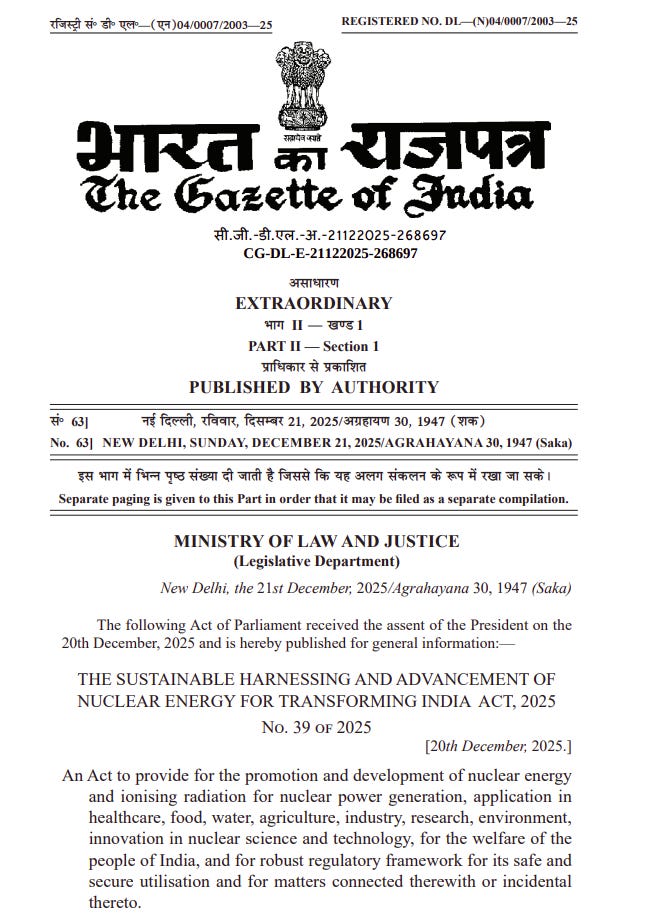
Private companies have worked on Indian nuclear plants for decades. What they could not do was own and operate one. The SHANTI Act has now made that legally possible. But the projects taking shape today sit at different points between those two extremes.
The easiest way to understand India’s nuclear opening, then, is as a ladder. At the bottom, private companies work as contractors. Higher up, they finance projects and help develop technology. At the top, they become licensed nuclear operators.
India has occupied the lower rungs for years. It is now experimenting with the middle while the top rung remains mostly theoretical.
The first rung: Helping build the reactor
Larsen & Toubro and HCC have handled major construction and engineering work at nuclear plants. HCC claims it has helped build 60% of India’s installed nuclear capacity. Walchandnagar Industries and MTAR make specialised equipment and components, alongside the government-owned BHEL.
NPCIL’s recent tender for the Bharat Small Reactor programme belongs in this category. NPCIL — the Nuclear Power Corporation of India — is the government-owned company that builds, owns and operates most of India’s commercial nuclear plants.
The programme uses an adapted version of NPCIL’s existing 220-megawatt (MW) reactor design. It has invited consultants to undertake generic engineering and create a detailed 3D model for the reactor. The work covers civil engineering, piping, electrical systems, ventilation, instrumentation and other parts of the plant.
This is substantial work. A nuclear plant contains thousands of components that must fit together precisely and operate safely for decades. But NPCIL still owns the underlying reactor technology. It sets the requirements, reviews the consultant’s work and integrates the final design.
The same Bharat Small Reactor programme, however, allows industry to move one rung higher. Instead of merely helping NPCIL design the plant, an industrial company can finance the reactor and consume the electricity it produces.
The second rung: Paying for the reactor
In December 2024, NPCIL invited industries to finance these reactors for their own electricity needs. This is called captive use: a steel or aluminium company, for instance, would secure power for its factories rather than build a plant mainly to sell electricity to others.
The industrial company would provide land and cooling water, pay for construction and cover the plant’s running costs. Its commitments would also extend to fuel, waste management and decommissioning, the work needed to safely retire the plant at the end of its life.
NPCIL would supply the technology, supervise construction and operate the reactor with its trained staff. Under the proposed arrangement, ownership of the plant would transfer to NPCIL for a nominal ₹1 before operations began. In return for funding it, the industrial company would retain the right to the electricity, after the plant’s own needs were met.
This was possible even before SHANTI. It was designed to work within the old nuclear law by keeping ownership and operation with NPCIL while bringing in private money.
By July 2026, Hindalco was reportedly the only company to have submitted a proposal. Hindalco produces aluminium and copper, both of which require large amounts of electricity.
The trade-off is clear: the industrial partner could secure a long-term power supply, but would commit substantial capital without controlling the reactor’s operation. The limited response does not, by itself, establish why other companies stayed away.
Tata Power is also exploring the Bharat Small Reactor.
A July research report from Motilal Oswal describes plans for two 220 MW units with NPCIL, totalling 440 MW. Tata had identified possible sites and was pursuing water allocations and a detailed project report, while discussions about ownership and implementation continued.
Until that structure is agreed, Tata’s proposal cannot be treated as either another Hindalco-style captive project or a confirmed privately operated plant.
The public-sector exception: NTPC
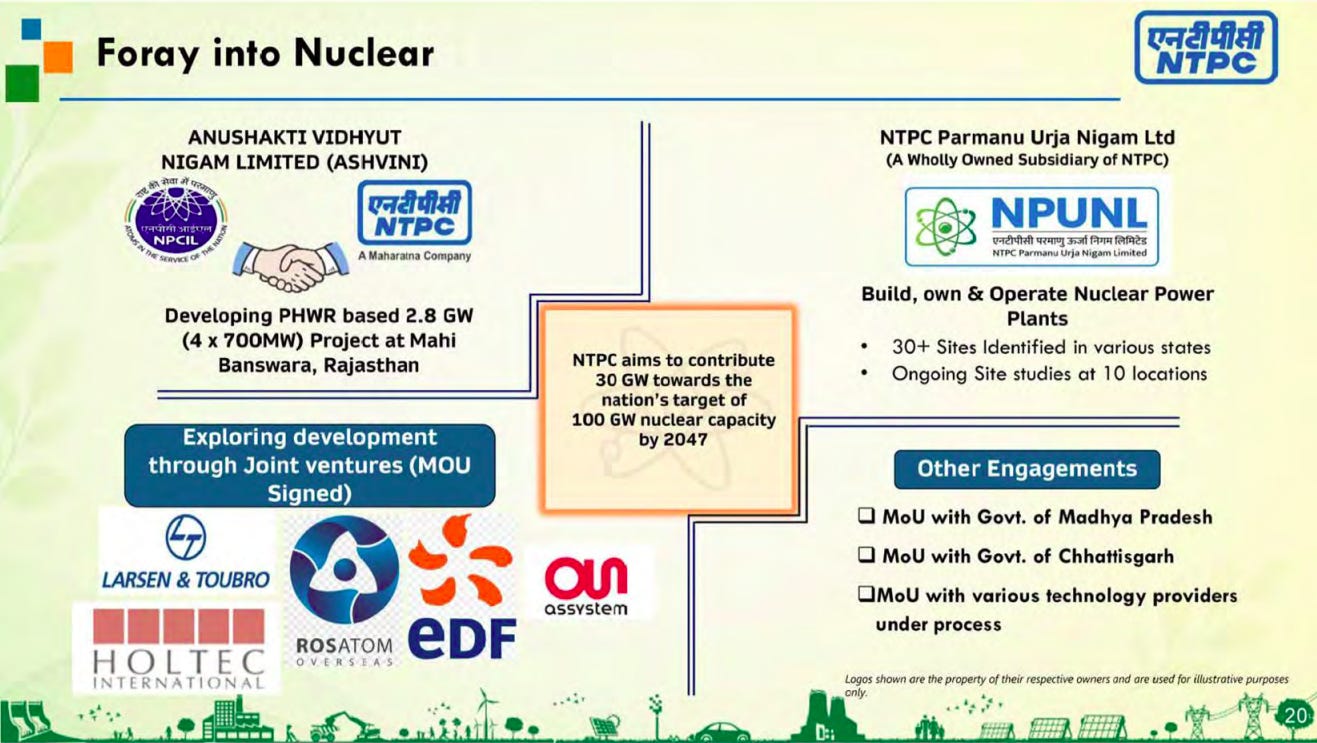
NTPC belongs in a separate category because it is government-owned. Before SHANTI, it could already help develop nuclear plants through ASHVINI, a joint venture owned 51% by NPCIL and 49% by NTPC.
Their first project is the ₹42,000 crore Mahi Banswara plant in Rajasthan. It has 4 NPCIL-designed reactors of 700 MW each. NPCIL brings nuclear technology and operating expertise; NTPC brings capital and experience in developing large power projects.
NTPC has also established a wholly owned nuclear subsidiary, NTPC Parmanu Urja Nigam, to develop, own and operate plants. It has identified more than 30 potential sites, with studies under way at ten.
The group’s latest stated ambition is 30 gigawatts by 2047, up from its earlier discussion of 10 GW over a decade. One gigawatt is 1,000 megawatts, so the new target is nearly a third of India’s planned 100 GW nuclear fleet.
The third rung: Helping develop the technology
A company can also invest in turning a new reactor design into something that can be built repeatedly. That is the opportunity behind the proposed BSMR-300 partnership.
The name stands for Bharat Small Modular Reactor, with a planned output of 300 MW. It is a different design from the 220 MW Bharat Small Reactor discussed above. “Modular” describes the aim of making major sections in factories and assembling them at the site, so later plants can use the same design and manufacturing process.
BARC, which is the Bhabha Atomic Research Centre, India’s main nuclear research institution, is developing the reactor with NPCIL. It is not yet an operating commercial design. BARC is reportedly discussing a partnership with NTPC, Reliance Industries, the Adani Group and L&T to help bring it into commercial use.
The proposal is to form a separate project company through which industry could invest. Participants could help fund development and build the manufacturing capacity needed to supply successive reactors. The company might also hold intellectual-property rights. This includes the rights over the design and how it can be used.
This would make participants investors in the technology, sharing its development risks and potential returns, rather than simply contractors paid to deliver a component. It would not, however, automatically make them the owners or operators of plants using that design.
The discussions remain preliminary. A formal invitation for proposals is expected, and investment commitments, ownership and the rights to the technology have not been finalised.
Adani and Reliance have ambitions beyond this proposal. Adani has announced a target of 10 GW by 2035, while Reliance has proposed 7.2 GW in Maharashtra. These announcements do not establish that either company will use the BSMR-300 across its planned fleet.
The final rung: Owning and operating the reactor
At the top of the ladder, the private company is responsible for the nuclear plant itself and not just its financing, equipment or design.
This is the route SHANTI creates. But enactment is not the same as a fully operational licensing system. The Department of Atomic Energy, published draft rules and safety regulations for consultation in August 2026 and we are yet to see any of this in practice.
For a developer, the task is to bring together a suitable site, cooling water, a reactor technology and the money to build it. It also needs someone to buy the electricity over many years, or a business that can consume the power itself.
Technology could come from NPCIL, BARC or an overseas supplier. But buying a design is not enough: the developer needs trained staff and long-term technical support to operate and maintain the plant.
The company would need a nuclear licence from DAE and separate safety authorisations from the Atomic Energy Regulatory Board, or AERB. Safety oversight covers the design and site, construction, testing before start-up, and operation. The operator would be responsible for nuclear safety and would need the legally required financial cover for accident compensation.
Private ownership would still leave important functions with the government.
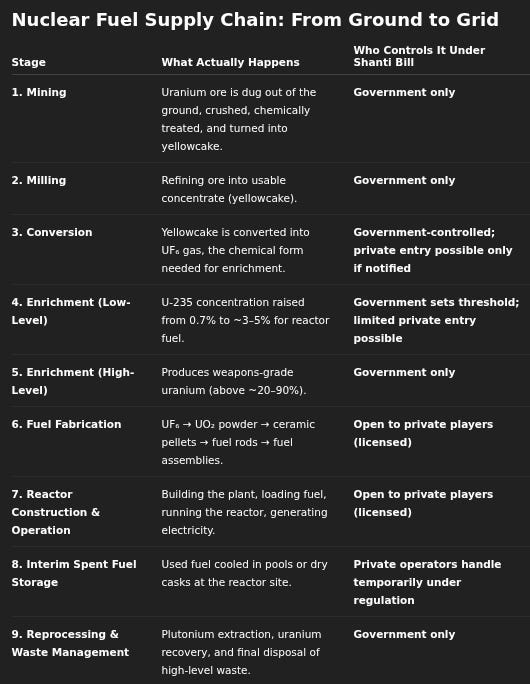
Under SHANTI’s provisions, mining uranium and thorium and processing used nuclear fuel remain reserved for government entities. The state also retains high-level radioactive-waste management. Used, or “spent”, fuel would be stored safely for a prescribed period before being handed over to the government or returned to its country of origin.
So a private company may own the plant and hold its operating licence, but it will continue to depend on the state for fuel, waste management, safety approvals and, in most cases, reactor technology and trained personnel.
There is also a gap between changing the law and producing a bankable project. Lenders will want to know who bears the risk of delays and cost overruns. Developers will need clarity on tariffs or long-term electricity buyers. Regulators must decide whether companies with no history of running reactors are qualified to do so.
None of the private projects announced so far has crossed that threshold.
India is therefore not moving from a government nuclear industry to a private one overnight. It is taking a system once controlled almost entirely by the state and separating it into individual roles.
A company can supply equipment without financing the plant. It can finance the project without owning it. It can help develop the technology without operating the reactor. SHANTI now makes it possible for all these roles to come together under a private developer.
Possible is the important word. The recent announcements show that plenty of companies want to enter nuclear power. India is still figuring out which of them can actually be trusted to run it.

A crisis in India’s tea industry
It’s tea time! In most homes, that’s usually a moment of relaxation, reflection, and even joy.

However, inside India’s tea industry, the mood is anything but.
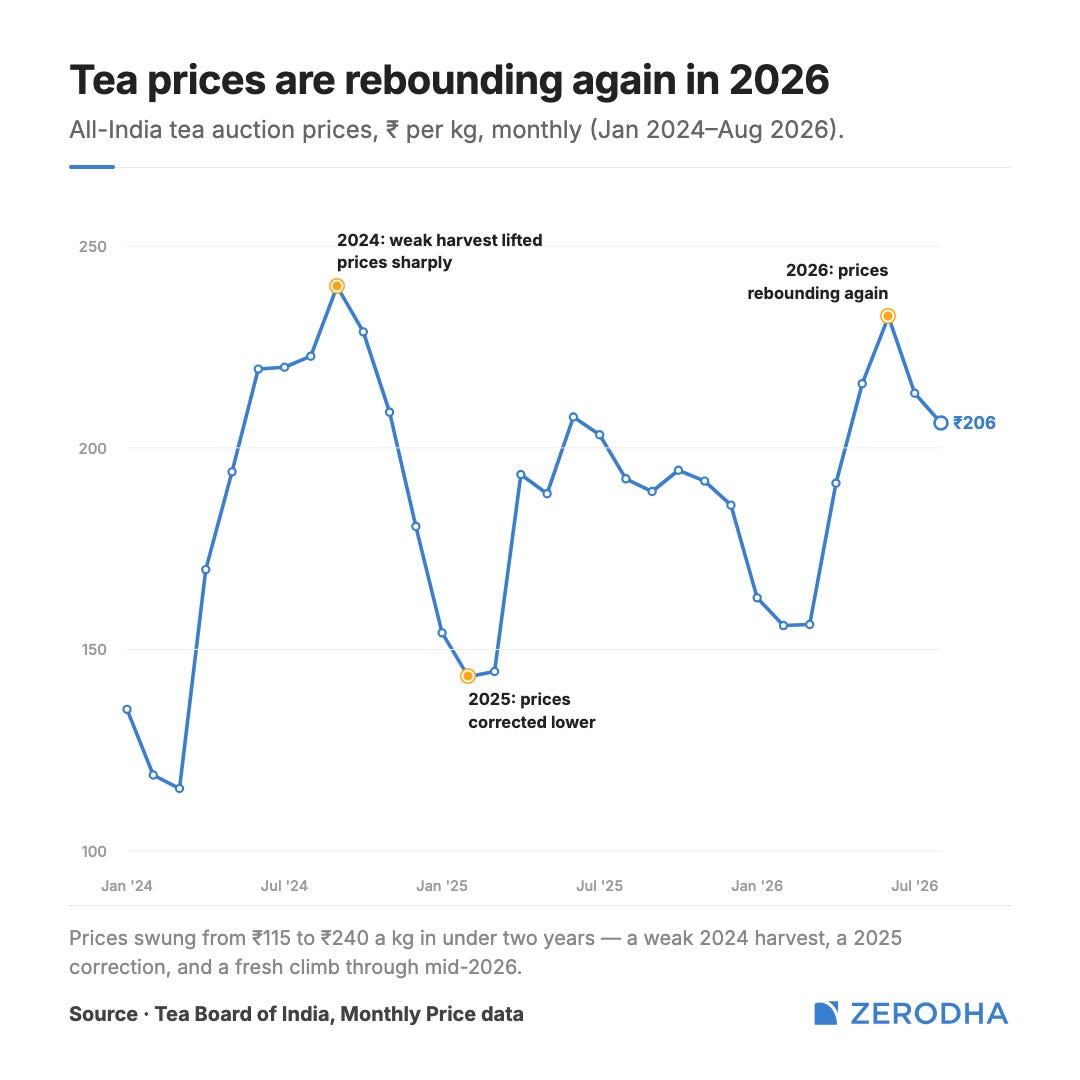
In August 2026, the average price of tea sold at Indian auctions reached ₹206 per kg in August 2026, up from ₹192 in August last year. Between January-August this year, the all-India average was about 9% higher than during the same period in 2025.
On the face of it, that should be good news for an industry that has spent years complaining about low prices. But this price uptick has come only after a long slump that only bodes ominously for Indian tea. The tea industry is very worried about an impending crisis because they can no longer predict their crop with full certainty.
Maximum uncertainty
The current rise makes more sense when seen against what happened in the recent past.
In 2024, India produced 128 crore kg of tea, which was 7.8% less than in 2023. Assam, India’s largest tea-producing state, saw output fall from 69 crore kg to 65 crore kg. Heatwaves and floods disrupted production during growing months. That year, with less tea reaching the market, India’s average auction price rose ~18% to ~₹199 per kg.
But this price increase didn’t last. In 2025-26, Tea Board data show that the all-India average fell from ~₹202 per kg in 2024–25 to ~₹189. The supply of tea leaves was up again.
The direction has changed once again. Between April and August 2026, tea averaged ~₹214 per kg at auction, against ~₹198 during the same five months last year.
So when you zoom out, you see high volatility in prices, which is reflective of extreme unpredictability in production.
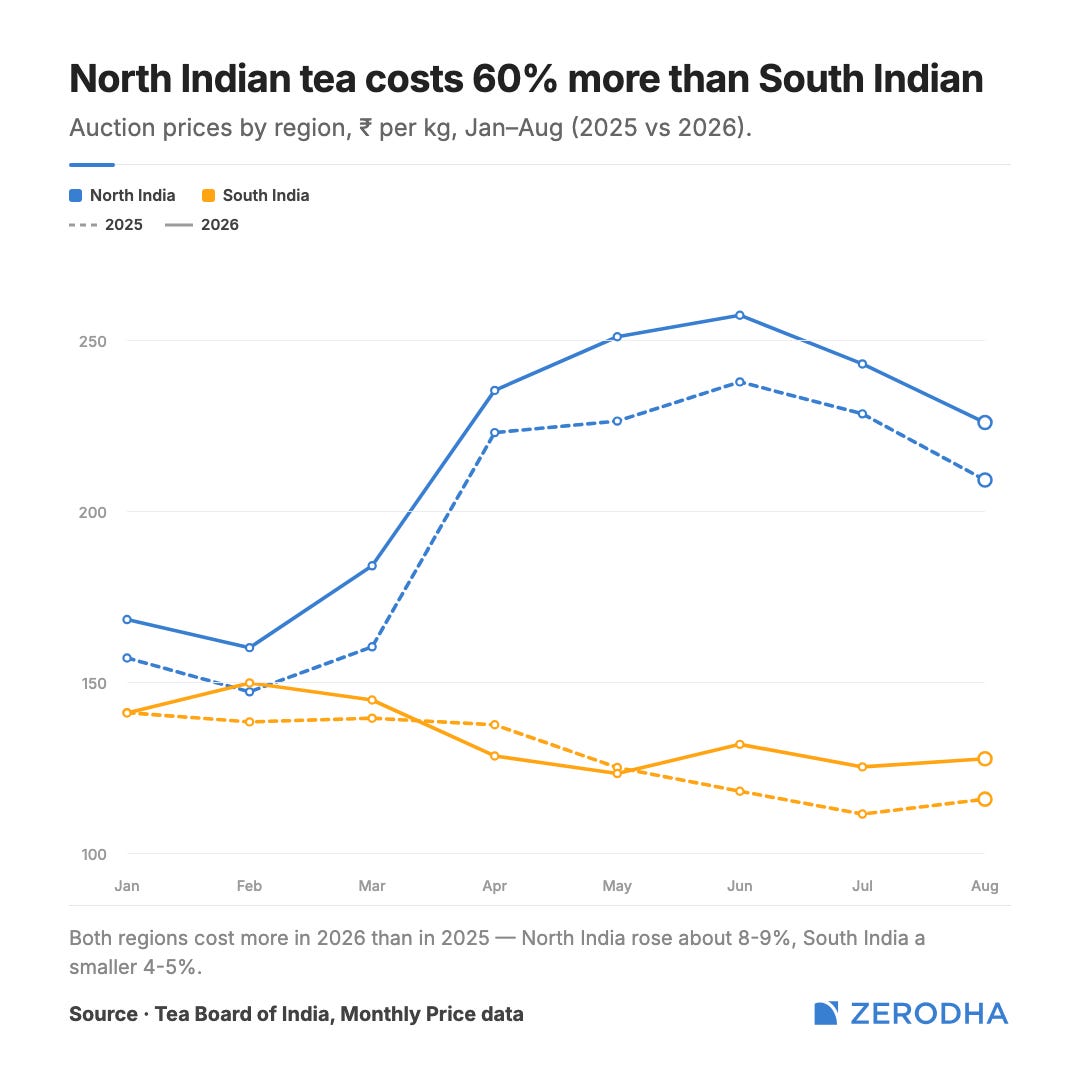
It’s also important to note that these prices represent a national average, which hides a wide regional gulf.
Between January-August 2026, tea sold in North India averaged ~₹227 per kg. In South India, it averaged only ~₹132. North Indian prices were about 10% higher than a year earlier, while South Indian prices were up around 4%. That cumulative figure itself hides that prices fell sharply between July and August this year.
Part of this difference comes down to what is being sold and its quality. CTC (Crush, Tear, Curl) tea, the tea bags that are commonly used in everyday chai, orthodox tea sold to export markets, dust tea and premium seasonal teas, all command different prices. Even within Assam, a prized second-flush tea and an ordinary mass-market tea are two very different products.
Force of nature
Tea is a perennial crop. Producers cannot respond to a shortage in the way a vegetable farmer might simply sow more acreage next season. Tea bushes take years to become commercially productive, while the quality and quantity of leaves depend heavily on temperature and rainfall.
That is becoming a problem.
In Assam, longer dry spells, higher temperatures and erratic rain are affecting yields. Warmer conditions can also increase pest attacks. Estates are spending more on irrigation and pest control, while excessive heat can reduce the number of hours workers are able to spend plucking leaves.
The impact is not limited to the total crop. Assam’s second flush, harvested during a relatively narrow window and valued for its distinctive flavour, is particularly sensitive to changing conditions. If heat or rain arrives at the wrong time, producers can lose quality as well as quantity.
Industry costs have been rising by around 8–9% annually, while plantations also need money to replace ageing bushes.
What’s more, climate change does not mean Indian tea production will decline every year. But what it does make harder is predicting when the bumper crop arrives and when it fails.

The people this affects the most aren’t large estates, but small tea growers, who account for around 54% of national production.
Tea growers usually receive two kinds of prices. One is for the raw tea leaves, and the other higher price is for processed leaves. Many small farmers do not own processing facilities, and sell their produce to factories, which is then sold at auction.
Now, fresh tea leaves cannot sit around indefinitely without being spoiled. So a farmer has to sell them as quickly as possible, giving them less bargaining power, particularly when market supply as a whole is high.
In August 2025, the price of green leaves in parts of North Bengal reportedly fell to ~₹14 per kg, nearly half the level seen a year earlier, even though consumers would not have noticed their tea suddenly becoming 50% cheaper.
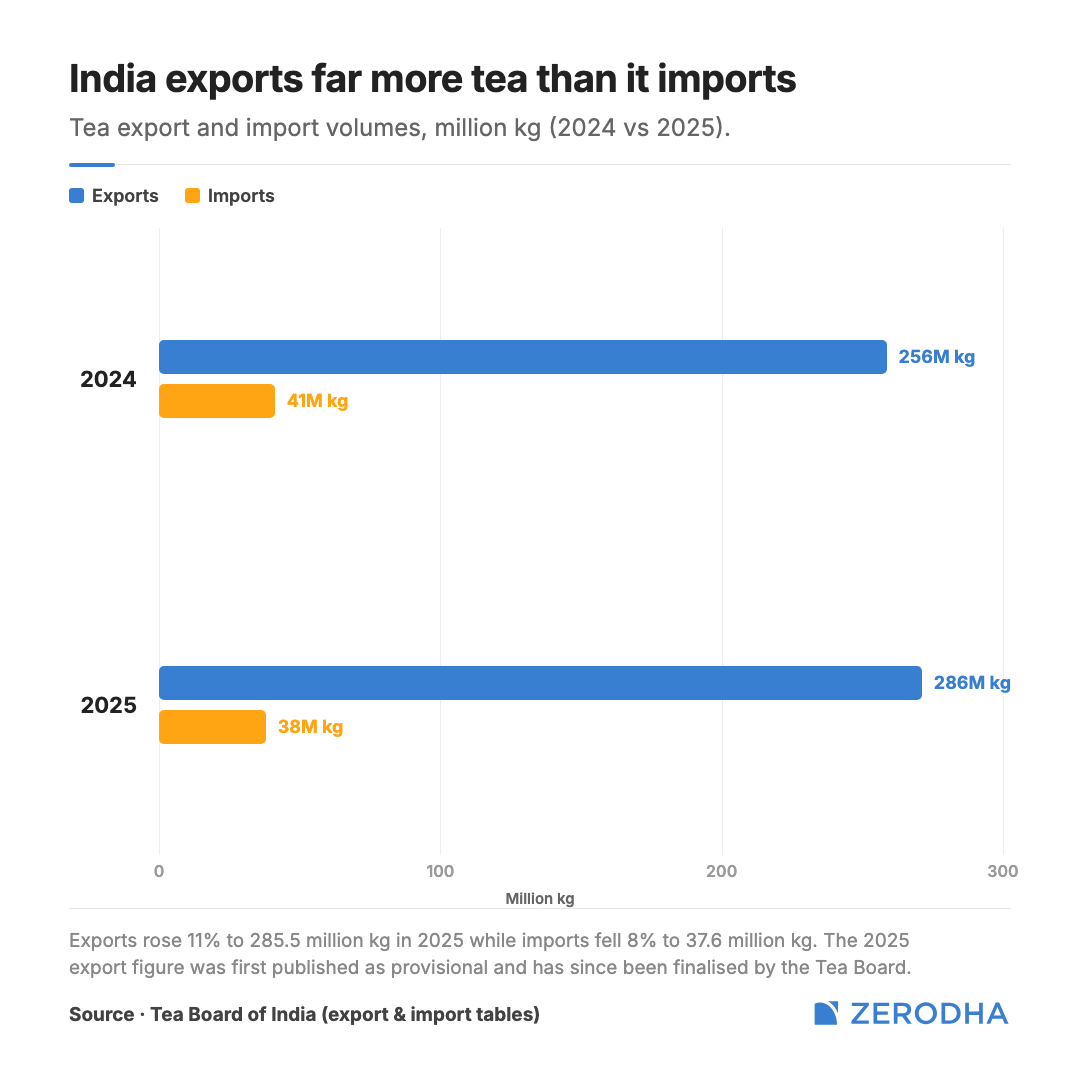
Curiously, 2025 was also India’s best year for tea exports. That year, the domestic supply of all kinds of tea increased, while demand from Iraq, Iran and China for high-quality produce had also helped push prices up. So even as there was weakness in domestic prices, those who sold high-quality leaves benefited from exports.
Between the lines
Now, what have leading tea brands and estates said about this fragile moment for tea?
Jay Shree Tea, which owns estates and manufactures tea, said India’s larger 2025 crop pushed average tea prices down by roughly ₹20 per kg. CTC prices fell by about ₹30 per kg, while the company’s own price realisation declined by ₹14 per kg. Orthodox tea performed better, supported by demand from Iran and other Middle Eastern markets.
The company also described a long-term mismatch between tea prices and production costs. Labour shortages, rising input expenses, pest infestations and climate-related disruption are making tea more expensive to grow, while the price of ordinary tea has not consistently kept pace. It is responding by developing hardier tea plants, improving rainwater harvesting and increasing shade cover across its estates.
For Tata Consumer, the equation works in reverse. Tea is a raw material for brands such as Tata Tea and Tetley. When tea prices surged following the 2024 production shock, its raw-material costs increased by 34% in the October-December quarter, and margins fell.
Tata subsequently raised prices across its tea portfolio. But the increases initially did not fully cover the higher costs. When tea prices later eased, the situation reversed. Tata Consumer’s branded Indian business recorded a 47.5% increase in operating profit in the September 2025 quarter, helped by the stabilisation of tea prices.
Conclusion
So, what does this mean for your tea packet?
Now, higher auction prices on a given day don’t always imply inflated retail prices the next. Auction prices are only one part of the retail price. Packaged-tea companies buy different grades from multiple regions, blend them, hold inventory and incur costs for packaging, transport, marketing and distribution. A packet bought today may contain tea procured months earlier.
Companies can also respond in different ways. They may absorb part of the increase, reduce discounts, change the blend, raise the printed price later or adjust the quantity sold at a particular price point.
But the auction market is the root of vulnerability in India’s tea supply, and the people producing it are operating with very little room for error.
India is not about to run out of tea. It remains one of the world’s largest producers, domestic consumption has continued to grow, and exports have just touched a record.
An efficient tea market should ideally have to satisfy three conditions: cover the growing cost of producing tea for estates, ensure stable procurement costs for packaged tea brands, and make affordable packets for consumers. But it’s clear that at any given time, unfortunately, at least one of those conditions may not be met.
- This edition of the newsletter was written by Kashish & Kulsum.
Tidbits
1. NaBFID makes a ₹12,000-crore bet on India’s data-centre boom
India’s state-owned infrastructure lender NaBFID has approved loans of over ₹3,000 crore each for four data-centre projects. Since these massive facilities take years to build and start earning money, borrowers won’t begin repaying the principal for five years. After that, they will have ten years to repay the loans.
Source: Business Standard
2. Higher EPF coverage could cost employers ₹1,200 more per worker
The government plans to raise the salary limit for mandatory EPF coverage from ₹15,000 to ₹25,000 a month. This could bring more than 51 lakh additional workers into the EPFO system, while increasing employers’ contribution costs by as much as ₹1,200 per worker every month.
Source: Business Standard
3. India’s electronics trade gap with China has become structural
India’s trade deficit with China in electronics and electrical machinery reached $43.1 billion in FY26—twice its level in FY19. The gap is becoming harder to reduce because Indian manufacturers still depend heavily on China for essential inputs such as chips, semiconductors and smartphone components.
Source: ThePrint
4. India’s space startups are stuck in an insurance catch-22
India’s private space industry has run into a chicken-and-egg problem. Startups need insurance to protect expensive launches, attract funding and limit their losses when missions fail. But insurers want a longer record of successful launches and a more mature market before offering affordable coverage.
Source: The Ken
5. Food-safety violations force Mumbai’s Cafe Mondegar to shut temporarily
Mumbai’s food regulator has suspended the licence of the iconic Cafe Mondegar after finding serious food-safety and hygiene violations. The action is part of a wider inspection drive across the city, with other popular restaurants also coming under scrutiny.
Source: The Hindu
Want more tidbits? Catch up on last week’s recap!
Weekly Tidbits #5

Hi everyone, I’m Kulsum, and welcome to the fifth edition of Weekly Tidbits. Mridula is away collecting her degree at her convocation, so I’m filling in for her this week.
Our latest episode on Subtext is with Avantika Goswami and Trishant Dev from the think-tank CSE. We speak to them about the impossible question facing developing nations today: how do you industrialise and decarbonise at the same time? What are the power dynamics behind the climate policies Western nations impose on them? What does a just green transition look like?
Watch the full episode here.
Beyond Today’s Brief
There’s always more happening at Markets by Zerodha.
The Chatter: What new regulatory measures is SEBI introducing to deepen India’s corporate bond and AIF markets? How is Mazagon Dock navigating its ₹15,000 crore expansion alongside high-value naval bids? And how are firms like Mphasis, Redington, and TVS Supply Chain adapting to IT, AI, and global supply chain shifts?
Aftermarket Report: How did market breadth and key sectors perform as the Sensex logged its longest weekly losing streak since 2020? What are the latest trends in institutional flows, delivery patterns, and global markets?
Points & Figures: How severe is the synchronised global supply shock across energy, metals, and freight? What does India’s 510-basis-point WPI-CPI gap reveal about margin compression, and how are rising sovereign yields reshaping global rates?
Join us on WhatsApp, where we share interesting soundbites from concalls, articles, and everything else we come across throughout the day. You’ll also get notified the moment a new video or article drops so that you can read or watch it right away.
Thank you for reading. Do share this with your friends and make them as smart as you are 😉